
Essential Conditions for Integrating Technology Chris Anklam Columbus
Essential Conditions for Integrating Technology Chris Anklam Columbus State University EDMS 6474 May 30, 2016

What are Essential Conditions? �Essential conditions are the conditions in the workplace that determine if a teacher can use technology to their advantage (Roblyer, 2016).
Roblyer (2016) Suggests 8 Essential Conditions �A shared vision �Skilled Personnel (district wide) for technology integration �Standards and curriculum support �Required Policies �Access to hardware, software and other resources �Technical Assistance �Appropriate teaching and assessment models �Engaged community
1. A Shared Vision for Technology Integration �School and district planning is coordinated. Teachers and other personnel participate at every level �Annual budgets allow for both technology acquisition and sustainability �Continuing teacher training is emphasized �Technology is matched to curriculum needs
2. Standards and Curriculum Support �“It is critical to situate technology skills in content-area curriculum in ways that support both the subject-area content and the technology skills. This essential condition is best met when technology and content-area standards are designed to support each other. ”(Roblyer, 2016, p 65).
3. Required Policies �Most schools use an ‘Acceptable Use Policy’ to attempt to minimize harm to students using the internet. �Legal/ethical use policies to minimize harm or damage due to viruses or hacking. Firewalls are most commonly used to address this �Policies should ensure equity to all students and users �Financial assistance, incentives and accountablity policies to encourage teachers to integrate technology into their classrooms
4. Access to Hardware, Software, and other Resources �School districts should know all available resources available for funding (Title I, Federal Tax Impact of Naval bases, etc) �Know what hardware and software the teachers need �Ensure facilities and equipment are set up correctly
5. Skilled Personnel �Participants must have hands on experience with the tools they are going to use �In service training for teachers must be recurring and effective �Learn to use technology tools through a process of modeling, coaching and mentoring (1 -on-1 interactions) with more experienced teachers �“Just-in-time” training. Teachers should learn how to use a technology right before they are going to apply it
6. Technical Assistance �“Schools must support teachers by providing and maintaining resources vital to classroom use, as well as by providing continuing professional development in using resources effectively. ” (Roblyer, 2016, p 68).
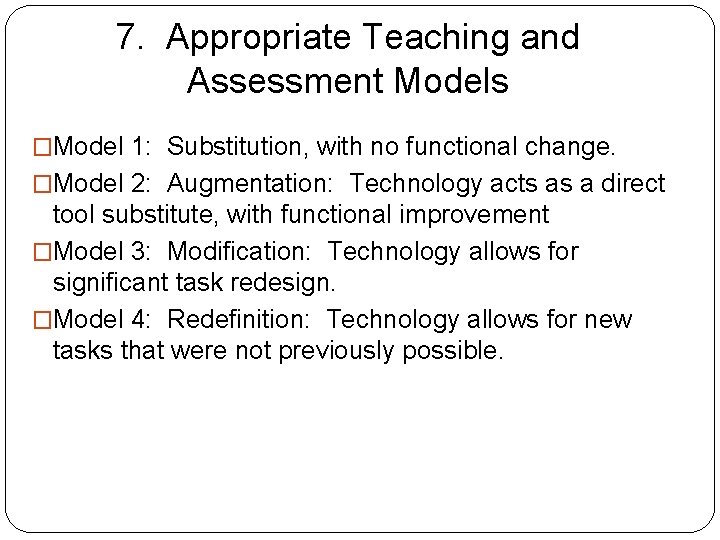
7. Appropriate Teaching and Assessment Models �Model 1: Substitution, with no functional change. �Model 2: Augmentation: Technology acts as a direct tool substitute, with functional improvement �Model 3: Modification: Technology allows for significant task redesign. �Model 4: Redefinition: Technology allows for new tasks that were not previously possible.
8. Engaged Community �“Technology has the most impact on achieving educational goals when schools involve the entire community. This means holding public forums about technology initiatives, bringing community members into the classroom, educating those who can play key roles, and fostering partnerships. . ” (Roblyer, 2016, p 69)
Reference ◦ Roblyer, M. D. (2016). Integrating educational technology into teaching (7 th ed. ). Upper Saddle River, NJ: Pearson Education, Inc.
- Slides: 12