
Essence Software Engineering Essentialized Part 4 Large Scale

- Slides: 27
Essence Software Engineering Essentialized Part 4 – Large Scale Complex Development Giuseppe Calavaro, Ph. D. www. semat. org
Agenda of this Teaching Module • Large-scale complex development • The three dimensions of Scaling – Zooming In – Scaling Up – Reaching Out • Travel. Essence Large Scale development using Essence • Value of Essence to Large Scale Development Example of using Essence on our project “Travel. Essence” are in green boxes 2
Module Objective • The objective here is to provide an understanding for what it means to work with large-scale development and how that is different from working with small-scale development – Here, it is not the objective to equip you with the competency needed to actually participate in large-scale development, – but to let you have a glimpse of what it is like • We also want to highlight that Essence is scalable to large-scale development • Large-scale complex development encompasses many challenges both collaboration and architectural – We have chosen to focus on the collaborative aspects – We leave the more advanced architectural aspects out of the scope for this book. 3
Large-scale complex development • Large Scale Projects have a lot of people involved, in many teams, working in parallel and collaborating with each other. – Usually there are multiple groups of stakeholders and multiple software systems being built or maintained – Yet, Large-scale projects is not just about having more people • The software system itself usually has more complex and more stringent requirements – For example performance, reliability, security, compliance • A program is a larger endeavor, which usually comprises several smaller, still potentially large related endeavors. – Different teams may work on different endeavors within the program. 4
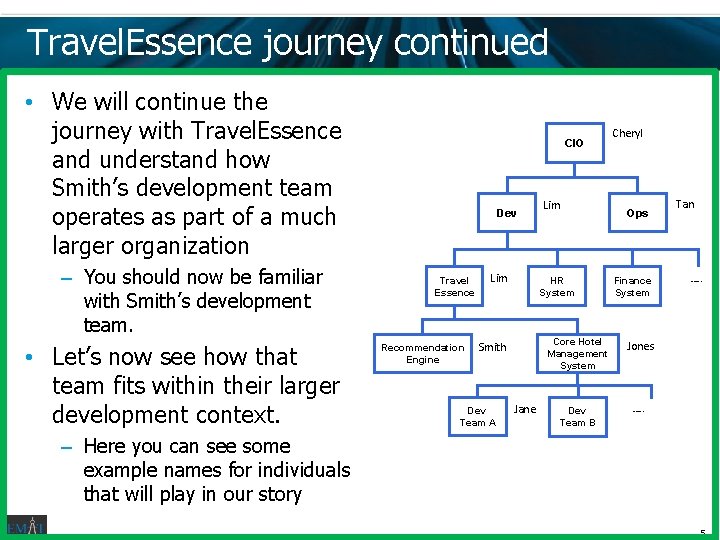
Travel. Essence journey continued • We will continue the journey with Travel. Essence and understand how Smith’s development team operates as part of a much larger organization – You should now be familiar with Smith’s development team. • Let’s now see how that team fits within their larger development context. CIO Dev Travel Essence Recommendation Engine Lim HR System Smith Dev Team A Lim Jane Cheryl Ops Finance System Core Hotel Management System Jones Dev Team B …. . Tan …. . – Here you can see some example names for individuals that will play in our story 5
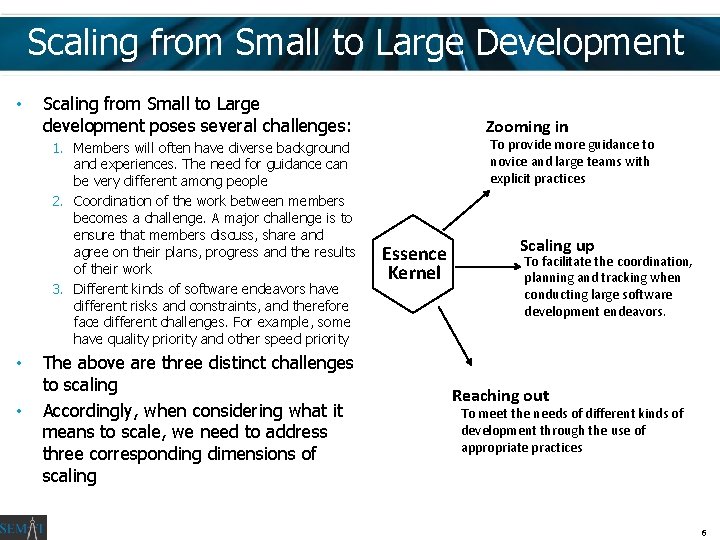
Scaling from Small to Large Development • Scaling from Small to Large development poses several challenges: 1. Members will often have diverse background and experiences. The need for guidance can be very different among people 2. Coordination of the work between members becomes a challenge. A major challenge is to ensure that members discuss, share and agree on their plans, progress and the results of their work 3. Different kinds of software endeavors have different risks and constraints, and therefore face different challenges. For example, some have quality priority and other speed priority • • The above are three distinct challenges to scaling Accordingly, when considering what it means to scale, we need to address three corresponding dimensions of scaling Zooming in To provide more guidance to novice and large teams with explicit practices Essence Kernel Scaling up To facilitate the coordination, planning and tracking when conducting large software development endeavors. Reaching out To meet the needs of different kinds of development through the use of appropriate practices 6
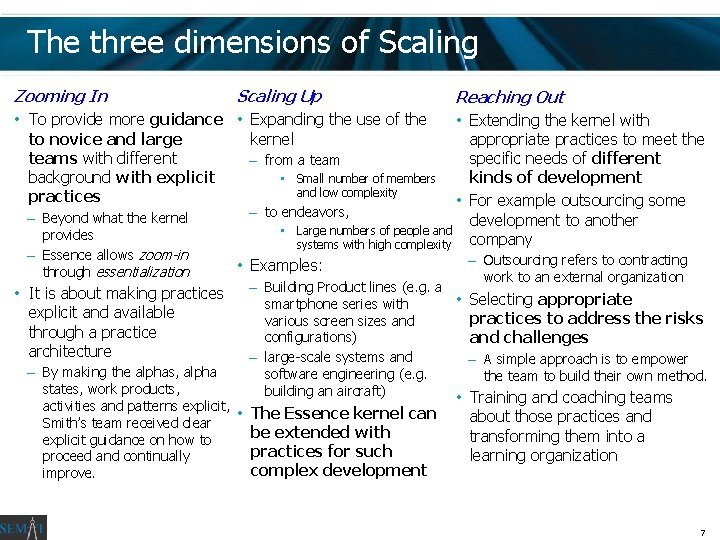
The three dimensions of Scaling Up Zooming In • To provide more guidance • Expanding the use of the to novice and large teams with different background with explicit practices – Beyond what the kernel provides – Essence allows zoom-in through essentialization • It is about making practices explicit and available through a practice architecture kernel Reaching Out • Extending the kernel with appropriate practices to meet the specific needs of different – from a team • Small number of members kinds of development and low complexity • For example outsourcing some – to endeavors, development to another • Large numbers of people and systems with high complexity company • Examples: – Outsourcing refers to contracting work to an external organization – Building Product lines (e. g. a • Selecting appropriate smartphone series with practices to address the risks various screen sizes and configurations) and challenges – large-scale systems and – A simple approach is to empower software engineering (e. g. the team to build their own method. building an aircraft) • Training and coaching teams – By making the alphas, alpha states, work products, activities and patterns explicit, • The Essence kernel can Smith’s team received clear be extended with explicit guidance on how to practices for such proceed and continually complex development improve. about those practices and transforming them into a learning organization 7
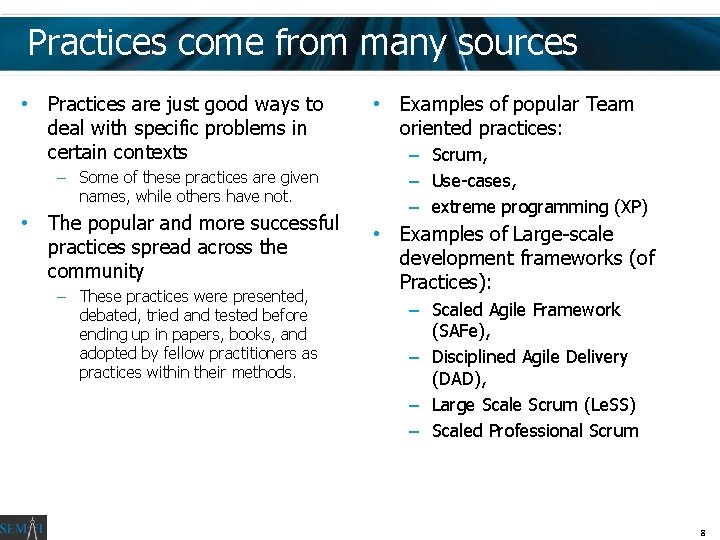
Practices come from many sources • Practices are just good ways to deal with specific problems in certain contexts – Some of these practices are given names, while others have not. • The popular and more successful practices spread across the community – These practices were presented, debated, tried and tested before ending up in papers, books, and adopted by fellow practitioners as practices within their methods. • Examples of popular Team oriented practices: – Scrum, – Use-cases, – extreme programming (XP) • Examples of Large-scale development frameworks (of Practices): – Scaled Agile Framework (SAFe), – Disciplined Agile Delivery (DAD), – Large Scale Scrum (Le. SS) – Scaled Professional Scrum 8
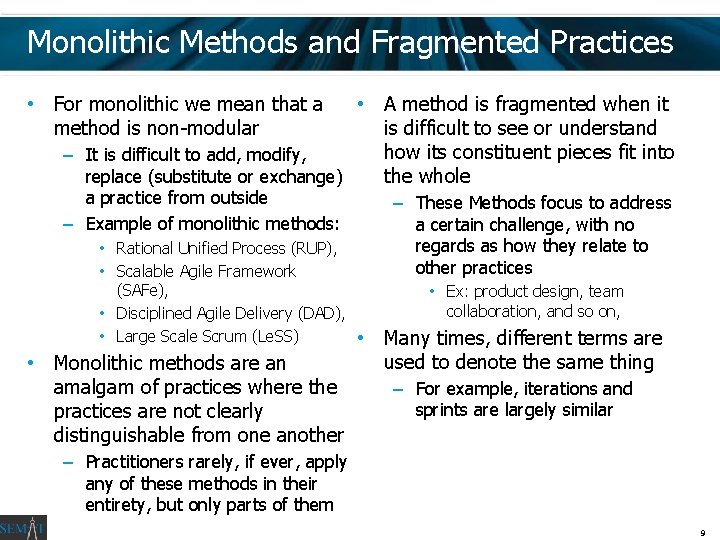
Monolithic Methods and Fragmented Practices • For monolithic we mean that a method is non-modular • A method is fragmented when it is difficult to see or understand how its constituent pieces fit into – It is difficult to add, modify, replace (substitute or exchange) the whole a practice from outside – Example of monolithic methods: • Rational Unified Process (RUP), • Scalable Agile Framework (SAFe), • Disciplined Agile Delivery (DAD), • Large Scale Scrum (Le. SS) • Monolithic methods are an amalgam of practices where the practices are not clearly distinguishable from one another – These Methods focus to address a certain challenge, with no regards as how they relate to other practices • Ex: product design, team collaboration, and so on, • Many times, different terms are used to denote the same thing – For example, iterations and sprints are largely similar – Practitioners rarely, if ever, apply any of these methods in their entirety, but only parts of them 9
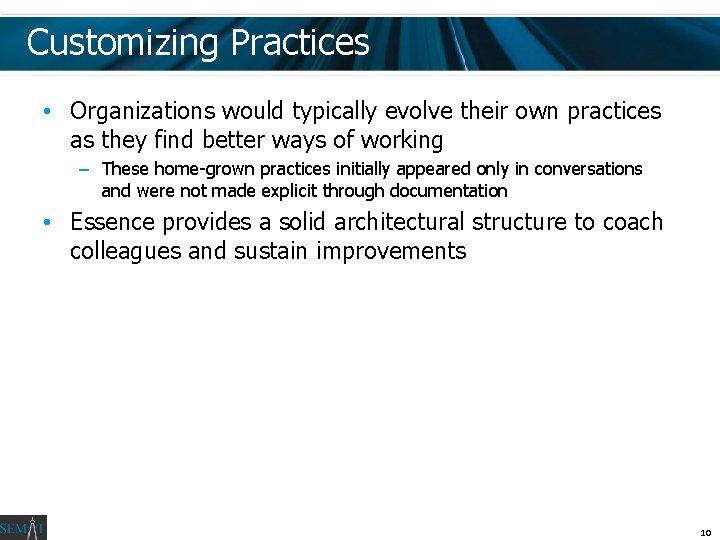
Customizing Practices • Organizations would typically evolve their own practices as they find better ways of working – These home-grown practices initially appeared only in conversations and were not made explicit through documentation • Essence provides a solid architectural structure to coach colleagues and sustain improvements 10
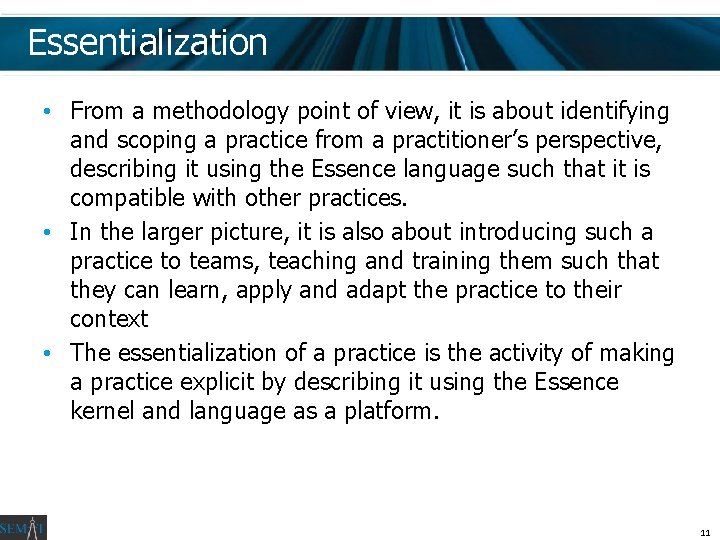
Essentialization • From a methodology point of view, it is about identifying and scoping a practice from a practitioner’s perspective, describing it using the Essence language such that it is compatible with other practices. • In the larger picture, it is also about introducing such a practice to teams, teaching and training them such that they can learn, apply and adapt the practice to their context • The essentialization of a practice is the activity of making a practice explicit by describing it using the Essence kernel and language as a platform. 11
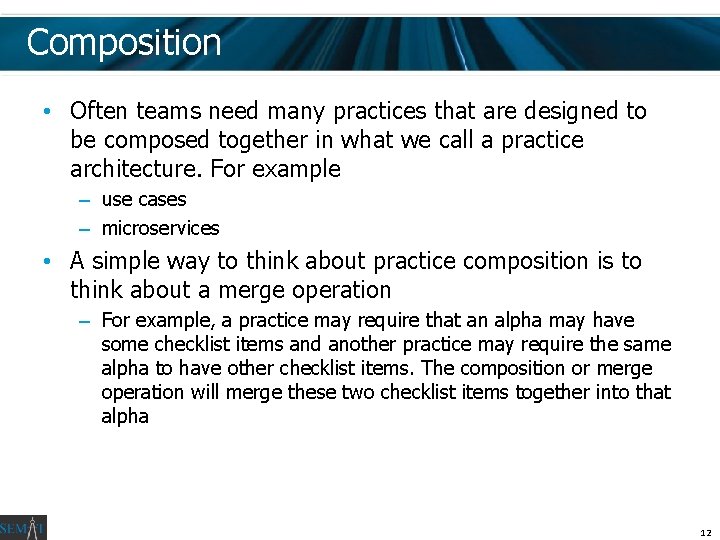
Composition • Often teams need many practices that are designed to be composed together in what we call a practice architecture. For example – use cases – microservices • A simple way to think about practice composition is to think about a merge operation – For example, a practice may require that an alpha may have some checklist items and another practice may require the same alpha to have other checklist items. The composition or merge operation will merge these two checklist items together into that alpha 12
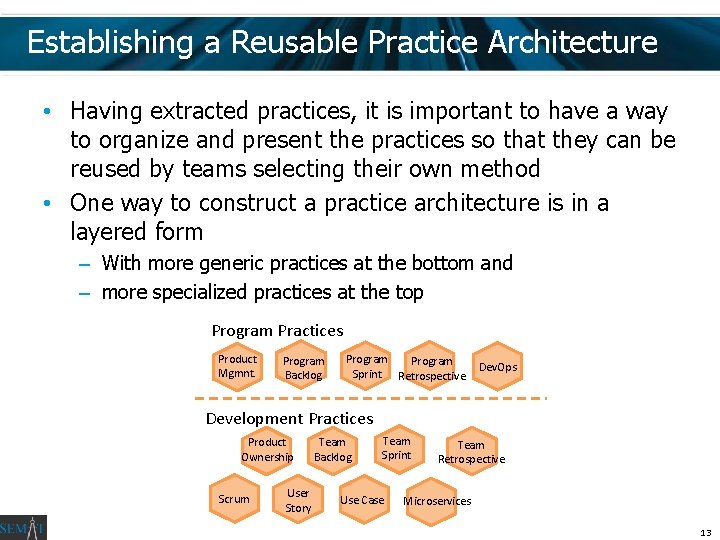
Establishing a Reusable Practice Architecture • Having extracted practices, it is important to have a way to organize and present the practices so that they can be reused by teams selecting their own method • One way to construct a practice architecture is in a layered form – With more generic practices at the bottom and – more specialized practices at the top Program Practices Product Mgmnt. Program Backlog Program Sprint Retrospective Dev. Ops Development Practices Product Ownership Scrum User Story Team Backlog Team Sprint Use Case Team Retrospective Microservices 13
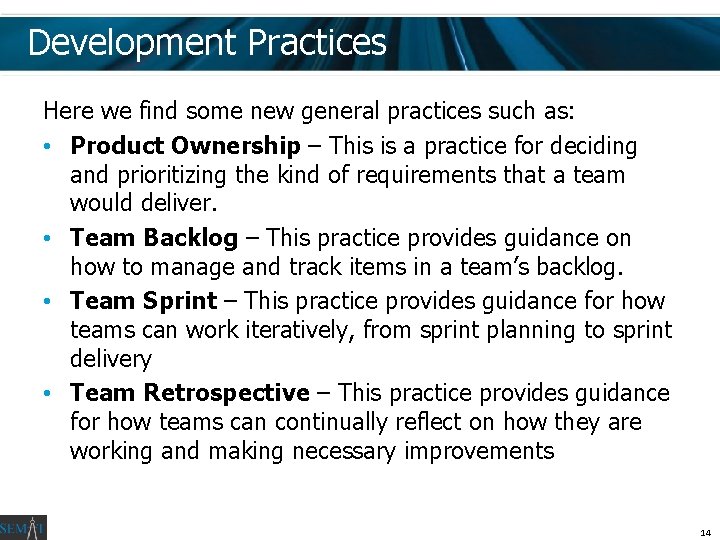
Development Practices Here we find some new general practices such as: • Product Ownership – This is a practice for deciding and prioritizing the kind of requirements that a team would deliver. • Team Backlog – This practice provides guidance on how to manage and track items in a team’s backlog. • Team Sprint – This practice provides guidance for how teams can work iteratively, from sprint planning to sprint delivery • Team Retrospective – This practice provides guidance for how teams can continually reflect on how they are working and making necessary improvements 14
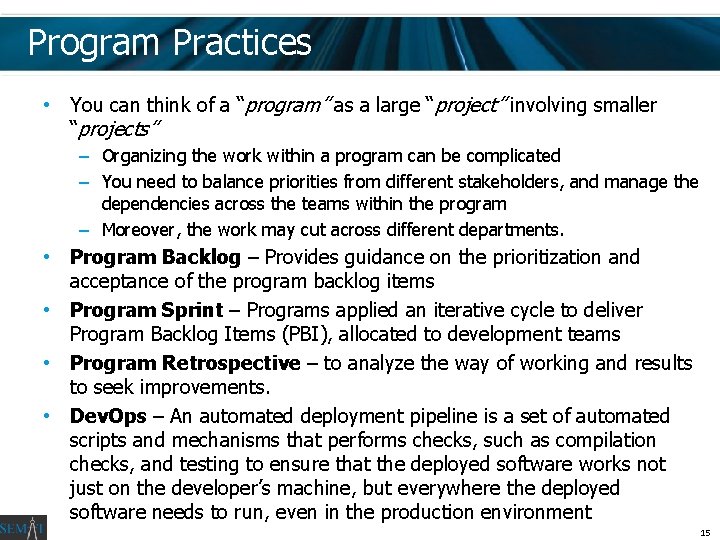
Program Practices • You can think of a “program” as a large “project” involving smaller “projects” – Organizing the work within a program can be complicated – You need to balance priorities from different stakeholders, and manage the dependencies across the teams within the program – Moreover, the work may cut across different departments. • Program Backlog – Provides guidance on the prioritization and acceptance of the program backlog items • Program Sprint – Programs applied an iterative cycle to deliver Program Backlog Items (PBI), allocated to development teams • Program Retrospective – to analyze the way of working and results to seek improvements. • Dev. Ops – An automated deployment pipeline is a set of automated scripts and mechanisms that performs checks, such as compilation checks, and testing to ensure that the deployed software works not just on the developer’s machine, but everywhere the deployed software needs to run, even in the production environment 15
Scaling Up to Large and Complex Development • In large-scale development, the team members are often distributed across geographical locations – These development teams will likely have multiple requirement sources coming from different customers at any point in time – They may also be serving different opportunities from different stakeholder groups • There are many approaches to large-scale development – The Capability Maturity Model Integration (CMMI) helps teams improve processes – the Rational Unified Process (RUP) is an iterative software development method • It is not easy to replicate what happens in the real world of large-scale development in a classroom setting – It is also not easy for new students who work mostly alone to visualize how large teams operate 16
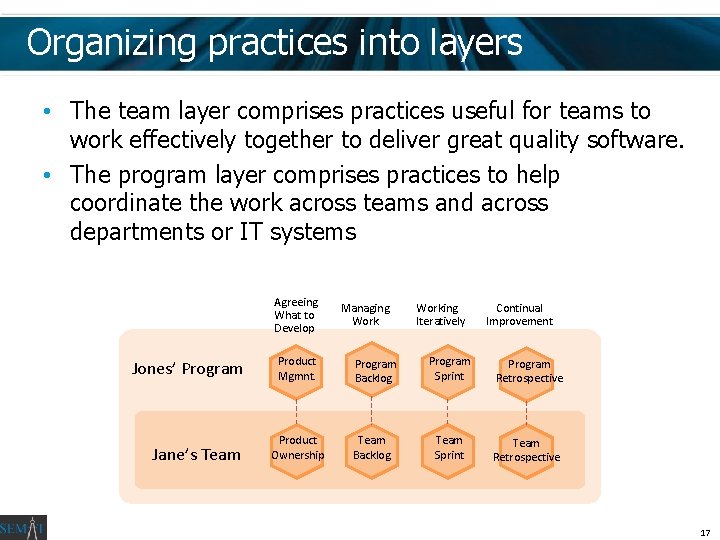
Organizing practices into layers • The team layer comprises practices useful for teams to work effectively together to deliver great quality software. • The program layer comprises practices to help coordinate the work across teams and across departments or IT systems Agreeing What to Develop Jones’ Program Jane’s Team Product Mgmnt. Product Ownership Managing Work Program Backlog Team Backlog Working Iteratively Continual Improvement Program Sprint Program Retrospective Team Sprint Team Retrospective 17
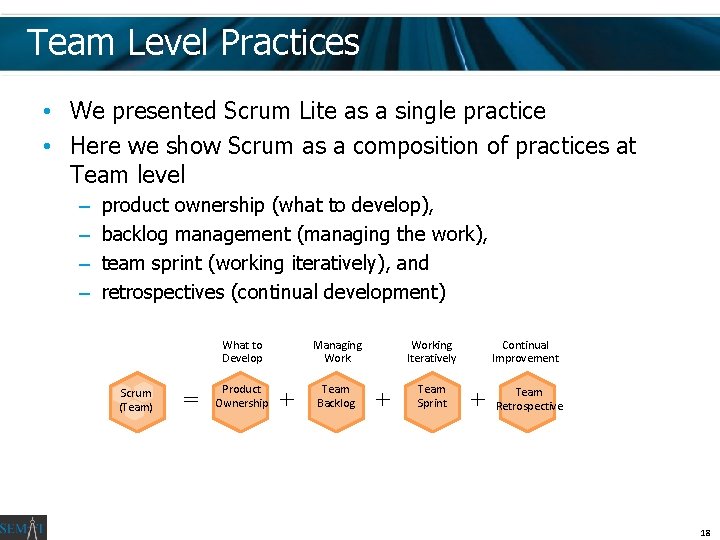
Team Level Practices • We presented Scrum Lite as a single practice • Here we show Scrum as a composition of practices at Team level – – product ownership (what to develop), backlog management (managing the work), team sprint (working iteratively), and retrospectives (continual development) What to Develop Scrum (Team) = Product Ownership Managing Work + Team Backlog Working Iteratively + Team Sprint Continual Improvement + Team Retrospective 18
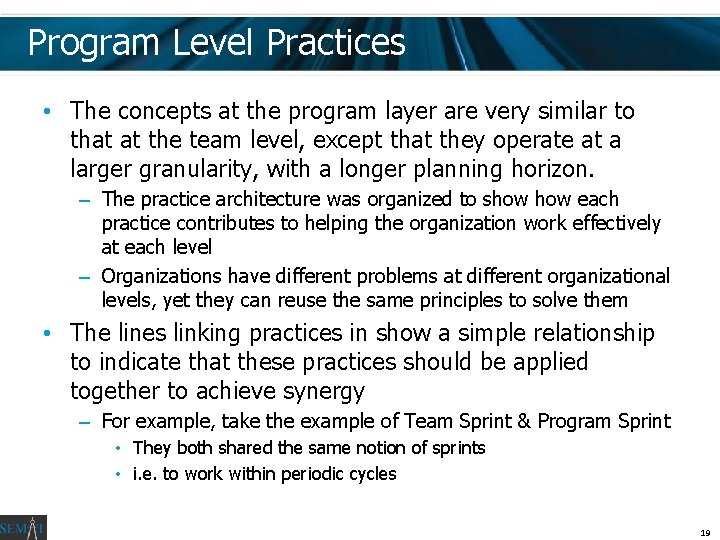
Program Level Practices • The concepts at the program layer are very similar to that at the team level, except that they operate at a larger granularity, with a longer planning horizon. – The practice architecture was organized to show each practice contributes to helping the organization work effectively at each level – Organizations have different problems at different organizational levels, yet they can reuse the same principles to solve them • The lines linking practices in show a simple relationship to indicate that these practices should be applied together to achieve synergy – For example, take the example of Team Sprint & Program Sprint • They both shared the same notion of sprints • i. e. to work within periodic cycles 19
Kick Starting Large Scale Development • Running large-scale development is not just about selecting and applying practices as we have seen above • The steps for large-scale development are 1. Understanding the context through the lens of Essence 2. Agree on development scope and checkpoints (where it begins and where it ends) 3. Agree on practices to apply 4. Agree on the important things to watch 20
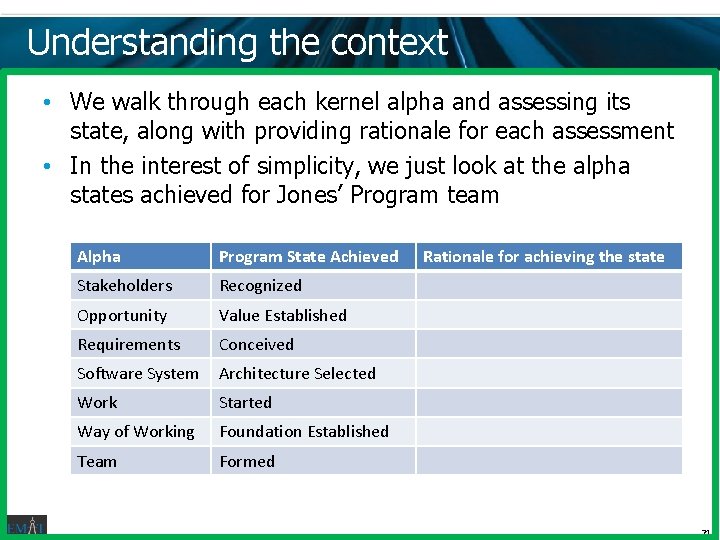
Understanding the context • We walk through each kernel alpha and assessing its state, along with providing rationale for each assessment • In the interest of simplicity, we just look at the alpha states achieved for Jones’ Program team Alpha Program State Achieved Stakeholders Recognized Opportunity Value Established Requirements Conceived Software System Architecture Selected Work Started Way of Working Foundation Established Team Formed Rationale for achieving the state 21
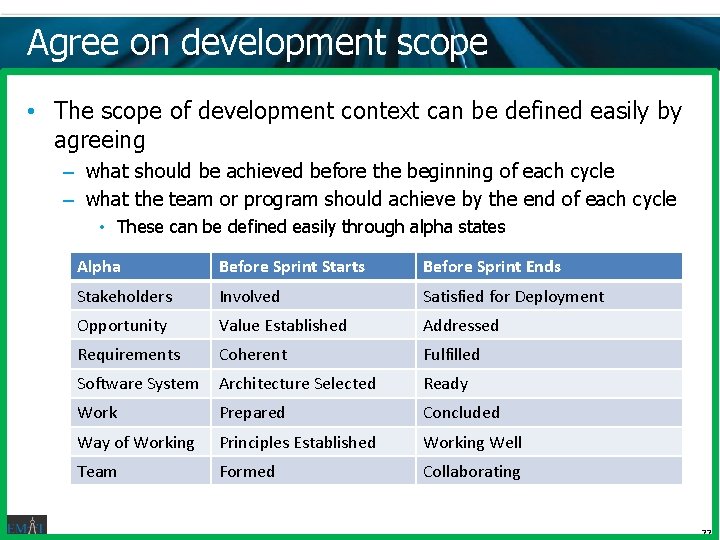
Agree on development scope • The scope of development context can be defined easily by agreeing – what should be achieved before the beginning of each cycle – what the team or program should achieve by the end of each cycle • These can be defined easily through alpha states Alpha Before Sprint Starts Before Sprint Ends Stakeholders Involved Satisfied for Deployment Opportunity Value Established Addressed Requirements Coherent Fulfilled Software System Architecture Selected Ready Work Prepared Concluded Way of Working Principles Established Working Well Team Formed Collaborating 22
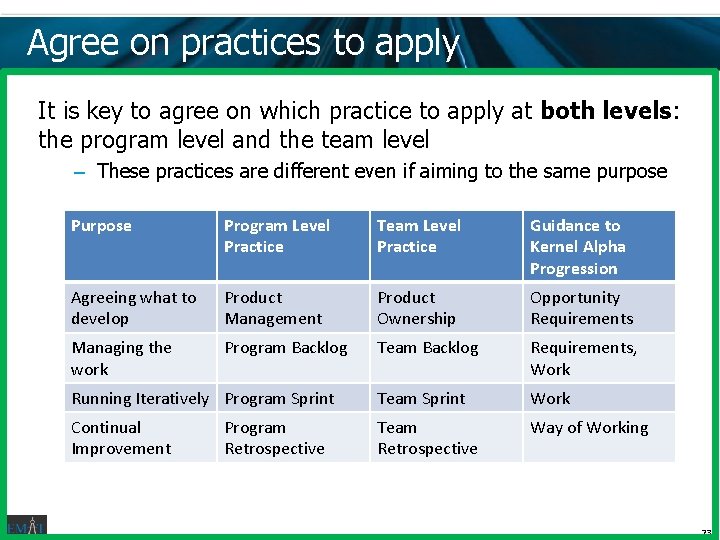
Agree on practices to apply It is key to agree on which practice to apply at both levels: the program level and the team level – These practices are different even if aiming to the same purpose Program Level Practice Team Level Practice Guidance to Kernel Alpha Progression Agreeing what to develop Product Management Product Ownership Opportunity Requirements Managing the work Program Backlog Team Backlog Requirements, Work Running Iteratively Program Sprint Team Sprint Work Continual Improvement Team Retrospective Way of Working Program Retrospective 23
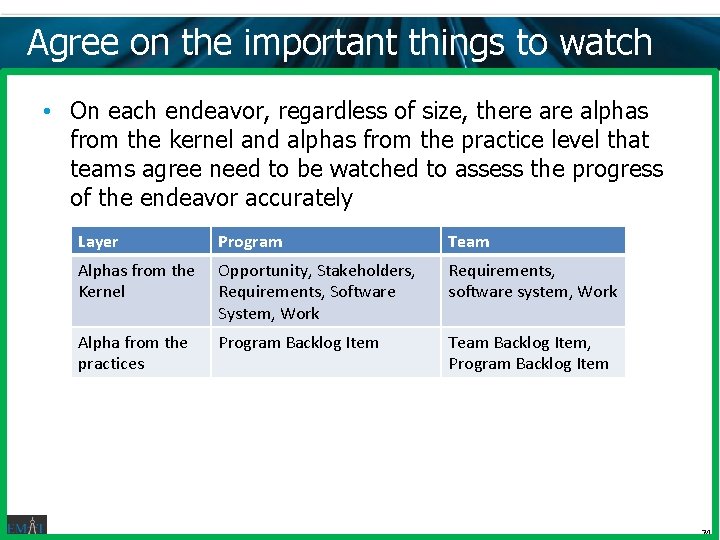
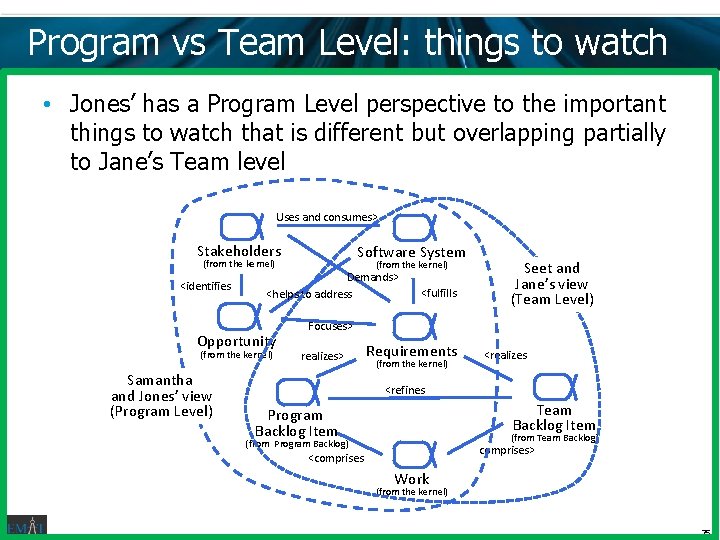
Agree on the important things to watch • On each endeavor, regardless of size, there alphas from the kernel and alphas from the practice level that teams agree need to be watched to assess the progress of the endeavor accurately Layer Program Team Alphas from the Kernel Opportunity, Stakeholders, Requirements, Software System, Work Requirements, software system, Work Alpha from the practices Program Backlog Item Team Backlog Item, Program Backlog Item 24
Program vs Team Level: things to watch • Jones’ has a Program Level perspective to the important things to watch that is different but overlapping partially to Jane’s Team level Uses and consumes> Stakeholders Software System (from the kernel) <identifies Opportunity (from the kernel) Samantha and Jones’ view (Program Level) (from the kernel) Demands> <helps to address <fulfills Seet and Jane’s view (Team Level) Focuses> realizes> Requirements (from the kernel) <realizes <refines Team Backlog Item Program Backlog Item (from Team Backlog) (from Program Backlog) comprises> <comprises Work (from the kernel) 25
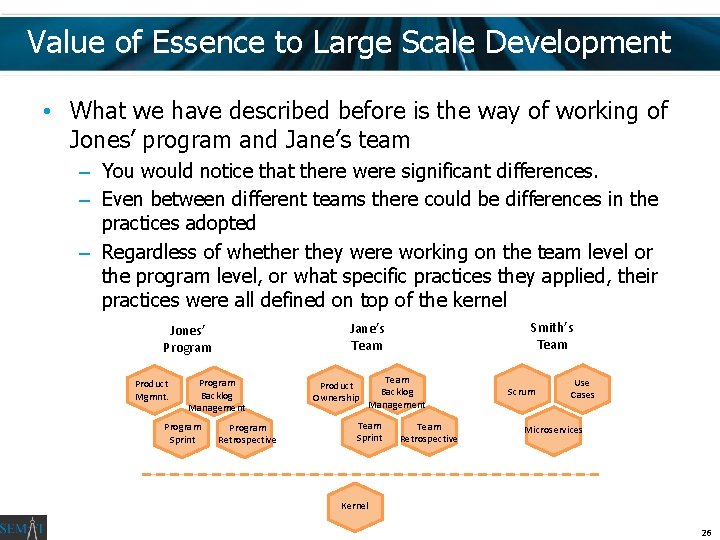
Value of Essence to Large Scale Development • What we have described before is the way of working of Jones’ program and Jane’s team – You would notice that there were significant differences. – Even between different teams there could be differences in the practices adopted – Regardless of whether they were working on the team level or the program level, or what specific practices they applied, their practices were all defined on top of the kernel Product Mgmnt. Program Backlog Management Program Sprint Smith’s Team Jane’s Team Jones’ Program Retrospective Product Ownership Team Backlog Management Team Sprint Team Retrospective Scrum Use Cases Microservices Kernel 26
27