
ESSC Public hearing Summary of the costs and
ESSC Public hearing Summary of the costs and benefits of investments in occupational safety and health (OSH) Room JDE 62, EESC building, Rue Belliard 99, 1040 Brussels 17 June 2019, 9. 30 – 13. 00 Matthias Fritz Unit EMPL. B 3 ‘Health and safety’ Directorate-General Employment, Social Affairs and Inclusion European Commission, European Union 1 Employment, Social Affairs and Inclusion
Overall aspects of cost and benefits of OSH (1) • Accidents and illnesses at work • Damages to workers, other persons, equipment, environment • Recognised and non-recognised occupational diseases • Partial vs. full, temporary vs. permanent incapacity to work, including acquired disability due to accidents and illnesses 2 Employment, Social Affairs and Inclusion
Overall aspects of cost and benefits of OSH (2) • Absenteeism and presenteeism (working with reduced efficiency) • Quantifying (monetising) accidents and illnesses • Company (direct) and societal (indirect) costs • Benefits: avoiding or reducing direct and indirect costs, company / sector reputation and attractiveness for workers and clients, motivation of workers • Existing studies: - European Commission (2011): Socio-economic costs of accidents at work and work-related ill health (ben. OSH) - International Social Security Association (2011): The return on prevention: Calculating the costs and benefits of investments in occupational safety and health in companies) 3 Employment, Social Affairs and Inclusion
Accidents at work – some aspects and issues • Administrative data collections and surveys • Caused by work and occurring at work, e. g. traffic accidents • Comparing accident rates at work and at home / during leisure • Under-coverage: regular of accidents due to the exclusion of certain economic sectors, occupations or labour status in the data collection • Under-reporting: irregular non-reporting of accidents although the company / worker should be included • Insurance and legal obligation systems in Member States • Numbers and incidence rates, reference populations 4 Employment, Social Affairs and Inclusion
Key figures on accidents at work • 3, 549 officially reported fatal and about 3, 3 million nonfatal work accidents in EU-28 in all economic sectors in 2016 from European Statistics on Accidents at Work (ESAW, Eurostat). • Corresponding incidence rates: 1. 71 fatal and 1, 586 non- fatal accidents at work per 100, 000 workers in EU-28, 2016. • Incidence rates decreased by about 60% 1994 – 2016 in EU -15. • Data on occupational injuries resulting in death from Institute for Health Metrics and Evaluation (IHME), University of Washington, U. S. , for EU-28, 2015: 7, 300 fatalities (estimation) 5 Employment, Social Affairs and Inclusion
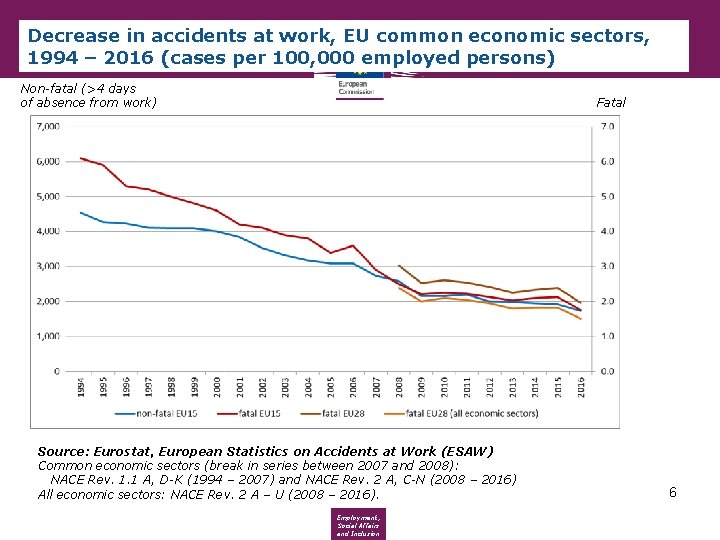
Decrease in accidents at work, EU common economic sectors, 1994 – 2016 (cases per 100, 000 employed persons) Non-fatal (>4 days of absence from work) Fatal Source: Eurostat, European Statistics on Accidents at Work (ESAW) Common economic sectors (break in series between 2007 and 2008): NACE Rev. 1. 1 A, D-K (1994 – 2007) and NACE Rev. 2 A, C-N (2008 – 2016) All economic sectors: NACE Rev. 2 A – U (2008 – 2016). Employment, Social Affairs and Inclusion 6
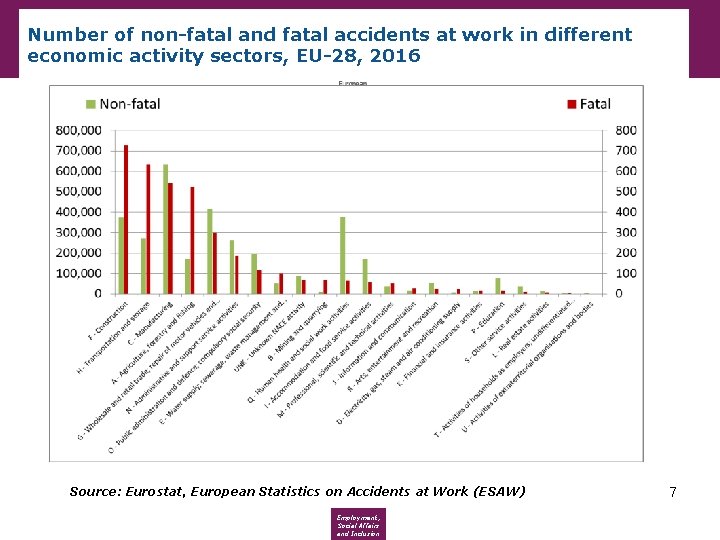
Number of non-fatal and fatal accidents at work in different economic activity sectors, EU-28, 2016 Source: Eurostat, European Statistics on Accidents at Work (ESAW) Employment, Social Affairs and Inclusion 7
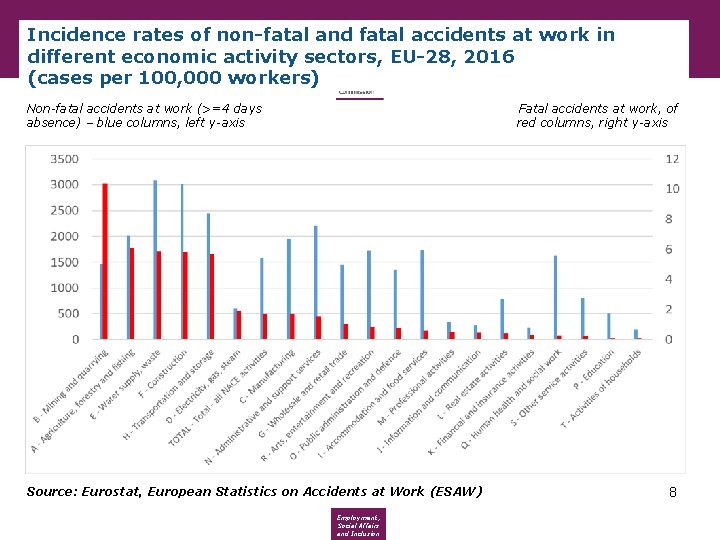
Incidence rates of non-fatal and fatal accidents at work in different economic activity sectors, EU-28, 2016 (cases per 100, 000 workers) Non-fatal accidents at work (>=4 days absence) – blue columns, left y-axis Fatal accidents at work, of red columns, right y-axis Source: Eurostat, European Statistics on Accidents at Work (ESAW) Employment, Social Affairs and Inclusion 8
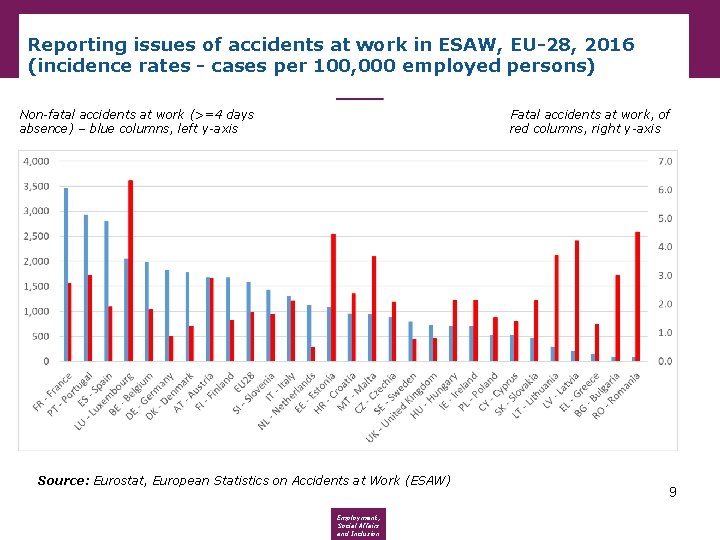
Reporting issues of accidents at work in ESAW, EU-28, 2016 (incidence rates - cases per 100, 000 employed persons) Non-fatal accidents at work (>=4 days absence) – blue columns, left y-axis Fatal accidents at work, of red columns, right y-axis Source: Eurostat, European Statistics on Accidents at Work (ESAW) Employment, Social Affairs and Inclusion 9
Illnesses at work – some aspects and issues • See aspects and issues on slide “accidents at work” • Identification and recognition of occupational diseases • Administrative, diagnostic and exposure criteria for recognition • Classification systems of diseases (ICD-10 / 11) • Long latency diseases, incidence rates and reference populations • Attributable fractions methods (share of occupational cases in in all cases of a specific disease such as lung cancer) 10 Employment, Social Affairs and Inclusion
Key figures on occupational health (1) • EU Labour Force Survey ad-hoc module 2013 (Eurostat): • 2. 8% of workers in EU-28 answered in 2013 that they suffered from nonfatal work-related health problems of at least 4 days of absence (compared with about 1. 5% of workers who suffered from a non-fatal work accident according to LFS and ESAW, or 1. 81% according to EWCS). • European Working Conditions Survey (Eurofound): • 5. 2% (preliminary value) of workers in EU-28 answered in 2015 that they suffered from non-fatal work-related health problems of at least 4 days of absence. 11 Employment, Social Affairs and Inclusion
Key figures on occupational health (2) • European Statistics on Occupational Diseases (EODS, Eurostat) • About 160, 000 non-fatal and fatal cases of recognised occupational diseases according to ICD-10 classification, EU-28, 2015. - Musculoskeletal diseases (MSDs), hearing loss and others - About 5% cancers (mesothelioma, malignant neoplasms of bronchus and lung etc. ). • Data from Institute for Health Metrics and Evaluation (IHME), University of Washington, U. S. , for EU-28, 2015 • Deaths due to specific occupational risks: 126, 500 deaths in total, - Occupational carcinogens: 99, 400 - Occupational injuries: 7, 300 - etc. 12 Employment, Social Affairs and Inclusion
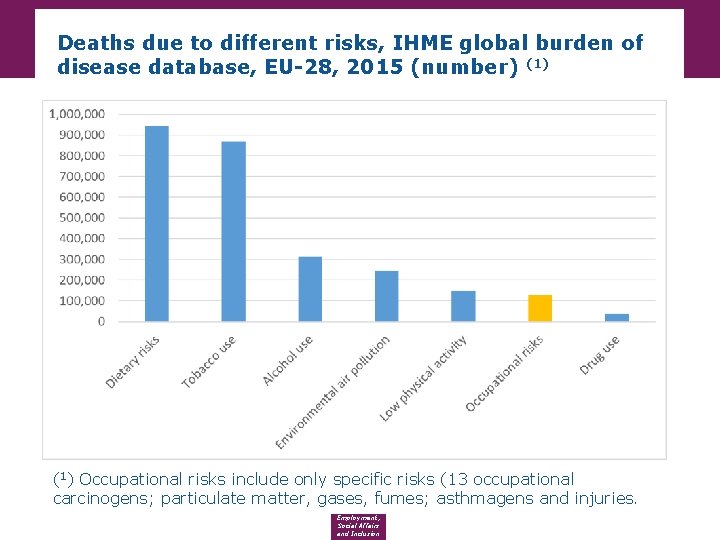
Deaths due to different risks, IHME global burden of disease database, EU-28, 2015 (number) (1) Occupational risks include only specific risks (13 occupational carcinogens; particulate matter, gases, fumes; asthmagens and injuries. Employment, Social Affairs and Inclusion 13
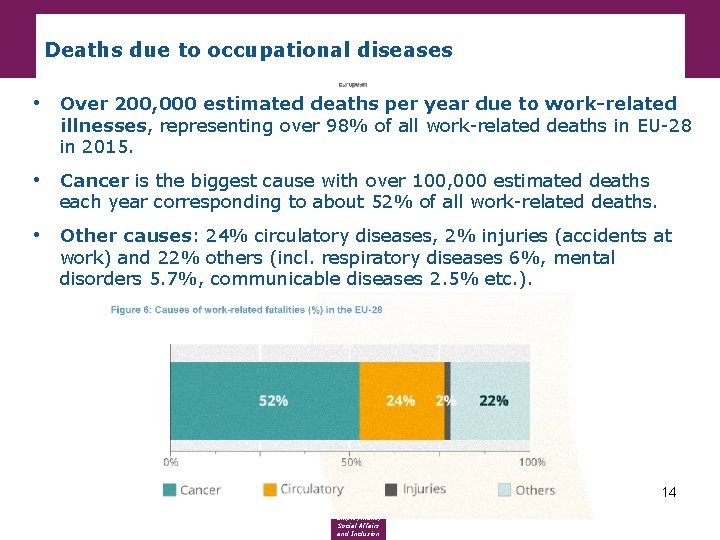
Deaths due to occupational diseases • Over 200, 000 estimated deaths per year due to work-related illnesses, representing over 98% of all work-related deaths in EU-28 in 2015. • Cancer is the biggest cause with over 100, 000 estimated deaths each year corresponding to about 52% of all work-related deaths. • Other causes: 24% circulatory diseases, 2% injuries (accidents at work) and 22% others (incl. respiratory diseases 6%, mental disorders 5. 7%, communicable diseases 2. 5% etc. ). 14 Employment, Social Affairs and Inclusion
Main existing EU data collections on OSH (1) European Commission (Eurostat) • European Statistics on Accidents at Work (ESAW, Eurostat) • European Union Labour Force Survey ad-hoc modules 2020 (planned), 2013, 2007 and 1999 on accidents at work and other work-related health problems (EU-LFS ad-hoc modules, Eurostat) • Eurostat articles on health and safety at work: • https: //ec. europa. eu/eurostat/statisticsexplained/index. php? title=Category: Health_and_safety • https: //ec. europa. eu/eurostat/statistics-explained/index. php? title=Selfreported_work-related_health_problems_and_risk_factors_-_key_statistics 15 Employment, Social Affairs and Inclusion
Main existing EU data collections on OSH (2) European Commission (Eurostat – cont. ) • European Health Interview Survey (EHIS): e. g. analysis of 16 diseases (such as MSDs, allergies, asthma, depression, diabetes) by economic sector and occupation. EHIS 1 (2006 – 09, gentlemen‘s agreement, 17 MS), EHIS 2 (2013 – 2015, EU -28), EHIS 3 (2019) • https: //ec. europa. eu/eurostat/web/microdata/european-health-interviewsurvey • https: //ec. europa. eu/eurostat/web/products-manuals-and-guidelines/-/KS 02 -18 -240 • European Occupational Diseases Statistics (EODS): pilot project on collecting recognised cases of occupational diseases in the EU, planned to be finalised in 2021. 16 Employment, Social Affairs and Inclusion
Main existing EU data collections on OSH (3) European Foundation for the Improvement of Living and Working Conditions (Eurofound, Dublin, Ireland) • European Working Conditions Surveys (EWCS, EU-OSHA) Institute for Health Metrics and Evaluation (IHME), University of Washington • Global burden of disease database (deaths, DALYs) http: //ghdx. healthdata. org/gbd-results-tool 17 Employment, Social Affairs and Inclusion
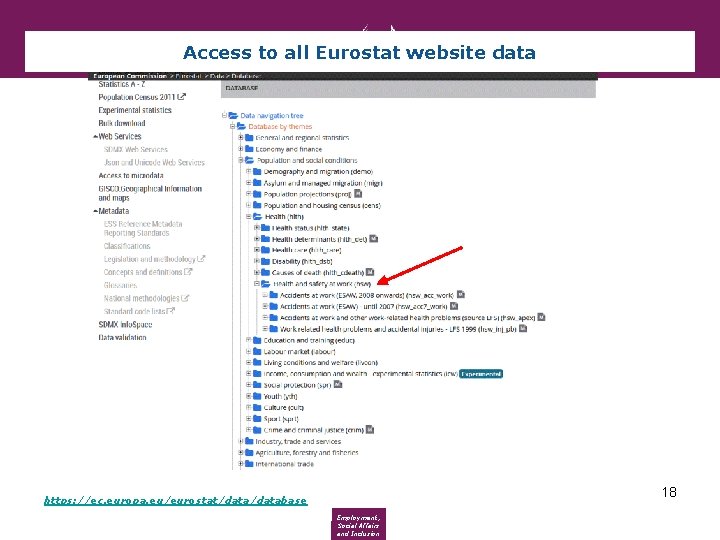
Access to all Eurostat website data 18 https: //ec. europa. eu/eurostat/database Employment, Social Affairs and Inclusion
Challenges 1. Lack of more detailed ICD-10 data on (non-recognized) occupational diseases 2. Comparability issues of recognized occupational diseases Possible solutions • Collecting cases of illnesses leading to at least 4 – 14 days of absence from work by economic sector / occupation? • Similar to accidents at work reports • Data from health insurances • More harmonised recognition systems • Minimum list of occupational diseases to be recognized? • Harmonisation of diagnostic and exposure criteria? Employment, Social Affairs and Inclusion 19
Thank you for your attention “What goes unreported goes unfixed” Matthias Fritz European Commission DG Employment, Social Affairs and Inclusion Unit EMPL. B 3 Matthias. Fritz@ec. europa. eu Employment, Social Affairs and Inclusion
- Slides: 20