
ESSAYS MRS BELOFS GUIDE TO WRITING 5 PARAGRAPH
ESSAYS MRS. BELOF’S GUIDE TO WRITING 5 PARAGRAPH ESSAYS
INTRODUCTORY PARAGRAPH It is true that the first impression—whether it’s a first meeting with a person or the first sentence of a paper—sets the stage for a lasting impression. The introductory paragraph of any paper, long or short, should start with a sentence that peaks the interest of readers. In a typical essay, that first sentence leads into two or three other statements that provide details about the writer's subject or process. All of these sentences build up to the essay's thesis statement. The introduction paragraph typically has: Attention-Getter (Lead-in) Set Up for the Thesis/Essay Map
ATTENTION GETTERS & LEAD-INS To get a paper off to a great start, writers should try to have a first sentence that engages their reader. This first sentence should be broadly related to the topic of the essay. Ways writers can begin: • Paradoxical or Intriguing Statement • Shocking Statement or Statistic • Rhetorical Question • Anecdote
STATEMENT OF THE PROBLEM PROVERB, MAXIM, OR STRONG STATEMENT Set Up for a Thesis After the attention getter or lead-in, writers need to gradually narrow the broad subject towards thesis. Gradually narrowing can: • provide background information, • explain underlying information, • describe the complexity of the issue, • introduce various layers of the subject, and • help transition from these more broad ideas to the narrow thesis.
THESIS STATEMENTS A thesis statement manages to encapsulate an essay's main argument in a succinct, one -sentence comment. Beginner writers often times find it useful to create an essay map thesis, where thesis briefly lists the areas that will be discussed in the essay. A Thesis Statement: • has a clearly stated opinion, but does not bluntly announce the opinion ("In this essay I will. . . "), • is narrow enough to write a focused essay, • but is also broad enough to write at least 3 body paragraphs, • is clearly stated in specific terms, • is easily recognized as the main idea, • is forceful and direct, • is not softened with token phrases ("in my opinion" or "I think"), and • can list the 3 main points that will be made.
IN THE INTRODUCTION PARAGRAPH NEVER. . . • apologize for the material that is being written ("In my humble opinion. . . ") • go into a detailed account of the writing • include random information that has nothing to do with the essay • use an encyclopedia or dictionary definition ("According to Webster's. . . ) • dilly-dally. Get to it. Move confidently into the essay.
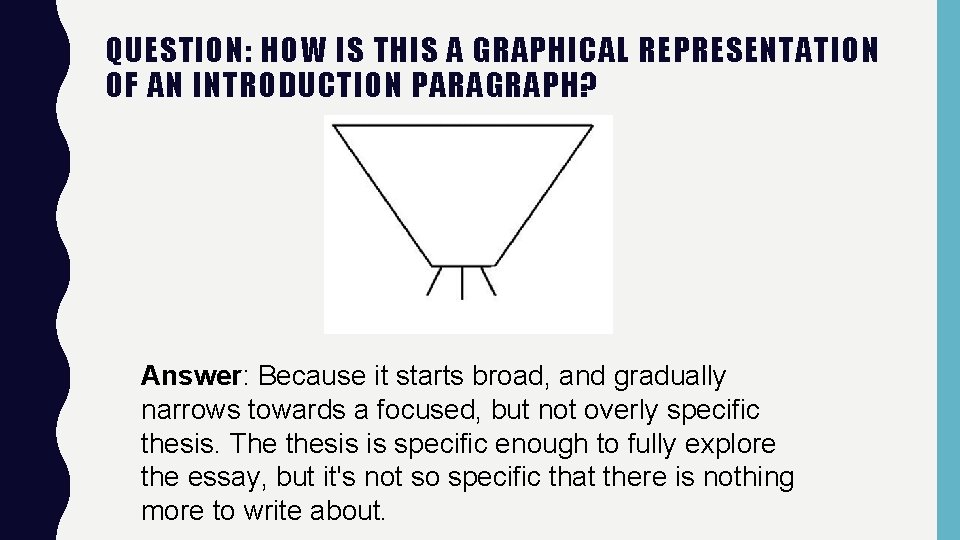
QUESTION: HOW IS THIS A GRAPHICAL REPRESENTATION OF AN INTRODUCTION PARAGRAPH? Answer: Because it starts broad, and gradually narrows towards a focused, but not overly specific thesis. The thesis is specific enough to fully explore the essay, but it's not so specific that there is nothing more to write about.
![SAMPLE THESIS (4 PARAGRAPH ESSAY) [Attention-Getter] After the September 11, 2001 terrorist attacks on](http://slidetodoc.com/presentation_image_h2/2994a258d18e4ead4d6730a0b33e396b/image-8.jpg "SAMPLE THESIS (4 PARAGRAPH ESSAY) [Attention-Getter] After the September 11, 2001 terrorist attacks on")
SAMPLE THESIS (4 PARAGRAPH ESSAY) [Attention-Getter] After the September 11, 2001 terrorist attacks on New York's World Trade Towers and the Pentagon, the debate surrounding racial profiling in airports intensified. Many people believed that profiling was the best way to identify possible terrorists, but many others worried about violations of civil liberties. While some airports began to target passengers based solely on their Middle Eastern origins, others instituted random searches instead. [Begin setting-up thesis] Neither of these techniques seems likely to eliminate terrorism. Now many experts in the government and in airport security are recommending the use of a national ID card or Safe Traveler Card. [Thesis] If every US citizen had such a card, airlines could screen for terrorists more effectively than they do now and avoid procedures that single out individuals solely on the basis of race. • Taken from College Writers pg. 727
HOW TO WRITE A THESIS (CONT) What is a Thesis? • The thesis statement is a statement of belief expressed as fact and is what you are trying to prove in your essay. This is a strongly worded statement that is full of confidence yet must be free of personal allusion. Where is the Thesis Located? • For a standard formal essay, thesis is the LAST SENTENCE OF THE INTRODUCTORY PARAGRAPH. It should not appear anywhere else in the introduction and it should be restricted to ONE SENTENCE. By having it as the last sentence of the first paragraph of the essay, it provides a clear focus for the essay as it is the last statement read before the arguments begin.
BREAKING IT DOWN TO ITS SIMPLEST TERMS… How to Write a Thesis: • Examine your topic. Generally, the writer takes thesis directly from your topic question. For example, if the topic is: “Is Macbeth a hero? ” at least part of your thesis must address this question. Seeing how this is a “yes” or “no” question, the options are clear and thesis must identify your position on this statement. A very basic thesis statement resulting from this topic question could be “Macbeth is a hero. ” It is not very exciting, but it would work. It is, however, somewhat incomplete, especially for a standard five-paragraph essay. • When formulating your thesis, you should also provide as much directions as possible for your reader. Thus, state that Macbeth is a hero, but briefly outline in what THREE (for a basic five paragraph essay) ways he is heroic: • Macbeth is a hero because he ____________, and ____________. • You simply need to fill in the blanks with specific examples that prove your point and your thesis is complete. • Do be aware, however, that some of the best arguments are the ones that go against conventional thinking. These essays allow you to exhibit critical and creative thinking; thinking that your marker will appreciate.
One thing that you do NOT want to do in a formal essay is create a thesis that does not take a stand. Do not argue that Macbeth is both heroic and not heroic. While this may work for the start of a dialectic essay in History, English compositions require you to fully persuade, in a formal fashion, that your thesis is valid. You may use converse arguments to highlight your position, but not to the extent that is becomes unclear what you are actually trying to prove. Be as specific as possible in your thesis: Some examples of bad thesis statements: a. I think capital punishment is wrong in Canada. b. Child abuse is a big concern and something should be done about it. c. Sometimes Macbeth acts heroically, while other times he does evil things. Some examples of good thesis statements: a. Capital punishment is a penalty that Canada can ill afford because it is against the Canadian Charter of Rights and Freedoms, it allows the government to “play God, ” and it commits the same crime for which the punishment is death. Macbeth is an anti-hero because he commits treason, subscribes to witchcraft, and loses all compassion for those around him
How to Write Introduction and Concluding Paragraphs: Introductory Paragraphs: The introductory paragraph is one that creates guidance for the reader, creates interest, provides background and identifies thesis of the essay. Students often find it difficult to write introductions, so the following provides a guideline for information to include: a. Indicate the name of the piece(s) of literature you are using and the author(s). b. A BRIEF summary of the content of the literature. This should be no more than a sentence or two just to set up the premise of the story or an important theme. Note, however, that the summary should lean toward the topic; it should not be random information about the novel that has nothing to do with your essay. c. A brief explanation or definition of important concepts that may need clarification in order for the reader to fully understand the direction or content of the essay. d. The thesis statement. Note: This is a guideline to an introductory paragraph, not an outline.
Example of an Introductory Paragraph: In the dramatic play, The Tragedy of Macbeth, by William Shakespeare, the protagonist struggles with his conscience as he pursues his royal ambitions. Throughout the course of the play, Macbeth falls deeper and deeper into the mad schemes of the Weird Sisters and contemplates actions to which he was previously impervious. As he faces this conflict and is mired in treachery, he becomes an anti-hero; the antithesis of heroic behavior. While heroes are selfless and risk themselves to help others, Macbeth’s purpose persuades him to commit vile acts of treason and betrayal. Thus, Macbeth is an anti-hero because he commits treason, subscribes to witchcraft, and loses all compassion for those around him.
How to Write a Concluding Paragraph: The conclusion is a summary of the main points in the essay. It is a restatement of thesis (broken out of one sentence) and contains a decisive close. There should be a “clincher” statement offering words of wisdom or lessons learned. Conclusions can be relatively short and there should be NO NEW information presented in the conclusion. Concluding paragraphs often make connections between the literature and contemporary situations.
BODY PARAGRAPHS- P. E. E METHOD PEE stand for Point Evidence Explain. It is like a 3 layered explanation Step 1) P Make your Point. What are you trying to get at? For example: Cellular phones are better than landlines. Step 2) E Evidence. You need to support your point with some evidence. Examples: If evidence comes from a book – ‘[the author][book title] indicates that. . . ’ or find some factual evidence from the internet. My example: Cellular phones are better than landlines. Cellular phones, on average, cost less to run and if it is a smart phone, you can do so much more with them (citation). Now you have evidence, backed by internet research or book research, to prove your opinion. Step 3) E Explain. You need to explain your evidence in more detail and how it relates/proves your point. Example: Cellular phones are better than landlines. Cellular phones, on average, cost less to run and if it is a smart phone, you can do so much more with them (citation). With a cellular phone, you are far less restricted than with a landline because you are able to move freely. Basic writing frame • ________(P)_________. • find evidence to support your (P) ______(E)_______________. • Explain why the evidence is relevent______________(E)___________.
TIQA – (MRS. BELOF’S FAVOURITE!!) T Make sure the body paragraph has a topic sentence. It is in the topic sentence that you should argue your first of your three points. I Make sure that you introduce your quote Make sure that you provide some context. • Who says the words? Where are they said? When are they said? Are they in response to someone? Are they describing something? Pretend that your reader hasn’t read the book in a very long time, or that they do not know much about the topic you are arguing Q Provide a quote that supports your topic sentence. A Provide an analysis of how this quote supports your argument or your topic sentence. Explain how the quote proves what you are saying in the topic sentence.
REPEAT… T Transition into a second example. I Make sure that you introduce your second quote • Again, make sure that you provide some context. Who says the words? Where are they said? When are they said? Are they in response to someone? Are they describing something? Etc. Q Provide a second quote that supports your topic sentence. A Provide an analysis of how this quote supports your argument or your topic sentence. Explain how the quote proves what you are saying in the topic sentence.
WRITING TIPS: • Do not use first person (I, Me) • Do not use second person (You, Your. ) • Make sure you use page numbers. Do not use the word page or the letters pg. or the letter p. Remember that page numbers should look like this: When Jack is in the forest hunting, the narrator describes him as being “down like a sprinter” (48). • Have a title. Usually a title is a shortened version of your thesis, but in this case, it should be a shortened version of your topic sentence. • Follow proper MLA format for heading and paper. 1 inch margins. Double space throughout whole paper. Do not bold anything on the paper. And do not change font.
11 POINT PARAGRAPH • The 11 -point paragraph is the building block of the formal essay. This model expects you to support a topic with three main points. • Each main point must be sufficiently developed with a cluster of information that follows the “support, reference, comment” format. The key is that you select the most important information for each main point rather than writing everything you can think of about your topic. An example of a typical essay topic a teacher might give: As we know now, Aunt Alexander is living with Scout, Jem, and Atticus gives his reasons as to why she is there, but Scout does not seem very happy. You have two choices to write about. Remember, you are not just explaining something to me, you are PROVING it to me. No matter the choice, you have to SUPPORT YOUR TOPIC with THREE main points from the novel. Your choices are: • Atticus is NOT a good father • Atticus is a good father
FORMAT FOR AN 11 POINT PARAGRAPH In order to write the perfect 11 point paragraph, the paragraph must adhere to the following format: Sentence 1: Topic Sentence – introduces the main idea that will be discussed in the paragraph. Sentence 2: “supporting statement #1” – First point to support your topic Sentence 3: “reference #1” – Quotation containing evidence from the text to show ss#1 Sentence 4: “comment #1” – a statement of analysis or interpretation that shows the link between Sentence 2 and Sentence 3. Answers why or how the detail supports the point Sentence 5: “supporting statement #2” – Second point to support your topic Sentence 6: “reference #2” – Quotation containing evidence from the text to show ss #2 Sentence 7: “comment #2” – a statement of analysis or interpretation that shows the link between Sentence 5 and Sentence 6. Answers why or how the detail supports the point Sentence 8: “supporting statement #3” – Second point to support your topic Sentence 9: “reference #3” – Quotation containing evidence from the text to show Point ss#3 Sentence 10: “comment #3” – a statement of analysis or interpretation that shows the link between Sentence 8 and Sentence 9. Answers why or how the detail supports the point Sentence 11: Concluding Sentence
COMPARATIVE ESSAY • What is a comparison essay? A comparison essay (or a Compare and Contrast essay) is a commonly used type of writing assignment where you should critically analyze any two subjects, finding and pointing out their similarities and/or dissimilarities. Depending on your assignment, such essays can be comparative only (looking only at similarities), contrasting only (pointing out the differences) or both comparative and contrasting.
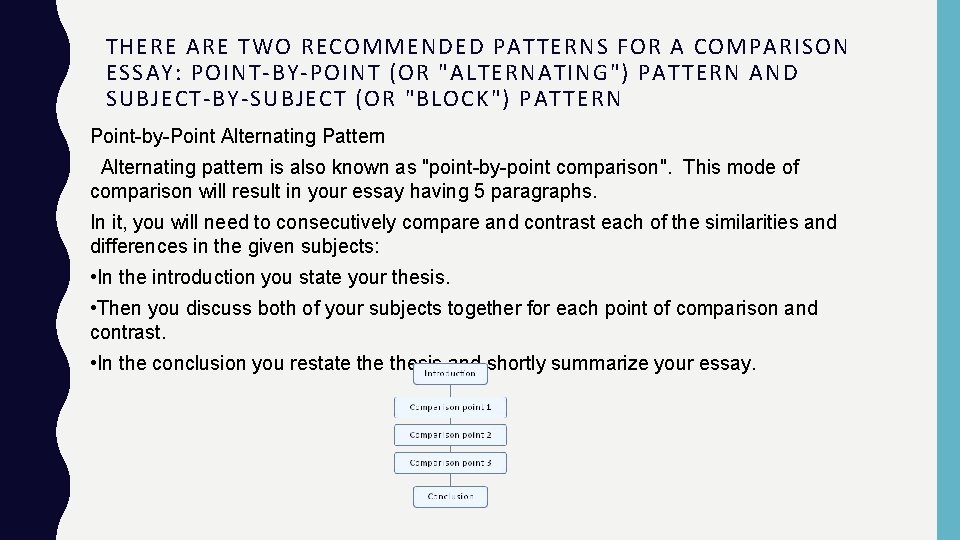
THERE ARE TWO RECOMMENDED PATTERNS FOR A COMPARISON ESSAY: POINT-BY-POINT (OR "ALTERNATING") PATTERN AND SUBJECT-BY-SUBJECT (OR "BLOCK") PATTERN Point-by-Point Alternating Pattern Alternating pattern is also known as "point-by-point comparison". This mode of comparison will result in your essay having 5 paragraphs. In it, you will need to consecutively compare and contrast each of the similarities and differences in the given subjects: • In the introduction you state your thesis. • Then you discuss both of your subjects together for each point of comparison and contrast. • In the conclusion you restate thesis and shortly summarize your essay.
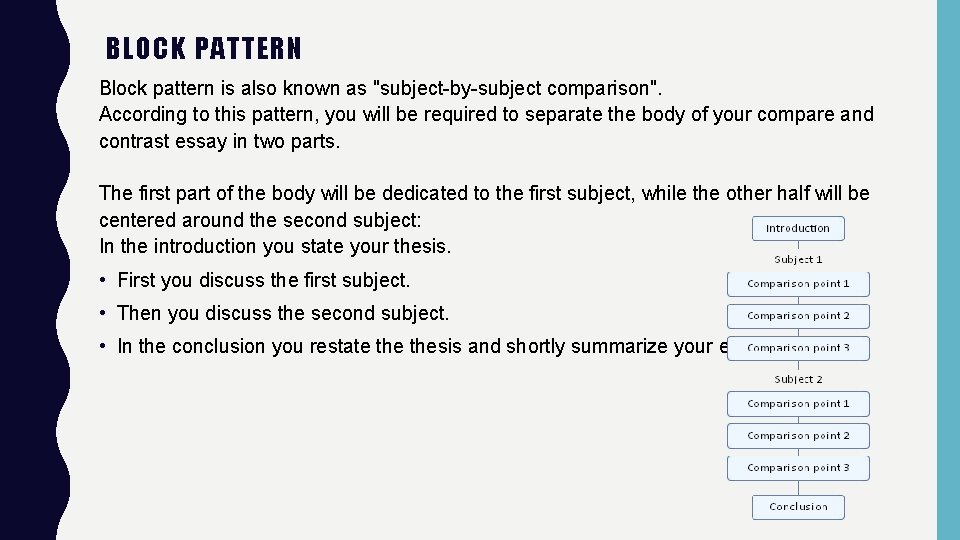
BLOCK PATTERN Block pattern is also known as "subject-by-subject comparison". According to this pattern, you will be required to separate the body of your compare and contrast essay in two parts. The first part of the body will be dedicated to the first subject, while the other half will be centered around the second subject: In the introduction you state your thesis. • First you discuss the first subject. • Then you discuss the second subject. • In the conclusion you restate thesis and shortly summarize your essay.
PERSUASIVE ESSAY I. Introductory Paragraph o Your introductory paragraph sets the stage or the context for the position you are arguing for. o This introduction should end with a thesis statement that provides your claim (what you are arguing for) and the reasons for your position on an issue. A. Your thesis: o states what your position on an issue is o appears at the end of the introduction in a 5 paragraph essay o should be clearly stated and often contains emphatic language (should, ought, must) B. Sample Argumentative Thesis o The production, sale, and possession of assault weapons for private citizens should be banned in the U. S.
II. Body of your Argument A. Background Information o This section of your paper gives the reader the basic information he or she needs to understand your position. This could be part of the introduction, but may work as its own section. B. Reasons or Evidence to Support your Claim o All evidence you present in this section should support your position. This is the heart of your essay. Generally, you begin with a general statement that you back up with specific details or examples. Depending on how long your argument is, you will need to devote one to two well-developed paragraphs to each reason/claim or type of evidence. Types of evidence include: • first-hand examples and experiential knowledge on your topic (specific examples help your readers connect to your topic in a way they cannot with abstract ideas) • Opinions from recognized authorities · The tipsheet on the three logical appeals covers the types of evidence you can use in argumentation. 1. Claim: Keeping assault weapons out of private citizens’ hands can lower the increasing occurrences of barbaric public slayings Evidence: o Jul 93 Law firm murders o Columbine School Shootings o How did these individuals gain access to weapons? o University of Virginia incident
2. Claim: The ban on assault weapons is backed heavily by public opinion, major organizations, and even law enforcement. Evidence: o 12% favor ban (Much 92 Timetable News) o Organizational endorsements o Nat'l Sherriff's Assoc. /lntn'l Assoc. of Police Chiefs 3. Claim: The monetary and human costs incurred by crimes committed with assault weapons are too great to ignore. Evidence: o 10, 561 murders in 1990 by handguns o Study of 131 injured patients’ medical expenses paid by public funds
III. Addressing the Opposite Side o Any well-written argument must anticipate and address positions in opposition to the one being argued. o Pointing out what your opposition is likely to say in response to your argument shows that you have thought critically about your topic. Addressing the opposite side actually makes your argument stronger! o Generally, this takes the form of a paragraph that can be placed either after the introduction or before the conclusion. A. 1 st Opposing View: Strict gun control laws won't affect crime rate Refutation: Low murder rate in Britain, Australia (etc. , where strict controls are in force. B. 2 nd Opposing View: Outlaws would still own guns Refutation: Any effort to move trend in opposite direction would benefit future generations
IV. Conclusion o The conclusion should bring the essay to a logical end. It should explain what the importance of your issue is in a larger context. Your conclusion should also reiterate why your topic is worth caring about. o Some arguments propose solutions or make prediction on the future of the topic. o Show your reader what would happen if your argument is or is not believed or acted upon as you believe it should be. Adapted from: Simon & Schuster Handbook for Writers. Ed. Lynn Quitman Troyka, 6 th ed. Upper Saddle River, NJ: Prentice Hall, 2002. The Writer’s Workplace. Ed. Sandra Scarry and John Scarry. 6 th ed. Boston: Thomson Wadsworth, 2008.
TIP SHEET: 3 LOGICAL APPEALS • Logical Appeal (logos) • Ethical Appeal (ethos) • Emotional Appeal (pathos) • See ap folder for powerpoint classesELA AP power pointslogos_ethos_pathos_powerpoint. ppt
WHAT IS A CRITIQUE? • A critique is a genre of academic writing that briefly summarises and critically evaluates a work or concept. Critiques can be used to carefully analyse a variety of works such as: • Creative works – novels, exhibits, film, images, poetry • Research – monographs, journal articles, systematic reviews, theories • Media – news reports, feature articles • Like an essay, a critique uses a formal, academic writing style and has a clear structure, that is, an introduction, body and conclusion. However, the body of a critique includes a summary of the work and a detailed evaluation. The purpose of an evaluation is to gauge the usefulness or impact of a work in a particular field.
HOW TO WRITE A CRITIQUE • Before you start writing, it is important to have a thorough understanding of the work that will be critiqued. • Study the work under discussion. • Make notes on key parts of the work. • Develop an understanding of the main argument or purpose being expressed in the work. • Consider how the work relates to a broader issue or context. • There a variety of ways to structure a critique. You should always use what your teacher provides for you. In the event that no guidelines are given, the following template, which showcases the main features of a critique, is an example of one way to write a critique.
INTRODUCTION AND SUMMARY OF WORK Introduction • Typically, the introduction is short (less than 10% of the word length) and you should: • Name the work being reviewed as well as the date it was created and the name of the author/creator. • Describe the main argument or purpose of the work. • Explain the context in which the work was created. This could include the social or political context, the place of the work in a creative or academic tradition, or the relationship between the work and the creator’s life experience. • Have a concluding sentence that signposts what your evaluation of the work will be. For instance, it may indicate whether it is a positive, negative, or mixed evaluation. Summary • Briefly summarise the main points and objectively describe how the creator portrays these by using techniques, styles, media, characters or symbols. This summary should not be the focus of the critique and is usually shorter than the critical evaluation.
CRITICAL EVALUATION • This section should give a systematic and detailed assessment of the different elements of the work, evaluating how well the creator was able to achieve the purpose through these. For example: you would assess the plot structure, characterisation and setting of a novel; an assessment of a painting would look at composition, brush strokes, colour and light; a critique of a research project would look at subject selection, design of the experiment, analysis of data and conclusions. • A critical evaluation does not simply highlight negative impressions. It should deconstruct the work and identify both strengths and weaknesses. It should examine the work and evaluate its success, in light of its purpose. Examples of key critical questions that could help your assessment include: • Who is the creator? Is the work presented objectively or subjectively? • What are the aims of the work? Were the aims achieved? • What techniques, styles, media were used in the work? Are they effective in portraying the purpose? • What assumptions underlie the work? Do they affect its validity? • What types of evidence or persuasion are used? Has evidence been interpreted fairly? • How is the work structured? Does it favour a particular interpretation or point of view? Is it effective? • Does the work enhance understanding of key ideas or theories? Does the work engage (or fail to engage) with key concepts or other works in its discipline? • This evaluation is written in formal academic style and logically presented. Group and order your ideas into paragraphs. Start with the broad impressions first and then move into the details of the technical elements. For shorter critiques, like we do, you may discuss the strengths of the works, and then the weaknesses. • To support the evaluation, provide evidence from the work itself, such as a quote or example, and you should also cite evidence from related sources. Explain how this evidence supports your evaluation of the work.
CONCLUSION AND REFERNCES Conclusion • This is usually a very brief paragraph, which includes: • A statement indicating the overall evaluation of the work • A summary of the key reasons, identified during the critical evaluation, why this evaluation was formed. • In some circumstances, recommendations for improvement on the work may be appropriate. Reference list • Include all resources cited in your critique. Check with your lecturer/tutor for which referencing style to use. Currently it is MLA 8. citewrite. qut. edu. au
CHECKLIST FOR A CRITIQUE Have I: • Mentioned the name of the work, the date of its creation and the name of the creator? • Accurately summarised the work being critiqued? • Mainly focused on the critical evaluation of the work? • Systematically outlined an evaluation of each element of the work to achieve the overall purpose? • used evidence, from the work itself as well as other sources, to back and illustrate my assessment of elements of the work? • formed an overall evaluation of the work, based on critical reading? • used a well structured introduction, body and conclusion? • used correct grammar, spelling and punctuation; clear presentation; and appropriate referencing style?
- Slides: 35