
Essay Writing The Essentials Purpose of Introduction Essential

- Slides: 21
Essay Writing The Essentials
Purpose of Introduction • Essential Question Statement • To set the tone for the essay • To “hook” the reader into wanting to read more
Introductions • The following can be included in an introduction: – Background information needed to understand the rest of the essay – Relevant statistics – Definitions needed for the rest of the essay
What isn’t an Introduction? • DOES NOT summarize your essay • DOES NOT state evidence (other than main points given in your essential question statement) • DOES NOT “dilly-dally” – straight and to the point!
Introduction A There are many extracurricular activities that students can get involved in. It is important for students to get involved in activities outside of school. Some of the things that students can learn are talking in public, time management and teamwork.
Introduction B Take a second to think about your most memorable moment at school. Chances are it did not happen in the classroom but during a school related activity. There are many extracurricular activities that students can get involved in during middle school and high school. Extracurricular activities are important for students to get involved in because they teach them a number of valuable life lessons. Some of these life lessons are public speaking, time management, and teamwork. .
Recipe for Body Paragraphs • One topic sentence • Many supporting ideas and evidence • Enough transitions • One closer
Ingredient #1: Topic Sentences • Each paragraph MUST start with a topic sentence – Provides a relevant idea about the paper – States something specific – Introduces the main idea – Lets the reader know what the paragraph will be about (a “hook” for that section)
Ingredient #2: Supporting Ideas • Be relevant to the topic • Give specific details, facts, or statistics to “prove” the main idea of the paragraph • Be descriptive and interesting • Explain or refine ideas/terms that may be unclear to the reader
Ingredient #3: Transitions • Help the essay flow • Link one idea to another: each sentence should connect to the one before but should still introduce new material • Strengthen ideas
Ingredient #4: Closers • Restate the main idea of the paragraph – USING DIFFERENT WORDS • Remind the reader of the writer’s feelings toward the topic • Appear at the end of the paragraph • After the closer it should only be natural for the paragraph to come to a close
In General… • Unity: each paragraph should only have ONE idea • Coherence: each paragraph should make sense (transitions!) • Adequacy: each paragraph should have a fully-developed topic (needs to be more than two-three sentences)
Body Paragraphs • Topic Sentence: introduce the topic of the paragraph and how it relates to thesis – there should be NO question as to what the paragraph is about THE TOP PIECE OF BREAD • Supporting Details: PROVE the main point in relation to thesis THE MEAT • Closer: draws the paragraph to a close – should tie closely with topic sentence THE BOTTOM PIECE OF BREAD
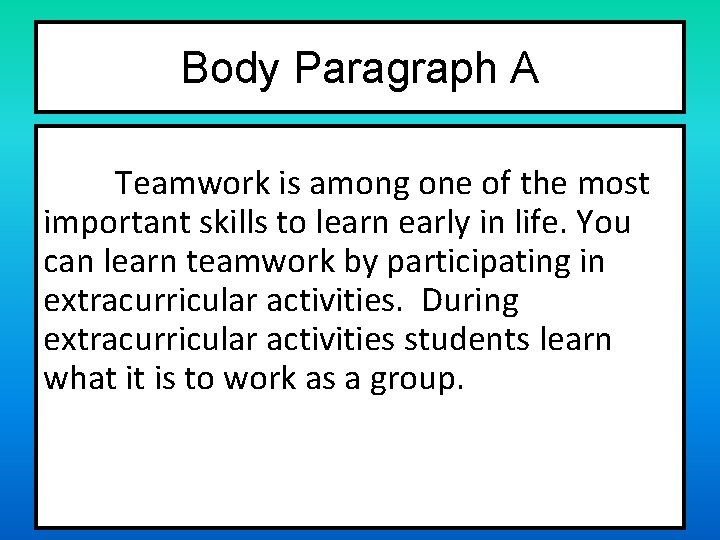
Body Paragraph A Teamwork is among one of the most important skills to learn early in life. You can learn teamwork by participating in extracurricular activities. During extracurricular activities students learn what it is to work as a group.
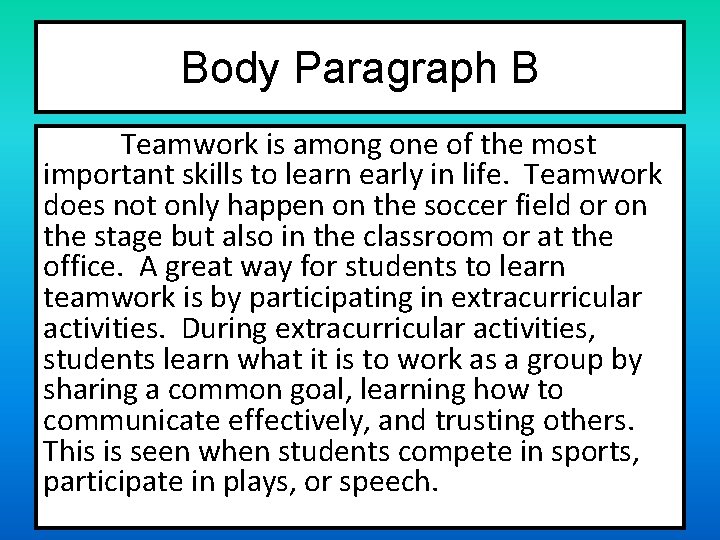
Body Paragraph B Teamwork is among one of the most important skills to learn early in life. Teamwork does not only happen on the soccer field or on the stage but also in the classroom or at the office. A great way for students to learn teamwork is by participating in extracurricular activities. During extracurricular activities, students learn what it is to work as a group by sharing a common goal, learning how to communicate effectively, and trusting others. This is seen when students compete in sports, participate in plays, or speech.
Transitions • The essay must flow smoothly and coherently • You may use simple transitions such as “one reason, ” “another reason, ” and “the final reason, ” BUT… • Be more creative and look for different transitions
What are Conclusions? • Are interesting • Leave the reader with a strong sense of what the paper was about • Leave the reader with something to think about • Are lively and keep the reader involved • Can relate to the introduction to give the reader a sense of order • Must be at least three sentences
Conclusion • Restate your essential question in DIFFERENT words • Leave the reader in awe of your wisdom! • Brings the essay full circle
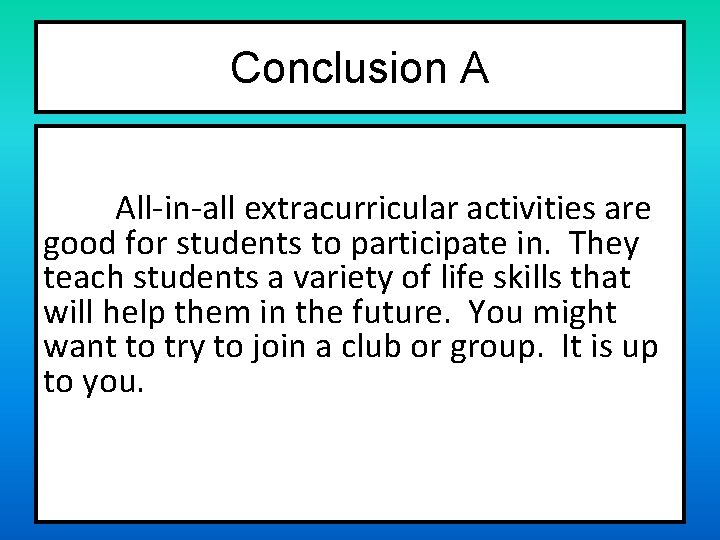
Conclusion A All-in-all extracurricular activities are good for students to participate in. They teach students a variety of life skills that will help them in the future. You might want to try to join a club or group. It is up to you.
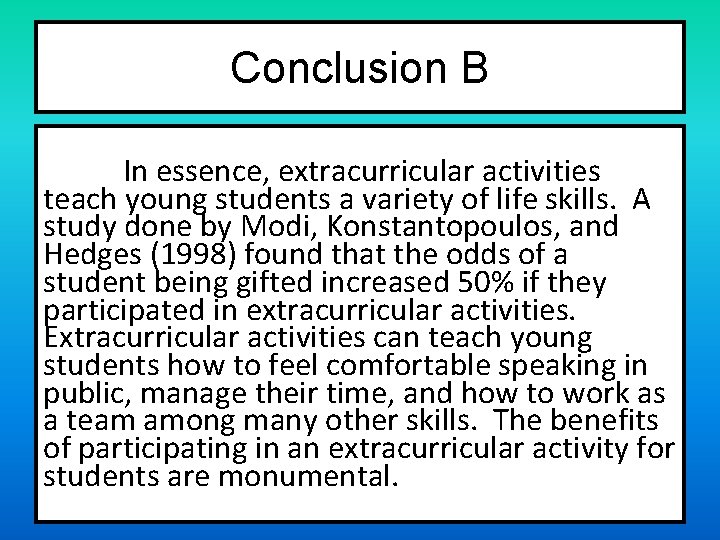
Conclusion B In essence, extracurricular activities teach young students a variety of life skills. A study done by Modi, Konstantopoulos, and Hedges (1998) found that the odds of a student being gifted increased 50% if they participated in extracurricular activities. Extracurricular activities can teach young students how to feel comfortable speaking in public, manage their time, and how to work as a team among many other skills. The benefits of participating in an extracurricular activity for students are monumental.
The Big No-No’s • Do not say, “This essay is about…” • Do not use things or stuff • Eliminate “diseases” • Do not use contractions: spell out “does not” instead of “doesn’t” • Do not use slang • Do not make grammar mistakes regarding rules we have discussed – you WILL be required to correct them WRITE LIKE THIS