
Essay Writing Some basic considerations What this lecture
Essay Writing Some basic considerations
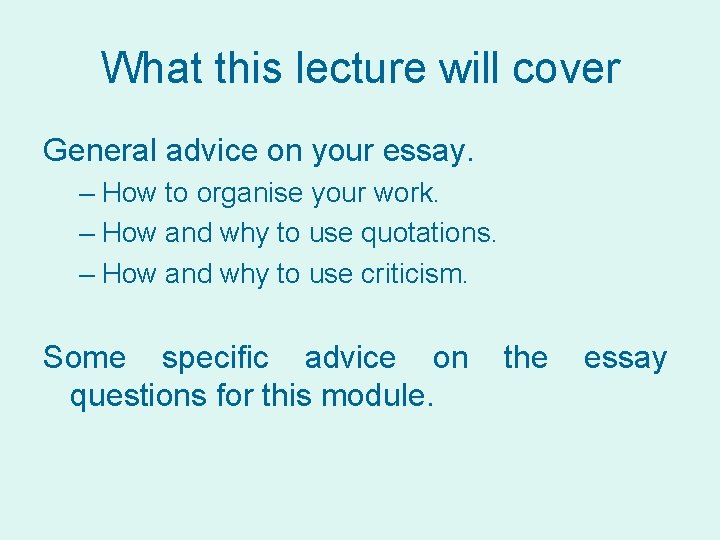
What this lecture will cover General advice on your essay. – How to organise your work. – How and why to use quotations. – How and why to use criticism. Some specific advice on questions for this module. the essay
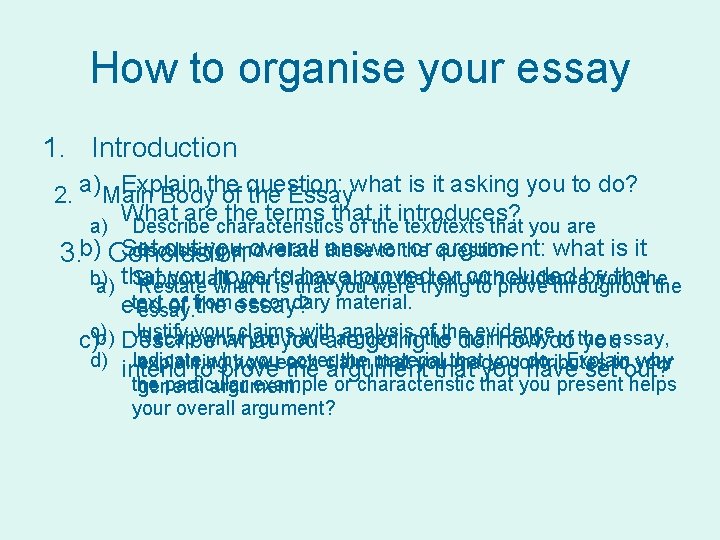
How to organise your essay 1. Introduction Explain 2. a)Main Bodythe of question: the Essaywhat is it asking you to do? What are the terms that it introduces? a) Describe characteristics of the text/texts that you are Set out youand overall answer or question. argument: what is it discussing relate these to the 3. b) Conclusion you all hope have proved or concluded by thethe b) Support your claims about thetrying text with evidence from a) that Restate what it to is that you were to prove throughout the text or from secondary material. end of the essay? essay. Justify claims with analysis evidence. Recapyour what youyou have argued inof the bodydo of the c)c)b) Describe what are going tothemain do: how youessay, d) intend Indicate youeach cover the material that you do. Explain why explaining how that you made contributes your towhy prove the claim argument that you have settoout? the particular example or characteristic that you present helps general argument. your overall argument?
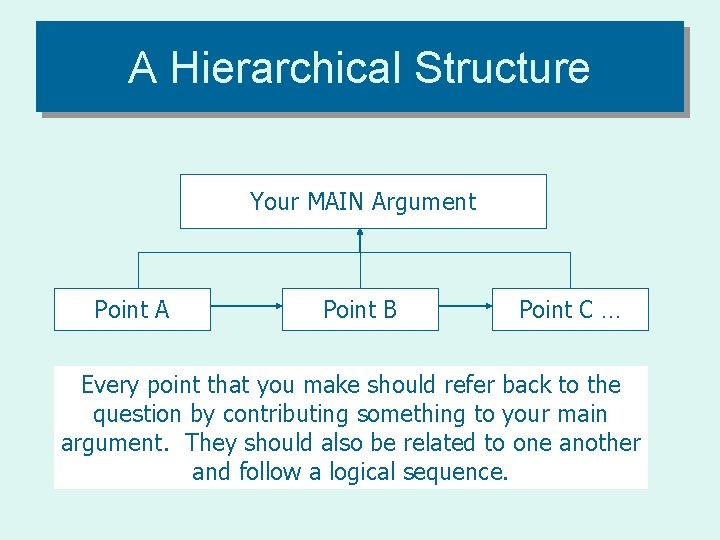
A Hierarchical Structure Your MAIN Argument Point A Point B Point C … Every point that you make should refer back to the question by contributing something to your main argument. They should also be related to one another and follow a logical sequence.
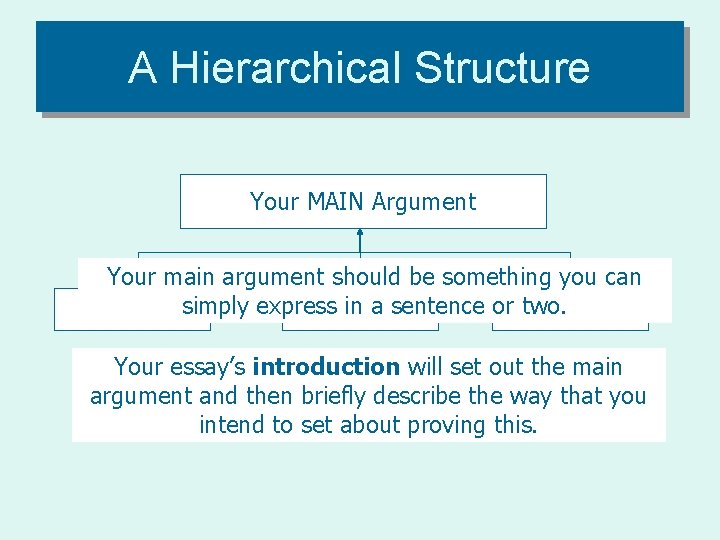
A Hierarchical Structure Your MAIN Argument Your main argument should be something you can in a. Bsentence or Point two. C … Point A simply express Your essay’s introduction will set out the main argument and then briefly describe the way that you intend to set about proving this.
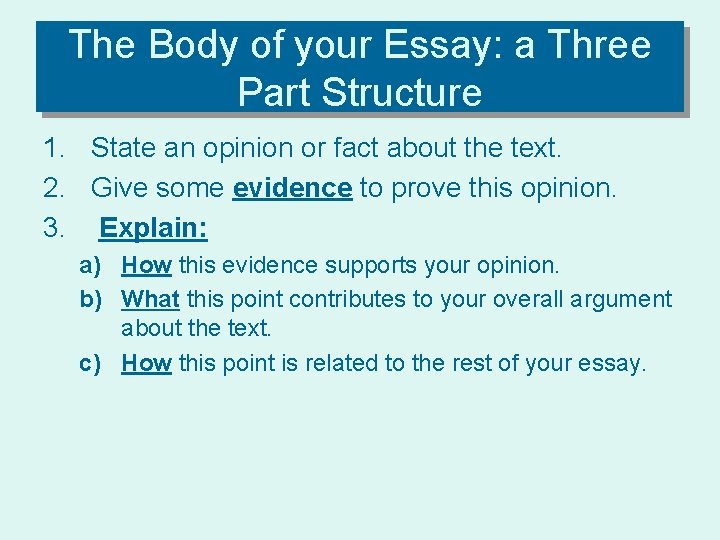
The Body of your Essay: a Three Part Structure 1. State an opinion or fact about the text. 2. Give some evidence to prove this opinion. 3. Explain: a) How this evidence supports your opinion. b) What this point contributes to your overall argument about the text. c) How this point is related to the rest of your essay.
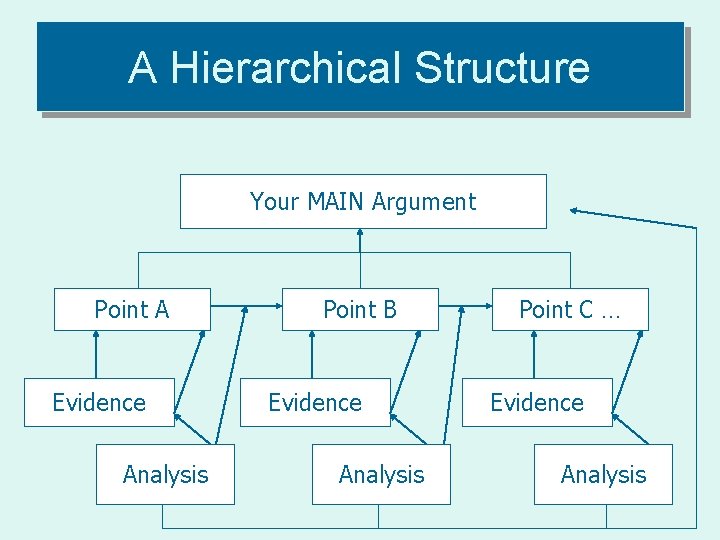
A Hierarchical Structure Your MAIN Argument Point A Evidence Analysis Point B Evidence Analysis Point C … Evidence Analysis
Using Quotations Look at the handout.
Using Criticism Reasons for using criticism? – To give you ideas about how to approach the text you are writing about. – To help put your own ideas into a critical context. – To provide you with examples of critical styles and approaches.
Using Criticism When and how much to quote from a critic. • You should quote if: Ø The quotation adds something to your argument. Ø You disagree with the critical judgement and you are quoting to indicate how cases your own critical judgement. In such you reading must bediffers carefulfrom not existing to misrepresent theagree view with of the Youcan must ensureupon or clarify Ø You a critic in butquestion. feel that you improve you give. That an accurate impression their view as forms their that argument. is, you should quote of if the quotation expressed. starting point for your own argument and you intend to show the specific argument of the critic can be taken further or applied to a particular example which does not appear in the original.
Using Criticism When and how much to quote from a critic. • Do not quote if: Ø You are merely using the quotation because you think the author puts the point better than you could. Ø You have nothing to add to the analysis that they provide. Ø The. Remember: point that the critic is making does not follow on from your own argument. Try to ensure a logical flow to your argument. • A footnote can be used to acknowledge the argument of a critic, you do not have to quote the actual argument. • Quotations from critics need just as much commentary as quotations from the text being analysed. Never leave a quotation from a critic hanging.
Using Criticism When and how much to quote from a critic. Only quote as much of a critic as is necessary. Your quotation should: • convey the critic’s argument simply and efficiently. • receive at least as many words of commentary as the quotation itself.
- Slides: 12