
Essay Writing and Referencing Seckin Baris Gulmez http
Essay Writing and Referencing Seckin Baris Gulmez http: //pir 1600. wordpress. com/
Essay Structure Introduction Ø Central question Ø Hypothetical answer Ø Composition of the essay The Developing Chapters Ø Depicting different arguments, pros-cons of the subject with reference to the literature. Ø Strengths and weaknesses of the literature Ø Examples Ø Criticizing the extant literature in line with our central argument
Essay Structure Conclusion Ø Summary of our argument and explanation of why our argument is valid while other explanations have weaknesses.
Referencing Harvard Style Quoting “Marx Believed that democratic government was essentially not viable in a capitalist society” (Held, 1996: 129) Paraphrasing According to Held/In Held’s view (1996: 129), Marx did not believe that democratic government was viable under capitalism.
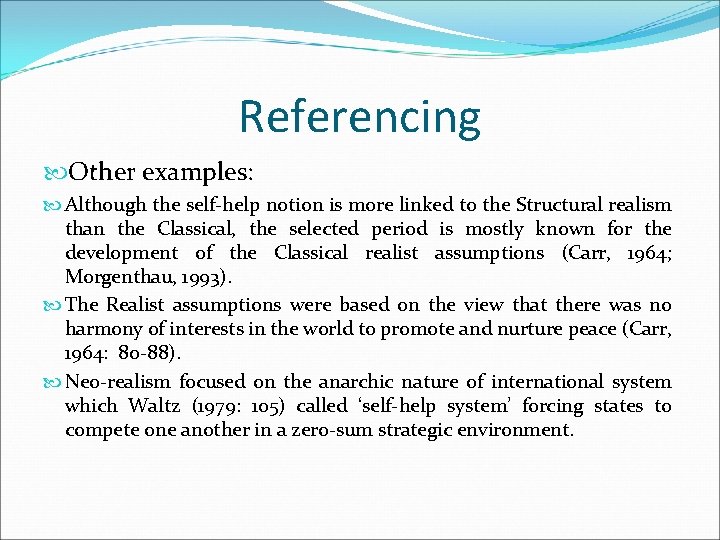
Referencing Other examples: Although the self-help notion is more linked to the Structural realism than the Classical, the selected period is mostly known for the development of the Classical realist assumptions (Carr, 1964; Morgenthau, 1993). The Realist assumptions were based on the view that there was no harmony of interests in the world to promote and nurture peace (Carr, 1964: 80 -88). Neo-realism focused on the anarchic nature of international system which Waltz (1979: 105) called ‘self-help system’ forcing states to compete one another in a zero-sum strategic environment.
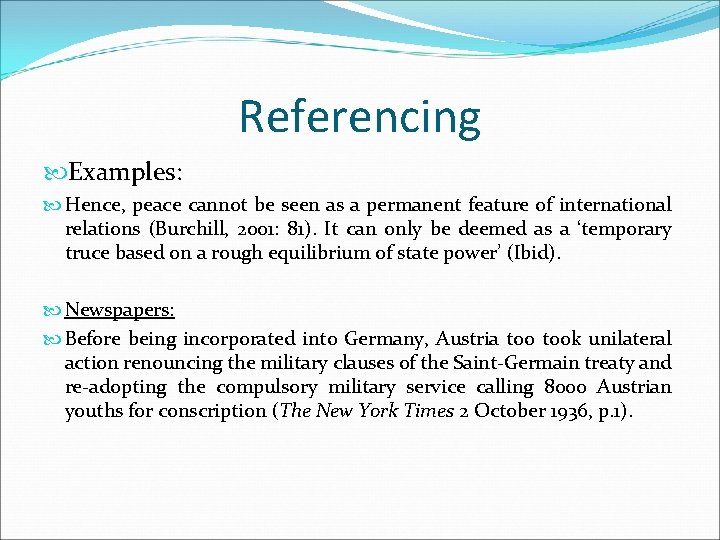
Referencing Examples: Hence, peace cannot be seen as a permanent feature of international relations (Burchill, 2001: 81). It can only be deemed as a ‘temporary truce based on a rough equilibrium of state power’ (Ibid). Newspapers: Before being incorporated into Germany, Austria took unilateral action renouncing the military clauses of the Saint-Germain treaty and re-adopting the compulsory military service calling 8000 Austrian youths for conscription (The New York Times 2 October 1936, p. 1).
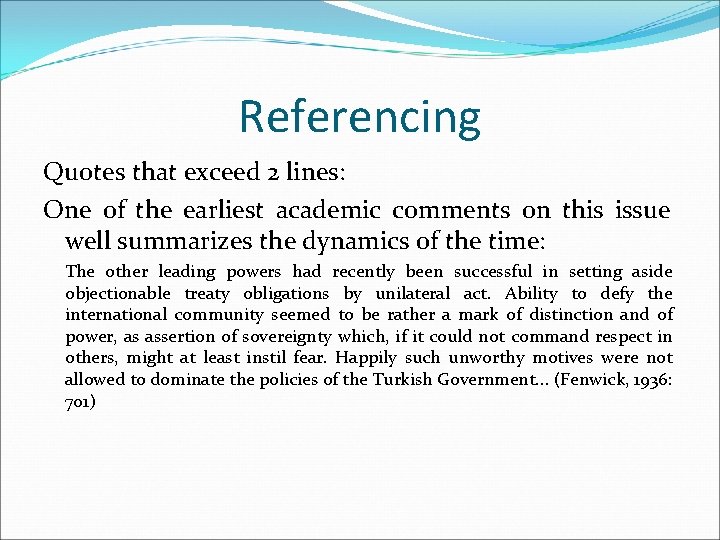
Referencing Quotes that exceed 2 lines: One of the earliest academic comments on this issue well summarizes the dynamics of the time: The other leading powers had recently been successful in setting aside objectionable treaty obligations by unilateral act. Ability to defy the international community seemed to be rather a mark of distinction and of power, as assertion of sovereignty which, if it could not command respect in others, might at least instil fear. Happily such unworthy motives were not allowed to dominate the policies of the Turkish Government. . . (Fenwick, 1936: 701)
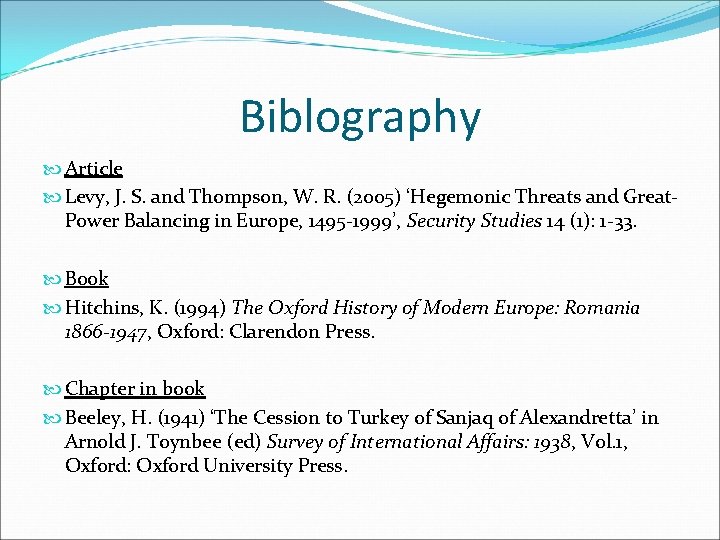
Biblography Article Levy, J. S. and Thompson, W. R. (2005) ‘Hegemonic Threats and Great. Power Balancing in Europe, 1495 -1999’, Security Studies 14 (1): 1 -33. Book Hitchins, K. (1994) The Oxford History of Modern Europe: Romania 1866 -1947, Oxford: Clarendon Press. Chapter in book Beeley, H. (1941) ‘The Cession to Turkey of Sanjaq of Alexandretta’ in Arnold J. Toynbee (ed) Survey of International Affairs: 1938, Vol. 1, Oxford: Oxford University Press.
![Bibliography sources in different language: Özersay, K. (2002) ‘Montreux Boğazlar Sözleşmesi’ [Montreux Straits Convention]](http://slidetodoc.com/presentation_image_h2/335854159be97de17321d9623f268517/image-9.jpg "Bibliography sources in different language: Özersay, K. (2002) ‘Montreux Boğazlar Sözleşmesi’ [Montreux Straits Convention]")
Bibliography sources in different language: Özersay, K. (2002) ‘Montreux Boğazlar Sözleşmesi’ [Montreux Straits Convention] in Baskın Oran (ed. ), Türk Dış Politikası: Kurtuluş Savaşından Bugüne Olgular, Belgeler, Yorumlar 1980 -2001 [Turkish Foreign Policy: Facts, Documents, Comments from the War of Independence until Today], Vol. 1, 4 th Edition. Ankara: İletişim. Online Sources: Koneska, C. (2009, 6 September), “As elections near, Euro-skepticism on the rise in Macedonia”, Balkanalysis, http: //www. balkanalysis. co. uk. Accessed 22 October 2009.
- Slides: 9