
Essay Organization Writing 2 Organization Of Essay Three






- Slides: 33
Essay Organization Writing 2
Organization Of Essay �Three Parts of an Essay �The Introductory Paragraph �Body Paragraphs �The Concluding Paragraph �Transitions Between Paragraphs �Essay Outlining �Planning an Essay �Review �Writing Assignment �Summary Writing 1 1
Three Parts Of Essay
The Essay �An Essay Introduction stimulates the reader’s interest and tells what the essay is about. �Thesis statement is usually the last sentence of introduction and names the specific topic of the essay. �The body consists of one or more paragraphs. Each paragraph develops a sub division of the topic. �The conclusion is the summary or review of the main points discussed in the body.
Example (See book “Introduction rd To Academic Writing 3 Edition page 159)
An essay has unity and coherence. Transition signals link the paragraphs into a cohesive whole.
The Introductory Paragraph (Introduction) �The first paragraph of an essay �It has two functions: 1. It attracts the reader’s interest 2. It introduces the topic of essay
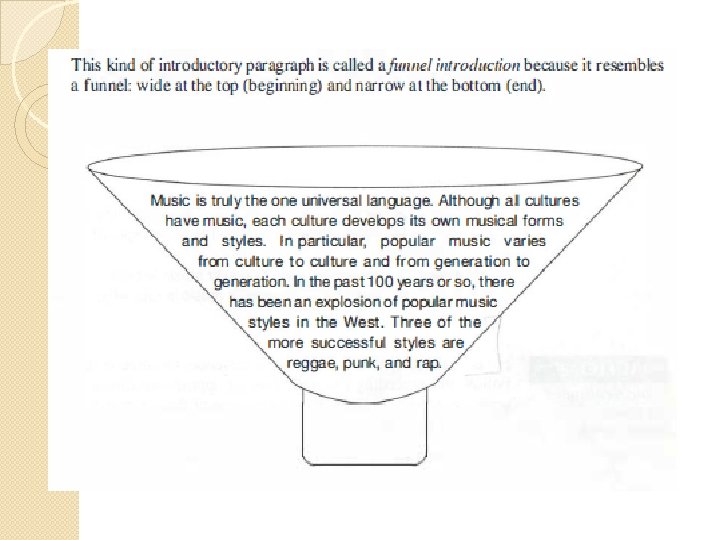
The funnel introduction has two parts: �Several general statements �One thesis statement
The general statements �Give the readers background information about the topic of the essay �Lead the reader gradually from a general idea of your topic to a very specific idea �The first general statement in a funnel introduction just introduces the topic
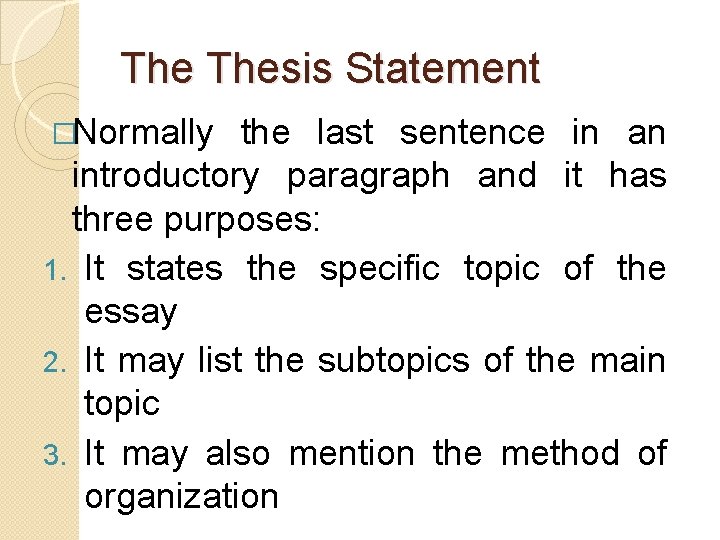
The Thesis Statement �Normally the last sentence in an introductory paragraph and it has three purposes: 1. It states the specific topic of the essay 2. It may list the subtopics of the main topic 3. It may also mention the method of organization
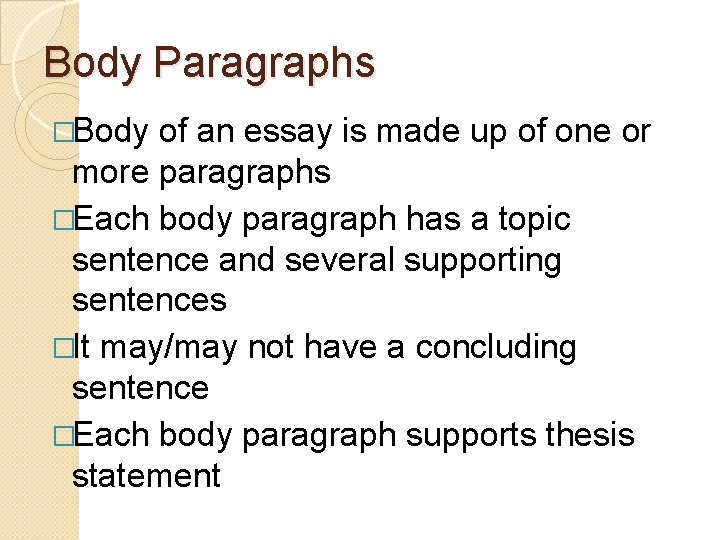
Body Paragraphs �Body of an essay is made up of one or more paragraphs �Each body paragraph has a topic sentence and several supporting sentences �It may/may not have a concluding sentence �Each body paragraph supports thesis statement
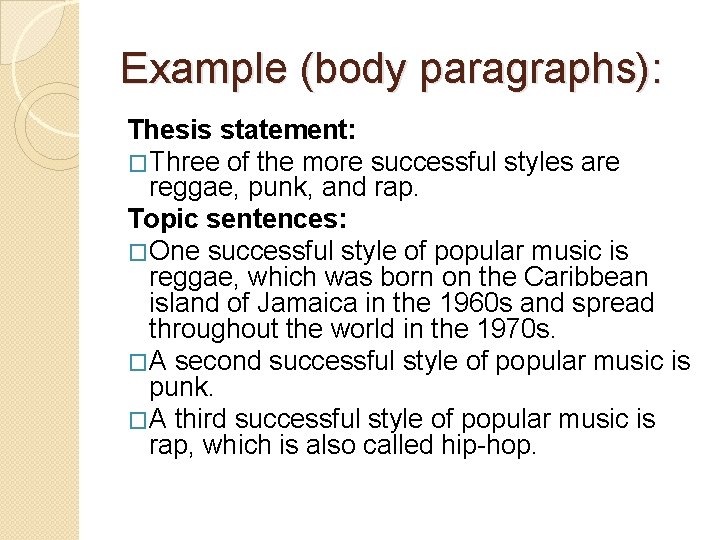
Example (body paragraphs): Thesis statement: �Three of the more successful styles are reggae, punk, and rap. Topic sentences: �One successful style of popular music is reggae, which was born on the Caribbean island of Jamaica in the 1960 s and spread throughout the world in the 1970 s. �A second successful style of popular music is punk. �A third successful style of popular music is rap, which is also called hip-hop.
EXERCISE (see book page 163) For each thesis statement, write topic sentences for three supporting body paragraphs. Follow the preceding example. Use an appropriate transition signal in each topic sentence.
The Concluding Paragraph It is the last paragraph of an essay and has three purposes: 1. It signals the end of the essay 2. It reminds the reader of your main points 3. It leaves the reader with your final thoughts on the topic
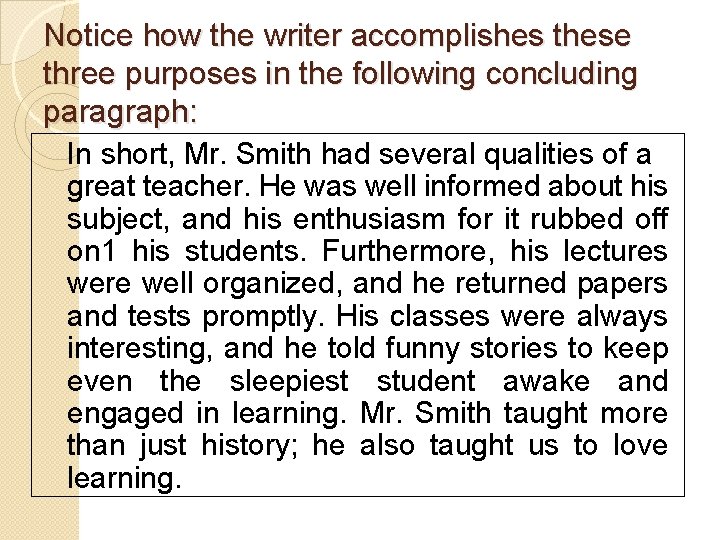
Notice how the writer accomplishes these three purposes in the following concluding paragraph: In short, Mr. Smith had several qualities of a great teacher. He was well informed about his subject, and his enthusiasm for it rubbed off on 1 his students. Furthermore, his lectures were well organized, and he returned papers and tests promptly. His classes were always interesting, and he told funny stories to keep even the sleepiest student awake and engaged in learning. Mr. Smith taught more than just history; he also taught us to love learning.
�The transition phrase In short signals the end of the essay. �It summarizes the qualities of Mr. Smith: he was well informed, enthusiastic, organized, and interesting. �It gives a final comment: Mr. Smith inspired students to love learning.
�The first part of the concluding paragraph summarizes the main points or repeats thesis statement in different words. It may require one or more than one sentence. �In the second part, you may add a final comment. This is the place to express your opinion, make a judgment, or give a recommendation. However, do not add any new ideas in the concluding paragraph. Just comment on what you have already discussed.
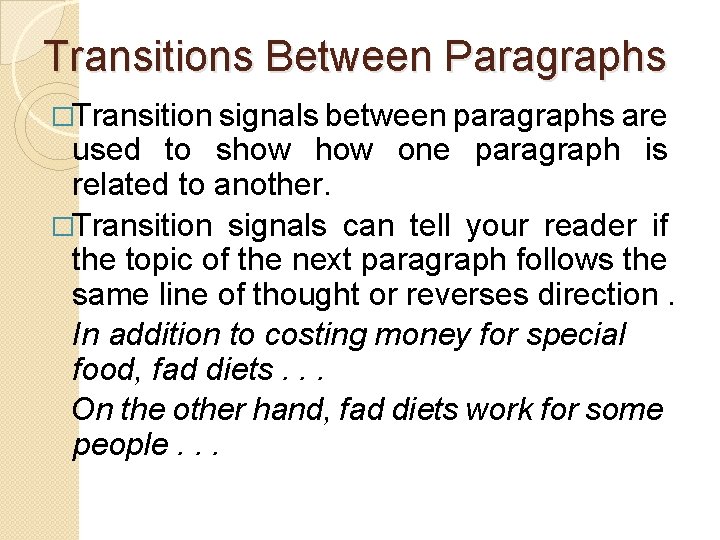
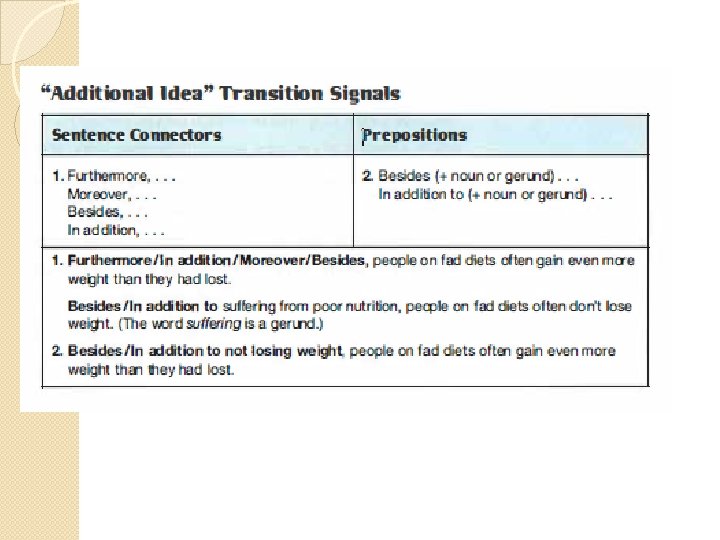
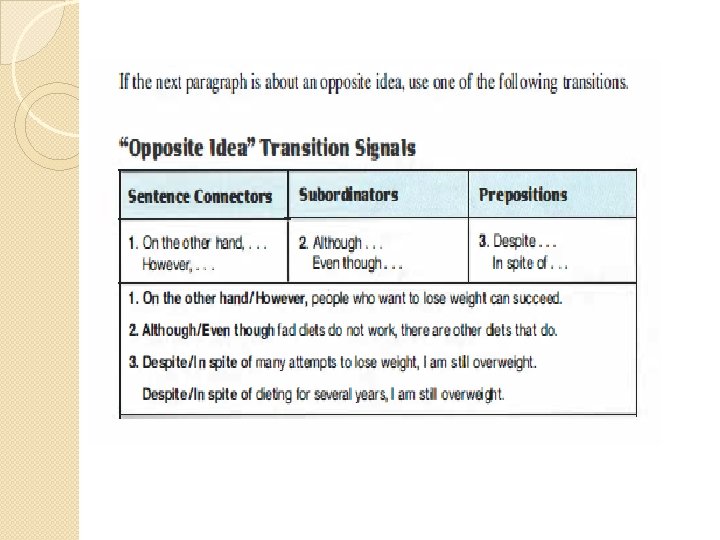
Transitions Between Paragraphs �Transition signals between paragraphs are used to show one paragraph is related to another. �Transition signals can tell your reader if the topic of the next paragraph follows the same line of thought or reverses direction. In addition to costing money for special food, fad diets. . . On the other hand, fad diets work for some people. . .
The concluding paragraph is the last paragraph of an essay. It has three purposes: � 1. It signals the end of the essay. � 2. It reminds the reader of your main points. � 3. It leaves the reader with your final thoughts on the topic.
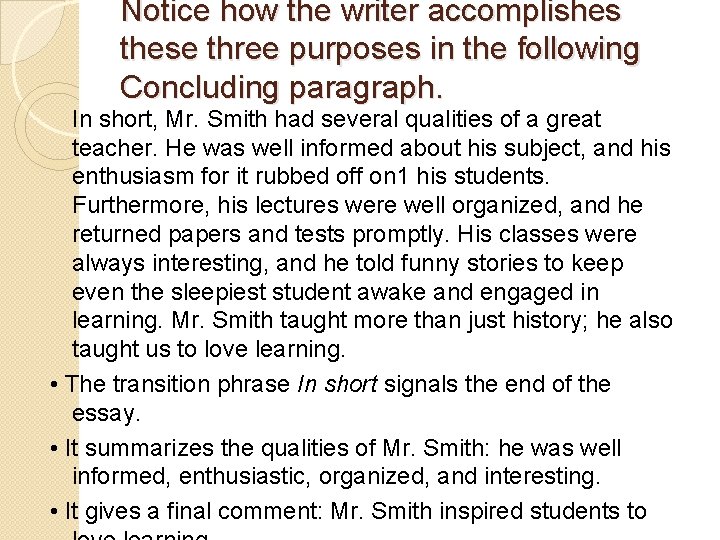
Notice how the writer accomplishes these three purposes in the following Concluding paragraph. In short, Mr. Smith had several qualities of a great teacher. He was well informed about his subject, and his enthusiasm for it rubbed off on 1 his students. Furthermore, his lectures were well organized, and he returned papers and tests promptly. His classes were always interesting, and he told funny stories to keep even the sleepiest student awake and engaged in learning. Mr. Smith taught more than just history; he also taught us to love learning. • The transition phrase In short signals the end of the essay. • It summarizes the qualities of Mr. Smith: he was well informed, enthusiastic, organized, and interesting. • It gives a final comment: Mr. Smith inspired students to
�The first part of the concluding paragraph summarizes the main points or repeats thesis statement in different words. It may require one or more than one sentence. �In the second part, you may add a final comment. This is the place to express your opinion, make a judgment, or give a recommendation. However, do not add any new ideas in the concluding paragraph. Just comment on what you have already discussed.
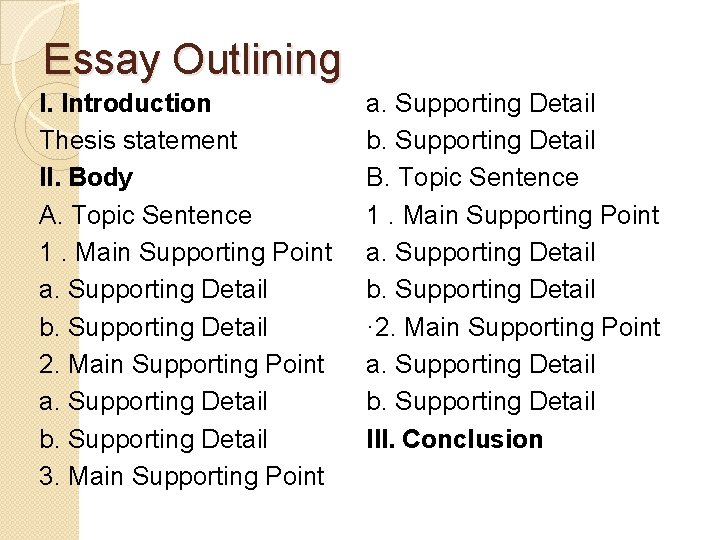
Essay Outlining I. Introduction Thesis statement II. Body A. Topic Sentence 1. Main Supporting Point a. Supporting Detail b. Supporting Detail 2. Main Supporting Point a. Supporting Detail b. Supporting Detail 3. Main Supporting Point a. Supporting Detail b. Supporting Detail B. Topic Sentence 1. Main Supporting Point a. Supporting Detail b. Supporting Detail · 2. Main Supporting Point a. Supporting Detail b. Supporting Detail III. Conclusion
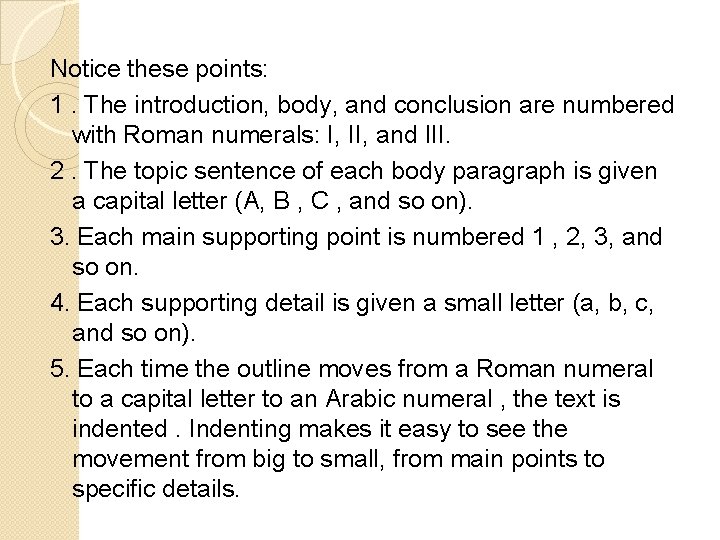
Notice these points: 1. The introduction, body, and conclusion are numbered with Roman numerals: I, II, and III. 2. The topic sentence of each body paragraph is given a capital letter (A, B , C , and so on). 3. Each main supporting point is numbered 1 , 2, 3, and so on. 4. Each supporting detail is given a small letter (a, b, c, and so on). 5. Each time the outline moves from a Roman numeral to a capital letter to an Arabic numeral , the text is indented. Indenting makes it easy to see the movement from big to small, from main points to specific details.
EXERCISE Outlining an Essay (see page 171) Complete the following outline for the model essay on pages 148 - 1 50. Notice that thesis statement, first topic sentence, and concluding sentences are written out in full. You should write out topic sentences in full, but you may use short phrases to list supporting points and supporting details if you wish.
Planning an Essay Planning an essay takes a little more work because there are many ideas and details to organize. �Step I Prewriting In this step, you choose a topic and then gather supporting ideas and details. There are several ways to gather ideas, including listing, clustering, freewriting, journal writing, interviewing classmates and friends, researching online, and researching in a library.
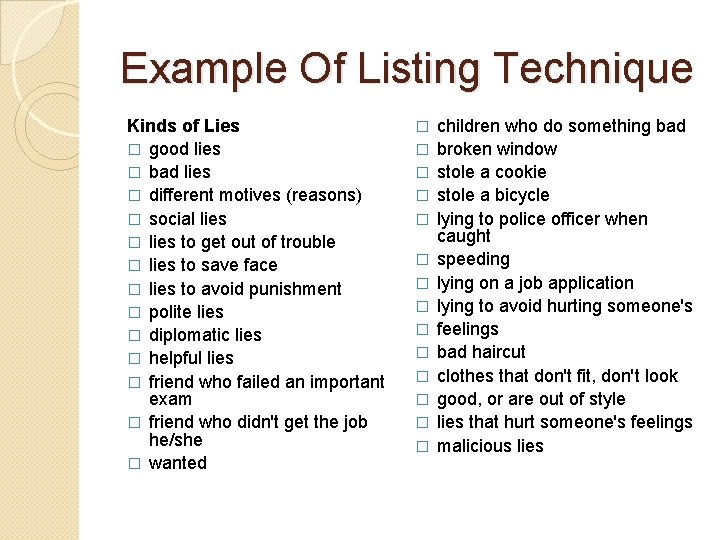
Example Of Listing Technique Kinds of Lies � good lies � bad lies � different motives (reasons) � social lies � lies to get out of trouble � lies to save face � lies to avoid punishment � polite lies � diplomatic lies � helpful lies � friend who failed an important exam � friend who didn't get the job he/she � wanted � � � � children who do something bad broken window stole a cookie stole a bicycle lying to police officer when caught speeding lying on a job application lying to avoid hurting someone's feelings bad haircut clothes that don't fit, don't look good, or are out of style lies that hurt someone's feelings malicious lies
Step 2 Organizing In the second step of the writing process, you organize your ideas. First, you divide your ideas into categories or groups. You may delete some ideas and add others. Then you make an outline and add specific details as necessary.
�Step 2 A Group ideas Logically The first step in organizing is to group your ideas logically. �Step 2 B Make an Outline The second step in organizing is to make an outline.
Review These are the important points covered in this chapter: 1. The organization of an essay is similar to the organization of a paragraph; it is just longer. 2. An essay has three parts: an introduction, a body, and a conclusion. • The introduction (or introductory paragraph) introduces the topic of the essay and arouses the reader's interest. It always contains one sentence that clearly states the main idea of the whole essay. This sentence is called thesis statement. • The body of an essay is made up of one or more paragraphs. Each body paragraph explains or develops one part of the essay topic. • The conclusion is the last paragraph. It summarizes the main points of the essay. 3. It is important to use transitions to show one body paragraph is related to the preceding one. 4. Because an essay is longer than a paragraph , it requires more careful planning. Always make an outline.
Writing Assignment Choose one of the topics from Practice 2 on page 152 or one of the alternative topics suggested. Step 1 Prewrite to get ideas. Step 2 Organize the ideas by making an outline. Step 3 Write the rough draft. Write ROUGH DRAFT at the top of your paper. Step 4 Polish the rough draft. • Exchange papers with a classmate and ask him or her to check your rough draft using Peer-Editing Worksheet 9 on page 2 1 4. Then discuss the completed worksheet and decide what changes you should make. Write a second draft. • Use Self-Editing Worksheet 9 on page 2 1 5 to check your second draft for grammar, punctuation, and sentence structure. Step 5 Write a final copy. Hand in your rough draft, your second draft, your final copy, and the page containing the two editing worksheets. Your teacher may also ask you to hand in your prewriting paper.