
ESS Target Proton Beam Imaging Systems CDR Project
ESS Target Proton Beam Imaging Systems CDR Project adaptation to updated ESS accelerator schedule Erik Adli Department of Physics, University of Oslo, Norway University of Oslo, October 24, 2017
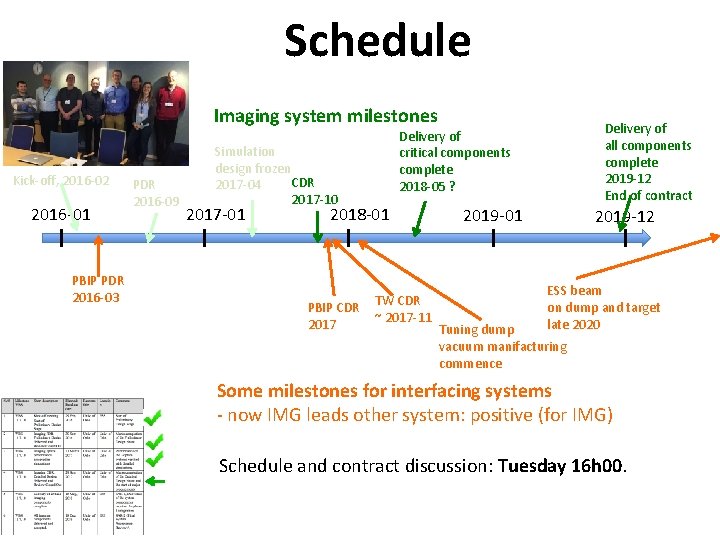
Schedule Imaging system milestones Kick-off, 2016 -02 2016 -01 PBIP PDR 2016 -03 PDR 2016 -09 Simulation design frozen CDR 2017 -04 2017 -10 2017 -01 2018 -01 PBIP CDR 2017 Delivery of all components complete 2019 -12 End of contract Delivery of critical components complete 2018 -05 ? TW CDR ~ 2017 -11 2019 -01 2019 -12 ESS beam on dump and target late 2020 Tuning dump vacuum manifacturing commence Some milestones for interfacing systems - now IMG leads other system: positive (for IMG) Schedule and contract discussion: Tuesday 16 h 00.
New schedule issue • The contract between Oslo and ESS runs from 01. 2016 until 31. 12. 2019. • The contract discusses final acceptance of the imaging system is done with beam. • However, a clause was entered at the time of writing to formally allow for contractual acceptance of the system without beam. • In 2017 a significant re-scheduling of ESS accelerator : first beam on both the tuning beam dump and on target is now scheduled for ca. October 2020. • Two main paths for how to align the project to the new schedule; • acceptance on time at zero extra cost • extension of Oslo contracts
PROJECT COMPLETION AT ZERO ADDITIONAL IN-KIND COST • All deliverables need to be completed by December 2019. • Final acceptance reviews needs to be done without beam. Acceptance criteria should be defined by ESS and agreed upon by Oslo. • A large part of the final installation and alignment of the systems, in the PBIP and tuning beam dump especially, may have been successfully completed by December 2019 according to present schedules. • Final alignment of the target systems, and final verification with beam will take place after the contact (must be done by ESS)
PROJECT COMPLETION BY ACCEPTANCE TESTS WITH BEAM • In order to complete the Oslo in-kind project as foreseen, the project should continue until acceptance tests with beam have been completed. • Hardware costs can be delayed. Key project manpower cost must be extended until the new project end, be covered by new contract/contract extension • If a contract extension is agreed upon, Oslo will still require tcompletion of all originally agreed payments by end 2019 • The new contract, on the other hand, could for example define a final system acceptance with beam ("SAR-3") as condition for payments related to the new contract
Disadvantage end-2019: target • Early system tests, even with test beams, will not be representative for the ESS target environment, due to the strong neutron flux and thermomechanical characteristics of the PBIP. • The PBIP characteristics have been a major driver in the optical system design, tolerancing and alignment strategies. It is important that expert knowledge is retained for the commissioning with beam when the PBIP gets heated in order to survey whether the deformations of the system are as expected. • The interpretation of fiducials, verification of the motion deblur, investigation of noise level, are all commissioning items that require access to system experts. • Final electronics and camera integration may not be completed
Disadvantage end-2019: dump • One of the design challenges for the dump system is the radiation environment of the tuning beam dump and the effect on electronics. Important to have system experts during commissioning • The system will not be ready for handing over to normal operation before a certain integrated beam power has been sent to the dump, including full ESS beam pulses. • While individual components, like screens with coated or sintered chromox, may be tested with test beams, a realistic full system test with beam cannot be done in existing test beam facilities due to the lower beam power and/or different geometry than the ESS beam dump.
Disadvantage end-2019: manpower • Oslo will be happy to answer questions and communicate with ESS after 2019 in order to maximize the success of the project, however, key personnel • However, the bulk of the man-hours in the project are being done by temporary Oslo employees, employed with in-kind money. It is possible that they will go on to new jobs when the in-kind contract ends. • In this case having access to answers on detailed technical questions cannot be guaranteed • Travel to ESS by former experts in new jobs is unlikely to happen.
- Slides: 8