
ESS ELLIPTICAL CAVITIES AND POWER COUPLERS Franck PEAUGER
- Slides: 29
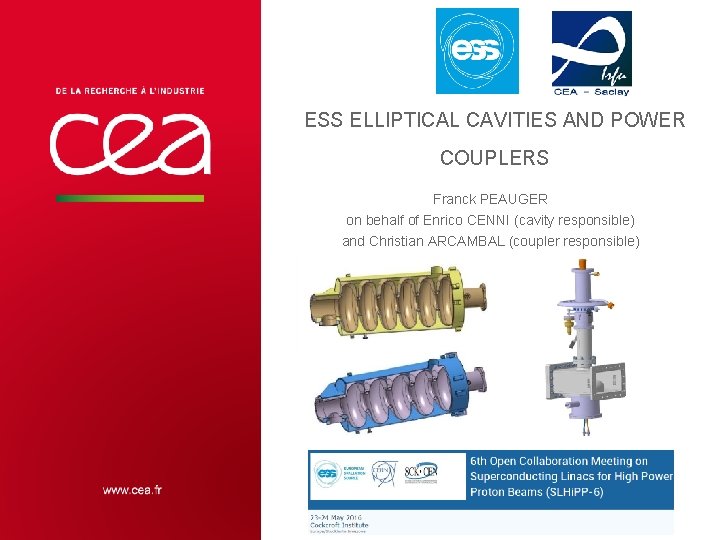
ESS ELLIPTICAL CAVITIES AND POWER COUPLERS Franck PEAUGER on behalf of Enrico CENNI (cavity responsible) and Christian ARCAMBAL (coupler responsible)
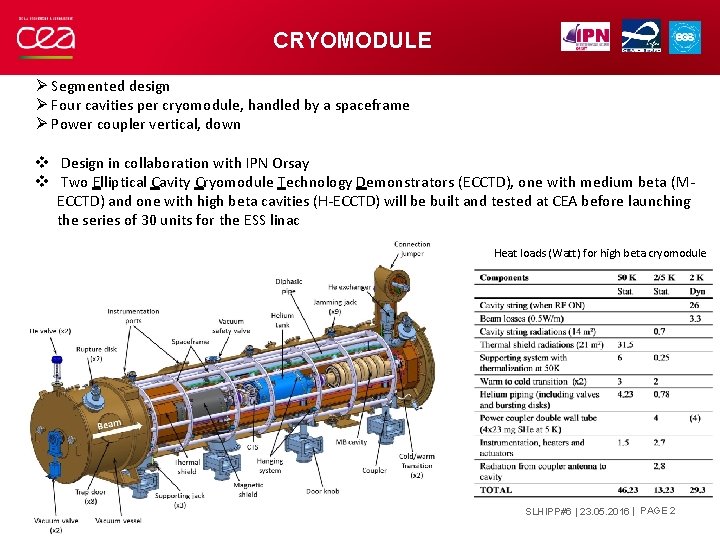
CRYOMODULE Ø Segmented design Ø Four cavities per cryomodule, handled by a spaceframe Ø Power coupler vertical, down v Design in collaboration with IPN Orsay v Two Elliptical Cavity Cryomodule Technology Demonstrators (ECCTD), one with medium beta (MECCTD) and one with high beta cavities (H-ECCTD) will be built and tested at CEA before launching the series of 30 units for the ESS linac Heat loads (Watt) for high beta cryomodule SLHIPP#6 | 23. 05. 2016 | PAGE 2
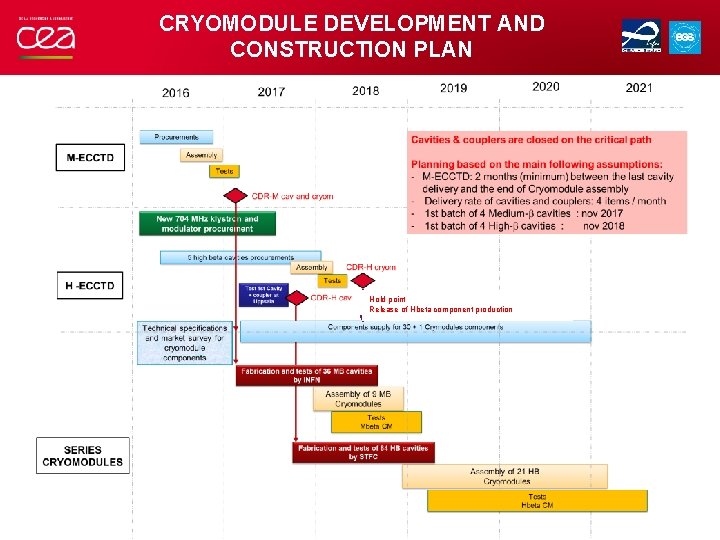
CRYOMODULE DEVELOPMENT AND CONSTRUCTION PLAN Hold point Release of Hbeta component production SLHIPP#6 | 23. 05. 2016 | PAGE 3
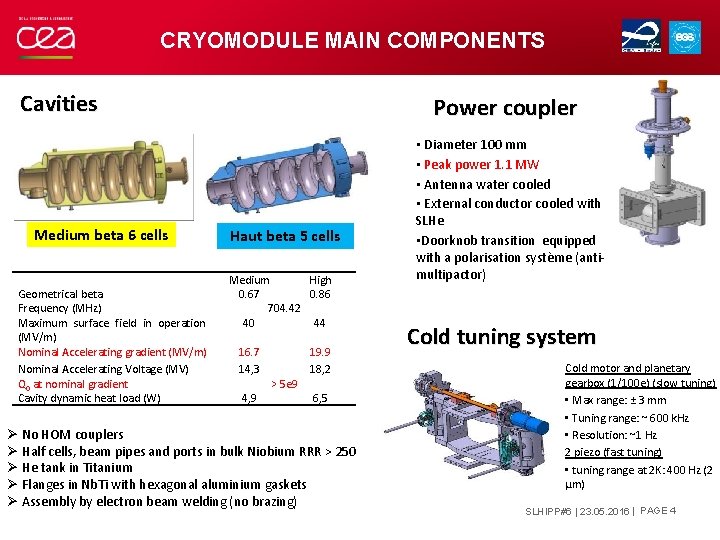
CRYOMODULE MAIN COMPONENTS Cavities Medium beta 6 cells Geometrical beta Frequency (MHz) Maximum surface field in operation (MV/m) Nominal Accelerating gradient (MV/m) Nominal Accelerating Voltage (MV) Q 0 at nominal gradient Cavity dynamic heat load (W) Power coupler Haut beta 5 cells Medium High 0. 67 0. 86 704. 42 40 44 16. 7 14, 3 4, 9 > 5 e 9 19. 9 18, 2 6, 5 Ø No HOM couplers Ø Half cells, beam pipes and ports in bulk Niobium RRR > 250 Ø He tank in Titanium Ø Flanges in Nb. Ti with hexagonal aluminium gaskets Ø Assembly by electron beam welding (no brazing) • Diameter 100 mm • Peak power 1. 1 MW • Antenna water cooled • External conductor cooled with SLHe • Doorknob transition equipped with a polarisation système (antimultipactor) Cold tuning system Cold motor and planetary gearbox (1/100 e) (slow tuning) • Max range: ± 3 mm • Tuning range: ~ 600 k. Hz • Resolution: ~1 Hz 2 piezo (fast tuning) • tuning range at 2 K: 400 Hz (2 µm) SLHIPP#6 | 23. 05. 2016 | PAGE 4
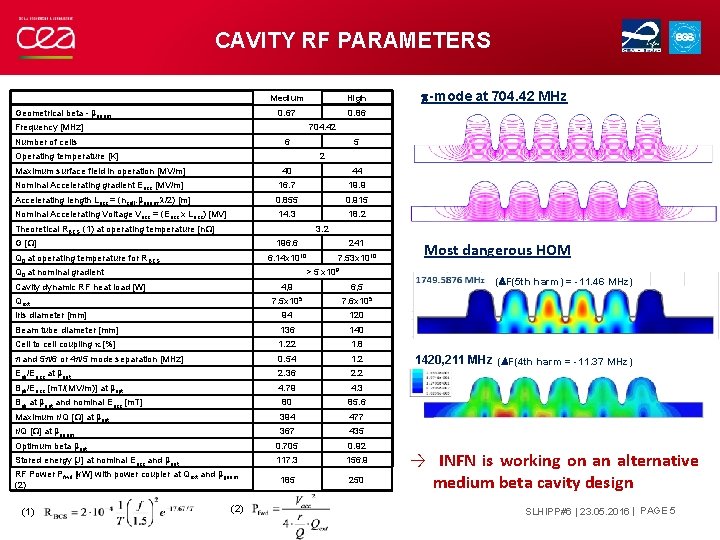
CAVITY RF PARAMETERS Geometrical beta - bgeom Medium High 0. 67 0. 86 Frequency [MHz] 704. 42 Number of cells 6 5 Operating temperature [K] 2 Maximum surface field in operation [MV/m] 40 44 Nominal Accelerating gradient Eacc [MV/m] 16. 7 19. 9 Accelerating length Lacc = (ncell. bgeom. l/2) [m] 0. 855 0. 915 Nominal Accelerating Voltage Vacc = (Eacc x Lacc) [MV] 14. 3 18. 2 Theoretical RBCS (1) at operating temperature [n. W] 3. 2 G [W] Q 0 at operating temperature for RBCS 196. 6 241 6. 14 x 1010 7. 53 x 1010 Q 0 at nominal gradient > 5 x 10⁹ Cavity dynamic RF heat load [W] 4, 9 6, 5 7. 5 x 10⁵ 7. 6 x 10⁵ 94 120 Beam tube diameter [mm] 136 140 Cell to cell coupling k [%] 1. 22 1. 8 p and 5 p/6 or 4 p/5 mode separation [MHz] 0. 54 1. 2 Epk/Eacc at bopt 2. 36 2. 2 Bpk/Eacc [m. T/(MV/m)] at bopt 4. 79 4. 3 Bpk at bopt and nominal Eacc [m. T] 80 85. 6 Maximum r/Q [W] at bopt 394 477 r/Q [W] at bgeom 367 435 Qext Iris diameter [mm] Optimum beta bopt 0. 705 0. 92 Stored energy [J] at nominal Eacc and bopt RF Power Pfwd [k. W] with power coupler at Qext and bgeom (2) 117. 3 156. 9 185 250 (1) p-mode at 704. 42 MHz (2) Most dangerous HOM (DF(5 th harm) = -11. 46 MHz) 1420, 211 MHz (DF(4 th harm = -11. 37 MHz) → INFN is working on an alternative medium beta cavity design SLHIPP#6 | 23. 05. 2016 | PAGE 5
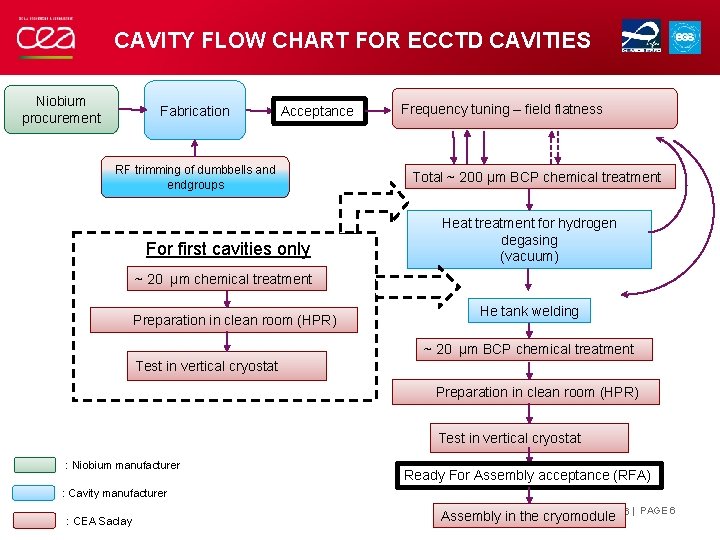
CAVITY FLOW CHART FOR ECCTD CAVITIES Niobium procurement Fabrication Acceptance RF trimming of dumbbells and endgroups For first cavities only Frequency tuning – field flatness Total ~ 200 µm BCP chemical treatment Heat treatment for hydrogen degasing (vacuum) ~ 20 µm chemical treatment Preparation in clean room (HPR) He tank welding ~ 20 µm BCP chemical treatment Test in vertical cryostat Preparation in clean room (HPR) Test in vertical cryostat : Niobium manufacturer Ready For Assembly acceptance (RFA) : Cavity manufacturer : CEA Saclay SLHIPP#6 | 23. 05. 2016 | Assembly in the cryomodule PAGE 6
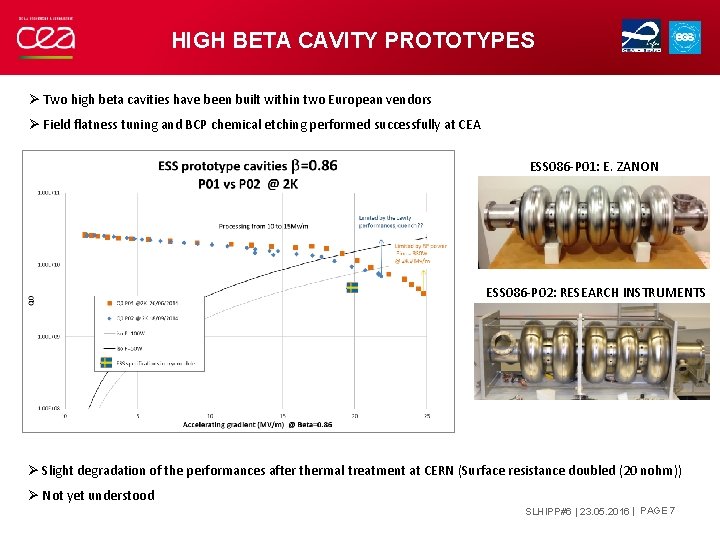
HIGH BETA CAVITY PROTOTYPES Ø Two high beta cavities have been built within two European vendors Ø Field flatness tuning and BCP chemical etching performed successfully at CEA ESS 086 -P 01: E. ZANON ESS 086 -P 02: RESEARCH INSTRUMENTS Ø Slight degradation of the performances after thermal treatment at CERN (Surface resistance doubled (20 nohm)) Ø Not yet understood SLHIPP#6 | 23. 05. 2016 | PAGE 7
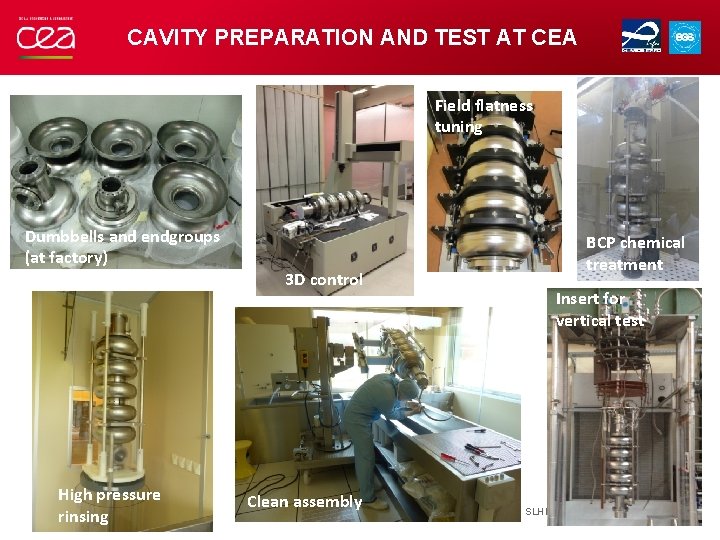
CAVITY PREPARATION AND TEST AT CEA Field flatness tuning Dumbbells and endgroups (at factory) 3 D control High pressure rinsing Clean assembly BCP chemical treatment Insert for vertical test SLHIPP#6 | 23. 05. 2016 | PAGE 8
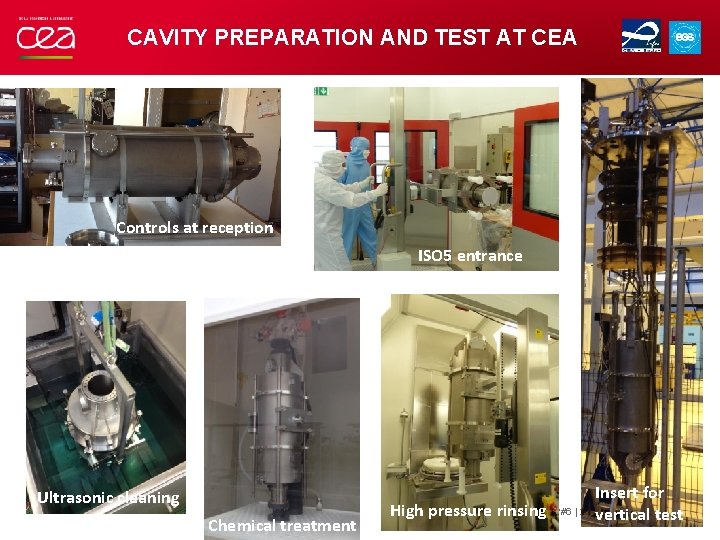
CAVITY PREPARATION AND TEST AT CEA Controls at reception ISO 5 entrance Ultrasonic cleaning Chemical treatment Insert for SLHIPP#6 | 23. 05. 2016 | PAGE 9 High pressure rinsing vertical test
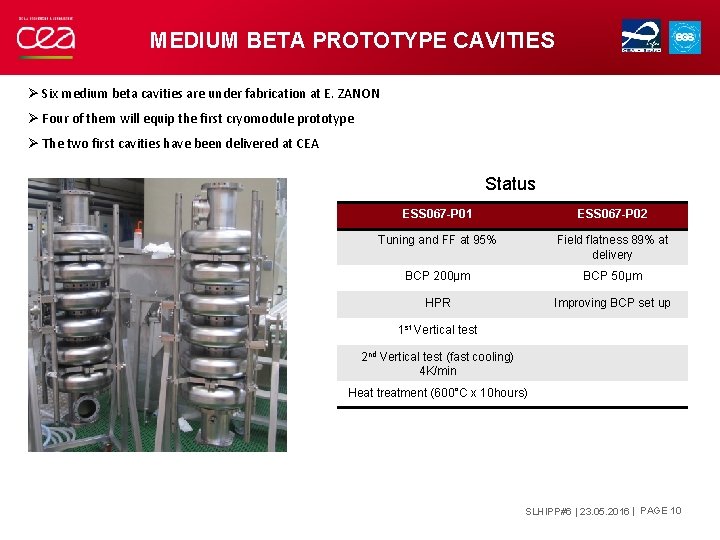
MEDIUM BETA PROTOTYPE CAVITIES Ø Six medium beta cavities are under fabrication at E. ZANON Ø Four of them will equip the first cryomodule prototype Ø The two first cavities have been delivered at CEA Status ESS 067 -P 01 ESS 067 -P 02 Tuning and FF at 95% Field flatness 89% at delivery BCP 200µm BCP 50µm HPR Improving BCP set up 1 st Vertical test 2 nd Vertical test (fast cooling) 4 K/min Heat treatment (600°C x 10 hours) SLHIPP#6 | 23. 05. 2016 | PAGE 10
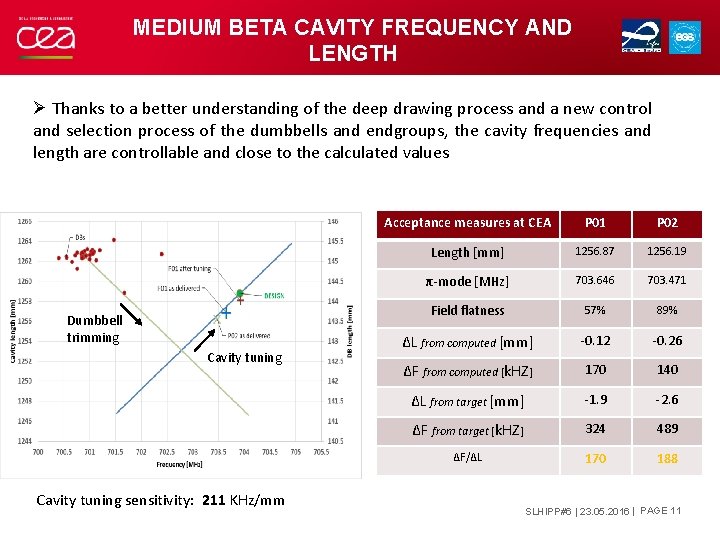
MEDIUM BETA CAVITY FREQUENCY AND LENGTH Ø Thanks to a better understanding of the deep drawing process and a new control and selection process of the dumbbells and endgroups, the cavity frequencies and length are controllable and close to the calculated values Dumbbell trimming Cavity tuning sensitivity: 211 KHz/mm Acceptance measures at CEA P 01 P 02 Length [mm] 1256. 87 1256. 19 π-mode [MHz] 703. 646 703. 471 Field flatness 57% 89% ΔL from computed [mm] -0. 12 -0. 26 ΔF from computed [k. HZ] 170 140 ΔL from target [mm] -1. 9 -2. 6 ΔF from target [k. HZ] 324 489 ΔF/ΔL 170 188 SLHIPP#6 | 23. 05. 2016 | PAGE 11
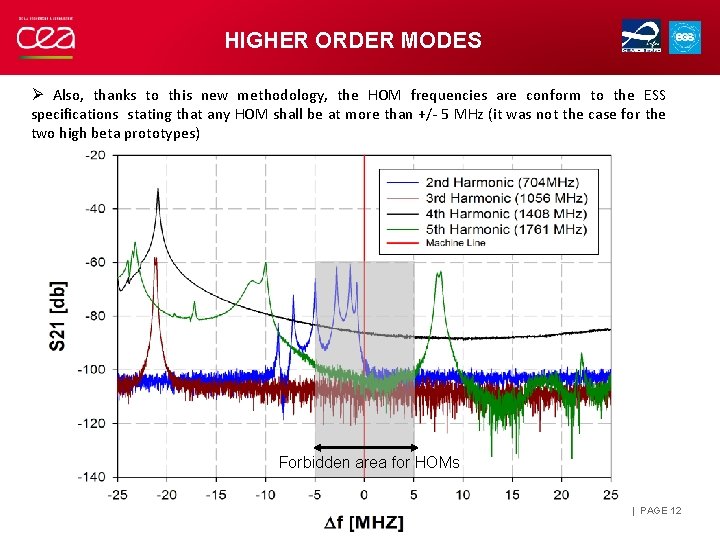
HIGHER ORDER MODES Ø Also, thanks to this new methodology, the HOM frequencies are conform to the ESS specifications stating that any HOM shall be at more than +/- 5 MHz (it was not the case for the two high beta prototypes) Forbidden area for HOMs SLHIPP#6 | 23. 05. 2016 | PAGE 12
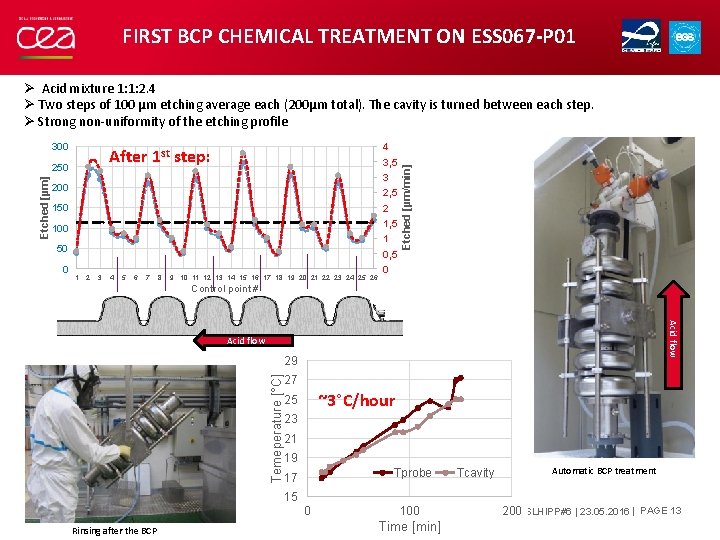
FIRST BCP CHEMICAL TREATMENT ON ESS 067 -P 01 300 After 1 st step: 200 150 100 50 0 1 2 3 4 5 6 7 8 9 10 11 12 13 14 15 16 17 18 19 20 21 22 23 24 25 26 Control point # Acid flow 29 Temeperature [°C] Etched [µm] 250 4 3, 5 3 2, 5 2 1, 5 1 0, 5 0 Etched [µm/min] Ø Acid mixture 1: 1: 2. 4 Ø Two steps of 100 µm etching average each (200µm total). The cavity is turned between each step. Ø Strong non-uniformity of the etching profile 27 ~3°C/hour 25 23 21 19 Tprobe 17 Tcavity Automatic BCP treatment 15 0 Rinsing after the BCP 100 Time [min] 200 SLHIPP#6 | 23. 05. 2016 | PAGE 13
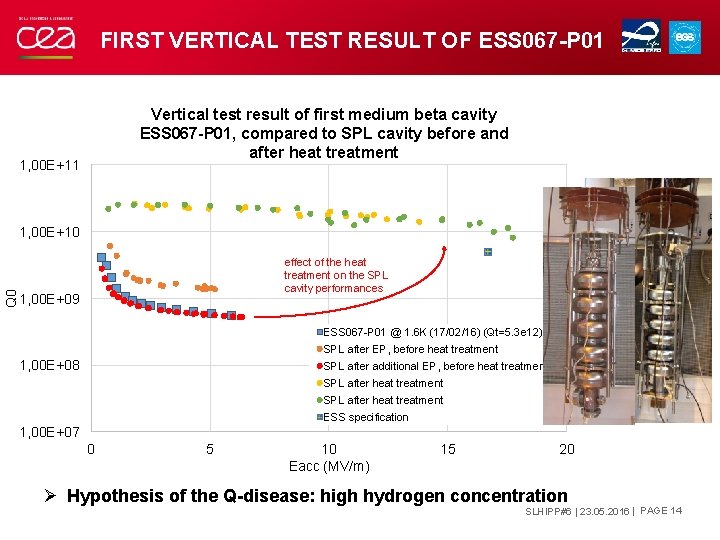
FIRST VERTICAL TEST RESULT OF ESS 067 -P 01 Vertical test result of first medium beta cavity ESS 067 -P 01, compared to SPL cavity before and ESS 067 -P 01 after heat treatment 1, 00 E+11 Q 0 1, 00 E+10 effect of the heat treatment on the SPL cavity performances 1, 00 E+09 ESS 067 -P 01 @ 1. 6 K (17/02/16) (Qt=5. 3 e 12) SPL after EP, before heat treatment 1, 00 E+08 SPL additional EP, before heat treatment ESSafter specification SPL after heat treatment ESS specification 1, 00 E+07 0 5 10 Eacc (MV/m) 15 20 Ø Hypothesis of the Q-disease: high hydrogen concentration SLHIPP#6 | 23. 05. 2016 | PAGE 14
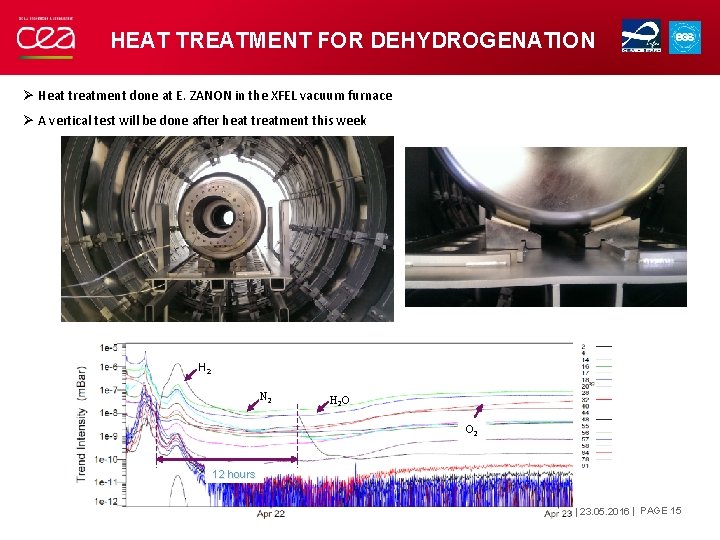
HEAT TREATMENT FOR DEHYDROGENATION Ø Heat treatment done at E. ZANON in the XFEL vacuum furnace Ø A vertical test will be done after heat treatment this week H 2 N 2 H 2 O O 2 12 hours SLHIPP#6 | 23. 05. 2016 | PAGE 15
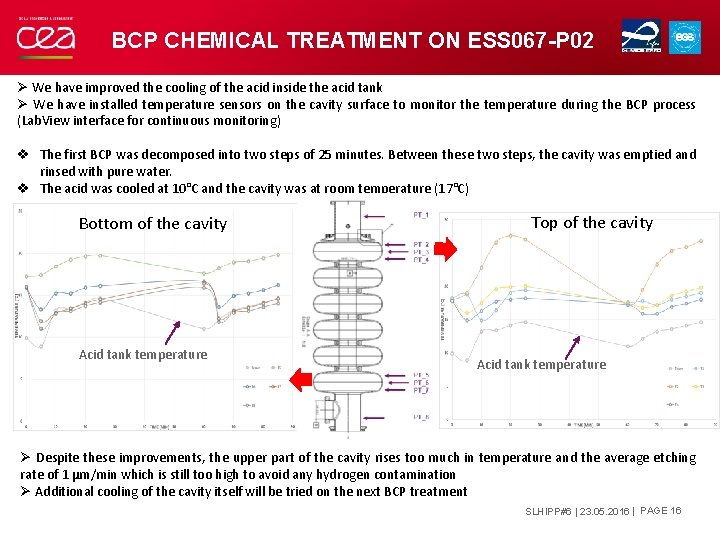
BCP CHEMICAL TREATMENT ON ESS 067 -P 02 Ø We have improved the cooling of the acid inside the acid tank Ø We have installed temperature sensors on the cavity surface to monitor the temperature during the BCP process (Lab. View interface for continuous monitoring) v The first BCP was decomposed into two steps of 25 minutes. Between these two steps, the cavity was emptied and rinsed with pure water. v The acid was cooled at 10°C and the cavity was at room temperature (17°C) Bottom of the cavity Acid tank temperature Top of the cavity Acid tank temperature Ø Despite these improvements, the upper part of the cavity rises too much in temperature and the average etching rate of 1 µm/min which is still too high to avoid any hydrogen contamination Ø Additional cooling of the cavity itself will be tried on the next BCP treatment SLHIPP#6 | 23. 05. 2016 | PAGE 16
MISCELLANEOUS ON CAVITIES SRF collaboration within ESS: Ø Discussions and meetings between ESS, CEA, INFN LASA and STFC to prepare the cavity series production High beta cavities: Ø New call for tender for five more cavities. Four of them will equip the second prototype cryomodule. Ø Niobium material have been ordered Cavity toolings: Ø New type of compact closing flanges with copper coating for the vertical tests, compatible with cavity string assembly toolings Infrastructure : Ø High pressure rinsing system and vertical test stand validated with single cell reference cavity → High priority is put on medium beta cavities to have four cavities ready for integration inside the cryomule by the end of the year SLHIPP#6 | 23. 05. 2016 | PAGE 17
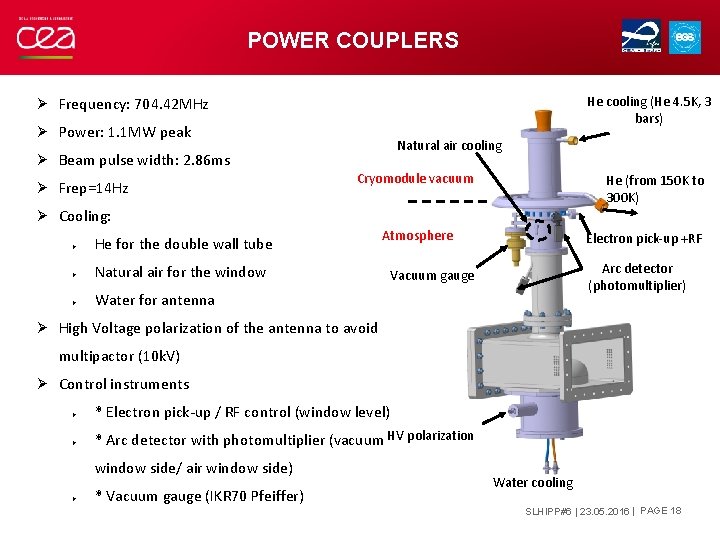
POWER COUPLERS He cooling (He 4. 5 K, 3 bars) Ø Frequency: 704. 42 MHz Ø Power: 1. 1 MW peak Natural air cooling Ø Beam pulse width: 2. 86 ms Ø Frep=14 Hz Cryomodule vacuum He (from 150 K to 300 K) Ø Cooling: Ø He for the double wall tube Ø Natural air for the window Ø Water for antenna Atmosphere Electron pick-up +RF Arc detector (photomultiplier) Vacuum gauge Ø High Voltage polarization of the antenna to avoid multipactor (10 k. V) Ø Control instruments Ø * Electron pick-up / RF control (window level) Ø * Arc detector with photomultiplier (vacuum HV polarization window side/ air window side) Ø * Vacuum gauge (IKR 70 Pfeiffer) Water cooling SLHIPP#6 | 23. 05. 2016 | PAGE 18
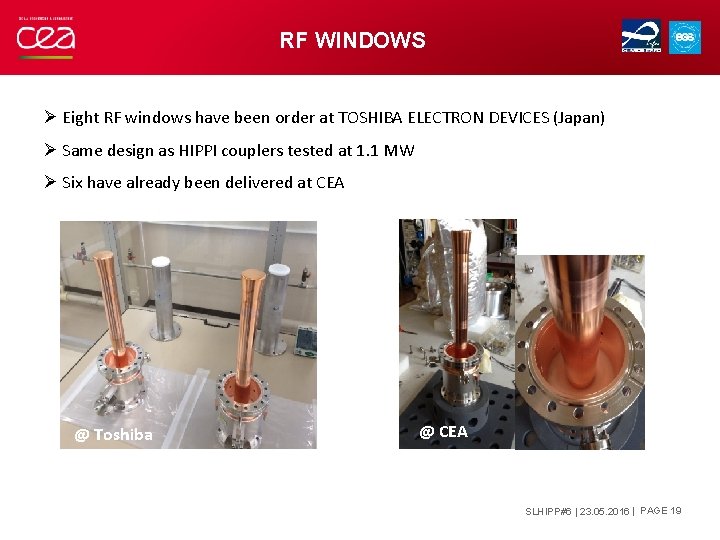
RF WINDOWS Ø Eight RF windows have been order at TOSHIBA ELECTRON DEVICES (Japan) Ø Same design as HIPPI couplers tested at 1. 1 MW Ø Six have already been delivered at CEA @ Toshiba @ CEA SLHIPP#6 | 23. 05. 2016 | PAGE 19
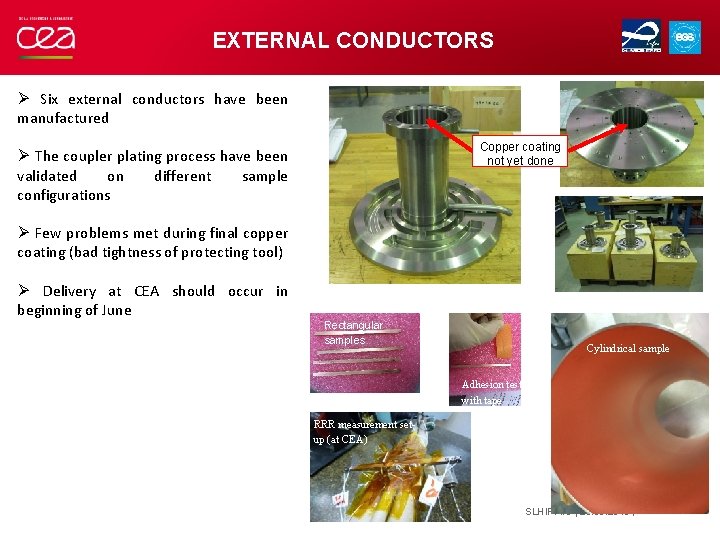
EXTERNAL CONDUCTORS Ø Six external conductors have been manufactured Copper coating not yet done Ø The coupler plating process have been validated on different sample configurations Ø Few problems met during final copper coating (bad tightness of protecting tool) Ø Delivery at CEA should occur in beginning of June Rectangular samples Cylindrical sample Adhesion test with tape RRR measurement setup (at CEA) SLHIPP#6 | 23. 05. 2016 | PAGE 20
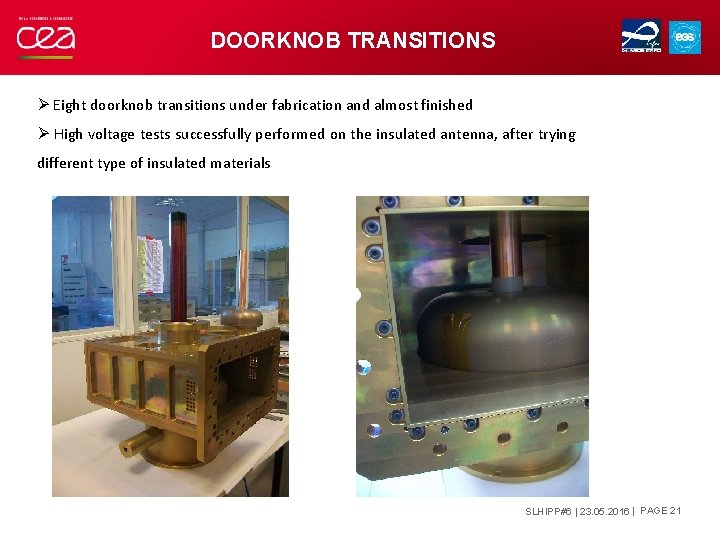
DOORKNOB TRANSITIONS Ø Eight doorknob transitions under fabrication and almost finished Ø High voltage tests successfully performed on the insulated antenna, after trying different type of insulated materials SLHIPP#6 | 23. 05. 2016 | PAGE 21
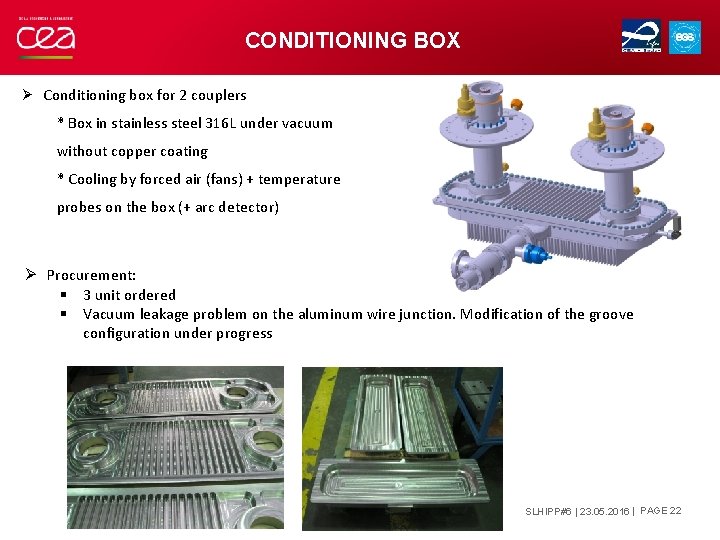
CONDITIONING BOX Ø Conditioning box for 2 couplers * Box in stainless steel 316 L under vacuum without copper coating * Cooling by forced air (fans) + temperature probes on the box (+ arc detector) Ø Procurement: § 3 unit ordered § Vacuum leakage problem on the aluminum wire junction. Modification of the groove configuration under progress SLHIPP#6 | 23. 05. 2016 | PAGE 22
MISCELLANEOUS ON POWER COUPLERS Components ordered recently: Ø Special CF 100 copper gaskets with RF contact Ø Mirrors and photomultipliers (and supports) Ø Electron pickups Ø Baking : heating tape with max. temp of 230°C, silicone rubber Clean room assembly: Ø New tooling for cavity/coupler assembly: received at CEA Infrastructure upgrade: Ø Vacuum pumping system improvement Ø Water cooling distribution definition Ø High voltage modulator: RF pulse enlarged up to 3. 6 ms Ø Control system of the conditioning test stand: new EPICS interface under development Ø High power tests of the first ESS coupler pair is expected in June 2016 SLHIPP#6 | 23. 05. 2016 | PAGE 23
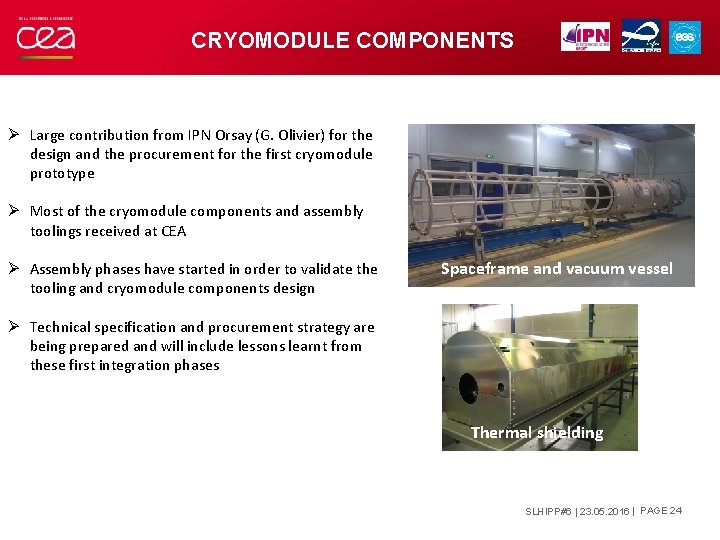
CRYOMODULE COMPONENTS Ø Large contribution from IPN Orsay (G. Olivier) for the design and the procurement for the first cryomodule prototype Ø Most of the cryomodule components and assembly toolings received at CEA Ø Assembly phases have started in order to validate the tooling and cryomodule components design Spaceframe and vacuum vessel Ø Technical specification and procurement strategy are being prepared and will include lessons learnt from these first integration phases Thermal shielding SLHIPP#6 | 23. 05. 2016 | PAGE 24
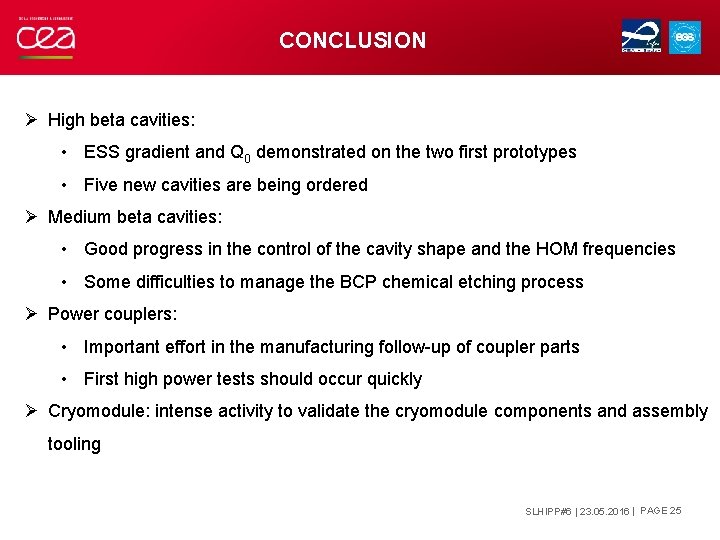
CONCLUSION Ø High beta cavities: • ESS gradient and Q 0 demonstrated on the two first prototypes • Five new cavities are being ordered Ø Medium beta cavities: • Good progress in the control of the cavity shape and the HOM frequencies • Some difficulties to manage the BCP chemical etching process Ø Power couplers: • Important effort in the manufacturing follow-up of coupler parts • First high power tests should occur quickly Ø Cryomodule: intense activity to validate the cryomodule components and assembly tooling SLHIPP#6 | 23. 05. 2016 | PAGE 25
THANK YOU FOR YOUR ATTENTION ESS Christian ARCAMBAL Florence ARDELLIER Nicolas BERTON Stephane BERRY Adrien BOUYGUES Pierre BOSLAND Anais BRUNIQUEL Pol CARBONNIER Enrico CENNI Jean Pierre CHARRIER Guillaume DEVANZ Antoine DAEL Fabien EOZENOU Denis GEVAERT Françoise GOUGNAUD Abdallah HAMDI Xavier HANUS Philippe HARDY Vincent HENNION Eric JACQUES Tom JOANNEM Denis LOISEAU Fabien LESEIGNEUR Catherine MADEC Luc MAURICE Gilles OLIVIER (IPNO) Franck PEAUGER Alain PEROLAT Jean Pierre POUPEAU Olivier PIQUET Juliette PLOUIN Bertrand RENARD Dominique ROUDIER Patrick SAHUQUET Christophe SERVOUIN Jean Pierre THERMEAU (IPNO) Gabriele CONSTANZA Hakan DANARED Christine DARVE Nuno ELIAS Mats LINDROOS Felix SCHLANDER
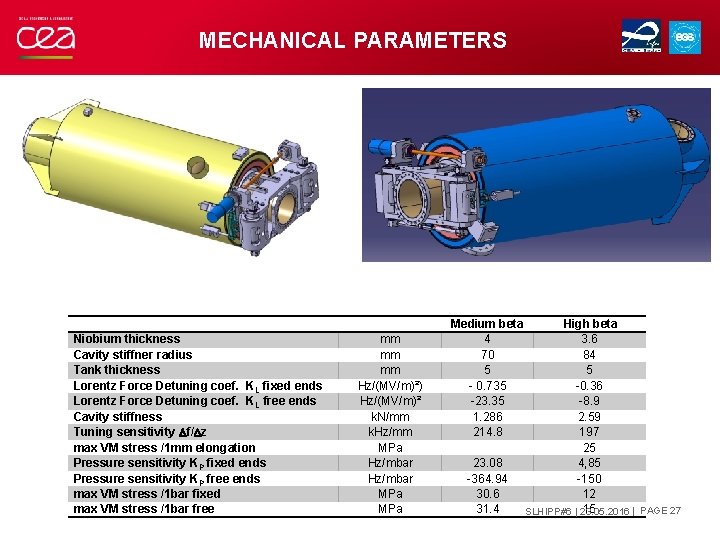
MECHANICAL PARAMETERS Niobium thickness Cavity stiffner radius Tank thickness Lorentz Force Detuning coef. K L fixed ends Lorentz Force Detuning coef. K L free ends Cavity stiffness Tuning sensitivity Df/Dz max VM stress /1 mm elongation Pressure sensitivity KP fixed ends Pressure sensitivity KP free ends max VM stress /1 bar fixed max VM stress /1 bar free mm mm mm Hz/(MV/m)²) Hz/(MV/m)² k. N/mm k. Hz/mm MPa Hz/mbar MPa Medium beta 4 70 5 - 0. 735 -23. 35 1. 286 214. 8 23. 08 -364. 94 30. 6 31. 4 High beta 3. 6 84 5 -0. 36 -8. 9 2. 59 197 25 4, 85 -150 12 15 | PAGE 27 SLHIPP#6 | 23. 05. 2016
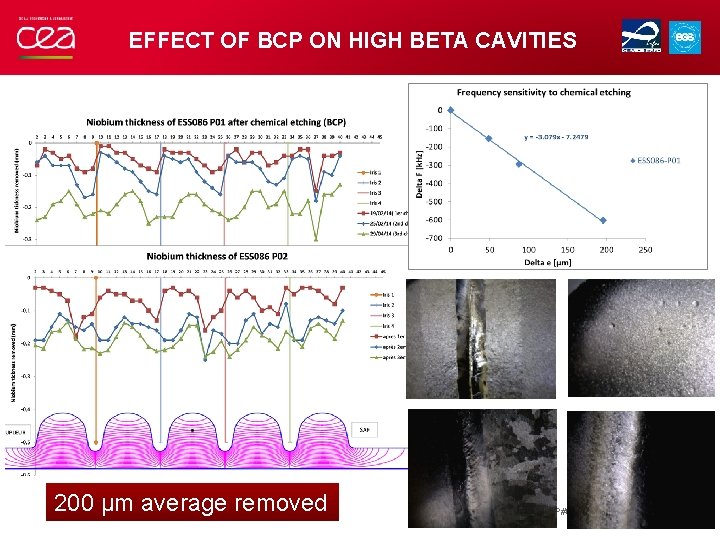
EFFECT OF BCP ON HIGH BETA CAVITIES 200 µm average removed SLHIPP#6 | 23. 05. 2016 | PAGE 28
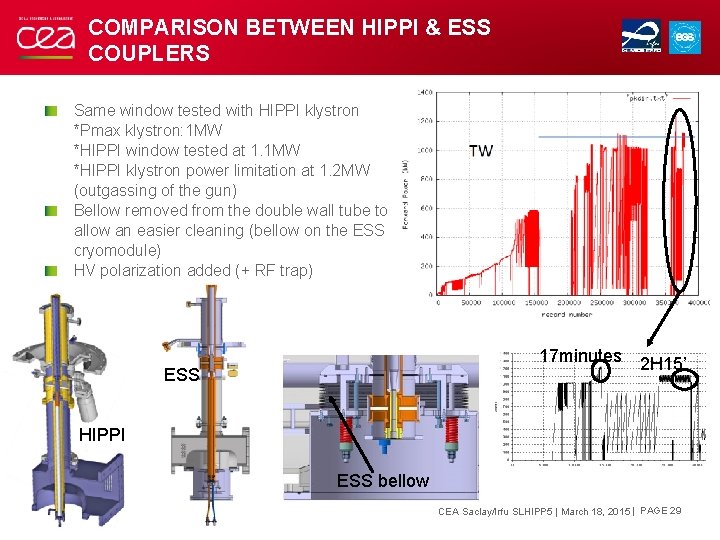
COMPARISON BETWEEN HIPPI & ESS COUPLERS Same window tested with HIPPI klystron *Pmax klystron: 1 MW *HIPPI window tested at 1. 1 MW *HIPPI klystron power limitation at 1. 2 MW (outgassing of the gun) Bellow removed from the double wall tube to allow an easier cleaning (bellow on the ESS cryomodule) HV polarization added (+ RF trap) 17 minutes ESS 2 H 15’ HIPPI ESS bellow CEA Saclay/Irfu SLHIPP 5 | March 18, 2015 | PAGE 29