
ESS 454 Hydrogeology Module 4 Flow to Wells

- Slides: 13
ESS 454 Hydrogeology • • • Module 4 Flow to Wells Preliminaries, Radial Flow and Well Function Non-dimensional Variables, Theis “Type” curve, and Cooper-Jacob Analysis Aquifer boundaries, Recharge, Thiem equation Other “Type” curves Well Testing Last Comments Instructor: Michael Brown brown@ess. washington. edu
Learning Objectives • Recognize causes for departure of well drawdown data from the Theis “non -equilibrium” formula • Be able to explain why a pressure head is necessary to recover water from a confined aquifer • Be able to explain how recharge is enhanced by pumping • Be able to qualitatively show drawdown vs time deviates from Theis curves in the case of leakage, recharge and barrier boundaries • Be able to use diffusion time scaling to estimate the distance to an aquifer boundary • Understand how to use the Thiem equation to determine T for a confined aquifer or K for an unconfined aquifer • Understand what Specific Capacity is and how to determine it.
When Theis Assumptions Fail 1. Total head becomes equal to the elevation head • To pump, a confined aquifer must have pressure head • Cannot pump confined aquifer below elevation head • Pumping rate has to decrease 1. Aquifer ends at some distance from well • Water cannot continue to flow in from farther away • Drawdown has to increase faster and/or pumping rate has to decrease
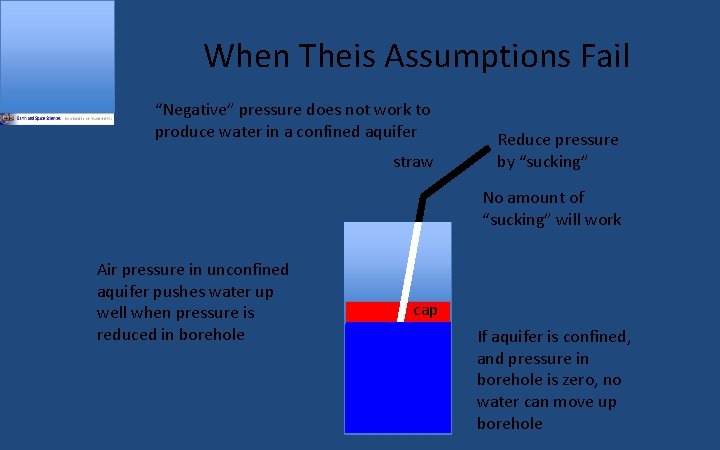
When Theis Assumptions Fail “Negative” pressure does not work to produce water in a confined aquifer straw Reduce pressure by “sucking” No amount of “sucking” will work Air pressure in unconfined aquifer pushes water up well when pressure is reduced in borehole cap If aquifer is confined, and pressure in borehole is zero, no water can move up borehole
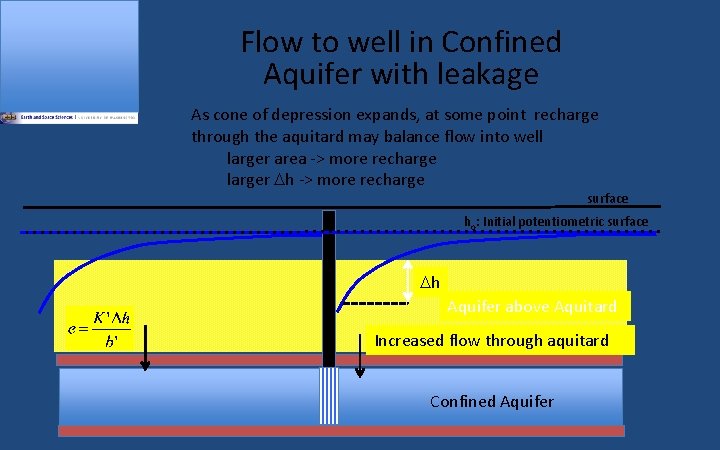
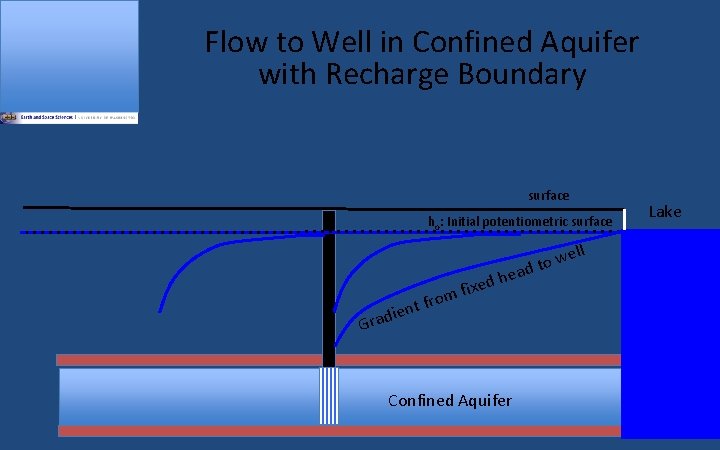
When Theis Assumptions Fail 3. Leakage through confining layer provides recharge • Decrease in aquifer head causes increase in Dh across aquitard ü Pumping enhances recharge ü When cone of depression is sufficiently large, recharge equals pumping rate 4. Cone of depression extends out to a fixed head source • Water flows from source to well
Flow to well in Confined Aquifer with leakage As cone of depression expands, at some point recharge through the aquitard may balance flow into well larger area -> more recharge larger Dh -> more recharge surface ho: Initial potentiometric surface Dh Aquifer above Aquitard Increased flow through aquitard Confined Aquifer
Flow to Well in Confined Aquifer with Recharge Boundary surface ho: Initial potentiometric surface ad ient d a r G fro he d e x i mf Confined Aquifer ll e w to Lake
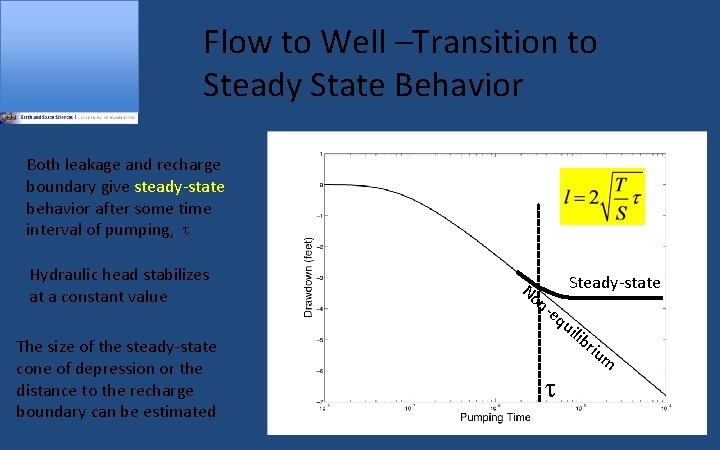
Flow to Well –Transition to Steady State Behavior Both leakage and recharge boundary give steady-state behavior after some time interval of pumping, t Hydraulic head stabilizes at a constant value The size of the steady-state cone of depression or the distance to the recharge boundary can be estimated No n- Steady-state eq t uil ibr ium
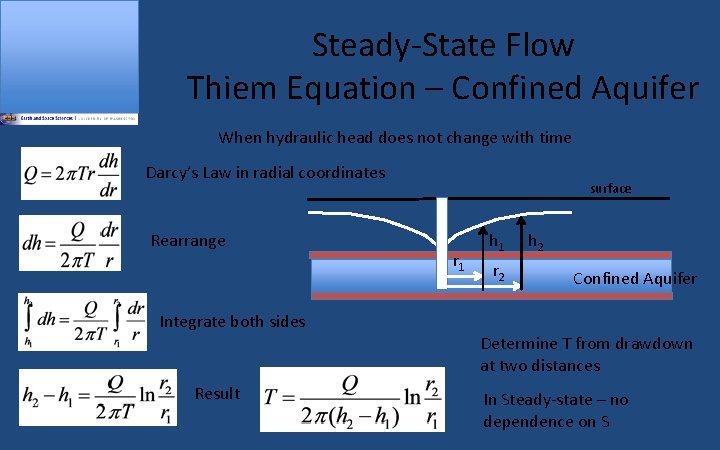
Steady-State Flow Thiem Equation – Confined Aquifer When hydraulic head does not change with time Darcy’s Law in radial coordinates Rearrange surface r 1 h 1 r 2 h 2 Confined Aquifer Integrate both sides Determine T from drawdown at two distances Result In Steady-state – no dependence on S
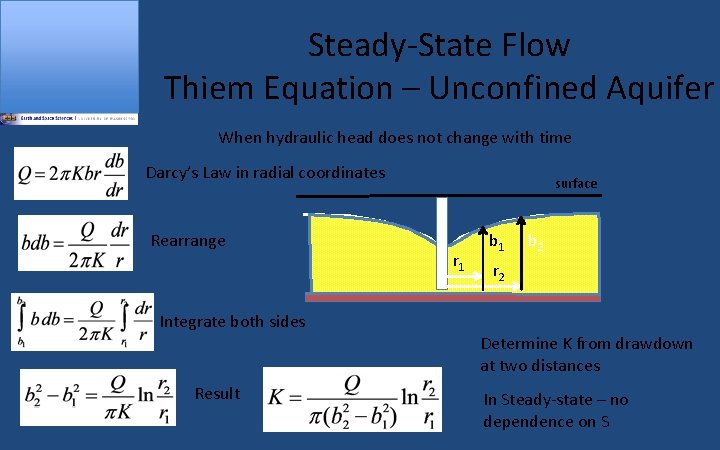
Steady-State Flow Thiem Equation – Unconfined Aquifer When hydraulic head does not change with time Darcy’s Law in radial coordinates Rearrange surface r 1 b 2 r 2 Integrate both sides Determine K from drawdown at two distances Result In Steady-state – no dependence on S
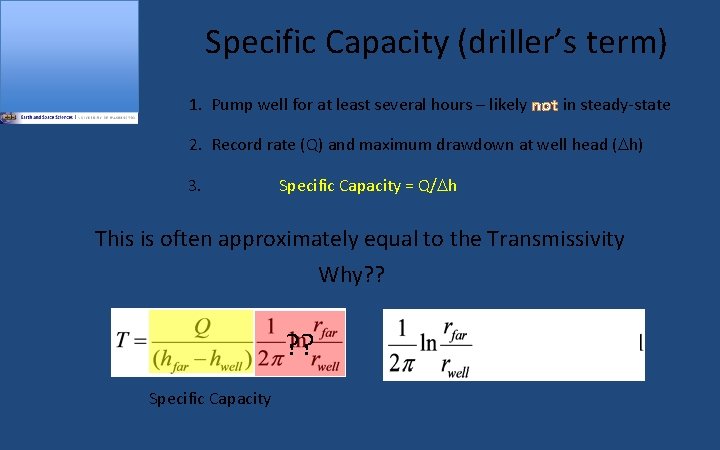
Specific Capacity (driller’s term) 1. Pump well for at least several hours – likely not in steady-state 2. Record rate (Q) and maximum drawdown at well head (Dh) 3. Specific Capacity = Q/Dh This is often approximately equal to the Transmissivity Why? ? Specific Capacity
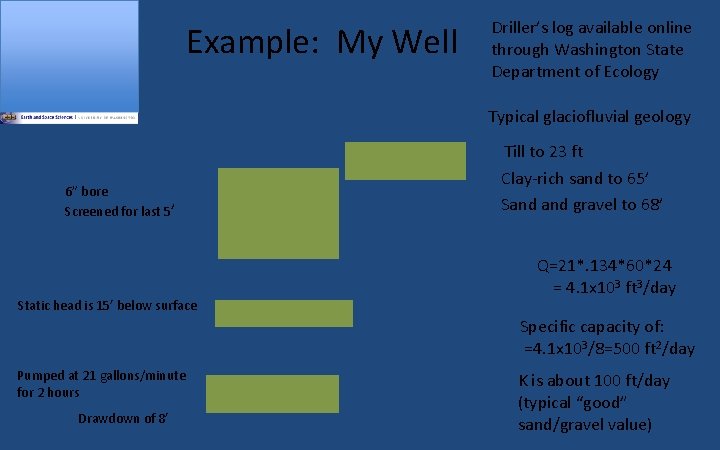
Example: My Well Driller’s log available online through Washington State Department of Ecology Typical glaciofluvial geology 6” bore Screened for last 5’ Static head is 15’ below surface Till to 23 ft Clay-rich sand to 65’ Sand gravel to 68’ Q=21*. 134*60*24 = 4. 1 x 103 ft 3/day Specific capacity of: =4. 1 x 10³/8=500 ft 2/day Pumped at 21 gallons/minute for 2 hours Drawdown of 8’ K is about 100 ft/day (typical “good” sand/gravel value)
The End: Breakdown of Theis assumptions and steady-state behavior Coming up: Other “Type” curves