
ESR 15 OnBoard Computer and Camera for Space
ESR 15 On-Board Computer and Camera for Space Applications A. Coronetti 1, F. Manni 2, J. Mekki 2, D. Dangla 2, C. Virmontois 2, N. Kerboub 1, R. Garcia Alia 1 1 CERN, 2 CNES, 1211 Geneva, Switzerland 31400 Toulouse Cedex, France RADSAGA System Level Test Review November 13 th, 2019 RADSAGA is a project funded by the European Union’s Horizon 2020 research and innovation programme under the MSC agreement no. 721624.
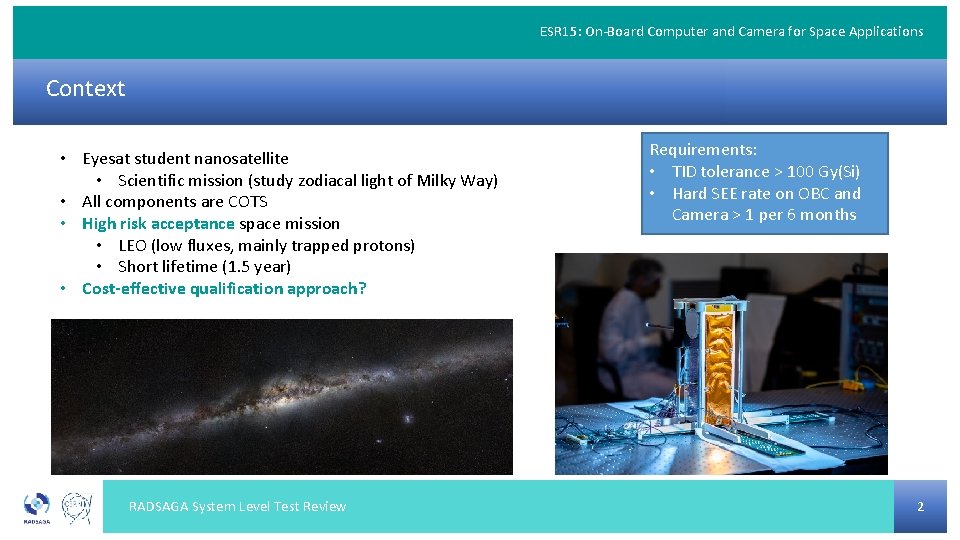
ESR 15: On-Board Computer and Camera for Space Applications Context • Eyesat student nanosatellite • Scientific mission (study zodiacal light of Milky Way) • All components are COTS • High risk acceptance space mission • LEO (low fluxes, mainly trapped protons) • Short lifetime (1. 5 year) • Cost-effective qualification approach? RADSAGA System Level Test Review Requirements: • TID tolerance > 100 Gy(Si) • Hard SEE rate on OBC and Camera > 1 per 6 months 2
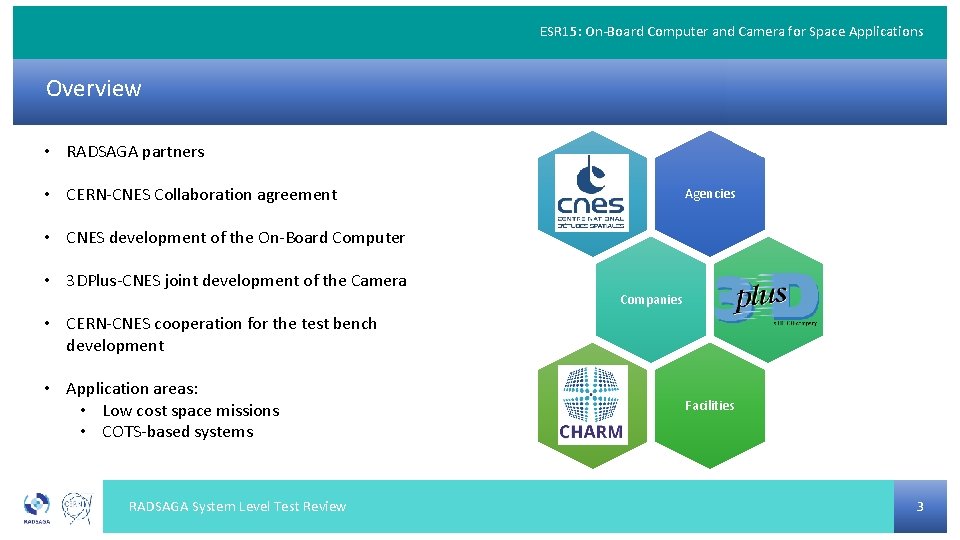
ESR 15: On-Board Computer and Camera for Space Applications Overview • RADSAGA partners • CERN-CNES Collaboration agreement Agencies • CNES development of the On-Board Computer • 3 DPlus-CNES joint development of the Camera Companies • CERN-CNES cooperation for the test bench development • Application areas: • Low cost space missions • COTS-based systems RADSAGA System Level Test Review Facilities 3
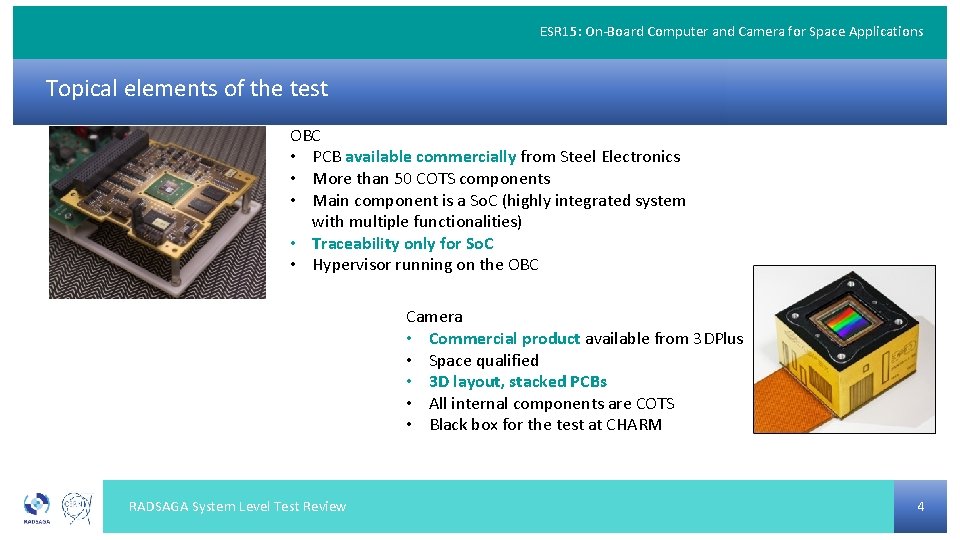
ESR 15: On-Board Computer and Camera for Space Applications Topical elements of the test OBC • PCB available commercially from Steel Electronics • More than 50 COTS components • Main component is a So. C (highly integrated system with multiple functionalities) • Traceability only for So. C • Hypervisor running on the OBC Camera • Commercial product available from 3 DPlus • Space qualified • 3 D layout, stacked PCBs • All internal components are COTS • Black box for the test at CHARM RADSAGA System Level Test Review 4

ESR 15: On-Board Computer and Camera for Space Applications Link to Existing Standards Zynq 7000 So. C • SEL free up to 60 Me. V. cm 2/mg CMOS Camera • SEL cross section Experiments performed independently by CNES SEE Heavy ions TID Co-60 SEE Protons No standard proton testing RADSAGA System Level Test Review Zynq 7000 So. C • Dose level device is not functional anymore CMOS Camera • Functional at 500 Gy(Si) • Dark current measurements • • Other components on the PCB? Soft SEEs from the Zynq? Global functionality? HW/SW integration of OBC and payload? 5
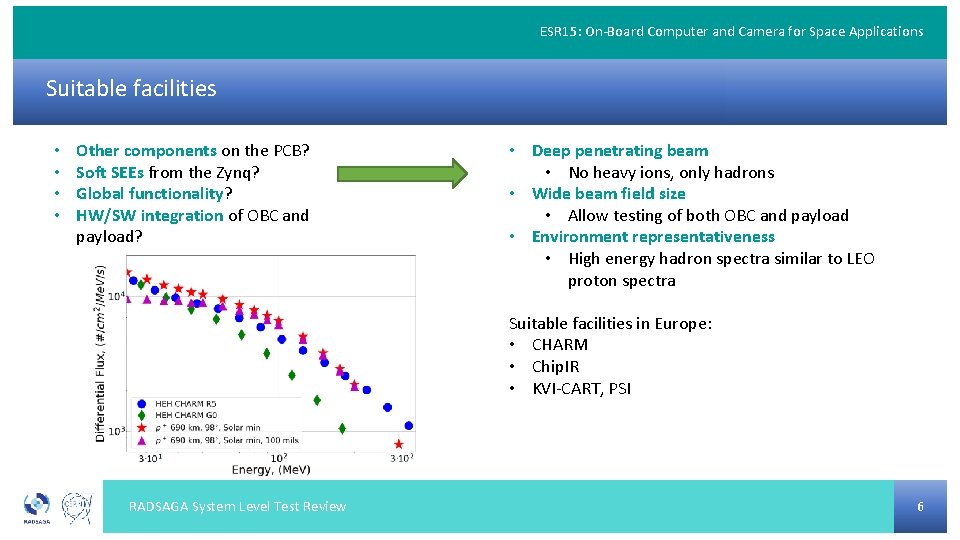
ESR 15: On-Board Computer and Camera for Space Applications Suitable facilities • • Other components on the PCB? Soft SEEs from the Zynq? Global functionality? HW/SW integration of OBC and payload? • Deep penetrating beam • No heavy ions, only hadrons • Wide beam field size • Allow testing of both OBC and payload • Environment representativeness • High energy hadron spectra similar to LEO proton spectra Suitable facilities in Europe: • CHARM • Chip. IR • KVI-CART, PSI RADSAGA System Level Test Review 6
ESR 15: On-Board Computer and Camera for Space Applications Component level standards shortcomings • Limitations in SEE standards for complex ICs/boards • SEL • Feasible if delidding is possible • SEU • Shall you test individually any subparts of a So. C/FPGA? • JEDEC standard and NASA guideline point out which elements shall be tested, however • Real applications make simultaneous use of a set of resources • Cross section varies with embedded software and firmware • Not easy to define all failure modes before a test • Common mode failures can be missed Example: • During the CHARM test large bunches of errors appeared simultaneously on different elements • Not SEU on the sub-components themselves • Errors due to a fault of the common GPIO port defined in the digital design • 40% of logged errors on the ECC protected BRAM, 12% of total OBC SEFI RADSAGA System Level Test Review 7

ESR 15: On-Board Computer and Camera for Space Applications Component level standards shortcomings • How to deal with 3 D Layout devices? • In general, no corresponding 2 D board is available • Traceability of internal components? • How to interpret and use information provided by the manufacturer? • The Camera datasheet reports that the device is SEL-free up to 60 Me. V. cm 2/mg • During system level test at CHARM Camera configuration resets were observed • Heavy ion test demonstrated SEL sensitivity down to 11 Me. V. cm 2/mg • Camera is equipped by the manufacturer with anti-latchup system • No HW damage • But no mitigation at SW level in the OBC • To acknowledge SEL happened • To react and increase payload availability RADSAGA System Level Test Review 8
ESR 15: On-Board Computer and Camera for Space Applications System level testing: What to look for • Potential destructive events at board level (SEL) • Detectable and with protection function • No SEL observed • TID performance degradation • Telemetry of the Zynq (not affected during the test) • Unmonitored for other elements • SEFI on OBC and rate prediction for mission • Cause of error identifiable by logging of the hypervisor • Processor crash vs. FPGA fault • Different self-recovery techniques tested • Power cycling • SW reset on the FPGA • SW reset on the partition RADSAGA System Level Test Review 9
ESR 15: On-Board Computer and Camera for Space Applications System level testing: What to look for • System run with all mitigations used for the final application • Ability to perform self-recovery • Satisfactory • Full functionality recovered in less than 10 seconds • Rate for orbit (once every 2. 5 years) is compatible with the mission • Rare deadlocks on SW reset (1 every 100 reboots) • Ability to recognize permanent data corruption • Not very satisfactory • All corrupted sequences ended in reboots • But mean time to reboot was 60 minutes in a strong flux environment • Data may remain corrupted longer in milder flux environment (e. g. 150 minutes to reboot in G 0) • Data logging with raw data RADSAGA System Level Test Review 10
ESR 15: On-Board Computer and Camera for Space Applications System level testing: What to look for • Coupling of sophisticated devices • Use of flight software on the OBC to run the Camera • OBC controlling the Camera with the flight software embedded • Communication protocol run through spacewire • SEL of the camera are mitigated at HW level by internal anti-latchup (no damage on camera) • But they were not mitigated at SW level in the OBC • 44% unavailability of the camera during the test • OBC disrupting Camera operations • Picture data corruption • Data stored in Camera and OBC memories RADSAGA System Level Test Review 11
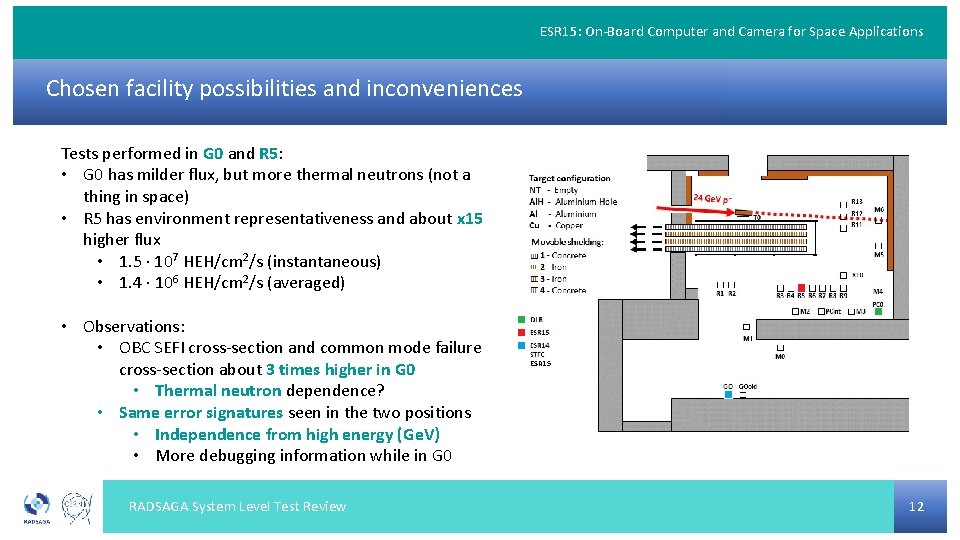
ESR 15: On-Board Computer and Camera for Space Applications Chosen facility possibilities and inconveniences Tests performed in G 0 and R 5: • G 0 has milder flux, but more thermal neutrons (not a thing in space) • R 5 has environment representativeness and about x 15 higher flux • 1. 5 · 107 HEH/cm 2/s (instantaneous) • 1. 4 · 106 HEH/cm 2/s (averaged) • Observations: • OBC SEFI cross-section and common mode failure cross-section about 3 times higher in G 0 • Thermal neutron dependence? • Same error signatures seen in the two positions • Independence from high energy (Ge. V) • More debugging information while in G 0 RADSAGA System Level Test Review ESR 15 12
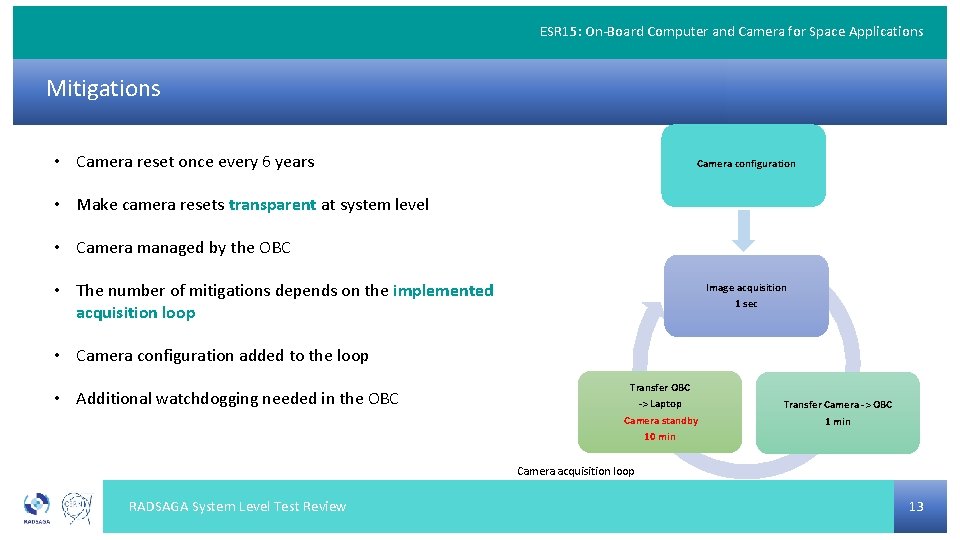
ESR 15: On-Board Computer and Camera for Space Applications Mitigations • Camera reset once every 6 years Camera configuration • Make camera resets transparent at system level • Camera managed by the OBC • The number of mitigations depends on the implemented acquisition loop Image acquisition 1 sec • Camera configuration added to the loop • Additional watchdogging needed in the OBC Transfer OBC -> Laptop Camera standby 10 min Transfer Camera -> OBC 1 min Camera acquisition loop RADSAGA System Level Test Review 13
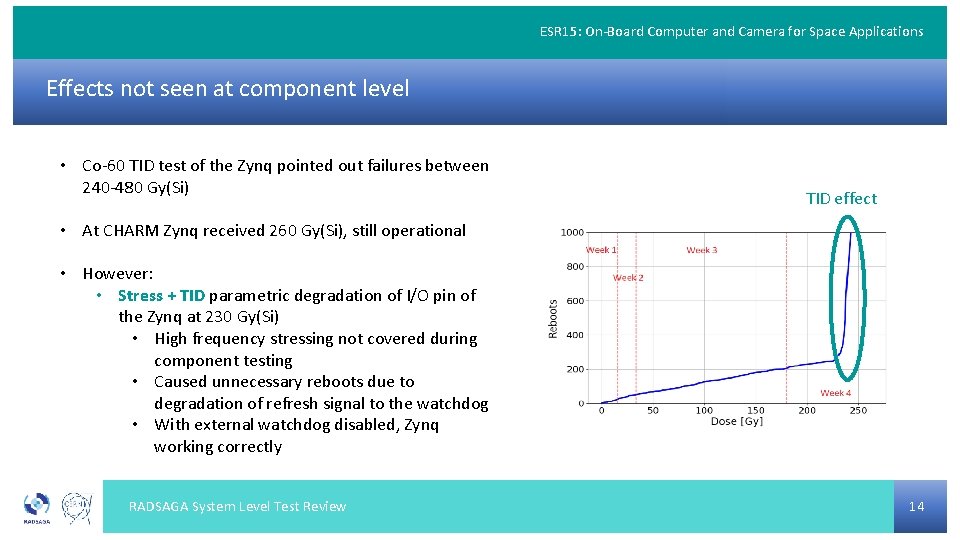
ESR 15: On-Board Computer and Camera for Space Applications Effects not seen at component level • Co-60 TID test of the Zynq pointed out failures between 240 -480 Gy(Si) TID effect • At CHARM Zynq received 260 Gy(Si), still operational • However: • Stress + TID parametric degradation of I/O pin of the Zynq at 230 Gy(Si) • High frequency stressing not covered during component testing • Caused unnecessary reboots due to degradation of refresh signal to the watchdog • With external watchdog disabled, Zynq working correctly RADSAGA System Level Test Review 14
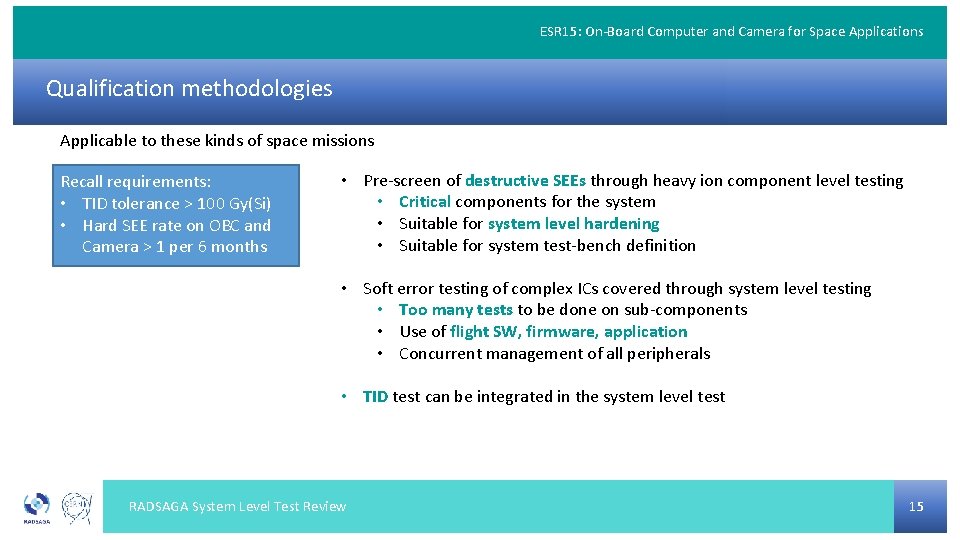
ESR 15: On-Board Computer and Camera for Space Applications Qualification methodologies Applicable to these kinds of space missions Recall requirements: • TID tolerance > 100 Gy(Si) • Hard SEE rate on OBC and Camera > 1 per 6 months • Pre-screen of destructive SEEs through heavy ion component level testing • Critical components for the system • Suitable for system level hardening • Suitable for system test-bench definition • Soft error testing of complex ICs covered through system level testing • Too many tests to be done on sub-components • Use of flight SW, firmware, application • Concurrent management of all peripherals • TID test can be integrated in the system level test RADSAGA System Level Test Review 15
ESR 15 On-Board Computer and Camera for Space Applications A. Coronetti 1, F. Manni 2, J. Mekki 2, D. Dangla 2, C. Virmontois 2, N. Kerboub 1, R. Garcia Alia 1 1 CERN, 2 CNES, 1211 Geneva, Switzerland 31400 Toulouse Cedex, France RADSAGA System Level Test Review November 13 th, 2019 RADSAGA is a project funded by the European Union’s Horizon 2020 research and innovation programme under the MSC agreement no. 721624.
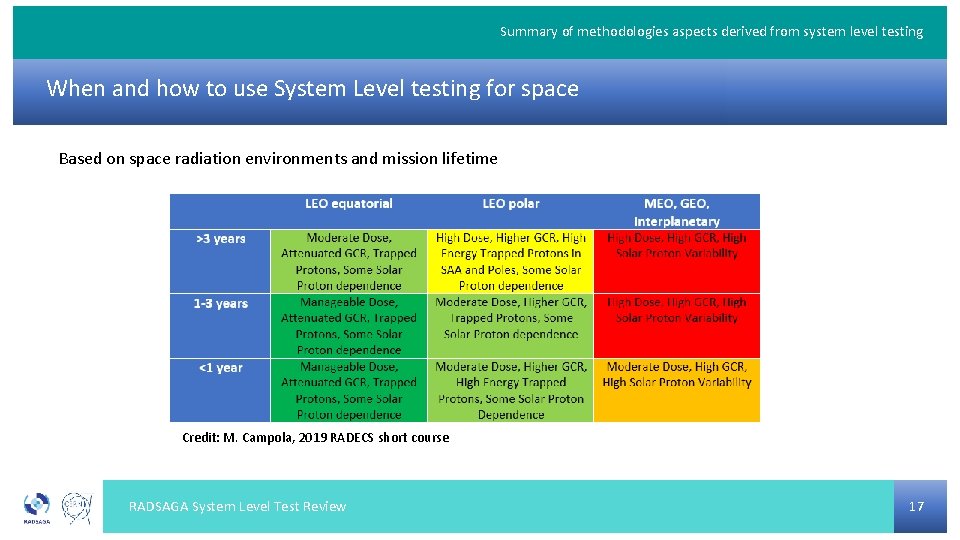
Summary of methodologies aspects derived from system level testing When and how to use System Level testing for space Based on space radiation environments and mission lifetime Credit: M. Campola, 2019 RADECS short course RADSAGA System Level Test Review 17
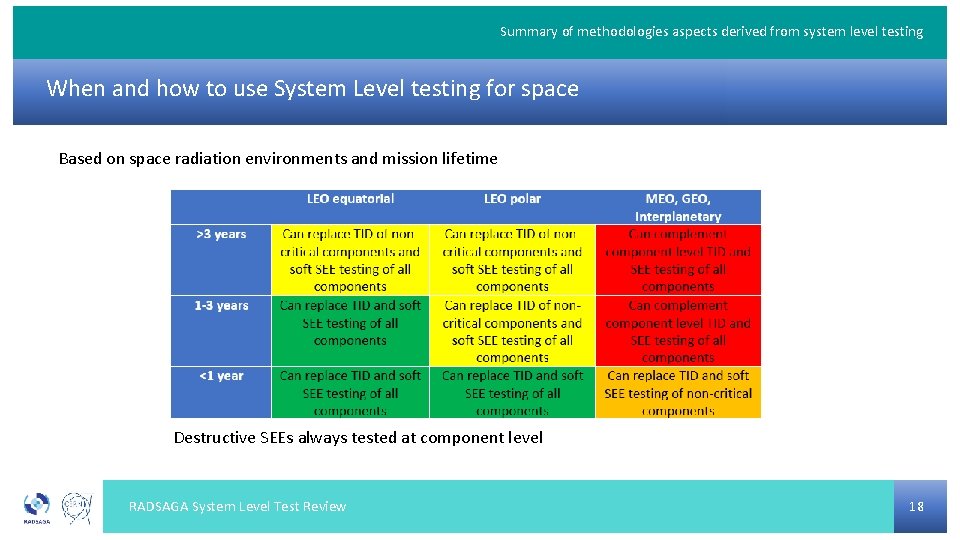
Summary of methodologies aspects derived from system level testing When and how to use System Level testing for space Based on space radiation environments and mission lifetime Destructive SEEs always tested at component level RADSAGA System Level Test Review 18
- Slides: 18