
Espaol Clase 3 Libro de estudios Nombre Colegio
Español Clase 3 Libro de estudios Nombre: …………………… Colegio: …………………… © Rha
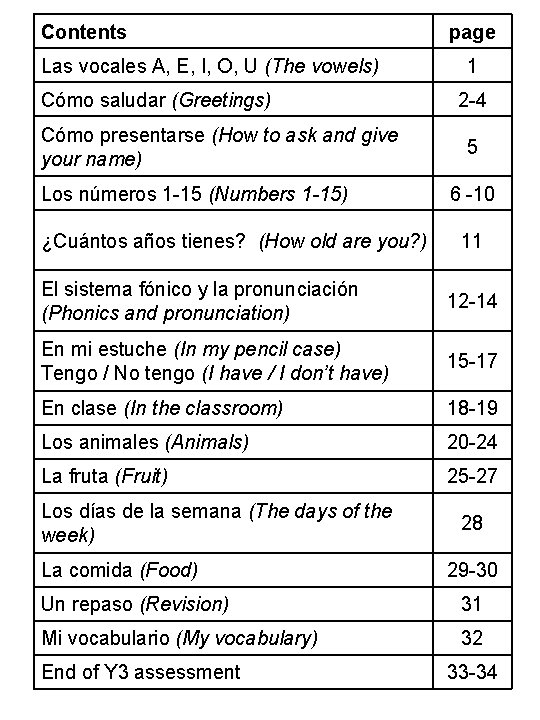
Contents Las vocales A, E, I, O, U (The vowels) Cómo saludar (Greetings) Cómo presentarse (How to ask and give your name) Los números 1 -15 (Numbers 1 -15) ¿Cuántos años tienes? (How old are you? ) page 1 2 -4 5 6 -10 11 El sistema fónico y la pronunciación (Phonics and pronunciation) 12 -14 En mi estuche (In my pencil case) Tengo / No tengo (I have / I don’t have) 15 -17 En clase (In the classroom) 18 -19 Los animales (Animals) 20 -24 La fruta (Fruit) 25 -27 Los días de la semana (The days of the week) La comida (Food) 28 29 -30 Un repaso (Revision) 31 Mi vocabulario (My vocabulary) 32 End of Y 3 assessment 33 -34
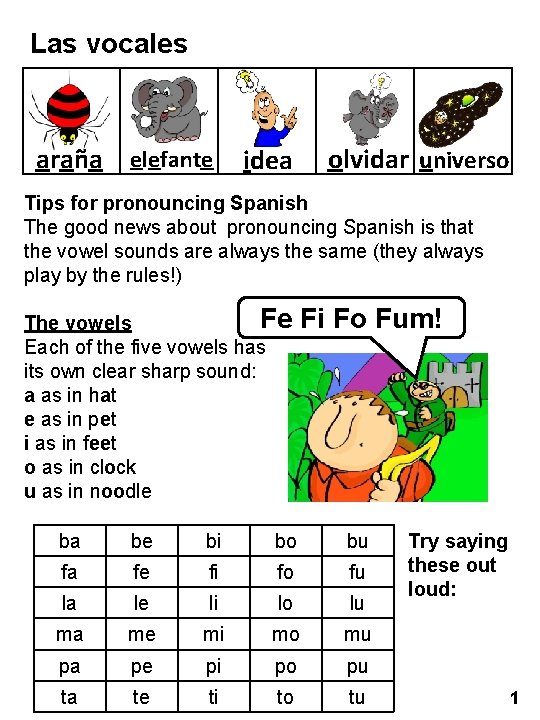
Las vocales araña elefante idea olvidar universo Tips for pronouncing Spanish The good news about pronouncing Spanish is that the vowel sounds are always the same (they always play by the rules!) Fe The vowels Each of the five vowels has its own clear sharp sound: a as in hat e as in pet i as in feet o as in clock u as in noodle Fi Fo Fum! ba be bi bo bu fa fe fi fo fu la le li lo lu ma me mi mo mu pa pe pi po pu ta te ti to tu Try saying these out loud: 1
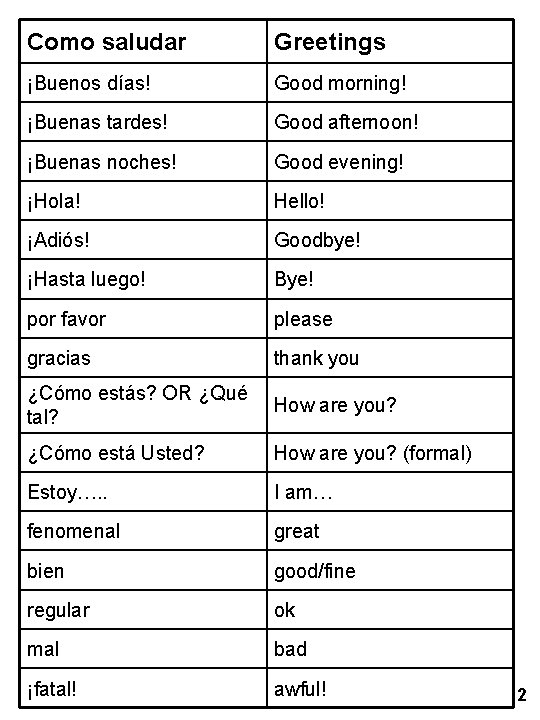
Como saludar Greetings ¡Buenos días! Good morning! ¡Buenas tardes! Good afternoon! ¡Buenas noches! Good evening! ¡Hola! Hello! ¡Adiós! Goodbye! ¡Hasta luego! Bye! por favor please gracias thank you ¿Cómo estás? OR ¿Qué tal? How are you? ¿Cómo está Usted? How are you? (formal) Estoy…. . I am… fenomenal great bien good/fine regular ok mal bad ¡fatal! awful! 2
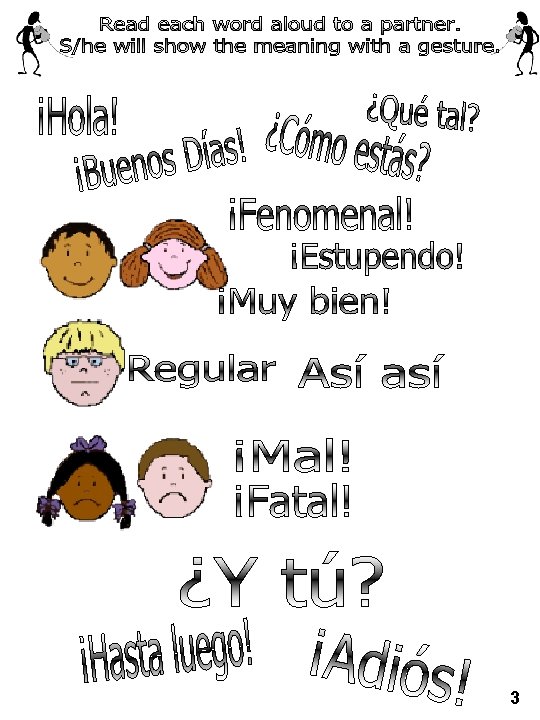
3
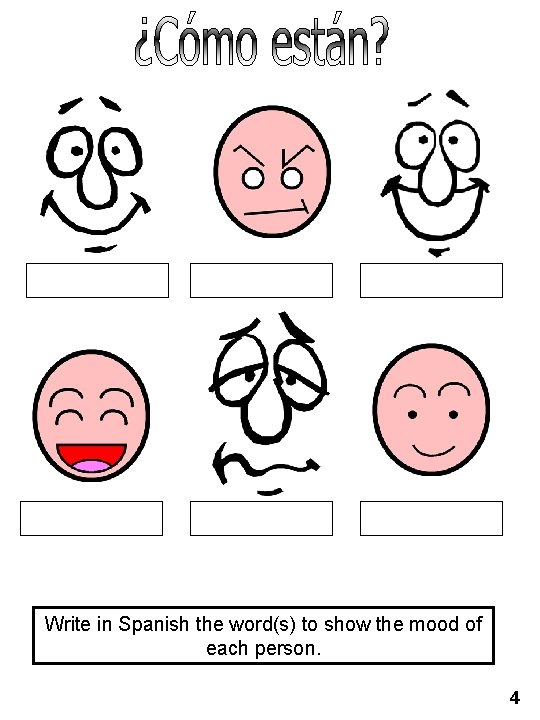
Write in Spanish the word(s) to show the mood of each person. 4
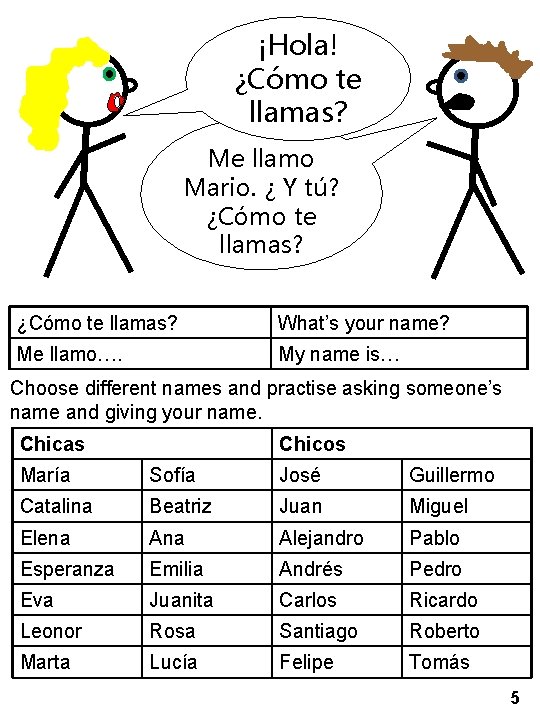
¡Hola! ¿Cómo te llamas? Me llamo Mario. ¿ Y tú? ¿Cómo te llamas? What’s your name? Me llamo…. My name is… Choose different names and practise asking someone’s name and giving your name. Chicas Chicos María Sofía José Guillermo Catalina Beatriz Juan Miguel Elena Alejandro Pablo Esperanza Emilia Andrés Pedro Eva Juanita Carlos Ricardo Leonor Rosa Santiago Roberto Marta Lucía Felipe Tomás 5
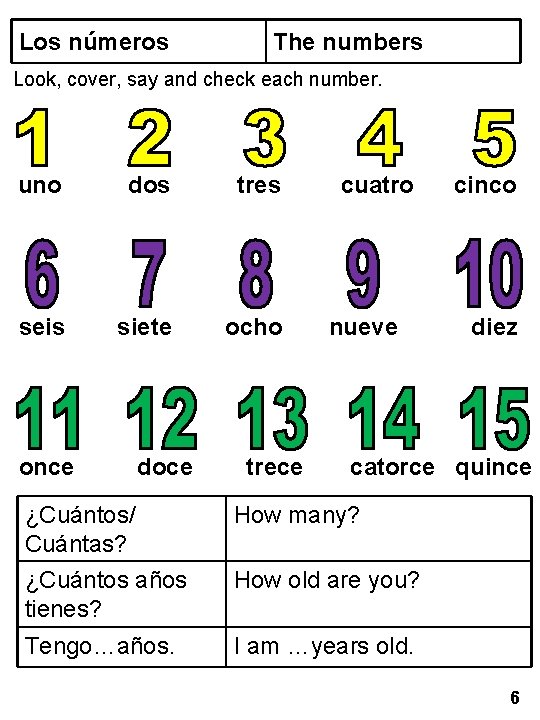
Los números The numbers Look, cover, say and check each number. uno dos tres seis siete ocho once doce trece cuatro nueve cinco diez catorce quince ¿Cuántos/ Cuántas? How many? ¿Cuántos años tienes? How old are you? Tengo…años. I am …years old. 6
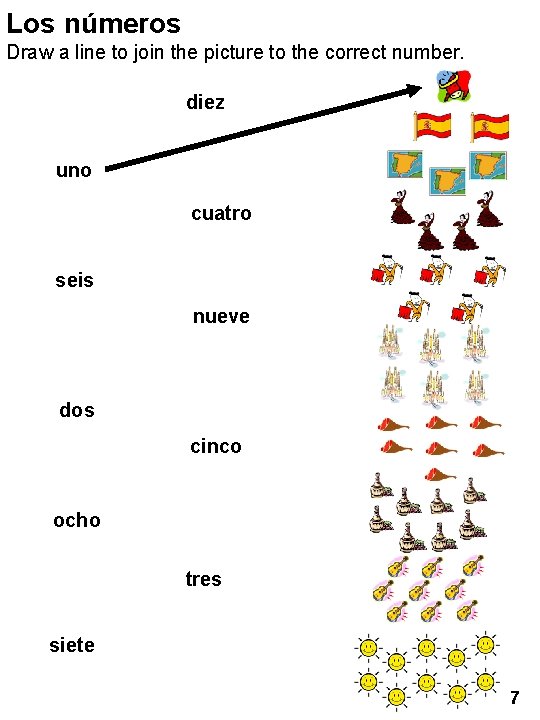
Los números Draw a line to join the picture to the correct number. diez uno cuatro seis nueve dos cinco ocho tres siete 7
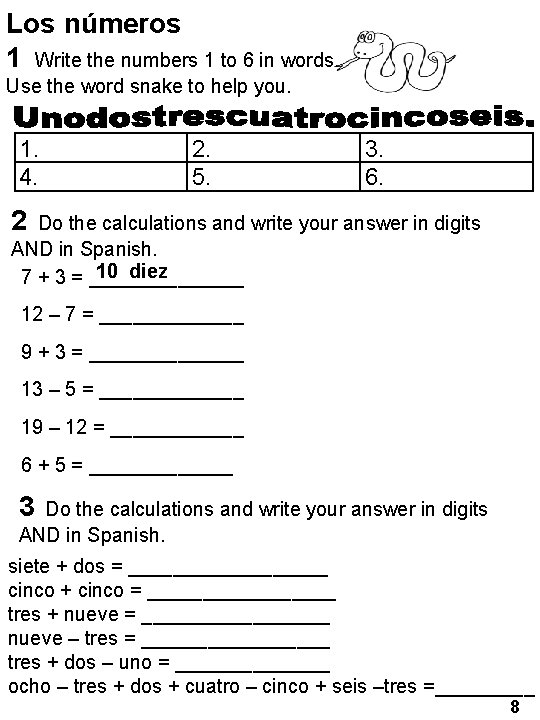
Los números 1 Write the numbers 1 to 6 in words. Use the word snake to help you. 1. 4. 2. 5. 3. 6. 2 Do the calculations and write your answer in digits AND in Spanish. 10 diez 7 + 3 = _______ 12 – 7 = _______ 9 + 3 = _______ 13 – 5 = _______ 19 – 12 = ______ 6 + 5 = _______ 3 Do the calculations and write your answer in digits AND in Spanish. siete + dos = _________ cinco + cinco = _________ tres + nueve = _________ nueve – tres = _________ tres + dos – uno = _______ ocho – tres + dos + cuatro – cinco + seis –tres =_____ 8
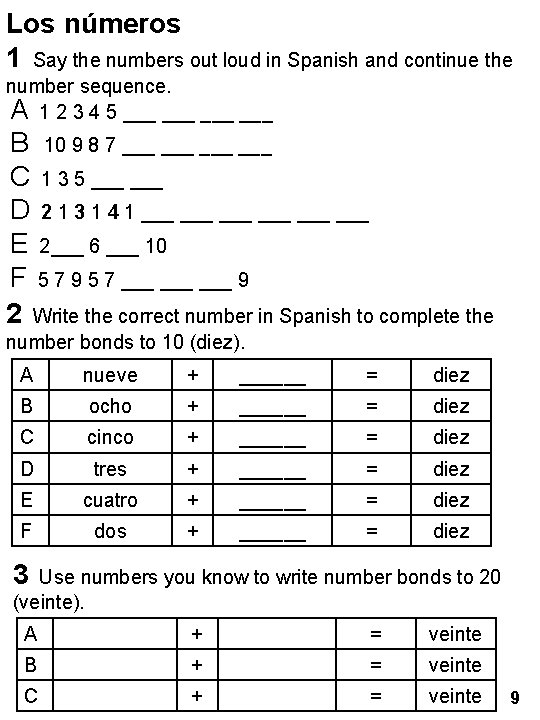
Los números 1 Say the numbers out loud in Spanish and continue the number sequence. A 1 2 3 4 5 ___ ___ B 10 9 8 7 ___ ___ C 1 3 5 ___ D 2 1 3 1 4 1 ___ ___ ___ E 2___ 6 ___ 10 F 5 7 9 5 7 ___ ___ 9 2 Write the correct number in Spanish to complete the number bonds to 10 (diez). A nueve + ______ = diez B ocho + ______ = diez C cinco + ______ = diez D tres + ______ = diez E cuatro + ______ = diez F dos + ______ = diez 3 Use numbers you know to write number bonds to 20 (veinte). A + = veinte B + = veinte C + = veinte 9
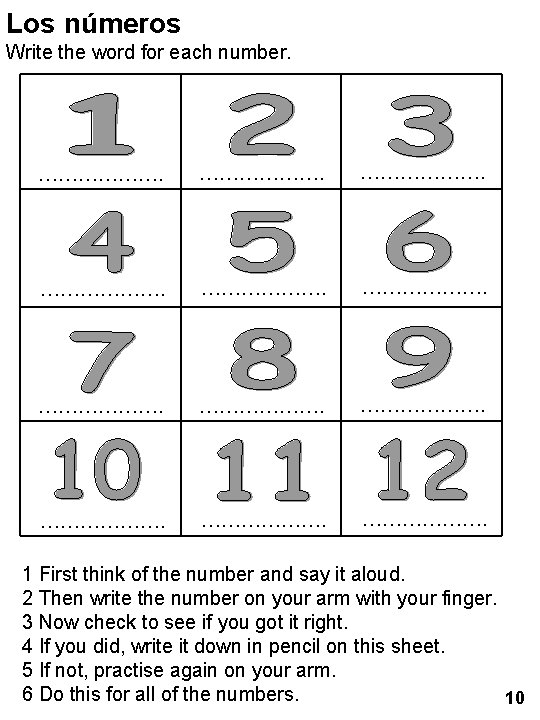
Los números Write the word for each number. ………………. 1 First think of the number and say it aloud. 2 Then write the number on your arm with your finger. 3 Now check to see if you got it right. 4 If you did, write it down in pencil on this sheet. 5 If not, practise again on your arm. 6 Do this for all of the numbers. 10
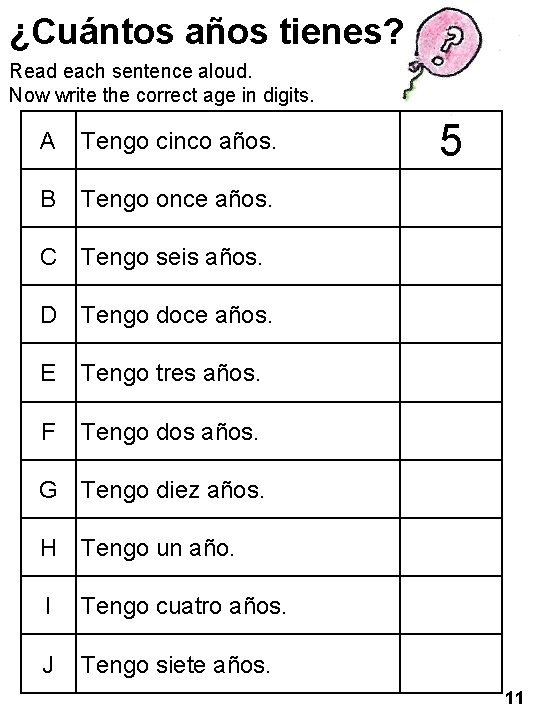
¿Cuántos años tienes? Read each sentence aloud. Now write the correct age in digits. A Tengo cinco años. 5 B Tengo once años. C Tengo seis años. D Tengo doce años. E Tengo tres años. F Tengo dos años. G Tengo diez años. H Tengo un año. I Tengo cuatro años. J Tengo siete años. 11
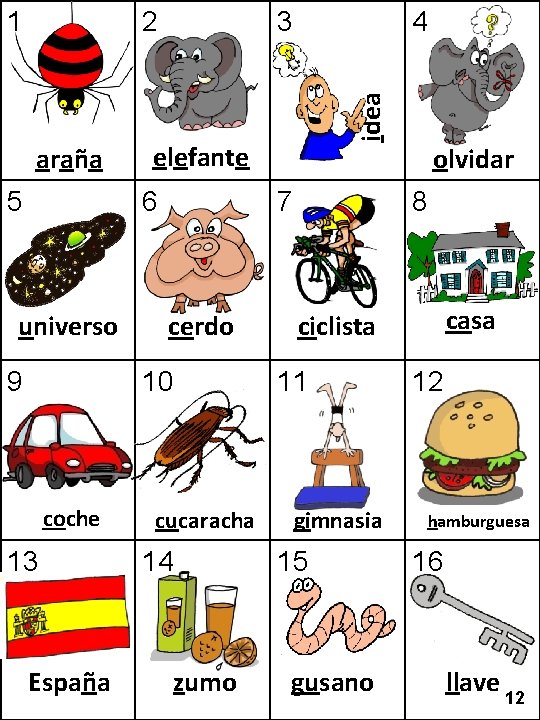
2 araña 5 3 elefante 6 universo 9 7 cerdo 10 coche 13 España 4 idea 1 cucaracha 14 zumo olvidar 8 casa ciclista 11 gimnasia 15 gusano 12 hamburguesa 16 llave 12
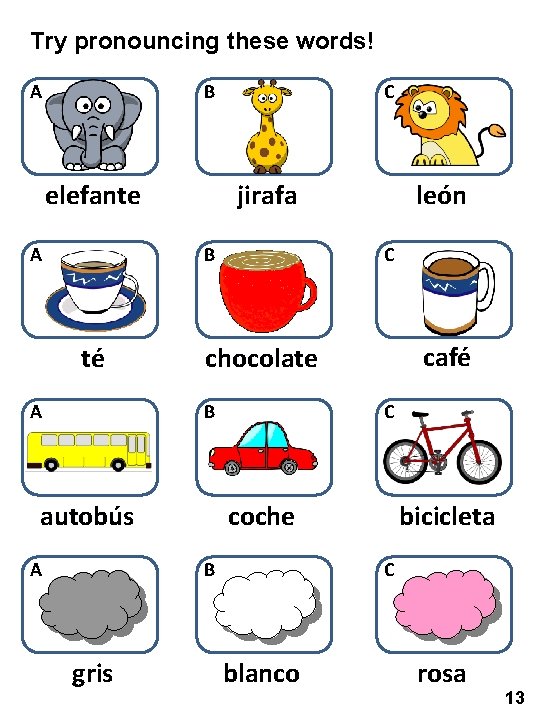
Try pronouncing these words! A B elefante A C jirafa B té A C autobús C coche B gris café chocolate B A león bicicleta C blanco rosa 13
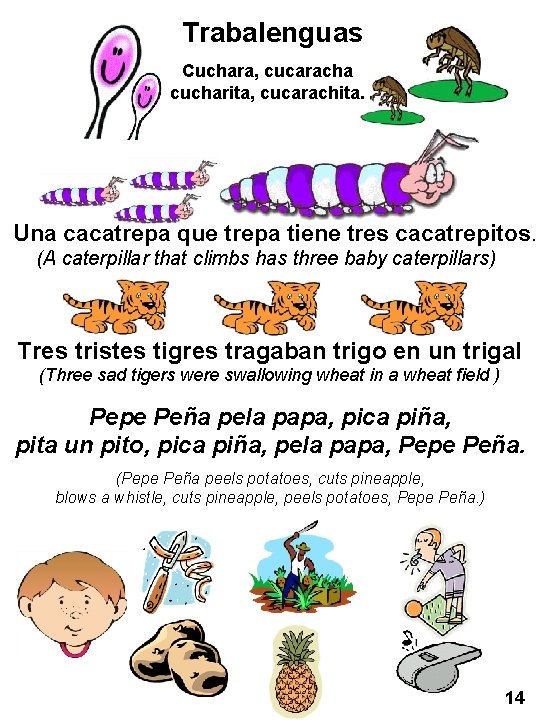
Trabalenguas Cuchara, cucaracha cucharita, cucarachita. Una cacatrepa que trepa tiene tres cacatrepitos. (A caterpillar that climbs has three baby caterpillars) Tres tristes tigres tragaban trigo en un trigal (Three sad tigers were swallowing wheat in a wheat field ) Pepe Peña pela papa, pica piña, pita un pito, pica piña, pela papa, Pepe Peña. (Pepe Peña peels potatoes, cuts pineapple, blows a whistle, cuts pineapple, peels potatoes, Pepe Peña. ) 14
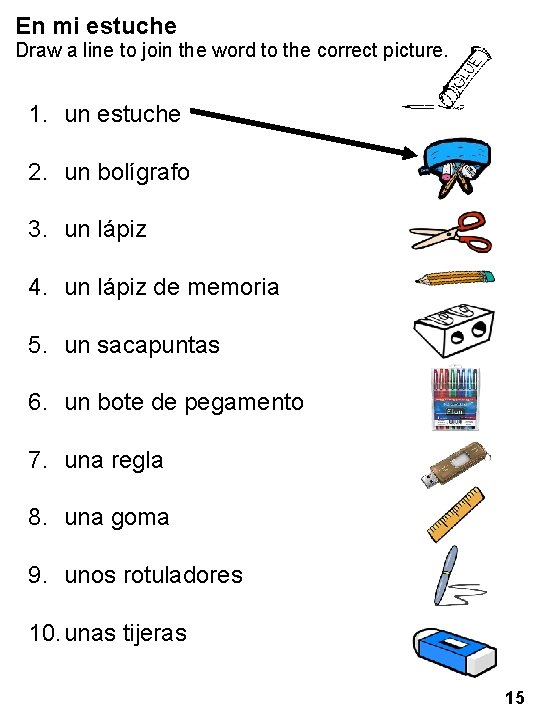
En mi estuche Draw a line to join the word to the correct picture. 1. un estuche 2. un bolígrafo 3. un lápiz 4. un lápiz de memoria 5. un sacapuntas 6. un bote de pegamento 7. una regla 8. una goma 9. unos rotuladores 10. unas tijeras 15
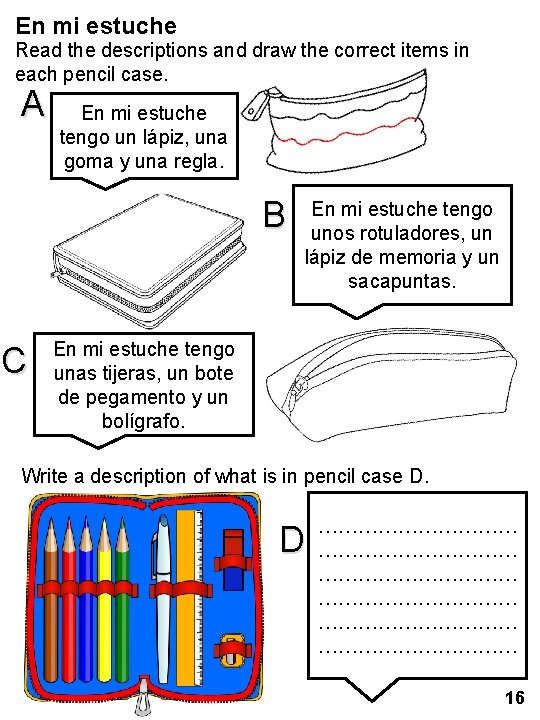
En mi estuche Read the descriptions and draw the correct items in each pencil case. A En mi estuche tengo un lápiz, una goma y una regla. B C En mi estuche tengo unos rotuladores, un lápiz de memoria y un sacapuntas. En mi estuche tengo unas tijeras, un bote de pegamento y un bolígrafo. Write a description of what is in pencil case D. D ………………………… ………………………… 16
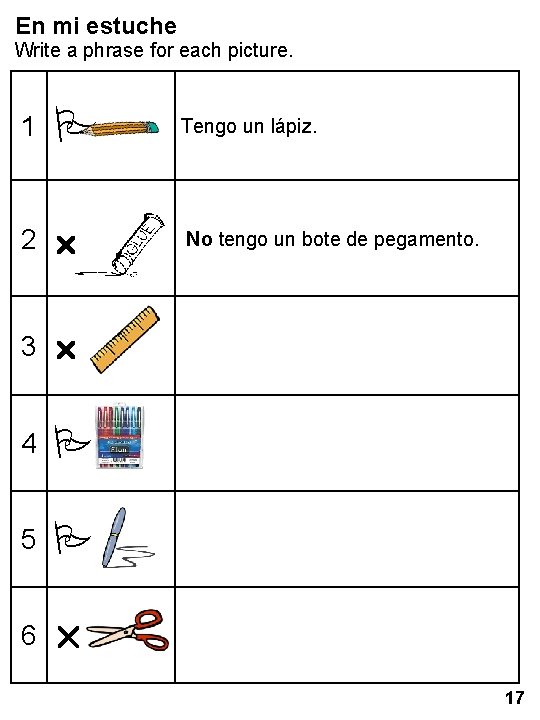
En mi estuche Write a phrase for each picture. 1 2 Tengo un lápiz. No tengo un bote de pegamento. 3 4 5 6 17
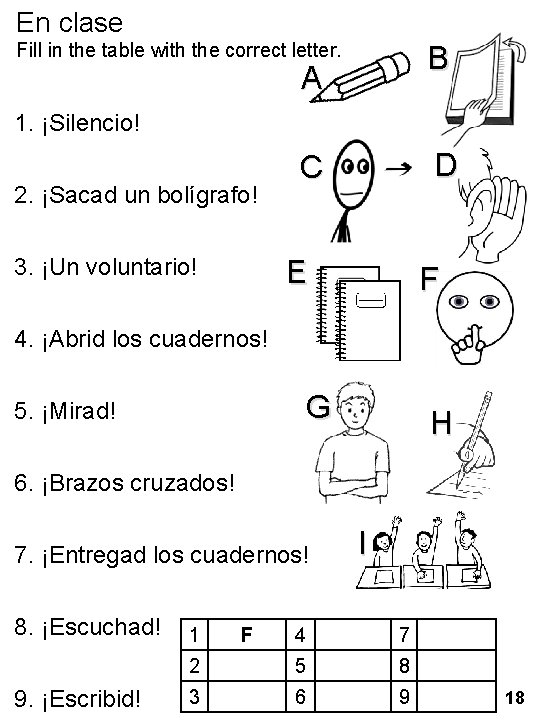
En clase Fill in the table with the correct letter. B A 1. ¡Silencio! 2. ¡Sacad un bolígrafo! 3. ¡Un voluntario! D C E F 4. ¡Abrid los cuadernos! G 5. ¡Mirad! H 6. ¡Brazos cruzados! 7. ¡Entregad los cuadernos! 8. ¡Escuchad! 9. ¡Escribid! 1 F I 4 7 2 5 8 3 6 9 18
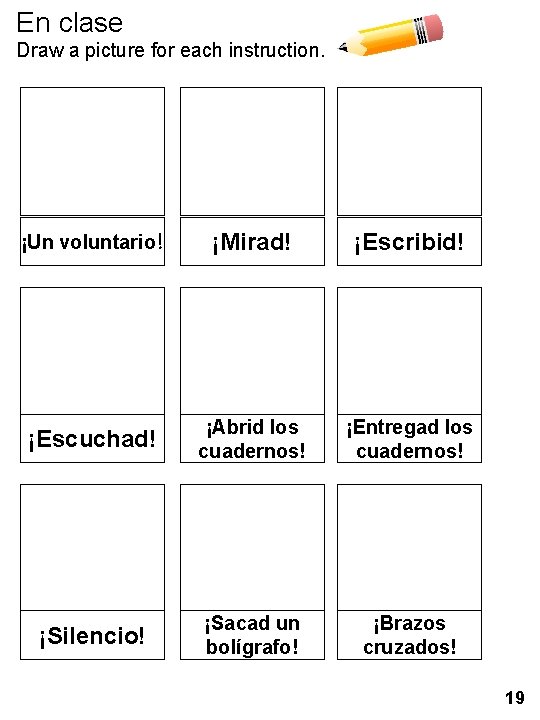
En clase Draw a picture for each instruction. ¡Un voluntario! ¡Mirad! ¡Escribid! ¡Escuchad! ¡Abrid los cuadernos! ¡Entregad los cuadernos! ¡Silencio! ¡Sacad un bolígrafo! ¡Brazos cruzados! 19
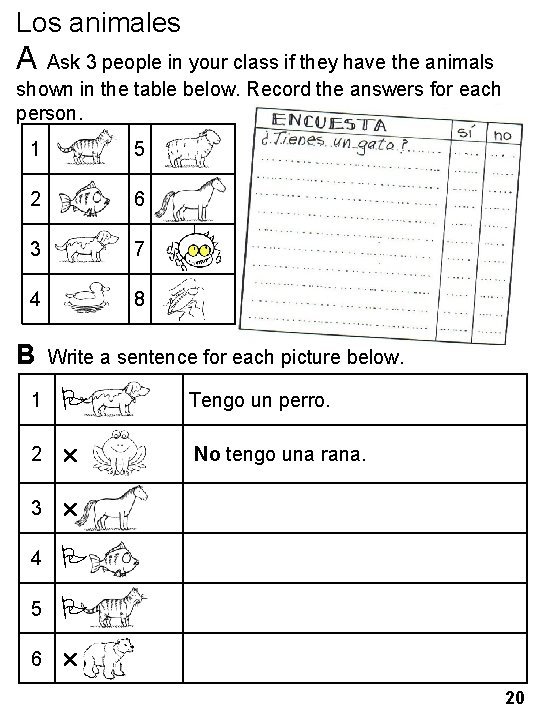
Los animales A Ask 3 people in your class if they have the animals shown in the table below. Record the answers for each person. 1 5 2 6 3 7 4 8 B Write a sentence for each picture below. 1 Tengo un perro. 2 No tengo una rana. 3 4 5 6 20
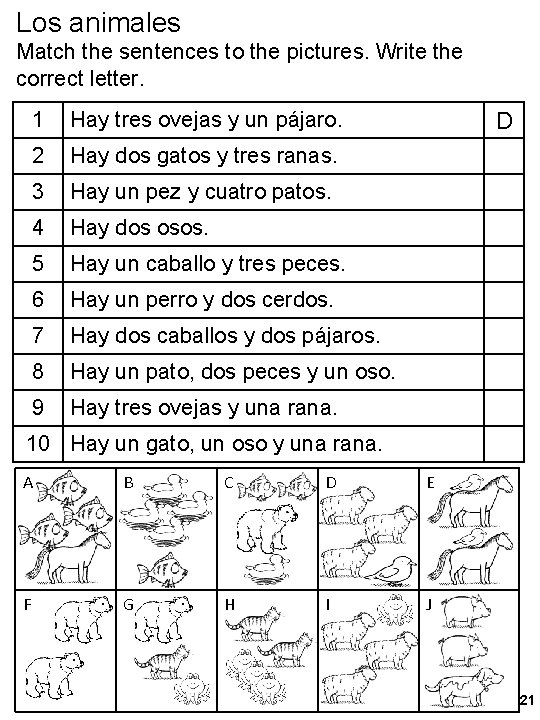
Los animales Match the sentences to the pictures. Write the correct letter. 1 Hay tres ovejas y un pájaro. 2 Hay dos gatos y tres ranas. 3 Hay un pez y cuatro patos. 4 Hay dos osos. 5 Hay un caballo y tres peces. 6 Hay un perro y dos cerdos. 7 Hay dos caballos y dos pájaros. 8 Hay un pato, dos peces y un oso. 9 Hay tres ovejas y una rana. D 10 Hay un gato, un oso y una rana. A B C D E F G H I J 21
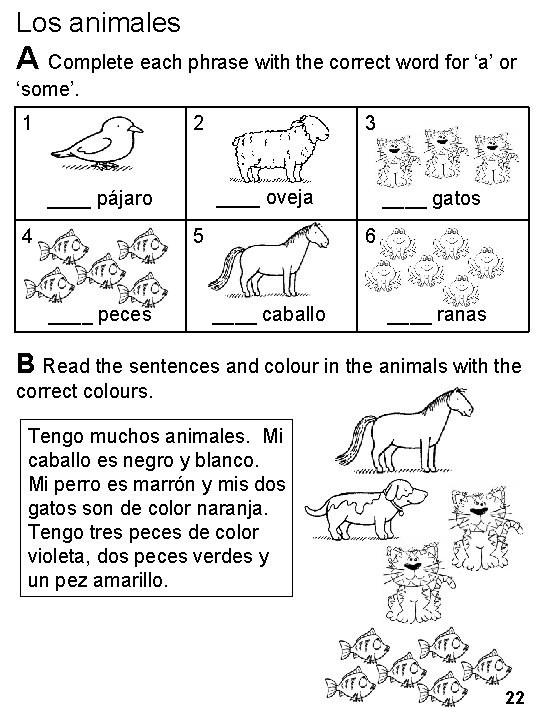
Los animales A Complete each phrase with the correct word for ‘a’ or ‘some’. 1 2 ____ oveja ____ pájaro 4 3 5 ____ peces ____ gatos 6 ____ caballo ____ ranas B Read the sentences and colour in the animals with the correct colours. Tengo muchos animales. Mi caballo es negro y blanco. Mi perro es marrón y mis dos gatos son de color naranja. Tengo tres peces de color violeta, dos peces verdes y un pez amarillo. 22
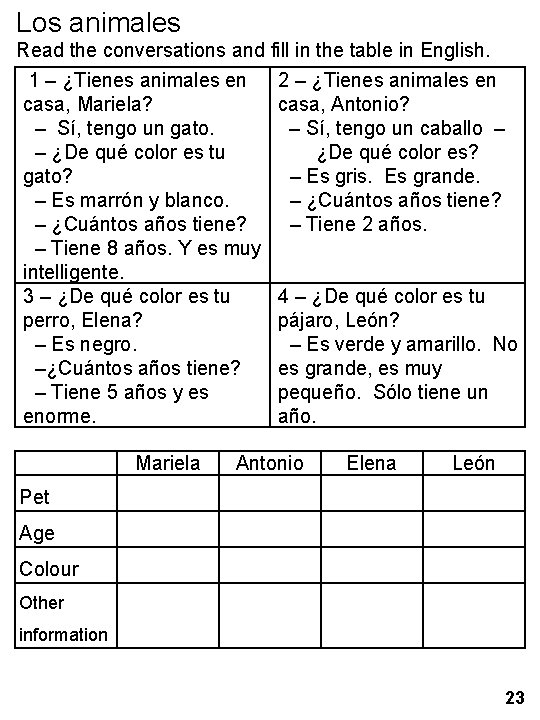
Los animales Read the conversations and fill in the table in English. 1 – ¿Tienes animales en 2 – ¿Tienes animales en casa, Mariela? casa, Antonio? – Sí, tengo un gato. – Sí, tengo un caballo – – ¿De qué color es tu ¿De qué color es? gato? – Es gris. Es grande. – Es marrón y blanco. – ¿Cuántos años tiene? – Tiene 2 años. – Tiene 8 años. Y es muy intelligente. 3 – ¿De qué color es tu 4 – ¿De qué color es tu perro, Elena? pájaro, León? – Es negro. – Es verde y amarillo. No –¿Cuántos años tiene? es grande, es muy – Tiene 5 años y es pequeño. Sólo tiene un enorme. año. Mariela Antonio Elena León Pet Age Colour Other information 23
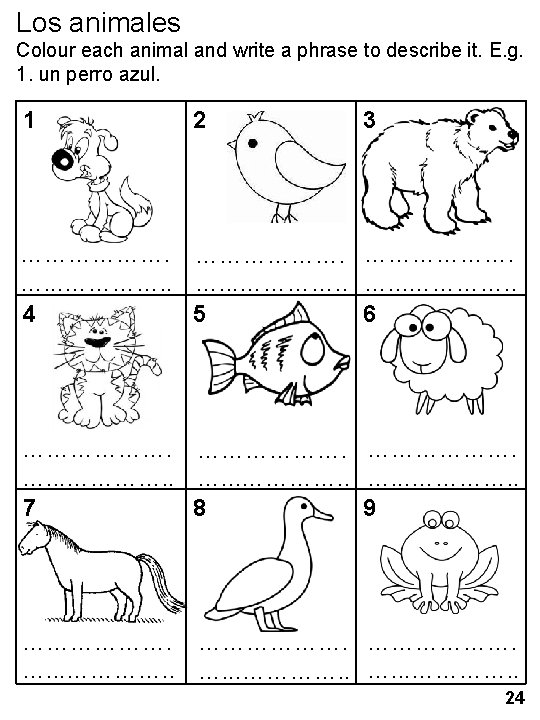
Los animales Colour each animal and write a phrase to describe it. E. g. 1. un perro azul. 1 2 3 ………………. …. . . …………. . 4 5 6 ………………. …. . . …………. . 7 8 9 ………………. …. . . …………. . 24
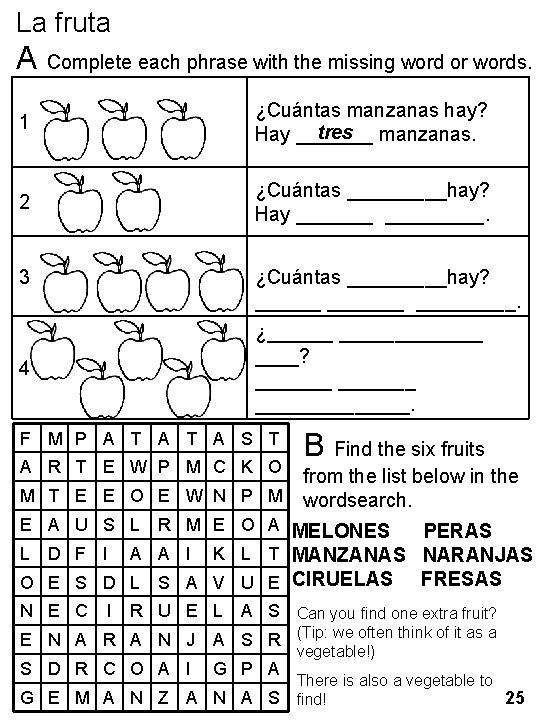
La fruta A Complete each phrase with the missing word or words. 1 ¿Cuántas manzanas hay? tres Hay _______ manzanas. 2 ¿Cuántas _____hay? Hay _________. 3 ¿Cuántas _____hay? _______. ¿_______ ____? _______. 4 F M P A T A S T A R T E W P M C K O M T E E O E W N P M B Find the six fruits from the list below in the wordsearch. E A U S L R M E O A MELONES PERAS L D F I A A I K L T MANZANAS NARANJAS O E S D L S A V U E CIRUELAS N E C I FRESAS R U E L A S Can you find one extra fruit? E N A R A N J A S R (Tip: we often think of it as a S D R C O A I G P A G E M A N Z A N A S vegetable!) There is also a vegetable to 25 find!
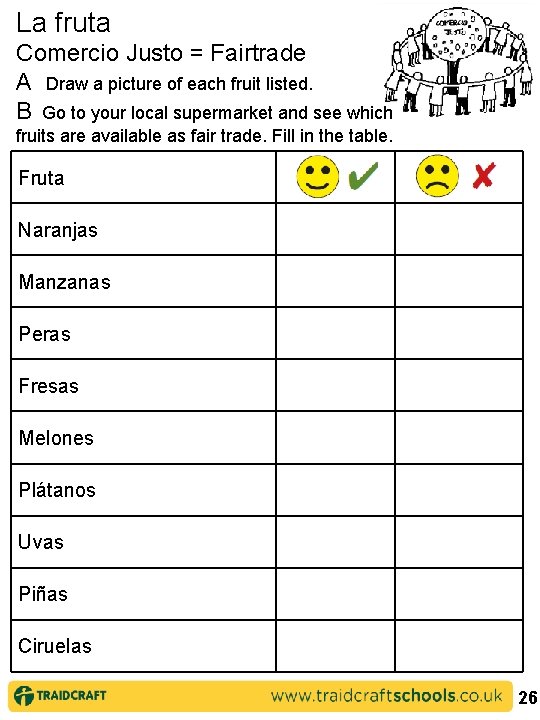
La fruta Comercio Justo = Fairtrade A Draw a picture of each fruit listed. B Go to your local supermarket and see which fruits are available as fair trade. Fill in the table. Fruta Naranjas Manzanas Peras Fresas Melones Plátanos Uvas Piñas Ciruelas 26
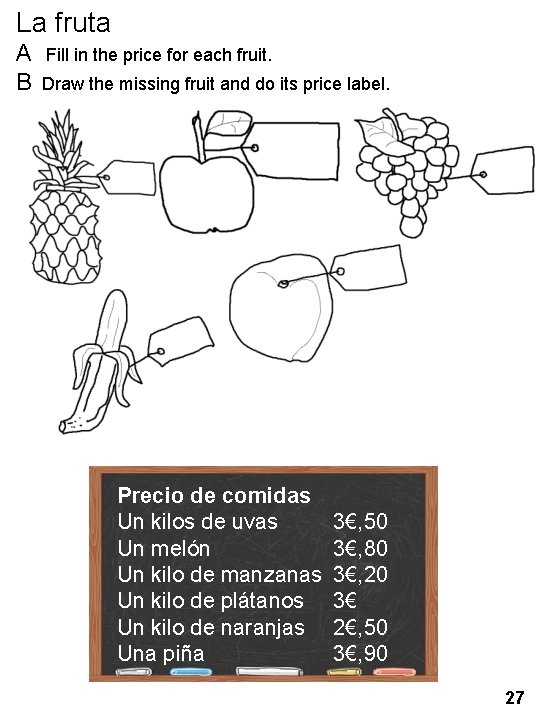
La fruta A Fill in the price for each fruit. B Draw the missing fruit and do its price label. Precio de comidas Un kilos de uvas Un melón Un kilo de manzanas Un kilo de plátanos Un kilo de naranjas Una piña 3€, 50 3€, 80 3€, 20 3€ 2€, 50 3€, 90 27
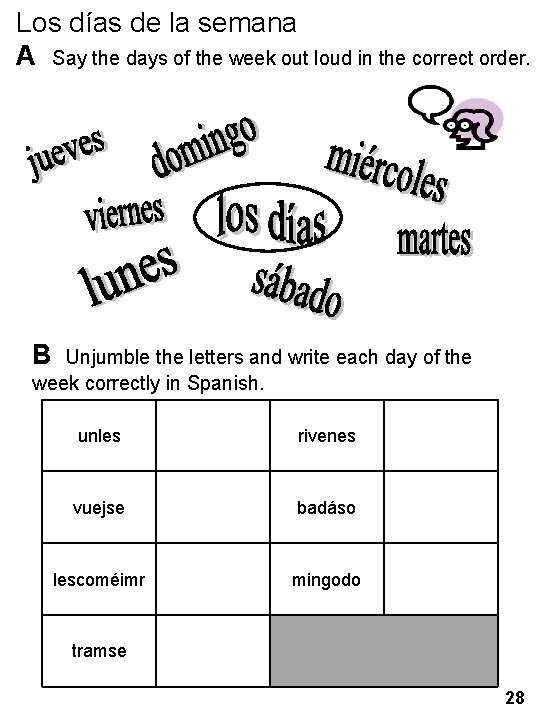
Los días de la semana A Say the days of the week out loud in the correct order. B Unjumble the letters and write each day of the week correctly in Spanish. unles rivenes vuejse badáso lescoméimr mingodo tramse 28
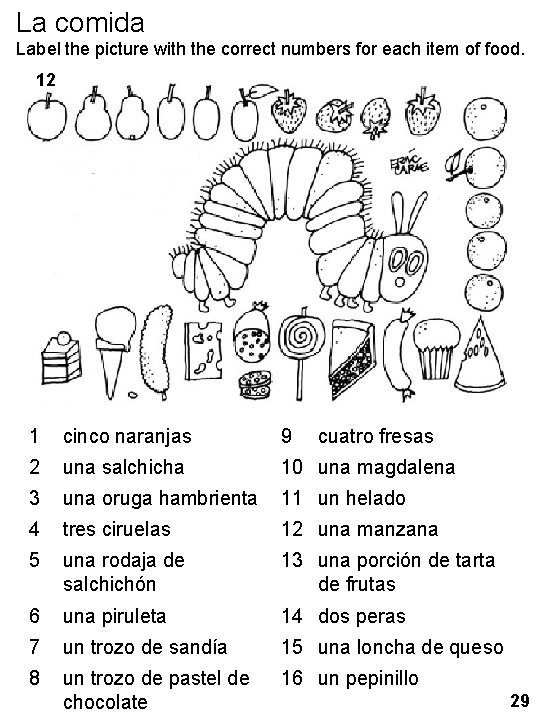
La comida Label the picture with the correct numbers for each item of food. 12 1 cinco naranjas 9 cuatro fresas 2 una salchicha 10 una magdalena 3 una oruga hambrienta 11 un helado 4 tres ciruelas 12 una manzana 5 una rodaja de salchichón 13 una porción de tarta de frutas 6 una piruleta 14 dos peras 7 un trozo de sandía 15 una loncha de queso 8 un trozo de pastel de chocolate 16 un pepinillo 29
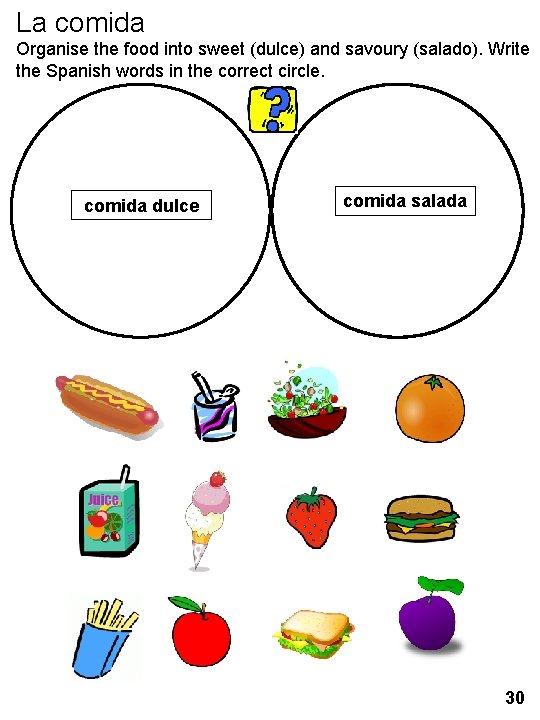
La comida Organise the food into sweet (dulce) and savoury (salado). Write the Spanish words in the correct circle. comida dulce comida salada 30
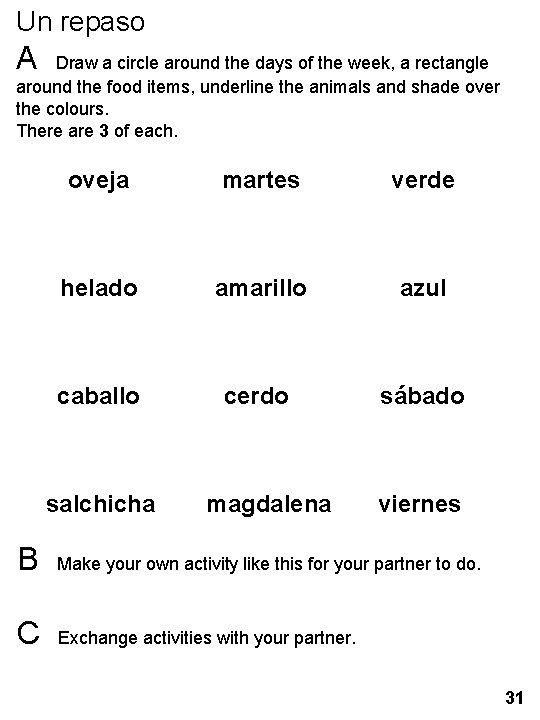
Un repaso A Draw a circle around the days of the week, a rectangle around the food items, underline the animals and shade over the colours. There are 3 of each. oveja martes verde helado amarillo azul caballo cerdo sábado salchicha magdalena viernes B Make your own activity like this for your partner to do. C Exchange activities with your partner. 31
Mi vocabulario 32
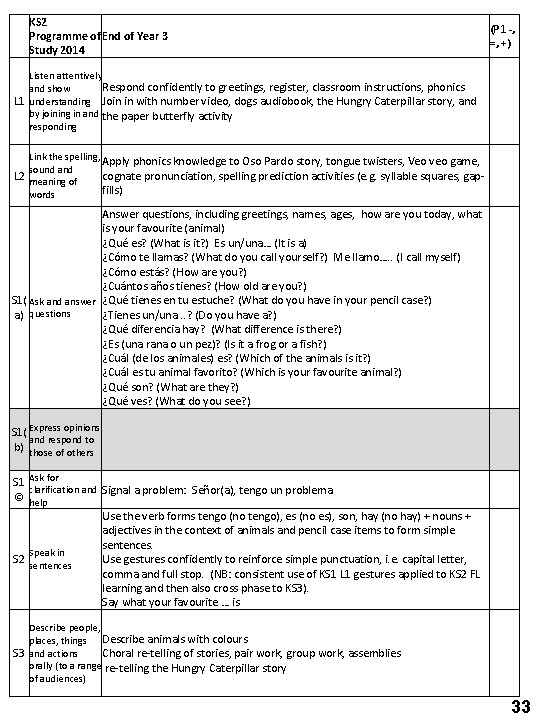
KS 2 Programme of End of Year 3 Study 2014 (P 1 -, =, +) Listen attentively Respond confidently to greetings, register, classroom instructions, phonics and show L 1 understanding Join in with number video, dogs audiobook, the Hungry Caterpillar story, and by joining in and the paper butterfly activity responding Link the spelling, Apply phonics knowledge to Oso Pardo story, tongue twisters, Veo veo game, sound and L 2 meaning of cognate pronunciation, spelling prediction activities (e. g. syllable squares, gapfills) words Answer questions, including greetings, names, ages, how are you today, what is your favourite (animal) ¿Qué es? (What is it? ) Es un/una… (It is a) ¿Cómo te llamas? (What do you call yourself? ) Me llamo…. . (I call myself) ¿Cómo estás? (How are you? ) ¿Cuántos años tienes? (How old are you? ) S 1( Ask and answer ¿Qué tienes en tu estuche? (What do you have in your pencil case? ) a) questions ¿Tienes un/una. . . ? (Do you have a? ) ¿Qué diferencia hay? (What difference is there? ) ¿Es (una rana o un pez)? (Is it a frog or a fish? ) ¿Cuál (de los animales) es? (Which of the animals is it? ) ¿Cuál es tu animal favorito? (Which is your favourite animal? ) ¿Qué son? (What are they? ) ¿Qué ves? (What do you see? ) S 1( Express opinions and respond to b) those of others S 1 Ask for clarification and Signal a problem: Señor(a), tengo un problema © help Speak in S 2 sentences Use the verb forms tengo (no tengo), es (no es), son, hay (no hay) + nouns + adjectives in the context of animals and pencil case items to form simple sentences. Use gestures confidently to reinforce simple punctuation, i. e. capital letter, comma and full stop. (NB: consistent use of KS 1 L 1 gestures applied to KS 2 FL learning and then also cross phase to KS 3). Say what your favourite … is Describe people, places, things Describe animals with colours S 3 and actions Choral re-telling of stories, pair work, group work, assemblies orally (to a range re-telling the Hungry Caterpillar story of audiences) 33
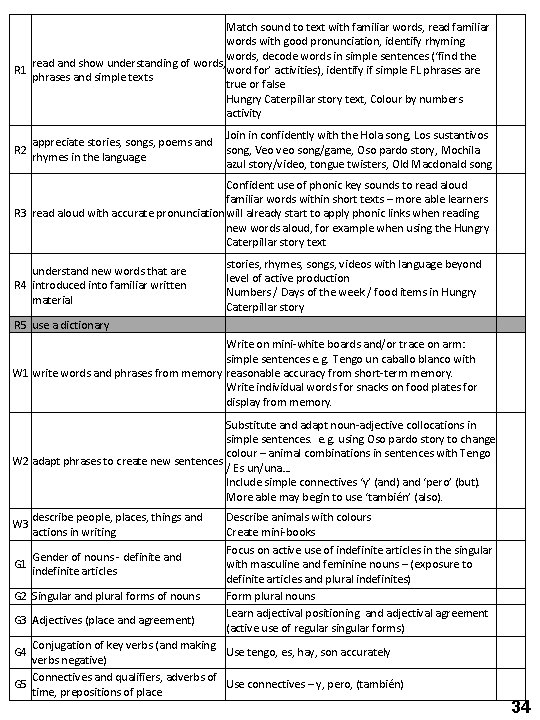
Match sound to text with familiar words, read familiar words with good pronunciation, identify rhyming words, decode words in simple sentences (‘find the read and show understanding of words, word for’ activities), identify if simple FL phrases are R 1 phrases and simple texts true or false Hungry Caterpillar story text, Colour by numbers activity Join in confidently with the Hola song, Los sustantivos appreciate stories, songs, poems and R 2 song, Veo veo song/game, Oso pardo story, Mochila rhymes in the language azul story/video, tongue twisters, Old Macdonald song Confident use of phonic key sounds to read aloud familiar words within short texts – more able learners R 3 read aloud with accurate pronunciation will already start to apply phonic links when reading new words aloud, for example when using the Hungry Caterpillar story text understand new words that are R 4 introduced into familiar written material stories, rhymes, songs, videos with language beyond level of active production Numbers / Days of the week / food items in Hungry Caterpillar story R 5 use a dictionary Write on mini-white boards and/or trace on arm: simple sentences e. g. Tengo un caballo blanco with W 1 write words and phrases from memory reasonable accuracy from short-term memory. Write individual words for snacks on food plates for display from memory. Substitute and adapt noun-adjective collocations in simple sentences. e. g. using Oso pardo story to change colour – animal combinations in sentences with Tengo W 2 adapt phrases to create new sentences / Es un/una… Include simple connectives ‘y’ (and) and ‘pero’ (but). More able may begin to use ‘también’ (also). W 3 describe people, places, things and actions in writing Gender of nouns - definite and G 1 indefinite articles G 2 Singular and plural forms of nouns G 3 Adjectives (place and agreement) Describe animals with colours Create mini-books Focus on active use of indefinite articles in the singular with masculine and feminine nouns – (exposure to definite articles and plural indefinites) Form plural nouns Learn adjectival positioning and adjectival agreement (active use of regular singular forms) Conjugation of key verbs (and making Use tengo, es, hay, son accurately verbs negative) Connectives and qualifiers, adverbs of G 5 Use connectives – y, pero, (también) time, prepositions of place G 4 34
- Slides: 36