
ESOL Learners Who Struggle to Learn What causes
- Slides: 64
ESOL Learners Who Struggle to Learn: What causes them to struggle and what you can do to help them learn Robin Lovrien Schwarz M. Sp. Ed: LD; Ph. D. Independent Consultant in Adult ESOL
Do you know these learners? Jeanne: – 40 -something Haitian – Two + years in adult ESOL program – Repeated several years of school several times in Haiti – No progress in learning to read; very poor spoken English despite many years in US – Teachers have “tried everything— she must have LD”
Do you know these learners? Maria: – Guatemalan matron (60+) – Two years schooling in Guatemala – 2+ years in low-intermediate English phonics class—no progress – Teachers: low literacy; not a good student: attendance, homework erratic – Teachers and Maria very frustrated
Do you know these learners? Jok: – Sudanese in early 20’s? (Real age? ? ) – Almost no education—some in camps – Speaks Dinka, Arabic, Kiswahili; English (strong but accented) – First language unwritten; not clear if literate in Arabic – Two years of ESOL every day in high school-little progress in reading, writing; continued to be evaluated as “low beginner” orally – Teachers: probably has LD— “no higher level thinking skills; ” “can’t retain information” – School psychologist: Testing inconclusive--he couldn’t do a number of tasks correctly
Do you know these learners? Simon: – – 30+ Colombian medical doctor Political refugee Superior reading/spelling skills 6 months in conversation school= NO conversational English – No understanding of English speakers – “I wish people can understand how it is hard to try hard and not to do something. ”
Do you know these learners? Etienne: – 50+ Haitian cook – In US 30+ years– Daughter wants him to learn English – Apparently no literacy in Kriol – One month in program and no engagement at all—just smiled. – Teacher concerned about learning difficulties
Do you know these learners? • Alice: – Refugee from atrocities in Liberia; then servant in family in Africa, sent away by mother, lived in refugee camps – Dentist estimated age at 20 --not 14 as foster family was told – Living in luxurious home N. of Boston – No education in Africa – Learning to read using Wilson Reading System – Stuck at 3 --letter words– appeared to memorize parts of books--couldn’t read the same word on different page – Very emotional, acted out in school; had catatonic reactions at home; often experienced physical distress from eating
Do you know these learners? • Abdi – Ethiopian—late 20’s – No education in his country – Trying for 5 years to learn to read English--has had every literacy program and tutor in his city – Sent to the local program for most challenging learners – Oral English comprehensible but highly ungrammatical – Tutor said he could not remember letters after many weeks of tutoring
Why We Must Look At Struggling ESOL Learners Differently: • ALL – – Are in your programs to learn ENGLISH Speak at least one other language Come from a different culture Are or have experienced culture shock to some degree • MANY – Come from cultures extremely different from mainstream US – Speak languages that are not written – Have no prior literacy/education • SOME – Had difficulty learning in previous education
Why We Must Look at Adult ESOL Learners Differently: • • • Cultural differences Language differences, Adult language learning Low/no literacy Trauma Poor health/physical function challenges ALL make learning ü English, ü IN English, ü Culturally different content, ü In a culturally different education setting Difficult !!
Why We Must Look at Adult ESOL Learners Differently: These factors ALSO make it impossible --and legally questionable--to screen or test non-native English speakers from other cultures for learning difficulties or disabilities in ways developed for English speakers from our culture: • Tests and the testing process are inherently for these learners: – – biased Language of testing is inappropriate Cultural knowledge needed Cultural expectations of testing differ enormously Cultural approach to testing—how questions are asked or knowledge must be shown unfamiliar – Knowledge (prior information) needed to do well • ALL TESTS IN ENGLISH ARE FIRST TESTS OF ENGLISH
Therefore, in Pondering Why They Struggle… WE MUST KEEP IN MIND 1. Physical and mental health issues 2. Adult language learning needs 3. Influences of their first/dominant language 4. Phonological processing skills must be strong 5. Level of literacy; extent of experience with formal education 6. Cultural influences, ideas, attitudes 7. Susceptibility of these students to good/bad teaching
I. What health issues could cause learners to struggle? • Problems with: – VISUAL FUNCTIONS —near, far point acuity, binocularity – VISUAL STRESS SYNDROME-sensitivity to light, black print on white pages – HEARING FUNCTION – ATTENTION PROBLEMS – HEALTH ISSUES—diagnosed or undiagnosed illnesses, effects of medications – MENTAL HEALTH ISSUES— trauma, homesickness, culture shock
Remember our learners? Maria: – Completely deaf in one ear, 75% hearing loss in other ear— no one asked, she told no one! – Very depressed– mother has advanced Alzheimer’s, Maria sole caretaker—no relief – Maria completely literate in Spanish; has large English vocabulary, writes and reads English well– cannot understand people because she is deaf: Who knew? ? ? – Only her oral/aural skills were evaluated!!
Remember our learners? Etienne: – Severe problems with prostate; consumed by his pain and worry – Often sleepless – Came to program anyway– liked classes; daughter wanted him in school Though placed in a class for the lowest ESL learners, he had no initial interview —only forms--though he was essentially illiterate and unable to speak English! How can we know these things if we don’t ASK the students?
Remember our learners? Abdi: Asked what he saw when he looked at the letters: He moved his hands back and forth • Visual stress syndrome—moving words/letters—goldenrod overlay stopped the letters: he saw letters consistently for the first time Alice: Asked what she saw when she looked at the page: “ The words are all over the place. ” • Severe binocularity problems—two eyes not working together—as well as VSS; Blue-gray overlay helped —special glasses needed
Remember our learners? Alice: Literally immobilized by culture shock and homesickness – even after 9 months in a loving family; unable to talk about it-culturally NOT done! Jok: Unable to relate to anything except war stories: Diary of Anne Frank, Trojan War— • He and his fellow-refugees suffer from endless nightmares
Implications? ? • Make sure learners have had checkups: – Hearing – Vision/glasses updated • Screen for – Visual Linked Stress (Light sensitivity)with colored overlays • Be alert for: – Attention problems – Depression – Other mental instability Culturally appropriate interventions for mental health issues may be available among communities of your learners.
Implications? • Interview carefully to find out about: – Health issues – Trauma – Depression – Adjustment issues/current living conditions, stressors • Do it in private, use a qualified translator!
BOTTOM LINE: • Learners cannot learn if they cannot – – SEE HEAR LOOK AT PRINT COMFORTABLY PAY ATTENTION • They won’t be available for learning if they are – – Seriously homesick Ill and unable to get healthcare Distracted by trauma Struggling with adjustment to new land, culture, food, language, human interactions, etc.
II. What could cause Adult Language Learners to struggle? • Their needs as adult language learners are not met • Adults learn language differently from children: • They do not learn oral language readily, especially if they have not learned another language; neuroscience tells us their brains do not process sound the same way, so they do not hear the sounds of the new language well
Remember our learners? Simon -- could NOT – Hear sounds of English – Remember sequences of words – Hear idioms accurately • He reported frequently that it was all a blur of sound Jeanne-- unable to distinguish words in sentences • Never could repeat words accurately
Adult Language Learners Need • Explicit instruction in – Pragmatics—when and how to use language--many don’t pick up on this easily – Being active language learners: contrastive analysis (Be careful of low literate learners who have no understanding of grammar and language terminology) – Understanding how their first language impacts learning English (next item)
ALL Language Learners Need: • Support in developing BOTH – BICS: (Basic Interpersonal Communication Skills)—Survival conversational English And – CALP: (Cognitive Academic Language Proficiency)vocabulary for reading/test taking/classroom discourse; ability to understand complex grammar, abstract, impersonal language
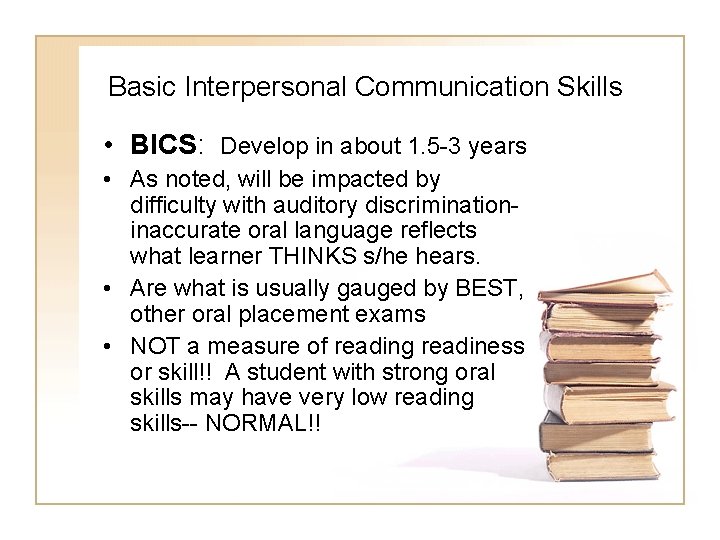
Basic Interpersonal Communication Skills • BICS: Develop in about 1. 5 -3 years • As noted, will be impacted by difficulty with auditory discriminationinaccurate oral language reflects what learner THINKS s/he hears. • Are what is usually gauged by BEST, other oral placement exams • NOT a measure of reading readiness or skill!! A student with strong oral skills may have very low reading skills-- NORMAL!!
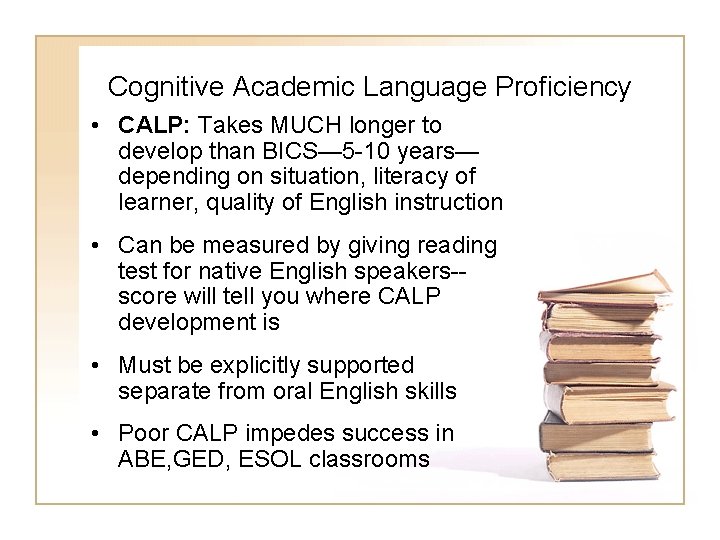
Cognitive Academic Language Proficiency • CALP: Takes MUCH longer to develop than BICS— 5 -10 years— depending on situation, literacy of learner, quality of English instruction • Can be measured by giving reading test for native English speakers-score will tell you where CALP development is • Must be explicitly supported separate from oral English skills • Poor CALP impedes success in ABE, GED, ESOL classrooms
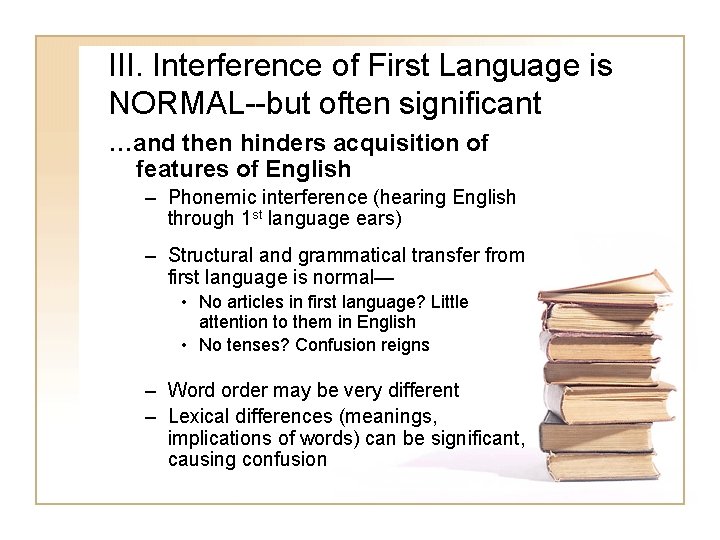
III. Interference of First Language is NORMAL--but often significant …and then hinders acquisition of features of English – Phonemic interference (hearing English through 1 st language ears) – Structural and grammatical transfer from first language is normal— • No articles in first language? Little attention to them in English • No tenses? Confusion reigns – Word order may be very different – Lexical differences (meanings, implications of words) can be significant, causing confusion
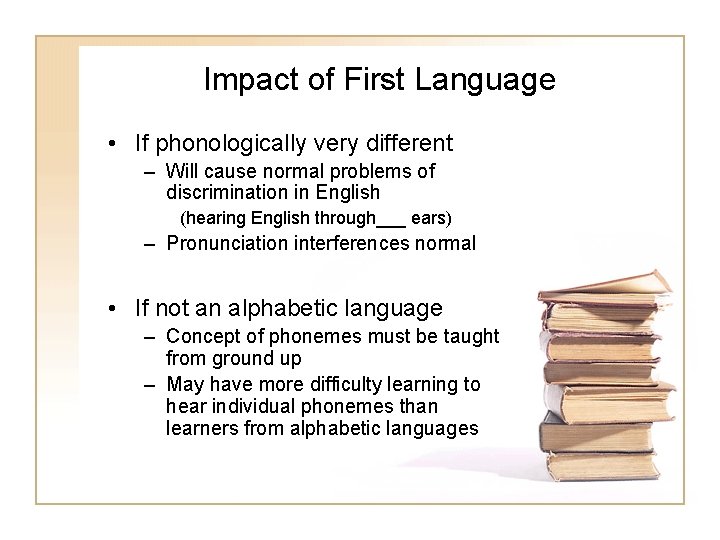
Impact of First Language • If phonologically very different – Will cause normal problems of discrimination in English (hearing English through___ ears) – Pronunciation interferences normal • If not an alphabetic language – Concept of phonemes must be taught from ground up – May have more difficulty learning to hear individual phonemes than learners from alphabetic languages
First Language Interference: The more distant a language is phonologically, structurally, grammatically from English, the more interference is likely, the harder it is for an adult language learner to master the differences in English: Jeanne & Etienne’s Kriol, Jok’s Dinka, Alice’s Kru have significant sound, grammar and pragmatic differences from English
Other Ways Nature of the First Language Impacts Learning • If not a written language: – Learner cannot reference literacy and grammar terms and constructs – Concept of sound/symbol relationship must be built from beginning • If different orthography from English (i. e. Arabic, Chinese, Thai, Korean)– Learner needs time and multisensory learning to learn alphabet – Directionality will normally interfere only briefly
Impact of Nature of First Language • If highly regular (transparent) orthography (what you see is what you say is what you write) – Learner may over generalize—not be sensitive to high degree of irregularity of English – May mask PA problems—easy to compensate for in regular language • If structurally very different from English (word order, use of tenses, etc. ) – May be harder for less educated learners to grasp differences – May interfere in written and oral language noticeably-
Impact of Nature of First Language • All other languages have significantly fewer words – Harder to learn vast array of synonyms and synonymous expressions in English – Harder to gain necessary practice for learning patterns in English unless they are explicitly isolated • Many other languages have registers of speech (levels of formality) expressed in different words (e. g. tu/usted) – Lack of explicit registers in English may be confusing for some learners to grasp – Contributes to unwillingness to speak or confusion about grammar
Remember our Learners? • Jok–Phonological aspects of L 1 VERY different from English; difficult to grasp English because of differences – Pronunciation challenges remain— (no /p/--/f/ distinction) normal—NOT a “speech impediment” as characterized by tester!! • Maria– no difficulty at all– – Transfer from Spanish was complete– just(!) deafness in the way • Simon– very confused by irregularities of pronunciation of English graphemes because Spanish highly regular – Pronunciation unusually difficult for him
IV. Phonological Processing Skills May Not Be Strong Competent speakers and readers in English have strong phonological skills – PHONOLOGICAL MEMORY (PM)—ability to remember and manipulate new sounds, words and patterns in oral language • For listening and speaking skills • Needed for oral vocabulary building – PHONOLOGICAL AWARENESS (PA)— awareness of patterns of sound and eventually, how the sounds relate to the written language • Critical for competent reading and writing
Impact of Poor Phonological Memory: • Very little listening comprehension; class discussions, directions, conversations not retained • Poor ability to learn new words and language strings, idioms, etc. • Can be weak where PA is strong– poor oral English—ungrammatical, “plateaus” /fossilizes Simon: VERY strong PA, but extremely poor PM-- could not discriminate nor remember new sounds, words in speech stream
Poor Auditory Discrimination Adds to Poor PM: You must TEACH • The sound system of English explicitly – Mastery of names and sounds of letters – Sounds that do not exist in learner’s language – Sounds that impact meaning—inflections (HEARING final s, -ed, ing, short vowels, ) stress, intonation, – Discrimination of key sounds in English (minimal pairs) – How words and sounds run together in English (Ya wanna cumover) (Whadjeat? He droptit)
Phonological Awareness • Fundamental skill for learning to read. • Learners MUST be aware of large chunks of language: – Words in sentences – Syllables in words – In English, rhyme • PHONEMIC AWARENESS comes with emerging literacy—Cannot be learned if pre-literacy PA is weak
Impact of Poor Phonological Awareness: • Impaired ability to learn to read, write, spell (note—for literate learners, spelling skill has visual, morphological components as well. ) NOTE: Abdi, Alice, and Maria had NO weakness in PA! Problems were VISUAL) • Fundamental problem in dyslexia in English • May be impacted by poor auditory discrimination –BUT not tied to oral skills—can be weak where oral/aural are strong skills
Phonological Awareness and Learners with Higher Literacy • BASIC skills transfer READILY from one language to another—no matter what language—IF they are in place ( I. e. hearing chunks of sound, knowing there is a graphic-sound correspondence of some kind) • If learner is literate in another language but having difficulty becoming literate in English—poor PA in ENGLISH should be suspected FIRST. --
Phonological Awareness and Learners with High Literacy • English PA harder than most languages--may need to target some skills (e. g. rhyming, hearing certain sounds for clearer input) • Can combine with other L 1 interferences as detailed earlier to make new language difficult • May be the learner who has good listening speaking skills but poor reading/writing
IMPLICATIONS? ? : • Check phonological skills (after health, physical functions) as PART OF PLACEMENT PROCESS or first thing in instruction (Can student count words in short sentence? Repeat a short sentence ACCURATELY? Hear rhyme? ) • Pay attention to what is weak and reinforce vigorously— cannot learn reading/writing or listening/speaking if phonological skills are weak. Jeanne: Weak in both skills---VERY challenged by traditional teaching methods, which did not address PPS
For Adequate Language Learning, ADULT Language Learners Need: – Fundamental phonological skills – To be able to hear sounds in new language accurately – Language taught comprehensibly – To learn through all learning channels (Visual; Auditory; Kinesthetic; Tactile ) – Support in building two kinds of vocabulary – Support in being active, knowledgeable language learners
Remember our Learners? • Jok: (Telling us about CALP) “I think teachers go to a shelf and take a book. They teach the vocabulary. Then they take another book and teach that vocabulary. ” • Though his oral English was strong, his vocabulary was below first grade because of holes in his knowledge. The teaching did not help him create a cohesive vocabulary.
V. Literacy Level Can Significantly Affect Speed and Content of Learning: Literacy skills NORMALLY transfer readily from one language to another--no matter what the language – Thus– college students can USUALLY learn literacy skills in a new language in a few weeks or months • If someone is already literate in another language, failing to become literate in a new language is a PROBLEM (see PA information) • Non-literate learners require much more time to become literate in a new language – Struggling to become literate for the first time in a second/other language is normal.
How Low/No Literacy Impacts Learning: – Visual orientation to one-dimensional information is impacted—probably don’t see what you see – May not even have orientation to direction of books/text – Little orientation to environmental text (signs)--doesn’t notice them – Little or no understanding of the reading process— likely to feel it is very effortful – Probably has never held a writing instrument
How Low/No Literacy Impacts Learning: • Non-literate learner does not process new language/sounds the same way a literate person does • Does not have ANY reference to literacy terminology/constructs: grammar, functions of different kinds of text • Probably has little--or limited- world information; cannot understand or relate to typical topics in textbooks • NO basic educational orientation (circling answers, underlining things, drawing figures, writing on lines, working from top to bottom, using word boxes, choose the “best” answer, etc. ) REMEMBER: We don’t yet KNOW what is normal rate of learning for these learners!
How Low/No Literacy Impacts Learning: • Underdeveloped phonological awareness normal —ability to hear patterns and chunks of language and manipulate them—KEY to literacy • Alice/ Abdi/ Jok– none had prior education, had adequate to good PM and emerging PA– could hear and manipulate patterns at gross level (words, syllables) not yet at phonemic level--but impaired – NOT
How Intermediate or Higher Literacy Impacts Learning: • Literacy skills transfer readily— higher level of literacy, easier to learn to read and write in another language (CALP transfer, knowledge of literacy functions) • Learners from different orthographies (writing systems) may take a little longer to learn new system--often NO transfer except of NOTION of a writing system • Much of English learning will be translation of known information
Higher Levels of First Language Literacy; Struggles to Learn in English: • Lessons/content may be TOO EASY--student is disaffected (Simon) • Content material may be unfamiliar • Possibly has hearing, attention or vision difficulties (Maria!!) • Cultural differences may be getting in the way • (Students do not understand your idea of homework) • May not be as literate as s/he reports • Phonological skills may not be good • Auditory discrimination of English undoubtedly needs strengthening.
Remember Our Learners? • Jok---Unable to understand grammar, writing constructs— nothing to reference, no body of information to translate • Simon--Extremely literate in Spanish and English– did not help listening or speaking skills! • Maria-- Excellent literacy in L 1, but not recognized in her school • Jeanne---Could not become literate in first language (Kriol)– unsuccessful in English as well Extremely poor phonological skills
Implications for Teaching Learners with LOW/NO LITERACY • Assure pre-literacy phonological awareness skills are strong • Help learners gain orientation to one-dimensional information slowly • Avoid using text and writing as a crutch to teaching-- it doesn’t help!! • Allow ample time for literacy concepts to be grasped one at a time—symbols, alphabet –before words are attempted • Do NOT assume they have LD!! And if they did ( Jeanne? ? ) WHAT would Change? ?
Implications for Teaching Learners with Intermediate to High LITERACY • Expect that learner can transfer skills – Reading should come readily– TEACH how to use English dictionary effectively (and online resources that include pronunciation features) – If literate in Romance language, do not need instruction in reading—only translations – Those literate in non-Roman alph. Need quick access to English phonics, practice writing alphabet--but NOT THE WHOLE CLASS • Strengthen phonological processing skills AS NEEDED ONLY! • Help learner develop metacognitive skills • Build on what is already in place: literacy level, education/world knowledge • Do NOT treat as ‘arch” beginners even if no oral English!!
VI. How Do Cultural Differences Impact Learning? • Let me count the ways……… – Learner’s expectations of and experience with education, teachers, other learners – How everyone interacts—who is in charge, what students can do, teachers should do – How learning happens (memorizing vs. analytical thinking; purpose of homework, how you do it, WHETHER you do it) – What is talked about and what not-- and on…. . is
Cultural Differences That Impact Learners’ Engagement – How errors and poor work are viewed/responded to – How learners with differences are viewed – How speech/text are organized and used – Constructs of writing– main idea? ? – To stand out or not stand out: How competition/reward are viewed – How social behaviors in pictures and text are understood – How information/content learning is —and in what order • Just a sampling of factors that impact learners’ engagement, trust in validity of instruction, of you, of school taught
In other words: • EVERYTHING you and your learners do is impacted by your culture and theirs • Becoming versed in your learners’ cultures can help you a great deal!!! • Do not expect change to happen on a time schedule– if at all • Acculturation is irregular—long– not always positive thing
Remember our Learners? • Jok– Culturally uncomfortable asking any questions in classes– and answering direct questions—conversational indirectness is culturally expected • Maria–DID NOT complain or report hearing loss—afraid of teacher’s reprisal • Etienne-- did not tell anyone about his problem until asked • Jeanne– Assumed she was not trying hard enough—would not ask for help
Remember our Learners? • Alice– would not talk about her trauma or homesickness or memories – Social worker pronounced her unable to develop insight, but culturally, talk therapy is not acceptable! • Jok--also no talking directly about trauma– had to be done indirectly--MANY cultural interferences • Simon– Though unhappy with English conversation classes, did not want to complain openly -Highly sensitive to cultural differences and afraid he was offending if not doing things the “American” way
VII. Pedagogically Induced Learning Difficulties: Setting up Learners for FAILURE, not SUCCESS • Teachers/tutors had – Low or unrealistic expectations--no clear idea of what could/should be accomplished in a given period of time – Vague, unmeasurable goals for learners (Improve reading; Improve English; work in this book until? ? ) – Little or no knowledge of learners’ cultures, languages-– Inappropriate lessons, materials not relevant to or within scope of learners’ goals or experience
Pedagogically Induced Learning Difficulties • Failure to – Teach skills to mastery – Take educational background fully into account – Strengthen/teach explicit phonological skills and sound system of English — basic language learning needs – Recognize difference between BICS and CALP and consequently assume learner can manage written materials because of good oral skills. – Provide learners with a way to indicate their satisfaction or wishes about learning, class, etc.
Remember our learners? • JOK— teachers did not take illiterate background, lack of world knowledge, extent of trauma fully into account • SIMON— teacher was unprepared to explain English in a way Simon needed to learn • JEANNE— teachers did not check for phonological skills • ALL: REAL NEEDS of learners were not recognized –all were assumed to have LD
REVIEW: What were the causes of struggle for our learners? • Poor health, vision, hearing, Visual Stress Syndrome • Adult language learning needs not met • Weak phonological skills (normal or otherwise) • Low or no literacy, in first language or very high literacy unable to transfer • Nature of first language • Cultural differences—huge or small • Teacher/instructional inadequacies
What were the causes for their not thriving that CAN BE CHANGED? • Assessment of vision, hearing, health concerns • Assumption that struggling to learn MUST mean LD • Low or misplaced expectations • Poorly defined goals, failure to teach to mastery; inappropriate materials • Normal language needs not addressed • Needs as adult learners not addressed— relevance of material to be learned • Mismatch of cultural expectations
What to do? ASK: • About health, check vision, hearing • A LOT OF QUESTIONS About prior education • Learners and everyone else about their language, culture so you understand behaviors, attitudes • What learners want/need to learn • If learners are satisfied with their learning • Learners to help you structure their learning the best way possible Keep asking questions and learning !!!
What to do? ? • Watch films about immigrants and refugees from various cultures and educational levels (e. g. “God Grew Tired of Us”) • Check resources on ELL-U/CAELA • Review discussions on ELA Discussion list about non-literate learners (lincs. ed. gov) • Learn ways to differentiate instruction (e. g. learning centers see robinsadultesl. com)