
ESOL and Maths Workshop Friday 24 th June









- Slides: 40
ESOL and Maths Workshop Friday 24 th June 2011 Sittingbourne AEC
Aims and Outcomes Aim Attendees will discover new techniques and methods for innovative numeracy delivery and share teaching strategies and good practice to overcome the difficulties caused by low levels of English. Outcomes • Identify learning and teaching strategies for key problem areas for ESOL learners of maths • Create new ideas for contextualised learning without the use of the worksheet. • Measure learning taking place.
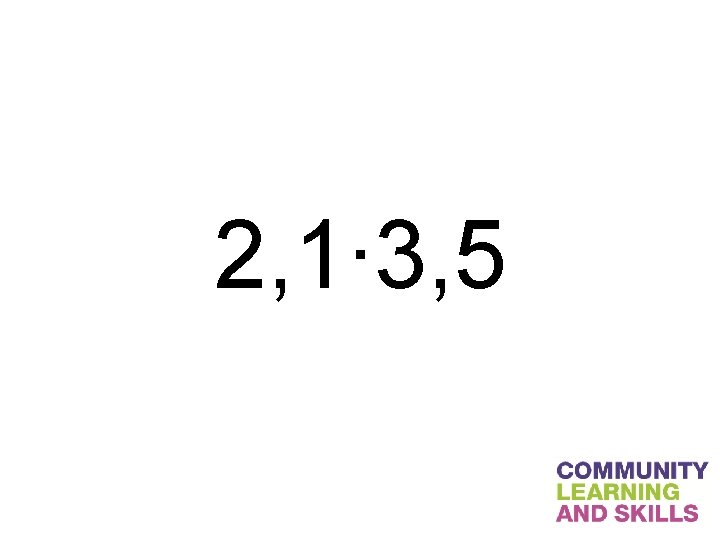
Starter Activity In your groups, attempt to answer the numeracy exam questions.
• What problems did you have? • What translations/vocabulary would have helped you to answer the questions?
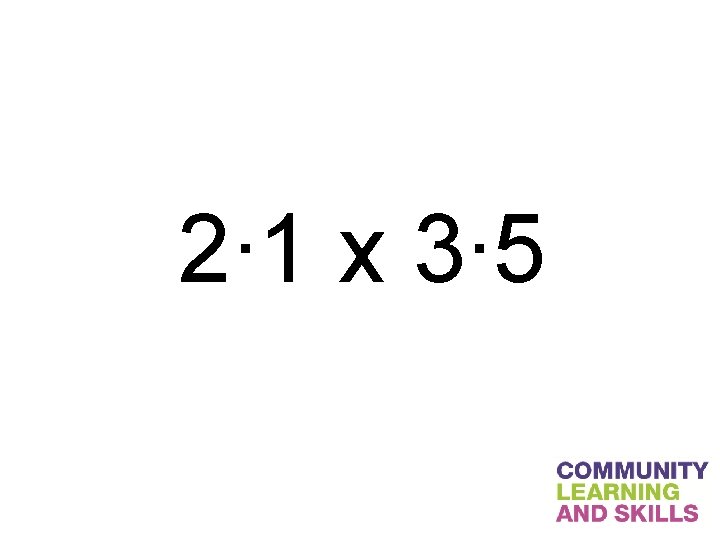
2∙ 1 x 3∙ 5
Cultural Differences in Numerical Methods Discuss the different methods with the person next to you. Identify the main differences to how you solve these problems.
What other cultural differences may our learners face?
Always, Sometimes, Never • In your groups sort the cards according to whether you think the statements are always true, sometimes true or never true • Stick your cards to the paper • Use the paper to test your answers Always Sometimes Never
Coffee break (15 mins) Have a look at the other posters
Numeracy Core Curriculum Rearrange the core curriculum references according to their level
ESOL resources – pulling out the maths
Lunch
Resource Workshop Take a look at the resources and discuss how they measure learning
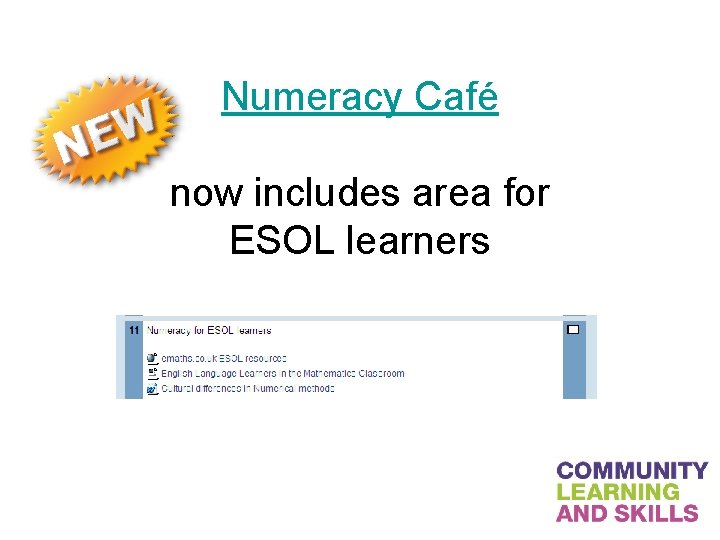
Numeracy Café now includes area for ESOL learners
Your turn! Make your own resource and identify how it measures the learning taking place Please help yourself to coffee
Different Methods, Same answer
Long Multiplication What is long multiplication? A number multiplied by a 2 digit (or larger) number e. g. 25 x 13 Is there only one way to do? Are there any tips that can help make it easier?
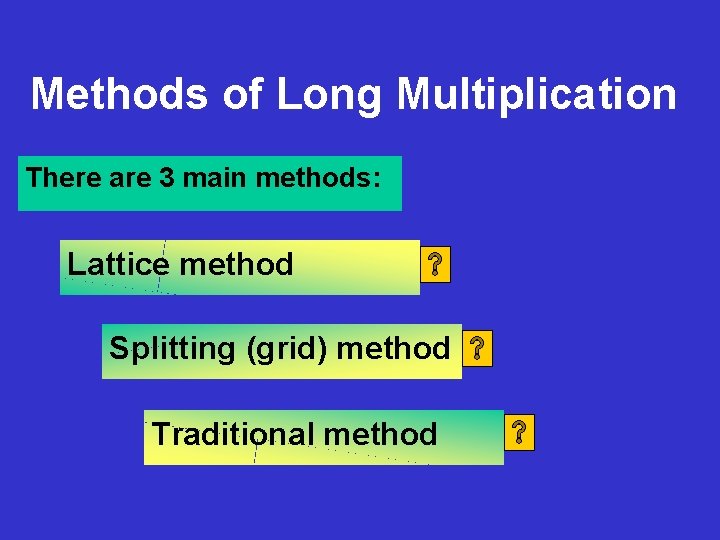
Methods of Long Multiplication There are 3 main methods: Lattice method Splitting (grid) method Traditional method
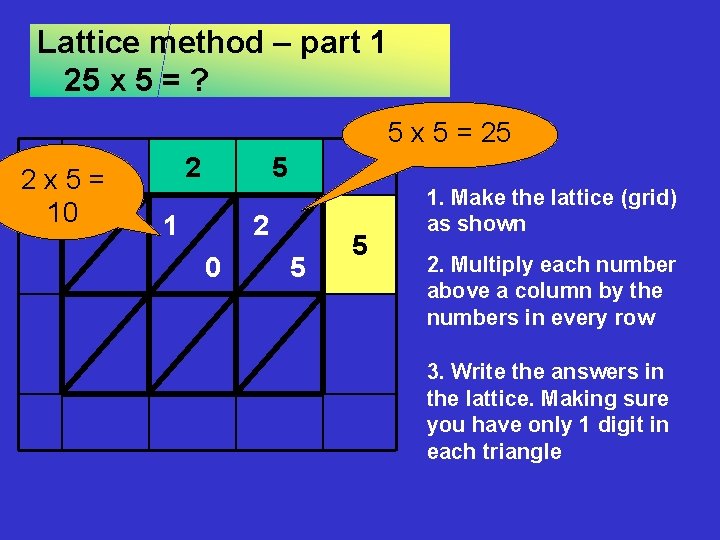
Lattice method – part 1 25 x 5 = ? 5 x 5 = 25 2 x 5 = 10 2 5 1 2 0 5 5 1. Make the lattice (grid) as shown 2. Multiply each number above a column by the numbers in every row 3. Write the answers in the lattice. Making sure you have only 1 digit in each triangle
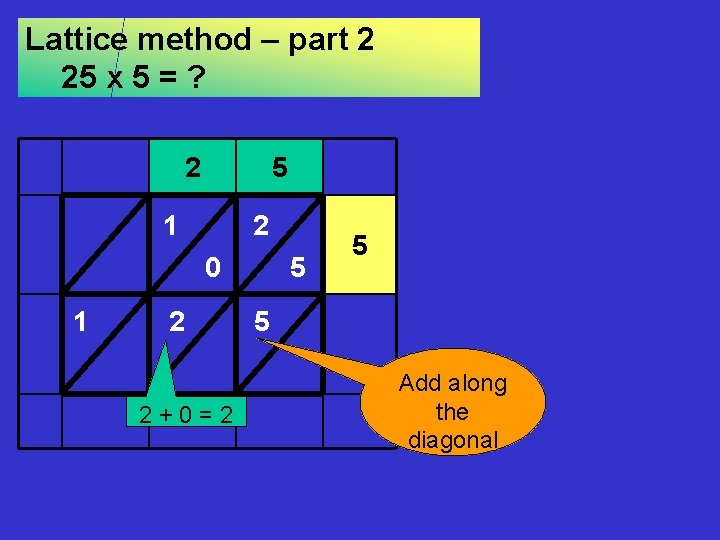
Lattice method – part 2 25 x 5 = ? 2 5 1 2 0 1 2 2 + 0 = 2 5 5 5 Add along the diagonal
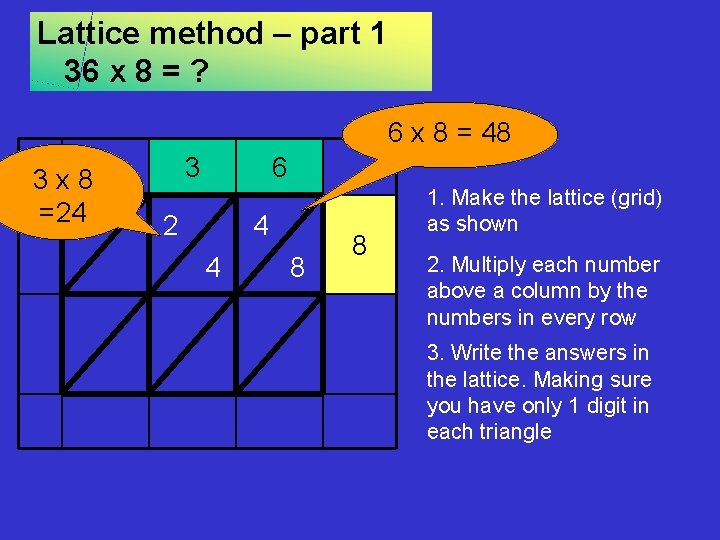
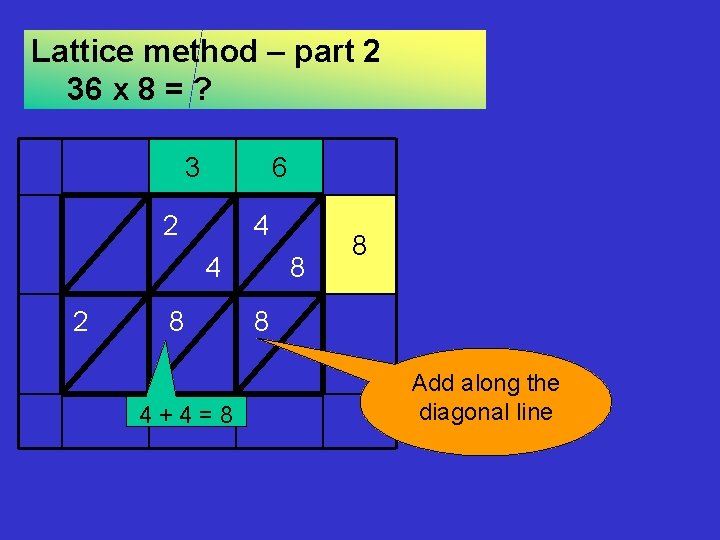
Lattice method – part 1 36 x 8 = ? 6 x 8 = 48 3 x 8 =24 3 6 2 4 4 8 8 1. Make the lattice (grid) as shown 2. Multiply each number above a column by the numbers in every row 3. Write the answers in the lattice. Making sure you have only 1 digit in each triangle
Lattice method – part 2 36 x 8 = ? 3 6 2 4 4 2 8 4 + 4 = 8 8 Add along the diagonal line
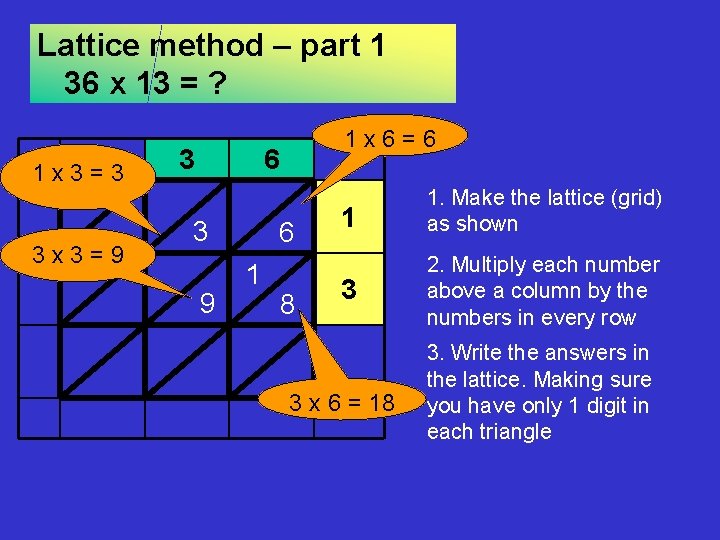
Lattice method – part 1 36 x 13 = ? 1 x 3 = 3 3 x 3 = 9 3 1 x 6 = 6 6 3 9 6 1 8 1 1. Make the lattice (grid) as shown 3 2. Multiply each number above a column by the numbers in every row 3 x 6 = 18 3. Write the answers in the lattice. Making sure you have only 1 digit in each triangle
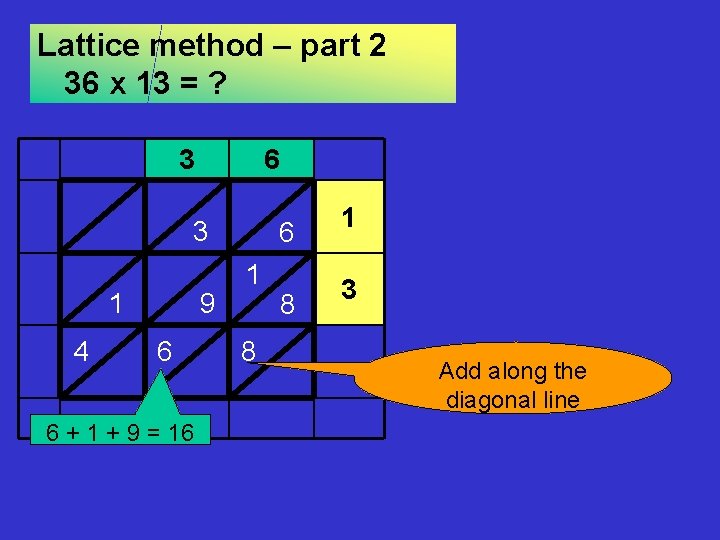
Lattice method – part 2 36 x 13 = ? 3 6 3 1 4 9 6 6 + 1 + 9 = 16 6 1 8 8 1 3 Add along the diagonal line
Try the questions at the bottom of the worksheets
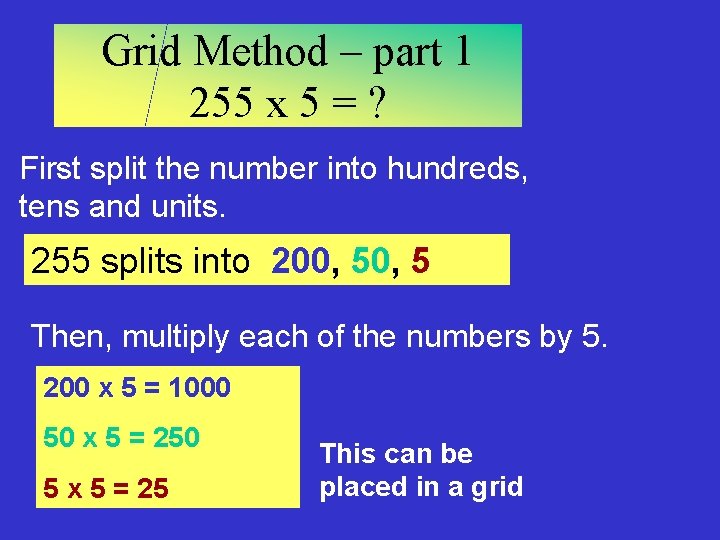
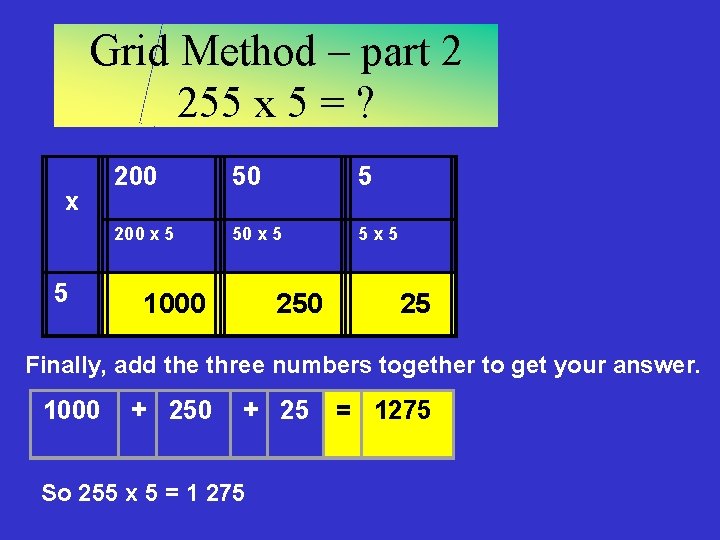
Grid Method – part 1 255 x 5 = ? First split the number into hundreds, tens and units. 255 splits into 200, 5 Then, multiply each of the numbers by 5. 200 x 5 = 1000 50 x 5 = 250 5 x 5 = 25 This can be placed in a grid
Grid Method – part 2 255 x 5 = ? x 5 200 50 5 200 x 5 5 x 5 1000 25 Finally, add the three numbers together to get your answer. 1000 + 250 + 25 So 255 x 5 = 1 275 = 1275
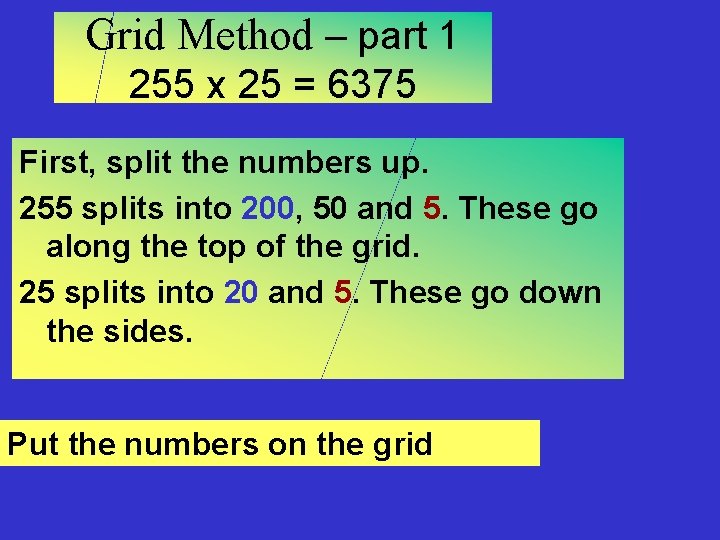
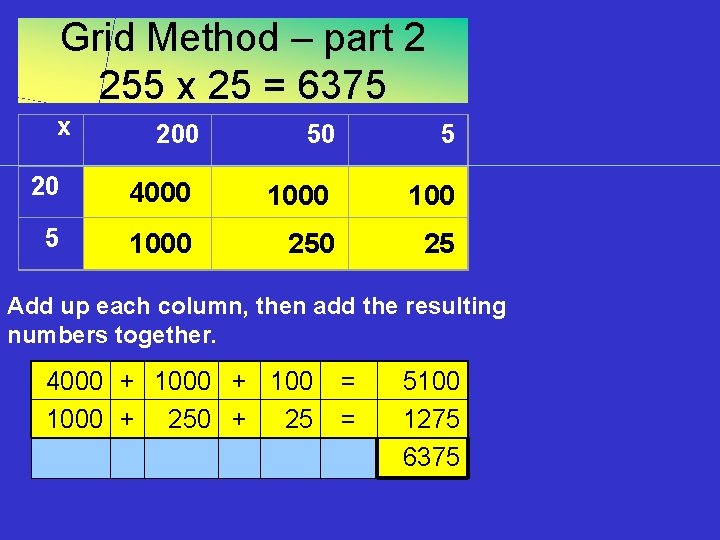
Grid Method – part 1 255 x 25 = 6375 First, split the numbers up. 255 splits into 200, 50 and 5. These go along the top of the grid. 25 splits into 20 and 5. These go down the sides. Put the numbers on the grid
Grid Method – part 2 255 x 25 = 6375 x 200 50 5 20 4000 100 5 1000 25 Add up each column, then add the resulting numbers together. 4000 + 100 1000 + 25 = = 5100 1275 6375
Try the questions again using the splitting method
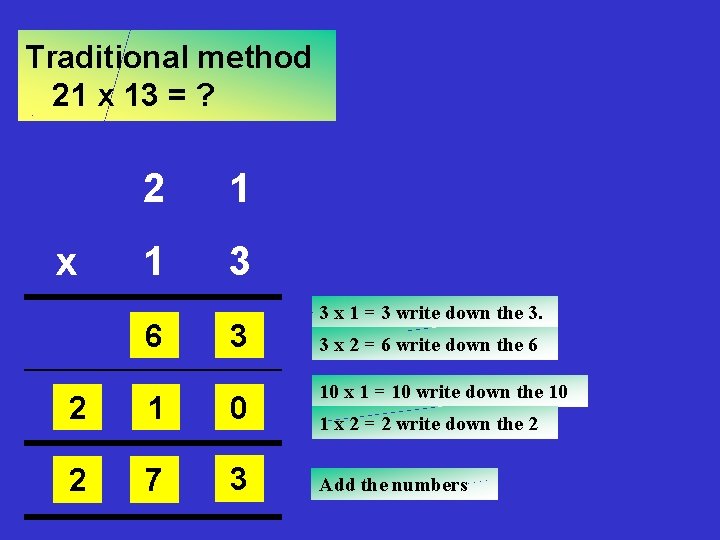
Traditional method 21 x 13 = ? x 2 1 1 3 6 3 2 1 0 2 7 3 3 x 1 = 3 write down the 3. 3 x 2 = 6 write down the 6 10 x 1 = 10 write down the 10 1 x 2 = 2 write down the 2 Add the numbers
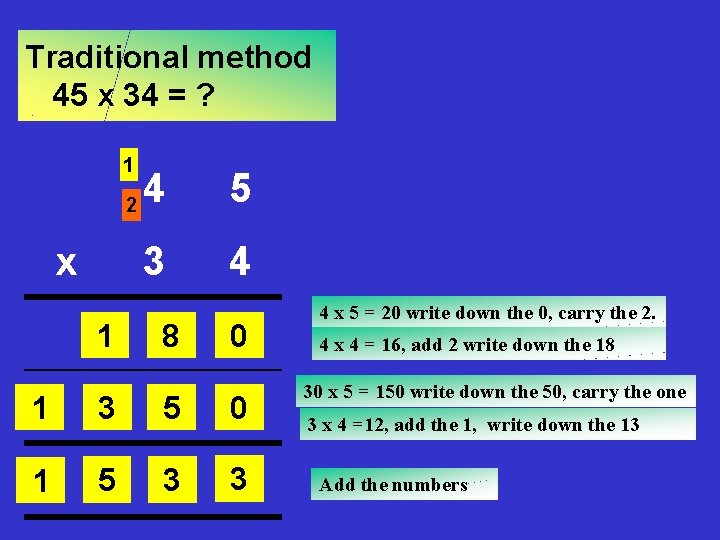
Traditional method 45 x 34 = ? 1 2 x 1 4 5 3 4 8 0 1 3 5 0 1 5 3 3 4 x 5 = 20 write down the 0, carry the 2. 4 x 4 = 16, add 2 write down the 18 30 x 5 = 150 write down the 50, carry the one 3 x 4 =12, add the 1, write down the 13 Add the numbers
Try the questions again using the traditional method
Power. Point from www. skillsworkshop. org and is also in the Numeracy Café
Good practice
Q&A
Action Point
To improve your numeracy or find out more about the different methods contact your nearest Skills Plus Centre