
ESMA and the shortselling regulation European Court of

- Slides: 27
ESMA and the short-selling regulation European Court of Justice, Grand Chamber, 22 January 2014, Case C-270/12 EU Financial Law Lesson April 16, 2019
Facts and history of the procedure
Legal background • The establishment of ESMA: Regulation n. 1095/2010 • Articles n. 8 and 9: tasks and powers of the authority • The power to adopt decisions addressed to competent authorities and to financial market participants (art. 9, par. 5)
• Article 28 of Regulation n. 236/2012 «ESMA intervention powers in exceptional circumstances» • «Esma shall, subject to par. 2 of this article, either: a) Require natural or legal person who have net short positions in relation to a specific financial instrument to notify a competent authority or to disclose to the public details of any such position; b) Prohibit or impose conditions on the entry by natural or legal persons into a short sale»
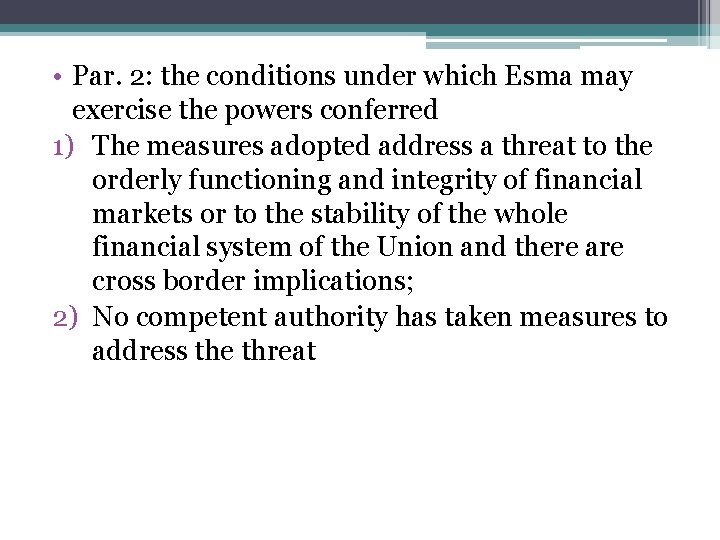
• Par. 2: the conditions under which Esma may exercise the powers conferred 1) The measures adopted address a threat to the orderly functioning and integrity of financial markets or to the stability of the whole financial system of the Union and there are cross border implications; 2) No competent authority has taken measures to address the threat
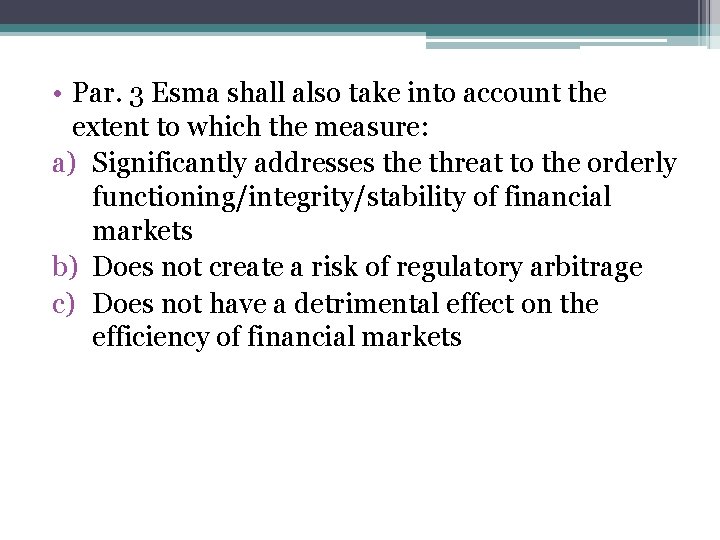
• Par. 3 Esma shall also take into account the extent to which the measure: a) Significantly addresses the threat to the orderly functioning/integrity/stability of financial markets b) Does not create a risk of regulatory arbitrage c) Does not have a detrimental effect on the efficiency of financial markets
The action before ECJ
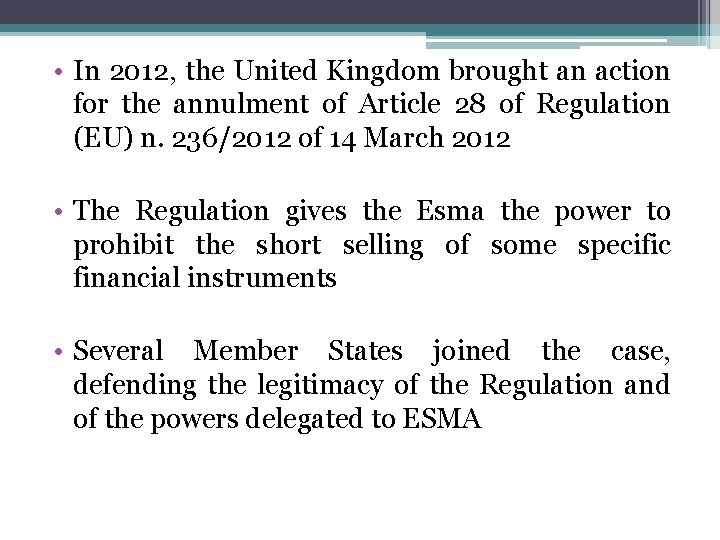
• In 2012, the United Kingdom brought an action for the annulment of Article 28 of Regulation (EU) n. 236/2012 of 14 March 2012 • The Regulation gives the Esma the power to prohibit the short selling of some specific financial instruments • Several Member States joined the case, defending the legitimacy of the Regulation and of the powers delegated to ESMA
• The UK Government had abstained itself from voting in the Council when the Regulation was adopted • The lawsuit against Esma is one in a series of legal challenges in what was presented to be a campaign to limit the powers of the EU financial authorities
4 pleas against article 28 1) Esma powers, entailing «a very large measure of discretion» , are in breach of the Meroni doctrine 2) Esma may adopt «quasi-legislative measures» of general application, contrary to the Romano doctrine 3) Delegation of powers under art. 28 is incompatible with articles 290 and 291 TFUE 4) Article 114 does not constitute a sufficient legal basis for the delegation of such powers to Esma
2. The legal framework
• Recital 1 of Regulation n. 1095: • “The financial crisis in 2007 and 2008 exposed important shortcomings in financial regulation (…). Nationally based supervisory models have lagged behind financial globalisation and the integrated and interconnected european financial markets”
• One of the answers to the crisis was to create a more integrate system of financial supervision • 2010 => creation of ESAs (European Supervisory Authorities) • Regulation n. 1095/2010, in particular, created Esma (European securities and markets authority)
• Recital n. 5: • “this new system should be aimed at upgrading the quality and consistency of national supervision strengthening oversight of cross – border groups and establishing a European single rulebook applicable to all financial markets participants”
The objective of Esma • Art. 1: protect the public interest to a stable and effective financial system, having regard to: • (1) improving the functioning of the internal market by a sound, effective and consistent level of regulation; • (2) ensuring the transparency and the integrity of the market; • (3) strengthening the coordination between national competent authorities
The powers of Esma • Article n. 8, par. 2: • (1) develop draft regulatory technical standars and implementing technical standars • (2) issue guidelines and recommendations • (3) issue opinions to the European Parliament, the Council and the Commission • (4) develop a common supervisory culture, coordinating NCAs, mediating and setting disagreements between them.
• Article 9, par. 5: • “The Authority may temporarily prohibit or restrict certain financial activities that threaten the orderly functioning and integrity of financial markets or its stability (. . . ) in the cases specified and under the conditions laid down in the legislative acts (. . . ) or if so required in the case of an emergency situation in accordance with art. 18” • => Direct supervisory powers
Regulation n. 236/2012 • Article 28, on the basis of article 9, par. 5, authorizes ESMA to prohibit or impose conditions on short selling in exceptional circumstances, when there is “a threat to the orderly functioning and integrity of financial markets or to the stability of the whole or part of the financial system in the Union and there are cross-border implications”.
Legislative and decision making powers under EU legal order • These powers must be exercised within the limits set by the treaties • The observance of the limits is granted through judicial review
• Article 263 TFUE «the Court of Justice shall review the legality of legislative acts, of acts of the Council, of the Commission and of the European Central Bank, other than recommendations and opinions, and of acts of the European Parliament and of tge European Council intended to produce legal effects vis a vis third parties. It shall also review the legality of acts of bodies, offices or agencies intended to produce legal effects vis a vis third parties» .
• Actions can be brought by a Member State, the European Parliament, the Council or the Commission • Article 264 «if the action is well founded, the Court of Justice shall declare the act concerned to be void»
The Meroni doctrine • (1958) The Court of Justice argued that only a delegation of executive powers could be admitted under EU law • A delegation of discretionary powers is unlawful
The Romano case • (1990) The Court stated that an administrative commission (such as Esma) may not be empowered by the Council to adopt acts having the force of law
The judgement • The ECJ rejects all the four pleas presentend by UK • Upholds the legitimacy of the delegation of significant powers to Esma under article 28, considering article 114 TFUE as a sufficient legal basis for such delegation • Pushes the interpretation of the long lasting Meroni doctrine and elaborates a new standard for delegation of powers under EU law
Did Esma exercise the powers granted by article 28? • Since 2012 Esma has not directly prohibited the short selling of any CDS • Rather, it has exercised its coordination powers on temporary bans decisions adopted by NCAs • 4 october 2016: Esma issued an opinion agreeing to extending an emergency short selling prohibition (90 days) by Consob on net short positions in Banca Monte dei Paschi di Siena shares • 12 september 2017: issued the same opinion on a prohibition adopted by the Comisiòn Nacional del Mercado de Valores
European Commission proposal n. 536/2017 • On september 2017 the European Commission submitted to the European Parliament a recommendation to extend Esma supervisory powers • It aims for the introduction of direct supervisory powers in some relevant sectors as: - coordination of investigations regarding market abuse - authorization on the functioning of certain investment funds - approval of the stock offer document of some non-EU and EU operators