
ESE 534 Computer Organization Day 22 April 16
![Big Ideas [MSB Ideas] • Several cases cannot profitably reuse same logic at device](https://slidetodoc.com/presentation_image_h2/aa672ad9cebfe9635b8041c902dc9585/image-61.jpg "Big Ideas [MSB Ideas] • Several cases cannot profitably reuse same logic at device")
![Big Ideas [MSB-1 Ideas] • Energy benefit for large p • Economical retiming becomes](https://slidetodoc.com/presentation_image_h2/aa672ad9cebfe9635b8041c902dc9585/image-62.jpg "Big Ideas [MSB-1 Ideas] • Energy benefit for large p • Economical retiming becomes")
- Slides: 63
ESE 534: Computer Organization Day 22: April 16, 2014 Time Multiplexing Penn ESE 534 Spring 2014 -- De. Hon 1
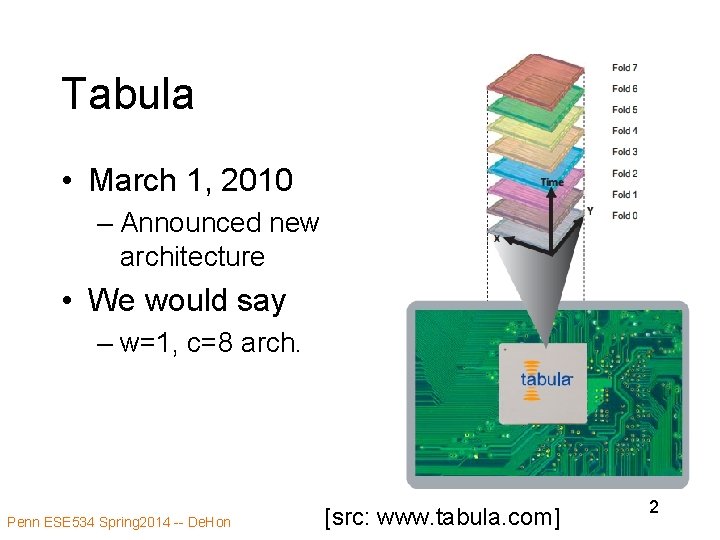
Tabula • March 1, 2010 – Announced new architecture • We would say – w=1, c=8 arch. Penn ESE 534 Spring 2014 -- De. Hon [src: www. tabula. com] 2
Previously • Basic pipelining • Saw how to reuse resources at maximum rate to do the same thing • Saw how to use instructions to reuse resources in time to do different things • Saw demand-for and options-to-support data retiming Penn ESE 534 Spring 2014 -- De. Hon 3
Today • Multicontext – Review why – Cost – Packing into contexts – Retiming requirements for Multicontext – Some components • [concepts we saw in overview week 2 -3, we can now dig deeper into details] Penn ESE 534 Spring 2014 -- De. Hon 4
How often is reuse of the same operation applicable? • In what cases can we exploit highfrequency, heavily pipelined operation? • …and when can we not? Penn ESE 534 Spring 2014 -- De. Hon 5
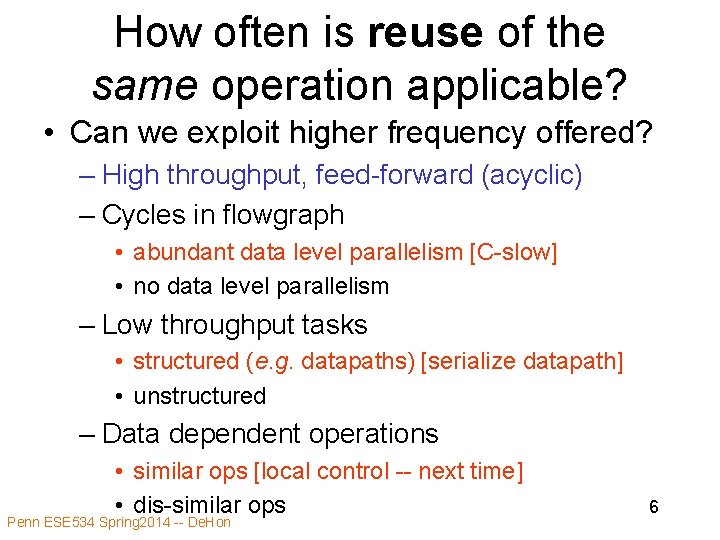
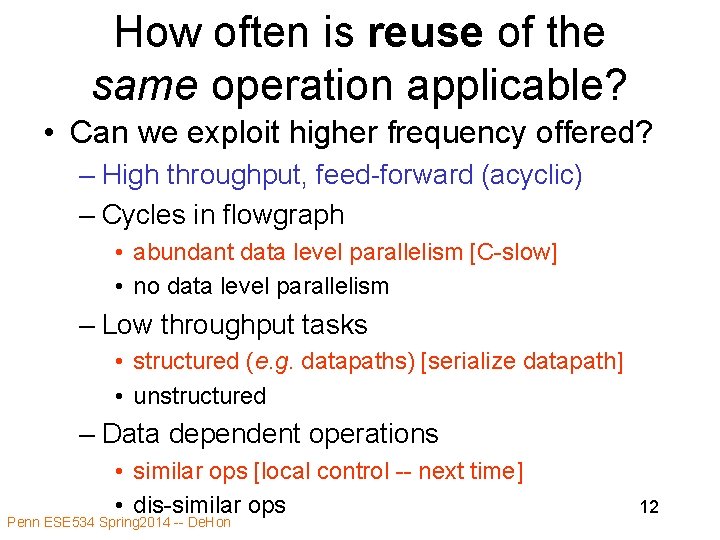
How often is reuse of the same operation applicable? • Can we exploit higher frequency offered? – High throughput, feed-forward (acyclic) – Cycles in flowgraph • abundant data level parallelism [C-slow] • no data level parallelism – Low throughput tasks • structured (e. g. datapaths) [serialize datapath] • unstructured – Data dependent operations • similar ops [local control -- next time] • dis-similar ops Penn ESE 534 Spring 2014 -- De. Hon 6
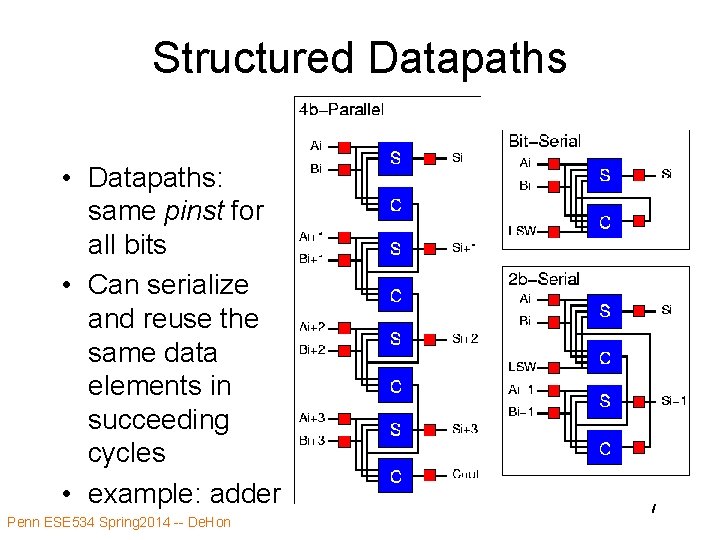
Structured Datapaths • Datapaths: same pinst for all bits • Can serialize and reuse the same data elements in succeeding cycles • example: adder Penn ESE 534 Spring 2014 -- De. Hon 7
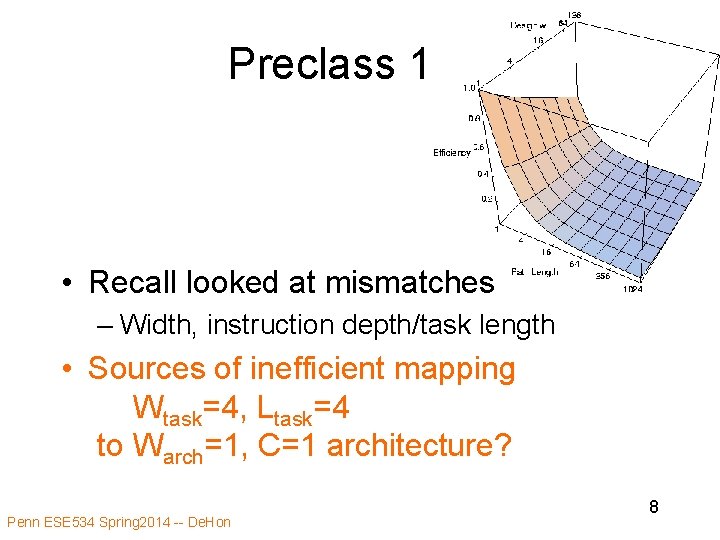
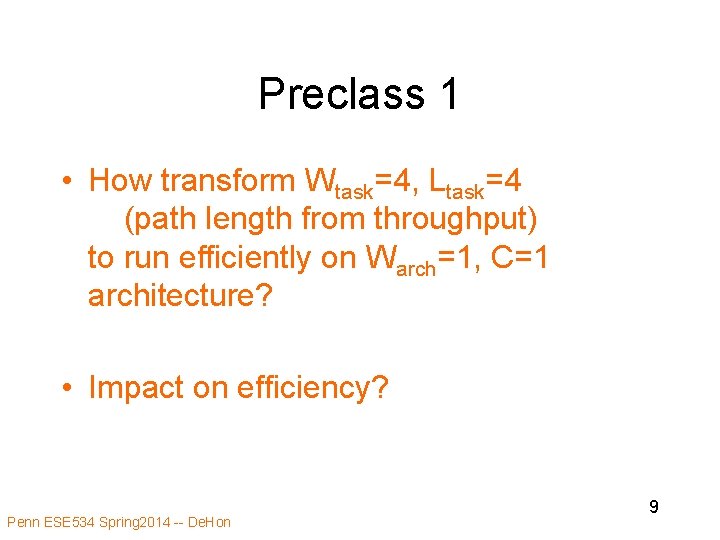
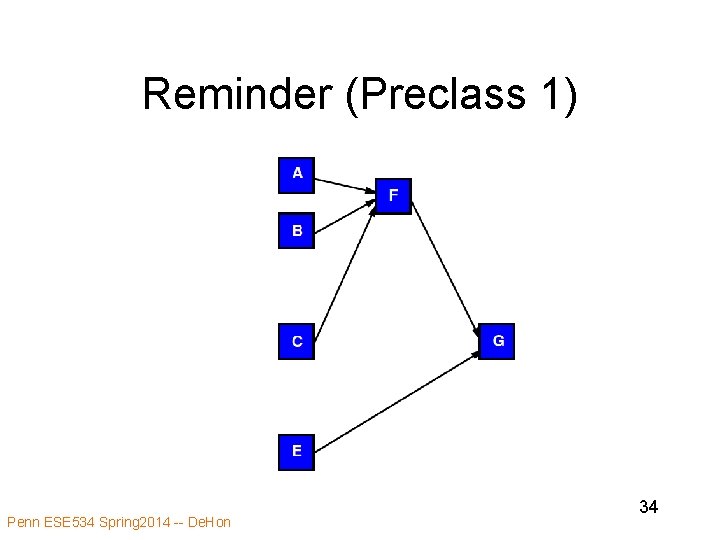
Preclass 1 • Recall looked at mismatches – Width, instruction depth/task length • Sources of inefficient mapping Wtask=4, Ltask=4 to Warch=1, C=1 architecture? Penn ESE 534 Spring 2014 -- De. Hon 8
Preclass 1 • How transform Wtask=4, Ltask=4 (path length from throughput) to run efficiently on Warch=1, C=1 architecture? • Impact on efficiency? Penn ESE 534 Spring 2014 -- De. Hon 9
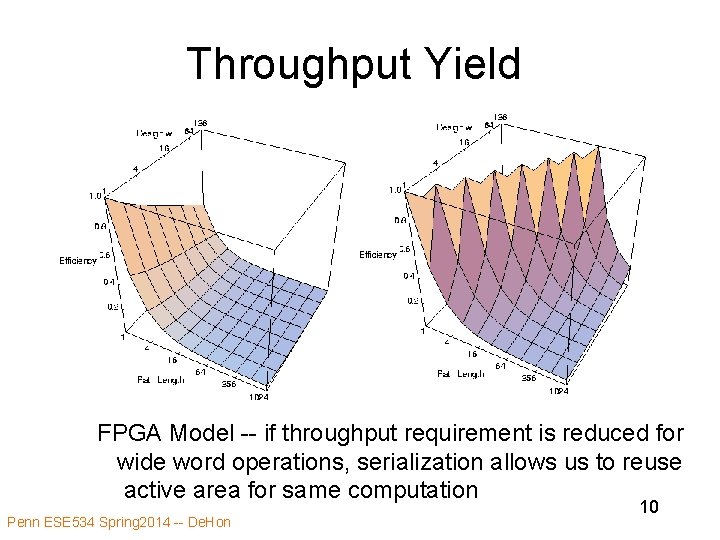
Throughput Yield FPGA Model -- if throughput requirement is reduced for wide word operations, serialization allows us to reuse active area for same computation Penn ESE 534 Spring 2014 -- De. Hon 10
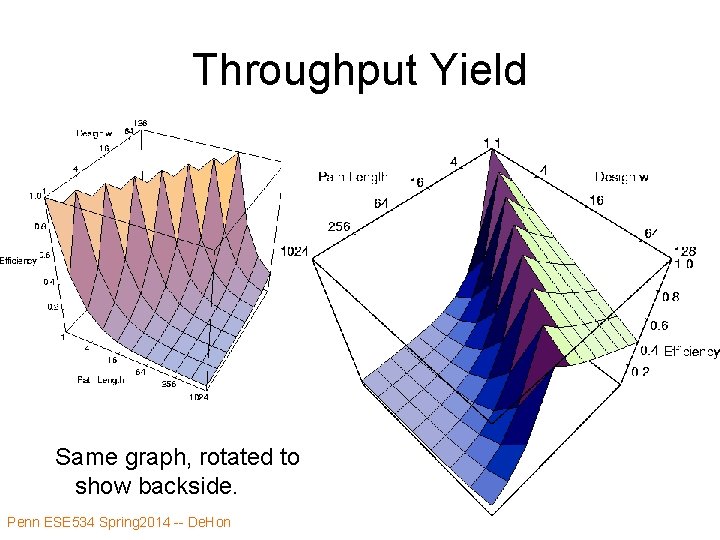
Throughput Yield Same graph, rotated to show backside. Penn ESE 534 Spring 2014 -- De. Hon 11
How often is reuse of the same operation applicable? • Can we exploit higher frequency offered? – High throughput, feed-forward (acyclic) – Cycles in flowgraph • abundant data level parallelism [C-slow] • no data level parallelism – Low throughput tasks • structured (e. g. datapaths) [serialize datapath] • unstructured – Data dependent operations • similar ops [local control -- next time] • dis-similar ops Penn ESE 534 Spring 2014 -- De. Hon 12
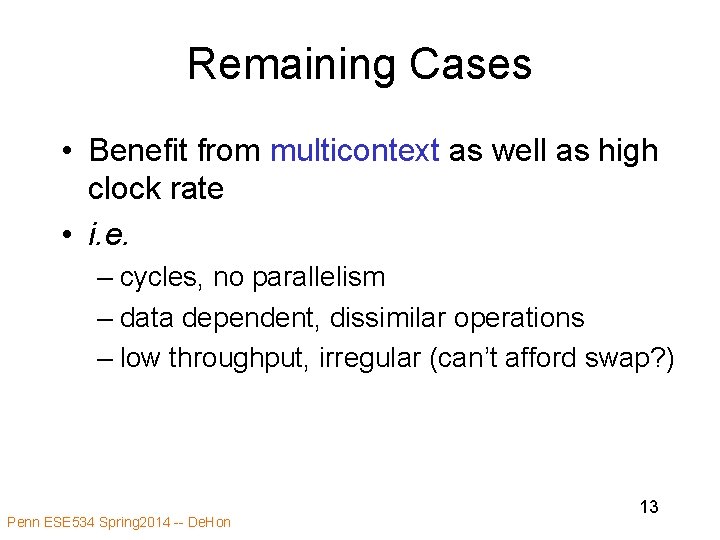
Remaining Cases • Benefit from multicontext as well as high clock rate • i. e. – cycles, no parallelism – data dependent, dissimilar operations – low throughput, irregular (can’t afford swap? ) Penn ESE 534 Spring 2014 -- De. Hon 13
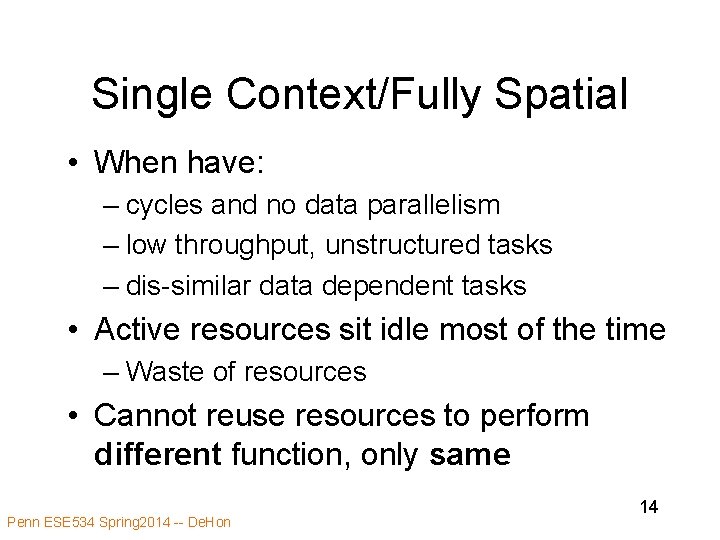
Single Context/Fully Spatial • When have: – cycles and no data parallelism – low throughput, unstructured tasks – dis-similar data dependent tasks • Active resources sit idle most of the time – Waste of resources • Cannot reuse resources to perform different function, only same Penn ESE 534 Spring 2014 -- De. Hon 14
Resource Reuse • To use resources in these cases – must direct to do different things. • Must be able tell resources how to behave • separate instructions (pinsts) for each behavior Penn ESE 534 Spring 2014 -- De. Hon 15
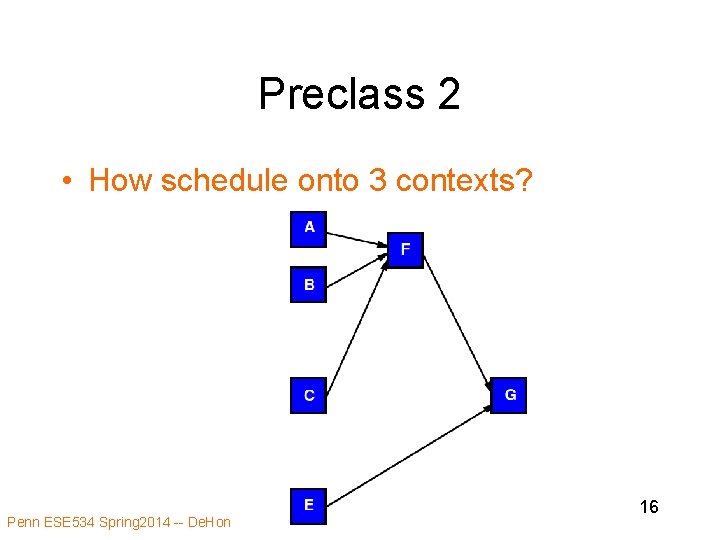
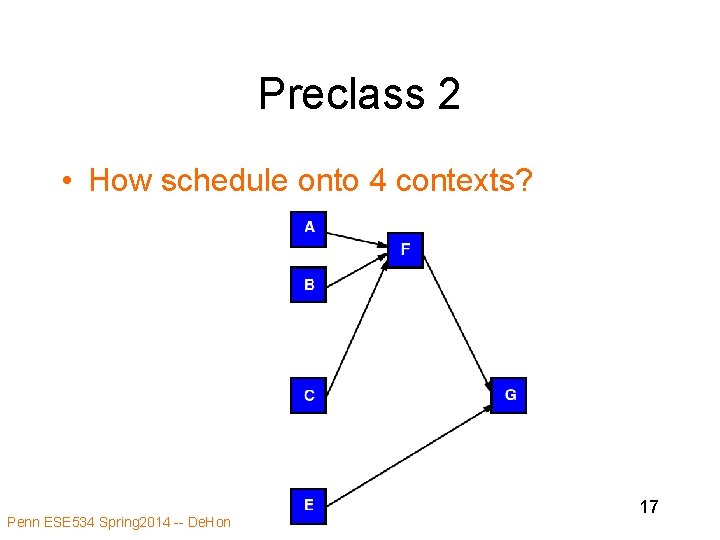
Preclass 2 • How schedule onto 3 contexts? Penn ESE 534 Spring 2014 -- De. Hon 16
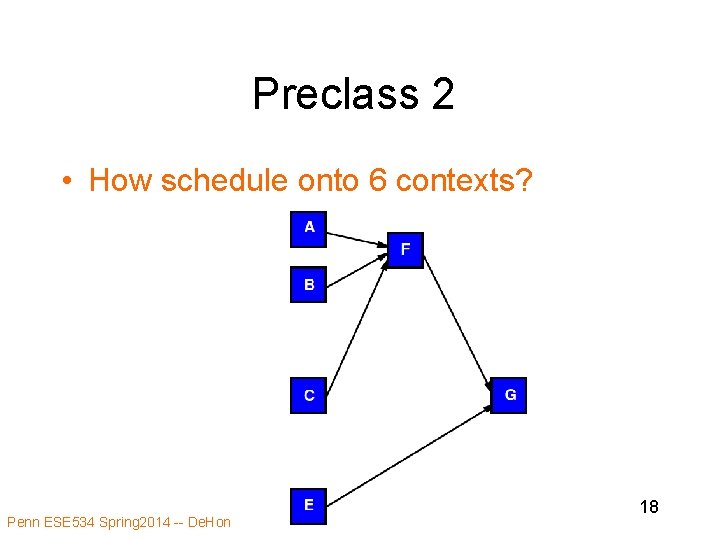
Preclass 2 • How schedule onto 4 contexts? Penn ESE 534 Spring 2014 -- De. Hon 17
Preclass 2 • How schedule onto 6 contexts? Penn ESE 534 Spring 2014 -- De. Hon 18
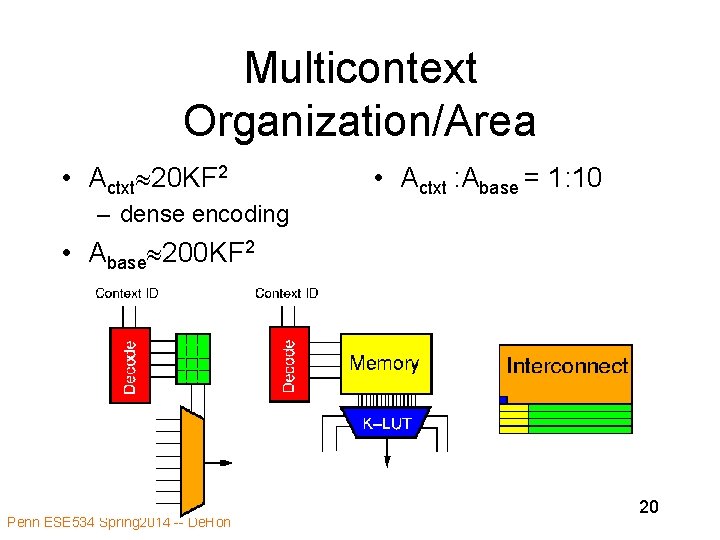
Multicontext Organization/Area • Actxt 20 KF 2 • Actxt : Abase = 1: 10 – dense encoding • Abase 200 KF 2 Penn ESE 534 Spring 2014 -- De. Hon 20
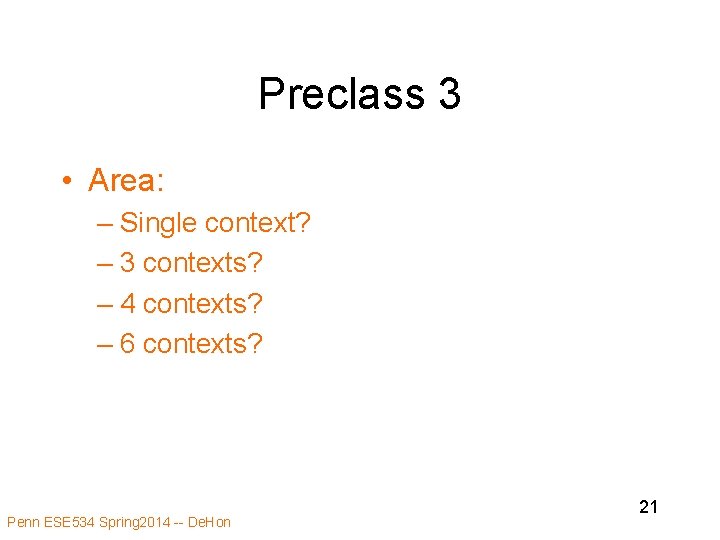
Preclass 3 • Area: – Single context? – 3 contexts? – 4 contexts? – 6 contexts? Penn ESE 534 Spring 2014 -- De. Hon 21
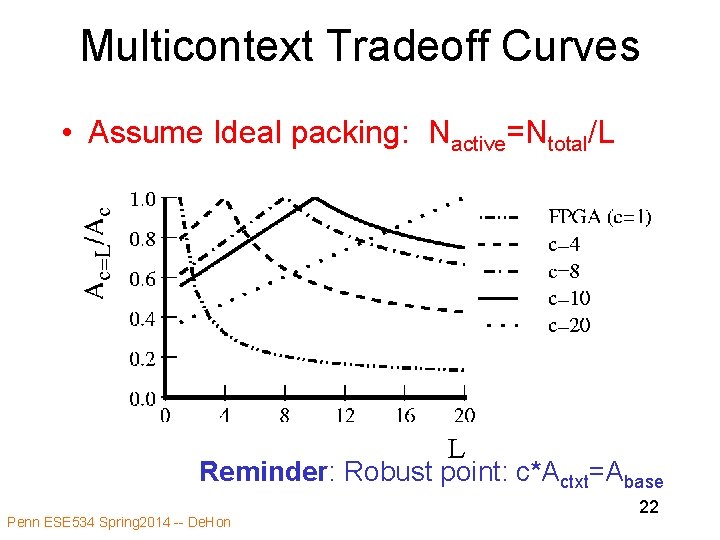
Multicontext Tradeoff Curves • Assume Ideal packing: Nactive=Ntotal/L Reminder: Robust point: c*Actxt=Abase Penn ESE 534 Spring 2014 -- De. Hon 22
In Practice Limitations from: • Scheduling • Retiming Penn ESE 534 Spring 2014 -- De. Hon 23
Scheduling Penn ESE 534 Spring 2014 -- De. Hon 24
Scheduling Limitations • NA (active) – size of largest stage • Precedence: can evaluate a LUT only after predecessors have been evaluated cannot always, completely equalize stage requirements Penn ESE 534 Spring 2014 -- De. Hon 25
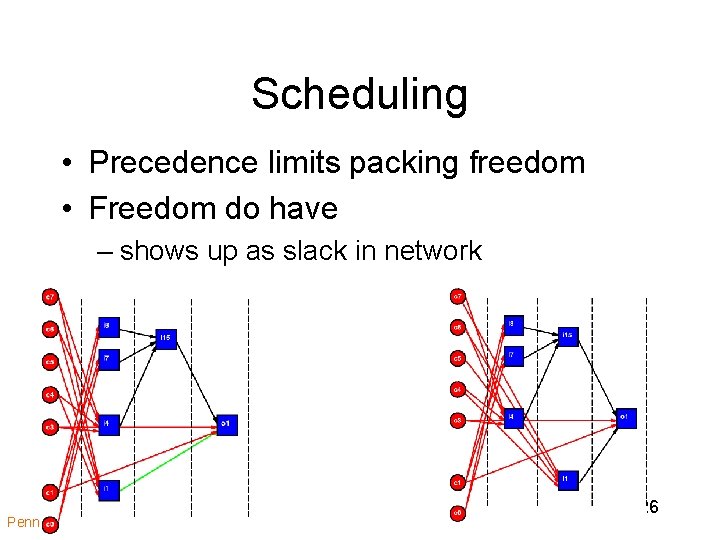
Scheduling • Precedence limits packing freedom • Freedom do have – shows up as slack in network Penn ESE 534 Spring 2014 -- De. Hon 26
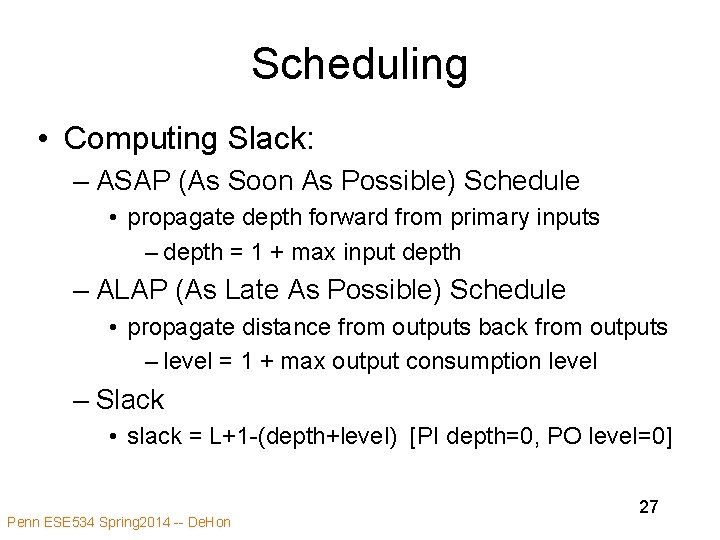
Scheduling • Computing Slack: – ASAP (As Soon As Possible) Schedule • propagate depth forward from primary inputs – depth = 1 + max input depth – ALAP (As Late As Possible) Schedule • propagate distance from outputs back from outputs – level = 1 + max output consumption level – Slack • slack = L+1 -(depth+level) [PI depth=0, PO level=0] Penn ESE 534 Spring 2014 -- De. Hon 27
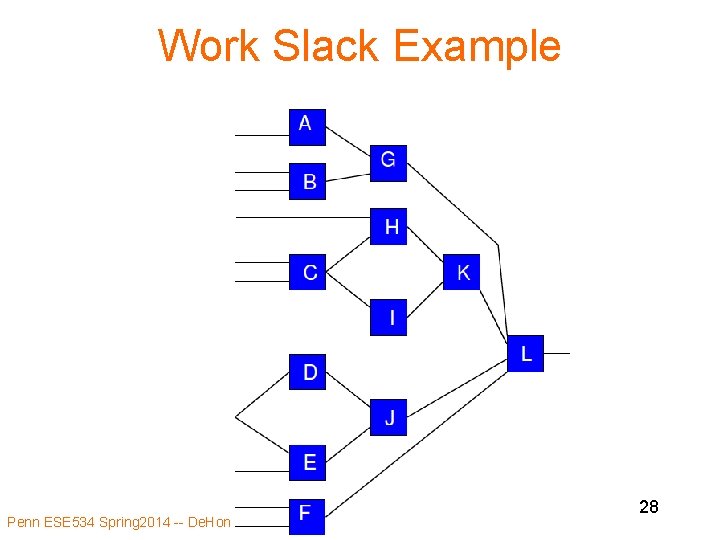
Work Slack Example Penn ESE 534 Spring 2014 -- De. Hon 28
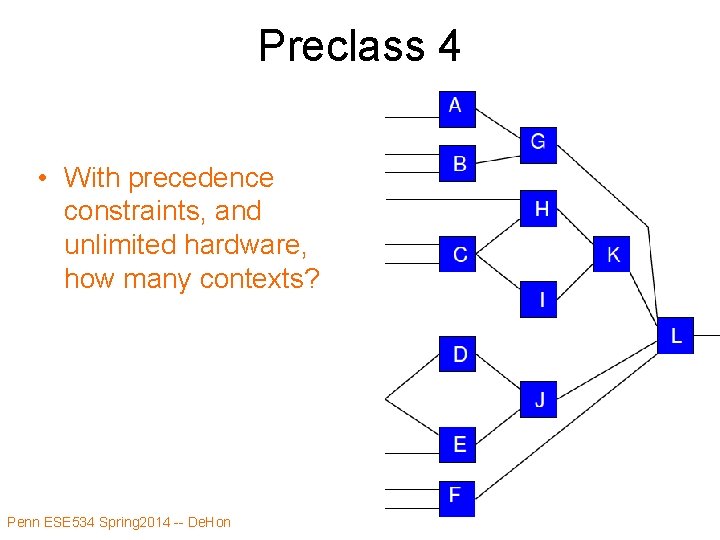
Preclass 4 • With precedence constraints, and unlimited hardware, how many contexts? Penn ESE 534 Spring 2014 -- De. Hon 29
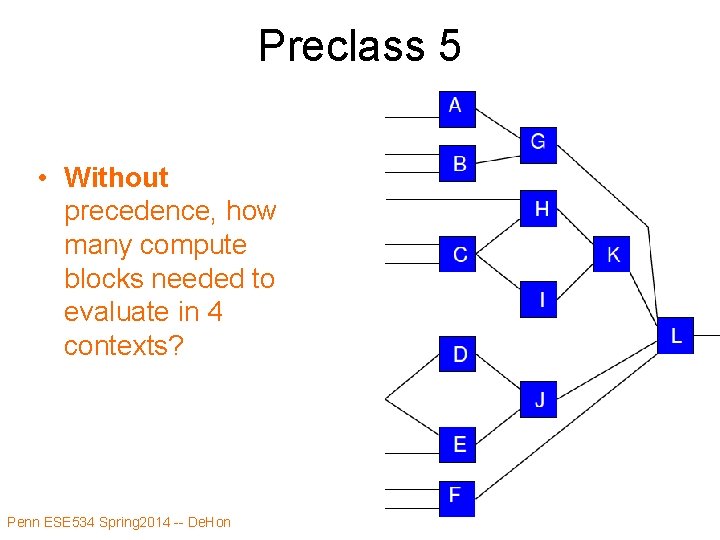
Preclass 5 • Without precedence, how many compute blocks needed to evaluate in 4 contexts? Penn ESE 534 Spring 2014 -- De. Hon 30
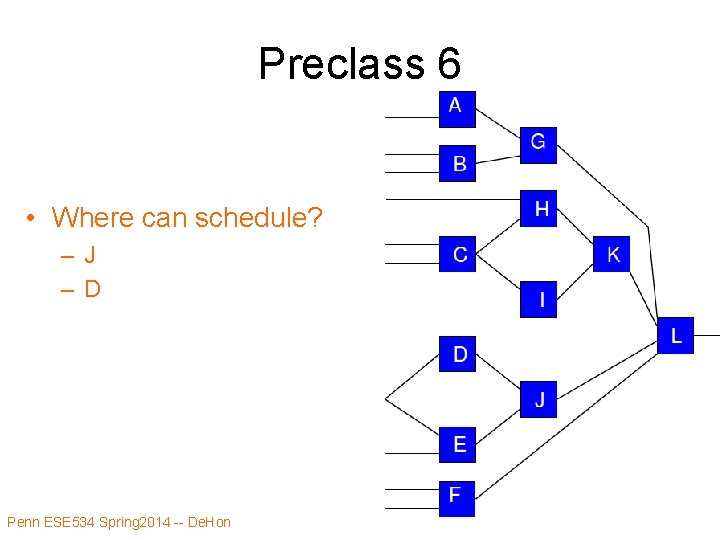
Preclass 6 • Where can schedule? –J –D Penn ESE 534 Spring 2014 -- De. Hon 31
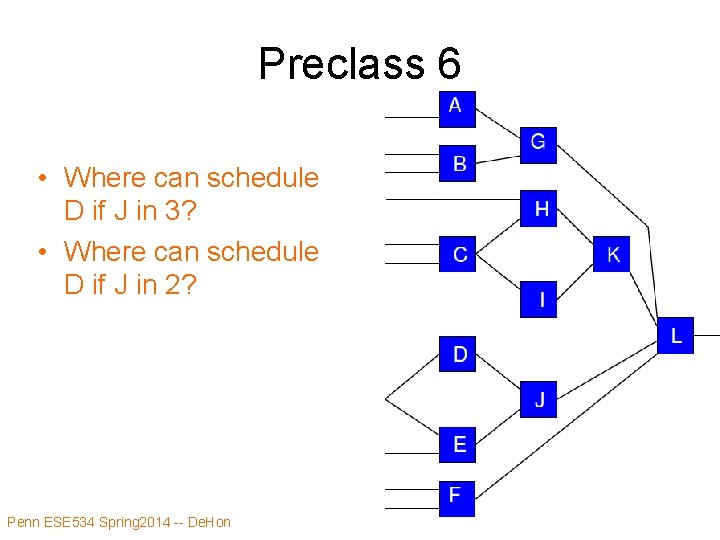
Preclass 6 • Where can schedule D if J in 3? • Where can schedule D if J in 2? Penn ESE 534 Spring 2014 -- De. Hon 32
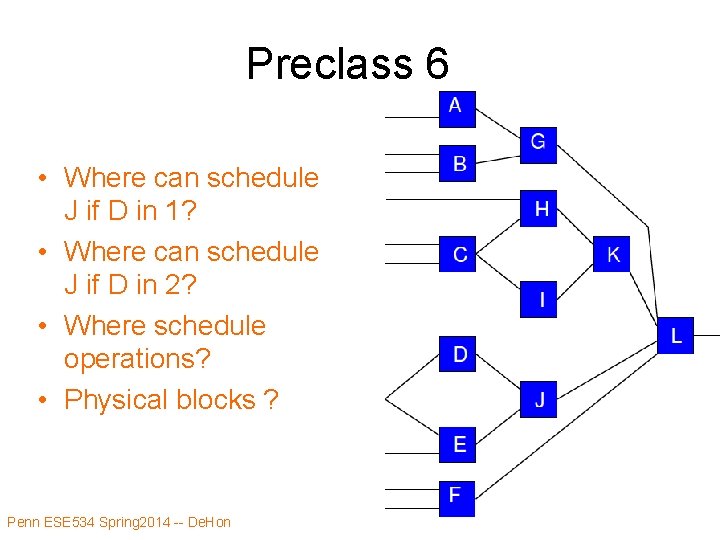
Preclass 6 • Where can schedule J if D in 1? • Where can schedule J if D in 2? • Where schedule operations? • Physical blocks ? Penn ESE 534 Spring 2014 -- De. Hon 33
Reminder (Preclass 1) Penn ESE 534 Spring 2014 -- De. Hon 34
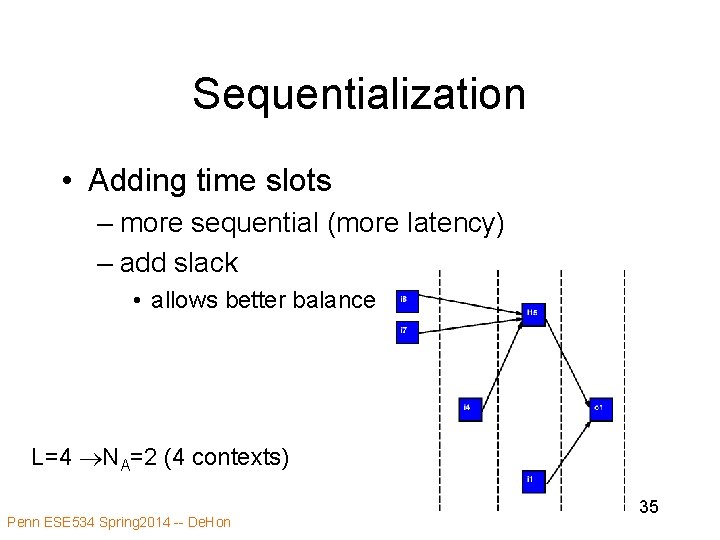
Sequentialization • Adding time slots – more sequential (more latency) – add slack • allows better balance L=4 NA=2 (4 contexts) Penn ESE 534 Spring 2014 -- De. Hon 35
Retiming Penn ESE 534 Spring 2014 -- De. Hon 36
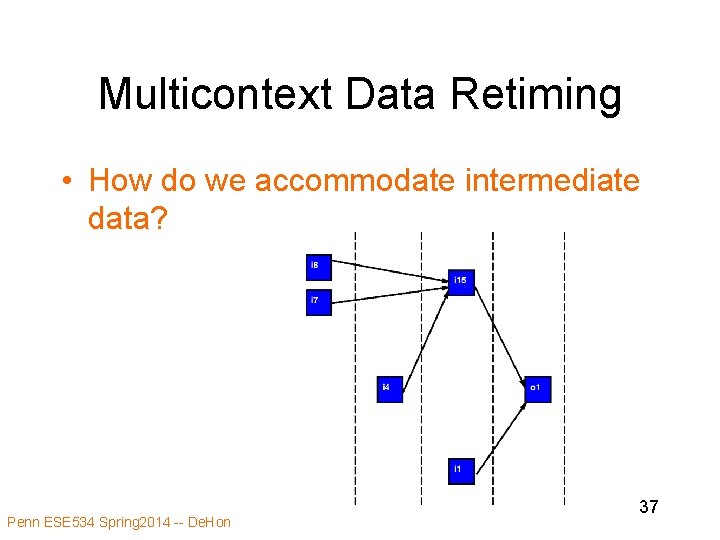
Multicontext Data Retiming • How do we accommodate intermediate data? Penn ESE 534 Spring 2014 -- De. Hon 37
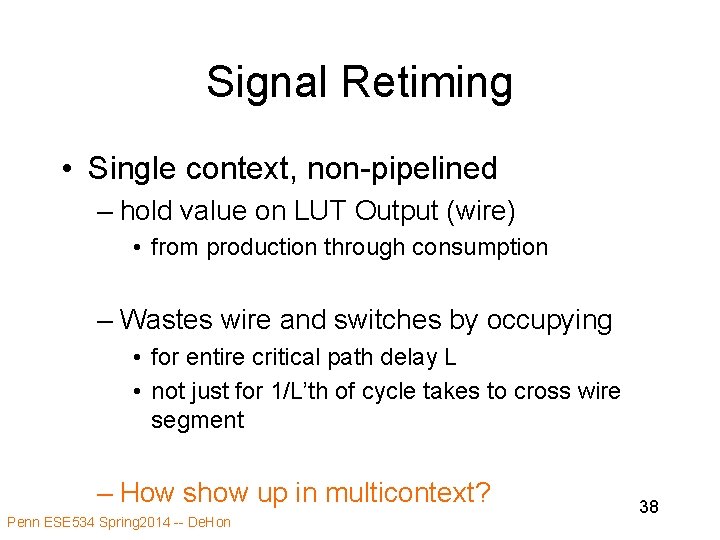
Signal Retiming • Single context, non-pipelined – hold value on LUT Output (wire) • from production through consumption – Wastes wire and switches by occupying • for entire critical path delay L • not just for 1/L’th of cycle takes to cross wire segment – How show up in multicontext? Penn ESE 534 Spring 2014 -- De. Hon 38
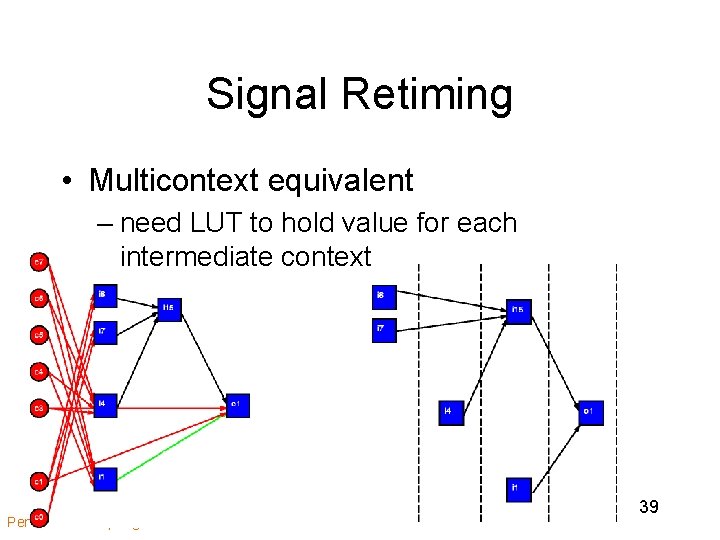
Signal Retiming • Multicontext equivalent – need LUT to hold value for each intermediate context Penn ESE 534 Spring 2014 -- De. Hon 39
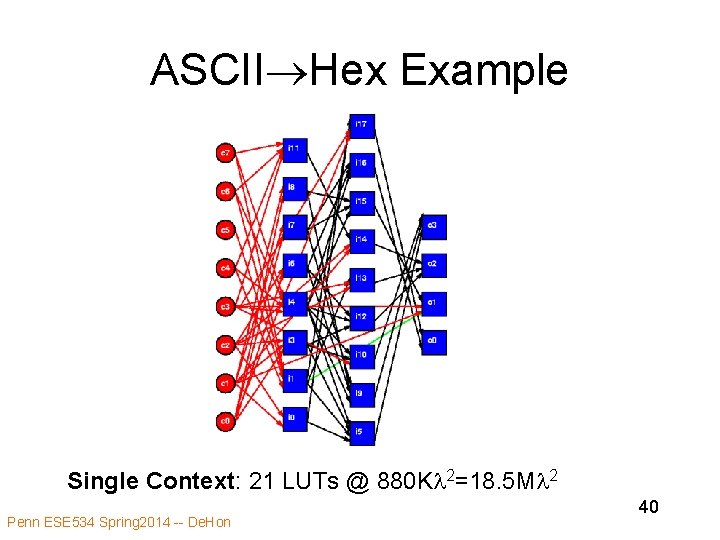
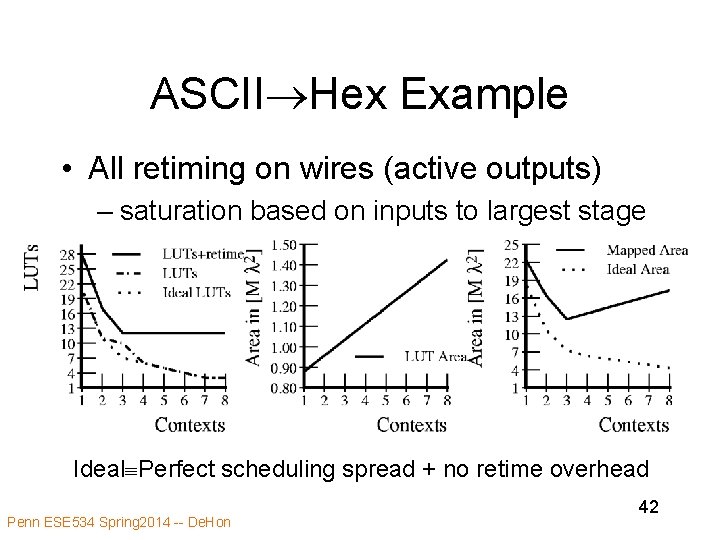
ASCII Hex Example Single Context: 21 LUTs @ 880 Kl 2=18. 5 Ml 2 Penn ESE 534 Spring 2014 -- De. Hon 40
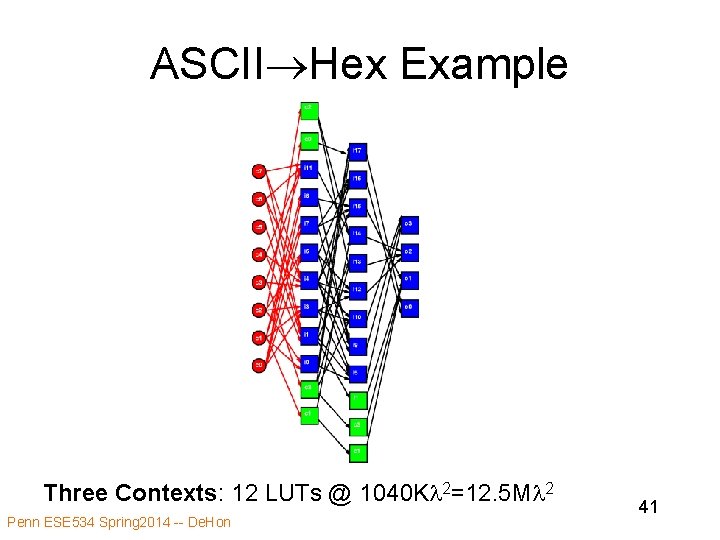
ASCII Hex Example Three Contexts: 12 LUTs @ 1040 Kl 2=12. 5 Ml 2 Penn ESE 534 Spring 2014 -- De. Hon 41
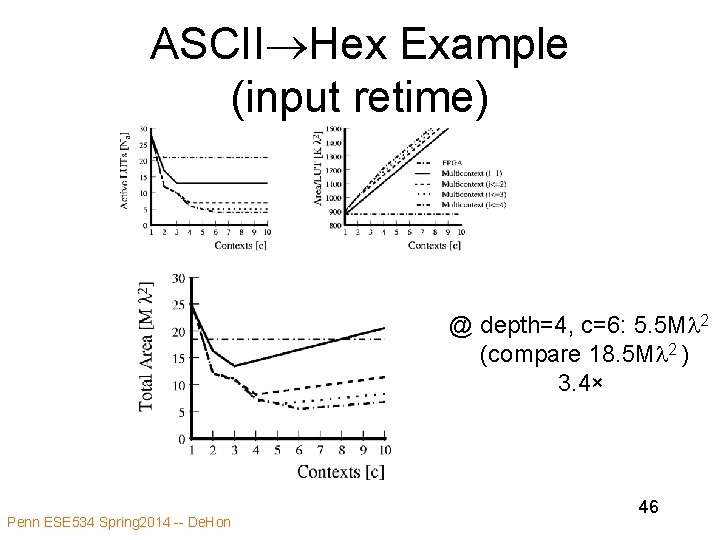
ASCII Hex Example • All retiming on wires (active outputs) – saturation based on inputs to largest stage Ideal Perfect scheduling spread + no retime overhead Penn ESE 534 Spring 2014 -- De. Hon 42
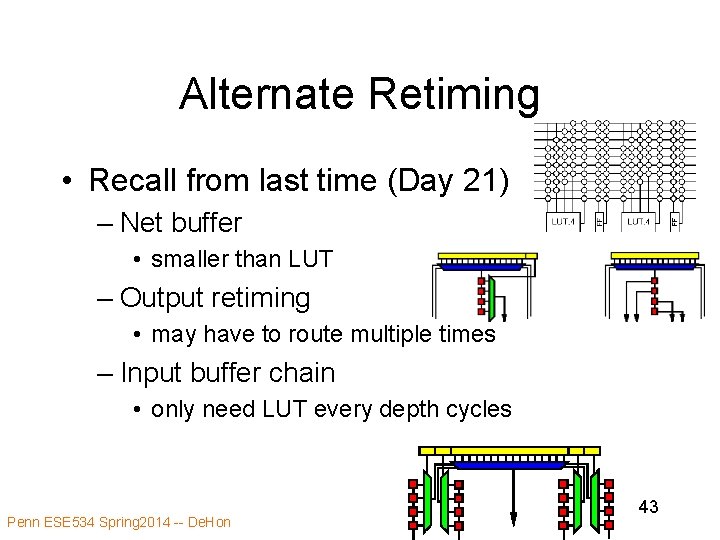
Alternate Retiming • Recall from last time (Day 21) – Net buffer • smaller than LUT – Output retiming • may have to route multiple times – Input buffer chain • only need LUT every depth cycles Penn ESE 534 Spring 2014 -- De. Hon 43
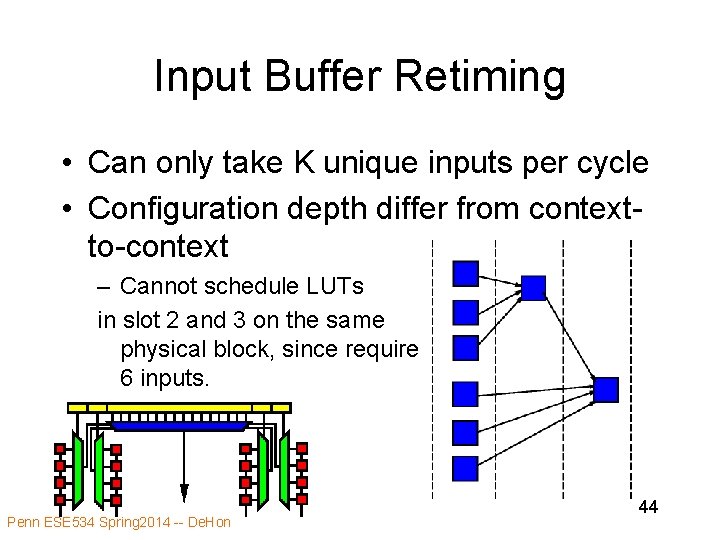
Input Buffer Retiming • Can only take K unique inputs per cycle • Configuration depth differ from contextto-context – Cannot schedule LUTs in slot 2 and 3 on the same physical block, since require 6 inputs. Penn ESE 534 Spring 2014 -- De. Hon 44
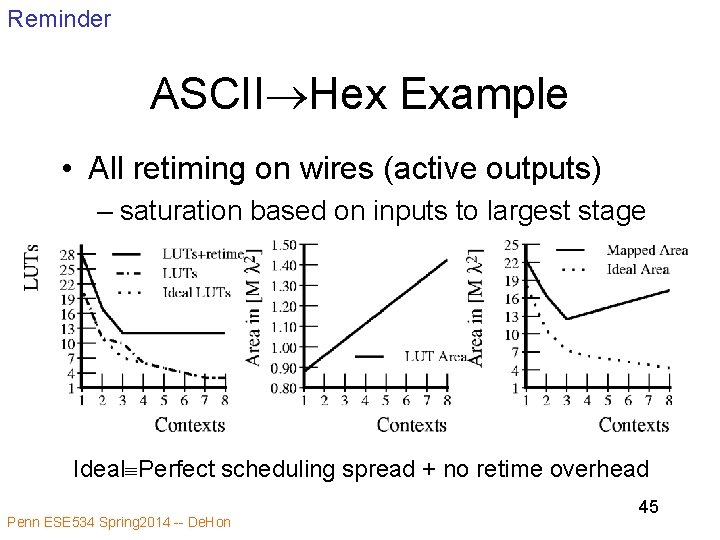
Reminder ASCII Hex Example • All retiming on wires (active outputs) – saturation based on inputs to largest stage Ideal Perfect scheduling spread + no retime overhead Penn ESE 534 Spring 2014 -- De. Hon 45
ASCII Hex Example (input retime) @ depth=4, c=6: 5. 5 Ml 2 (compare 18. 5 Ml 2 ) 3. 4× Penn ESE 534 Spring 2014 -- De. Hon 46
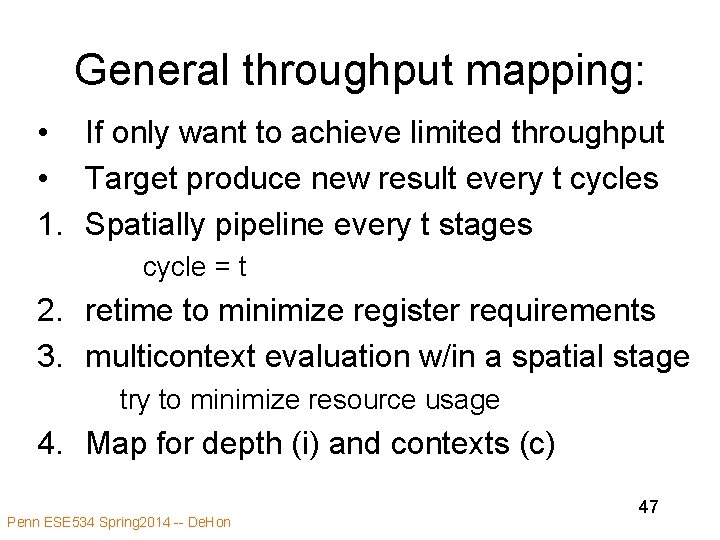
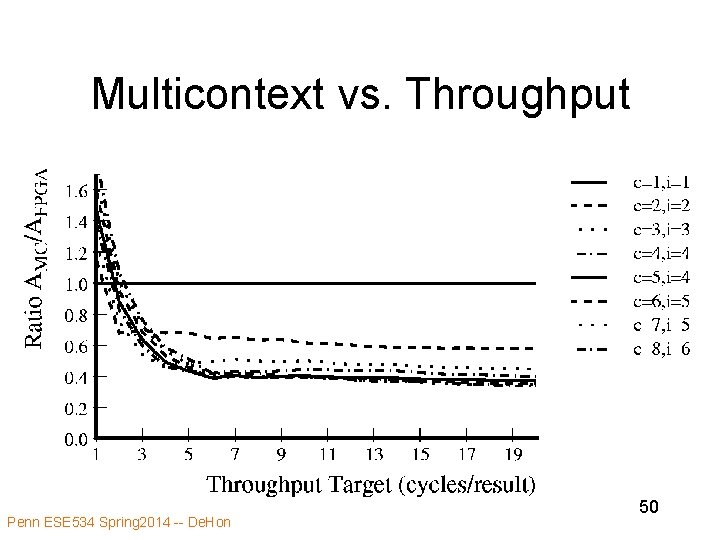
General throughput mapping: • If only want to achieve limited throughput • Target produce new result every t cycles 1. Spatially pipeline every t stages cycle = t 2. retime to minimize register requirements 3. multicontext evaluation w/in a spatial stage try to minimize resource usage 4. Map for depth (i) and contexts (c) Penn ESE 534 Spring 2014 -- De. Hon 47
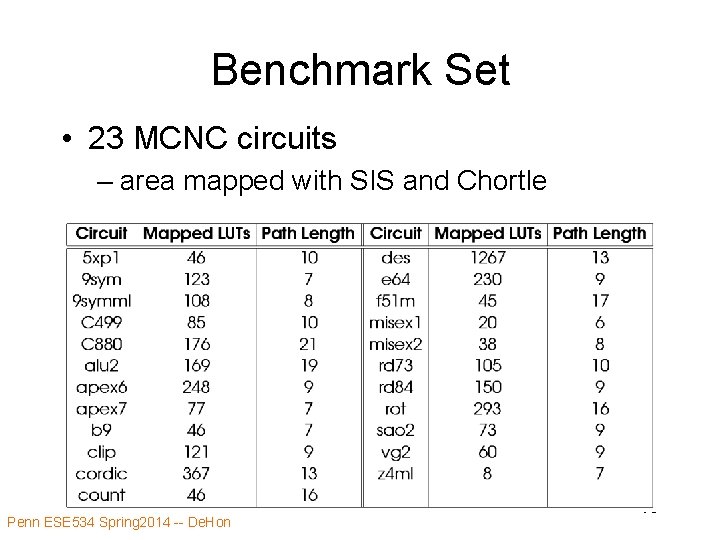
Benchmark Set • 23 MCNC circuits – area mapped with SIS and Chortle Penn ESE 534 Spring 2014 -- De. Hon 48
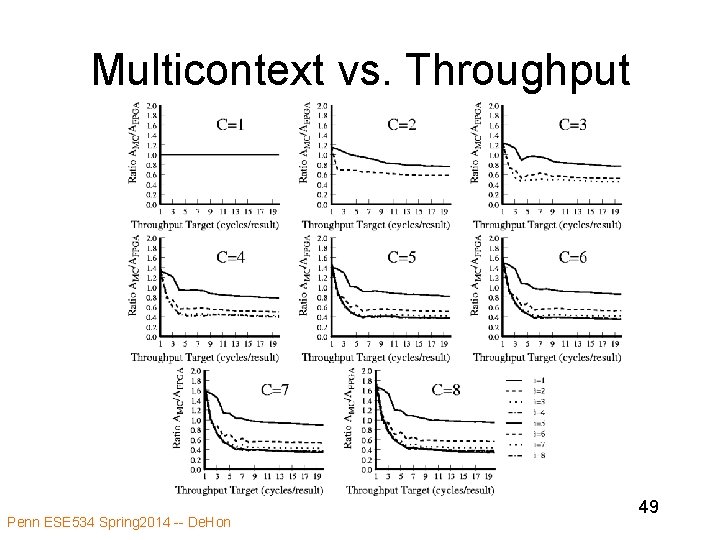
Multicontext vs. Throughput Penn ESE 534 Spring 2014 -- De. Hon 49
Multicontext vs. Throughput Penn ESE 534 Spring 2014 -- De. Hon 50
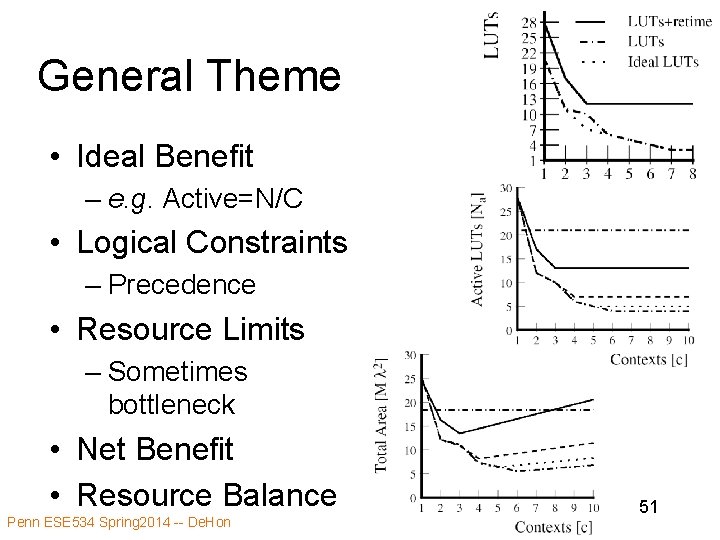
General Theme • Ideal Benefit – e. g. Active=N/C • Logical Constraints – Precedence • Resource Limits – Sometimes bottleneck • Net Benefit • Resource Balance Penn ESE 534 Spring 2014 -- De. Hon 51
Beyond Area Penn ESE 534 Spring 2014 -- De. Hon 52
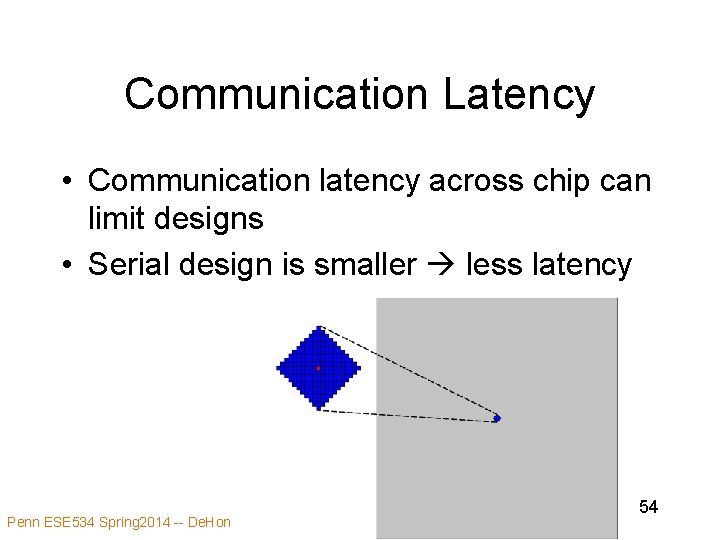
Only an Area win? • If area were free, would we always want a fully spatial design? Penn ESE 534 Spring 2014 -- De. Hon 53
Communication Latency • Communication latency across chip can limit designs • Serial design is smaller less latency Penn ESE 534 Spring 2014 -- De. Hon 54
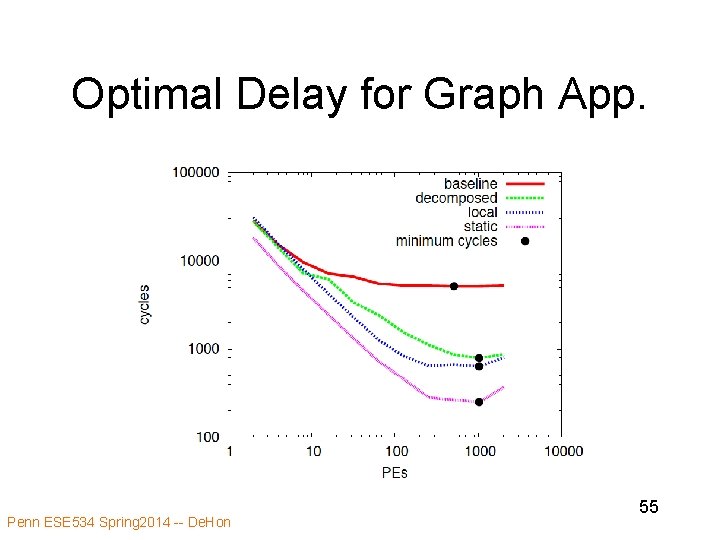
Optimal Delay for Graph App. Penn ESE 534 Spring 2014 -- De. Hon 55
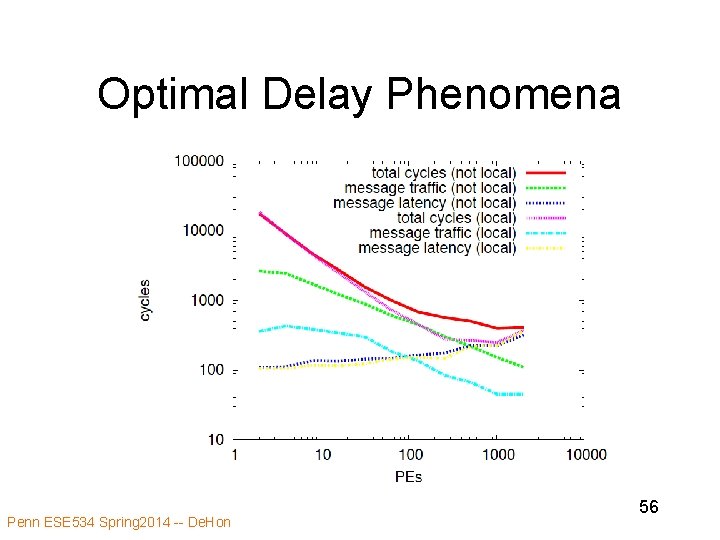
Optimal Delay Phenomena Penn ESE 534 Spring 2014 -- De. Hon 56
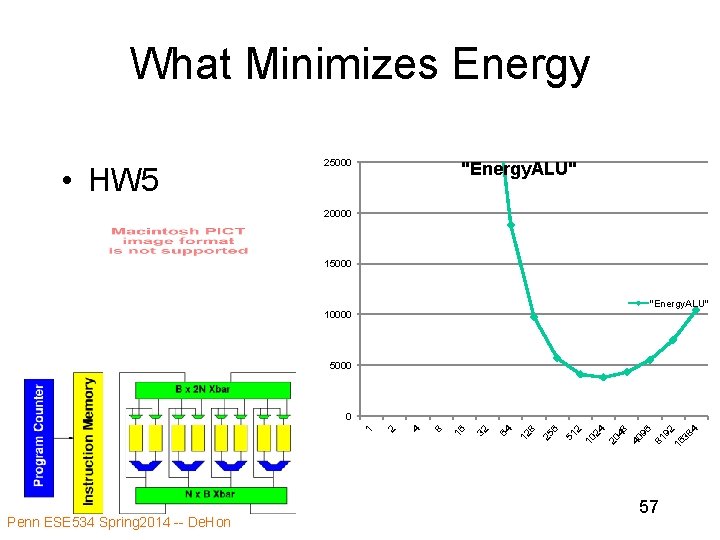
What Minimizes Energy • HW 5 25000 "Energy. ALU" 20000 15000 "Energy. ALU" 10000 5000 Penn ESE 534 Spring 2014 -- De. Hon 81 92 16 38 4 40 96 20 48 2 10 24 51 6 25 8 12 64 32 16 8 4 2 1 0 57
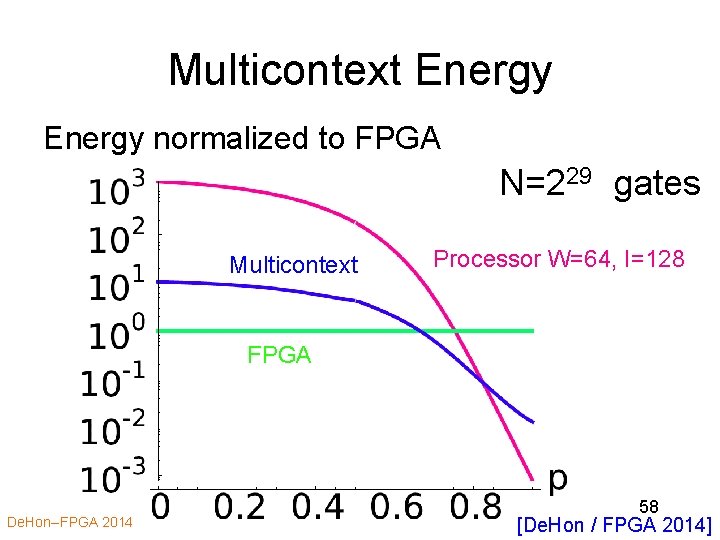
Multicontext Energy normalized to FPGA N=229 gates Multicontext Processor W=64, I=128 FPGA De. Hon--FPGA 2014 58 [De. Hon / FPGA 2014]
Components Penn ESE 534 Spring 2014 -- De. Hon 59
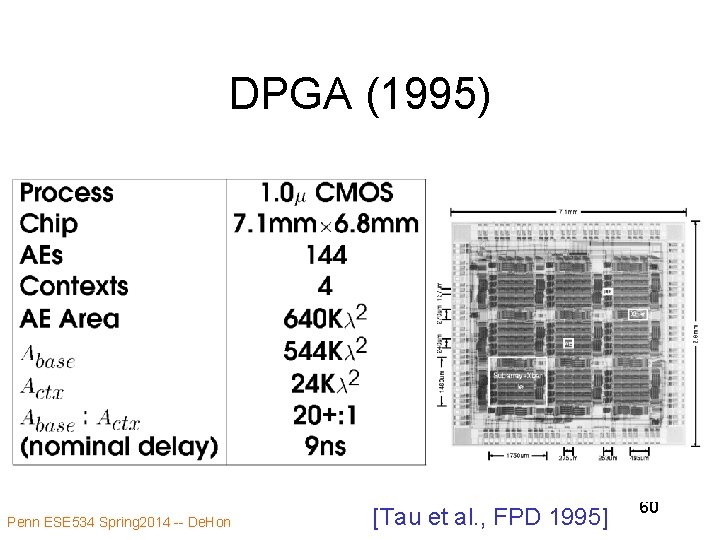
DPGA (1995) Penn ESE 534 Spring 2014 -- De. Hon [Tau et al. , FPD 1995] 60
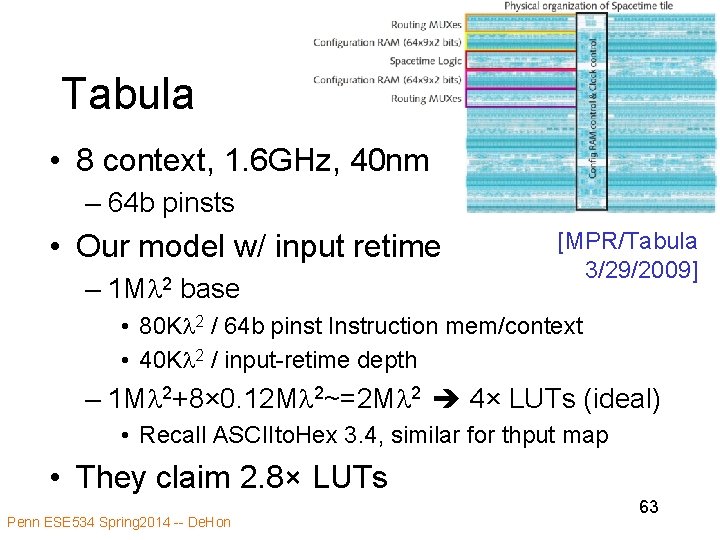
Tabula • 8 context, 1. 6 GHz, 40 nm – 64 b pinsts • Our model w/ input retime – 1 Ml 2 base [MPR/Tabula 3/29/2009] • 80 Kl 2 / 64 b pinst Instruction mem/context • 40 Kl 2 / input-retime depth – 1 Ml 2+8× 0. 12 Ml 2~=2 Ml 2 4× LUTs (ideal) • Recall ASCIIto. Hex 3. 4, similar for thput map • They claim 2. 8× LUTs Penn ESE 534 Spring 2014 -- De. Hon 63
Big Ideas [MSB Ideas] • Several cases cannot profitably reuse same logic at device cycle rate – cycles, no data parallelism – low throughput, unstructured – dis-similar data dependent computations • These cases benefit from more than one instructions/operations per active element • Actxt<< Aactive makes interesting – save area by sharing active among instructions Penn ESE 534 Spring 2014 -- De. Hon 64
Big Ideas [MSB-1 Ideas] • Energy benefit for large p • Economical retiming becomes important here to achieve active LUT reduction – one output reg/LUT leads to early saturation • c=4 --8, I=4 --6 automatically mapped designs roughly 1/3 single context size • Most FPGAs typically run in realm where multicontext is smaller – How many for intrinsic reasons? – How many for lack of register/CAD support? Penn ESE 534 Spring 2014 -- De. Hon 65
Admin • HW 9 today • Final Exercise • Reading for Monday on Web Penn ESE 534 Spring 2014 -- De. Hon 66