
ESE 290291 Introduction to Electrical Systems Engineering Research
- Slides: 10
ESE 290/291 Introduction to Electrical & Systems Engineering Research Methodology & Design https: //upenn. instructure. com/courses/1312059 http: //ese 290. highermedia. com Lecture 0: Administrative Details D. E. Koditschek kod@upenn. edu Penn Engineering Research Collaboration Hub (PERCH) 3 rd Floor Pennovation Center (Bldg 6176) 3401 Grays Ferry Ave, PA 19146
Outline • Motivation & Philosophy • Course overview – content; organization – sponsored projects – timeline • Logistics (workload; credit) • Summary
Motivation • Student Interest (Chair’s UG Advisory Board) • Student Need – learning “how to learn” • literature search in unfamiliar technical domains • taking the pulse of current state-of-art • addressing gaps in personal knowledge base – extracting more complete value from Penn – assessing career options (full spectrum) • Departmental Need – students do not really know us – intellectual culture
Philosophy • Need for Lifelong Education: Independent Learner – Human knowledge continues to explode – Technology changes too quickly to teach much specifics • Independent Learner ) Critical Thinker – Motivated: curiosity-driven inquiry – Skeptical: evidence-driven “cross-checks” – Social: diverse-group-driven progress • Critical Thinker ) Scientific Researcher social creation of a never-ending web of technical hypotheses • Scientific Researcher ) Effective Citizen ability to determine facts opens up the hope of establishing truth
Course overview: workload; goals • Workload: 1. 5 CU ¼ 10 – 15 hr/wk effort – ESE 290: ~ 40 - 60 min/wk lecture; ~ 2 -4 hr/wk exercises – ESE 291: ~ 5 -10 hr/wk lecture lab work (more as research progresses) • Students gain – critical thinking skills: relevant to any technical/engineering career – research experience: what it’s like; what ESE faculty “do” – potential longer term match: summer internship; papers; …
A Bit More Detailed Overview • ESE 290, 0. 5 CU: scaffolded introduction to research process (2 – 4 hr/wk) – – – Lectures (Towne 305): ~ 40 – 60 min (remainder of class time for group check-in) Exercises: finding, interpreting, using source articles Design: planning, organizing, executing, recording research Communications: mid-term & final presentations and papers Instructor’s Office hours (358 GRW) : Tue, 10: 30 -11: 30 pm; Fri, 9: 00 - 11: 00 pm TA’s Office hours (tba) • ESE 291, 1. 0 CU: mentored lab experience (5 – 10+ hr/wk) – individually arranged student/faculty pairing: students apply; sponsor chooses – research project guided by mentor as directed by sponsor • Prequisites: MATH 240, PHYS 150, ESE 215 and 218, or ESE 204 and 210, or ESE 215 and CIS 240 • Selection process via repository http: //ese 290. highermedia. com – majority of class (16/22) now matched with sponsor/mentor/project – remaining cases should be readily matchable (apply online – or propose your own) – selection by some faculty sponsor • • • required for continued permission to remain in course final date for sponsor selection: Jan. 30 (end of course selection period) Impact on ESE Program Requirements – fulfill’s EE, SSE, NETS 1. 5 CU lab requirement – does not fulfill CMPE concurrency lab requirement
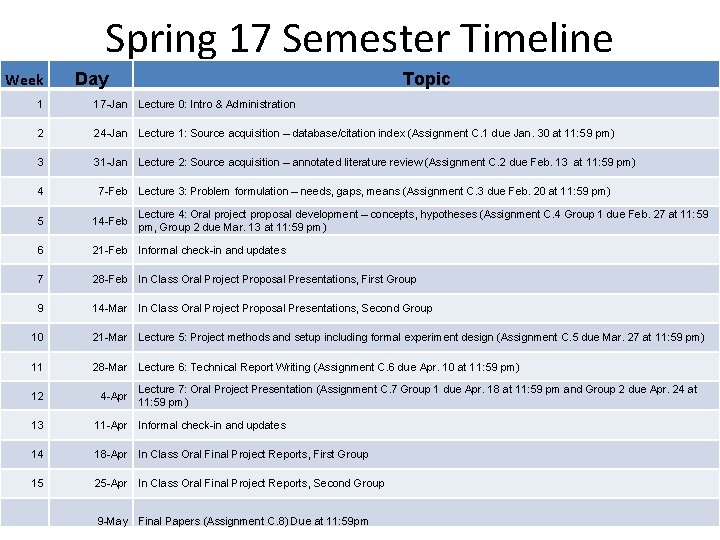
Spring 17 Semester Timeline Week Day Topic 1 17 -Jan Lecture 0: Intro & Administration 2 24 -Jan Lecture 1: Source acquisition – database/citation index (Assignment C. 1 due Jan. 30 at 11: 59 pm) 3 31 -Jan Lecture 2: Source acquisition – annotated literature review (Assignment C. 2 due Feb. 13 at 11: 59 pm) 4 7 -Feb Lecture 3: Problem formulation – needs, gaps, means (Assignment C. 3 due Feb. 20 at 11: 59 pm) Lecture 4: Oral project proposal development – concepts, hypotheses (Assignment C. 4 Group 1 due Feb. 27 at 11: 59 pm, Group 2 due Mar. 13 at 11: 59 pm) 5 14 -Feb 6 21 -Feb Informal check-in and updates 7 28 -Feb In Class Oral Project Proposal Presentations, First Group 9 14 -Mar In Class Oral Project Proposal Presentations, Second Group 10 21 -Mar Lecture 5: Project methods and setup including formal experiment design (Assignment C. 5 due Mar. 27 at 11: 59 pm) 11 28 -Mar Lecture 6: Technical Report Writing (Assignment C. 6 due Apr. 10 at 11: 59 pm) 12 4 -Apr Lecture 7: Oral Project Presentation (Assignment C. 7 Group 1 due Apr. 18 at 11: 59 pm and Group 2 due Apr. 24 at 11: 59 pm) 13 11 -Apr Informal check-in and updates 14 18 -Apr In Class Oral Final Project Reports, First Group 15 25 -Apr In Class Oral Final Project Reports, Second Group 9 -May Final Papers (Assignment C. 8) Due at 11: 59 pm
Workload Details • Scaffold Component (290) – 8 bi-weekly (roughly) pdf submissions via Canvas portal only – no credit for late submissions • Research Component (291) – highly variable • Ethics (http: //www. seas. upenn. edu/undergraduate/handbook/student-ethics. php) • Collaboration – discuss work freely with others (in class; out) – submitted exercises must reflect individual effort (generated by you working with mentor & sponsor) – when in doubt: cite your sources • web, • informal, e. g. , “personal communication”, etc.
Credit • Weekly exercises – broken out into rubrics – point values posted at portal – scored by combination of 290 & 291 staff – graders‘ comments via Canvas (pdf stickies & sheet) • Credit only as recorded on Canvas spreadsheet • Final numerical score: accumulated sum of points • Grade assignment: – strictly by numerical range – posted on web course description document
Summary • 1. 5 CU: apply for project via repository – ESE 290 : 0. 5 CU structured exercises – ESE 291: 1. 0 CU individually mentored project • Try out a world class research experience – connection : may lead to independent study projects or lab positions – life skills: critical thinking; problem solving; self-directed – University of Pennsylvania: don’t miss out/regret • Have Fun!