
ESDIS Budget Process Diane Hronek Jeanne Behnke DAAC
ESDIS Budget Process Diane Hronek Jeanne Behnke DAAC Managers Meeting May 17, 2019
Goals for this Session • Come away from the meeting understanding: – Terminology – Budget Formulation Process – Budget Execution Process For NASA Internal Use Only 2
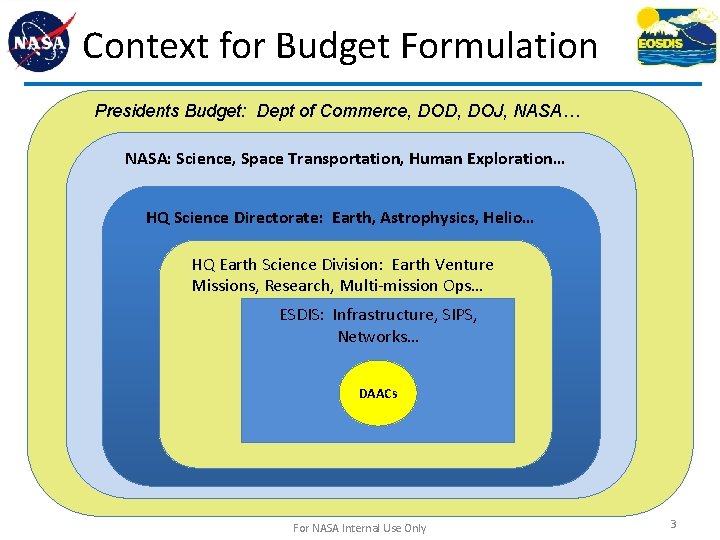
Context for Budget Formulation Presidents Budget: Dept of Commerce, DOD, DOJ, NASA… NASA: Science, Space Transportation, Human Exploration… HQ Science Directorate: Earth, Astrophysics, Helio… HQ Earth Science Division: Earth Venture Missions, Research, Multi-mission Ops… ESDIS: Infrastructure, SIPS, Networks… DAACs For NASA Internal Use Only 3

NASA Budget Process (PPBE) • PPBE = Planning, Programming, Budgeting and Execution – Guidance from NASA Program and Project Management Processes and Requirements (NPR) 7120. 5 – More info: check out the NASA home page under budget and performance • http: //www. nasa. gov/news/budget/index. html#. Uv 1 d. Ufax. Yfk – It takes approximately 21 months from Budget start to Appropriation following the process: • • • 6 months with the agencies 3 months with OMB 3 months with the President 6 months with Congress 2 months back with OMB 1 month back at the Agency with the Appropriation For NASA Internal Use Only 4
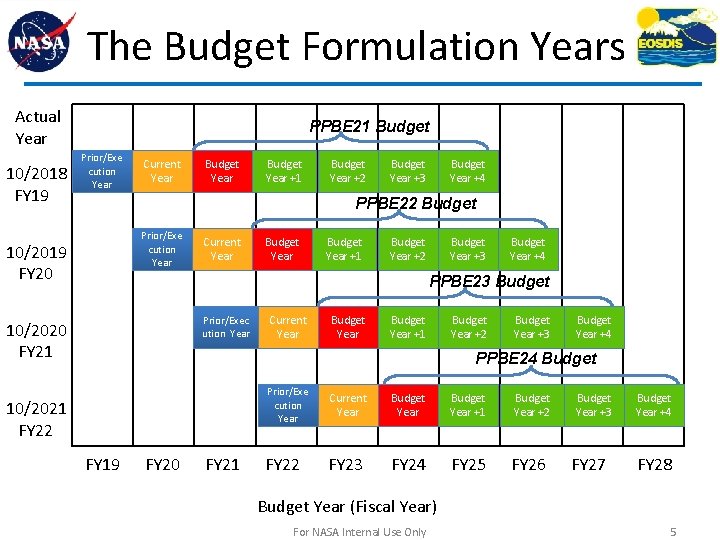
The Budget Formulation Years Actual Year 10/2018 FY 19 PPBE 21 Budget Prior/Exe cution Year Current Year Budget Year +1 Budget Year +2 Budget Year +3 Budget Year +4 PPBE 22 Budget Prior/Exe cution Year 10/2019 FY 20 Current Year Budget Year +1 Budget Year +2 Budget Year +3 Budget Year +4 PPBE 23 Budget Prior/Exec ution Year 10/2020 FY 21 Current Year Budget Year +1 Budget Year +2 Budget Year +3 Budget Year +4 PPBE 24 Budget 10/2021 FY 22 FY 19 FY 20 FY 21 Prior/Exe cution Year Current Year Budget Year +1 Budget Year +2 FY 23 FY 24 FY 25 FY 26 Budget Year +3 FY 27 Budget Year +4 FY 28 Budget Year (Fiscal Year) For NASA Internal Use Only 5
Budget “An Expression of Policy” • An ESDIS financial plan that provides a summary of intended expenditures along with proposals for how to meet them • A managerial/administrative instrument that ensures all ESDIS programs/activities will be reviewed at least once a year • An accounting instrument that holds the ESDIS PM and staff responsible for the funds with which they have been entrusted For NASA Internal Use Only 6
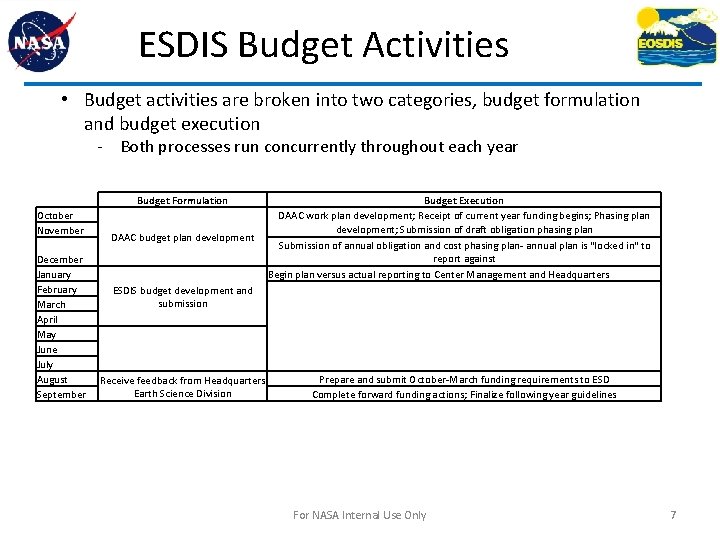
ESDIS Budget Activities • Budget activities are broken into two categories, budget formulation and budget execution - Both processes run concurrently throughout each year Budget Formulation October November December January February March April May June July August September DAAC budget plan development Budget Execution DAAC work plan development; Receipt of current year funding begins; Phasing plan development; Submission of draft obligation phasing plan Submission of annual obligation and cost phasing plan- annual plan is "locked in" to report against Begin plan versus actual reporting to Center Management and Headquarters ESDIS budget development and submission Receive feedback from Headquarters Earth Science Division Prepare and submit October-March funding requirements to ESD Complete forward funding actions; Finalize following year guidelines For NASA Internal Use Only 7
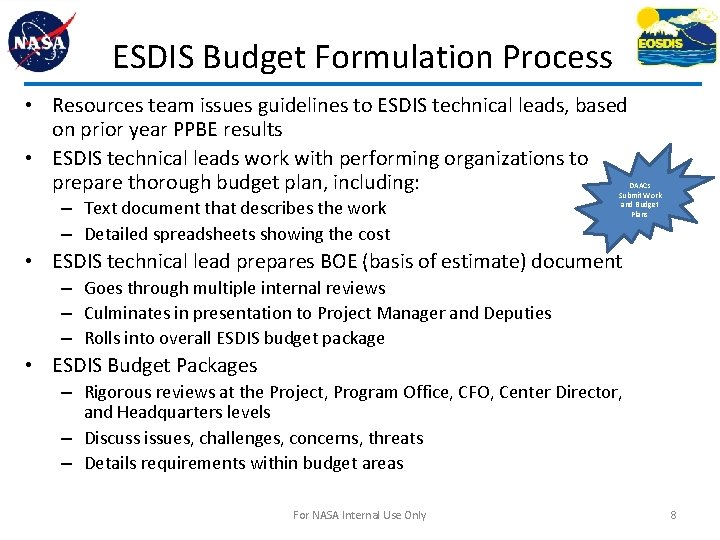
ESDIS Budget Formulation Process • Resources team issues guidelines to ESDIS technical leads, based on prior year PPBE results • ESDIS technical leads work with performing organizations to prepare thorough budget plan, including: – Text document that describes the work – Detailed spreadsheets showing the cost DAACs Submit Work and Budget Plans • ESDIS technical lead prepares BOE (basis of estimate) document – Goes through multiple internal reviews – Culminates in presentation to Project Manager and Deputies – Rolls into overall ESDIS budget package • ESDIS Budget Packages – Rigorous reviews at the Project, Program Office, CFO, Center Director, and Headquarters levels – Discuss issues, challenges, concerns, threats – Details requirements within budget areas For NASA Internal Use Only 8
ESDIS Budget Formulation Process • The budget package includes a lengthy description of all of the ESDIS requirements, for example: Science Operations/Distributed Active Archive Centers (DAACs): – Provide science data receipt, ingest, processing, archive, and distribution to users via the DAACs: Alaska SAR Facility (ASF) Atmosphere Science Data Center at La. RC (ASDC) Goddard Earth Science Data and Information System Center (GES DISC) Land Processes Data Center at USGS (LPDC) National Snow and Ice Data Center (NSIDC) Oak Ridge National Laboratory DAAC (ORNL) Physical Oceanography DAAC (PODAAC) Socio-economic Data and Applications Center (SEDAC) Crustal Dynamics Data Information System (CDDIS) Global Hydrology Research Center at MSFC (GHRC) – Collect and report metrics on EOSDIS with the EOSDIS Metrics System (EMS) – Conduct the ACSI Customer Satisfaction Survey of data centers to continually improve service to users – Ensure security in alignment with Agency requirements – Continue Data Stewardship process of EOSDIS archive, in alignment with HQ plans For NASA Internal Use Only 9
ESDIS Budget Formulation Process • DAACs have an established budget for all of their work to maintain the EOSDIS collections – This forms the CORE budget • The CORE budget may change – As instruments/measurements are eliminated the CORE budget should decrease, because of decreased requirements (i. e. no forward stream) – As new instruments/measurements/work efforts are added, the DAAC budget may increase • New missions added to CORE after successful launch, installation, etc. • Where specific accounting is required by HQ, we have to ask the DAAC to track the funding separate from the CORE – Direct funding from Project Scientists – Funding for certain new missions or efforts For NASA Internal Use Only 10
ESDIS Budget Formulation Process • Over-guide has different meanings, depending where your component fits into the ESDIS budget – At the ESDIS project level, “over-guide” is the amount of budget requested that is above the dollar guideline issued in the PPBE guidance • NASA HQ provides guidance, including dollar guidelines and a written description of what should be included in the budget submission • An “over-guide” request is submitted in response to a request included in the guidance and is referred to as “directed over-guide” – Typically new missions or new requirements • Unsolicited requests are generally not submitted – At the individual DAAC level • Requests that exceed the issued guideline may not be over-guide to the project – Requests that are not directed over-guides to ESDIS are considered at the project level • ESDIS is typically informed of directed over-guide request status in the August-October timeframe For NASA Internal Use Only 11
Budget Execution • Prior to the start of any fiscal year, ESDIS submits monthly funding requirements for October through March, in preparation for a CR (continuing resolution) – ESDIS receives funds and provides by center allocations to ESD, beginning in early October – Forward funding, from the previous fiscal year, is necessary to ensure continuation of work while new funding is moving through the process to obligation by the CO • Forward funding is obligated funding for ongoing work that has not been completed • At the end of the FY, ESDIS typically funds contracts and tasks as far as available funding allows • Forward funding counts toward the guideline for the next FY • What is a phasing plan? – – Detailed plan providing schedule for obligating and costing budget Overall plan is phased by month and broken down to the lowest WBS level Speaks to Project Manager’s credibility Influences future funding from ESD For NASA Internal Use Only 12

Budget Execution • ESDIS Resources team works with technical leads to collect realistic and achievable phasing plans and consolidate into a project level submission to GSFC and ESD – Input requirements vary depending on performing organizations – This becomes the final plan for the year and is “locked in” for reporting against • The phasing plan is used for multiple purposes: – – Assess monthly requirements under a CR Track obligation and cost against plan to identify issues or concerns Assess whether funding goals and requirements will be met Report progress to Center Management and ESD • ESDIS may request a plan for additional funds that are provided after the formal phasing plan is submitted – Incorporated into ESDIS internal records – Used to update ESDIS forecasts and monitor progress For NASA Internal Use Only 13
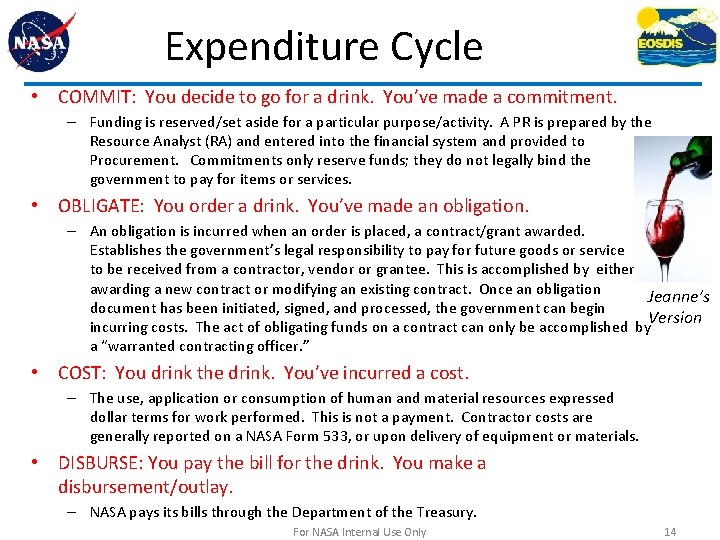
Expenditure Cycle • COMMIT: You decide to go for a drink. You’ve made a commitment. – Funding is reserved/set aside for a particular purpose/activity. A PR is prepared by the Resource Analyst (RA) and entered into the financial system and provided to Procurement. Commitments only reserve funds; they do not legally bind the government to pay for items or services. • OBLIGATE: You order a drink. You’ve made an obligation. – An obligation is incurred when an order is placed, a contract/grant awarded. Establishes the government’s legal responsibility to pay for future goods or service to be received from a contractor, vendor or grantee. This is accomplished by either awarding a new contract or modifying an existing contract. Once an obligation Jeanne’s document has been initiated, signed, and processed, the government can begin Version incurring costs. The act of obligating funds on a contract can only be accomplished by a “warranted contracting officer. ” • COST: You drink the drink. You’ve incurred a cost. – The use, application or consumption of human and material resources expressed dollar terms for work performed. This is not a payment. Contractor costs are generally reported on a NASA Form 533, or upon delivery of equipment or materials. • DISBURSE: You pay the bill for the drink. You make a disbursement/outlay. – NASA pays its bills through the Department of the Treasury. For NASA Internal Use Only 14
Budget Execution Flow • Commitment: Performed by the Resource Analyst – Funds are committed on a purchase request (PR) • Obligation: Performed by the Contracting Officer (CO) – Funding modification to contract is issued – On an end item or level of effort cost reimbursable contract an agreed logo (limitation of government’s obligation) date is specified in the contract mod providing the funds. (AKA Allotment Date) • One piece of information Resource Analyst uses to ensure contract has adequate funding • Cost: Planned expenditure(s) realized by Contractor – H/W order delivered & billed – Monthly labor expenses accrued – On contracts, costs are shown as “actuals” on 533 • Disbursement: NASA pays the bill For NASA Internal Use Only Diane’s Version 15
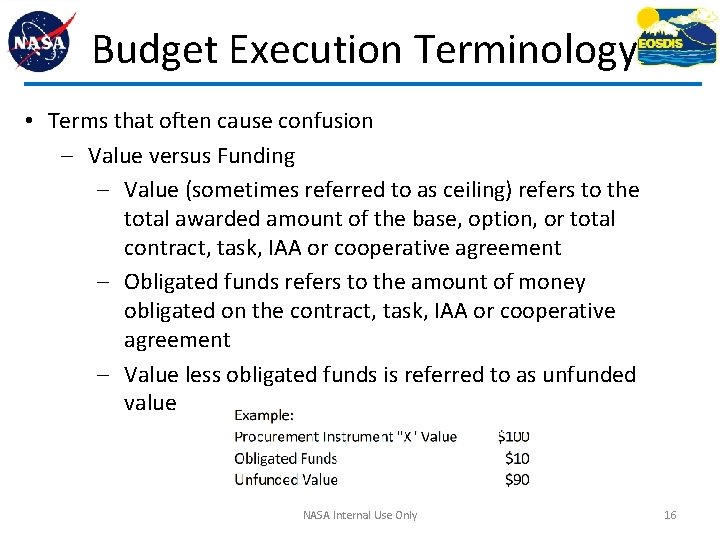
Budget Execution Terminology • Terms that often cause confusion Value versus Funding Value (sometimes referred to as ceiling) refers to the total awarded amount of the base, option, or total contract, task, IAA or cooperative agreement Obligated funds refers to the amount of money obligated on the contract, task, IAA or cooperative agreement Value less obligated funds is referred to as unfunded value NASA Internal Use Only 16
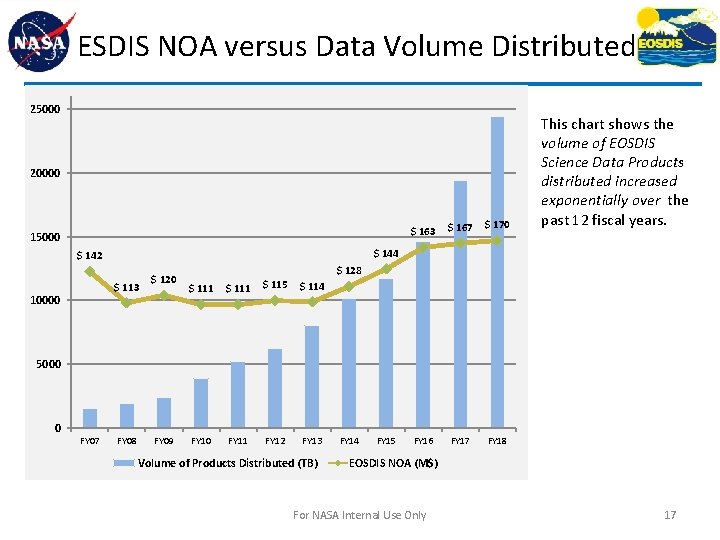
ESDIS NOA versus Data Volume Distributed 25000 20000 15000 $ 167 $ 170 FY 16 FY 17 FY 18 $ 144 $ 142 $ 113 10000 $ 163 This chart shows the volume of EOSDIS Science Data Products distributed increased exponentially over the past 12 fiscal years. $ 120 $ 128 $ 111 $ 115 $ 114 FY 10 FY 11 FY 12 FY 13 5000 0 FY 07 FY 08 FY 09 Volume of Products Distributed (TB) FY 14 FY 15 EOSDIS NOA (M$) For NASA Internal Use Only 17
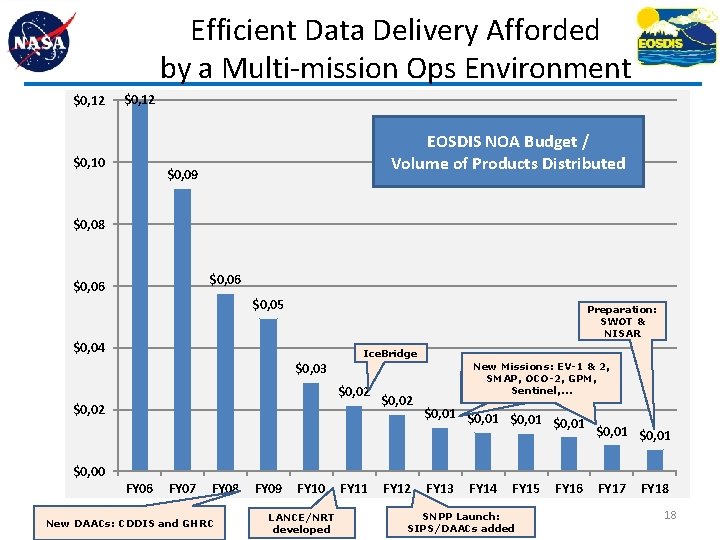
Efficient Data Delivery Afforded by a Multi-mission Ops Environment $0, 12 $0, 10 EOSDIS NOA Budget / Volume of Products Distributed $0, 09 $0, 08 $0, 06 $0, 05 Preparation: SWOT & NISAR $0, 04 Ice. Bridge New Missions: EV-1 & 2, SMAP, OCO-2, GPM, New Missions Sentinel, … $0, 03 $0, 02 $0, 01 $0, 01 $0, 00 FY 06 FY 07 FY 08 New DAACs: CDDIS and GHRC FY 09 FY 10 LANCE/NRT developed FY 11 FY 12 FY 13 FY 14 FY 15 SNPP Launch: SIPS/DAACs added FY 16 FY 17 FY 18 18
Back-up
Terminology • Appropriation: Program/Agency budgets determined by Congress • Apportionment: Distribution of funds to Agencies from OMB • Allotment: Distribution of funds within the Agency to Programs/Projects (not to be confused with contracts funding “allotment date” ) • Commitment: Funds reservation via PR (Purchase Requests) • Obligation: Actual addition of funds to a legal instrument; e. g. a contract. Funding now available for contractor to bill against • Cost: Actual and/or accrued requirement • Disbursement: Payment to vendor that liquidates obligation (partially or in total) For NASA Internal Use Only 20
Terminology (cont’d) • Uncosted Obligation: Total obligation less total cost • Continuing Resolution: (CR) Stop gap funding authority for Agencies that have not yet received a regular appropriation for the Fiscal Year Limited in scope Funding period specified- available until appropriation approved or new CR Existing and ongoing work, no new initiatives NASA Internal Use Only 21
- Slides: 21