
ESDC Secretariat Building Ecole Royale Militaire Avenue Kortenberg
ESDC Secretariat, Building Ecole Royale Militaire Avenue Kortenberg 115, Brussels Web. Page: http: //esdc. mil-edu. be/ The European Security and Defence College and the European Initiative for the Exchange of Young Officers inspired by Erasmus
ESDC - Objectives Ø enhance the European security culture within the CSDP Ø to promote a better understanding of CSDP as part of the CFSP among civilian and military personnel Ø to provide EU instances and Member States with knowledgeable people familiar with EU policies, institutions and procedures and able to work efficiently on all CSDP matters Ø help to promote professional relations and contacts among training participants

ESDC Training Concept tio CSDP High-Level Seminar rtic ipa High-Ranking Staff and Decision-Makers ESDC Training Activities n Training Audiences CSDP High-Level Course Jo int Civ il a nd mi lita Specialist and Expert Level General (mid rank) Working Level Alumni Seminars ry pa Senior Staff Level Courses for i. a. PPI Staff, LEGAD, POLAD, SSR and others OC open to International Audiences OC for National Audiences ESDP Courses for Specialised Staff and Experts ESDP Orientation Courses / Common CSDP Modules OC-type course with focus on thematic, regional or horizontal issues Training material and IDL system support for all training levels, organised and co-ordinated through the ESDC IDL Support
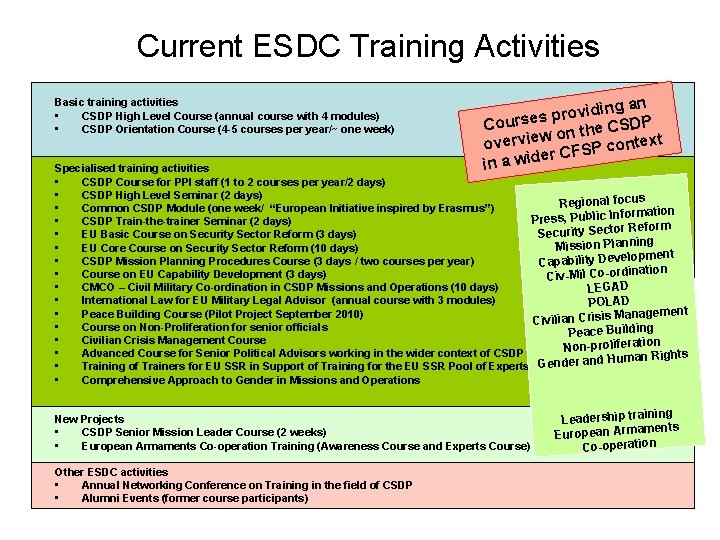
Current ESDC Training Activities Basic training activities • CSDP High Level Course (annual course with 4 modules) • CSDP Orientation Course (4 -5 courses per year/~ one week) ding an i v o r p s Course CSDP e h t n o overview FSP context er C in a wid Specialised training activities • CSDP Course for PPI staff (1 to 2 courses per year/2 days) • CSDP High Level Seminar (2 days) Regional focus • Common CSDP Module (one week/ “European Initiative inspired by Erasmus”) formation Press, Public In • CSDP Train-the-trainer Seminar (2 days) Reform Security Sector • EU Basic Course on Security Sector Reform (3 days) g Mission Plannin • EU Core Course on Security Sector Reform (10 days) m op ent • CSDP Mission Planning Procedures Course (3 days / two courses per year) Capability Devel ation • Course on EU Capability Development (3 days) Civ-Mil Co-ordin • CMCO – Civil Military Co-ordination in CSDP Missions and Operations (10 days) LEGAD • International Law for EU Military Legal Advisor (annual course with 3 modules) POLAD • Peace Building Course (Pilot Project September 2010) agement ivilian Crisis Man C • Course on Non-Proliferation for senior officials Peace Building • Civilian Crisis Management Course n Non-proliferatio • Advanced Course for Senior Political Advisors working in the wider context of CSDP d Human Rights • Training of Trainers for EU SSR in Support of Training for the EU SSR Pool of Experts Gender an • Comprehensive Approach to Gender in Missions and Operations New Projects • CSDP Senior Mission Leader Course (2 weeks) • European Armaments Co-operation Training (Awareness Course and Experts Course) Other ESDC activities • Annual Networking Conference on Training in the field of CSDP • Alumni Events (former course participants) ing Leadership train ents European Armam Co-operation
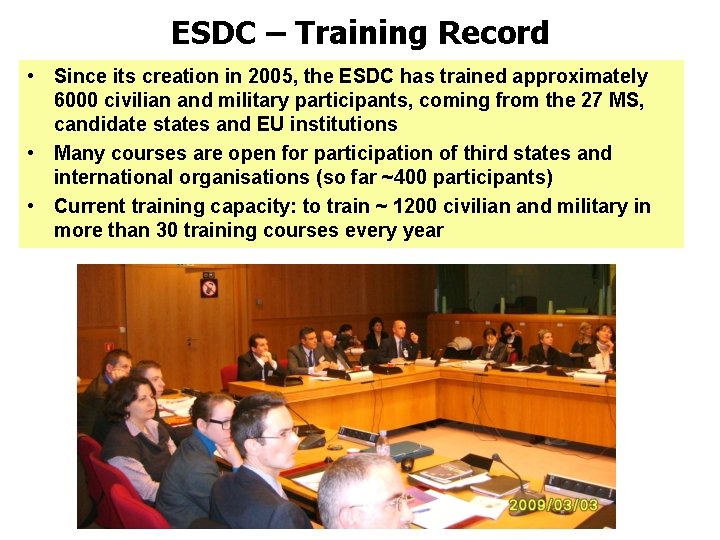
ESDC – Training Record • Since its creation in 2005, the ESDC has trained approximately 6000 civilian and military participants, coming from the 27 MS, candidate states and EU institutions • Many courses are open for participation of third states and international organisations (so far ~400 participants) • Current training capacity: to train ~ 1200 civilian and military in more than 30 training courses every year
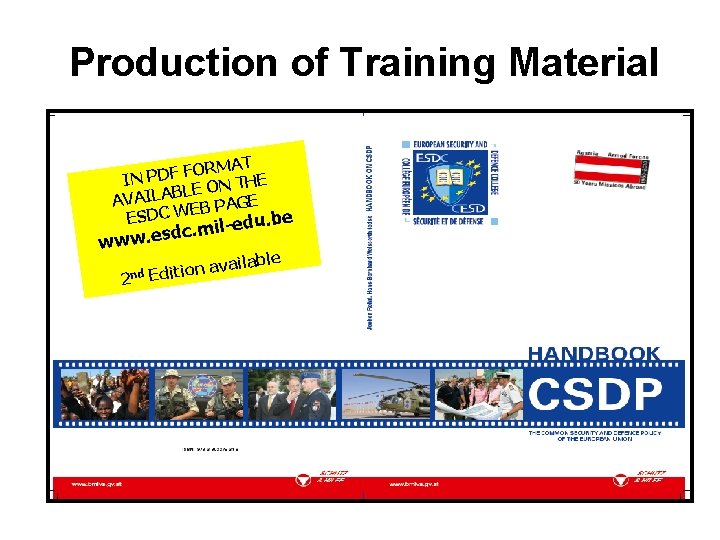
Production of Training Material ORMAT F F D P IN N THE O E L B A AVAIL PAGE B E W C ESD du. be mil-e. c d s e. www nd 2 vailable a n o i t i Ed
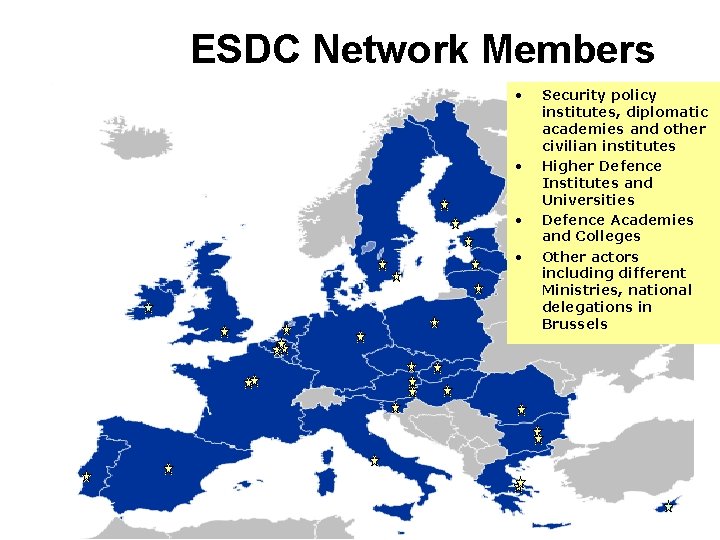
ESDC Network Members • • Security policy institutes, diplomatic academies and other civilian institutes Higher Defence Institutes and Universities Defence Academies and Colleges Other actors including different Ministries, national delegations in Brussels
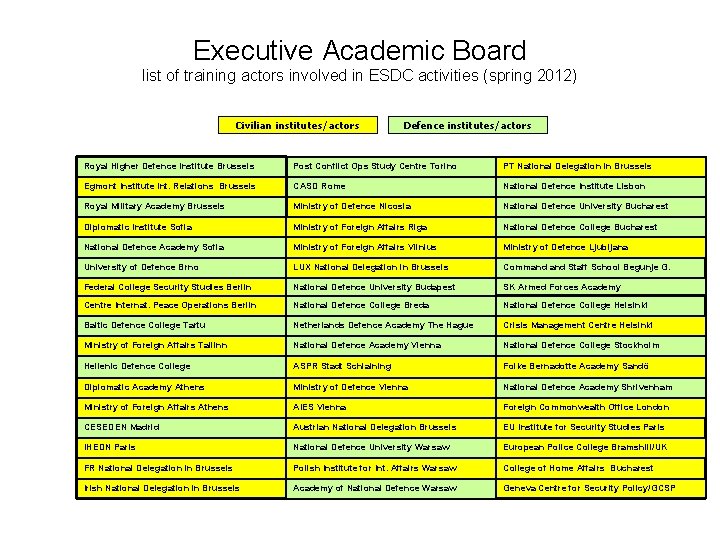
Executive Academic Board list of training actors involved in ESDC activities (spring 2012) Civilian institutes/actors Defence institutes/actors Royal Higher Defence Institute Brussels Post Conflict Ops Study Centre Torino PT National Delegation in Brussels Egmont Institute Int. Relations Brussels CASD Rome National Defence Institute Lisbon Royal Military Academy Brussels Ministry of Defence Nicosia National Defence University Bucharest Diplomatic Institute Sofia Ministry of Foreign Affairs Riga National Defence College Bucharest National Defence Academy Sofia Ministry of Foreign Affairs Vilnius Ministry of Defence Ljubljana University of Defence Brno LUX National Delegation in Brussels Command Staff School Begunje G. Federal College Security Studies Berlin National Defence University Budapest SK Armed Forces Academy Centre Internat. Peace Operations Berlin National Defence College Breda National Defence College Helsinki Baltic Defence College Tartu Netherlands Defence Academy The Hague Crisis Management Centre Helsinki Ministry of Foreign Affairs Tallinn National Defence Academy Vienna National Defence College Stockholm Hellenic Defence College ASPR Stadt Schlaining Folke Bernadotte Academy Sandö Diplomatic Academy Athens Ministry of Defence Vienna National Defence Academy Shrivenham Ministry of Foreign Affairs Athens AIES Vienna Foreign Commonwealth Office London CESEDEN Madrid Austrian National Delegation Brussels EU Institute for Security Studies Paris IHEDN Paris National Defence University Warsaw European Police College Bramshill/UK FR National Delegation in Brussels Polish Institute for Int. Affairs Warsaw College of Home Affairs Bucharest Irish National Delegation in Brussels Academy of National Defence Warsaw Geneva Centre for Security Policy/GCSP
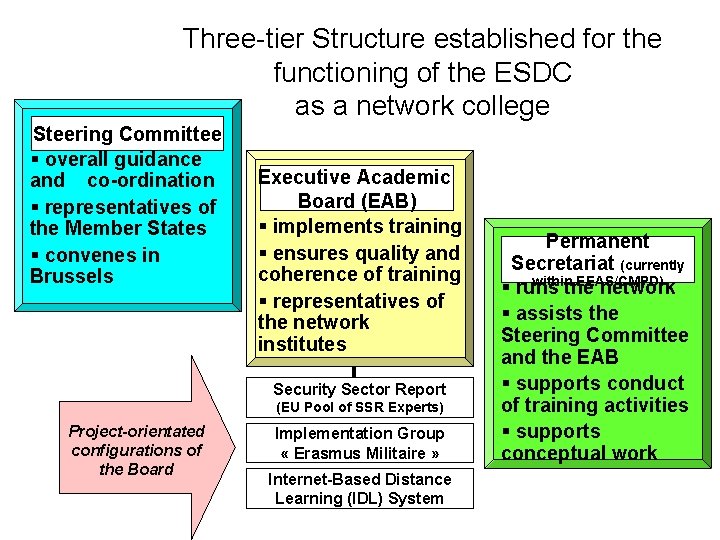
Three-tier Structure established for the functioning of the ESDC as a network college Steering Committee § overall guidance and co-ordination § representatives of the Member States § convenes in Brussels Executive Academic Board (EAB) § implements training § ensures quality and coherence of training § representatives of the network institutes Security Sector Report (EU Pool of SSR Experts) Project-orientated configurations of the Board Implementation Group « Erasmus Militaire » Internet-Based Distance Learning (IDL) System Permanent Secretariat (currently within EEAS/CMPD) § runs the network § assists the Steering Committee and the EAB § supports conduct of training activities § supports conceptual work
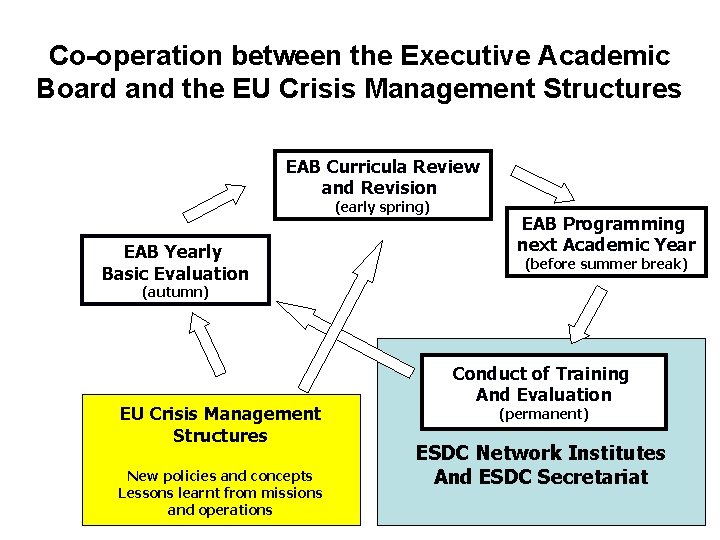
Co-operation between the Executive Academic Board and the EU Crisis Management Structures EAB Curricula Review and Revision (early spring) EAB Yearly Basic Evaluation EAB Programming next Academic Year (before summer break) (autumn) EU Crisis Management Structures New policies and concepts Lessons learnt from missions and operations Conduct of Training And Evaluation (permanent) ESDC Network Institutes And ESDC Secretariat
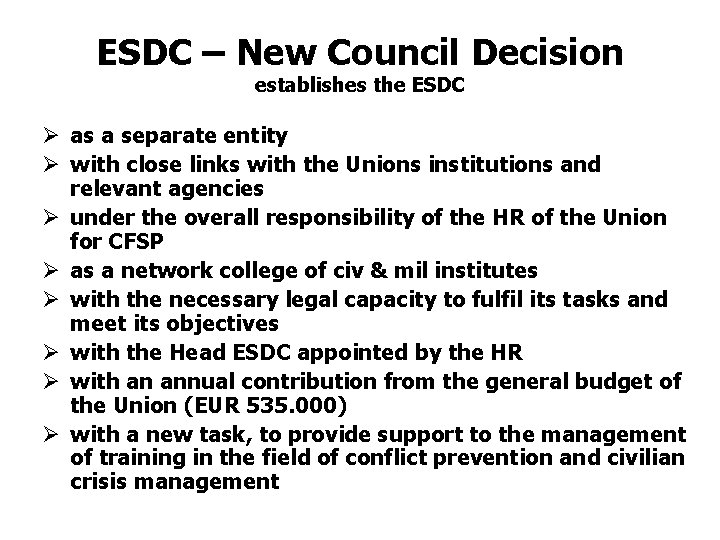
ESDC – New Council Decision establishes the ESDC Ø as a separate entity Ø with close links with the Unions institutions and relevant agencies Ø under the overall responsibility of the HR of the Union for CFSP Ø as a network college of civ & mil institutes Ø with the necessary legal capacity to fulfil its tasks and meet its objectives Ø with the Head ESDC appointed by the HR Ø with an annual contribution from the general budget of the Union (EUR 535. 000) Ø with a new task, to provide support to the management of training in the field of conflict prevention and civilian crisis management
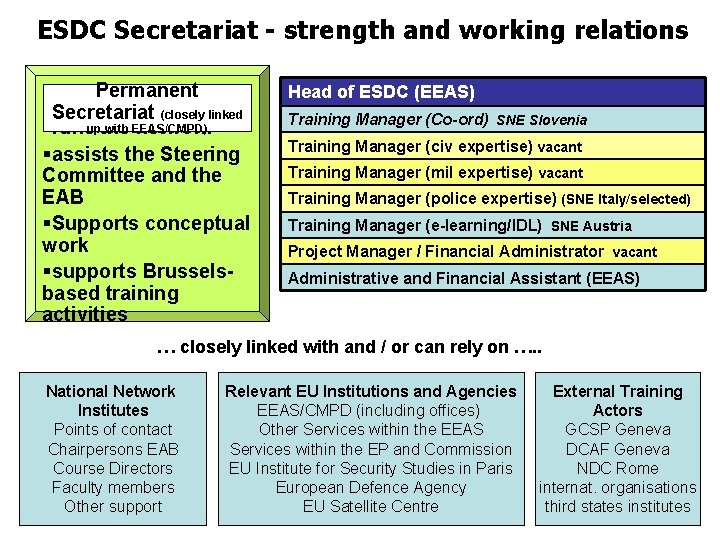
ESDC Secretariat - strength and working relations Permanent Secretariat (closely linked with EEAS/CMPD) §runsupthe network §assists the Steering Committee and the EAB §Supports conceptual work §supports Brusselsbased training activities Head of ESDC (EEAS) Training Manager (Co-ord) SNE Slovenia Training Manager (civ expertise) vacant Training Manager (mil expertise) vacant Training Manager (police expertise) (SNE Italy/selected) Training Manager (e-learning/IDL) SNE Austria Project Manager / Financial Administrator vacant Administrative and Financial Assistant (EEAS) … closely linked with and / or can rely on …. . National Network Institutes Points of contact Chairpersons EAB Course Directors Faculty members Other support Relevant EU Institutions and Agencies EEAS/CMPD (including offices) Other Services within the EEAS Services within the EP and Commission EU Institute for Security Studies in Paris European Defence Agency EU Satellite Centre External Training Actors GCSP Geneva DCAF Geneva NDC Rome internat. organisations third states institutes
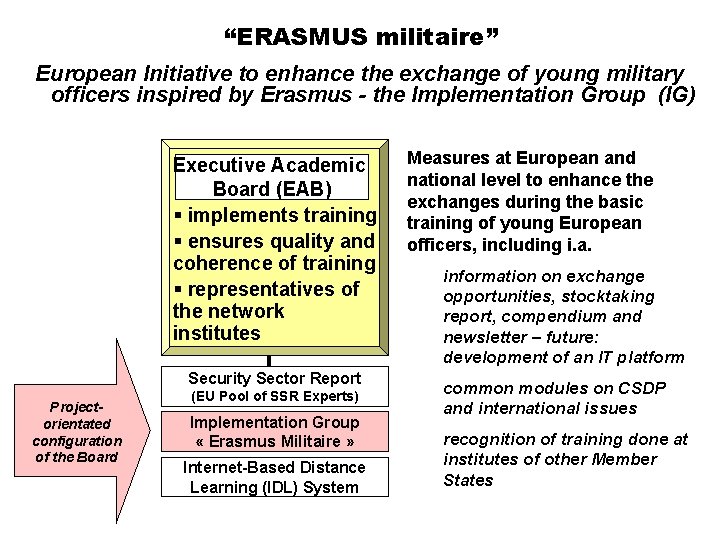
“ERASMUS militaire” European Initiative to enhance the exchange of young military officers inspired by Erasmus - the Implementation Group (IG) Executive Academic Board (EAB) § implements training § ensures quality and coherence of training § representatives of the network institutes Security Sector Report Projectorientated configuration of the Board (EU Pool of SSR Experts) Implementation Group « Erasmus Militaire » Internet-Based Distance Learning (IDL) System Measures at European and national level to enhance the exchanges during the basic training of young European officers, including i. a. information on exchange opportunities, stocktaking report, compendium and newsletter – future: development of an IT platform common modules on CSDP and international issues recognition of training done at institutes of other Member States
Measures at European level • Compare the training offered by the various colleges on the basis of national indicative lists of skills • Create an IT platform • Identify ways of dealing with administrative, legal and other obstacles to exchanges • Develop and conduct common training modules on CSDP and other international issues • Provide military academies access and use of the ESDC IDL system and enlarge the scope of available teaching material • Develop an equivalence system for the military components of initial officer training; examine the possible use of ECTS • Draw on the Erasmus programme to establish mechanisms to promote officer exchanges
Measures at national level • Encourage Member States and their national colleges to make full use of the instruments and measures offered by the Bologna process • Encourage national colleges to increase the mobility of military students and teaching staff among the Member States • Encourage Member States to recognise the training which their officers have received at establishments in other member States • Encourage the teaching of EU languages, in particular the teaching of a second foreign language, in order to extend the range of potential exchanges
ESDC Secretariat, Building Ecole Royale Militaire Avenue Kortenberg 115, Brussels Web. Page: http: //esdc. mil-edu. be/ The European Security and Defence College and the European Initiative for the Exchange of Young Officers inspired by Erasmus
- Slides: 16