
ESD methods DIALOGUE MAPPING Education for Sustainable Development

ESD methods: DIALOGUE MAPPING Education for Sustainable Development (ESD) in Protected Areas and Biosphere Reserves Amfissa, Greece Prof. Dr. Roberto Biloslavo, University of Primorska, Faculty of Management, Slovenia
About myself • Prof. of Management • University of Primorska, Faculty of Management (Slovenia) • Research areas: management, strategic management, sustainable development, wisdom & leadership • co-author of „Management of Sustainable Development“ – Msc. programme 2
Time schedule • 9. 15 – 11. 00 Theoretical Introduction • 11. 30 – 12. 45 Presentation of Dialogue Mapping by use of Compendium software (free available) • 16. 15 – 18. 00 Work in groups (3 cases of interests/ group, design of possible solution by use of DM for the most worthy) • 18. 30 – 19. 45 Presentations (20 min presentation, 5 min discussion) 3
Collective intelligence and forces of fragmetation • Collective inteligence = the creativity and resourcefulness that a group or team can bring to a complex and novel problem • Forces of fragmentation = support conditions in which the people involved see themselves as more separated than united, and in which information and knowledge are chaotic and scattered Fragmentation = Wickedness x Social Complexity 4
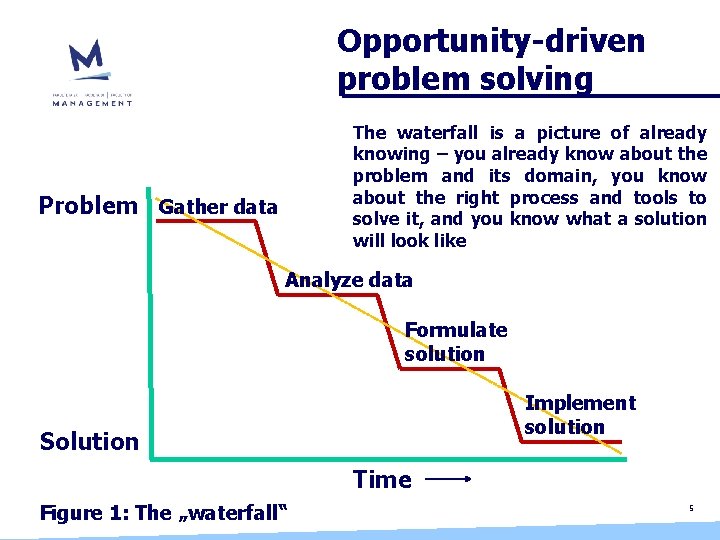
Opportunity-driven problem solving The waterfall is a picture of already knowing – you already know about the problem and its domain, you know about the right process and tools to solve it, and you know what a solution will look like Problem Gather data Analyze data Formulate solution Implement solution Solution Time Figure 1: The „waterfall“ 5
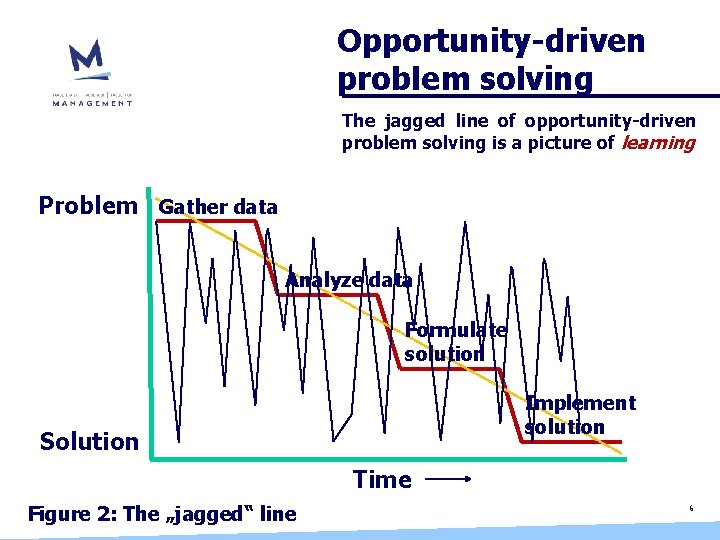
Opportunity-driven problem solving The jagged line of opportunity-driven problem solving is a picture of learning Problem Gather data Analyze data Formulate solution Implement solution Solution Time Figure 2: The „jagged“ line 6
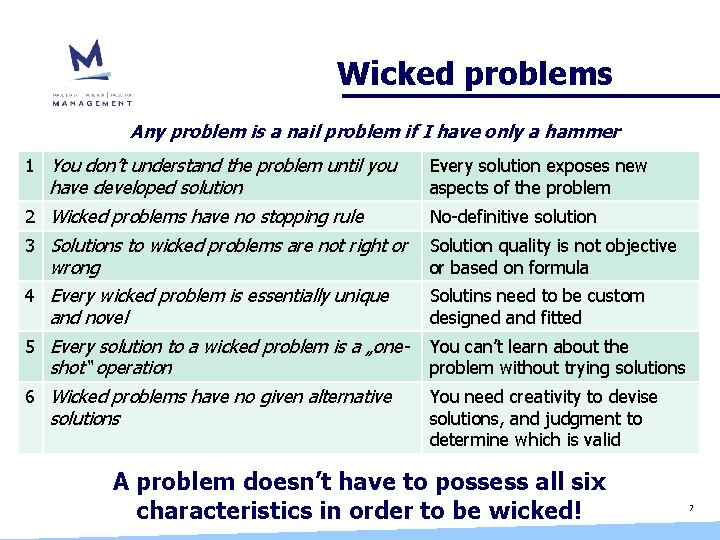
Wicked problems Any problem is a nail problem if I have only a hammer 1 You don’t understand the problem until you Every solution exposes new aspects of the problem 2 Wicked problems have no stopping rule No-definitive solution 3 Solutions to wicked problems are not right or Solution quality is not objective or based on formula 4 Every wicked problem is essentially unique Solutins need to be custom designed and fitted 5 Every solution to a wicked problem is a „one- You can’t learn about the problem without trying solutions 6 Wicked problems have no given alternative You need creativity to devise solutions, and judgment to determine which is valid have developed solution wrong and novel shot“ operation solutions A problem doesn’t have to possess all six characteristics in order to be wicked! 7

Tame problems 1 Has a well defined and stable problem statement 2 Has a definite stopping point (i. e. when solution is reached) 3 Has s solution that can be objectively evaluated as right or wrong 4 Belongs to a class of similar problems that are solved in the same similar way 5 Has solutions that can be easily tried and abandoned 6 Comes with a limited set of alternative solutions 8

How we cope with wicked problems Two approaches: 1. Studying the problem; 2. Taming it 1 Lock down the problem definition Descibe it in a way that you can solve it or split it in a sub-problem and declare that to be a PROBLEM 2 Assert that the problem is solved 3 Specify objective parameters by which to What is measured becomes the measure the solution’s success problem 4 Cast the problem as „just like“ a Ignore or filter out evidences that do not fit 5 Give up on trying to get a good solution Just follow orders, do your job previous problem that has been solved to the problem 6 Declare that there are just a few possible solutions, and focus on selecting one of them 9
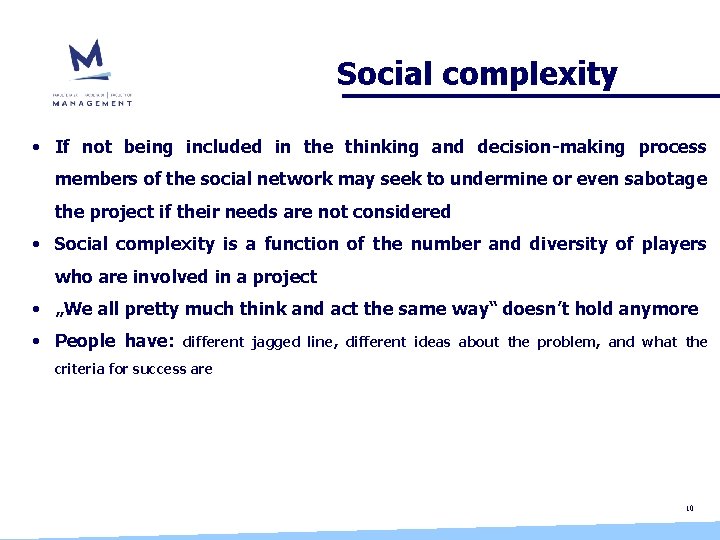
Social complexity • If not being included in the thinking and decision-making process members of the social network may seek to undermine or even sabotage the project if their needs are not considered • Social complexity is a function of the number and diversity of players who are involved in a project • „We all pretty much think and act the same way“ doesn’t hold anymore • People have: different jagged line, different ideas about the problem, and what the criteria for success are 10
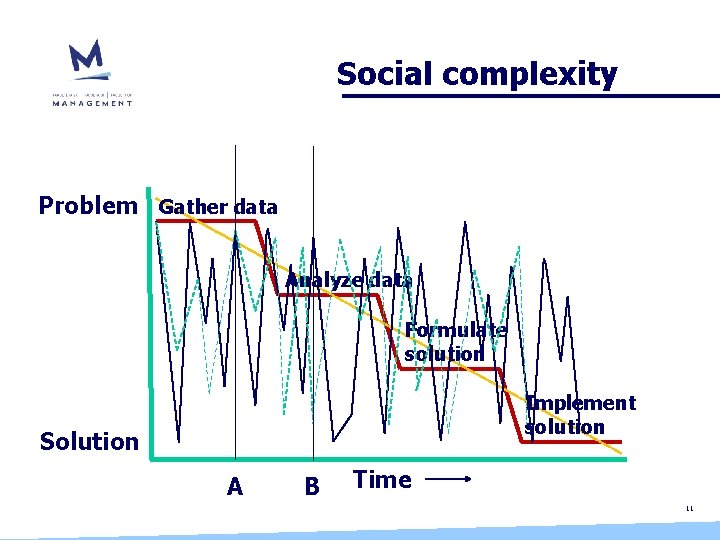
Social complexity Problem Gather data Analyze data Formulate solution Implement solution Solution A B Time 11
Shared understanding and share commitment • Because of social complexity, solving a wicked problem is fundamentally a SOCIAL process • The Holy Grail of effective collaboration: creating shared understanding about the problem, and shared commitment to the possible solution • Shared understading does NOT mean necessarily an agreement • Shared understading means that the stakeholders understand each other’s positions well enough to have intelligent dialogoue about the different interpretations of the problem • Shared understading focuses on where we are, shared commitment focuses on where we’re going Design polarity = What ought to be vs. What can be done 12
Elements of dialogue mapping 1. Display – shared display medium such as a computer projector, flipchart paper, or a whiteboard 2. Notation – a grammar or method that provides the „rules“ for how the content is to be structured in the display medium 3. Mapping - a person skilled in capturing group interactions in the display according to the notation 13
Dialogue mapper 1. Actively listen to the conversation 2. Summarize the conversational moves in the collaborative display using the IBIS argumentation structure 3. Incrementally validate the map so that group members accept and own the map as a faithful representation of their thinking 14
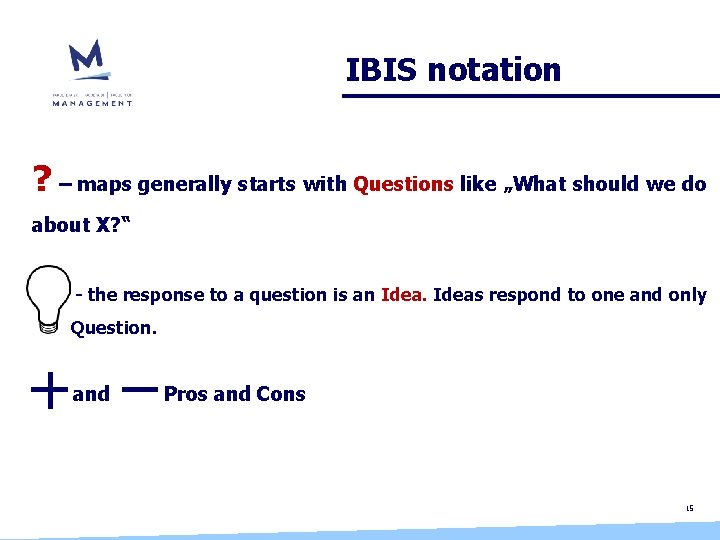
IBIS notation ? – maps generally starts with Questions like „What should we do about X? “ - the response to a question is an Ideas respond to one and only one Question. and Pros and Cons 15
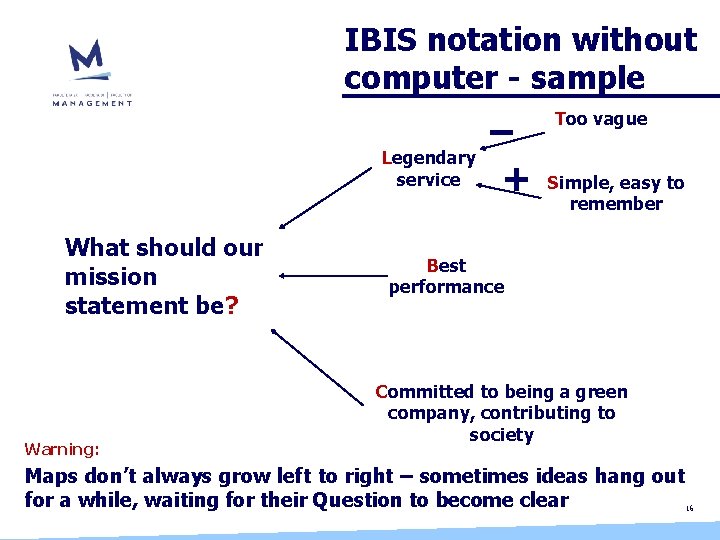
IBIS notation without computer - sample Too vague Legendary service What should our mission statement be? Warning: Simple, easy to remember Best performance Committed to being a green company, contributing to society Maps don’t always grow left to right – sometimes ideas hang out for a while, waiting for their Question to become clear 16
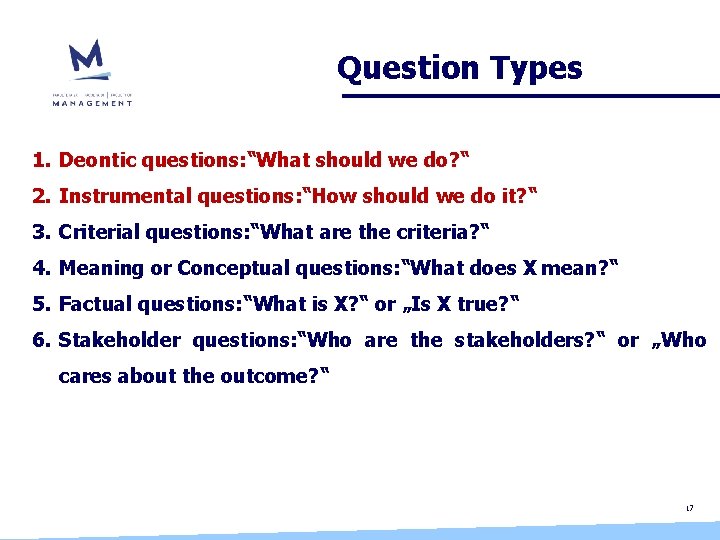
Question Types 1. Deontic questions: “What should we do? “ 2. Instrumental questions: “How should we do it? “ 3. Criterial questions: “What are the criteria? “ 4. Meaning or Conceptual questions: “What does X mean? “ 5. Factual questions: “What is X? “ or „Is X true? “ 6. Stakeholder questions: “Who are the stakeholders? “ or „Who cares about the outcome? “ 17
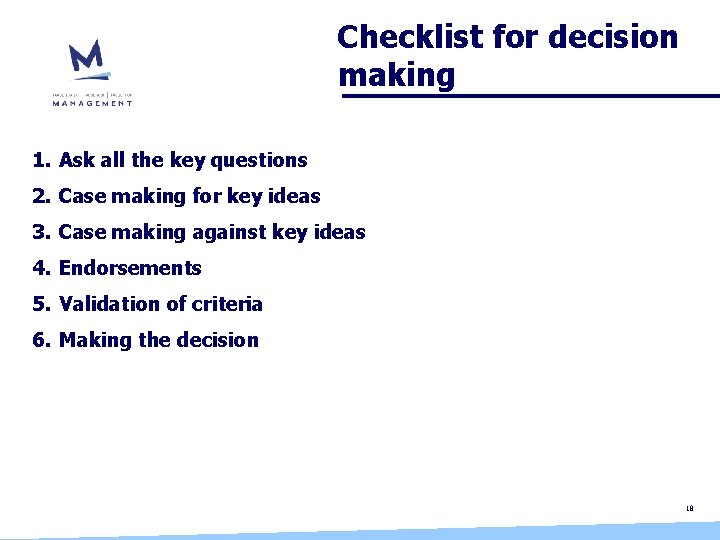
Checklist for decision making 1. Ask all the key questions 2. Case making for key ideas 3. Case making against key ideas 4. Endorsements 5. Validation of criteria 6. Making the decision 18
- Slides: 18