
ESD EBFM FRAMEWORKS Overview of the Subprogram Dr
ESD & EBFM FRAMEWORKS Overview of the Subprogram Dr Rick Fletcher ESD Subprogram Leader
Outline • History of ESD Subprogram • Summary of Progress • Future potential links to Coastal/Marine Planning • Some lessons learned
Why did we start this? • Fisheries Legislative Requirements (all have ESD in their Acts) • Other Government Requirements e. g. State Environmental Assessments, Schedule 4, EPBC, GBRMPA (some aspects of ESD) • Market Leverage/Access (varying aspects of ESD) • Develop one reporting process that meets most of these needs Initial focus was the assessment and management of individual fisheries and getting export approval
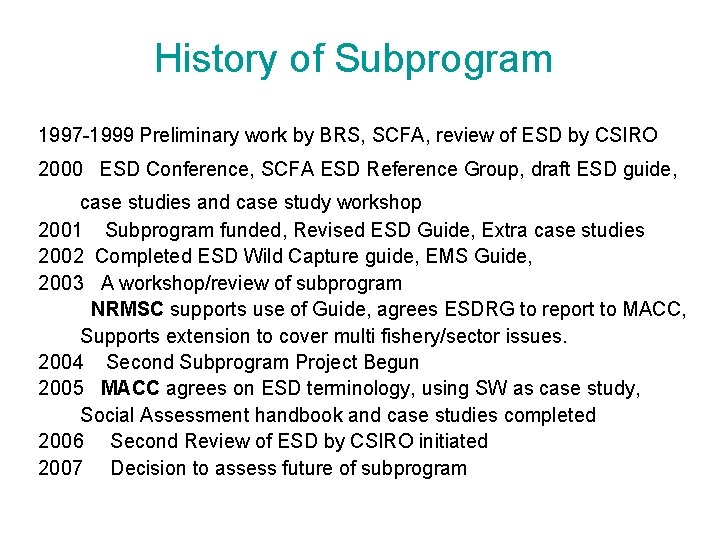
History of Subprogram 1997 -1999 Preliminary work by BRS, SCFA, review of ESD by CSIRO 2000 ESD Conference, SCFA ESD Reference Group, draft ESD guide, case studies and case study workshop 2001 Subprogram funded, Revised ESD Guide, Extra case studies 2002 Completed ESD Wild Capture guide, EMS Guide, 2003 A workshop/review of subprogram NRMSC supports use of Guide, agrees ESDRG to report to MACC, Supports extension to cover multi fishery/sector issues. 2004 Second Subprogram Project Begun 2005 MACC agrees on ESD terminology, using SW as case study, Social Assessment handbook and case studies completed 2006 Second Review of ESD by CSIRO initiated 2007 Decision to assess future of subprogram
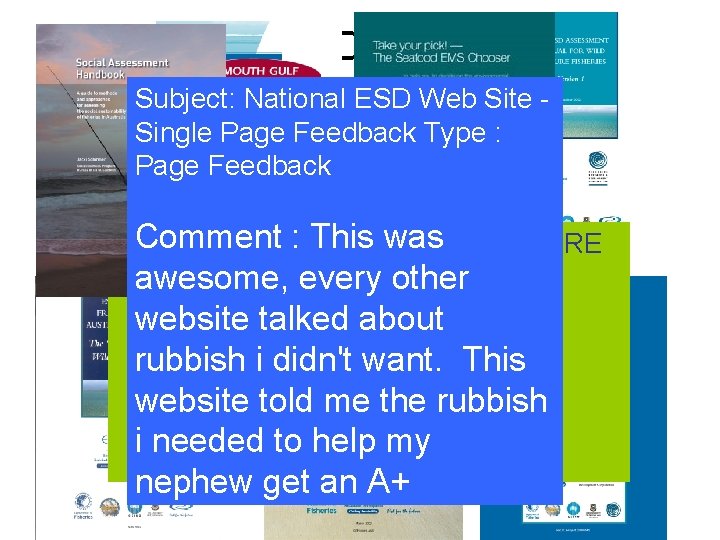
National ESD Subprogram Subject: National ESD Web Site Began in March 2000 it has now completed: Single Page Feedback Type : • ESDPage policy. Feedback documents • Reporting frameworks for wild capture and Comment : This ALL REPORTS ANDwas MANUALS ARE aquaculture, AVAILABLE FROM THE awesome, every other • EMS manual for industry SUBPROGRAM WEBSITE website talked about • Assessment manual for wild capture, www. fisheries-esd. com rubbish i didn't want. This • Social assessment and economic handbooks, website www. ebfm. com. au told me the rubbish • Processes to allocate andmy reallocate access i needed to help See Circulated Brochure nephew. ESD get reports an A+ • Completed
Universal Concepts of Sustainability • What impacts are my activities having on the assets that I manage? • What impacts am I having on the assets that someone else manages? • What are the economic/social benefits and costs generated by my activities? • What activities by others affect me and my assets? The ‘ my ‘ can be an individual, a company, a fishery, any industry, a Department, a Jurisdiction.

Basic ESD/EBFM PROCESS 1. 2. 3. 4. Scope and Values Identify Issues Prioritise Issues Develop Management systems (and linkage models) 5. Generate operational plans THE SAME STEPS ARE USED IRRESPECTIVE OF THE SITUATION BUT THE DETAILS CAN VARY GREATLY (eg Commonwealth system of ERM/ERA also fits within these same five steps)

Summary of ESD Framework Scope Specific Reports Plus General Background Information = ESD STATUS REPORT Government Audits Other Stakeholders
1. Determining Scope & Values Develop a clear description of what you are trying to manage/assess including the societal values that need to be addressed Clearly understand that there are issues that you can: • Control • Influence • Only react to
STEP 1. Tools Developed • Developed lists of questions and prompts • Common types of values • Need to know their relative importance 1 Status • People often don’t realise they are coming from different perspectives and values
STEP 2. Identifying Issues Given the scope: (a) Identify all possible relevant issues across all areas of ESD/EBFM (retained; non-retained; ecosystem, community; administration) (b) Agree on objectives wanted to achieve based on values
2. Tools Developed • Series of generic component trees have been developed. • Trees are refined from stakeholder input. • There also variations on this including check lists etc. STATUS These approaches are sufficient but can be refined or restructured made more automated Getting good involvement from all groups – could benefit from more involvement by social scientists
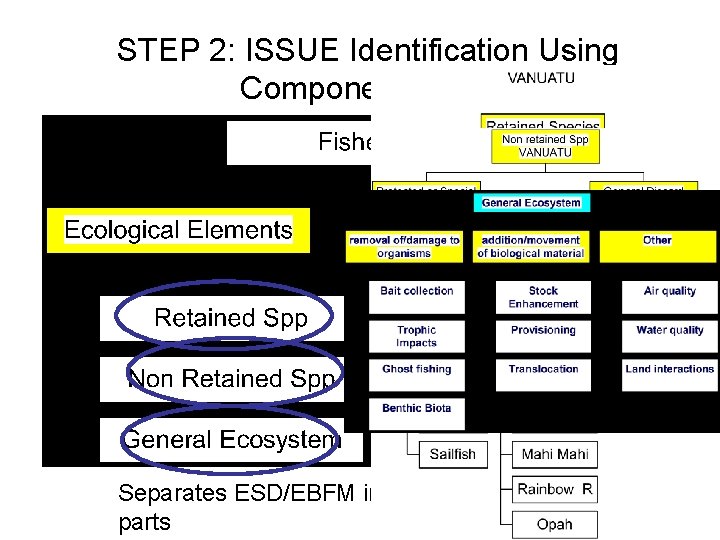
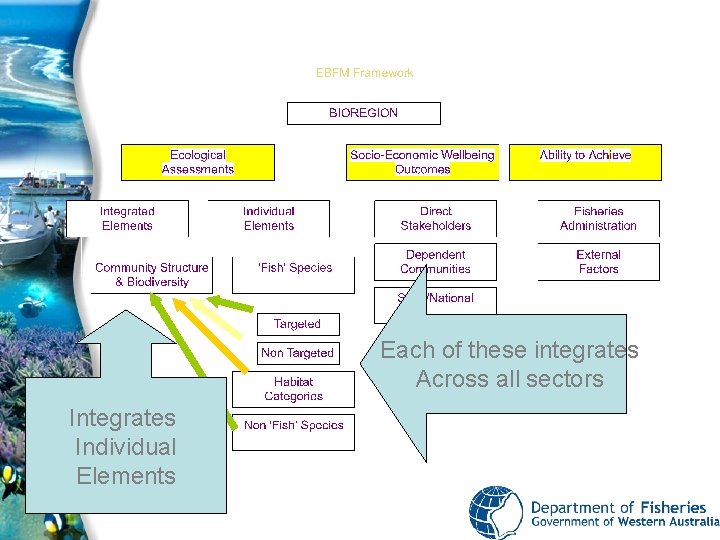
STEP 2: ISSUE Identification Using Component Trees Separates ESD/EBFM into component parts
Step 3 Prioritisation Determine, using some form of risk assessment or prioritisation process, which of these issues really needs to be managed directly. • Without doing this properly the process will stall – cannot directly manage everything!
3 Tools Developed/ Available • Qualitative systems based on the AS/NZ 4360 Standard that cover ecological, social and economic issues are available • Other qualitative and semi quantitative Ecological Risk Assessment techniques have also been generated (e. g. Commonwealth) or are being developed (CSIRO) plus multi criteria systems (NSW). • The most appropriate one to use may not necessary be the most complicated one.
Step 3 Status • Risk Assessment is still difficult to convey to stakeholders in a way that they understand accept – often confuse uncertainty for risk • The criteria for assessing broader ecological impacts not as clear as for individual species • Criteria to assess social and economic issues are also less developed. • Need to be clear what objective is being assessed, the risk (priority) can change • May need to separate cumulative risk from that generated by an individual fishery
4 Management Systems If an issue requires direct management, establish: • what is acceptable performance, • the management arrangements used to achieve this, • the monitoring and review processes • the processes to adjust arrangements when needed
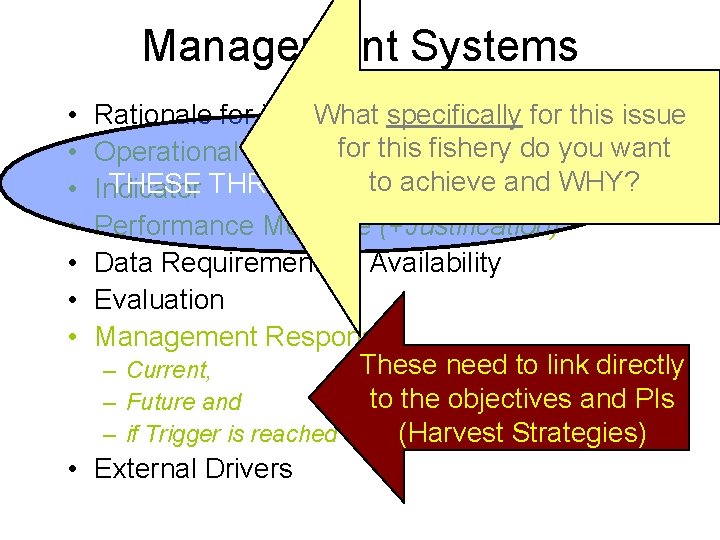
Management Systems • • What(risk specifically Rationale for inclusion rating) for this issue for this fishery do you want Operational Objectives (+Justification) and WHY? THESE THREE AREto A achieve PACKAGE Indicator Performance Measure (+Justification) Data Requirements & Availability Evaluation Management Responses These need to link directly – Current, to the objectives and PIs – Future and (Harvest Strategies) – if Trigger is reached • External Drivers
4 Status - systems • The system is consistent with all risk management and other feedback systems including EMS and the Commonwealth system (different headings and detail) • Multiple levels of detail can be used in reports - from quick to complex 4 Status – Performance measures/Indicators • Individual species – many available • Ecosystem – not many cost effective methods, lack of clarity of what is acceptable impact (caught with social values). Often not be sensible to assess for a single fishery. Social and Economic – while many indicators & assessment tools are available, not many examples where used
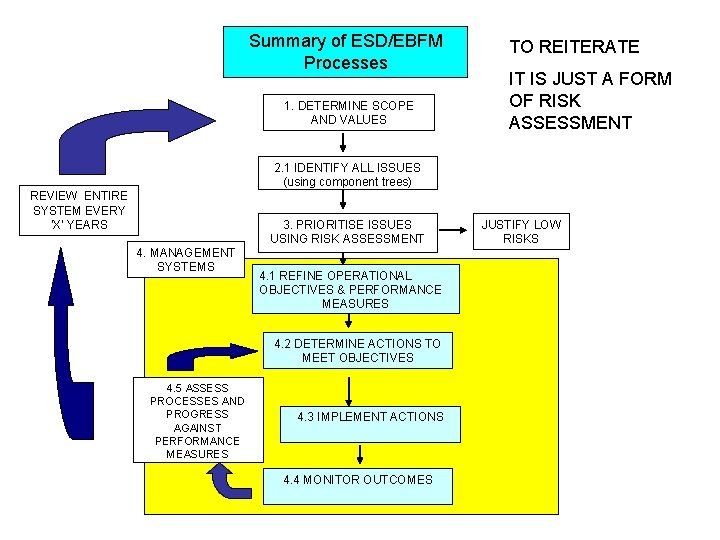
Summary of ESD/EBFM Processes 1. DETERMINE SCOPE AND VALUES TO REITERATE IT IS JUST A FORM OF RISK ASSESSMENT 2. 1 IDENTIFY ALL ISSUES (using component trees) REVIEW ENTIRE SYSTEM EVERY ‘X’ YEARS 3. PRIORITISE ISSUES USING RISK ASSESSMENT 4. MANAGEMENT SYSTEMS 4. 1 REFINE OPERATIONAL OBJECTIVES & PERFORMANCE MEASURES 4. 2 DETERMINE ACTIONS TO MEET OBJECTIVES 4. 5 ASSESS PROCESSES AND PROGRESS AGAINST PERFORMANCE MEASURES 4. 3 IMPLEMENT ACTIONS 4. 4 MONITOR OUTCOMES JUSTIFY LOW RISKS
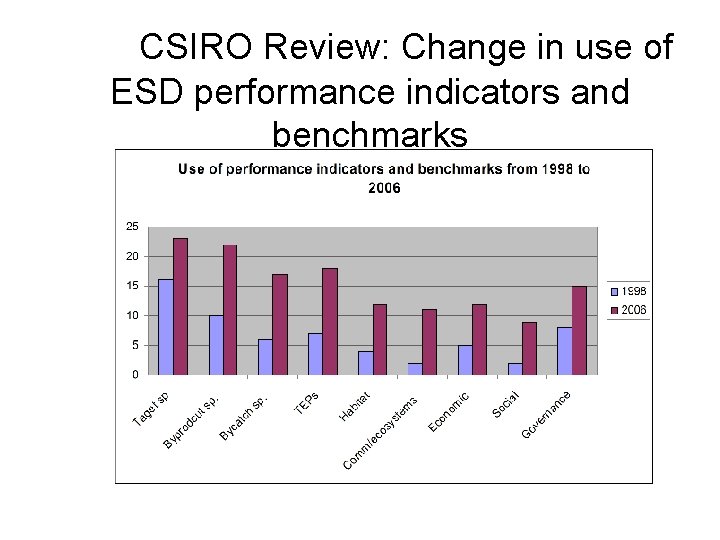
CSIRO Review: Change in use of ESD performance indicators and benchmarks
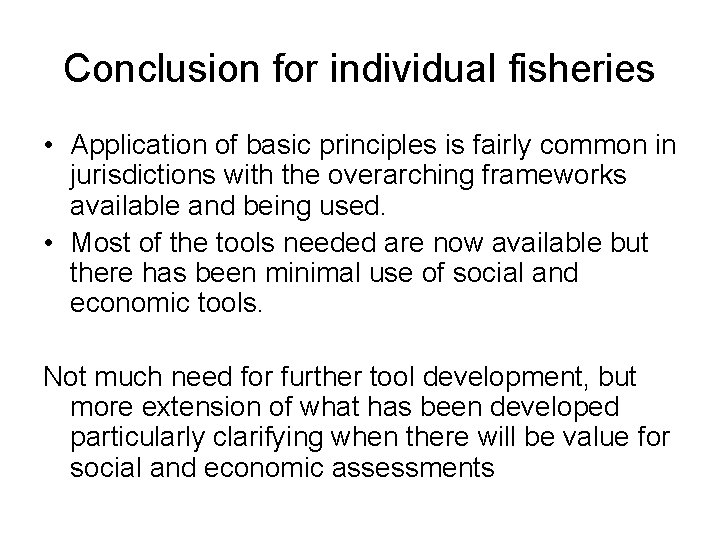
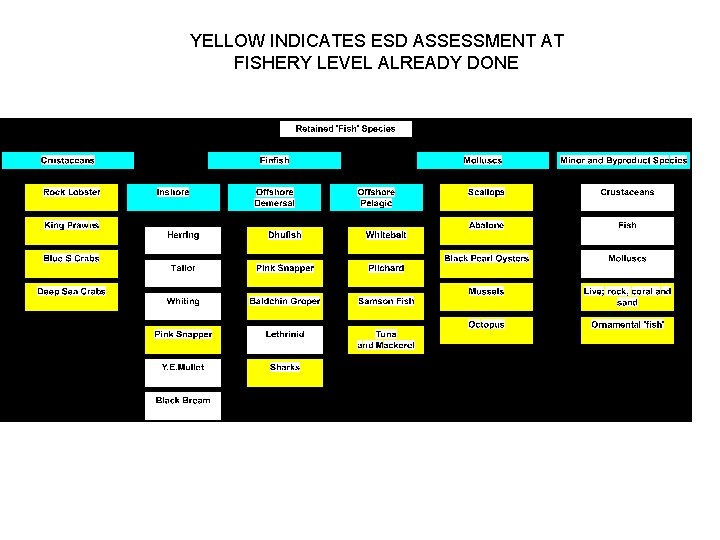
Conclusion for individual fisheries • Application of basic principles is fairly common in jurisdictions with the overarching frameworks available and being used. • Most of the tools needed are now available but there has been minimal use of social and economic tools. Not much need for further tool development, but more extension of what has been developed particularly clarifying when there will be value for social and economic assessments
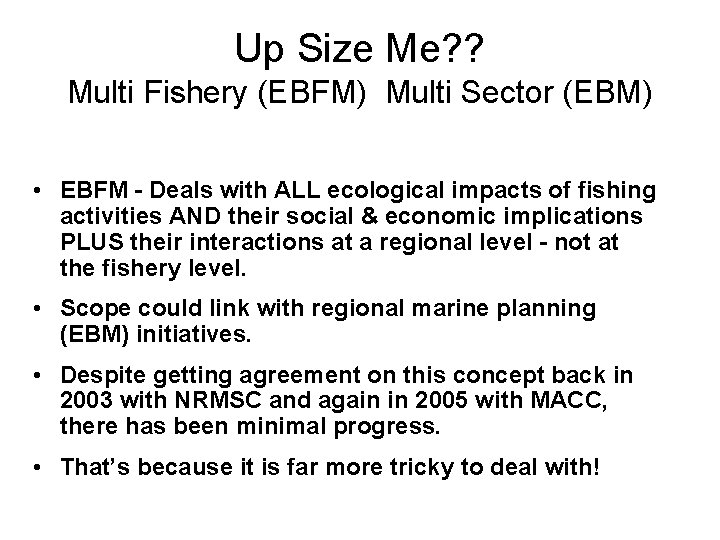
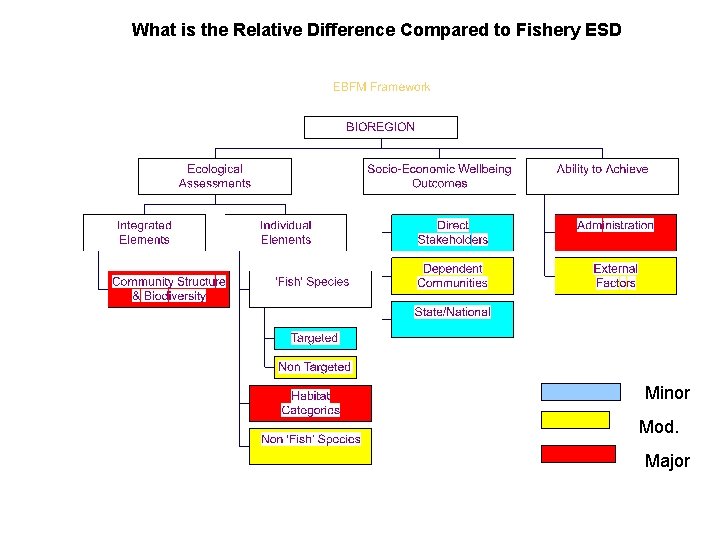
Up Size Me? ? Multi Fishery (EBFM) Multi Sector (EBM) • EBFM - Deals with ALL ecological impacts of fishing activities AND their social & economic implications PLUS their interactions at a regional level - not at the fishery level. • Scope could link with regional marine planning (EBM) initiatives. • Despite getting agreement on this concept back in 2003 with NRMSC and again in 2005 with MACC, there has been minimal progress. • That’s because it is far more tricky to deal with!
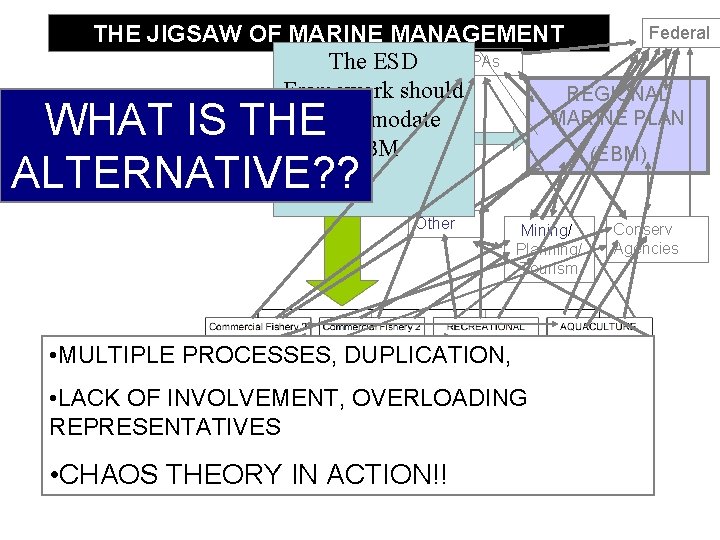
Federal THE JIGSAW OF MARINE MANAGEMENT MPAs The ESD Framework should REGIONAL MARINE PLAN accommodate REGIONAL FISHERIES PLAN/REPORT EBM (EBM) (EBFM) WHAT IS THE ALTERNATIVE? ? Other Mining/ Planning/ Tourism • MULTIPLE PROCESSES, DUPLICATION, • LACK OF INVOLVEMENT, OVERLOADING REPRESENTATIVES • CHAOS THEORY IN ACTION!! Conserv Agencies
Each of these integrates Across all sectors Integrates Individual Elements
What is the Relative Difference Compared to Fishery ESD Minor Mod. Major
YELLOW INDICATES ESD ASSESSMENT AT FISHERY LEVEL ALREADY DONE
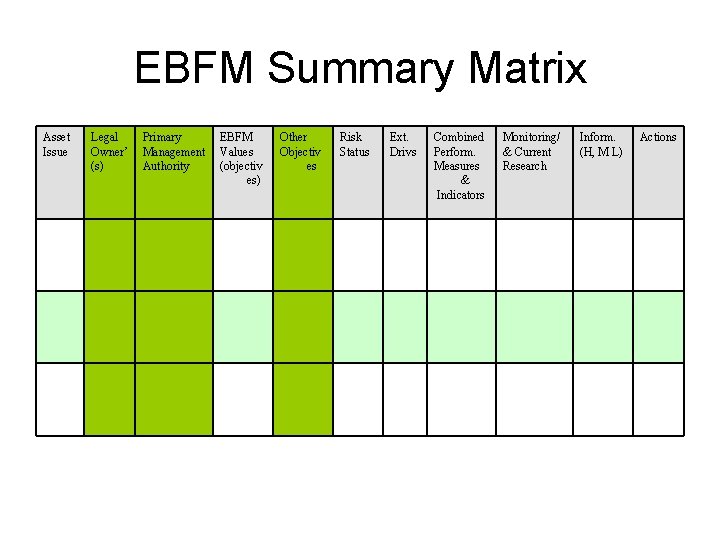
EBFM Summary Matrix Asset Issue Legal Owner’ (s) Primary Management Authority EBFM Values (objectiv es) Other Objectiv es Risk Status Ext. Drivs Combined Perform. Measures & Indicators Monitoring/ & Current Research Inform. (H, M L) Actions
Putting it All Together How to link all the components back together again? How does changing the management of one issue affect all the other elements – particularly those across the different components? Status A few systems already being developed. Management System Evaluations (MSEs) • Quantitative (e. g. Atlantis) • Qualitative (e. g. Dambacher)
KEY EBFM/EBM ISSUES • Defining who owns/manages each asset • Setting up multi agency governance structures to deal with overlaps (running in treacle would be easier) • Agreeing on what are the ‘ecosystems’ • Measuring biodiversity and community structure in a way that can be done in an ongoing manner? • Determining which social/economic components may be important from the 100’s of possibilities
Overarching EBFM Question DECIDING WHAT, IN ADDITION TO THE INDIVIDUAL FISHERY MANAGEMENT ACTIONS, REALLY NEEDS TO BE DONE TO ENSURE THAT THE REGIONAL OUTCOMES ARE OK Even if the answer is not much, that is very useful information to have plus getting an understanding of how the different bits all fit together.
Conclusion - National ESD Framework • Used in many commercial fisheries in Australia • Being implemented for the management for the WC Pacific Tuna Fisheries (FFA) • Potential use for coastal fisheries in the Pacific (SPC) • Used as the basis of FAO’s EAF approach • To be used for Canadian Herring Fishery • Trialed in many aquaculture industries • Used for assessing regional agricultural impacts Signposts • Being used to manage irrigation in Northern Australia – Irrigation Futures.
Final Comments on taking an ecosystem approach • Deals with all the ecological impacts of activities plus the social & economic implications of these and their interactions • It is fully consistent with sustainable development – it is not an ‘alternative’ to ESD • It requires taking a comprehensive approach based on risk management principles. • It is a MANAGEMENT process that is INFORMED by Science.
Where to from here? • We have made considerable progress but communicating this widely has been difficult. • Still a level of confusion about these fraemworks/systems and a tendency to ‘reinvent wheels’. • Need to get ‘buy-on’ to the principles of this process by other groups that operate in or affect aquatic areas to ensure efficient linkages and holistic outcomes can be achieved. • The ESD framework we have developed is capable of being applied in any situation – maybe getting broader adoption should increase effectiveness in dealing with cross agency issues. • Getting the policy and governance processes right for EBFM/EBM will be harder than dealing with the science questions.
- Slides: 37