
ESCAPADE Escape Plasma and Acceleration Dynamics Explorers Rob
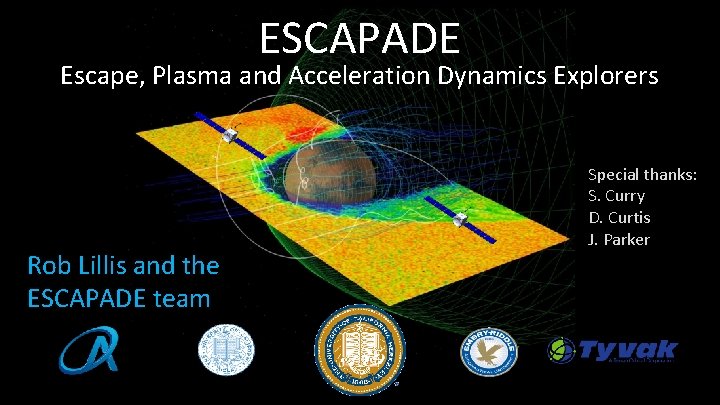
ESCAPADE Escape, Plasma and Acceleration Dynamics Explorers Rob Lillis and the ESCAPADE team Special thanks: S. Curry D. Curtis J. Parker
ESCAPADE History/Schedule MISEN 11/16: PSDS 3 10 -page proposal submitted 07/17: PSDS 3 selected ($400 k) 09/17: concept study start 03/18: presented at LPSC 04/18: final report to NASA ESCAPADE 07/18: SIMPLEX-II proposal 09/18: Science PMWs. 11/18: TMC PMWs. (agonizing wait) 06/19: Selection! 09/19: SRR 07/20: PDR 08/20: Downselect/Confirmation 08/22: Launch with Psyche

Planetary plasma environments: why do we care? • Understand structure, composition, variability and dynamics of planetary magnetospheres. • Atmospheric Escape Processes: ion and sputtering escape are important for climate evolution of terrestrial planets.
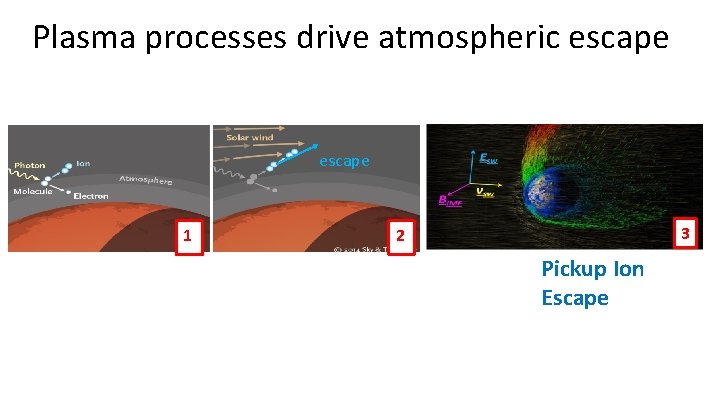
Plasma processes drive atmospheric escape 1 3 2 Pickup Ion Escape

Plasma processes drive atmospheric escape 1 • • 2 Minor contributions to escape from Mars today. Escape increases dramatically with space weather events. Early sun & solar wind were many times more active Understanding required to derive historical loss. 3 Sputtering Escape
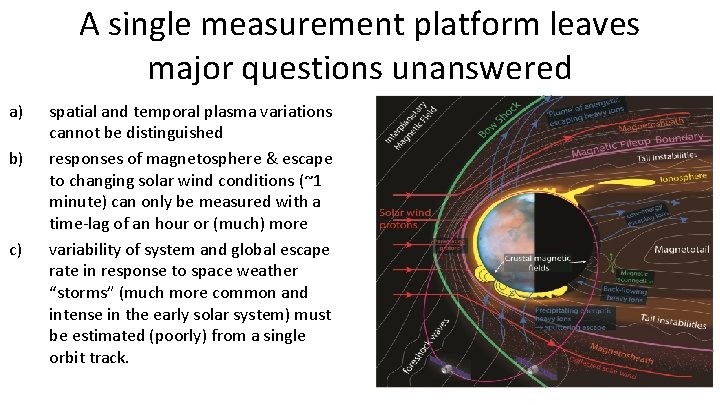
A single measurement platform leaves major questions unanswered a) b) c) spatial and temporal plasma variations cannot be distinguished responses of magnetosphere & escape to changing solar wind conditions (~1 minute) can only be measured with a time-lag of an hour or (much) more variability of system and global escape rate in response to space weather “storms” (much more common and intense in the early solar system) must be estimated (poorly) from a single orbit track.
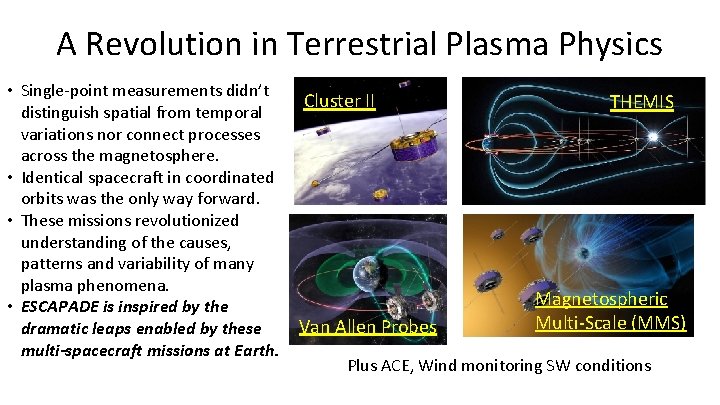
A Revolution in Terrestrial Plasma Physics • Single-point measurements didn’t distinguish spatial from temporal variations nor connect processes across the magnetosphere. • Identical spacecraft in coordinated orbits was the only way forward. • These missions revolutionized understanding of the causes, patterns and variability of many plasma phenomena. • ESCAPADE is inspired by the dramatic leaps enabled by these multi-spacecraft missions at Earth. Cluster II Van Allen Probes THEMIS Magnetospheric Multi-Scale (MMS) Plus ACE, Wind monitoring SW conditions
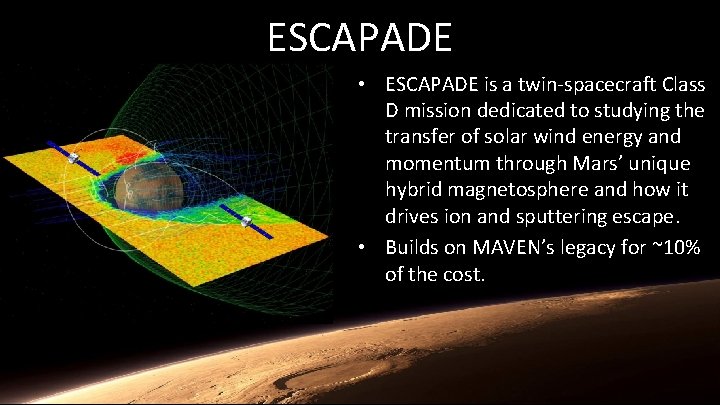
ESCAPADE • ESCAPADE is a twin-spacecraft Class D mission dedicated to studying the transfer of solar wind energy and momentum through Mars’ unique hybrid magnetosphere and how it drives ion and sputtering escape. • Builds on MAVEN’s legacy for ~10% of the cost.
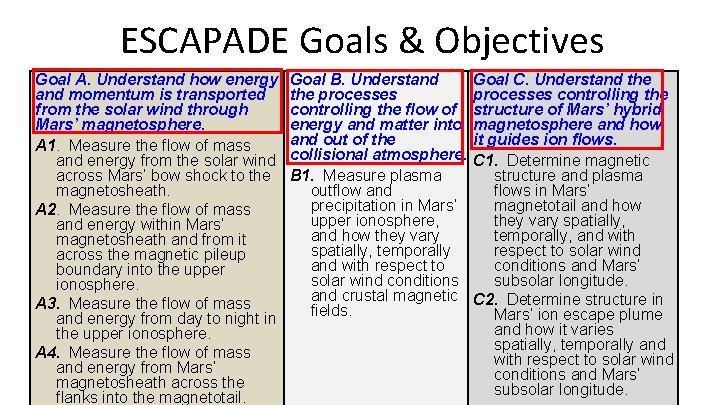
ESCAPADE Goals & Objectives Goal A. Understand how energy and momentum is transported from the solar wind through Mars’ magnetosphere. A 1. Measure the flow of mass and energy from the solar wind across Mars’ bow shock to the magnetosheath. A 2. Measure the flow of mass and energy within Mars’ magnetosheath and from it across the magnetic pileup boundary into the upper ionosphere. A 3. Measure the flow of mass and energy from day to night in the upper ionosphere. A 4. Measure the flow of mass and energy from Mars’ magnetosheath across the flanks into the magnetotail. Goal B. Understand the processes controlling the flow of energy and matter into and out of the collisional atmosphere. B 1. Measure plasma outflow and precipitation in Mars’ upper ionosphere, and how they vary spatially, temporally and with respect to solar wind conditions and crustal magnetic fields. Goal C. Understand the processes controlling the structure of Mars’ hybrid magnetosphere and how it guides ion flows. C 1. Determine magnetic structure and plasma flows in Mars’ magnetotail and how they vary spatially, temporally, and with respect to solar wind conditions and Mars’ subsolar longitude. C 2. Determine structure in Mars’ ion escape plume and how it varies spatially, temporally and with respect to solar wind conditions and Mars’ subsolar longitude.
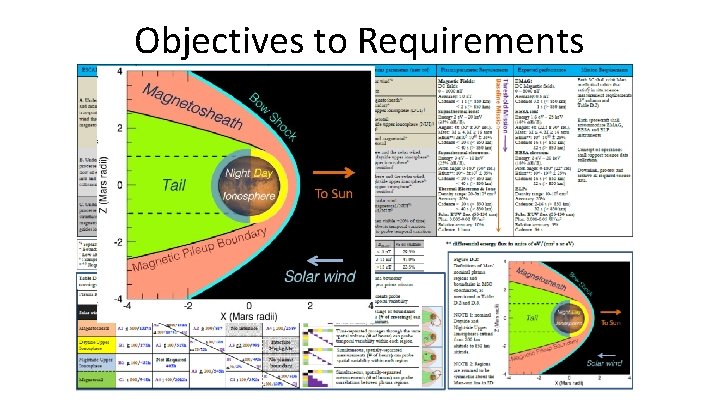
Objectives to Requirements
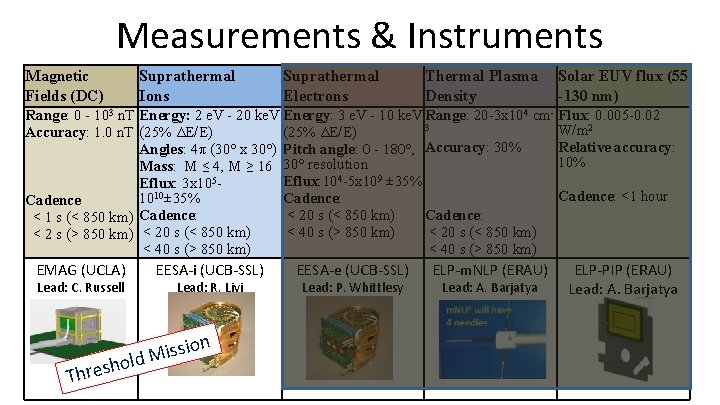
Measurements & Instruments Magnetic Fields (DC) Suprathermal Ions Suprathermal Electrons Thermal Plasma Density Solar EUV flux (55 -130 nm) Range: 0 - 103 n. T Energy: 2 e. V - 20 ke. V Energy: 3 e. V - 10 ke. V Range: 20 -3 x 104 cm- Flux: 0. 005 -0. 02 3 W/m 2 Accuracy: 1. 0 n. T (25% ΔE/E) Relative accuracy: Angles: 4 p (30° x 30°) Pitch angle: 0 - 180°, Accuracy: 30% 10% Mass: M ≤ 4, M ≥ 16 30° resolution Eflux: 104 -5 x 10⁹ ± 35% Eflux: 3 x 10⁵ Cadence: <1 hour 1010± 35% Cadence: Cadence < 20 s (< 850 km) Cadence: < 1 s (< 850 km) Cadence: < 40 s (> 850 km) < 20 s (< 850 km) < 2 s (> 850 km) < 20 s (< 850 km) < 40 s (> 850 km) EMAG (UCLA) Lead: C. Russell EESA-i (UCB-SSL) Lead: R. Livi sion s i M old h s e r Th EESA-e (UCB-SSL) Lead: P. Whittlesy ELP-m. NLP (ERAU) Lead: A. Barjatya ELP-PIP (ERAU) Lead: A. Barjatya
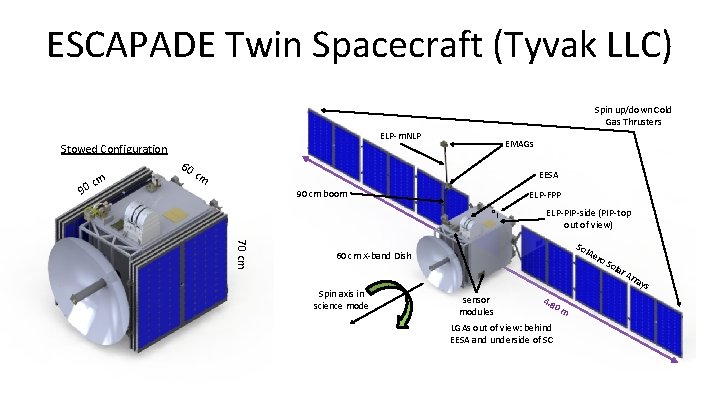
ESCAPADE Twin Spacecraft (Tyvak LLC) Spin up/down Cold Gas Thrusters ELP-m. NLP Stowed Configuration m c 90 60 EMAGs cm EESA 90 cm boom ELP-FPP ° ELP-PIP-side (PIP-top out of view) 70 cm Sol Ae 60 cm X-band Dish Spin axis in science mode sensor modules 4. 8 LGAs out of view: behind EESA and underside of SC 0 m ro S ola r. A rra ys

ESCAPADE Mission Design 1 st captured orbit 7. Mars Arrival 2 nd orbit Psyche’s Trajectory (dashed) Psyche’s Mars Flyby: 5/2023 4. Coast 3 rd 4 th 5. Cruise Active SEP Esca. PADE thrust vectors Sun Spiral start Orbit after 4 months 3. Initial Thrust 5 months 2. Spacecraft Checkout 6. Mars Rendezvous 1/29/2024 8. Mars Spiral 1. Launch: Psyche launch Date: 8/(626)/2022 C 3: 14. 53 km 2/s 2 RLA: 72. 96 deg 6 months 7 months 8 months 9. Phasing Coast for 5 months 10. Science Orbit 2/1/2026 Thrust arcs in red Use SEP to decelerate when passing through periapsis
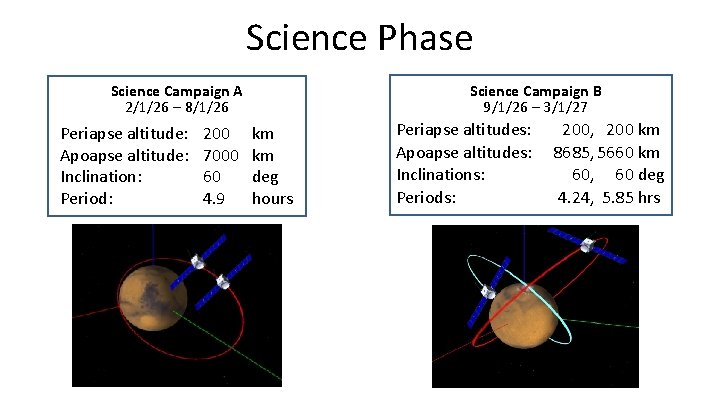
Science Phase Science Campaign A 2/1/26 – 8/1/26 Periapse altitude: Apoapse altitude: Inclination: Period: 200 7000 60 4. 9 Science Campaign B 9/1/26 – 3/1/27 km km deg hours Periapse altitudes: Apoapse altitudes: Inclinations: Periods: 200, 200 km 8685, 5660 km 60, 60 deg 4. 24, 5. 85 hrs
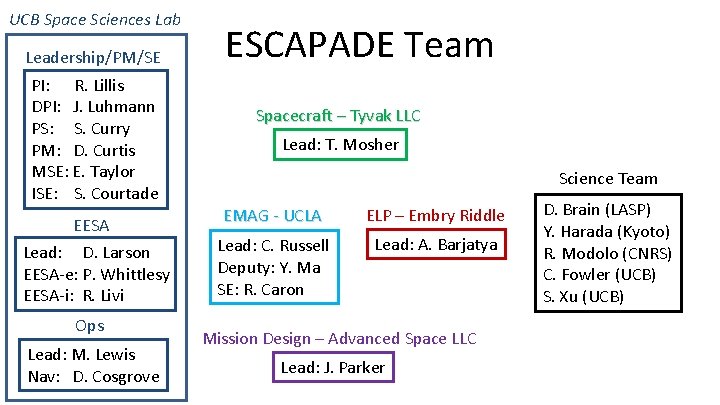
UCB Space Sciences Lab Leadership/PM/SE PI: R. Lillis DPI: J. Luhmann PS: S. Curry PM: D. Curtis MSE: E. Taylor ISE: S. Courtade EESA Lead: D. Larson EESA-e: P. Whittlesy EESA-i: R. Livi Ops Lead: M. Lewis Nav: D. Cosgrove ESCAPADE Team Spacecraft – Tyvak LLC Lead: T. Mosher Science Team EMAG - UCLA ELP – Embry Riddle Lead: C. Russell Deputy: Y. Ma SE: R. Caron Lead: A. Barjatya Mission Design – Advanced Space LLC Lead: J. Parker D. Brain (LASP) Y. Harada (Kyoto) R. Modolo (CNRS) C. Fowler (UCB) S. Xu (UCB)
Summary • ESCAPADE’s multi-point measurements are the only way to separate spatial and temporal variability & unravel cause-andeffect in Mars’ solar wind interaction and ion escape. • ESCAPADE’s instrument suite and robust mission design enable this groundbreaking science. • The team is excited to move towards a detailed design and PDR in summer 2020.
- Slides: 16