
ESA Explorer mission Earth CARE Earth Clouds Aerosols

- Slides: 22
ESA Explorer mission Earth. CARE: Earth Clouds, Aerosols and Radiation Explorer • Joint ESA/JAXA mission • Launch 2016 • Budget 700 MEuro
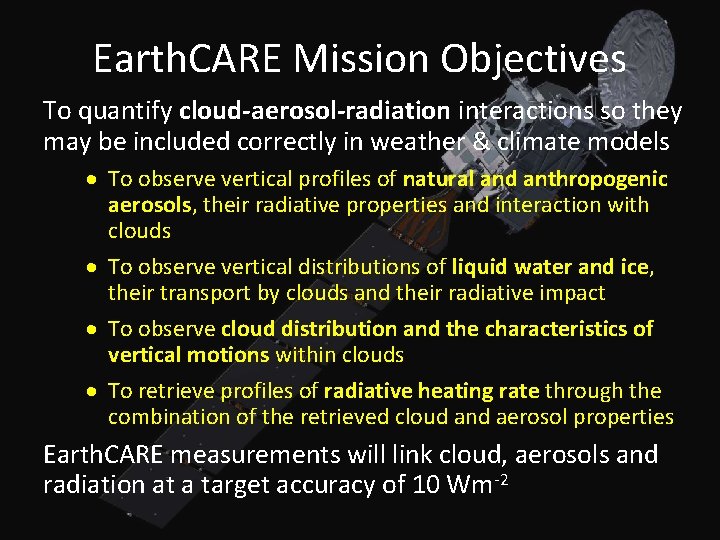
Earth. CARE Mission Objectives To quantify cloud-aerosol-radiation interactions so they may be included correctly in weather & climate models · To observe vertical profiles of natural and anthropogenic aerosols, their radiative properties and interaction with clouds · To observe vertical distributions of liquid water and ice, their transport by clouds and their radiative impact · To observe cloud distribution and the characteristics of vertical motions within clouds · To retrieve profiles of radiative heating rate through the combination of the retrieved cloud and aerosol properties Earth. CARE measurements will link cloud, aerosols and radiation at a target accuracy of 10 Wm-2
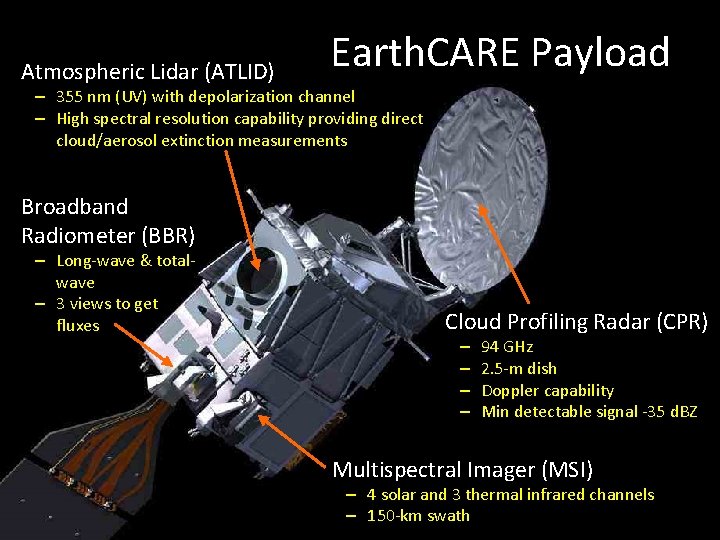
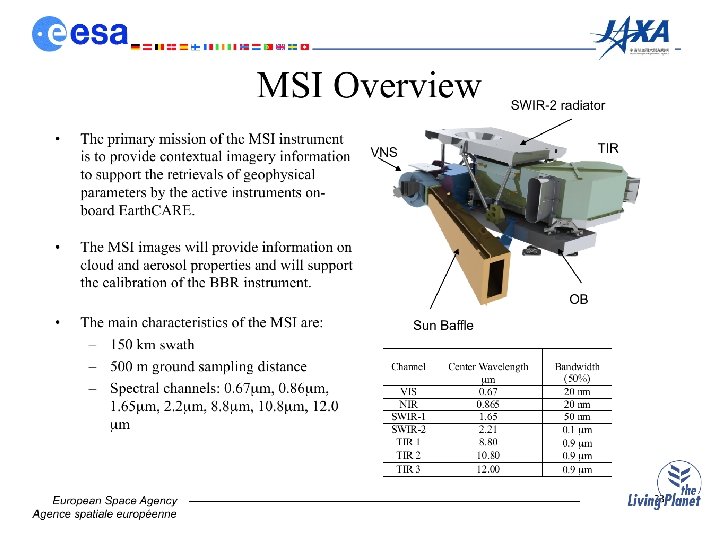
Atmospheric Lidar (ATLID) Earth. CARE Payload – 355 nm (UV) with depolarization channel – High spectral resolution capability providing direct cloud/aerosol extinction measurements Broadband Radiometer (BBR) – Long-wave & totalwave – 3 views to get fluxes Cloud Profiling Radar (CPR) – – 94 GHz 2. 5 -m dish Doppler capability Min detectable signal -35 d. BZ Multispectral Imager (MSI) – 4 solar and 3 thermal infrared channels – 150 -km swath
24/01/2013 ECARE overview KNMI
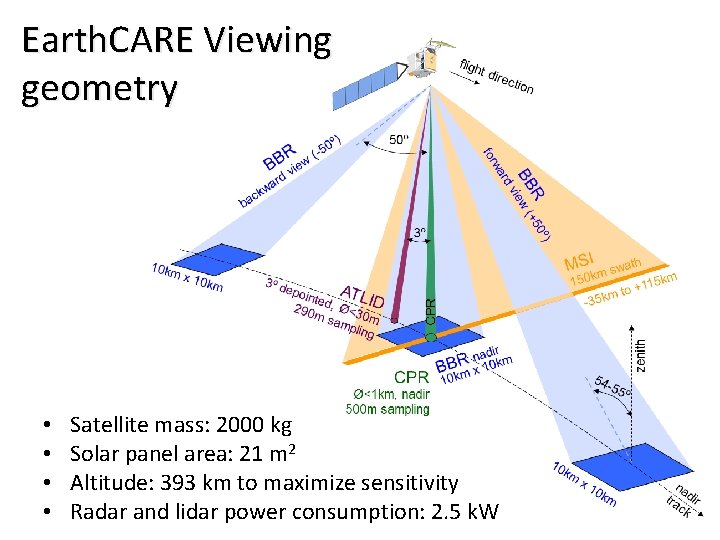
Earth. CARE Viewing geometry • • Satellite mass: 2000 kg Solar panel area: 21 m 2 Altitude: 393 km to maximize sensitivity Radar and lidar power consumption: 2. 5 k. W
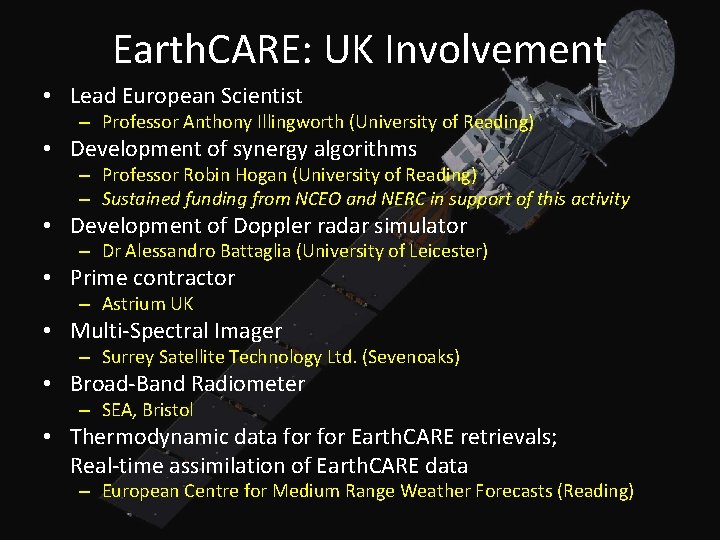
Earth. CARE: UK Involvement • Lead European Scientist – Professor Anthony Illingworth (University of Reading) • Development of synergy algorithms – Professor Robin Hogan (University of Reading) – Sustained funding from NCEO and NERC in support of this activity • Development of Doppler radar simulator – Dr Alessandro Battaglia (University of Leicester) • Prime contractor – Astrium UK • Multi-Spectral Imager – Surrey Satellite Technology Ltd. (Sevenoaks) • Broad-Band Radiometer – SEA, Bristol • Thermodynamic data for Earth. CARE retrievals; Real-time assimilation of Earth. CARE data – European Centre for Medium Range Weather Forecasts (Reading)
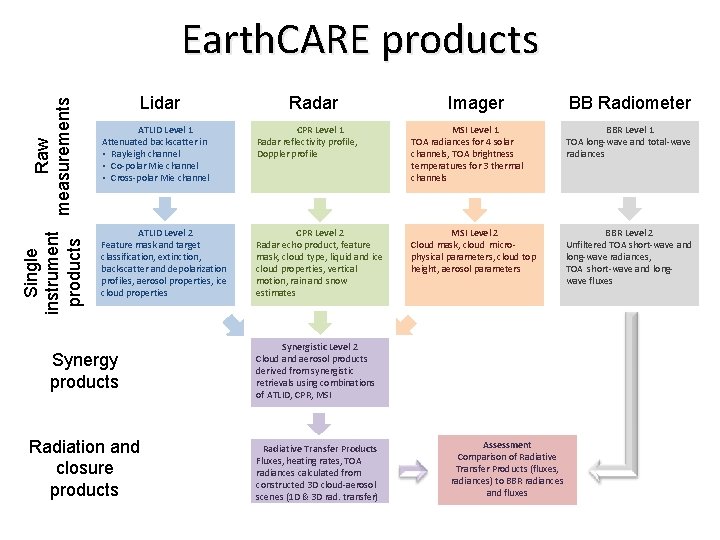
Single Raw instrument measurements products Earth. CARE products Lidar Radar Imager BB Radiometer ATLID Level 1 Attenuated backscatter in • Rayleigh channel • Co-polar Mie channel • Cross-polar Mie channel CPR Level 1 Radar reflectivity profile, Doppler profile MSI Level 1 TOA radiances for 4 solar channels, TOA brightness temperatures for 3 thermal channels BBR Level 1 TOA long-wave and total-wave radiances ATLID Level 2 Feature mask and target classification, extinction, backscatter and depolarization profiles, aerosol properties, ice cloud properties CPR Level 2 Radar echo product, feature mask, cloud type, liquid and ice cloud properties, vertical motion, rain and snow estimates MSI Level 2 Cloud mask, cloud microphysical parameters, cloud top height, aerosol parameters BBR Level 2 Unfiltered TOA short-wave and long-wave radiances, TOA short-wave and longwave fluxes Synergy products Synergistic Level 2 Cloud and aerosol products derived from synergistic retrievals using combinations of ATLID, CPR, MSI Radiation and closure products Radiative Transfer Products Fluxes, heating rates, TOA radiances calculated from constructed 3 D cloud-aerosol scenes (1 D & 3 D rad. transfer) Assessment Comparison of Radiative Transfer Products (fluxes, radiances) to BBR radiances and fluxes
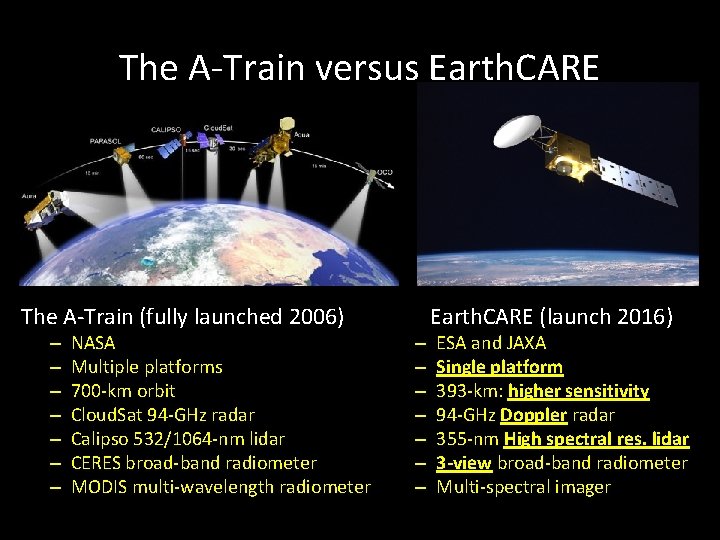
The A-Train versus Earth. CARE The A-Train (fully launched 2006) – – – – NASA Multiple platforms 700 -km orbit Cloud. Sat 94 -GHz radar Calipso 532/1064 -nm lidar CERES broad-band radiometer MODIS multi-wavelength radiometer Earth. CARE (launch 2016) – – – – ESA and JAXA Single platform 393 -km: higher sensitivity 94 -GHz Doppler radar 355 -nm High spectral res. lidar 3 -view broad-band radiometer Multi-spectral imager
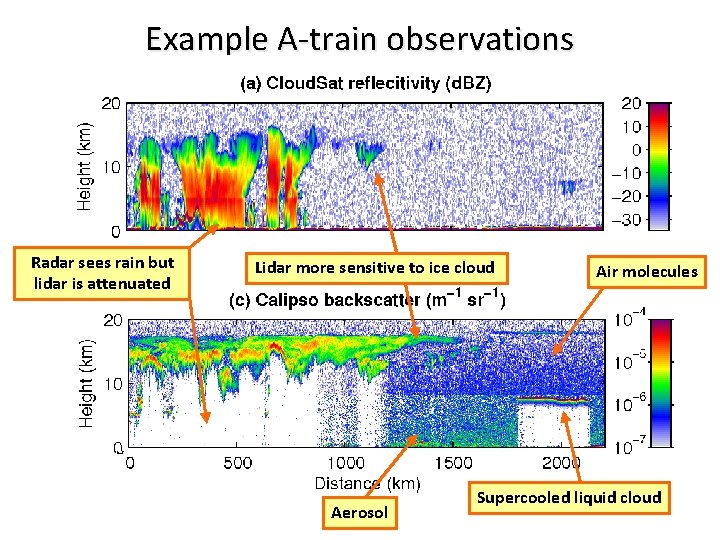
Example A-train observations Radar sees rain but lidar is attenuated Lidar more sensitive to ice cloud Aerosol Air molecules Supercooled liquid cloud
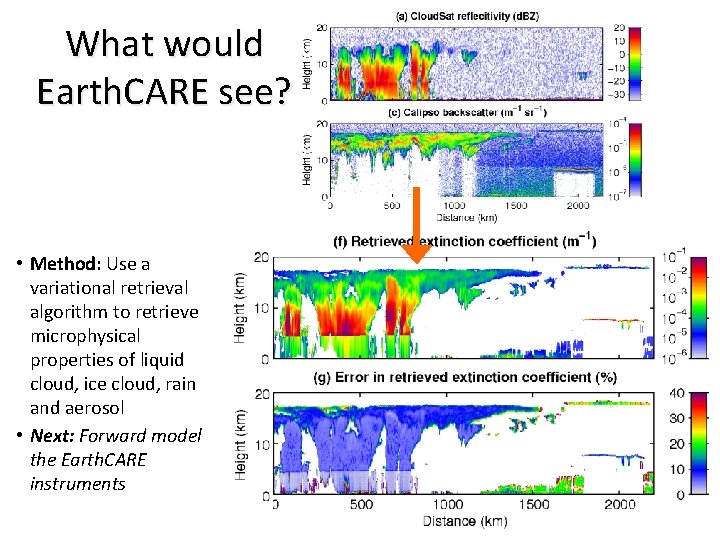
What would Earth. CARE see? • Method: Use a variational retrieval algorithm to retrieve microphysical properties of liquid cloud, ice cloud, rain and aerosol • Next: Forward model the Earth. CARE instruments
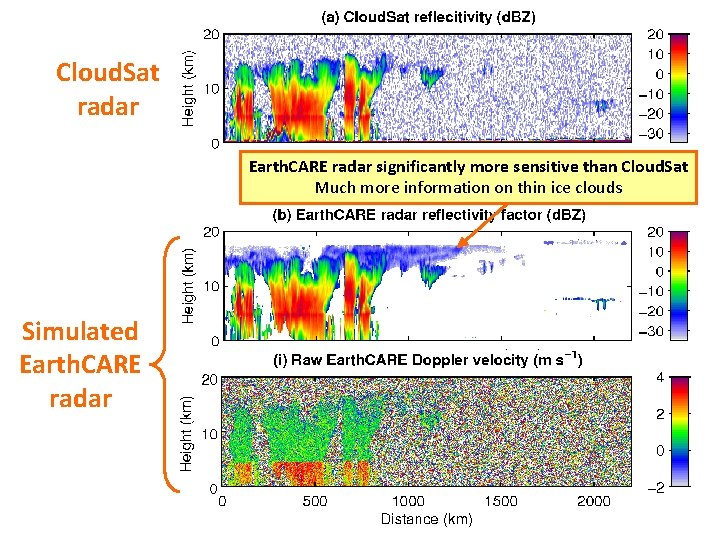
Cloud. Sat radar Earth. CARE radar significantly more sensitive than Cloud. Sat Much more information on thin ice clouds Simulated Earth. CARE radar
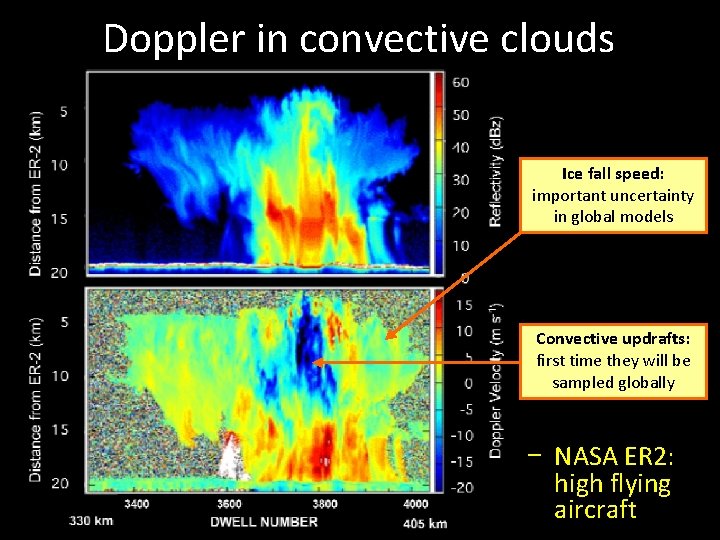
Doppler in convective clouds Ice fall speed: important uncertainty in global models Convective updrafts: first time they will be sampled globally − NASA ER 2: high flying aircraft
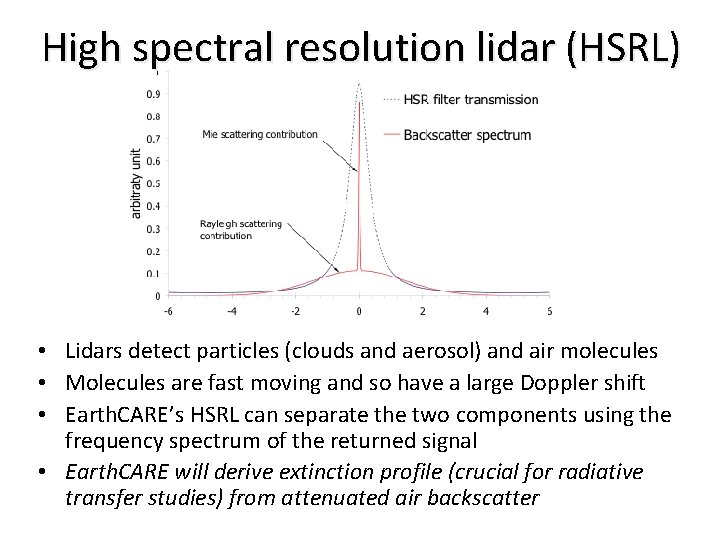
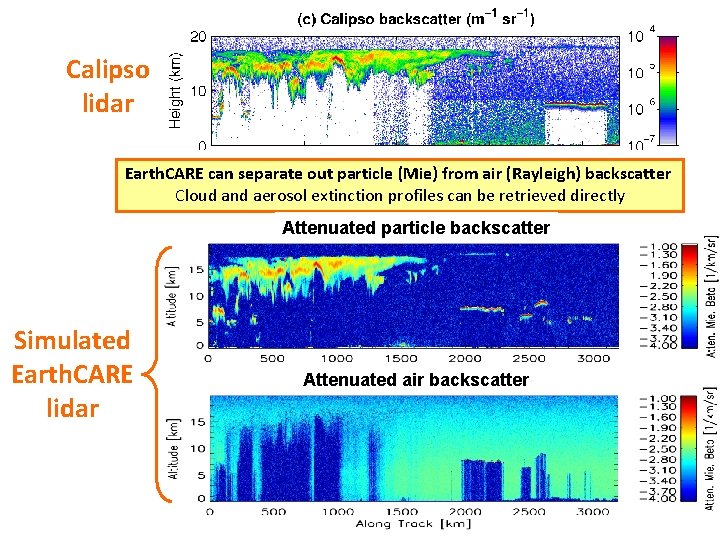
High spectral resolution lidar (HSRL) • Lidars detect particles (clouds and aerosol) and air molecules • Molecules are fast moving and so have a large Doppler shift • Earth. CARE’s HSRL can separate the two components using the frequency spectrum of the returned signal • Earth. CARE will derive extinction profile (crucial for radiative transfer studies) from attenuated air backscatter
Calipso lidar Earth. CARE can separate out particle (Mie) from air (Rayleigh) backscatter Cloud and aerosol extinction profiles can be retrieved directly Attenuated particle backscatter Simulated Earth. CARE lidar Attenuated air backscatter
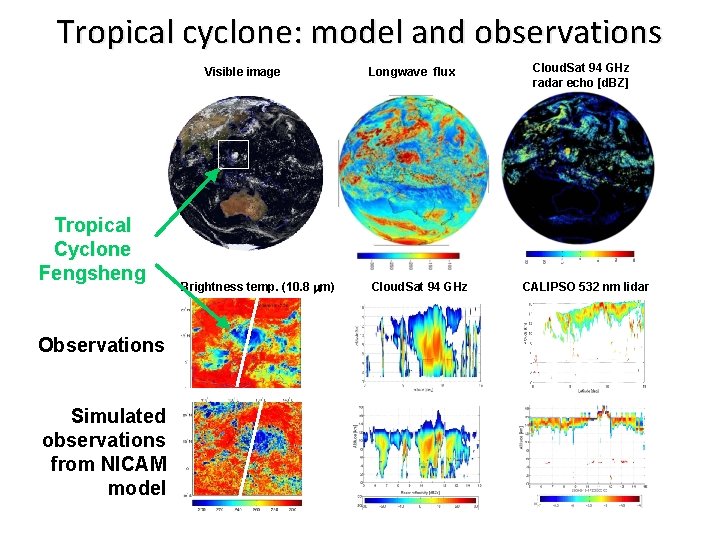
Tropical cyclone: model and observations Visible image Tropical Cyclone Fengsheng Observations Simulated observations from NICAM model Brightness temp. (10. 8 m) Longwave flux Cloud. Sat 94 GHz radar echo [d. BZ] CALIPSO 532 nm lidar
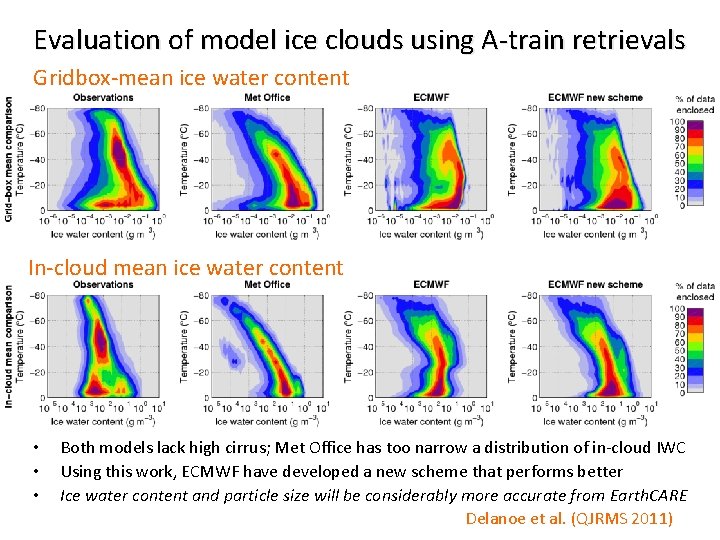
Evaluation of model ice clouds using A-train retrievals Gridbox-mean ice water content In-cloud mean ice water content • • • Both models lack high cirrus; Met Office has too narrow a distribution of in-cloud IWC Using this work, ECMWF have developed a new scheme that performs better Ice water content and particle size will be considerably more accurate from Earth. CARE Delanoe et al. (QJRMS 2011)
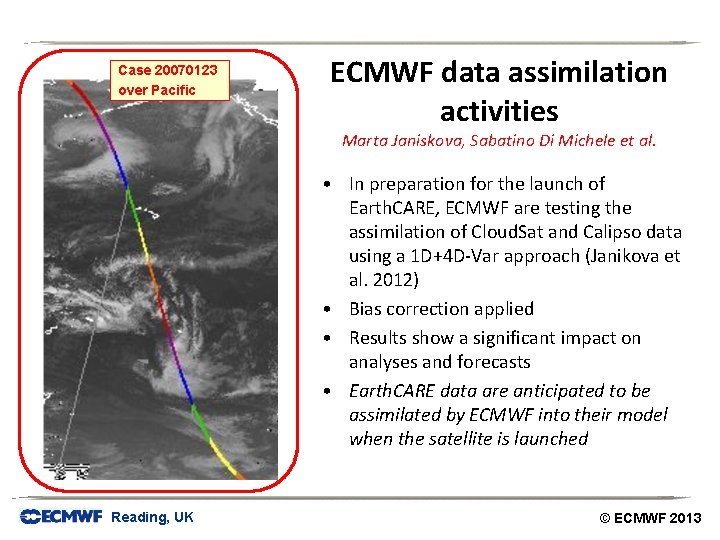
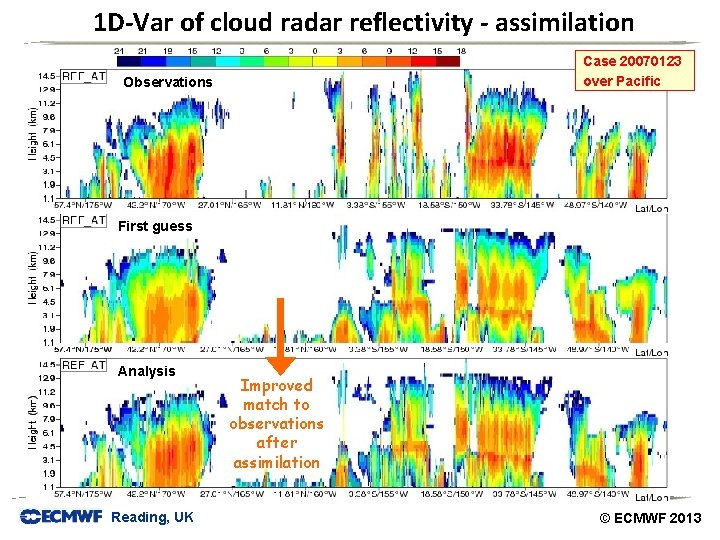
Case 20070123 over Pacific ECMWF data assimilation activities Marta Janiskova, Sabatino Di Michele et al. • In preparation for the launch of Earth. CARE, ECMWF are testing the assimilation of Cloud. Sat and Calipso data using a 1 D+4 D-Var approach (Janikova et al. 2012) • Bias correction applied • Results show a significant impact on analyses and forecasts • Earth. CARE data are anticipated to be assimilated by ECMWF into their model when the satellite is launched Reading, UK © ECMWF 2013
1 D-Var of cloud radar reflectivity - assimilation Case 20070123 over Pacific Observations First guess Analysis Reading, UK Improved match to observations after assimilation © ECMWF 2013
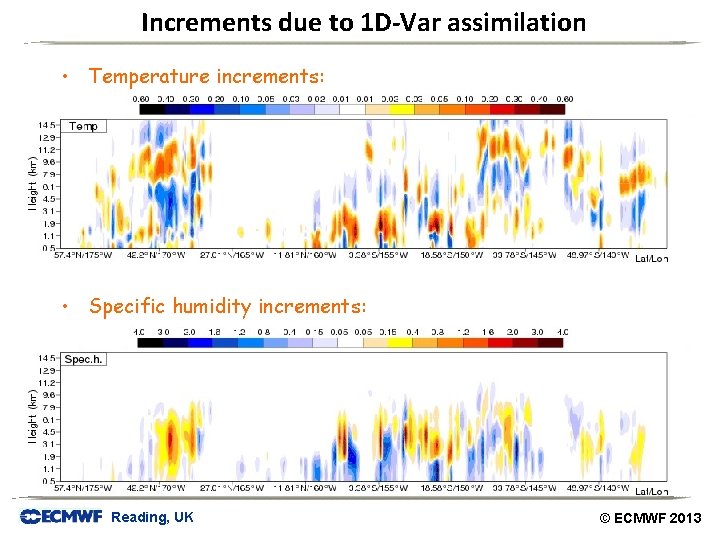
Increments due to 1 D-Var assimilation • Temperature increments: • Specific humidity increments: Reading, UK © ECMWF 2013
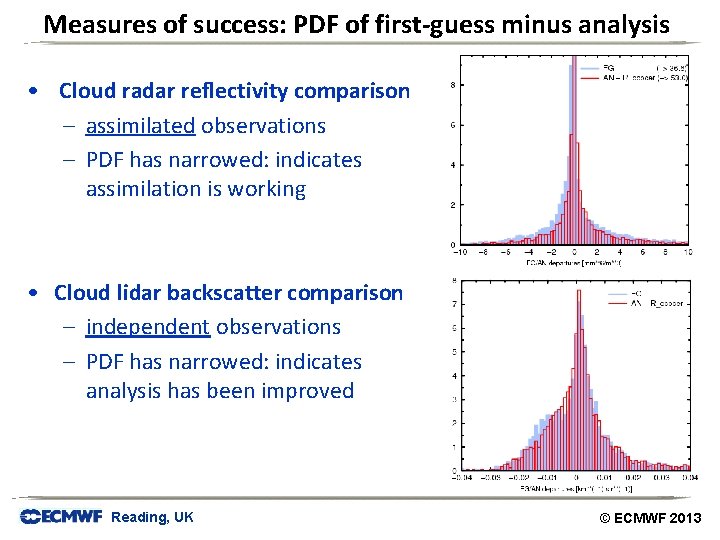
Measures of success: PDF of first-guess minus analysis • Cloud radar reflectivity comparison – assimilated observations – PDF has narrowed: indicates assimilation is working • Cloud lidar backscatter comparison – independent observations – PDF has narrowed: indicates analysis has been improved Reading, UK © ECMWF 2013
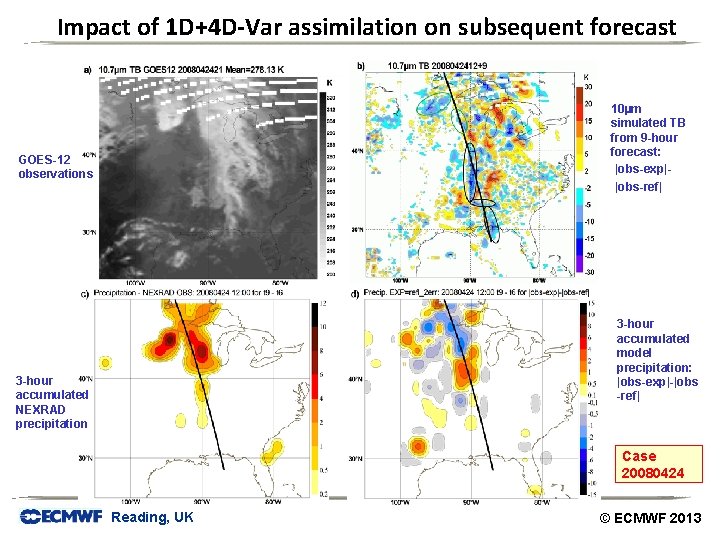
Impact of 1 D+4 D-Var assimilation on subsequent forecast 10 m simulated TB from 9 -hour forecast: |obs-exp||obs-ref| GOES-12 observations 3 -hour accumulated model precipitation: |obs-exp|-|obs -ref| 3 -hour accumulated NEXRAD precipitation Case 20080424 Reading, UK © ECMWF 2013
Earth. CARE and the Met Office Improving the simulation of clouds in our models is important for both short-term forecasting and for reducing uncertainty in our projections of future climate change. Earth. CARE will provide information of relevance to both of these aims. • We plan to use Earth. CARE data to compare with our weather and climate models to see how realistically we represent clouds. • This will help us to improving the representation of clouds in our models, including their formation, development and evolution over different time scales. © Crown copyright Met Office