
ES 2501 StaticsUnit 6 1 Equilibrium of Particles
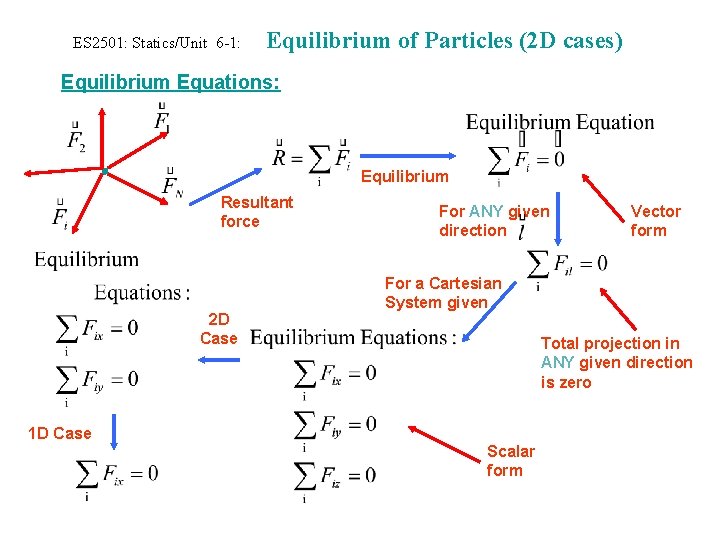
ES 2501: Statics/Unit 6 -1: Equilibrium of Particles (2 D cases) Equilibrium Equations: Equilibrium Resultant force 2 D Case For ANY given direction Vector form For a Cartesian System given Total projection in ANY given direction is zero 1 D Case Scalar form
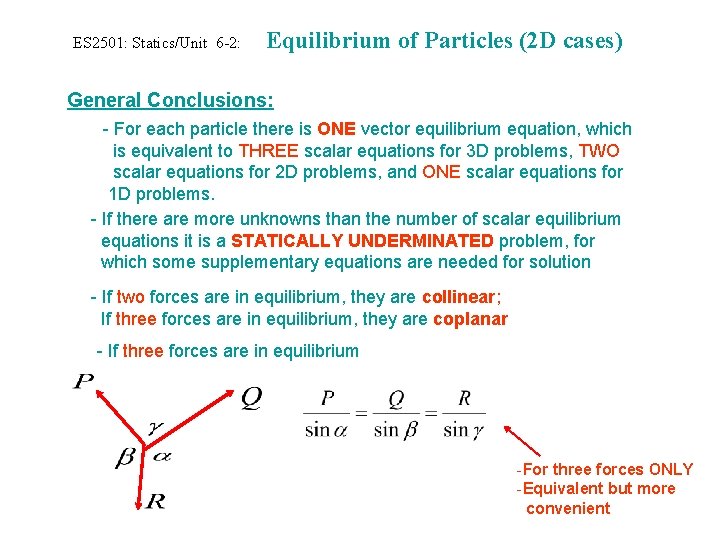
ES 2501: Statics/Unit 6 -2: Equilibrium of Particles (2 D cases) General Conclusions: - For each particle there is ONE vector equilibrium equation, which is equivalent to THREE scalar equations for 3 D problems, TWO scalar equations for 2 D problems, and ONE scalar equations for 1 D problems. - If there are more unknowns than the number of scalar equilibrium equations it is a STATICALLY UNDERMINATED problem, for which some supplementary equations are needed for solution - If two forces are in equilibrium, they are collinear; If three forces are in equilibrium, they are coplanar - If three forces are in equilibrium -For three forces ONLY -Equivalent but more convenient

ES 2501: Statics/Unit 6 -3: Equilibrium of Particles (2 D cases) Example 1: Find Step 1: Free-Body Diagram tensions of cables Note: Sign convention Step 2: List Eqs FBD of point C Action and reaction Staticaly determinant vs statically underminant problems Alternative Solution: FBD of block Step 3: Solution three eqs for three unknowns
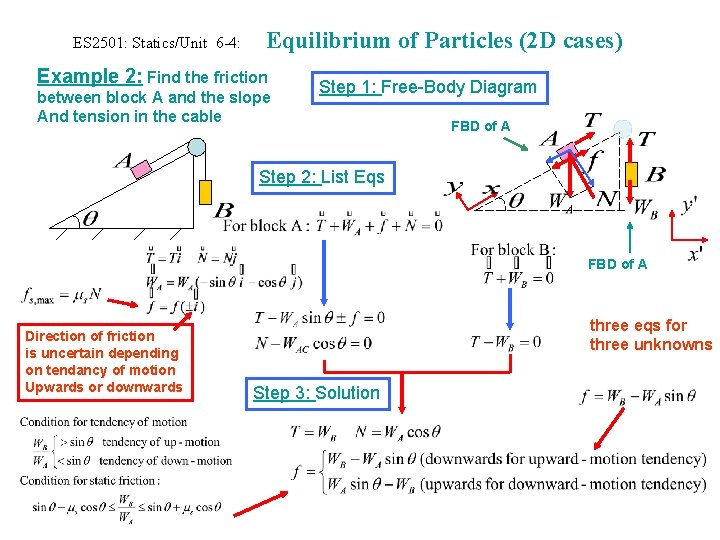
ES 2501: Statics/Unit 6 -4: Equilibrium of Particles (2 D cases) Example 2: Find the friction between block A and the slope And tension in the cable Step 1: Free-Body Diagram FBD of A Step 2: List Eqs FBD of A Direction of friction is uncertain depending on tendancy of motion Upwards or downwards three eqs for three unknowns Step 3: Solution
- Slides: 4