
ES 2501 StaticsUnit 5 1 FreeBody Diagram Introduction
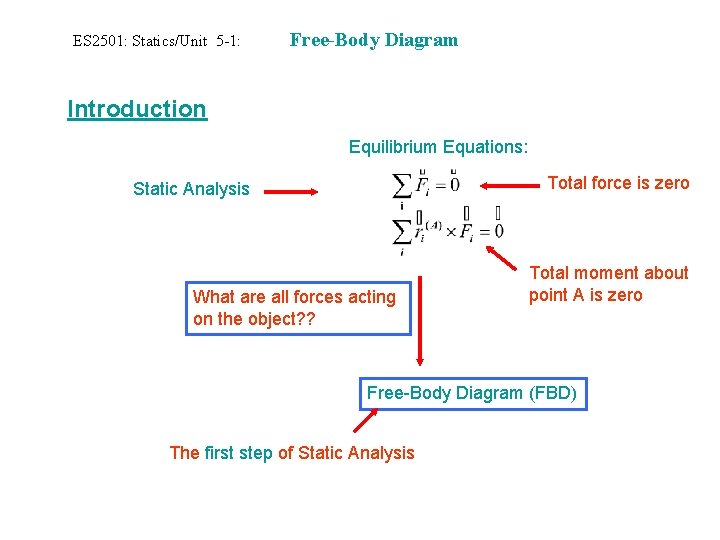
ES 2501: Statics/Unit 5 -1: Free-Body Diagram Introduction Equilibrium Equations: Total force is zero Static Analysis What are all forces acting on the object? ? Total moment about point A is zero Free-Body Diagram (FBD) The first step of Static Analysis
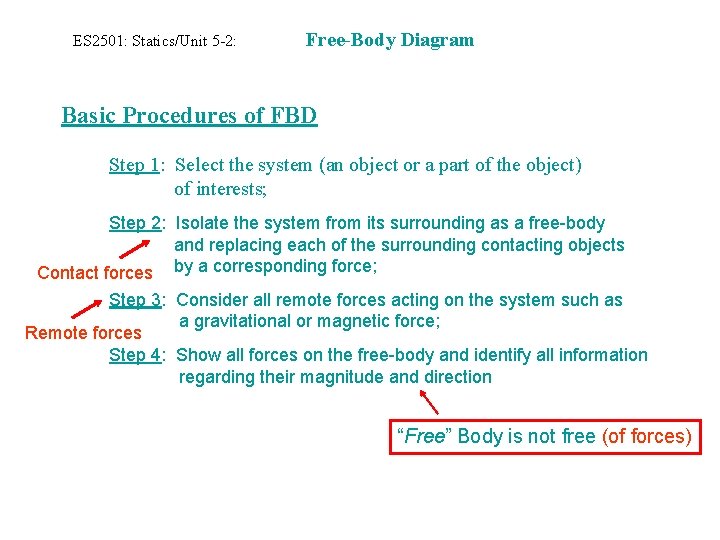
ES 2501: Statics/Unit 5 -2: Free-Body Diagram Basic Procedures of FBD Step 1: Select the system (an object or a part of the object) of interests; Step 2: Isolate the system from its surrounding as a free-body and replacing each of the surrounding contacting objects Contact forces by a corresponding force; Step 3: Consider all remote forces acting on the system such as a gravitational or magnetic force; Remote forces Step 4: Show all forces on the free-body and identify all information regarding their magnitude and direction “Free” Body is not free (of forces)
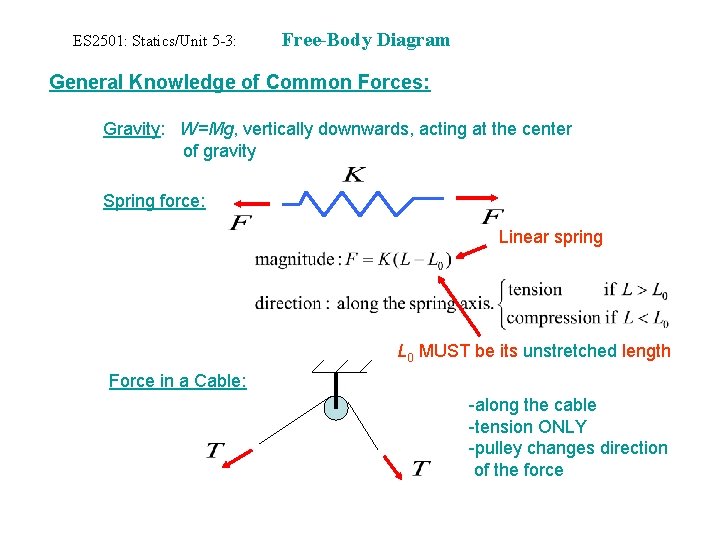
ES 2501: Statics/Unit 5 -3: Free-Body Diagram General Knowledge of Common Forces: Gravity: W=Mg, vertically downwards, acting at the center of gravity Spring force: Linear spring L 0 MUST be its unstretched length Force in a Cable: -along the cable -tension ONLY -pulley changes direction of the force
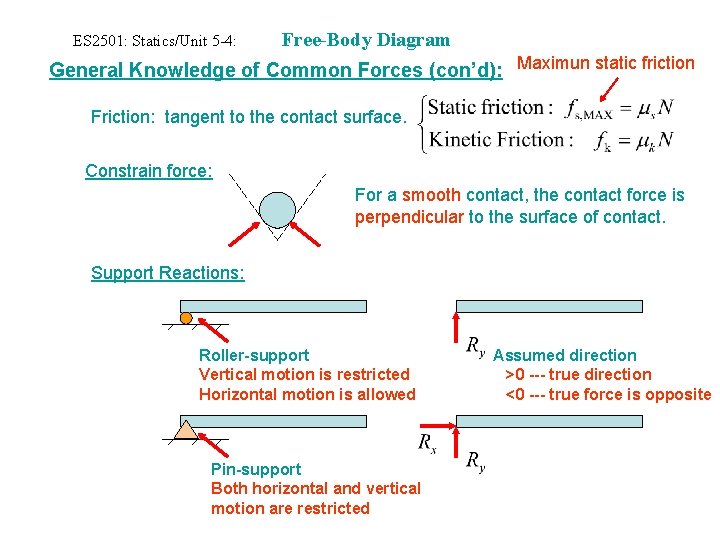
ES 2501: Statics/Unit 5 -4: Free-Body Diagram General Knowledge of Common Forces (con’d): Maximun static friction Friction: tangent to the contact surface. Constrain force: For a smooth contact, the contact force is perpendicular to the surface of contact. Support Reactions: Roller-support Vertical motion is restricted Horizontal motion is allowed Pin-support Both horizontal and vertical motion are restricted Assumed direction >0 --- true direction <0 --- true force is opposite

ES 2501: Statics/Unit 5 -5 FBD of the pulley: Examples: FBD of combined Pulley and cable ABCD: Cannot see the internal force Distributed force FBD of the cable: FBD of the block: FBD of point D: FBD of the spring: Action and reaction

ES 2501: Statics/Unit 5 -6 Free-Body Diagram Example 2: FBD of block B: Three FBDs can be drawn depending on the problem of interest FBD of blocks A & B: FBD of block A: Internal forces (forces between different parts of the system cannot be seen in a FBD of the System unless FBDs of the parts are used. Direction of force can be determined by physical judgment. Sometimes, an assumed direction can be used and the true direction will be modified by the final Answer. Resultant forces of distributed normal pressure and friction are used above, which is conditional depending on the problem,
- Slides: 6