
ES 240 Scientific and Engineering Computation Introduction to
- Slides: 23
ES 240: Scientific and Engineering Computation. Introduction to Fourier Series Trigonometric Fourier Series § Outline – – – Introduction Visualization Theoretical Concepts Qualitative Analysis Example Class Exercise
ES 240: Scientific and Engineering Computation. Introduction to Fourier Series Introduction § What is Fourier Series? – Representation of a periodic function with a weighted, infinite sum of sinusoids. § Why Fourier Series? – Any arbitrary periodic signal, can be approximated by using some of the computed weights – These weights are generally easier to manipulate and analyze than the original signal
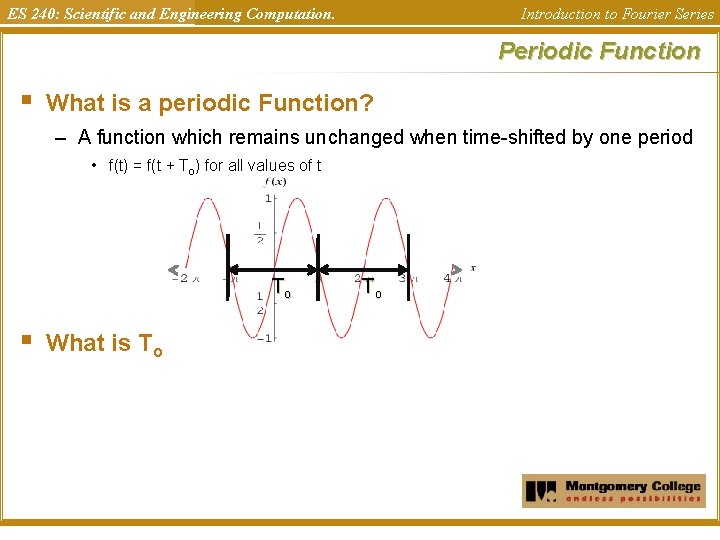
ES 240: Scientific and Engineering Computation. Introduction to Fourier Series Periodic Function § What is a periodic Function? – A function which remains unchanged when time-shifted by one period • f(t) = f(t + To) for all values of t To § What is To To
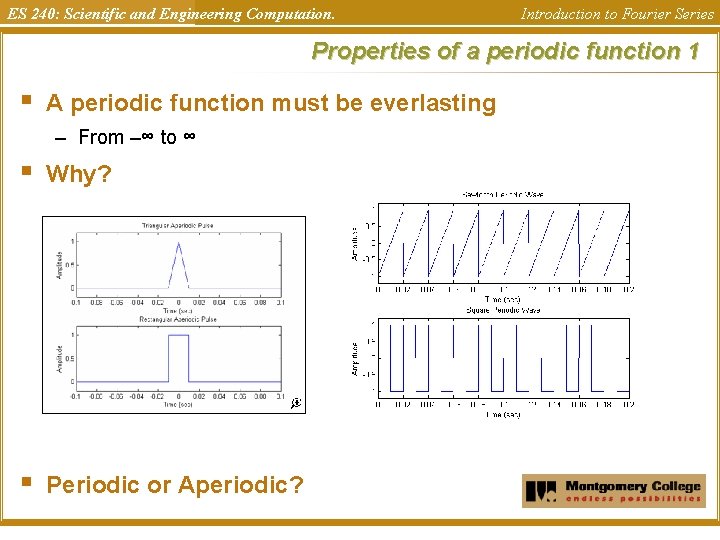
ES 240: Scientific and Engineering Computation. Introduction to Fourier Series Properties of a periodic function 1 § A periodic function must be everlasting – From –∞ to ∞ § Why? § Periodic or Aperiodic?
ES 240: Scientific and Engineering Computation. Introduction to Fourier Series Properties of a periodic function § You only need one period of the signal to generate the entire signal – Why? § A periodic signal cam be expressed as a sum of sinusoids of frequency F 0 = 1/T 0 and all its harmonics
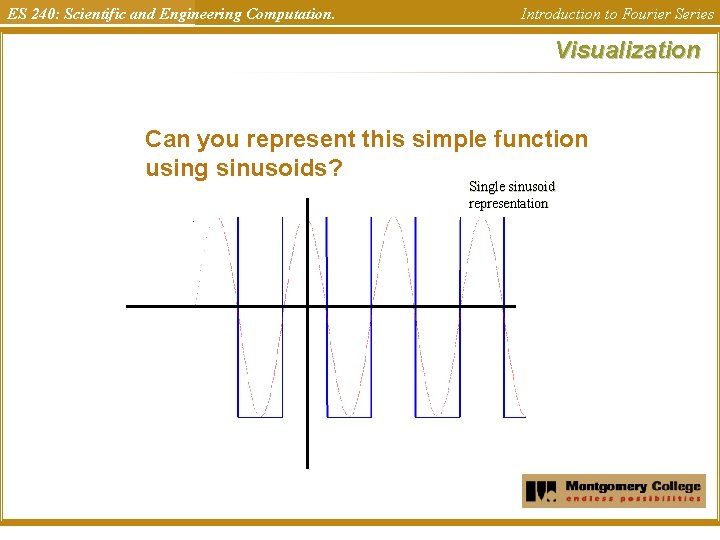
ES 240: Scientific and Engineering Computation. Introduction to Fourier Series Visualization Can you represent this simple function using sinusoids? Single sinusoid representation
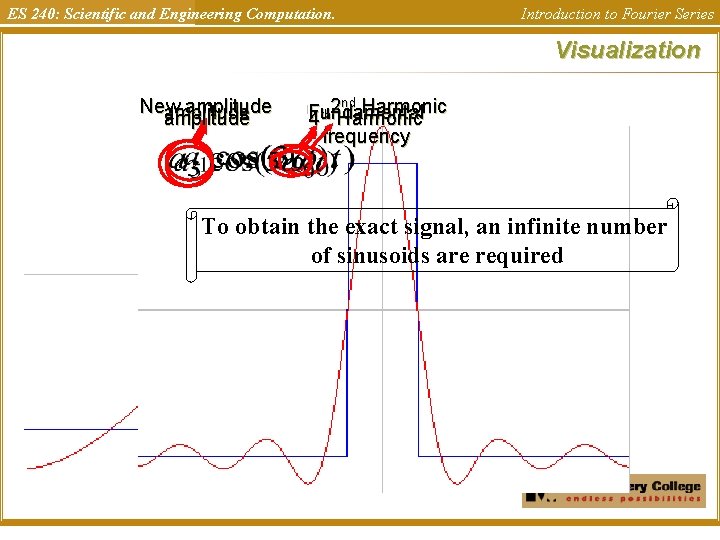
ES 240: Scientific and Engineering Computation. Introduction to Fourier Series Visualization New amplitude 2 nd Harmonic th Fundamental 4 Harmonic frequency To obtain the exact signal, an infinite number of sinusoids are required
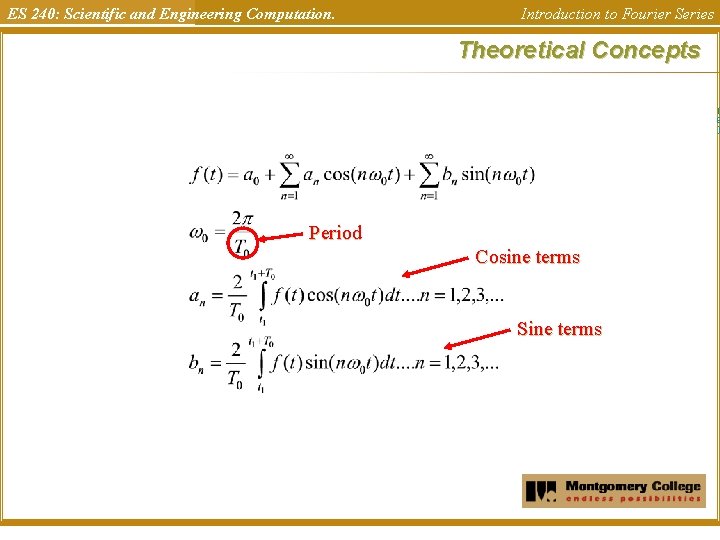
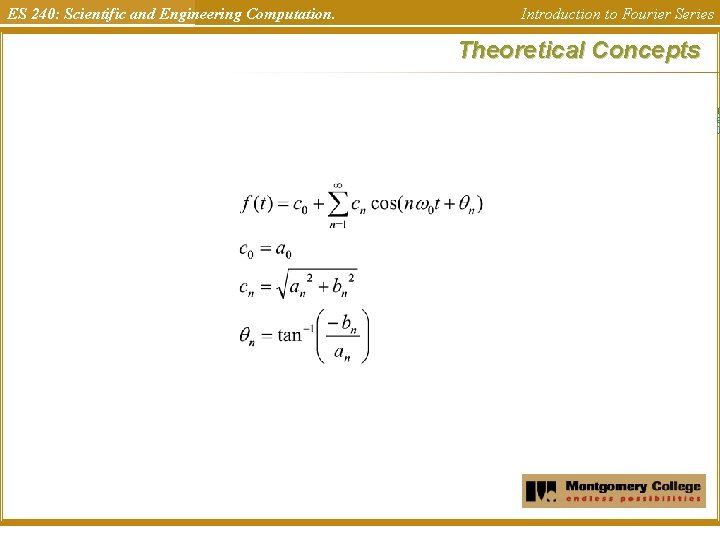
ES 240: Scientific and Engineering Computation. Introduction to Fourier Series Theoretical Concepts ( 6 ) Period Cosine terms Sine terms
ES 240: Scientific and Engineering Computation. Introduction to Fourier Series Theoretical Concepts ( 6 )
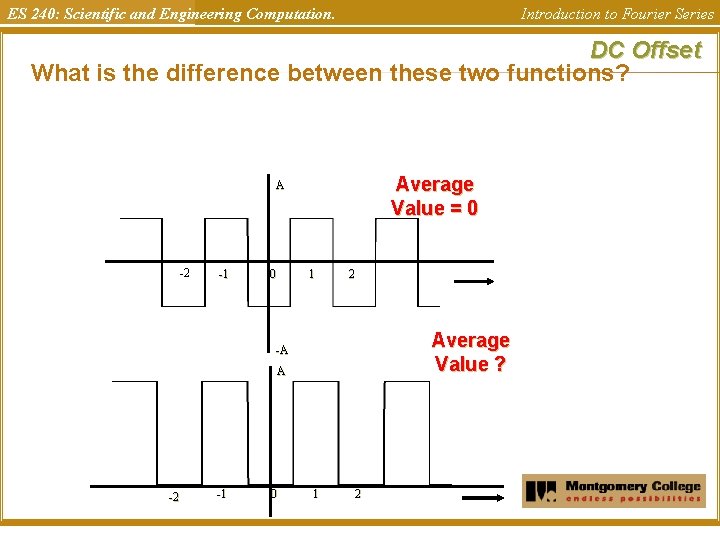
ES 240: Scientific and Engineering Computation. Introduction to Fourier Series DC Offset What is the difference between these two functions? Average Value = 0 A -2 -1 0 1 2 Average Value ? -A A -2 -1 0 1 2
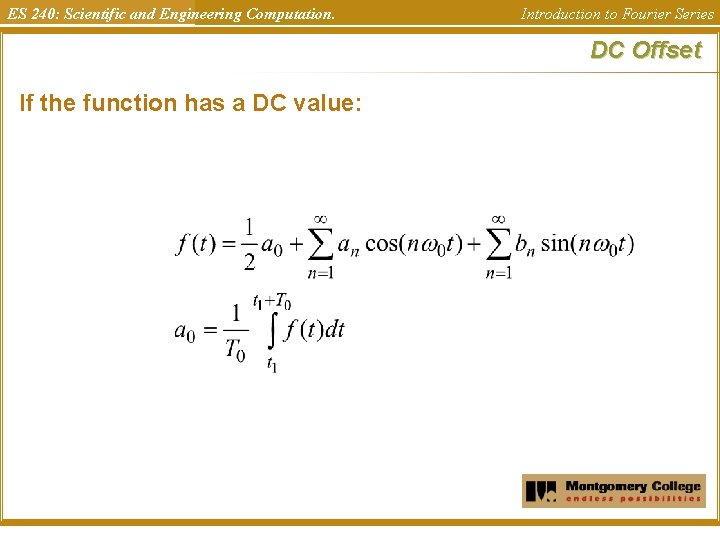
ES 240: Scientific and Engineering Computation. Introduction to Fourier Series DC Offset If the function has a DC value:
ES 240: Scientific and Engineering Computation. Introduction to Fourier Series Qualitative Analysis § Is it possible to have an idea of what your solution should be before actually computing it? For Sure
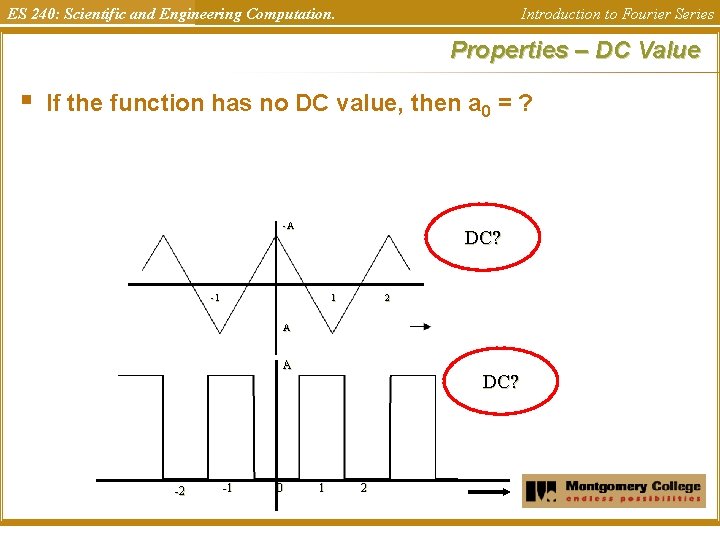
ES 240: Scientific and Engineering Computation. Introduction to Fourier Series Properties – DC Value § If the function has no DC value, then a 0 = ? -A DC? -1 1 2 A A -2 -1 0 DC? 1 2
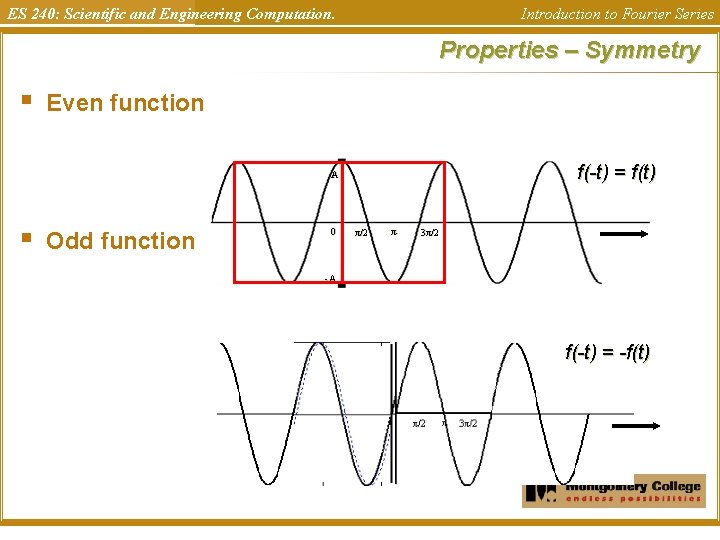
ES 240: Scientific and Engineering Computation. Introduction to Fourier Series Properties – Symmetry § Even function f(-t) = f(t) A § Odd function 0 π π/2 3π/2 -A f(-t) = -f(t) A 0 A π/2 π 3π/2
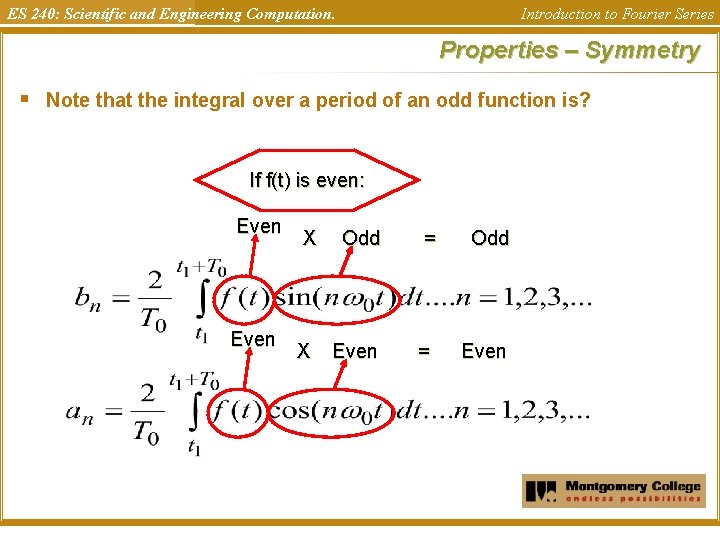
ES 240: Scientific and Engineering Computation. Introduction to Fourier Series Properties – Symmetry § Note that the integral over a period of an odd function is? If f(t) is even: Even X Odd = Odd X Even = Even
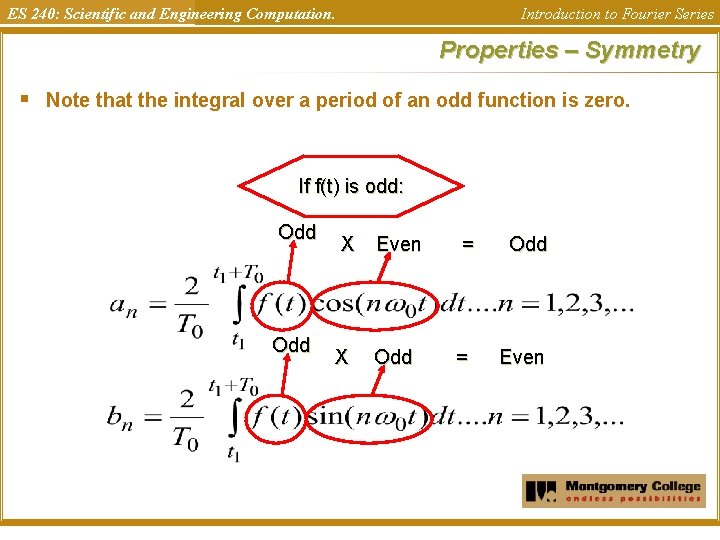
ES 240: Scientific and Engineering Computation. Introduction to Fourier Series Properties – Symmetry § Note that the integral over a period of an odd function is zero. If f(t) is odd: Odd X Even = Odd X Odd = Even
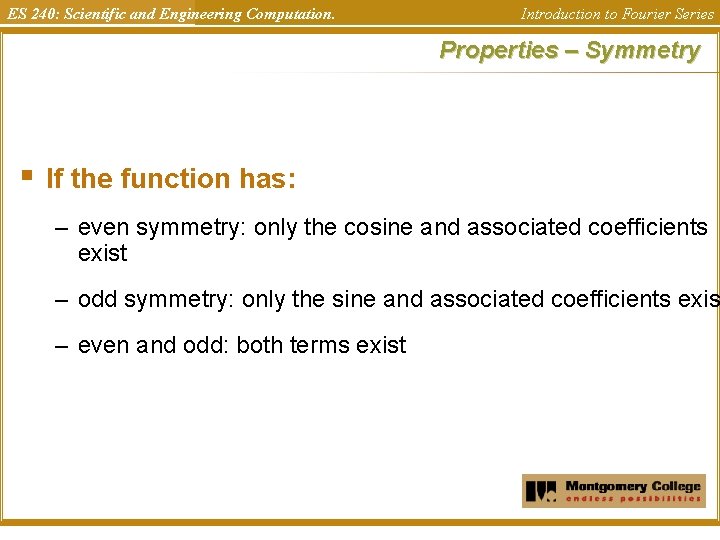
ES 240: Scientific and Engineering Computation. Introduction to Fourier Series Properties – Symmetry § If the function has: – even symmetry: only the cosine and associated coefficients exist – odd symmetry: only the sine and associated coefficients exis – even and odd: both terms exist
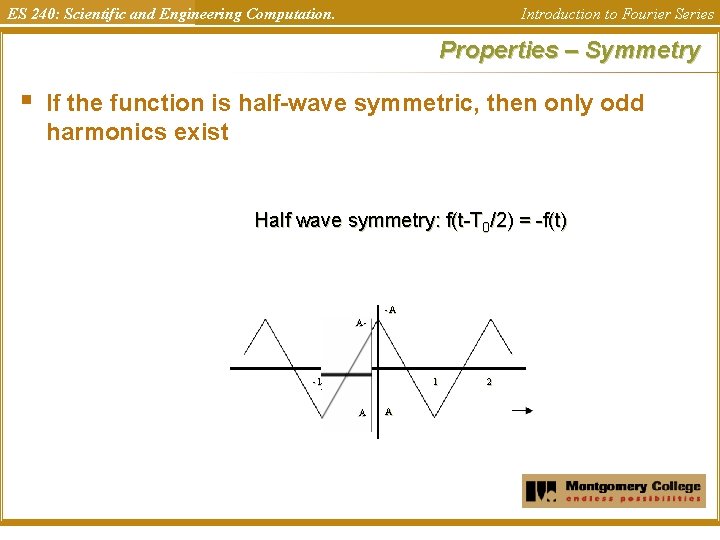
ES 240: Scientific and Engineering Computation. Introduction to Fourier Series Properties – Symmetry § If the function is half-wave symmetric, then only odd harmonics exist Half wave symmetry: f(t-T 0/2) = -f(t) -A -1 1 A 2
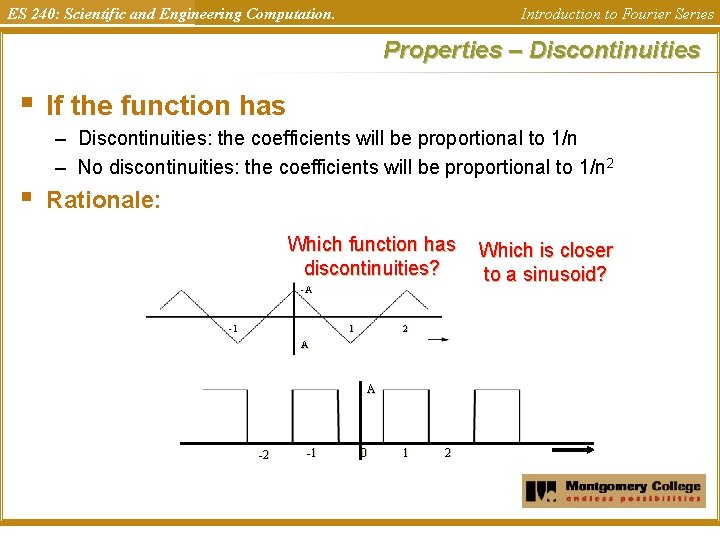
ES 240: Scientific and Engineering Computation. Introduction to Fourier Series Properties – Discontinuities § If the function has – Discontinuities: the coefficients will be proportional to 1/n – No discontinuities: the coefficients will be proportional to 1/n 2 § Rationale: Which function has discontinuities? -A -1 1 2 A A -2 -1 0 1 2 Which is closer to a sinusoid?
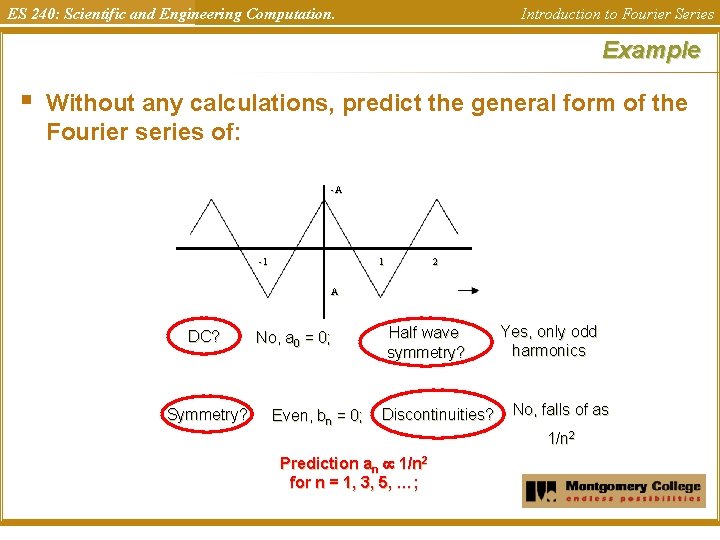
ES 240: Scientific and Engineering Computation. Introduction to Fourier Series Example § Without any calculations, predict the general form of the Fourier series of: -A -1 1 2 A DC? Symmetry? No, a 0 = 0; Even, bn = 0; Half wave symmetry? Discontinuities? Yes, only odd harmonics No, falls of as 1/n 2 Prediction an 1/n 2 for n = 1, 3, 5, …;
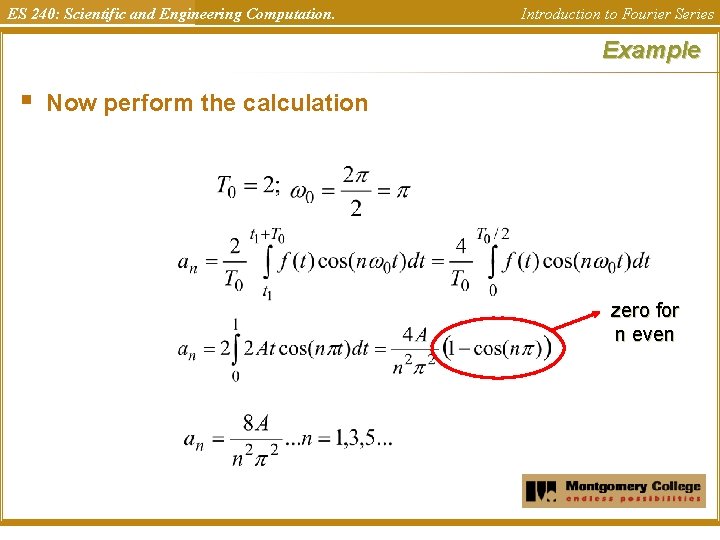
ES 240: Scientific and Engineering Computation. Introduction to Fourier Series Example § Now perform the calculation zero for n even
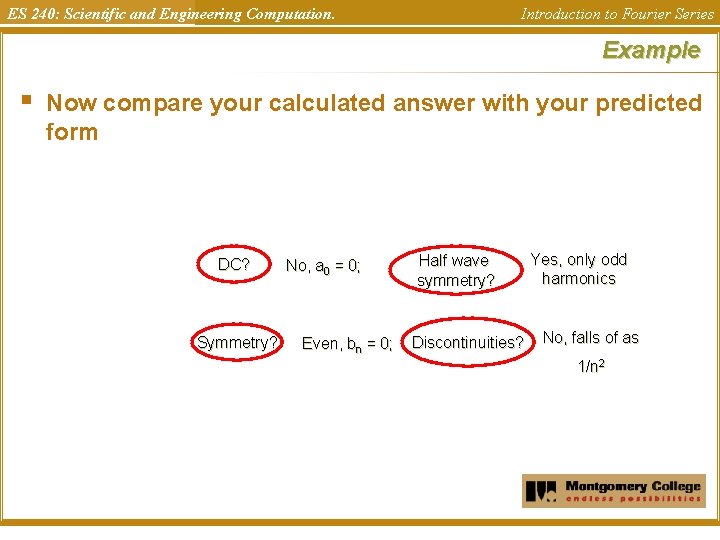
ES 240: Scientific and Engineering Computation. Introduction to Fourier Series Example § Now compare your calculated answer with your predicted form DC? Symmetry? No, a 0 = 0; Even, bn = 0; Half wave symmetry? Discontinuities? Yes, only odd harmonics No, falls of as 1/n 2
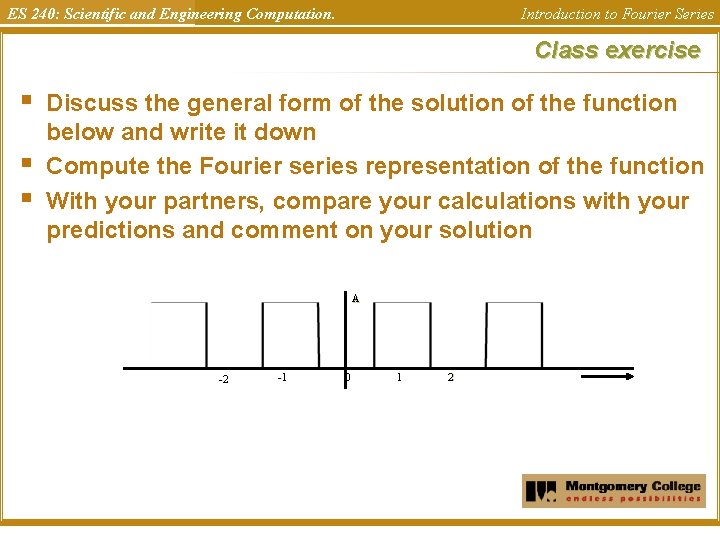
ES 240: Scientific and Engineering Computation. Introduction to Fourier Series Class exercise § § § Discuss the general form of the solution of the function below and write it down Compute the Fourier series representation of the function With your partners, compare your calculations with your predictions and comment on your solution A -2 -1 0 1 2