
ERT 433 HALAL PROCESSING Mdm Rohazita Bahari School

ERT 433 HALAL PROCESSING Mdm Rohazita Bahari School of Bioprocess Engineering, Uni. MAP Semester 2, 2019/2020

Course Outcomes (CO) 1 Ability to evaluate and apply knowledge of basic concept of Halal food laws, regulations and guidelines to meet domestic and international requirements and comparison of kosher, halal and vegetarian. 2
Teaching Plan ERT 433 : Halal ◍ Sinopsis kursus / Course synopsis: ◍ Halal food industries emerge as one of the important international trades in providing and supplying clean and permissible food to not only Muslim populations but also people across the globe. The requirements for producing halal food is very crucial to be upheld and becoming one of the important subject in the food industries. Thus, this course discusses various halal requirements for the main food including meat, dairy, fish and seafood, and cereals. Some food ingredients for example gelatine, enzymes and alcoholic materials will also be examined in terms of their requirements in the food processing. Towards the end of the course, student will learn about the current trend on biotechnology-based processing food or GMO and their processing and packaging. 3
4

5

“ ◍ Halal Laws : the system of rules which a particular country or community recognize as regulating the actions of its members and which it may enforce by the imposition of penalties. ◍ Regulation : rule or directive made & maintained by authority ◍ Guidelines : a general rule, principle 6

Introduction HALAL FOOD LAWS AND REGULATIONS Introduction to the halal food laws and regulations. Briefing on the general guidelines for halal food production. INTERNATIONAL AND DOMESTIC TRADE IN HALAL PRODUCTS Understand the requirements for producing products for Muslim markets. Discussion on the import requirements of countries with Muslim populations, which cover religious as well as safety aspects of imported food. 7
Introduction Halal food: § are those that are free from any component that Muslims are § prohibited from consuming- all good and clean foods are halal. Almost all foods of plant and animal origin are considered halal except those that have been specifically prohibited by the Quran and the Sunnah (the life, actions, and teachings of the Prophet Muhammad ( ﷺ Peace be upon him, PBUH) 8
Introduction v People all over the world are now more conscious about eating healthy foods that are low in calories, cholesterol, fat, and sodium. v And also foods that are organically produced without the use of synthetic pesticides and other non-natural chemicals. v Islam = 2 nd largest religion in the world v Muslim = ~ 2 billion populations 9

Halal Food Laws and Regulations • Food is considered one of the most important factors for interaction among various ethnic, social, and religious groups. • All people are concerned about the food they eat: Muslims want to ensure that their food is halal; Jews that their food is kosher; Hindus, Buddhists, and certain other groups that their food is vegetarian. 10
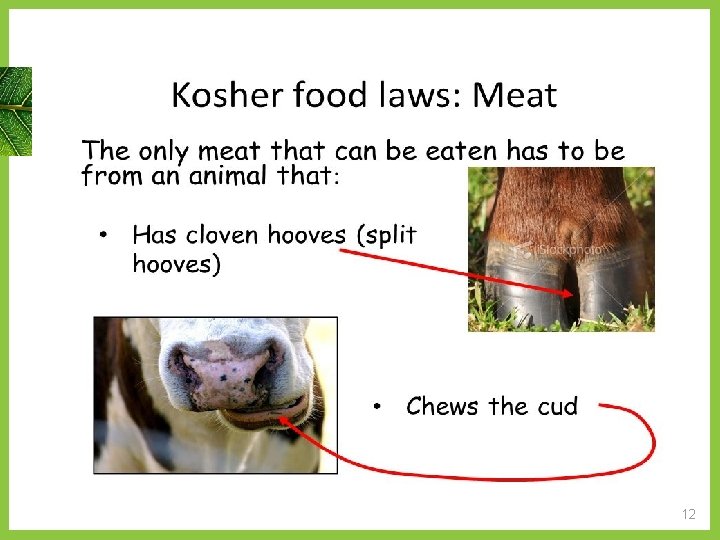
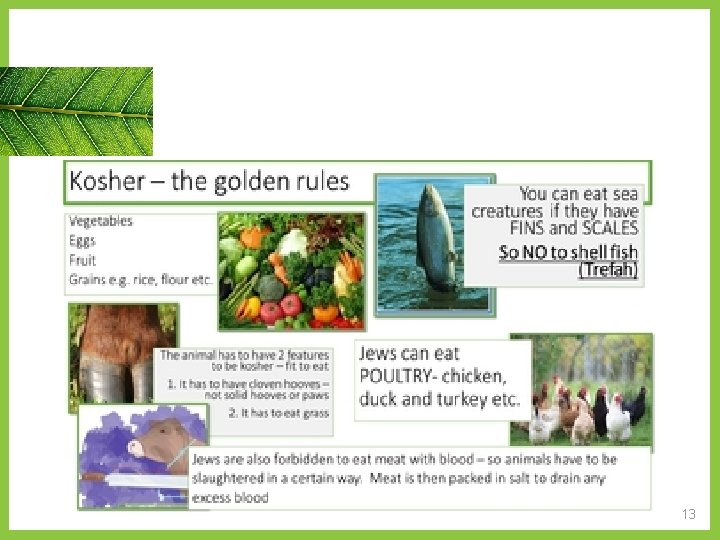
Kosher ◍ (of food, or premises in which food is sold, cooked, or eaten) satisfying the requirements of Jewish law ◍ To qualify as kosher, mammals must have split hooves and chew their cud (cud is a portion of food that returns from a ruminant’s stomach to the mouth to be chewed for second time) ◍ Fish must have fins and removable scales to be considered kosher. ◍ Only certain birds are kosher 11
12
13

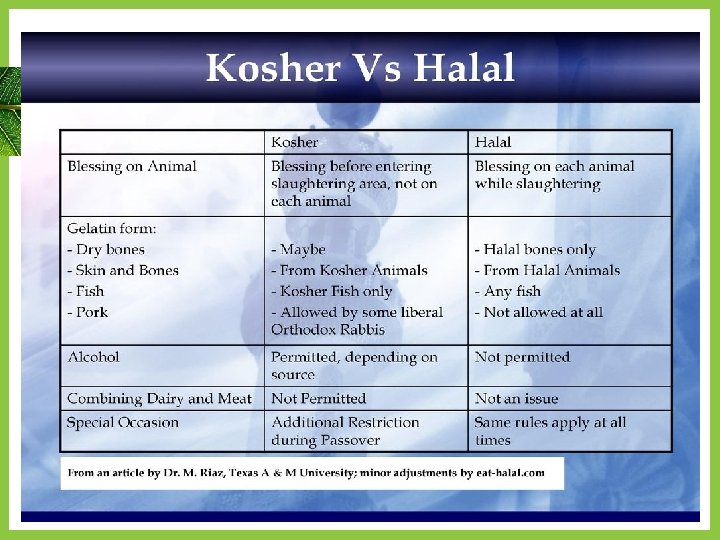
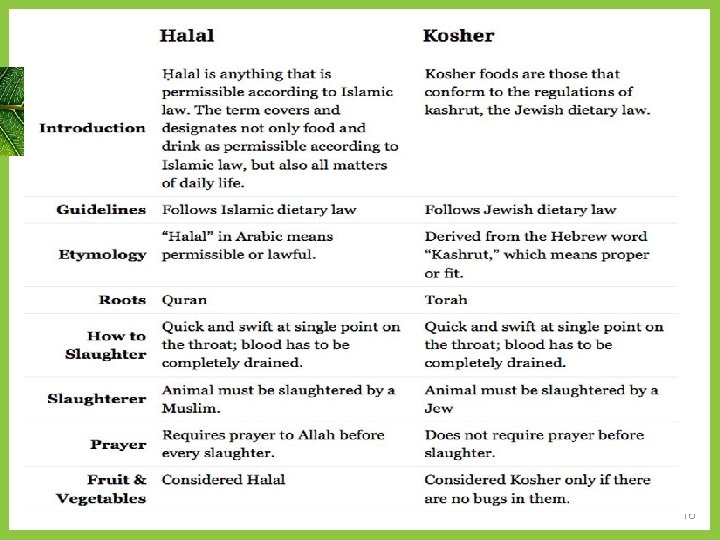
Difference between Kosher and Halal 14
15
16
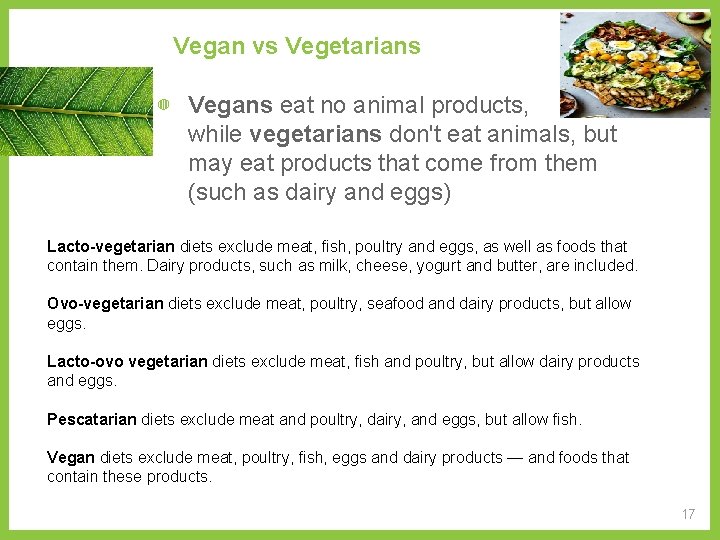
Vegan vs Vegetarians ◍ Vegans eat no animal products, while vegetarians don't eat animals, but may eat products that come from them (such as dairy and eggs) Lacto-vegetarian diets exclude meat, fish, poultry and eggs, as well as foods that contain them. Dairy products, such as milk, cheese, yogurt and butter, are included. Ovo-vegetarian diets exclude meat, poultry, seafood and dairy products, but allow eggs. Lacto-ovo vegetarian diets exclude meat, fish and poultry, but allow dairy products and eggs. Pescatarian diets exclude meat and poultry, dairy, and eggs, but allow fish. Vegan diets exclude meat, poultry, fish, eggs and dairy products — and foods that contain these products. 17

“ ◍ Jabatan Kemajuan Islam Malaysia (JAKIM) 18

From Portal : HALAL MALAYSIA OFFICIAL PORTAL ◍ RECOGNIZED AUTHORITY Recognized authority refers to JAKIM, JAIN or MAIN, whichever applies. ◍ ISLAMIC LAW (SYARA') Islamic Law (Syara’) refers to Islamic law according to the Syafi’e school of thought, or the Maliki, Hambali or Hanafi schools of thought, as decreed by the King of Malaysia and enforced in Wilayah Persekutuan or decreed by the Royal Head of State of any state and enforced in that respective state 19
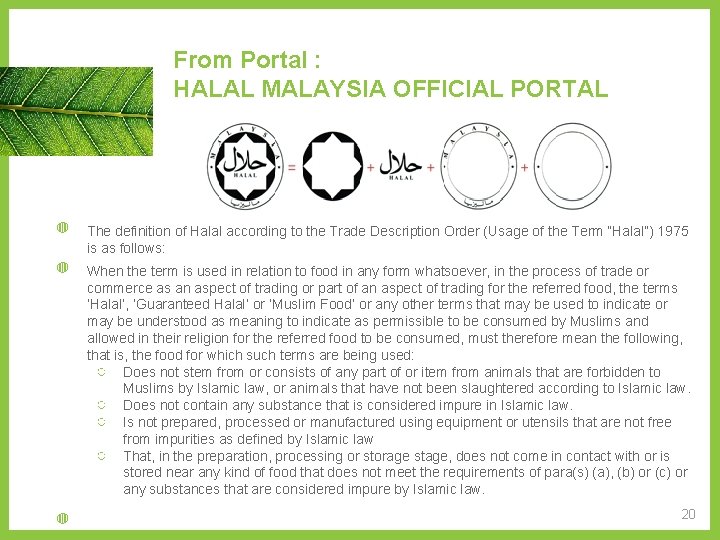
From Portal : HALAL MALAYSIA OFFICIAL PORTAL ◍ ◍ The definition of Halal according to the Trade Description Order (Usage of the Term “Halal”) 1975 is as follows: When the term is used in relation to food in any form whatsoever, in the process of trade or commerce as an aspect of trading or part of an aspect of trading for the referred food, the terms ‘Halal’, ‘Guaranteed Halal’ or ‘Muslim Food’ or any other terms that may be used to indicate or may be understood as meaning to indicate as permissible to be consumed by Muslims and allowed in their religion for the referred food to be consumed, must therefore mean the following, that is, the food for which such terms are being used: ○ Does not stem from or consists of any part of or item from animals that are forbidden to Muslims by Islamic law, or animals that have not been slaughtered according to Islamic law. ○ Does not contain any substance that is considered impure in Islamic law. ○ Is not prepared, processed or manufactured using equipment or utensils that are not free from impurities as defined by Islamic law ○ That, in the preparation, processing or storage stage, does not come in contact with or is stored near any kind of food that does not meet the requirements of para(s) (a), (b) or (c) or any substances that are considered impure by Islamic law. ◍ 20
From Portal : HALAL MALAYSIA OFFICIAL PORTAL ◍ FOOD AND BEVERAGE PRODUCTS; Food and beverage products refers to products that are made or produced or are products or produce or output that involve food and beverage. ◍ CONSUMER GOODS Consumer Goods refers to goods that are not food or beverage based; for instance cosmetics, clothing and equipment ◍ FOOD PREMISES Food Premises refer to buildings and premises where food and beverage business is conducted including restaurants, food courts, commercial kitchens, cafeterias, bakeries, fast food restaurants, canteens, club/hotel restaurants, kiosks, caterers and others. ◍ SLAUGHTER HOUSE Slaughter house refers to a place or premises for slaughtering and/or processing animals. 21

Standards & Procedures ◍ Manual Prosedur Halal Malaysia (Manual Procedure of Halal Certification Malaysia), ◍ ◍ MS 1500: 2009 Halal Food-Production, ◍ MS 2200 -1: 2008 Islamic Consumer Goods-Part 1: Cosmetic and Personal Care-General Guidelines, ◍ MS 2400 -1: 2010 Halalan-Toyyiban Assurance Pipeline. Part 1: Management System Requirements for Transportation of Goods and/or Cargo Chain Services, and ◍ MS 2400 -2: 2010 Halalan-Toyyiban Assurance Pipeline-Part 1: Management System Requirements for Warehousing and Related Activities Preparation, Handling and Storage-General Guidelines (Second Revision), 22
Citation from journal (will be upload in portal) ◍ Jabatan Kemajuan Islam Malaysia (JAKIM) dan Majlis/Jabatan Agama Islam Negeri (MAIN/JAIN) selaku badan autoriti yang dipertanggungjawabkan dalam urusan halal di Malaysia (Liziana & Mariam; Mustafa & Azlin, 2014) turut mendapat kerjasama dari agensi-agensi kerajaan lain dalam menguatkuasakan undang-undang halal seperti Kementerian Perdagangan Dalam Negeri, Koperasi dan Kepenggunaan (KPDNKK), Jabatan Standard Malaysia, Jabatan Perkhidmatan Veterinar, Kementerian Kesihatan Malaysia (KKM) , Jabatan Kastam Di Raja Malaysia (KDRM) dan Pihak Berkuasa Tempatan (PBT) (Zulkifli, 2007). Selain itu, terdapat kerjasama yang erat dengan Halal Industry Development Corporation (HDC) atau turut dikenali sebagai Perbadanan Pembangunan Industri Halal dalam membangunkan industri halal di Malaysia seiring dengan usaha untuk menjadikan Malaysia sebagai peneraju hab halal antarabangsa. 23

MANUAL PROCEDURE FOR MALAYSIA HALAL CERTIFICATION (THIRD REVISION) 2014 – (refer portal) ◍ CONTENT ◍ 1. Scope ◍ 2. Definition ◍ 3. Certification Scheme ◍ 4. Conditions for Certification ◍ 5. General Requirements for Certification ◍ 6. Specific Requirements for Certification in Accordance with Scheme ◍ 7. Application Procedure in Accordance with Scheme 3 ◍ 8. Certification Fee ◍ 9. Audit Procedure ◍ 10. Monitoring and Enforcement ◍ 11. Malaysia Halal Certificate and Malaysia Halal Logo ◍ 12. Responsibilities of Malaysia Halal Certificate Holder ◍ 13. Malaysia Halal Certification Panel ◍ 14. Appendix 24
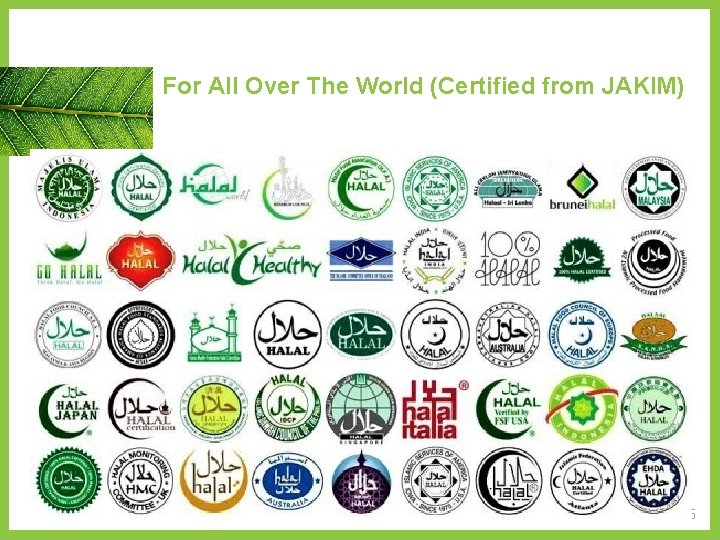
For All Over The World (Certified from JAKIM) 25
Principles regarding permissibility of food (Al-Qaradawi, 1984) ü The basic principle is that all things created by God are permitted, with a few exceptions that are specifically prohibited. ü To make lawful and unlawful is the right of God alone. No human being, no matter how pious or powerful, may take this right into his own hands. ü Prohibiting what is permitted and permitting what is prohibited is similar to ascribing partners to God. ü The basic reasons for the prohibition of things are impurity and harmfulness. A Muslim is not required to know exactly why or how something is unclean or harmful in what God has prohibited. There might be obvious reasons, and there might be obscure reasons. ü What is permitted is sufficient, and what is prohibited is then superfluous. God prohibited only things that are unnecessary or dispensable while providing better alternatives. ü Whatever is conducive to the “prohibited” is in itself prohibited. If something is prohibited, anything leading to it is also prohibited. ü Falsely representing unlawful as lawful is prohibited. It is unlawful to legalize God’s prohibitions by flimsy excuses. To represent lawful as unlawful is also prohibited. 26
Principles regarding permissibility of food (Al-Qaradawi, 1984) ü Good intentions do not make the unlawful acceptable. Whenever any permissible action of the believer is accompanied by a good intention, his action becomes an act of worship. In the case of haram, it remains haram no matter how good the intention, how honorable the purpose, or how lofty the goal. Islam does not endorse employing a haram means to achieve a praiseworthy end. Indeed, it insists not only that the goal be honorable, but also that the means chosen to attain it be proper. “The end justifies the means” and “Secure your right even through wrongdoing” are maxims not acceptable in Islamic law demands that the right should be secured through just means only. ü Doubtful things should be avoided. There is a gray area between clearly lawful and clearly unlawful. This is the area of “what is doubtful. ” Islam considers it an act of piety for Muslims to avoid doubtful things, and for them to stay clear of the unlawful. Muhammad said (Sakr, 1994): “Halal is clear and haram is clear; in between these two are certain things that are suspected. Many people may not know whether these items are halal or haram. Whosoever, leaves them, he is innocent toward his religion and his conscience. He is, therefore, safe. Anyone who gets involved in any of these suspected items, he may fall into the unlawful and the prohibition. This case is similar to the one who wishes to raise his animals next to a restricted area, he may step into it. Indeed the 27 restrictions of Allah are the unlawful. ”
Principles regarding permissibility of food (Al-Qaradawi, 1984) ü Unlawful things are prohibited to everyone alike. Islamic laws are universally applicable to all races, creeds, and sexes. There is no favored treatment of any privileged class. Actually, in Islam, there are no privileged classes; hence, the question of preferential treatment does not arise. This principle applies not only among Muslims but between Muslims and non. Muslims as well. ü Necessity dictates exceptions. The range of prohibited things in Islam is very narrow, but emphasis on observing the prohibitions is very strong. At the same time, Islam is not oblivious to the exigencies of life, to their magnitude, or to human weakness and capacity to face them. It permits the Muslim, under the compulsion of necessity, to eat a prohibited food in quantities sufficient to remove the necessity and thereby survive. 28
Terminology v Halal means permissible and lawful. It applies not only to meat and poultry, but also to other food products, cosmetics, and personal care products. The term also applies to personal behavior and interaction with the community. ◍ Haram means prohibited. It is directly opposite of halal. ◍ Mashbooh is something questionable or doubtful, either due to the differences in scholars’ opinions or the presence of undetermined ingredients in a food product. ◍ Makrooh is a term generally associated with someone’s dislike for a food product or, while not clearly haram, is considered dislikeable by some Muslims. ◍ Zabiha or dhabiha is a term often used by Muslims in the U. S to differentiate meat that has been slaughtered by Muslims as opposed to being slaughtered by Ahlul Kitab (Jews or Christians) or without religious connotation. 29

HALAL & HARAM “ O mankind, eat from whatever is on earth [that is] lawful and good and do not follow the footsteps of Satan. Indeed, he is to you a clear enemy. 30 (Al-Baqarah, verse 168)

HALAL & HARAM “ O you who have believed, eat from the good things which We have provided for you and be grateful to Allah if it is [indeed] Him that you worship 31 (Al-Baqarah, verse 172)

HALAL & “ 32 HARAM
HALAL & HARAM “ He hath forbidden you only carrion (dead animals), and blood, and swine flesh, and that which hath been immolated to (the name of) any other than Allah… (Al-Baqarah, verse 173) 33
“ 34 (Al-Mā’idah, verse 3)
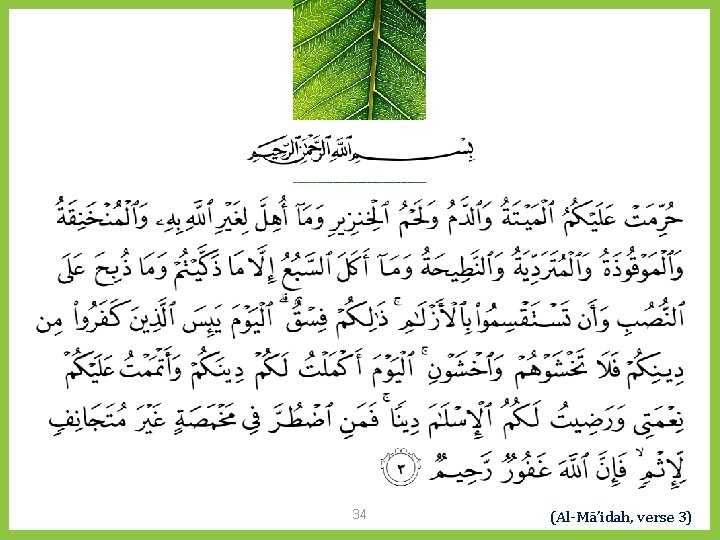
HALAL & HARAM “ Forbidden unto you (for food) are carrion and blood and swine flesh (pork), and that which hath been dedicated unto any other than Allah, and the strangled, and the dead through beating, and the dead through falling from a height, and that which hath been killed by (the goring of) horns, and the devoured of wild beasts saving that which ye make lawful (by the death-stroke) and that which hath been immolated unto idols. And (forbidden is it) that ye swear by the divining arrows. This is an abomination… 35 (Al-Mā’idah, verse 3)
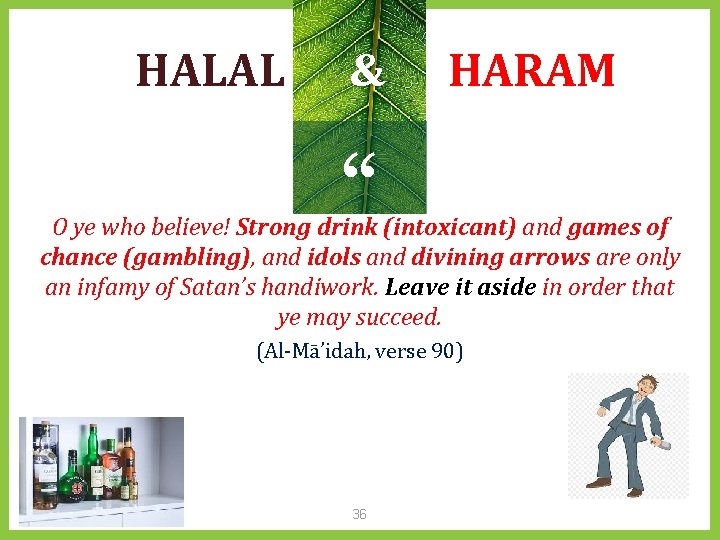
HALAL & HARAM “ O ye who believe! Strong drink (intoxicant) and games of chance (gambling), and idols and divining arrows are only an infamy of Satan’s handiwork. Leave it aside in order that ye may succeed. (Al-Mā’idah, verse 90) 36
HALAL & HARAM “ Al-An’ām, verse 118, 119, 142, 145 Al-An’ām, verse 121 Al-Mā’idah, verse 1, 4, 5 Al-Mā’idah, verse 87 Al-Mā’idah, verse 88 An-Nahl, verse 114, 115 37

Makrooh “ ﻣﻜﺮﻭﻩ Al-Bukhaari (5452) and Muslim (564) narrated from Jaabir ibn ‘Abd-Allaah that the Messenger of Allah ﷺ said: “Whoever eats garlic or onions, let him keep away from us, or keep away from our mosque and stay in his house. ” According to a version narrated by Muslim: “Whoever eats onions or garlic or leeks, let him not come near our mosque, for the angels are offended by the same things that offend the sons of Adam. ” 38
Basis for the Prohibitions Carrion and dead animals are unfit for human consumption because the decaying process leads to the formation of chemicals which are harmful to humans (Awan, 1988). v Blood that is drained from the body contains harmful bacteria, products of metabolism, and toxins (Awan, 1988; Hussaini and Sakr, 1983). v Swine serves as a vector for pathogenic worms to enter the human body. Infection by Trichinella spiralis and Taenia solium are not uncommon. Fatty acid composition of pork fat has been mentioned as incompatible with the human fat and biochemical systems (Awan, 1988; Hussaini and Sakr, 1983; Sakr, 1993). v Intoxicants are considered harmful for the nervous system, affecting the senses and human judgment. In many cases they lead to social and family problems and even loss of lives (Al-Qaradawi, 1984; Awan, 39 1988). v

HALAL Human dignity Modern civilized society & “ Proper Slaughtering § halal species-cattle, lamb, etc. ; § In the name of God § By Muslim of proper age § by cutting the throat of the animal in a manner that induces rapid, complete bleeding and results in the quickest death. 40 HARAM
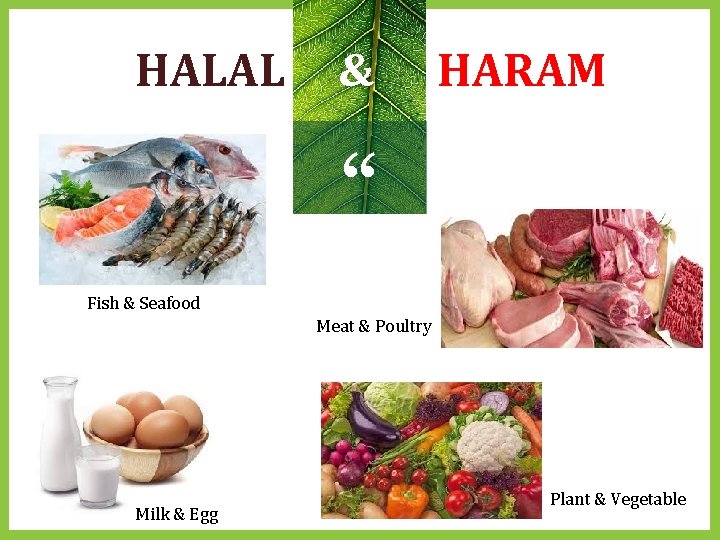
HALAL & HARAM “ Fish & Seafood Meat & Poultry Milk & Egg 41 Plant & Vegetable
CORONAVIRUS ◍ ◍ 2006 Dec; 12(12): 1834– 1840. doi: 10. 3201/eid 1212. 060401 Review of Bats and SARS ◍ ◍ Lin-Fa Wang, * Zhengli Shi, † Shuyi Zhang, ‡§ Hume Field, ¶ Peter Daszak, # and Bryan T. Eaton* Abstract Bats have been identified as a natural reservoir for an increasing number of emerging zoonotic viruses, including henipaviruses and variants of rabies viruses. Recently, we and another group independently identified several horseshoe bat species (genus Rhinolophus) as the reservoir host for a large number of viruses that have a close genetic relationship with the coronavirus associated with severe acute respiratory syndrome (SARS). Our current research focused on the identification of the reservoir species for the progenitor virus of the SARS coronaviruses responsible for outbreaks during 2002– 2003 and 2003– 2004. In addition to SARS-like coronaviruses, many other novel bat coronaviruses, which belong to groups 1 and 2 of the 3 existing coronavirus groups, have been detected by PCR. The discovery of bat SARS-like coronaviruses and the great genetic diversity of coronaviruses in bats have shed new light on the origin and transmission of SARS coronaviruses. Keywords: emerging zoonoses, SARS, coronavirus, bats, animal reservoir, spillover, synopsis 42

Slaughtering (from Manual – Jakim) PROSEDUR PENGELUARAN TAULIAH PENYEMBELIH JABATAN AGAMA ISLAM NEGERI SELURUH MALAYSIA 1. SYARAT-SYARAT PERMOHONAN ◍ Pemohon yang layak memohon Tauliah Penyembelih mestilah memenuhi syarat-syarat berikut: a) Beragama Islam; b) Sihat akal dan tubuh badan; c) Warganegara Malaysia atau Pemastautin Tetap Malaysia; d) Menghadiri kursus yang ditetapkan; dan e) Bekerja di premis penyembelihan yang berdaftar. 43
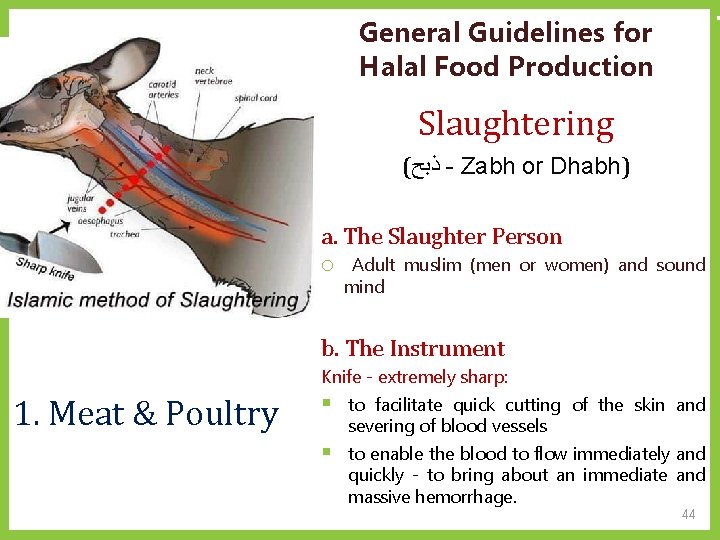
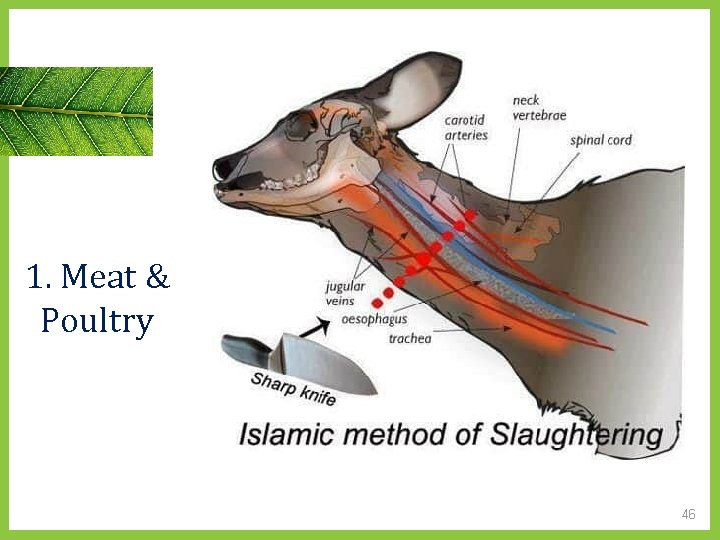
General Guidelines for Halal Food Production Slaughtering ( ﺫﺑﺢ - Zabh or Dhabh) a. The Slaughter Person o Adult muslim (men or women) mind and sound b. The Instrument Knife - extremely sharp: 1. Meat & Poultry § § to facilitate quick cutting of the skin and severing of blood vessels to enable the blood to flow immediately and quickly - to bring about an immediate and massive hemorrhage. 44
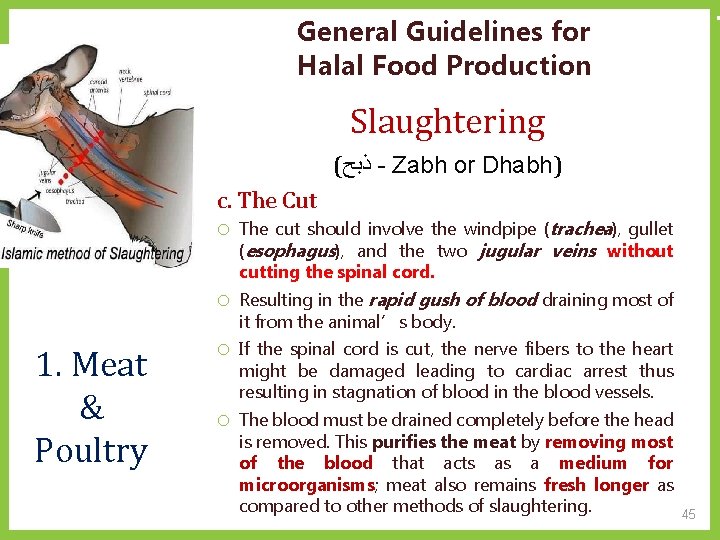
General Guidelines for Halal Food Production Slaughtering ( ﺫﺑﺢ - Zabh or Dhabh) c. The Cut o The cut should involve the windpipe (trachea), gullet (esophagus), and the two jugular veins without cutting the spinal cord. 1. Meat & Poultry o Resulting in the rapid gush of blood draining most of it from the animal’s body. o If the spinal cord is cut, the nerve fibers to the heart might be damaged leading to cardiac arrest thus resulting in stagnation of blood in the blood vessels. o The blood must be drained completely before the head is removed. This purifies the meat by removing most of the blood that acts as a medium for microorganisms; meat also remains fresh longer as compared to other methods of slaughtering. 45
1. Meat & Poultry 46

General Guidelines for Halal Food Production Slaughtering 1. Meat & Poultry ( ﺫﺑﺢ - Zabh or Dhabh) d. The Invocation - Pronouncing (Tasmiyah) the name of God by saying Bismillah (in the name of Allah) or Bismillahi Allahu Akbar (in the name of God, God is Great) before cutting the neck. - Imam Malik: if the name of God is not mentioned over the animal before slaughtering, the meat of such animal is haram or forbidden, whether one neglects to say Bismillah intentionally or unintentionally. - Abu Hanifah: if one neglects to say Bismillah intentionally, the meat is haram; if the omission is unintentional, the meat is halal. - Imam Shaf’ii: whether one neglects to say Bismillah intentionally or unintentionally before slaughtering, the meat is halal so long as the person is competent to perform dhabh (Khan, 1991). 47
Abominable (terrible) Acts in Slaying of Animal • Throw the animal down on its side and sharpen the knife • • afterwards. Let the knife reach the spinal cord or to cut off the head of the animal. It is abominable to break the neck of an animal or begin skinning it or cut any parts while it is convulsing or before its life is completely departed. Perform dhabh with a dull instrument. It is also abominable to slaughter one animal while the next in line is watching the animal being killed. This is against the humaneness of the process of slaughtering. 48
Advantages of Halal Slaughtering • The speed of the incision / sharp knife shortens the total time to slaughter and seems to inflict less pain than stunning. • In a modern slaughterhouse, where animals are stunned before slaying, • • some of the animals do not become unconscious with one blow and have to be hit more than once The method of dhabh allows rapid and efficient bleeding of the animal. Cutting the blood vessels - blood gushes out with dhabh slaughter; while it pours out somewhat slower when the animal has been stunned. The body of the dhabh animal convulses involuntarily more than the stunned animal. Convulsions produce the squeezing or wringing action of the muscles of the body on the blood vessels, which helps to get rid of maximum amount of blood from the meat tissue into the circulation (Khan, 1991). 49
2. Fish & Seafood ◍ ◍ ◍ Fish with scales are accepted by all denominations and groups of Muslims. Some groups do not consume fish without scales (e. g. , catfish). There additional differences among Muslims about seafood, especially molluscs (e. g. , clams, oysters, and squid) and crustaceans (e. g. , shrimp, lobster, and crab). “ 3. Milk & Eggs ü Milk and eggs from halal animals are also halal. ü Milk is used to make cheese, butter, and cream. ü A variety of enzymes are used in the production of cheeses. Enzymes can be halal or haram, depending on their source of origin. Enzymes from microbial sources or halalslaughtered animals are halal. ü However, an enzyme from a porcine source is haram. 50
4. Plant and Vegetable Materials Ø Foods from plants are halal, with the exception of khamr (intoxicating Ø Ø Ø drinks). In modern processing plants, however, animal or vegetable products might be processed in the same plant on the same equipment, increasing the chances of contamination. For example, in some factories, pork and beans as well as corn are canned on the same equipment. When proper cleaning procedures are used and the halal production segregated from non-halal, contamination can be avoided. Functional ingredients from animal sources, such as antifoams, must also be avoided in the processing of vegetables. This intentional inclusion of haram ingredients into plant and vegetable products may render them as haram. It is evident that processing aids and production methods have to be carefully monitored to maintain halal status of vegetable products. 51

5. Food Ingredients q Gelatin q Glycerin q Emulsifier q Enzymes q Alcohol q Animal fat and protein q Flavors and Flavorings 52
6. Sanitation ◍ During the manufacture of halal products, it is imperative that all ◍ ◍ possible sources of contamination be eliminated. This can be accomplished through proper scheduling of products as well as by thoroughly cleaning and sanitizing production lines and equipment. For nonmeat products, it is adequate to clean equipment and determine cleanliness by visual observation. A company might treat haram ingredients similar to allergens and make it part of an allergen control program. Chemicals used for cleaning (especially soaps and foams) should be screened to avoid animal fat origin. 53

7. Halal Certifications and Laws a) Akta Perihal Dagangan 1972 i. Perintah Perihal Dagangan (Penggunaan Perbahasaan ‘Halal’) 1975 ii. Perintah Perihal Dagangan (Penandaan Makanan) 1975 b) Akta/Enakmen Syariah Wilayah-Wilayah Persekutuan i. Akta/Enakmen Kesalahan Jenayah Syariah (Wilayah-Wilayah Persekutuan) 1997 [Akta 559] c) Akta Makanan 1983 (Akta 281) dan Peraturan-peraturan Makanan 1985 d) Animal Rules Ordinant 1962 e) Custom Act 1962 f) Undang-Undang Kecil Pihak Berkuasa Tempatan 54

55

“ Thank You 56
- Slides: 56