
ERT 316 ISOTHERMAL REACTOR DESIGN START 1 The
- Slides: 28
ERT 316 ISOTHERMAL REACTOR DESIGN
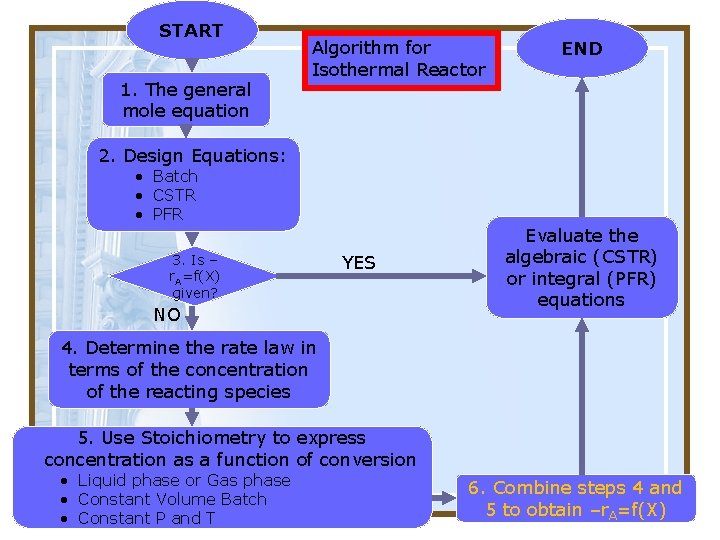
START 1. The general mole equation Algorithm for Isothermal Reactor END 2. Design Equations: • Batch • CSTR • PFR YES 3. Is – r. A=f(X) given? NO Evaluate the algebraic (CSTR) or integral (PFR) equations 4. Determine the rate law in terms of the concentration of the reacting species 5. Use Stoichiometry to express concentration as a function of conversion • Liquid phase or Gas phase • Constant Volume Batch • Constant P and T Copyright Cheng 05 6. Combine steps 4 and 5 to obtain –r. A=f(X)
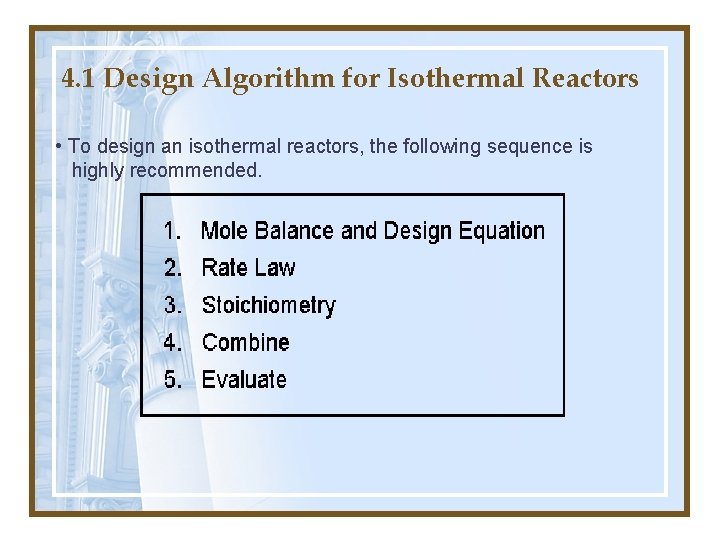
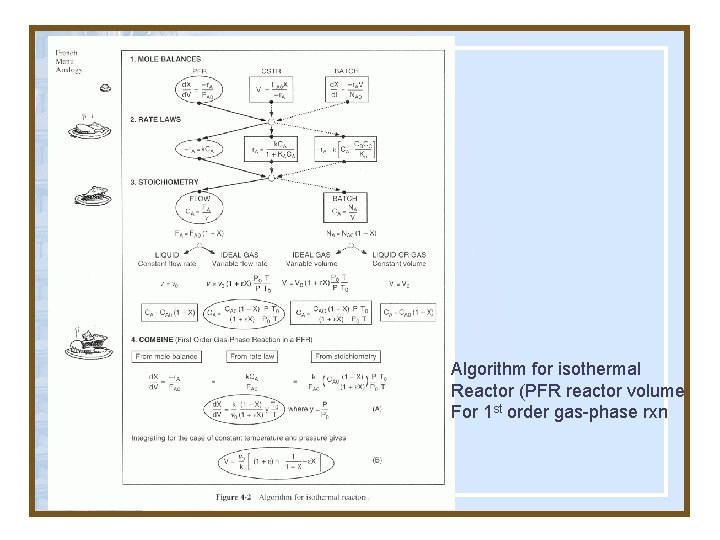
4. 1 Design Algorithm for Isothermal Reactors • To design an isothermal reactors, the following sequence is highly recommended.
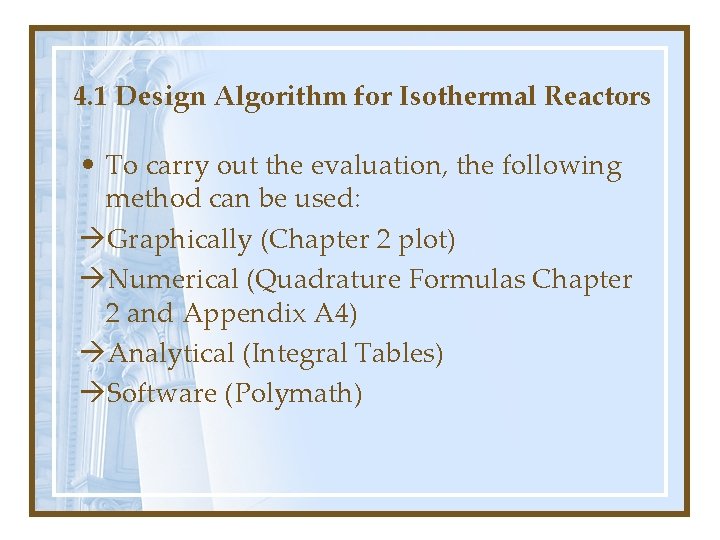
4. 1 Design Algorithm for Isothermal Reactors • To carry out the evaluation, the following method can be used: Graphically (Chapter 2 plot) Numerical (Quadrature Formulas Chapter 2 and Appendix A 4) Analytical (Integral Tables) Software (Polymath)
Algorithm for isothermal Reactor (PFR reactor volume For 1 st order gas-phase rxn Copyright Cheng 05
Scale up of Batch Reactor to the design of CSTR -scale up -pilot plant-costly -instead-build microplant(laboratory bench scale) -example: analyze data from a laboratory batch reactor-determine specific reaction rate, k-use it to design full-scale flow reactor
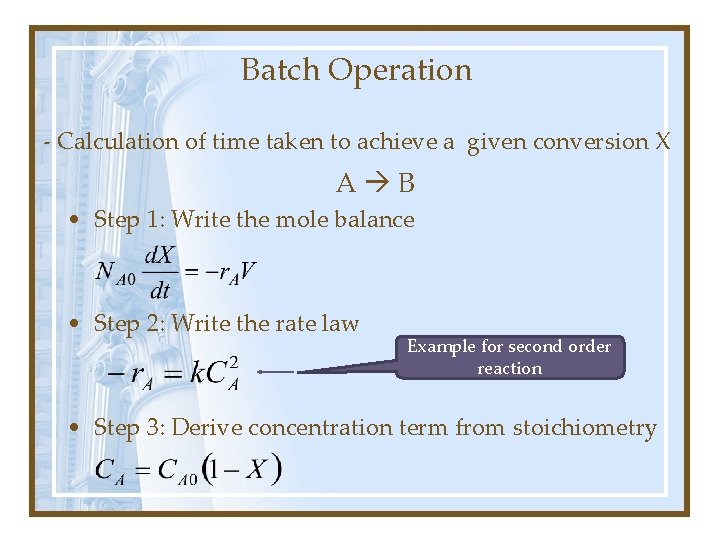
Batch Operation - Calculation of time taken to achieve a given conversion X A B • Step 1: Write the mole balance • Step 2: Write the rate law Example for second order reaction • Step 3: Derive concentration term from stoichiometry
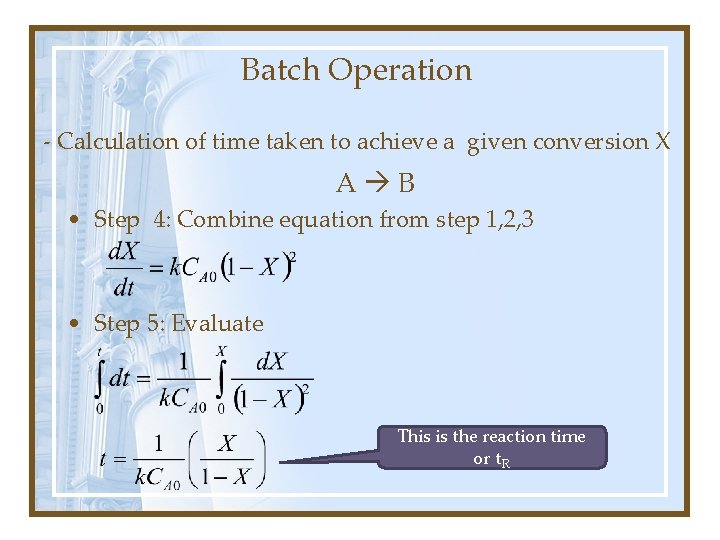
Batch Operation - Calculation of time taken to achieve a given conversion X A B • Step 4: Combine equation from step 1, 2, 3 • Step 5: Evaluate This is the reaction time or t. R
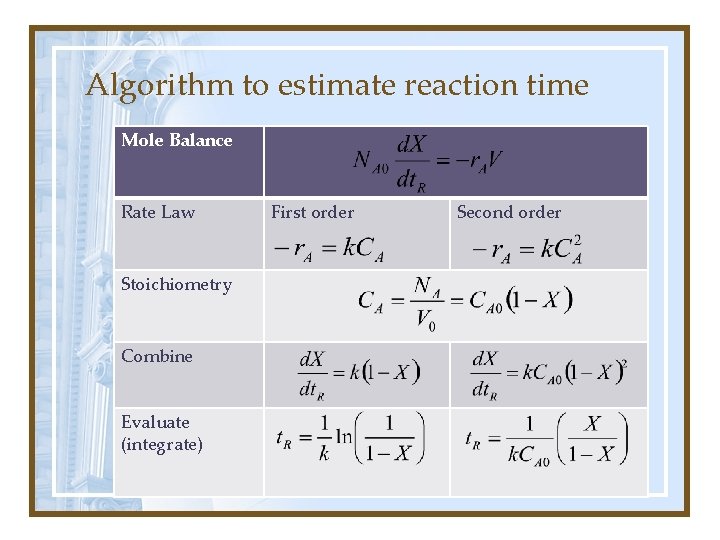
Algorithm to estimate reaction time Mole Balance Rate Law Stoichiometry Combine Evaluate (integrate) First order Second order
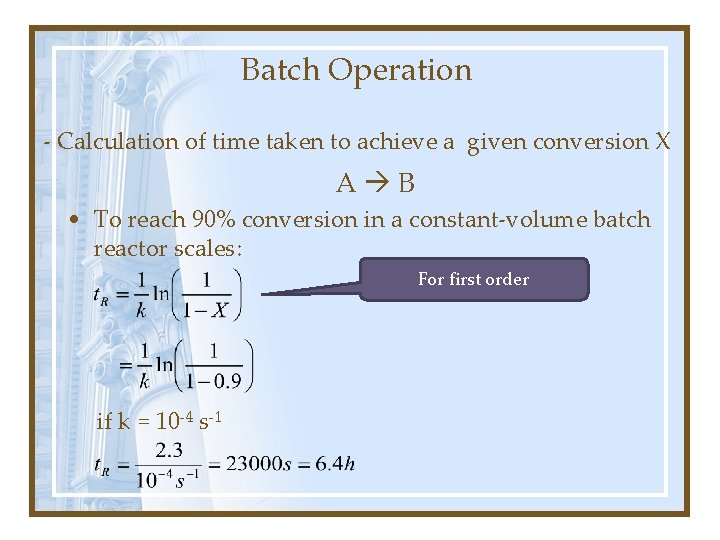
Batch Operation - Calculation of time taken to achieve a given conversion X A B • To reach 90% conversion in a constant-volume batch reactor scales: For first order if k = 10 -4 s-1
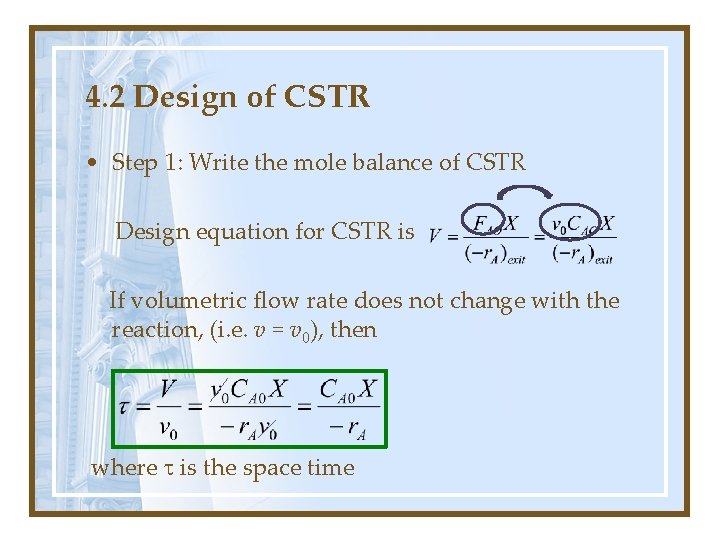
4. 2 Design of CSTR • Step 1: Write the mole balance of CSTR Design equation for CSTR is If volumetric flow rate does not change with the reaction, (i. e. v = v 0), then where t is the space time
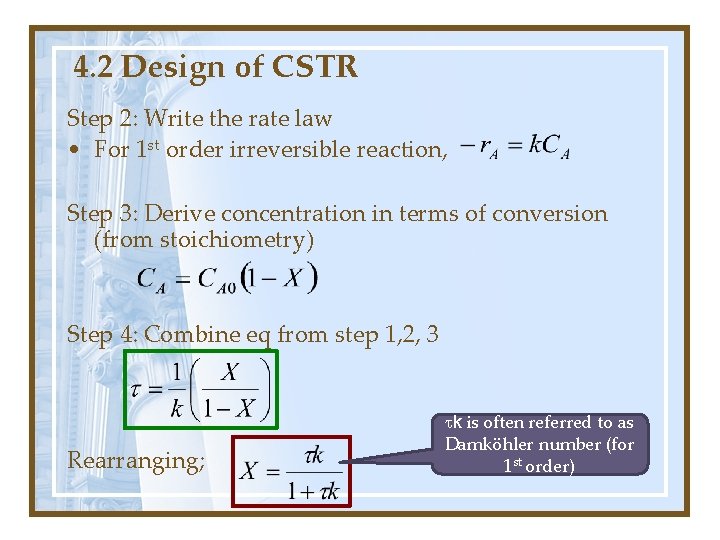
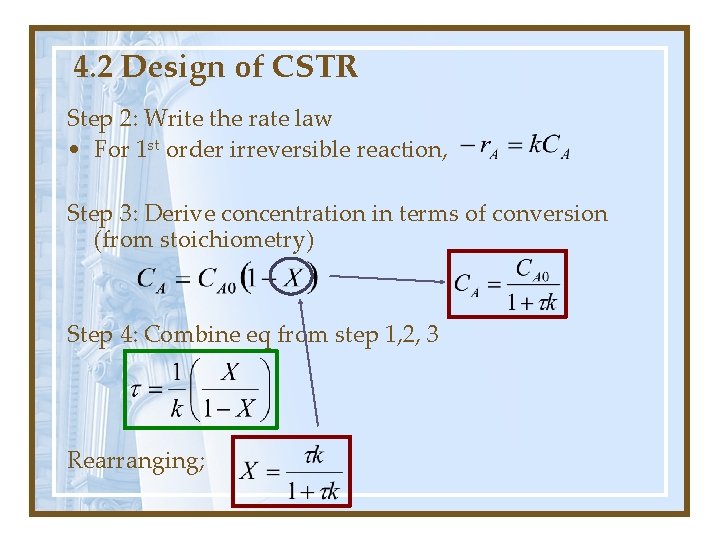
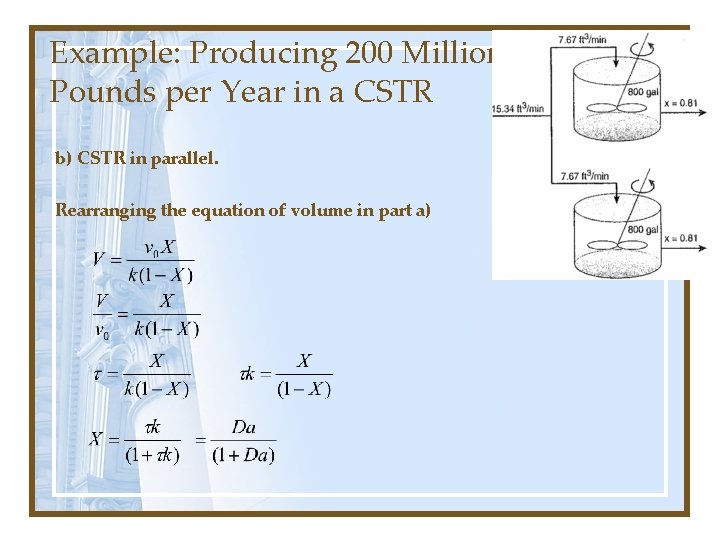
4. 2 Design of CSTR Step 2: Write the rate law • For 1 st order irreversible reaction, Step 3: Derive concentration in terms of conversion (from stoichiometry) Step 4: Combine eq from step 1, 2, 3 Rearranging; tk is often referred to as Damköhler number (for 1 st order)
4. 2 Design of CSTR Step 2: Write the rate law • For 1 st order irreversible reaction, Step 3: Derive concentration in terms of conversion (from stoichiometry) Step 4: Combine eq from step 1, 2, 3 Rearranging;
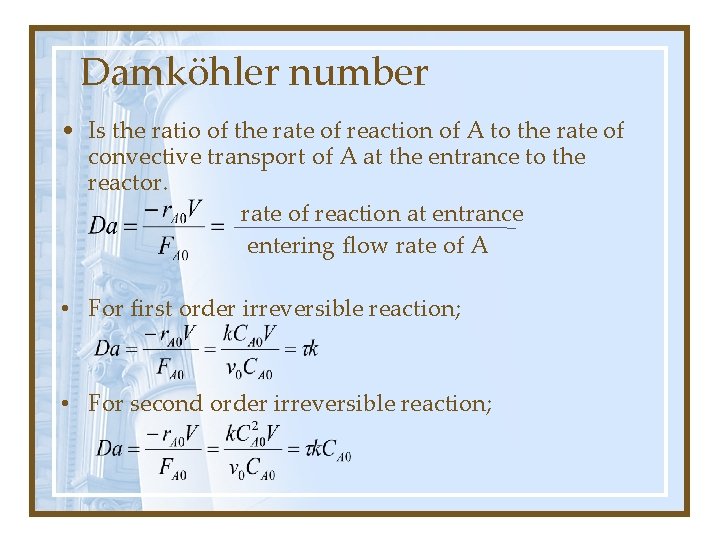
Damköhler number • Is the ratio of the rate of reaction of A to the rate of convective transport of A at the entrance to the reactor. rate of reaction at entrance entering flow rate of A • For first order irreversible reaction; • For second order irreversible reaction;
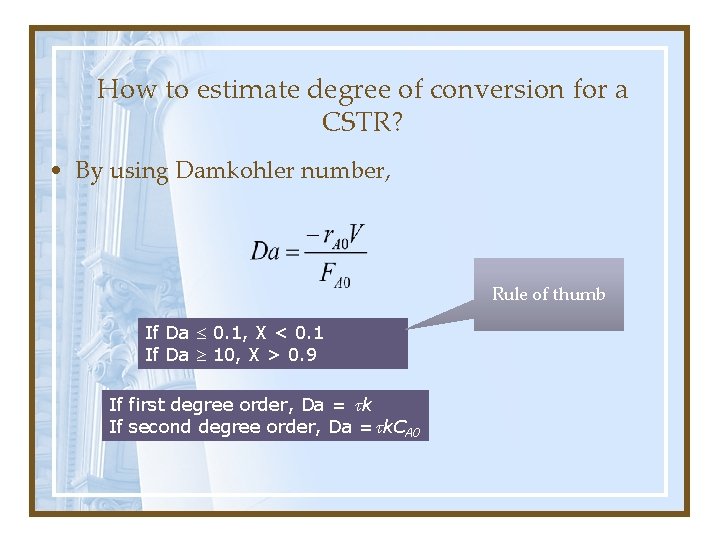
How to estimate degree of conversion for a CSTR? • By using Damkohler number, Rule of thumb If Da 0. 1, X < 0. 1 If Da 10, X > 0. 9 If first degree order, Da = k If second degree order, Da = k. CA 0
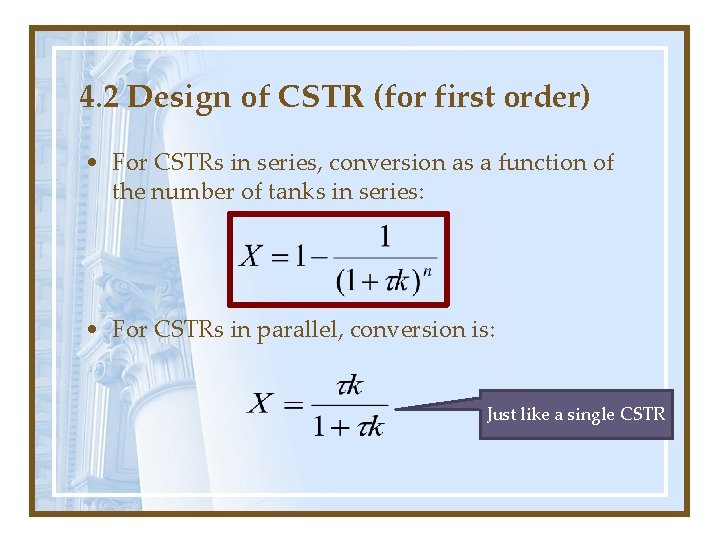
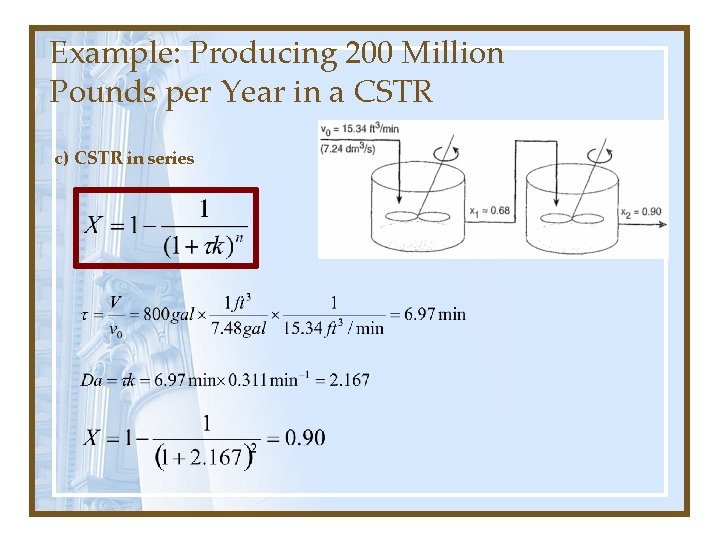
4. 2 Design of CSTR (for first order) • For CSTRs in series, conversion as a function of the number of tanks in series: • For CSTRs in parallel, conversion is: Just like a single CSTR
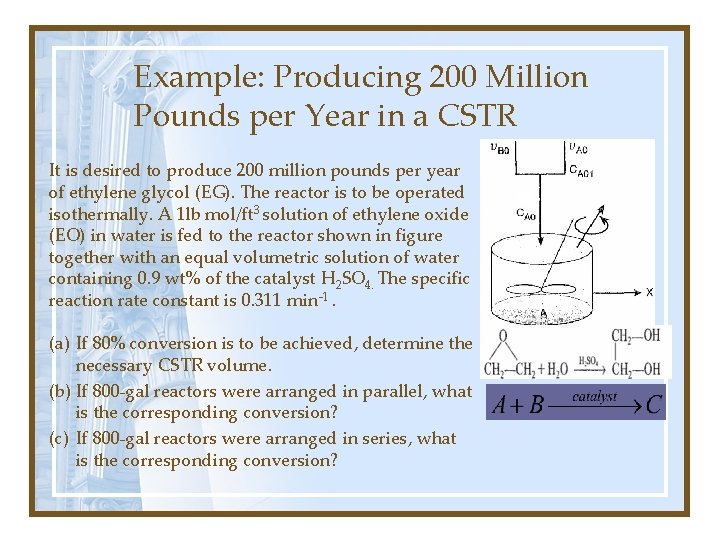
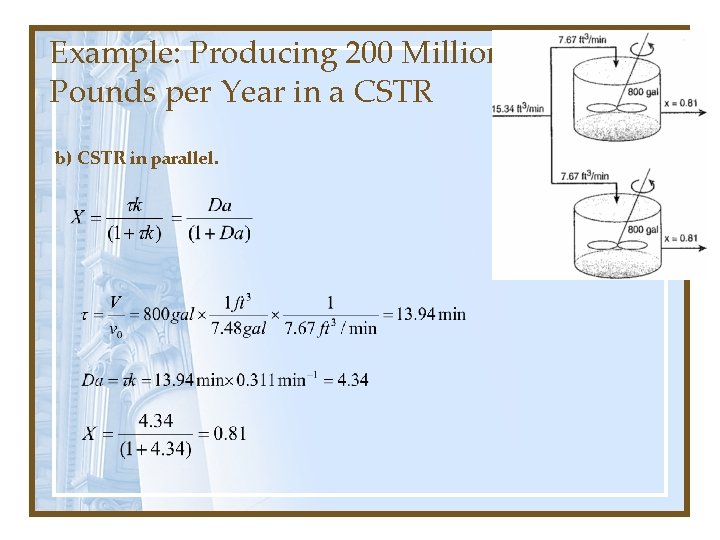
Example: Producing 200 Million Pounds per Year in a CSTR It is desired to produce 200 million pounds per year of ethylene glycol (EG). The reactor is to be operated isothermally. A 1 lb mol/ft 3 solution of ethylene oxide (EO) in water is fed to the reactor shown in figure together with an equal volumetric solution of water containing 0. 9 wt% of the catalyst H 2 SO 4. The specific reaction rate constant is 0. 311 min-1. (a) If 80% conversion is to be achieved, determine the necessary CSTR volume. (b) If 800 -gal reactors were arranged in parallel, what is the corresponding conversion? (c) If 800 -gal reactors were arranged in series, what is the corresponding conversion?
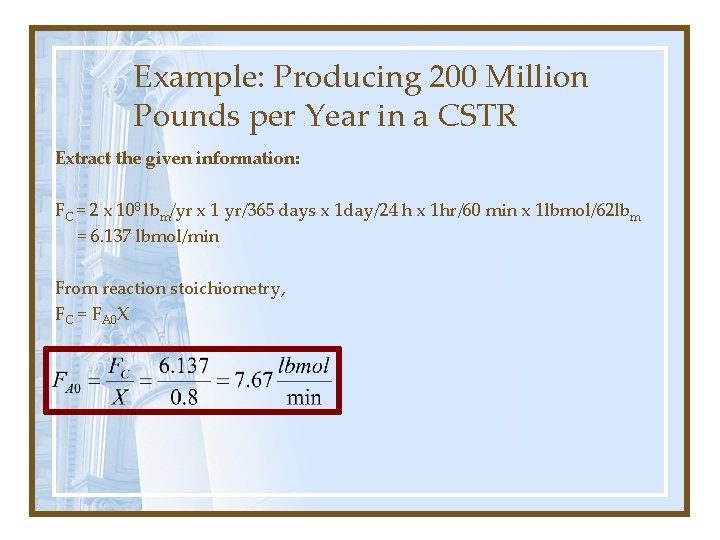
Example: Producing 200 Million Pounds per Year in a CSTR Extract the given information: FC = 2 x 10⁸ lbm/yr x 1 yr/365 days x 1 day/24 h x 1 hr/60 min x 1 lbmol/62 lbm = 6. 137 lbmol/min From reaction stoichiometry, FC = FA 0 X
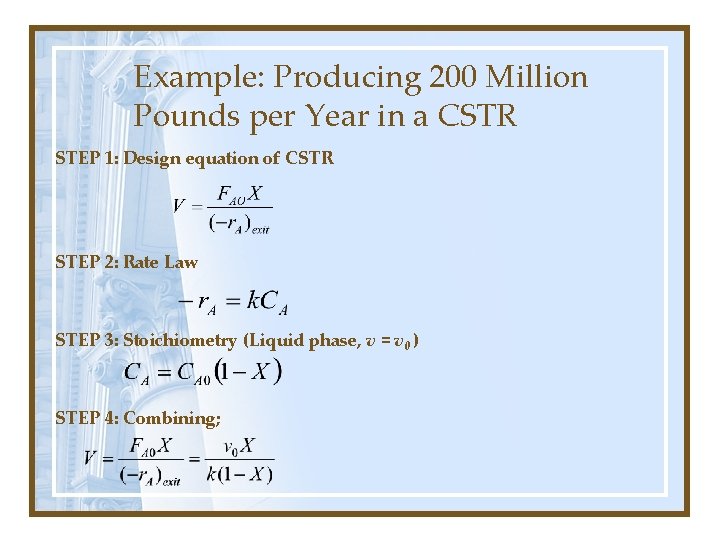
Example: Producing 200 Million Pounds per Year in a CSTR STEP 1: Design equation of CSTR STEP 2: Rate Law STEP 3: Stoichiometry (Liquid phase, v = v 0 ) STEP 4: Combining;
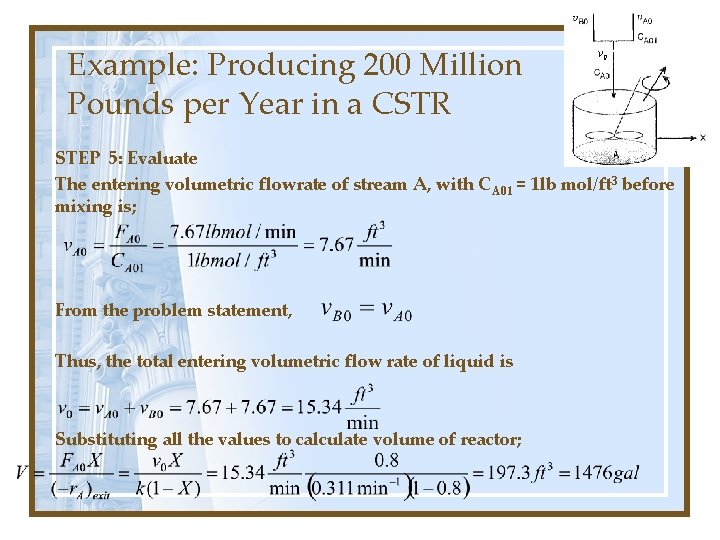
Example: Producing 200 Million Pounds per Year in a CSTR v 0 VV STEP 5: Evaluate The entering volumetric flowrate of stream A, with CA 01 = 1 lb mol/ft 3 before mixing is; From the problem statement, Thus, the total entering volumetric flow rate of liquid is Substituting all the values to calculate volume of reactor;
Example: Producing 200 Million Pounds per Year in a CSTR b) CSTR in parallel. Rearranging the equation of volume in part a)
Example: Producing 200 Million Pounds per Year in a CSTR b) CSTR in parallel.
Example: Producing 200 Million Pounds per Year in a CSTR c) CSTR in series
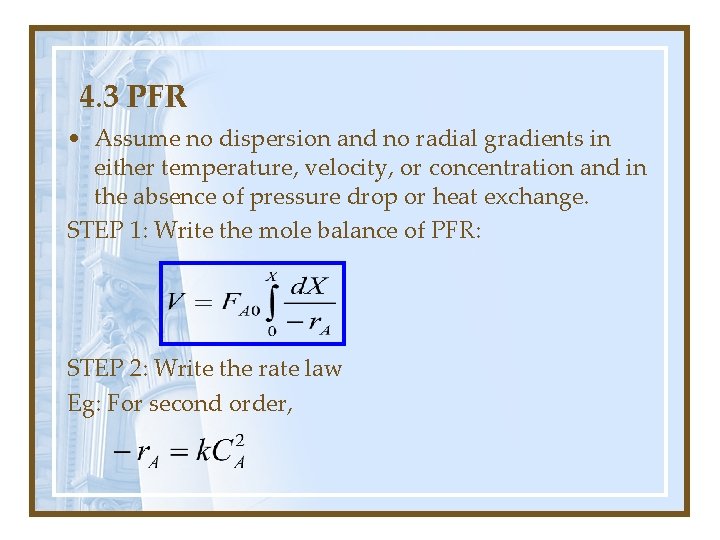
4. 3 PFR • Assume no dispersion and no radial gradients in either temperature, velocity, or concentration and in the absence of pressure drop or heat exchange. STEP 1: Write the mole balance of PFR: STEP 2: Write the rate law Eg: For second order,
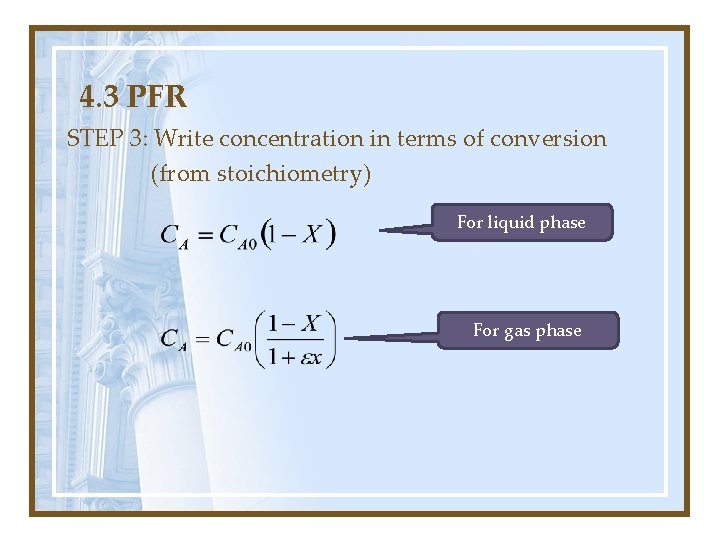
4. 3 PFR STEP 3: Write concentration in terms of conversion (from stoichiometry) For liquid phase For gas phase
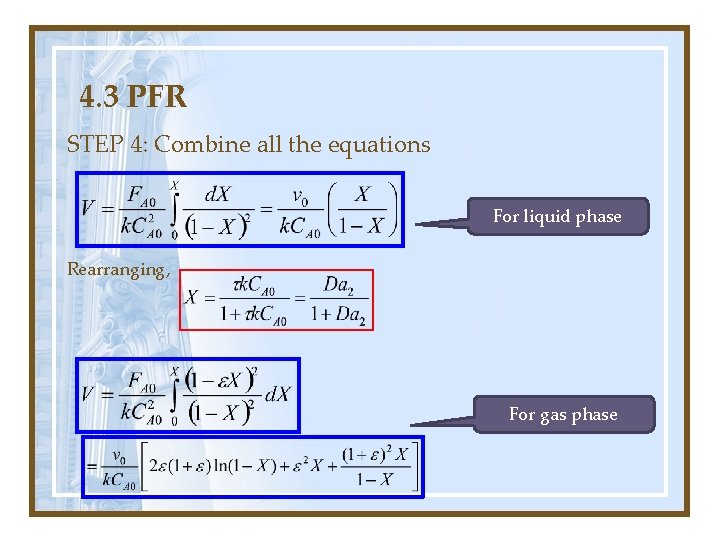
4. 3 PFR STEP 4: Combine all the equations For liquid phase Rearranging, For gas phase
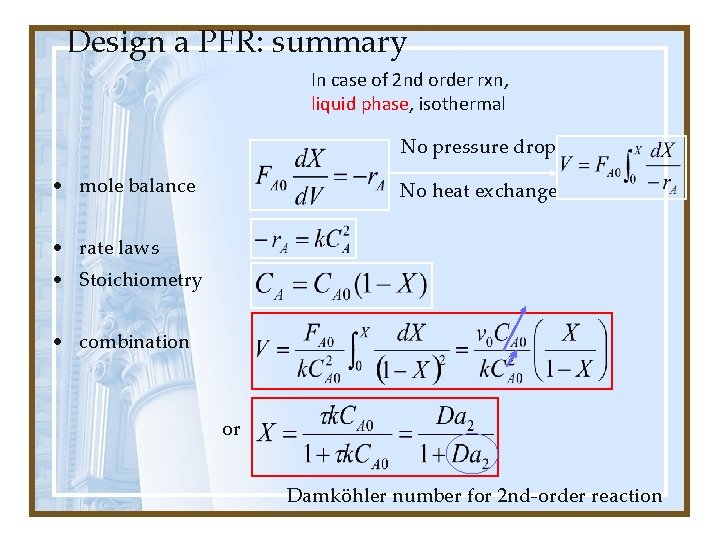
Design a PFR: summary In case of 2 nd order rxn, liquid phase, isothermal No pressure drop • mole balance No heat exchange • rate laws • Stoichiometry • combination or Damköhler number for 2 nd-order reaction
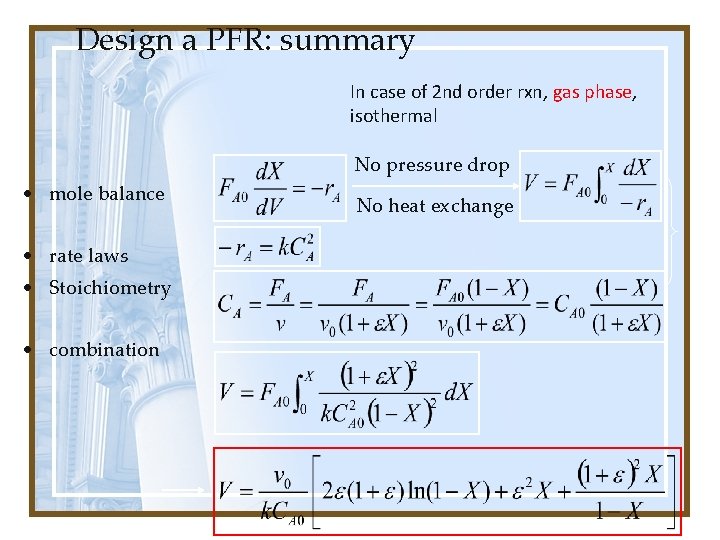
Design a PFR: summary In case of 2 nd order rxn, gas phase, isothermal No pressure drop • mole balance • rate laws • Stoichiometry • combination No heat exchange