
Errorcorrecting pairs for a publickey cryptosystem Ruud Pellikaan
Error-correcting pairs for a public-key cryptosystem Ruud Pellikaan and Irene Márquez-Corbella ICMETA 2016 Surakarta, Indonesia 6 December 2016
Content • 1. Introduction on Coding, Crypto and Security • 2. Public-key crypto systems • 3. One-way functions • 4. Code based public-key crypto system • 5. Error-correcting codes • 6. Error-correcting pairs
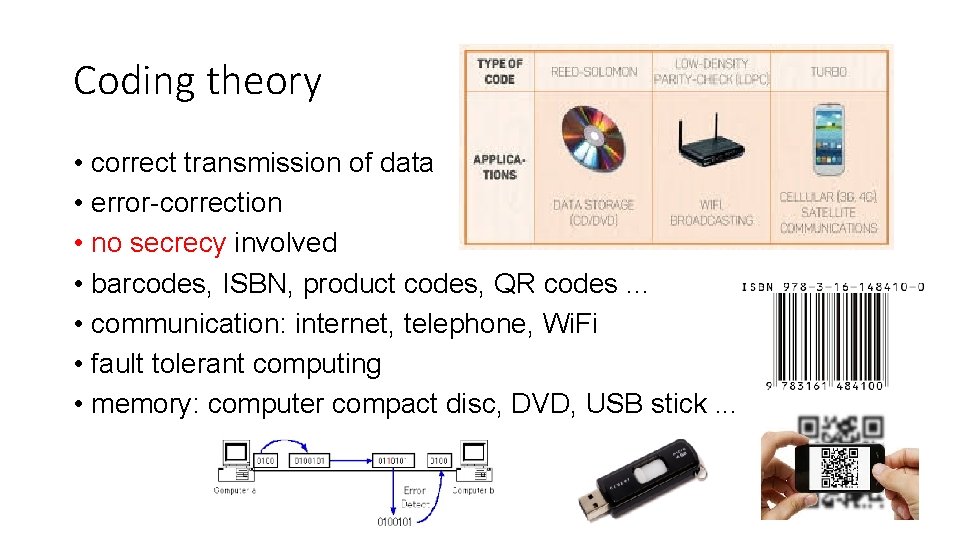
Coding theory • correct transmission of data • error-correction • no secrecy involved • barcodes, ISBN, product codes, QR codes. . . • communication: internet, telephone, Wi. Fi • fault tolerant computing • memory: computer compact disc, DVD, USB stick. . .
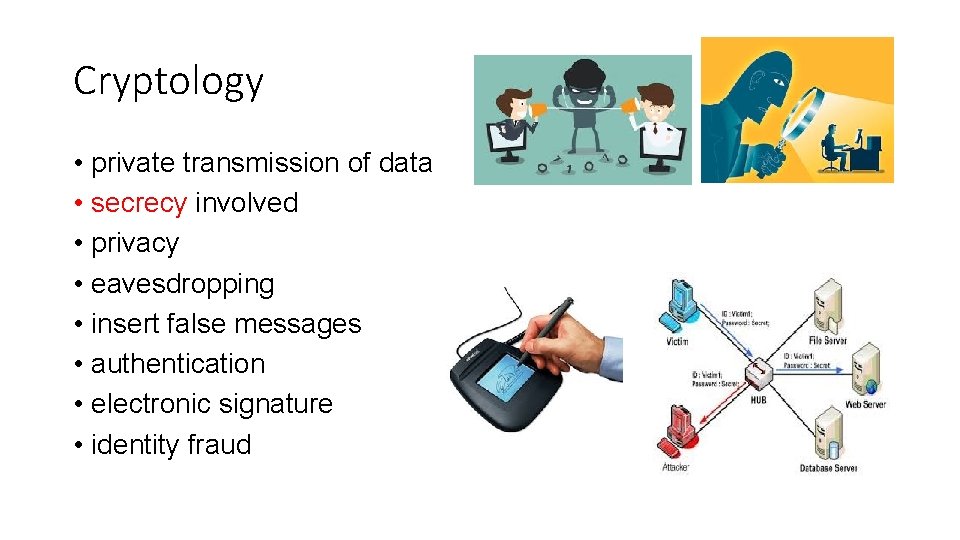
Cryptology • private transmission of data • secrecy involved • privacy • eavesdropping • insert false messages • authentication • electronic signature • identity fraud
Security • secure transmission of data • secrecy involved • electronic voting • electronic commerce • money transfer • databases of patients
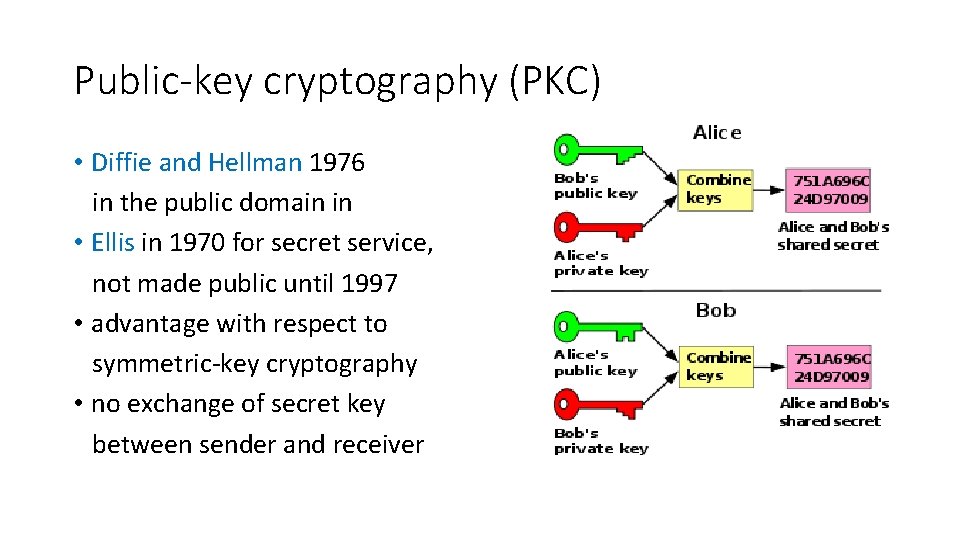
Public-key cryptography (PKC) • Diffie and Hellman 1976 in the public domain in • Ellis in 1970 for secret service, not made public until 1997 • advantage with respect to symmetric-key cryptography • no exchange of secret key between sender and receiver
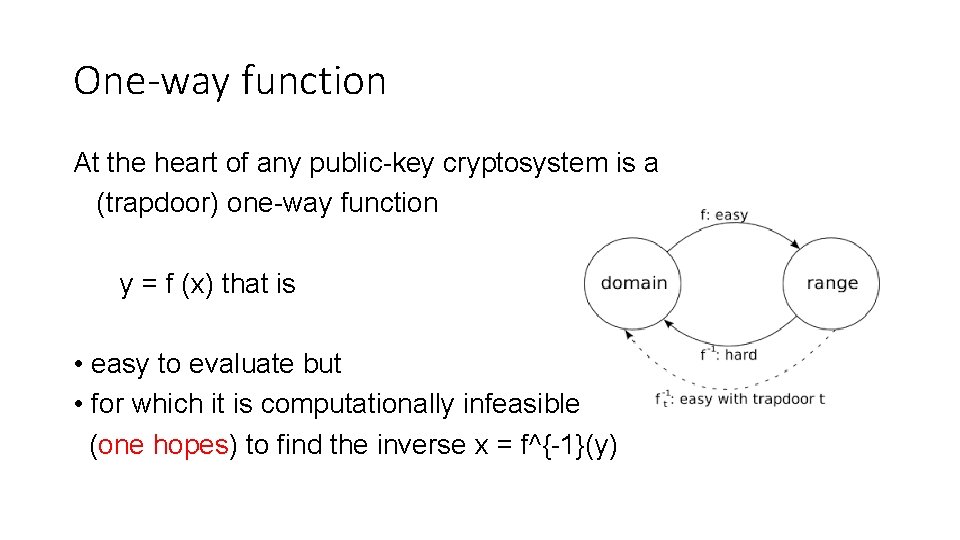
One-way function At the heart of any public-key cryptosystem is a (trapdoor) one-way function y = f (x) that is • easy to evaluate but • for which it is computationally infeasible (one hopes) to find the inverse x = f^{-1}(y)
Examples of one-way functions • Example 1 differentiation a function is easy integrating a function is difficult • Example 2 checking whether a given proof is correct is easy finding the proof of a proposition is difficult
Integer factorization x = (p, q) is a pair of distinct prime numbers y = pq is its product proposed by Cocks in 1973 in secret service Rivest-Shamir-Adleman (RSA) in 1978 in public domain based on assumption that factorizing integers is hard
Discrete logarithm G is a group (written multiplicatively) with a in G and x an integer y = a^x Diffie-Hellman in 1974 and 1976 in public domain proposed by Williamson in 1974 in secret service based on the assumption that finding discrete logarithms in a finite field is difficult
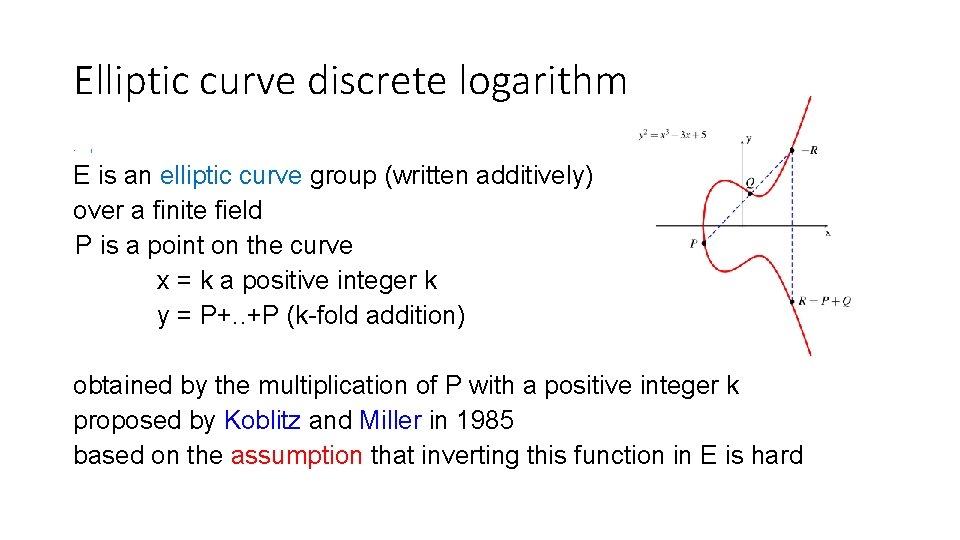
Elliptic curve discrete logarithm • I E is an elliptic curve group (written additively) over a finite field P is a point on the curve x = k a positive integer k y = P+. . +P (k-fold addition) obtained by the multiplication of P with a positive integer k proposed by Koblitz and Miller in 1985 based on the assumption that inverting this function in E is hard
Code based cryptography h_1, …, h_n is a given n-tuple of vectors in Fq^r x_1, …, x_n is an n-tuple of elements in Fq x_1 h_1+…+x_nh_n=0 x in Fq^n is of weight at most t proposed by Mc. Eliece in 1978 and Niederreiter based on the assumption that decoding error-correcting codes is hard
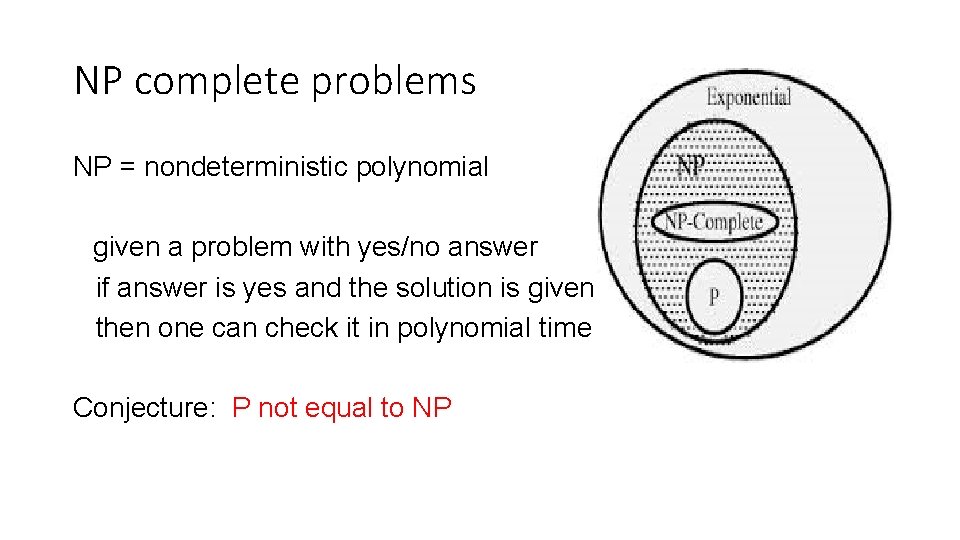
NP complete problems NP = nondeterministic polynomial given a problem with yes/no answer if answer is yes and the solution is given then one can check it in polynomial time Conjecture: P not equal to NP
Integer factorization Input: integer n Query: can one factorize n in n = pq with p and q > 1? if answer is yes and someone gives p and q then one easily checks that n = pq otherwise it is difficult to find p and q
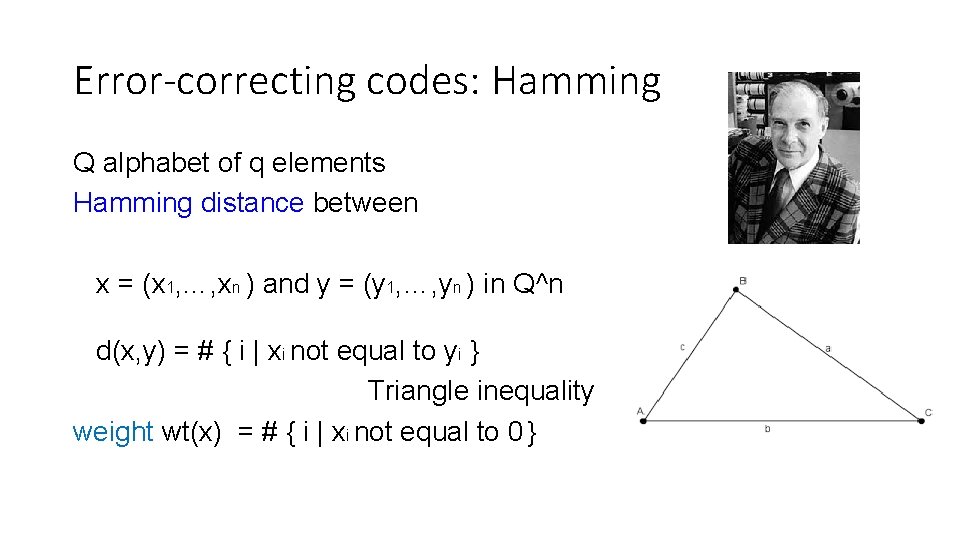
Error-correcting codes: Hamming Q alphabet of q elements Hamming distance between x = (x 1, …, xn ) and y = (y 1, …, yn ) in Q^n d(x, y) = # { i | xi not equal to yi } Triangle inequality weight wt(x) = # { i | xi not equal to 0 }
Block codes C block code is a subset of Q^n d(C) = min # { d(x, y) | x, y in C , not x=y } minimum distance of C t (C) = (d(C)-1)/2 error-correcting capability of C
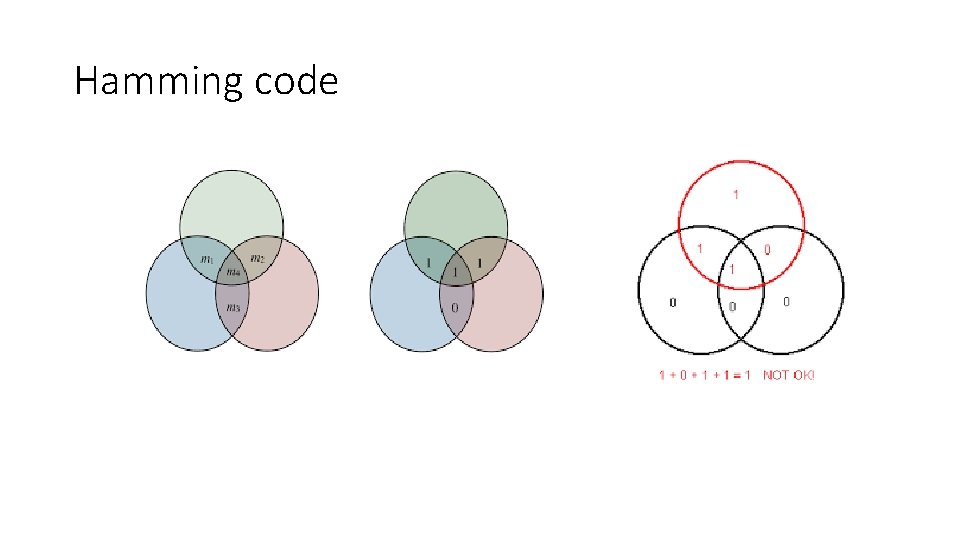
Hamming code
Linear codes and their parameters F_q the finite field with q elements, q = p^e and p prime F_q^n is an F_q -linear vector space of dimension n A linear code C is an F_q -linear subspace of F_q^n parameters [n, k, d] • n = length of C • k = dimension of C • d = minimum distance of C
Inner product The standard inner product is defined by a. b = a_1 b_1 + …+ a_nb_n • Is bilinear and non-degenerate, not the correct picture • since "positive definite“ makes no sense Two subsets A and B of F_q^n are called orthogonal if a. b = 0 for all a in A and b in B
Star product The star product is defined by coordinatewise multiplication a*b = (a_1 b_1, … , a_nb_n ) For two subsets A and B of F_q^n A *B is the subspace generated by all a*b with a in A and b in B
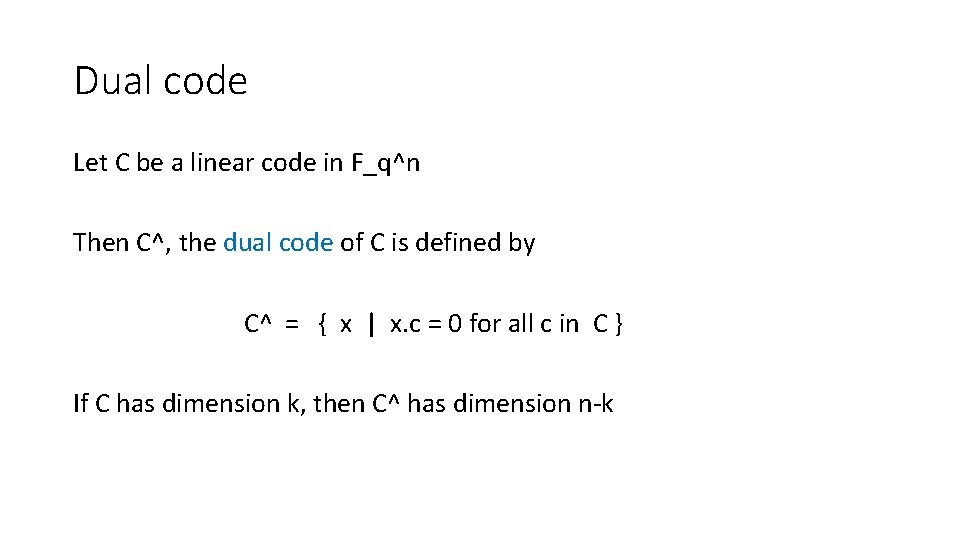
Dual code Let C be a linear code in F_q^n Then C^, the dual code of C is defined by C^ = { x | x. c = 0 for all c in C } If C has dimension k, then C^ has dimension n-k
Efficient decoding algorithms The following classes of codes: • Generalized Reed-Solomon codes • Cyclic codes • Alternant codes • Goppa codes • Algebraic geometry codes have efficient decoding algorithms: • Arimoto, Peterson, Gorenstein, Zierler • Berlekamp, Massey, Sakata • Justesen et al. , Vladut-Skrobogatov • Error-correcting pairs
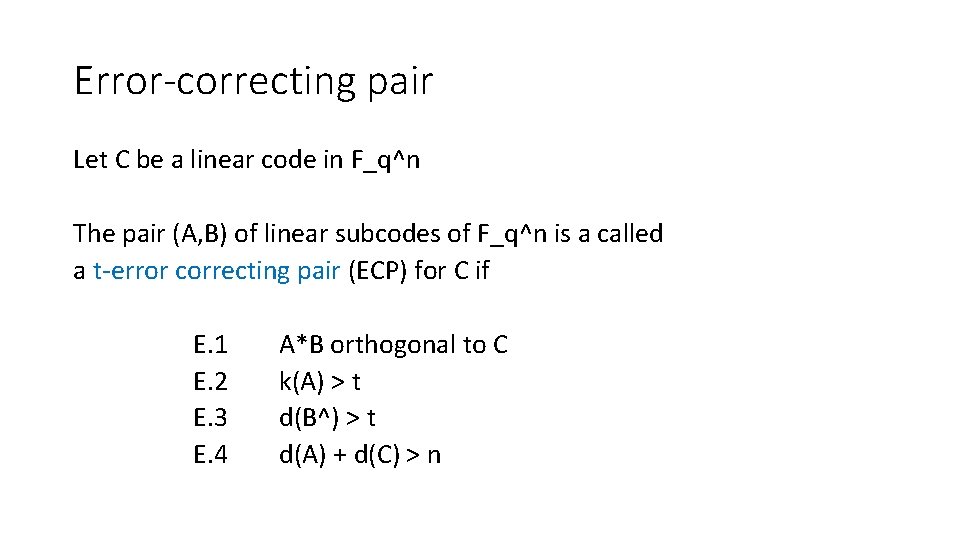
Error-correcting pair Let C be a linear code in F_q^n The pair (A, B) of linear subcodes of F_q^n is a called a t-error correcting pair (ECP) for C if E. 1 E. 2 E. 3 E. 4 A*B orthogonal to C k(A) > t d(B^) > t d(A) + d(C) > n
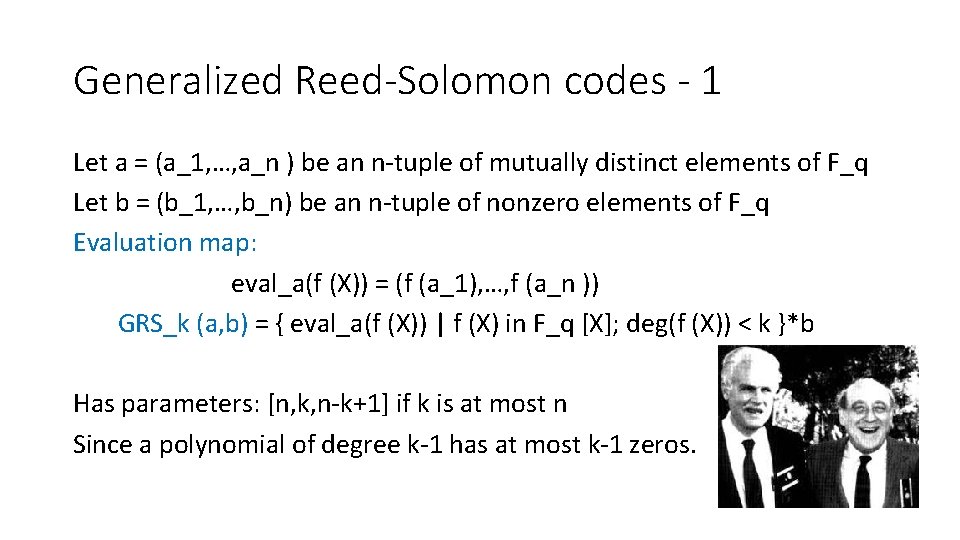
Generalized Reed-Solomon codes - 1 Let a = (a_1, …, a_n ) be an n-tuple of mutually distinct elements of F_q Let b = (b_1, …, b_n) be an n-tuple of nonzero elements of F_q Evaluation map: eval_a(f (X)) = (f (a_1), …, f (a_n )) GRS_k (a, b) = { eval_a(f (X)) | f (X) in F_q [X]; deg(f (X)) < k }*b Has parameters: [n, k, n-k+1] if k is at most n Since a polynomial of degree k-1 has at most k-1 zeros.
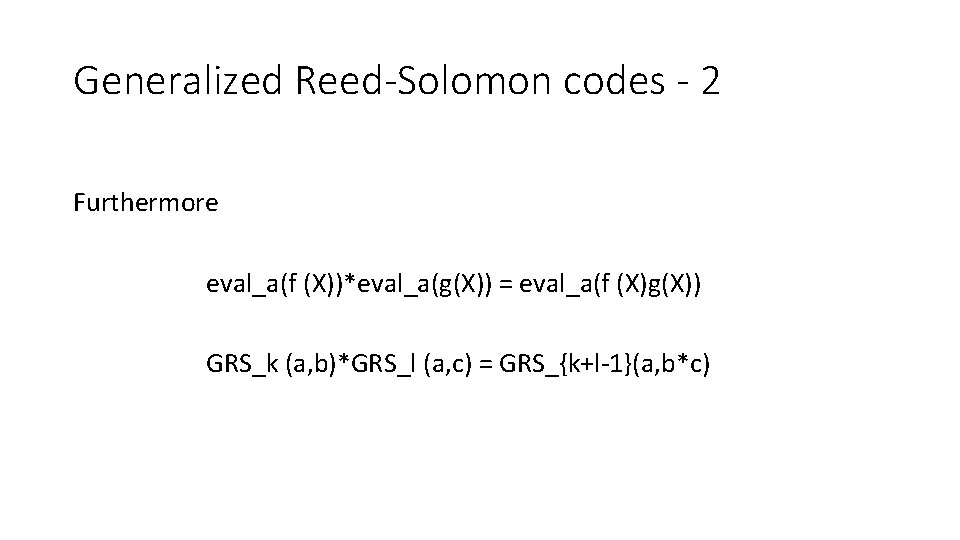
Generalized Reed-Solomon codes - 2 Furthermore eval_a(f (X))*eval_a(g(X)) = eval_a(f (X)g(X)) GRS_k (a, b)*GRS_l (a, c) = GRS_{k+l-1}(a, b*c)
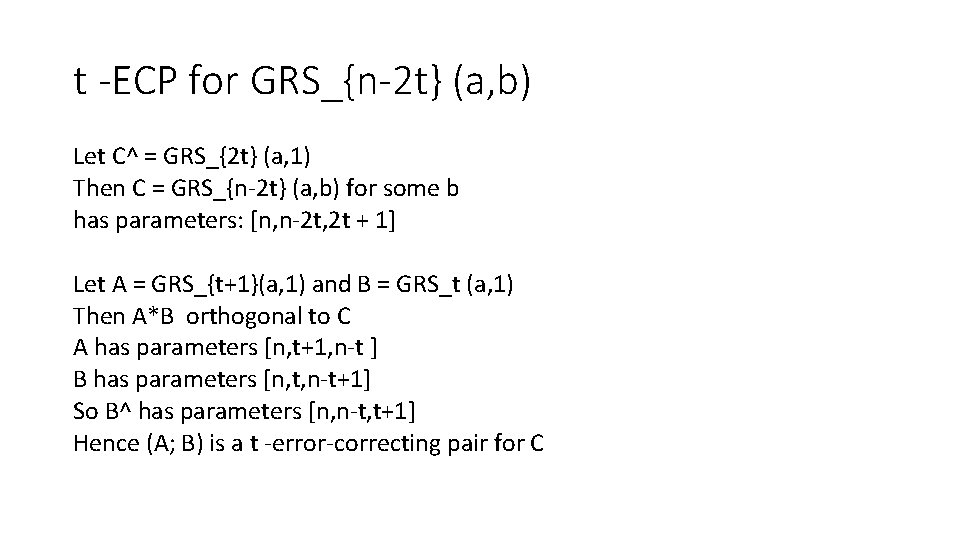
t -ECP for GRS_{n-2 t} (a, b) Let C^ = GRS_{2 t} (a, 1) Then C = GRS_{n-2 t} (a, b) for some b has parameters: [n, n-2 t, 2 t + 1] Let A = GRS_{t+1}(a, 1) and B = GRS_t (a, 1) Then A*B orthogonal to C A has parameters [n, t+1, n-t ] B has parameters [n, t, n-t+1] So B^ has parameters [n, n-t, t+1] Hence (A; B) is a t -error-correcting pair for C
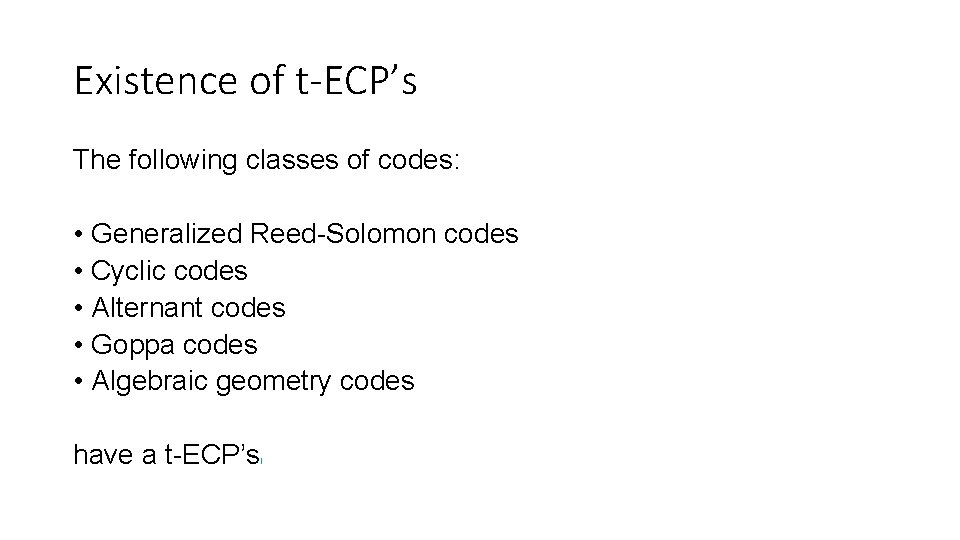
Existence of t-ECP’s The following classes of codes: • Generalized Reed-Solomon codes • Cyclic codes • Alternant codes • Goppa codes • Algebraic geometry codes have a t-ECP’s I
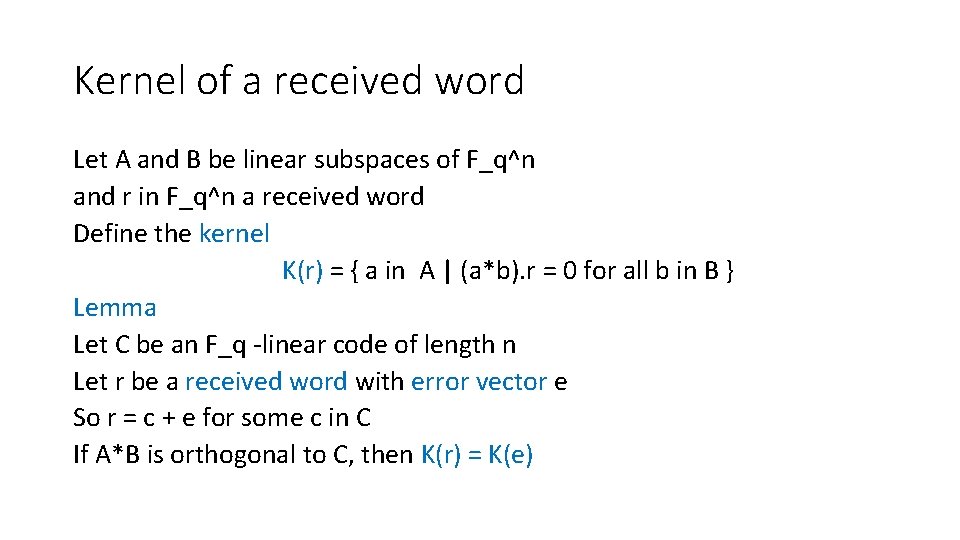
Kernel of a received word Let A and B be linear subspaces of F_q^n and r in F_q^n a received word Define the kernel K(r) = { a in A | (a*b). r = 0 for all b in B } Lemma Let C be an F_q -linear code of length n Let r be a received word with error vector e So r = c + e for some c in C If A*B is orthogonal to C, then K(r) = K(e)
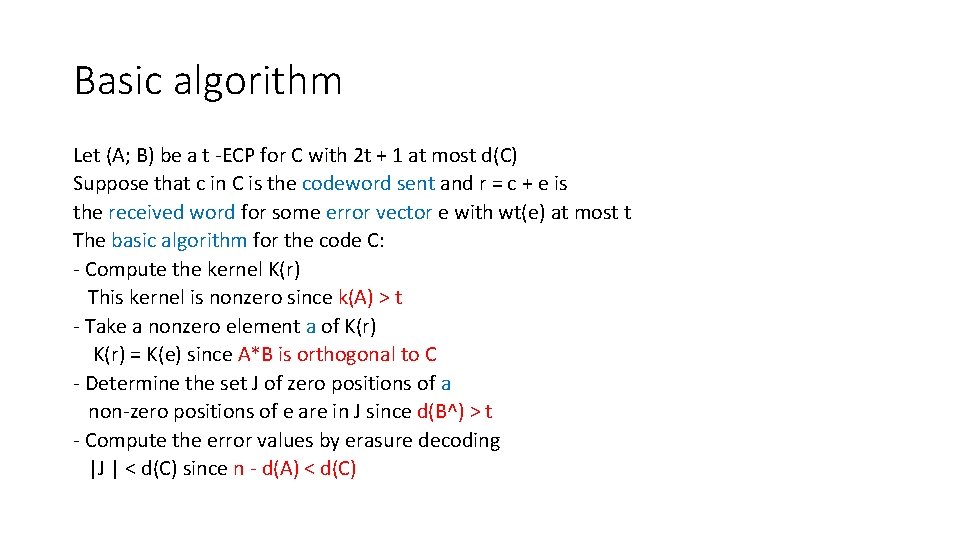
Basic algorithm Let (A; B) be a t -ECP for C with 2 t + 1 at most d(C) Suppose that c in C is the codeword sent and r = c + e is the received word for some error vector e with wt(e) at most t The basic algorithm for the code C: - Compute the kernel K(r) This kernel is nonzero since k(A) > t - Take a nonzero element a of K(r) = K(e) since A*B is orthogonal to C - Determine the set J of zero positions of a non-zero positions of e are in J since d(B^) > t - Compute the error values by erasure decoding |J | < d(C) since n - d(A) < d(C)
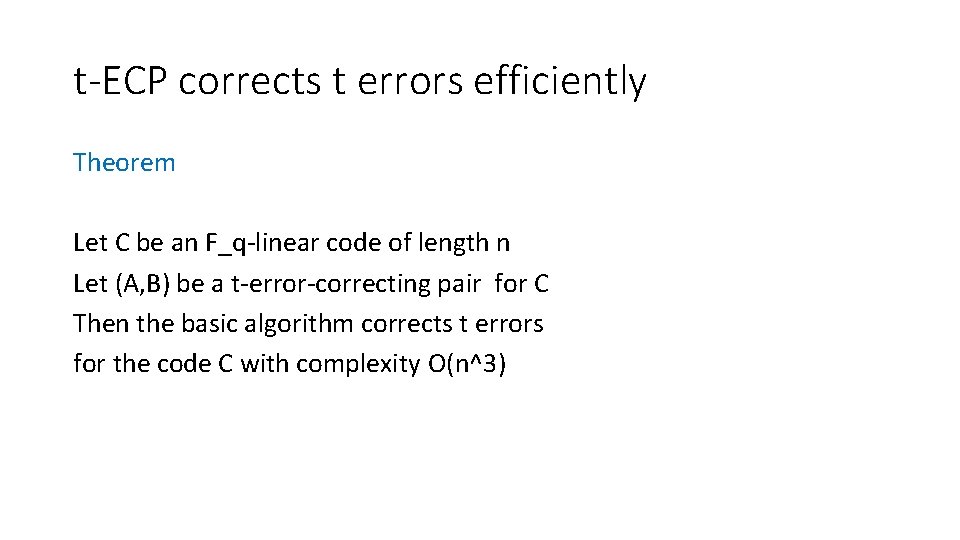
t-ECP corrects t errors efficiently Theorem Let C be an F_q-linear code of length n Let (A, B) be a t-error-correcting pair for C Then the basic algorithm corrects t errors for the code C with complexity O(n^3)
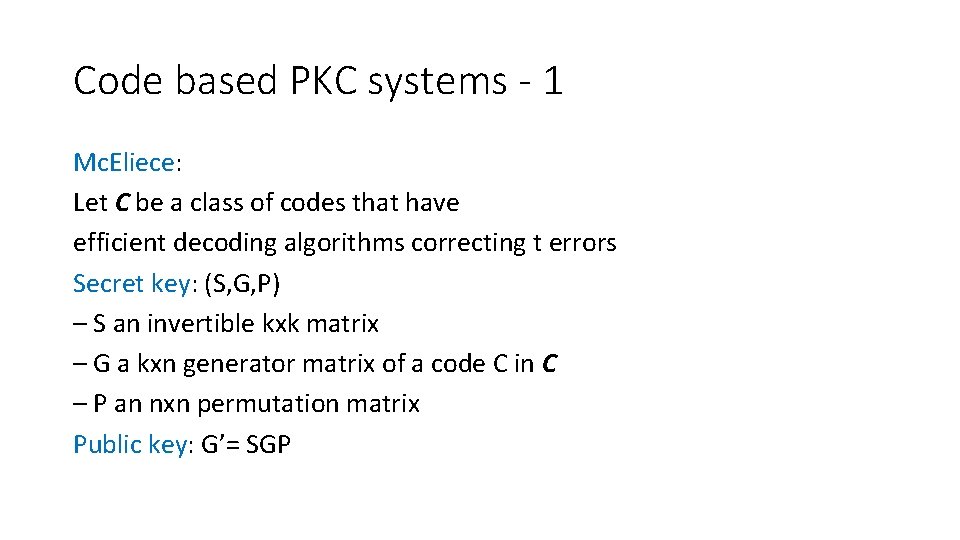
Code based PKC systems - 1 Mc. Eliece: Let C be a class of codes that have efficient decoding algorithms correcting t errors Secret key: (S, G, P) – S an invertible kxk matrix – G a kxn generator matrix of a code C in C – P an nxn permutation matrix Public key: G’= SGP
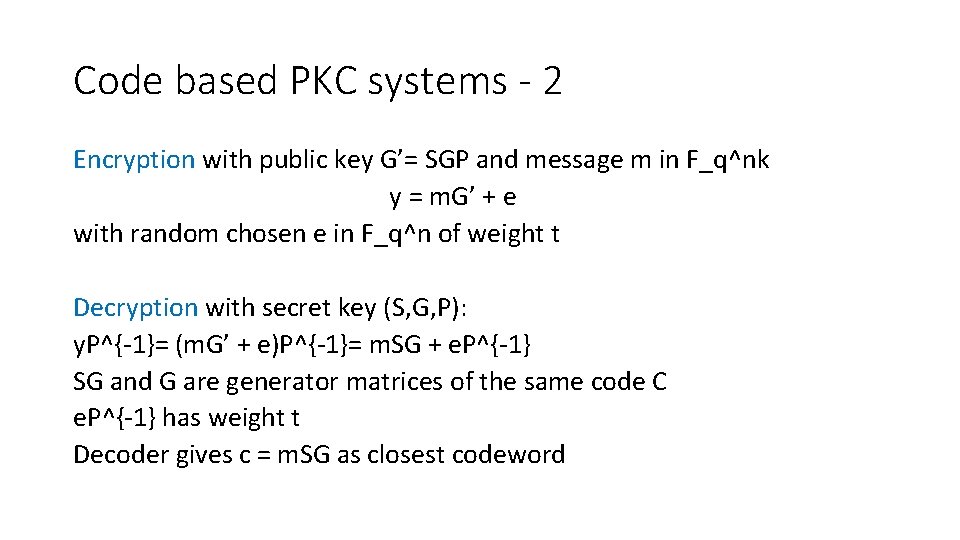
Code based PKC systems - 2 Encryption with public key G’= SGP and message m in F_q^nk y = m. G’ + e with random chosen e in F_q^n of weight t Decryption with secret key (S, G, P): y. P^{-1}= (m. G’ + e)P^{-1}= m. SG + e. P^{-1} SG and G are generator matrices of the same code C e. P^{-1} has weight t Decoder gives c = m. SG as closest codeword
Code based PKC systems - 3 Minimum distance decoding is NP-hard (Berlekamp-Mc. Eliece-Van Tilborg) It is assumed that: • 1. P not equal to NP • 2. Decoding up to half the minimum distance is hard • 3. One cannot distinguish nor retrieve the original code by disguising it by S and P
Attacks on code based PKC systems - 1 General attack – decoding algorithms: – Mc. Eliece 1978. . . – Brickell, Lee 1988 – Leon 1988 – van Tilburg 1988 – Stern 1989 – Canteaut, Chabaud, Sendrier 1998 – Finiasz-Sendrier 2009 – Bernstein-Lange-Peters 2008 -2011 – Becker-Joux-May-Meurer Eurocrypt 2012
Attacks on code based PKC systems - 2 Structural attacks: – GRS codes (Sidelnikov-Shestakov) – subcodes of GRS codes (Wieschebrink, Márquez-Martínez-P) – Alternant codes: open – Goppa codes: open – Algebraic geometry codes (Faure-Minder, genus g 2) – VSAG codes: (Márquez-Martínez-P-Ruano, arbitrary g) – Polynomial attack on AG codes and subcodes of AG codes (Couvreur-Márquez-P, ECP’s)
Codes with t -ECP P(n, t, q) is the collection of pairs (A, B) that satisfy E. 2 k(A) > t E. 3 d(B^) > t E. 5 d(A^) > 1 E. 6 d(A) + 2 t > n Let C be the dual of A*B Then d(C) is at least 2 t + 1 and (A, B) is a t -ECP for C
ECP one-way function F(n, t, q) is the collection of Fq -linear codes of length n and minimum distance d at least 2 t + 1 Consider the following map: P(n, t, q) F(n, t, q) Given by (A, B) is mapped to C = dual of A*B QUESTION: Is this a one-way function?
Conclusion Many known classes of codes that have efficient decoding algorithm correcting t-errors have a t-ECP and are not suitable for a code based PKC Question for future research: Is the ECP map a one-way function?

Terima kasih!
- Slides: 39