
Error Proofing Techniques Slide 1 ERROR PROOFING TECHNIQUES







- Slides: 140
Error Proofing Techniques Slide 1
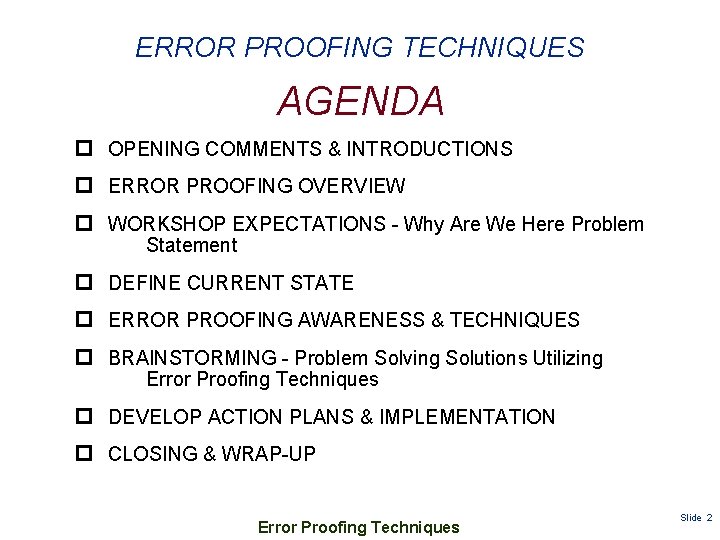
ERROR PROOFING TECHNIQUES AGENDA p OPENING COMMENTS & INTRODUCTIONS p ERROR PROOFING OVERVIEW p WORKSHOP EXPECTATIONS - Why Are We Here Problem Statement p DEFINE CURRENT STATE p ERROR PROOFING AWARENESS & TECHNIQUES p BRAINSTORMING - Problem Solving Solutions Utilizing Error Proofing Techniques p DEVELOP ACTION PLANS & IMPLEMENTATION p CLOSING & WRAP-UP Error Proofing Techniques Slide 2
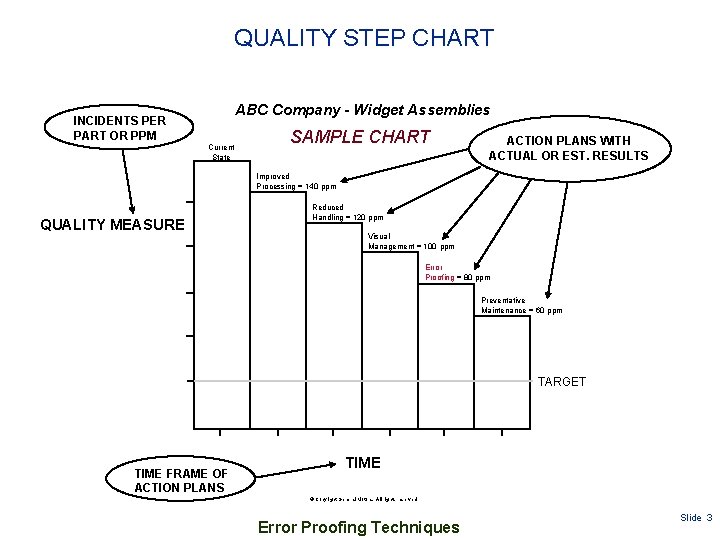
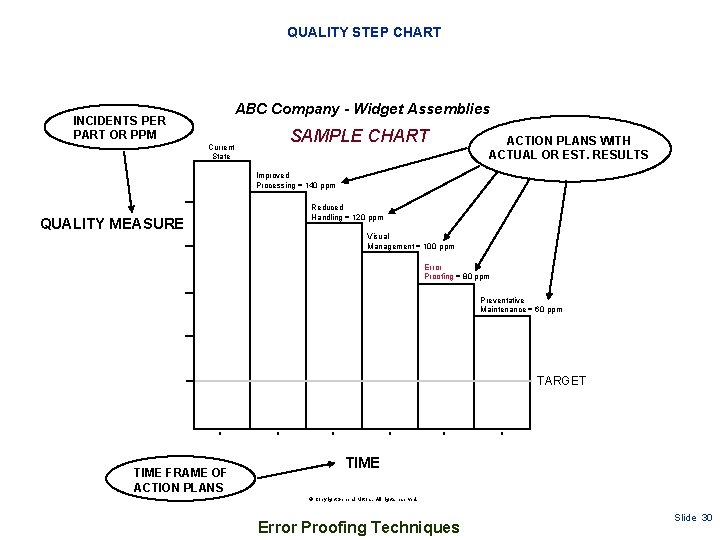
QUALITY STEP CHART ABC Company - Widget Assemblies INCIDENTS PER PART OR PPM Current State SAMPLE CHART ACTION PLANS WITH ACTUAL OR EST. RESULTS Improved Processing = 140 ppm QUALITY MEASURE Reduced Handling = 120 ppm Visual Management = 100 ppm Error Proofing = 80 ppm Preventative Maintenance = 60 ppm TARGET TIME FRAME OF ACTION PLANS TIME © Copyright General Motors. All rights reserved. Error Proofing Techniques Slide 3
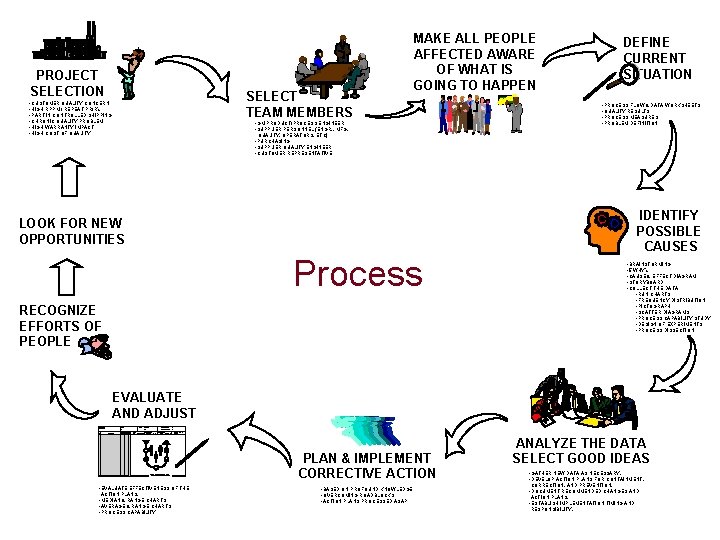
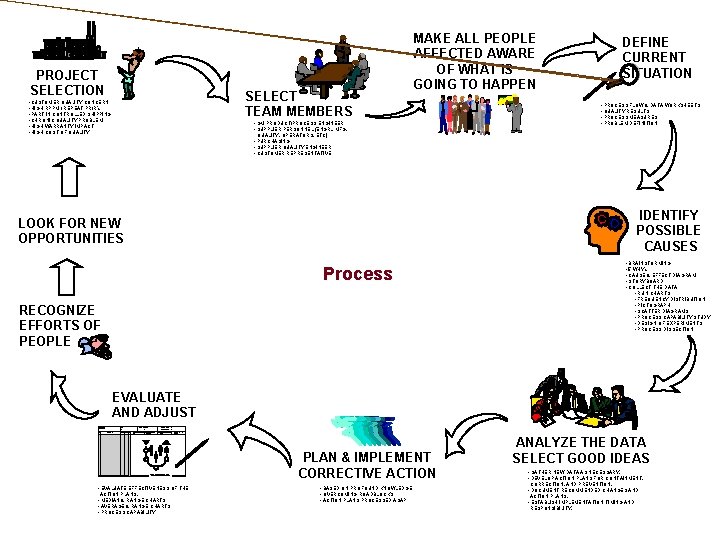
PROJECT SELECTION SELECT TEAM MEMBERS • CUSTOMER QUALITY CONCERN • HIGH RPPM / REPEAT PR/R’s • PART IN CONTROLLED SHIPPING • CHRONIC QUALITY PROBLEM • HIGH WARRANTY IMPACT • HIGH COST OF QUALITY MAKE ALL PEOPLE AFFECTED AWARE OF WHAT IS GOING TO HAPPEN DEFINE CURRENT SITUATION • PROCESS FLOW & DATA WORKSHEETS • QUALITY RESULTS • PROCESS MEASURES • PROBLEM DEFINITION • GM PRODUCT/PROCESS ENGINEER • SUPPLIER PERSONNEL (ENGR. , MFG, QUALITY, OPERATORS, ETC) • PURCHASING • SUPPLIER QUALITY ENGINEER • CUSTOMER REPRESENTATIVE IDENTIFY POSSIBLE CAUSES LOOK FOR NEW OPPORTUNITIES Process • BRAINSTORMING • 5 WHY’s • CAUSE & EFFECT DIAGRAM • STORYBOARD • COLLECT THE DATA • RUN CHARTS • FREQUENCY DISTRIBUTION • PICTOGRAPH • SCATTER DIAGRAMS • PROCESS CAPABILITY STUDY • DESIGN OF EXPERIMENTS • PROCESS DISSECTION RECOGNIZE EFFORTS OF PEOPLE EVALUATE AND ADJUST OPERATION: FROM: ______________ QUANTITY PER SHIFT: _______ TO: _______________ DESCRIPTION OF NO. OPERATION ELEMENT TIME HAND WORK MACHINE WALK SHIFT: ____ STANDARD INPROCESS STOCK Q CUSTOMER CYCLE TIME: _________ OPERATOR CYCLE TIME: _________ QUALITY CHECK 1 C CRITICAL OPERATION SAFETY 5 2 4 3 WORKSTATION AREA DRAWN TO SCALE 03/23/94 • EVALUATE EFFECTIVENESS OF THE ACTION PLANS. • MEDIAN & RANGE CHARTS • AVERAGE & RANGE CHARTS • PROCESS CAPABILITY PLAN & IMPLEMENT CORRECTIVE ACTION • BASED ON PROFOUND KNOWLEDGE • OVERCOMING ROADBLOCKS • ACTION PLANS PROCESSED ASAP ANALYZE THE DATA SELECT GOOD IDEAS • GATHER NEW DATA AS NECESSARY. • DEVELOP ACTION PLANS FOR CONTAINMENT, CORRECTION, AND PREVENTION. • DOCUMENT RECOMMENDED CHANGES AND ACTION PLANS. • ESTABLISH IMPLEMENTATION TIMING AND RESPONSIBILITY.
WHAT IS AN ERROR? ? ? • Errors are inadvertent, unintentional, accidental mistakes made by people because of the human sensitivity designed into our products and processes • Errors result in those “once in a while” defects that we always find difficult to control Error Proofing Techniques Slide 5
Inadvertent errors are not only possible but inevitable. Error Proofing Techniques Slide 6
EXAMPLES OF ERRORS AT HOME. . . • Running out of gas • Locking keys in your car • Forgetting to stop • Forgetting to turn off the coffee pot • Forgetting to unplug the iron Error Proofing Techniques Slide 7
What if you had to write your name 1500 times every day? With all of life’s distractions. . . Are you 100% sure that you would never make a mistake? !!!! Error Proofing Techniques Slide 8
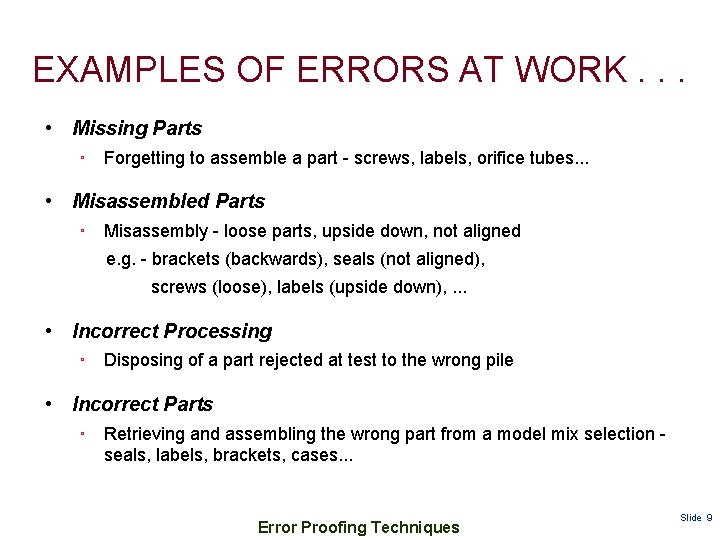
EXAMPLES OF ERRORS AT WORK. . . • Missing Parts ° Forgetting to assemble a part - screws, labels, orifice tubes. . . • Misassembled Parts ° Misassembly - loose parts, upside down, not aligned e. g. - brackets (backwards), seals (not aligned), screws (loose), labels (upside down), . . . • Incorrect Processing ° Disposing of a part rejected at test to the wrong pile • Incorrect Parts ° Retrieving and assembling the wrong part from a model mix selection seals, labels, brackets, cases. . . Error Proofing Techniques Slide 9
WHAT ABOUT ERRORS AT WORK? INJURIES Mistakes = Lost Time, Lost Money, and possibly Lost Business!!!! Error Proofing Techniques Slide 10
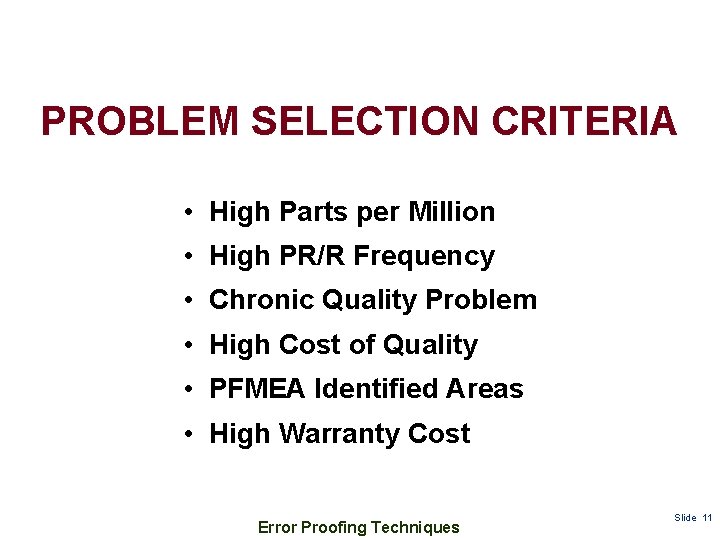
PROBLEM SELECTION CRITERIA • High Parts per Million • High PR/R Frequency • Chronic Quality Problem • High Cost of Quality • PFMEA Identified Areas • High Warranty Cost Error Proofing Techniques Slide 11
PROBLEM STATEMENT = LOST Error Proofing Techniques Slide 12
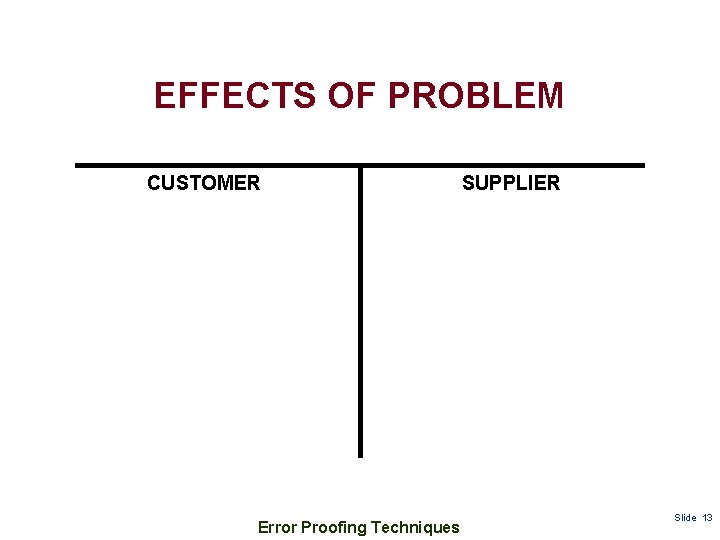
EFFECTS OF PROBLEM CUSTOMER Error Proofing Techniques SUPPLIER Slide 13
WHY DO HUMAN ERRORS OCCUR WHEN EVERYONE IS FOR QUALITY? Error Proofing Techniques Slide 14
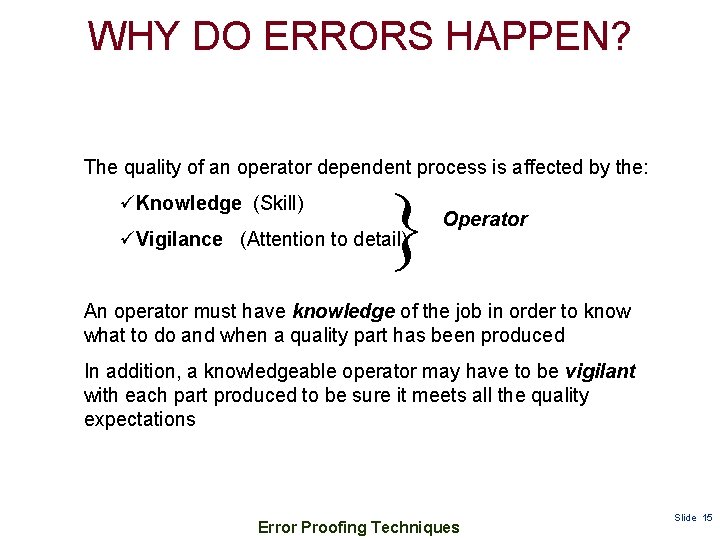
WHY DO ERRORS HAPPEN? The quality of an operator dependent process is affected by the: üKnowledge (Skill) } üVigilance (Attention to detail) Operator An operator must have knowledge of the job in order to know what to do and when a quality part has been produced In addition, a knowledgeable operator may have to be vigilant with each part produced to be sure it meets all the quality expectations Error Proofing Techniques Slide 15
KNOWLEDGE AND VIGILANCE EXAMPLE: I may be an expert at driving a car (KNOWLEDGE) BUT. . . Occasionally, I lock my keys in the car or run out of gas (LACK OF VIGILANCE!!!) Error Proofing Techniques Slide 16
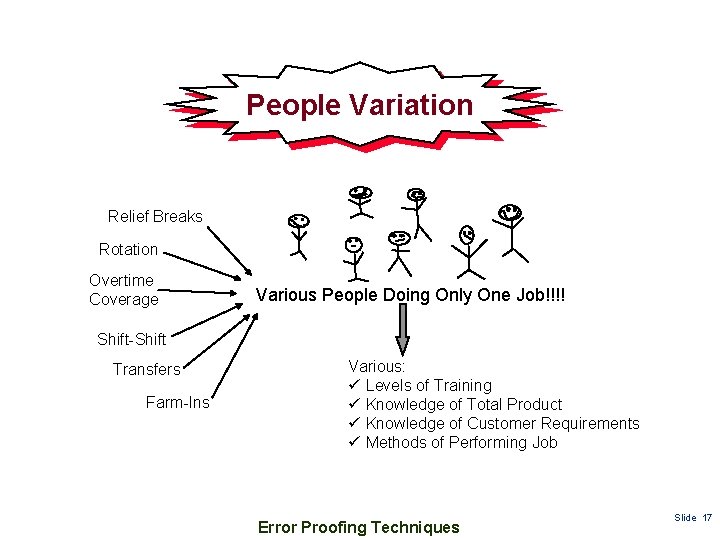
People Variation Relief Breaks Rotation Overtime Coverage Various People Doing Only One Job!!!! Shift-Shift Transfers Farm-Ins Various: ü Levels of Training ü Knowledge of Total Product ü Knowledge of Customer Requirements ü Methods of Performing Job Error Proofing Techniques Slide 17
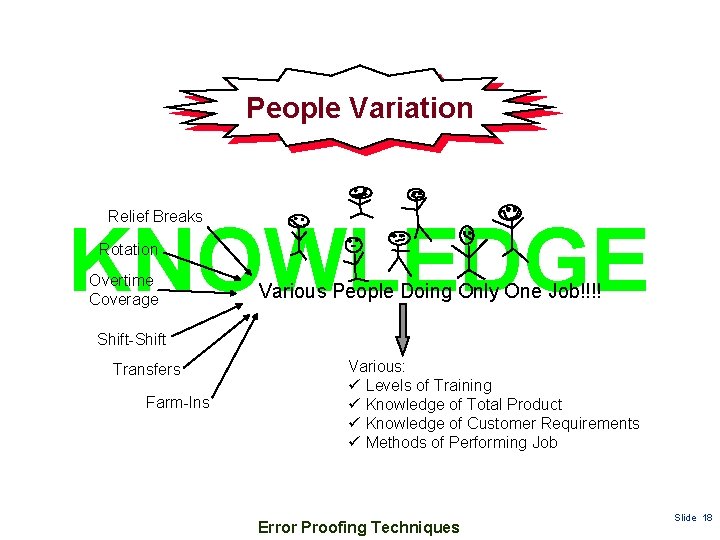
People Variation Relief Breaks KNOWLEDGE Rotation Overtime Coverage Various People Doing Only One Job!!!! Shift-Shift Transfers Farm-Ins Various: ü Levels of Training ü Knowledge of Total Product ü Knowledge of Customer Requirements ü Methods of Performing Job Error Proofing Techniques Slide 18
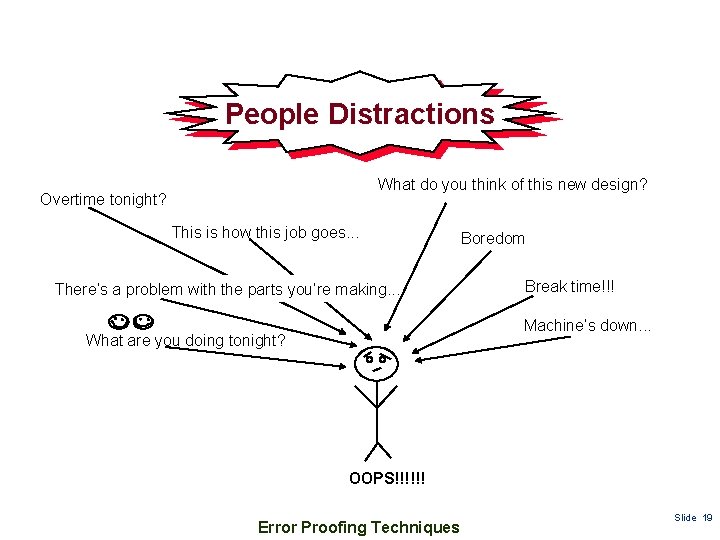
People Distractions What do you think of this new design? Overtime tonight? This is how this job goes. . . There’s a problem with the parts you’re making. . Boredom Break time!!! Machine’s down. . . What are you doing tonight? OOPS!!!!!! Error Proofing Techniques Slide 19
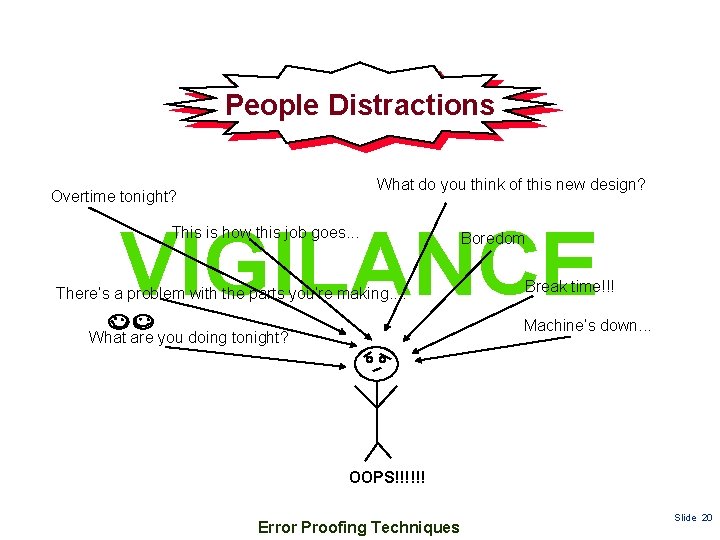
People Distractions What do you think of this new design? Overtime tonight? VIGILANCE This is how this job goes. . . There’s a problem with the parts you’re making. . Boredom Break time!!! Machine’s down. . . What are you doing tonight? OOPS!!!!!! Error Proofing Techniques Slide 20
WHY ARE MISTAKES A PROBLEM? üCost us money üCost us time üCause us danger/possible injury Error Proofing Techniques Slide 21
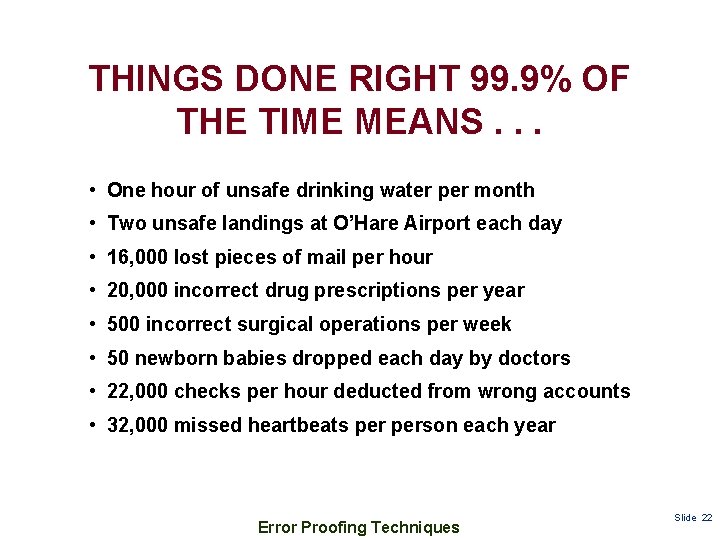
THINGS DONE RIGHT 99. 9% OF THE TIME MEANS. . . • One hour of unsafe drinking water per month • Two unsafe landings at O’Hare Airport each day • 16, 000 lost pieces of mail per hour • 20, 000 incorrect drug prescriptions per year • 500 incorrect surgical operations per week • 50 newborn babies dropped each day by doctors • 22, 000 checks per hour deducted from wrong accounts • 32, 000 missed heartbeats person each year Error Proofing Techniques Slide 22
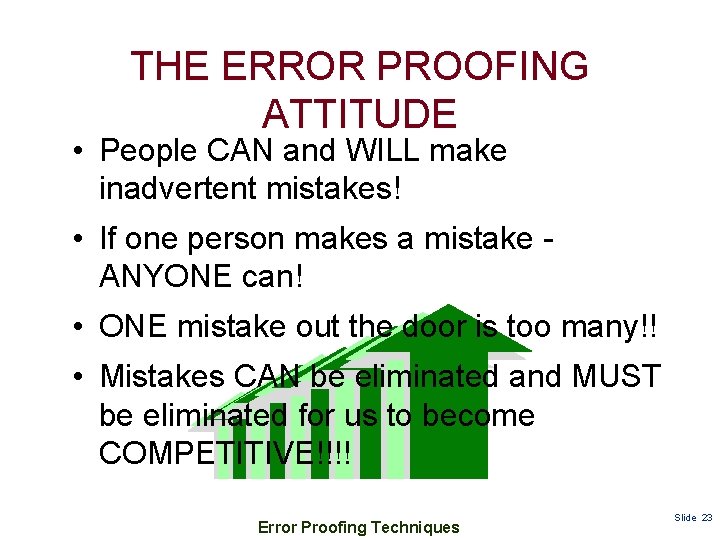
THE ERROR PROOFING ATTITUDE • People CAN and WILL make inadvertent mistakes! • If one person makes a mistake ANYONE can! • ONE mistake out the door is too many!! • Mistakes CAN be eliminated and MUST be eliminated for us to become COMPETITIVE!!!! Error Proofing Techniques Slide 23
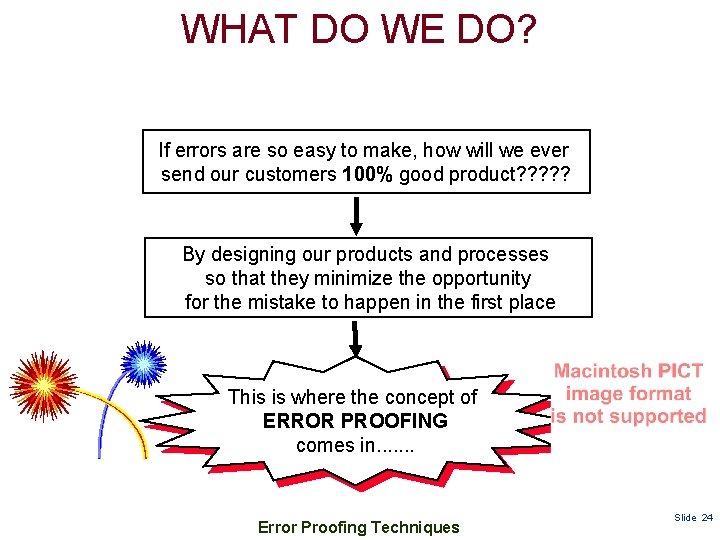
WHAT DO WE DO? If errors are so easy to make, how will we ever send our customers 100% good product? ? ? By designing our products and processes so that they minimize the opportunity for the mistake to happen in the first place This is where the concept of ERROR PROOFING comes in. . . . Error Proofing Techniques Slide 24
A SYSTEM IS NEEDED TO COMBAT THESE DRAWBACKS: • Detect an error in the process before a defective product is passed to the next station; whenever possible before a defective product is produced. • Perform detection and notification of operator immediately; i. e. for every unit of product. Error Proofing Techniques Slide 25
ERROR PROOFING TECHNIQUES BENEFITS 3 Assures 1 st Piece Quality 3 Assures Consistency during Set-Ups 3 Prevents Production of Defective Parts 3 Makes Quality Problems More Visible 3 Creates a Safer Work Environment 3 Eliminates Waste of Inspection and Repair 3 Lowers Cost of Design (DFM) and Cost to Manufacture (Poka-Yoke Devices) Error Proofing Techniques Slide 26
ERROR PROOFING TECHNIQUES OBJECTIVE To improve the PROCESS by helping people prevent ERRORS and increase the chances of DETECTION, so that FAILURE MODE occurrences are ELIMINATED. Error Proofing Techniques Slide 27
Error Proofing Techniques • INTRODUCTIONS / OPENING COMMENTS. • OVERVIEW OF SITE OPERATIONS AND DISCUSSION OF PROBLEM AREA(S). • WORKSITE REVIEW TO ASSESS PROBLEM AREA FOCUS AND ISSUES. • OVERVIEW OF WORKSHOP PROCESS AND ACTIVITIES. • PRE-WORKSHOP PREPARATION REQUIREMENTS. • GENERAL DISCUSSION AND ADJOURN. Error Proofing Techniques Slide 28
Error Proofing Techniques Slide 29
QUALITY STEP CHART ABC Company - Widget Assemblies INCIDENTS PER PART OR PPM Current State SAMPLE CHART ACTION PLANS WITH ACTUAL OR EST. RESULTS Improved Processing = 140 ppm QUALITY MEASURE Reduced Handling = 120 ppm Visual Management = 100 ppm Error Proofing = 80 ppm Preventative Maintenance = 60 ppm TARGET TIME FRAME OF ACTION PLANS TIME © Copyright General Motors. All rights reserved. Error Proofing Techniques Slide 30
PROJECT SELECTION SELECT TEAM MEMBERS • CUSTOMER QUALITY CONCERN • HIGH RPPM / REPEAT PR/R’s • PART IN CONTROLLED SHIPPING • CHRONIC QUALITY PROBLEM • HIGH WARRANTY IMPACT • HIGH COST OF QUALITY MAKE ALL PEOPLE AFFECTED AWARE OF WHAT IS GOING TO HAPPEN DEFINE CURRENT SITUATION • PROCESS FLOW & DATA WORKSHEETS • QUALITY RESULTS • PROCESS MEASURES • PROBLEM DEFINITION • GM PRODUCT/PROCESS ENGINEER • SUPPLIER PERSONNEL (ENGR. , MFG, QUALITY, OPERATORS, ETC) • PURCHASING • SUPPLIER QUALITY ENGINEER • CUSTOMER REPRESENTATIVE IDENTIFY POSSIBLE CAUSES LOOK FOR NEW OPPORTUNITIES • BRAINSTORMING • 5 WHY’s • CAUSE & EFFECT DIAGRAM • STORYBOARD • COLLECT THE DATA • RUN CHARTS • FREQUENCY DISTRIBUTION • PICTOGRAPH • SCATTER DIAGRAMS • PROCESS CAPABILITY STUDY • DESIGN OF EXPERIMENTS • PROCESS DISSECTION Process RECOGNIZE EFFORTS OF PEOPLE EVALUATE AND ADJUST OPERATION: FROM: ______________ QUANTITY PER SHIFT: _______ TO: _______________ DESCRIPTION OF NO. OPERATION ELEMENT TIME HAND WORK MACHINE WALK SHIFT: ____ STANDARD INPROCESS STOCK Q CUSTOMER CYCLE TIME: _________ OPERATOR CYCLE TIME: _________ QUALITY CHECK C CRITICAL OPERATION 1 5 2 4 SAFETY 3 WORKSTATION AREA DRAWN TO SCALE 03/23/94 • EVALUATE EFFECTIVENESS OF THE ACTION PLANS. • MEDIAN & RANGE CHARTS • AVERAGE & RANGE CHARTS • PROCESS CAPABILITY PLAN & IMPLEMENT CORRECTIVE ACTION • BASED ON PROFOUND KNOWLEDGE • OVERCOMING ROADBLOCKS • ACTION PLANS PROCESSED ASAP ANALYZE THE DATA SELECT GOOD IDEAS • GATHER NEW DATA AS NECESSARY. • DEVELOP ACTION PLANS FOR CONTAINMENT, CORRECTION, AND PREVENTION. • DOCUMENT RECOMMENDED CHANGES AND ACTION PLANS. • ESTABLISH IMPLEMENTATION TIMING AND RESPONSIBILITY.
Error Proofing Techniques Agenda p OPENING COMMENTS & INTRODUCTIONS p ERROR PROOFING OVERVIEW p WORKSHOP EXPECTATIONS - Why Are We Here Problem Statement p DEFINE CURRENT STATE p ERROR PROOFING AWARENESS & TECHNIQUES p BRAINSTORMING - Problem Solving Solutions Utilizing Proofing Techniques Error p DEVELOP ACTION PLANS & IMPLEMENTATION p CLOSING & WRAP-UP Error Proofing Techniques Slide 32
PROBLEM SELECTION CRITERIA • High Parts per Million • High PR/R Frequency • Chronic Quality Problem • High Cost of Quality • PFMEA Identified Areas • High Warranty Cost Error Proofing Techniques Slide 33
PROBLEM STATEMENT = LOST Error Proofing Techniques Slide 34
EFFECTS OF PROBLEM CUSTOMER Error Proofing Techniques SUPPLIER Slide 35
WHY ARE MISTAKES A PROBLEM? ü Cost us money ü Cost us time ü Cause us danger/possible injury Error Proofing Techniques Slide 36
THINGS DONE RIGHT 99. 9% OF THE TIME MEANS. . . • One hour of unsafe drinking water per month • Two unsafe landings at O’Hare Airport each day • 16, 000 lost pieces of mail per hour • 20, 000 incorrect drug prescriptions per year • 500 incorrect surgical operations per week • 50 newborn babies dropped each day by doctors • 22, 000 checks per hour deducted from wrong accounts • 32, 000 missed heartbeats person each year Error Proofing Techniques Slide 37
THE ERROR PROOFING ATTITUDE u People CAN and WILL make inadvertent mistakes! u If one person makes a mistake - ANYONE can! u ONE mistake out the door is too many!! u Mistakes CAN be eliminated and MUST be eliminated for us to become COMPETITIVE!!!! Error Proofing Techniques Slide 38
A SYSTEM IS NEEDED TO COMBAT THESE DRAWBACKS: • Detect an error in the process before a defective product is passed to the next station; whenever possible before a defective product is produced. • Perform detection and notification of operator immediately; i. e. for every unit of product. Error Proofing Techniques Slide 39
WHAT IS ERROR PROOFING? Error Proofing is the activity of awareness, detection, and prevention of errors which adversely affect: Our customers Our people (defects) (injuries) and result in WASTE! Awareness: Having the forethought that a mistake can be made, communicating the potential, and planning the design of the product or process to detect or prevent it. Detection: Allowing the mistake to happen but providing some means of detecting it and alerting someone so that we fix it before sending it to our customer. Prevention: Not allowing the possibility for the mistake to occur in the first place. Error Proofing Techniques Slide 40
ERROR PROOFING Techniques • Design for Manufacturability • “Poka-Yoke” System Devices Error Proofing Techniques Slide 41
ERROR PROOFING Techniques: • Design For Manufacturability (DFM) Technique that Results in Designs that Cannot be Incorrectly Manufactured or Assembled. This Technique can also be used to “Simplify” the Design and therefore reduce its cost. Error Proofing Techniques Slide 42
ERROR PROOFING Techniques (Continued) • “Poka-Yoke” System* Set-Up Devices or Inspection Techniques that Assure that Set-Up is Done Correctly; i. e. Produces 100% Good Parts from the First Piece on “Zero Quality Control: Source Inspection and the Poka-Yoke System” - Shigeo Shingo; 1986 Error Proofing Techniques Slide 43
EXAMPLES OF ERRORS AT WORK. . . u Missing Parts ü u Forgetting to assemble a part - screws, labels, orifice tubes. . . Misassembled Parts ü Misassembly - loose parts, upside down, not aligned e. g. - brackets (backwards), seals (not aligned), screws (loose), labels (upside down), . . . u Incorrect Processing ü u Disposing of a part rejected at test to the wrong pile Incorrect Parts ü Retrieving and assembling the wrong part from a model mix selection seals, labels, brackets, cases. . . Error Proofing Techniques Slide 44
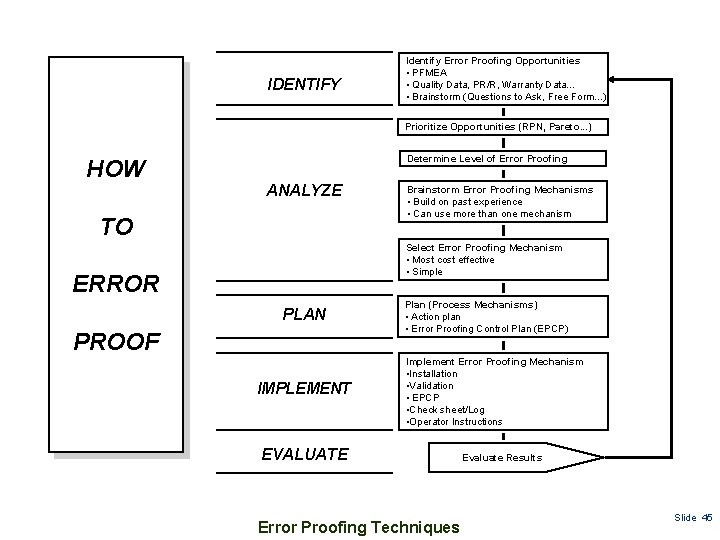
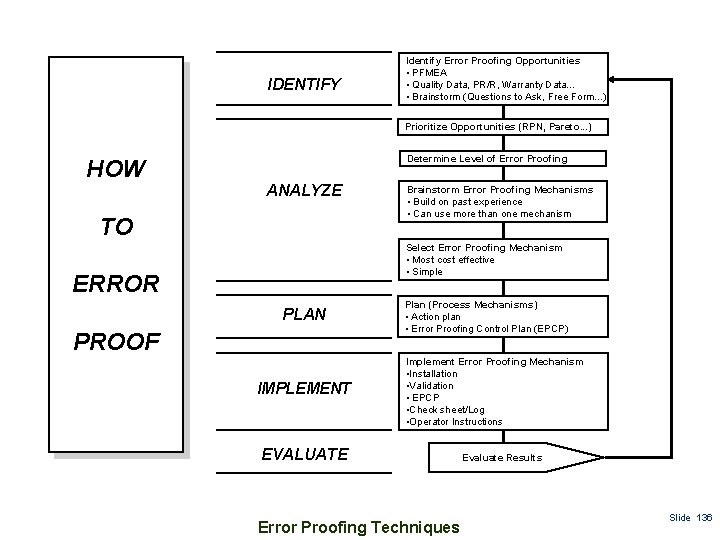
IDENTIFY Identify Error Proofing Opportunities • PFMEA • Quality Data, PR/R, Warranty Data. . . • Brainstorm (Questions to Ask, Free Form. . . ) Prioritize Opportunities (RPN, Pareto. . . ) HOW Determine Level of Error Proofing ANALYZE TO Brainstorm Error Proofing Mechanisms • Build on past experience • Can use more than one mechanism Select Error Proofing Mechanism • Most cost effective • Simple ERROR PLAN PROOF IMPLEMENT Plan (Process Mechanisms) • Action plan • Error Proofing Control Plan (EPCP) Implement Error Proofing Mechanism • Installation • Validation • EPCP • Check sheet/Log • Operator Instructions EVALUATE Error Proofing Techniques Evaluate Results Slide 45
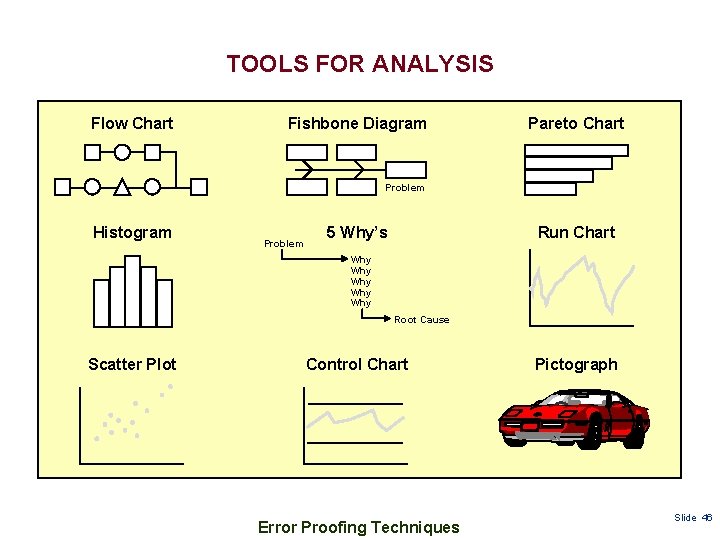
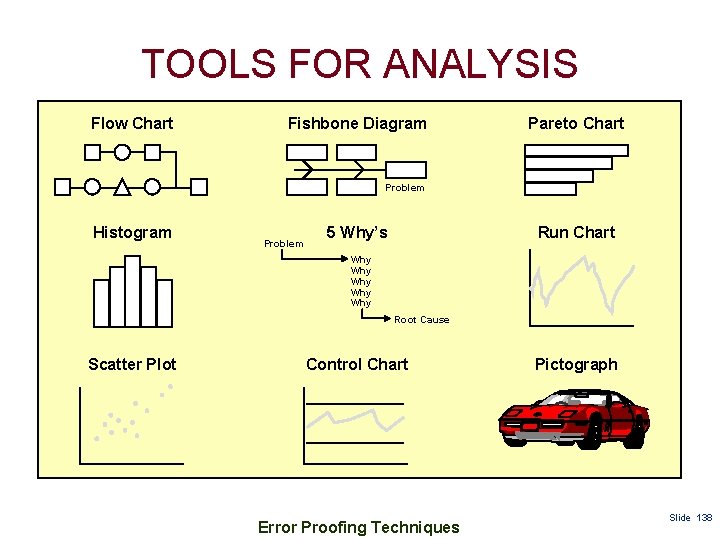
TOOLS FOR ANALYSIS Flow Chart Fishbone Diagram Pareto Chart Problem Histogram Problem 5 Why’s Run Chart Why Why Why Root Cause Scatter Plot Control Chart Error Proofing Techniques Pictograph Slide 46
ERROR PROOFING TECHNIQUES BENEFITS 3 Assures 1 st Piece Quality 3 Assures Consistency during Set-Ups 3 Prevents Production of Defective Parts 3 Makes Quality Problems More Visible 3 Creates a Safer Work Environment 3 Eliminates Waste of Inspection and Repair 3 Lowers Cost of Design (DFM) and Cost to Manufacture (Poka-Yoke Devices) Error Proofing Techniques Slide 47
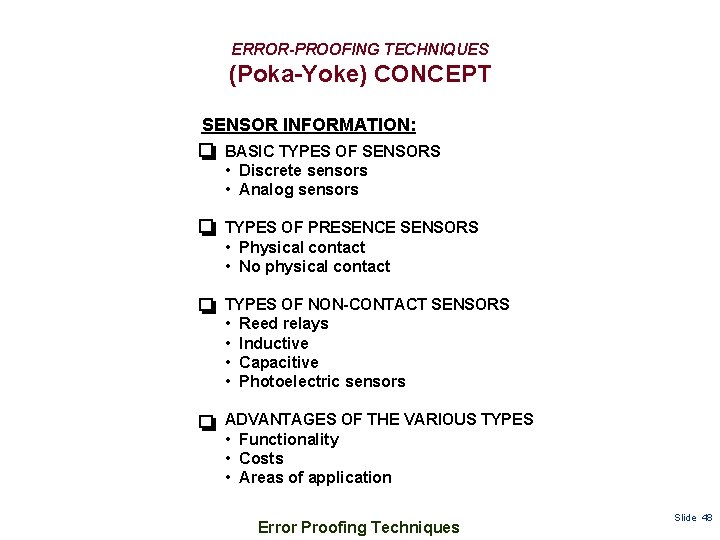
ERROR-PROOFING TECHNIQUES (Poka-Yoke) CONCEPT SENSOR INFORMATION: BASIC TYPES OF SENSORS • Discrete sensors • Analog sensors TYPES OF PRESENCE SENSORS • Physical contact • No physical contact TYPES OF NON-CONTACT SENSORS • Reed relays • Inductive • Capacitive • Photoelectric sensors ADVANTAGES OF THE VARIOUS TYPES • Functionality • Costs • Areas of application Error Proofing Techniques Slide 48
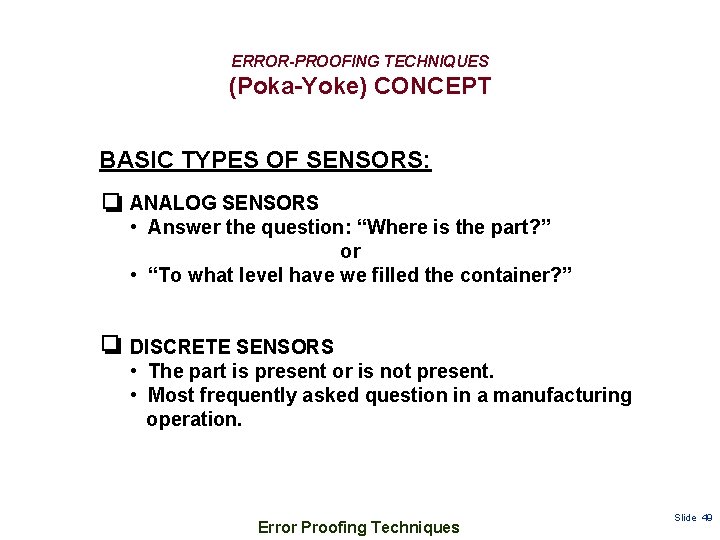
ERROR-PROOFING TECHNIQUES (Poka-Yoke) CONCEPT BASIC TYPES OF SENSORS: ANALOG SENSORS • Answer the question: “Where is the part? ” or • “To what level have we filled the container? ” DISCRETE SENSORS • The part is present or is not present. • Most frequently asked question in a manufacturing operation. Error Proofing Techniques Slide 49
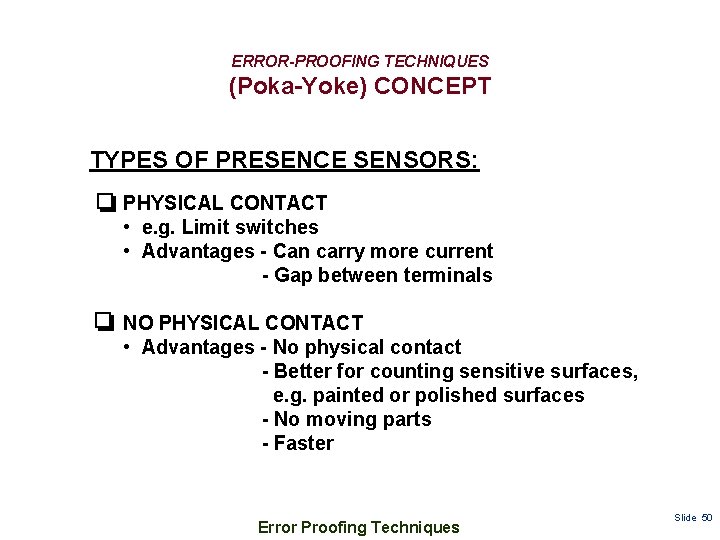
ERROR-PROOFING TECHNIQUES (Poka-Yoke) CONCEPT TYPES OF PRESENCE SENSORS: PHYSICAL CONTACT • e. g. Limit switches • Advantages - Can carry more current - Gap between terminals NO PHYSICAL CONTACT • Advantages - No physical contact - Better for counting sensitive surfaces, e. g. painted or polished surfaces - No moving parts - Faster Error Proofing Techniques Slide 50
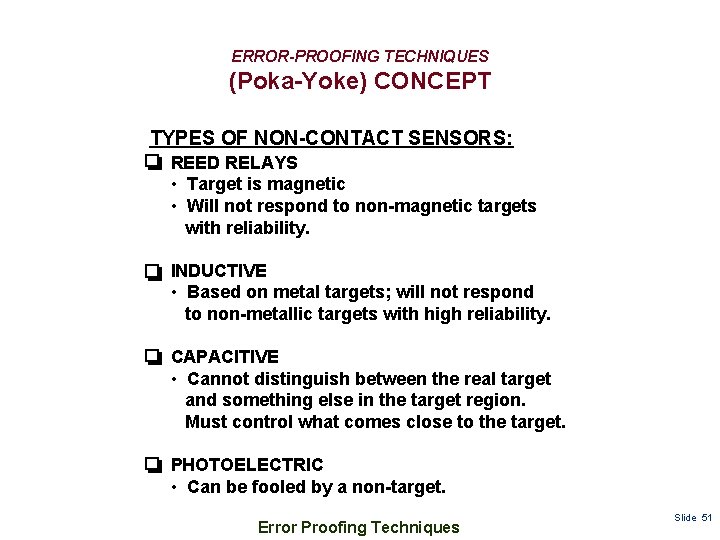
ERROR-PROOFING TECHNIQUES (Poka-Yoke) CONCEPT TYPES OF NON-CONTACT SENSORS: REED RELAYS • Target is magnetic • Will not respond to non-magnetic targets with reliability. INDUCTIVE • Based on metal targets; will not respond to non-metallic targets with high reliability. CAPACITIVE • Cannot distinguish between the real target and something else in the target region. Must control what comes close to the target. PHOTOELECTRIC • Can be fooled by a non-target. Error Proofing Techniques Slide 51
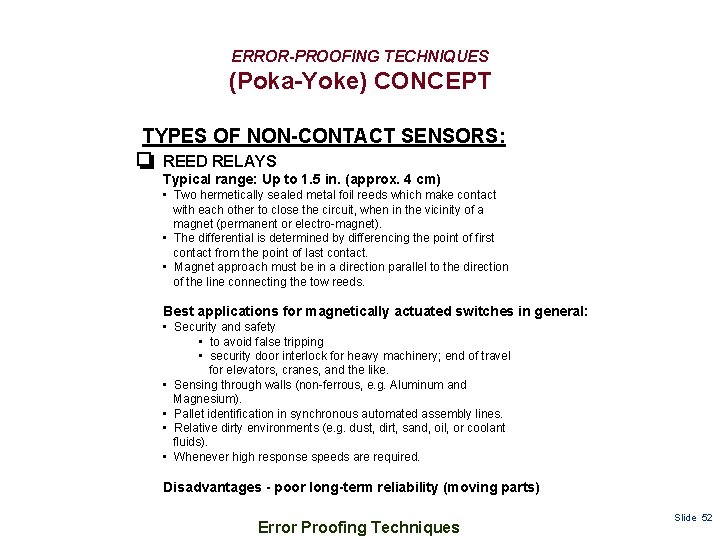
ERROR-PROOFING TECHNIQUES (Poka-Yoke) CONCEPT TYPES OF NON-CONTACT SENSORS: REED RELAYS Typical range: Up to 1. 5 in. (approx. 4 cm) • Two hermetically sealed metal foil reeds which make contact with each other to close the circuit, when in the vicinity of a magnet (permanent or electro-magnet). • The differential is determined by differencing the point of first contact from the point of last contact. • Magnet approach must be in a direction parallel to the direction of the line connecting the tow reeds. Best applications for magnetically actuated switches in general: • Security and safety • to avoid false tripping • security door interlock for heavy machinery; end of travel for elevators, cranes, and the like. • Sensing through walls (non-ferrous, e. g. Aluminum and Magnesium). • Pallet identification in synchronous automated assembly lines. • Relative dirty environments (e. g. dust, dirt, sand, oil, or coolant fluids). • Whenever high response speeds are required. Disadvantages - poor long-term reliability (moving parts) Error Proofing Techniques Slide 52
ERROR-PROOFING TECHNIQUES (Poka-Yoke) CONCEPT TYPES OF NON-CONTACT SENSORS: INDUCTIVE SENSORS • Principle of Operation: • Eddy currents are induced in the target (metallic) by the electromagnetic. • The target reacts with the Eddy currents as a function of the distance from the field. • Inside the field, the target attenuates the magnitude of the Eddy currents. • Outside the field, the target does not impede the Eddy currents. • This type of oscillator is referred to as a ECKO (Eddy Current Killed Oscillator). Error Proofing Techniques Slide 53
ERROR-PROOFING TECHNIQUES (Poka-Yoke) CONCEPT TYPES OF NON-CONTACT SENSORS: CAPACITIVE SENSORS • Principle of Operation: • Senses all materials • Contain a high frequency oscillator with one of its capacitor plates built into the sensor. • Method of Application: • All materials are sensed through a change on the dielectric characteristics. • Ideal applications include bulk materials and liquids in containers of glass and plastic. • Characteristics: • Poor choice for metal targets. • Is very sensitive to environmental factors. • Sensing range depends greatly on the material being sensed. • Can be misled and therefore it is important to control the material which is presented to the sensor. Error Proofing Techniques Slide 54
ERROR-PROOFING TECHNIQUES (Poka-Yoke) CONCEPT TYPES OF NON-CONTACT SENSORS: PHOTOELECTRIC SENSORS Photoelectric controls need no physical contact and are ideal where sensed objects must remain untouched. Photoelectric controls respond rapidly to parts moving quickly and in varying positions along a conveyor, yet operate dependably if actuated only infrequently. There are controls for indoor or outdoor use, for varying ambient light conditions, for high vibration, for areas restrictive in space, and even for explosive locations. Typical applications include: • • Counting Labeling Conveyor control Bin level control Parts inspection Feed and/or fill control Package handling Thread break detection • • Edge guide Web break detection Regristration control Food processing Parts monitoring and sorting Batch counting Robotics Parts handling Error Proofing Techniques Slide 55
ERROR-PROOFING TECHNIQUES (Poka-Yoke) CONCEPT TYPES OF NON-CONTACT SENSORS: PHOTOELECTRIC SENSORS Conveyor Control This application involves sorting brown cardboard boxes which are coded with up to four black marks per box. The application is to sense the number of marks on each box. Package Handling A diffuse scan photoelectric control is used to detect the light reflected from the object in this application. The control detects the light reflected off the box, turning ON and OFF the gluing machine. Labeling This application is designed to detect the leading edge of a black bar code on a read and write label. The labels are edge to edge on a spool. When the bar code is detected the sensor output triggers a laser bar code reader which reads the bar code. Food Processing This application monitors the level of an accumulator in a meat processing facility. A photoelectric control detects a fill level of hot-dogs in the accumulator then turns on the conveyor for a preset time period. Side walls of the accumulator are polished stainless steel. The equipment is subject to daily washdown. Fill Level Control This application inspects the fill level of various jars of food products. The photoelectric system produces an output when either an under or over fill condition is detected. Parts Handling Fiber optics are ideal for areas too small for a standard photoelectric control. The fiber optic cables direct the light from the base to where the sensing is needed. Error Proofing Techniques Slide 56
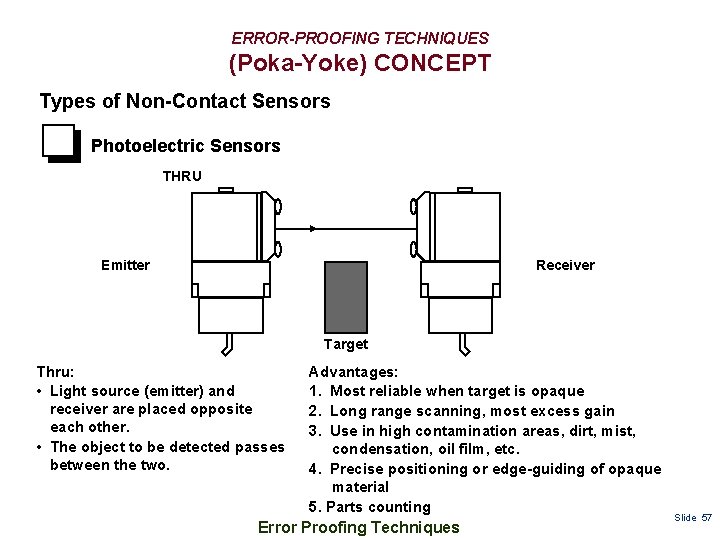
ERROR-PROOFING TECHNIQUES (Poka-Yoke) CONCEPT Types of Non-Contact Sensors Photoelectric Sensors THRU Emitter Receiver Target Thru: • Light source (emitter) and receiver are placed opposite each other. • The object to be detected passes between the two. Advantages: 1. Most reliable when target is opaque 2. Long range scanning, most excess gain 3. Use in high contamination areas, dirt, mist, condensation, oil film, etc. 4. Precise positioning or edge-guiding of opaque material 5. Parts counting Error Proofing Techniques Slide 57
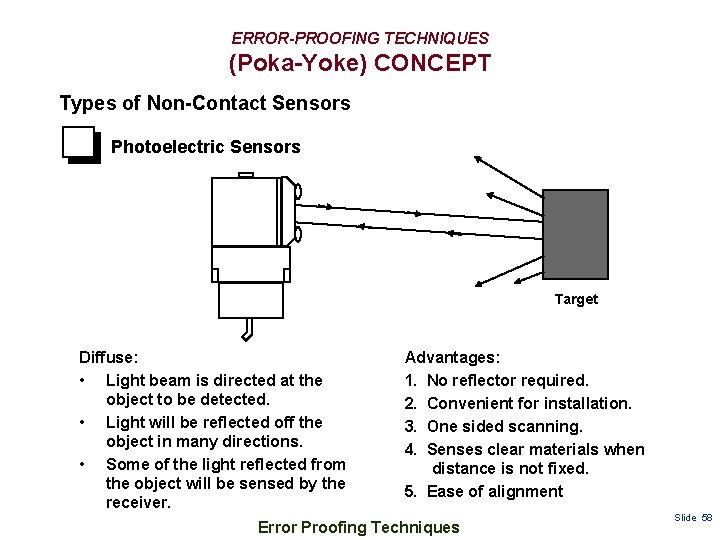
ERROR-PROOFING TECHNIQUES (Poka-Yoke) CONCEPT Types of Non-Contact Sensors Photoelectric Sensors Target Diffuse: • Light beam is directed at the object to be detected. • Light will be reflected off the object in many directions. • Some of the light reflected from the object will be sensed by the receiver. Advantages: 1. No reflector required. 2. Convenient for installation. 3. One sided scanning. 4. Senses clear materials when distance is not fixed. 5. Ease of alignment Error Proofing Techniques Slide 58
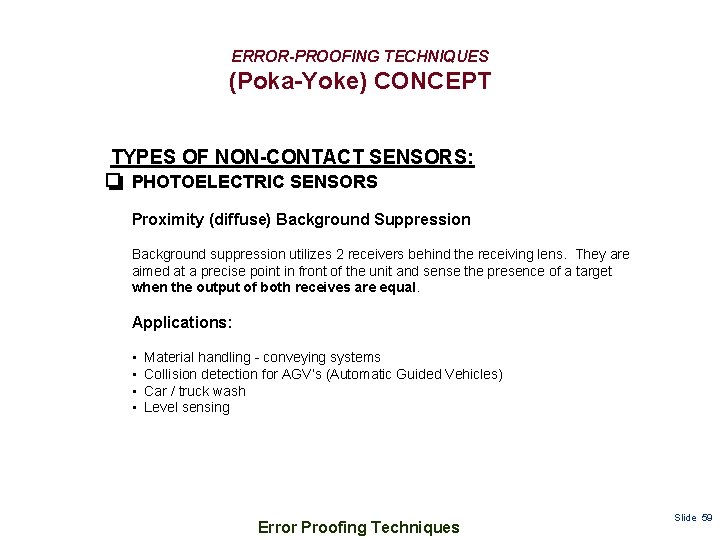
ERROR-PROOFING TECHNIQUES (Poka-Yoke) CONCEPT TYPES OF NON-CONTACT SENSORS: PHOTOELECTRIC SENSORS Proximity (diffuse) Background Suppression Background suppression utilizes 2 receivers behind the receiving lens. They are aimed at a precise point in front of the unit and sense the presence of a target when the output of both receives are equal. Applications: • • Material handling - conveying systems Collision detection for AGV’s (Automatic Guided Vehicles) Car / truck wash Level sensing Error Proofing Techniques Slide 59
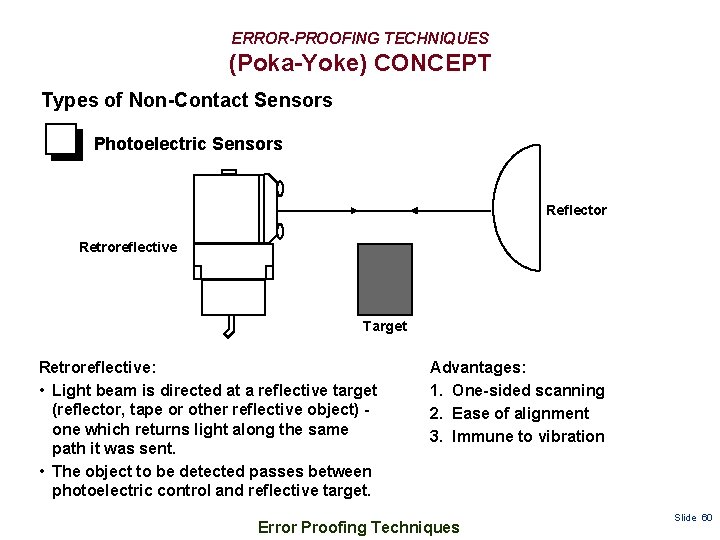
ERROR-PROOFING TECHNIQUES (Poka-Yoke) CONCEPT Types of Non-Contact Sensors Photoelectric Sensors Reflector Retroreflective Target Retroreflective: • Light beam is directed at a reflective target (reflector, tape or other reflective object) one which returns light along the same path it was sent. • The object to be detected passes between photoelectric control and reflective target. Advantages: 1. One-sided scanning 2. Ease of alignment 3. Immune to vibration Error Proofing Techniques Slide 60
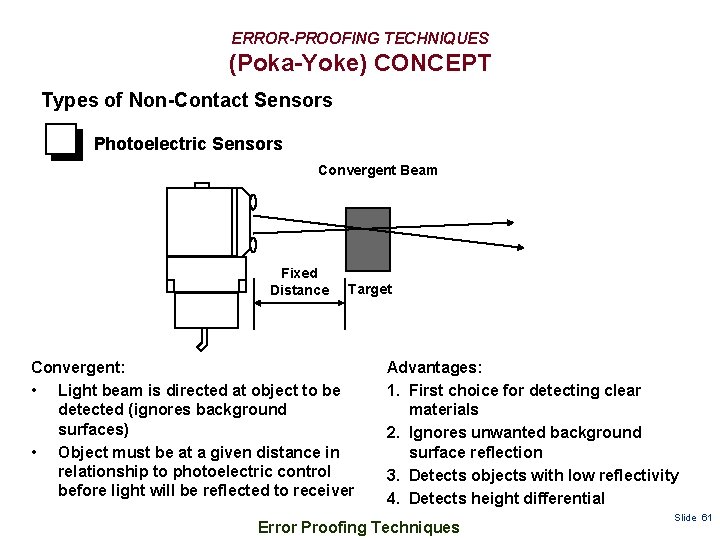
ERROR-PROOFING TECHNIQUES (Poka-Yoke) CONCEPT Types of Non-Contact Sensors Photoelectric Sensors Convergent Beam Fixed Distance Target Convergent: • Light beam is directed at object to be detected (ignores background surfaces) • Object must be at a given distance in relationship to photoelectric control before light will be reflected to receiver Advantages: 1. First choice for detecting clear materials 2. Ignores unwanted background surface reflection 3. Detects objects with low reflectivity 4. Detects height differential Error Proofing Techniques Slide 61
ERROR-PROOFING TECHNIQUES (Poka-Yoke) CONCEPT TYPES OF NON-CONTACT SENSORS: PHOTOELECTRIC SENSORS Fiber Optic Sensors What do you do when the physical constraints of the application don’t allow for installing regular, self-contained sensors? Maybe the target is in a high temperature or chemically aggressive environment. Perhaps the target is small or very fast-moving. Fiber-optics, applied to photoelectric scanning, solves these problems. Fiber Optics and Sensing All fiber optic sensing mode are implemented using one type of amplifier which contains both emitter and receiver in one housing. Fiber Optic Thru-beam Scanning Using two opposed, individual fiber optic cables, the object to be detected breaks the beam. The target must be at least the same dimension as the effective beam, which in this case, is the bundle diameter. Because the beam is very small, the detection can be very precise. A typical application might be edge detection for a web printing press. Needle tips reduce the beam dimension for use with extremely small targets, typical for application in semiconductors and pharmaceutical industries. Typical application: • Small parts detection • Edge detection • High temperature environment (600 degrees F+) Error Proofing Techniques Slide 62
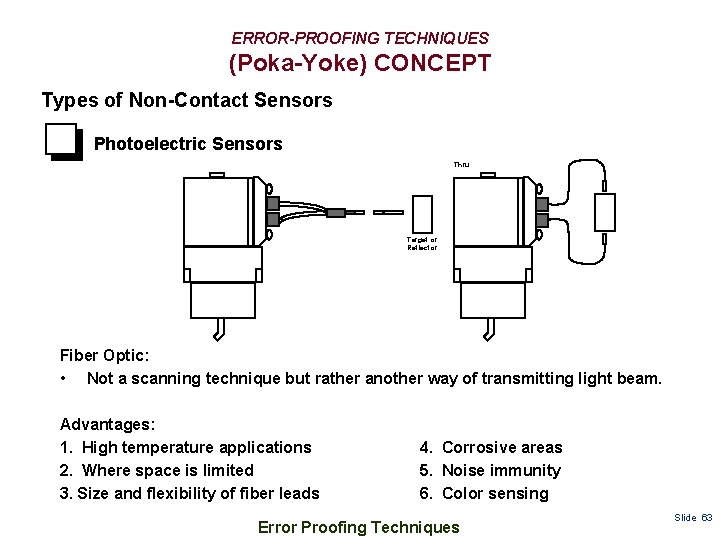
ERROR-PROOFING TECHNIQUES (Poka-Yoke) CONCEPT Types of Non-Contact Sensors Photoelectric Sensors Thru Target or Reflector Fiber Optic: • Not a scanning technique but rather another way of transmitting light beam. Advantages: 1. High temperature applications 2. Where space is limited 3. Size and flexibility of fiber leads 4. Corrosive areas 5. Noise immunity 6. Color sensing Error Proofing Techniques Slide 63
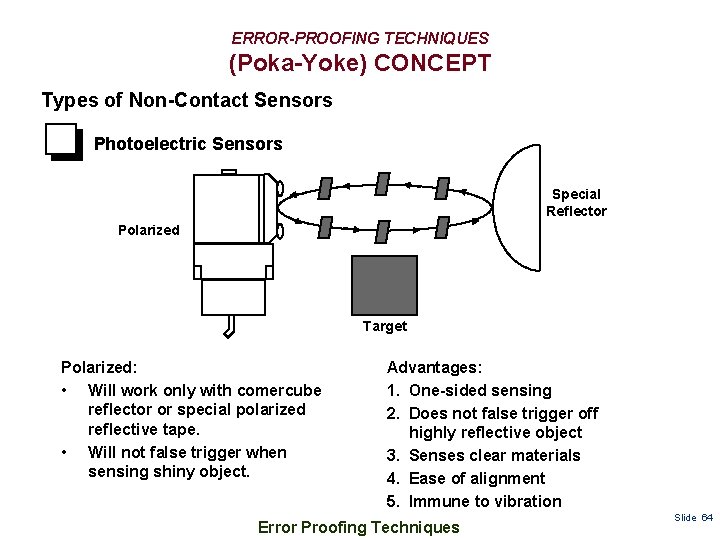
ERROR-PROOFING TECHNIQUES (Poka-Yoke) CONCEPT Types of Non-Contact Sensors Photoelectric Sensors Special Reflector Polarized Target Polarized: • Will work only with comercube reflector or special polarized reflective tape. • Will not false trigger when sensing shiny object. Advantages: 1. One-sided sensing 2. Does not false trigger off highly reflective object 3. Senses clear materials 4. Ease of alignment 5. Immune to vibration Error Proofing Techniques Slide 64
ERROR-PROOFING TECHNIQUES (Poka-Yoke) CONCEPT APPLICATIONS FOR PHOTOELECTRIC SENSORS Error Proofing Techniques Slide 65
ERROR-PROOFING TECHNIQUES (Poka-Yoke) CONCEPT Error Proofing Techniques Slide 66
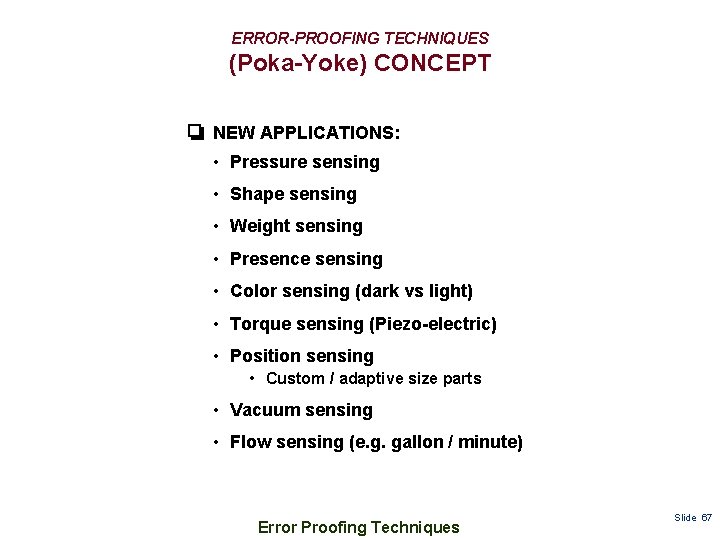
ERROR-PROOFING TECHNIQUES (Poka-Yoke) CONCEPT NEW APPLICATIONS: • Pressure sensing • Shape sensing • Weight sensing • Presence sensing • Color sensing (dark vs light) • Torque sensing (Piezo-electric) • Position sensing • Custom / adaptive size parts • Vacuum sensing • Flow sensing (e. g. gallon / minute) Error Proofing Techniques Slide 67
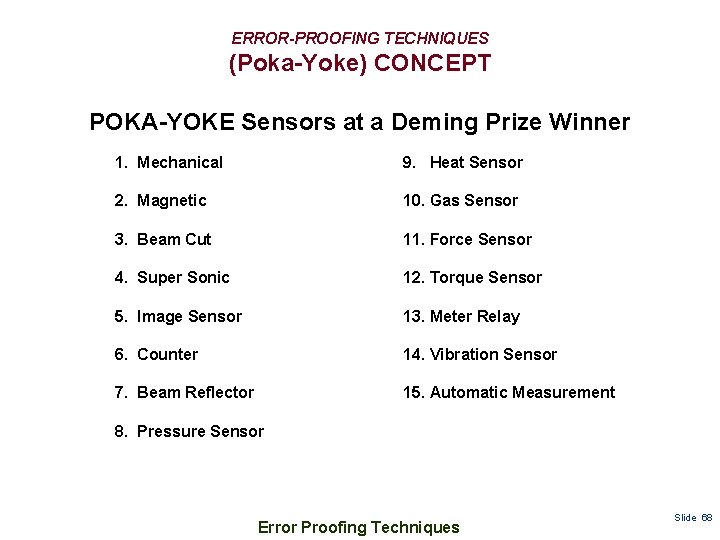
ERROR-PROOFING TECHNIQUES (Poka-Yoke) CONCEPT POKA-YOKE Sensors at a Deming Prize Winner 1. Mechanical 9. Heat Sensor 2. Magnetic 10. Gas Sensor 3. Beam Cut 11. Force Sensor 4. Super Sonic 12. Torque Sensor 5. Image Sensor 13. Meter Relay 6. Counter 14. Vibration Sensor 7. Beam Reflector 15. Automatic Measurement 8. Pressure Sensor Error Proofing Techniques Slide 68
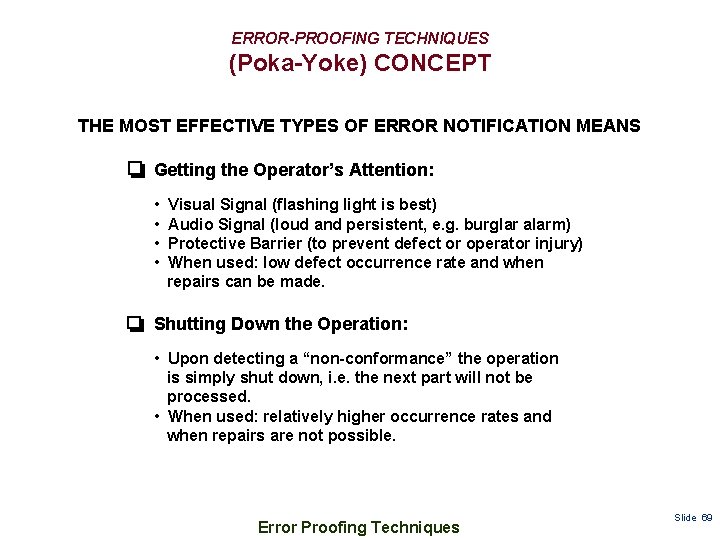
ERROR-PROOFING TECHNIQUES (Poka-Yoke) CONCEPT THE MOST EFFECTIVE TYPES OF ERROR NOTIFICATION MEANS Getting the Operator’s Attention: • • Visual Signal (flashing light is best) Audio Signal (loud and persistent, e. g. burglar alarm) Protective Barrier (to prevent defect or operator injury) When used: low defect occurrence rate and when repairs can be made. Shutting Down the Operation: • Upon detecting a “non-conformance” the operation is simply shut down, i. e. the next part will not be processed. • When used: relatively higher occurrence rates and when repairs are not possible. Error Proofing Techniques Slide 69
ERROR-PROOFING TECHNIQUES (Poka-Yoke) CONCEPT EXAMPLES OF POKA-YOKE’S FOR THE THREE MOST COMMON PROBLEMS Error Proofing Techniques Slide 70
ERROR-PROOFING TECHNIQUES (Poka-Yoke) CONCEPT BEST SENSING IDEAS What is the best method for sensing fluid levels for a machine? What is the best method for sensing magnets for electric motors? What are three possible methods for sensing burs on a cylinder bore? What is the best method for detecting the presence of an O-ring? Error Proofing Techniques Slide 71
Four Categories of Errors - Questions to Ask? ? Missing Parts ° Is there a model mix such that some models require a part while others require nothing at all in that location? ° Is the part assembled as a small part after some main activity? ° Is the part difficult to see after being assembled? Error Proofing Techniques Slide 72
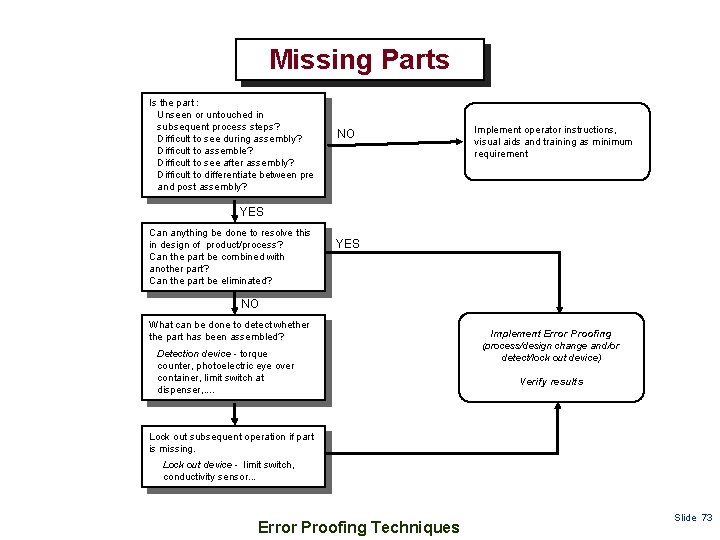
Missing Parts Is the part : Unseen or untouched in subsequent process steps? Difficult to see during assembly? Difficult to assemble? Difficult to see after assembly? Difficult to differentiate between pre and post assembly? NO Implement operator instructions, visual aids and training as minimum requirement YES Can anything be done to resolve this in design of product/process? Can the part be combined with another part? Can the part be eliminated? YES NO What can be done to detect whether the part has been assembled? Detection device - torque counter, photoelectric eye over container, limit switch at dispenser, . . Implement Error Proofing (process/design change and/or detect/lock out device) Verify results Lock out subsequent operation if part is missing. Lock out device - limit switch, conductivity sensor. . . Error Proofing Techniques Slide 73
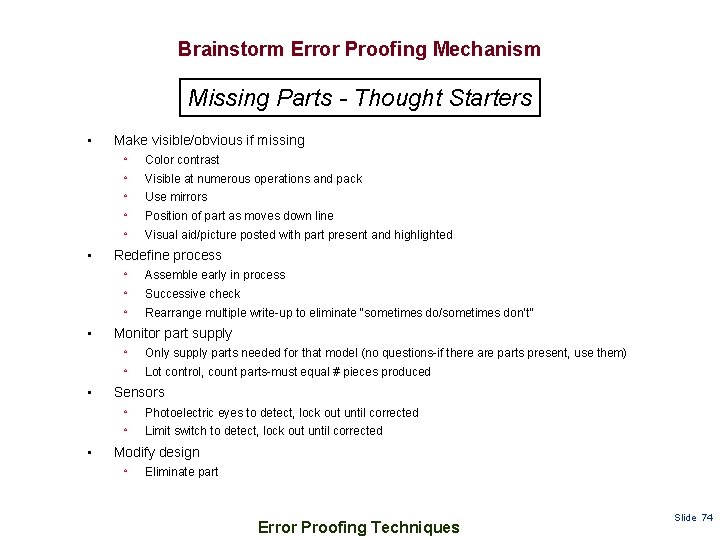
Brainstorm Error Proofing Mechanism Missing Parts - Thought Starters • • • Make visible/obvious if missing ° Color contrast ° Visible at numerous operations and pack ° Use mirrors ° Position of part as moves down line ° Visual aid/picture posted with part present and highlighted Redefine process ° Assemble early in process ° Successive check ° Rearrange multiple write-up to eliminate “sometimes do/sometimes don’t” Monitor part supply ° Only supply parts needed for that model (no questions-if there are parts present, use them) ° Lot control, count parts-must equal # pieces produced Sensors ° Photoelectric eyes to detect, lock out until corrected ° Limit switch to detect, lock out until corrected Modify design ° Eliminate part Error Proofing Techniques Slide 74
Four Categories of Errors-Questions to Ask? ? ‚ Misassembled Parts ° Is the operation difficult for the operator to see as they perform the job? ° Is there an assembly or positioning operation that can be completed incorrectly? Error Proofing Techniques Slide 75
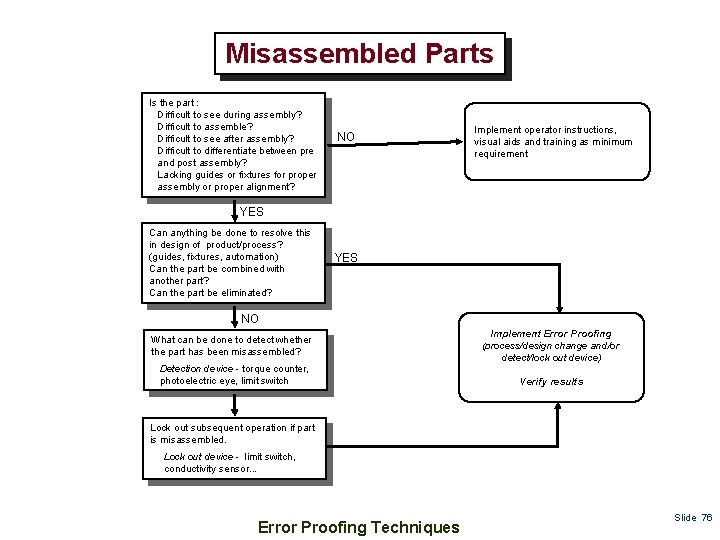
Misassembled Parts Is the part : Difficult to see during assembly? Difficult to assemble? Difficult to see after assembly? Difficult to differentiate between pre and post assembly? Lacking guides or fixtures for proper assembly or proper alignment? NO Implement operator instructions, visual aids and training as minimum requirement YES Can anything be done to resolve this in design of product/process? (guides, fixtures, automation) Can the part be combined with another part? Can the part be eliminated? YES NO What can be done to detect whether the part has been misassembled? Detection device - torque counter, photoelectric eye, limit switch Implement Error Proofing (process/design change and/or detect/lock out device) Verify results Lock out subsequent operation if part is misassembled. Lock out device - limit switch, conductivity sensor. . . Error Proofing Techniques Slide 76
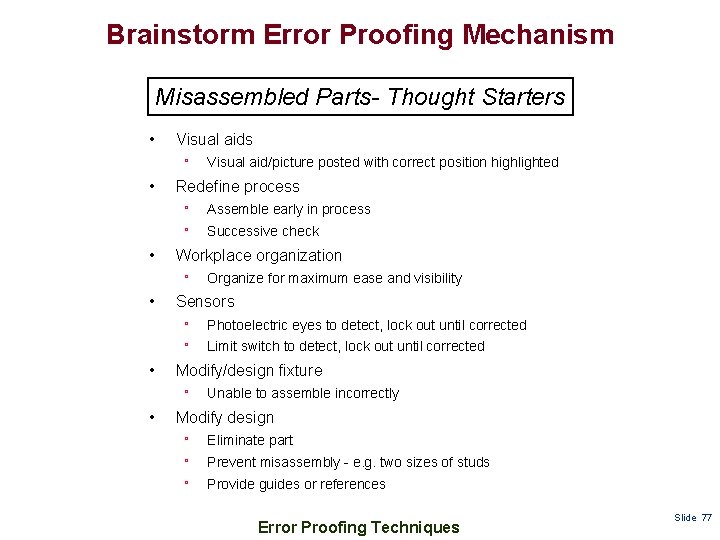
Brainstorm Error Proofing Mechanism Misassembled Parts- Thought Starters • Visual aids ° • • Redefine process ° Assemble early in process ° Successive check Workplace organization ° • • Organize for maximum ease and visibility Sensors ° Photoelectric eyes to detect, lock out until corrected ° Limit switch to detect, lock out until corrected Modify/design fixture ° • Visual aid/picture posted with correct position highlighted Unable to assemble incorrectly Modify design ° Eliminate part ° Prevent misassembly - e. g. two sizes of studs ° Provide guides or references Error Proofing Techniques Slide 77
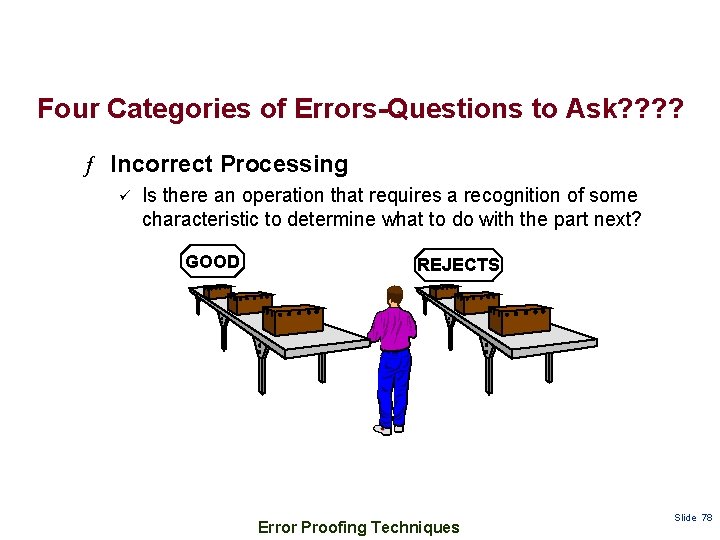
Four Categories of Errors-Questions to Ask? ? ƒ Incorrect Processing ü Is there an operation that requires a recognition of some characteristic to determine what to do with the part next? GOOD REJECTS Error Proofing Techniques Slide 78
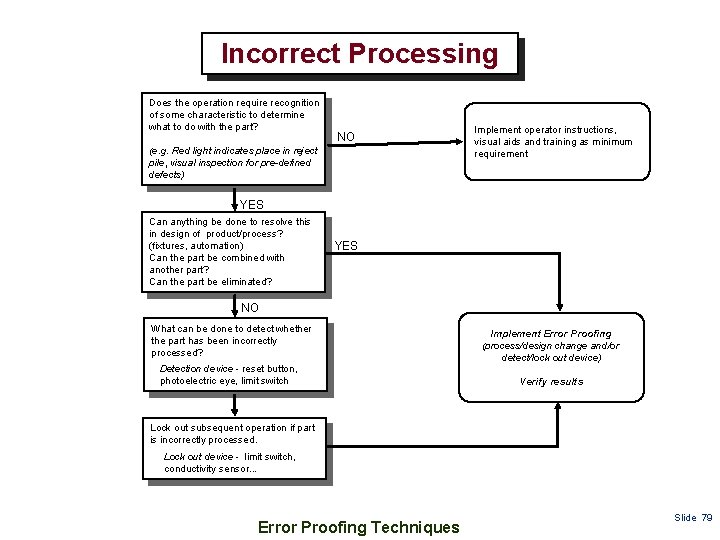
Incorrect Processing Does the operation require recognition of some characteristic to determine what to do with the part? NO (e. g. Red light indicates place in reject pile, visual inspection for pre-defined defects) Implement operator instructions, visual aids and training as minimum requirement YES Can anything be done to resolve this in design of product/process? (fixtures, automation) Can the part be combined with another part? Can the part be eliminated? YES NO What can be done to detect whether the part has been incorrectly processed? Detection device - reset button, photoelectric eye, limit switch Implement Error Proofing (process/design change and/or detect/lock out device) Verify results Lock out subsequent operation if part is incorrectly processed. Lock out device - limit switch, conductivity sensor. . . Error Proofing Techniques Slide 79
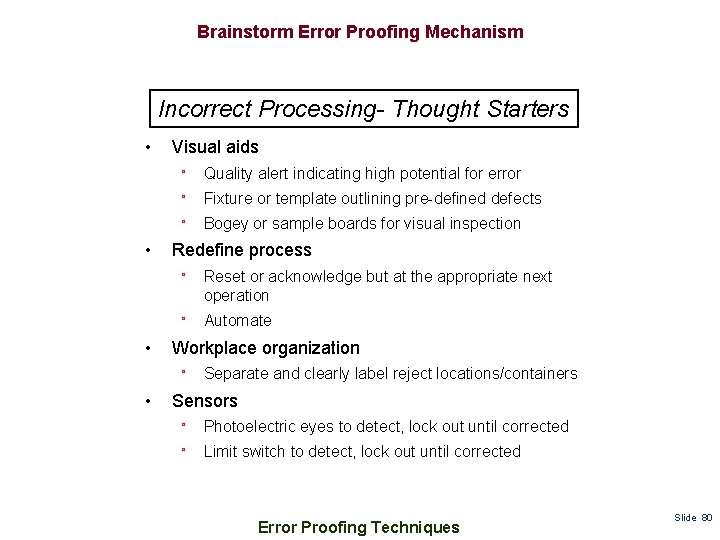
Brainstorm Error Proofing Mechanism Incorrect Processing- Thought Starters • • • Visual aids ° Quality alert indicating high potential for error ° Fixture or template outlining pre-defined defects ° Bogey or sample boards for visual inspection Redefine process ° Reset or acknowledge but at the appropriate next operation ° Automate Workplace organization ° • Separate and clearly label reject locations/containers Sensors ° Photoelectric eyes to detect, lock out until corrected ° Limit switch to detect, lock out until corrected Error Proofing Techniques Slide 80
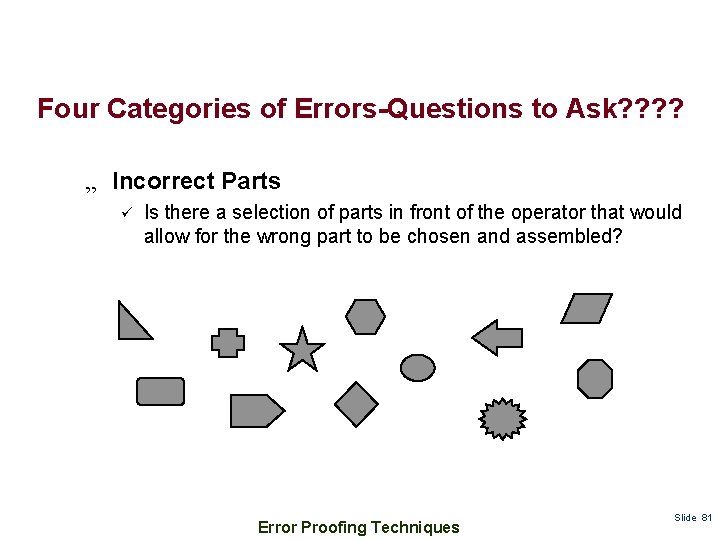
Four Categories of Errors-Questions to Ask? ? „ Incorrect Parts ü Is there a selection of parts in front of the operator that would allow for the wrong part to be chosen and assembled? Error Proofing Techniques Slide 81
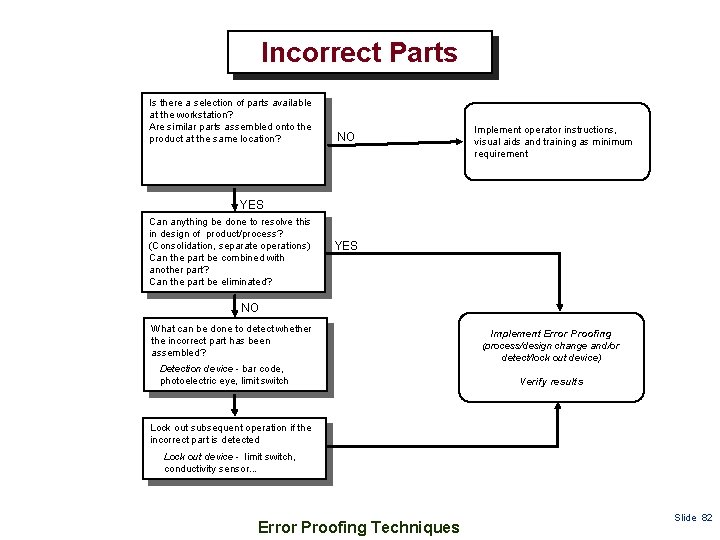
Incorrect Parts Is there a selection of parts available at the workstation? Are similar parts assembled onto the product at the same location? NO Implement operator instructions, visual aids and training as minimum requirement YES Can anything be done to resolve this in design of product/process? (Consolidation, separate operations) Can the part be combined with another part? Can the part be eliminated? YES NO What can be done to detect whether the incorrect part has been assembled? Detection device - bar code, photoelectric eye, limit switch Implement Error Proofing (process/design change and/or detect/lock out device) Verify results Lock out subsequent operation if the incorrect part is detected Lock out device - limit switch, conductivity sensor. . . Error Proofing Techniques Slide 82
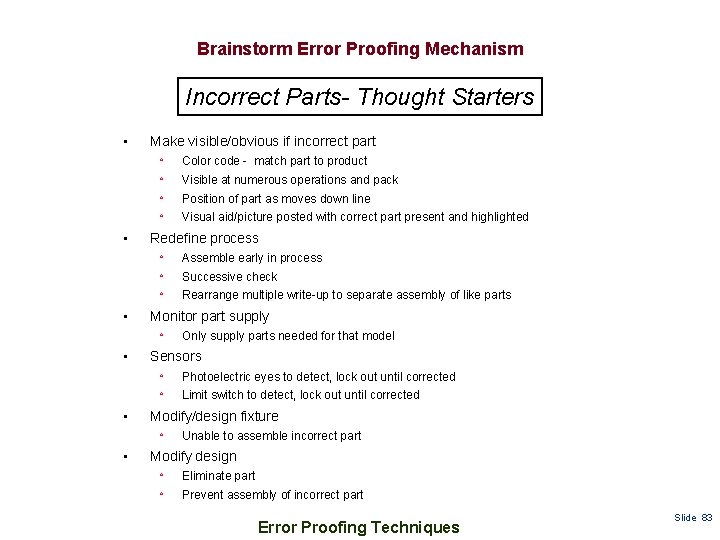
Brainstorm Error Proofing Mechanism Incorrect Parts- Thought Starters • • • Make visible/obvious if incorrect part ° Color code - match part to product ° Visible at numerous operations and pack ° Position of part as moves down line ° Visual aid/picture posted with correct part present and highlighted Redefine process ° Assemble early in process ° Successive check ° Rearrange multiple write-up to separate assembly of like parts Monitor part supply ° • • Sensors ° Photoelectric eyes to detect, lock out until corrected ° Limit switch to detect, lock out until corrected Modify/design fixture ° • Only supply parts needed for that model Unable to assemble incorrect part Modify design ° Eliminate part ° Prevent assembly of incorrect part Error Proofing Techniques Slide 83
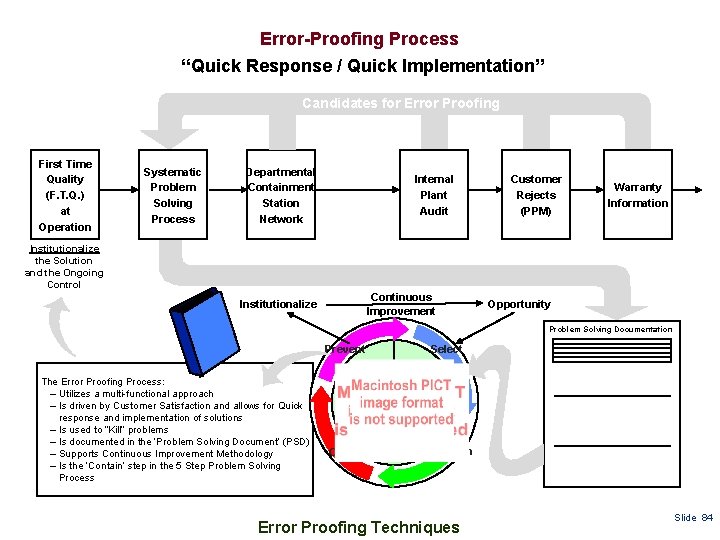
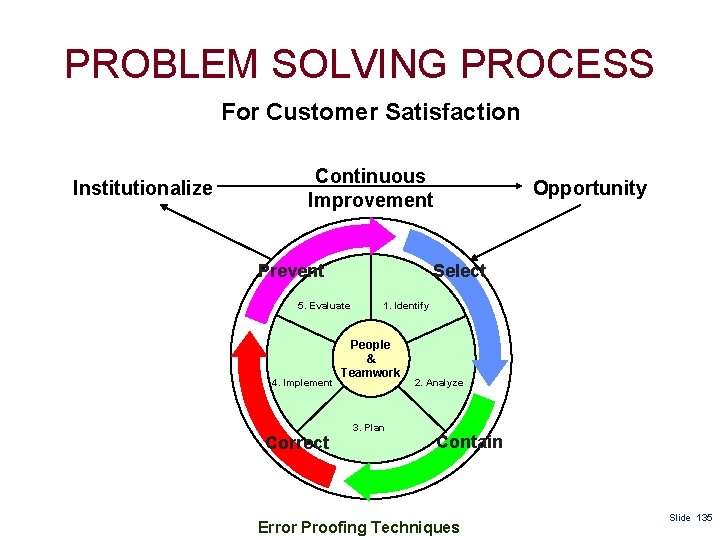
Error-Proofing Process “Quick Response / Quick Implementation” Candidates for Error Proofing First Time Quality (F. T. Q. ) at Operation Systematic Problem Solving Process Departmental Containment Station Network Internal Plant Audit Customer Rejects (PPM) Warranty Information Institutionalize the Solution and the Ongoing Control Continuous Improvement Institutionalize Opportunity Problem Solving Documentation Select Prevent 5. Evaluate The Error Proofing Process: – Utilizes a multi-functional approach – Is driven by Customer Satisfaction and allows for Quick response and implementation of solutions – Is used to “Kill” problems – Is documented in the ‘Problem Solving Document’ (PSD) – Supports Continuous Improvement Methodology – Is the ‘Contain’ step in the 5 Step Problem Solving Process 4. Implement Correct 1. Identify People & Teamwork 3. Plan 2. Analyze Contain Error Proofing Techniques Slide 84
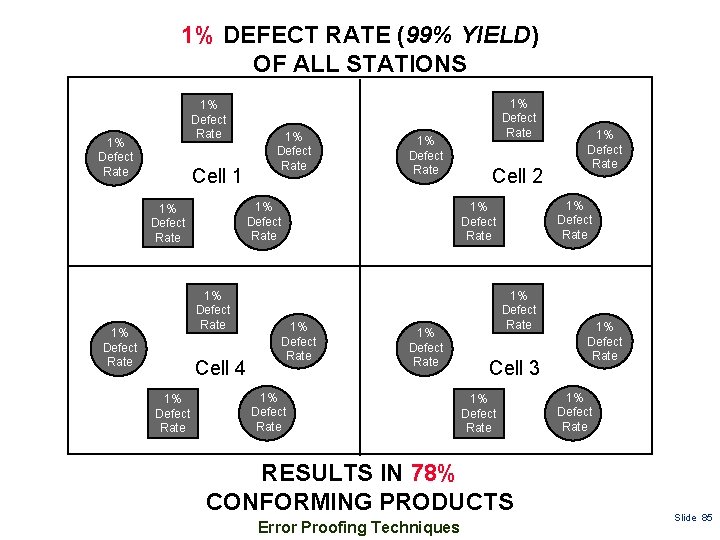
1% DEFECT RATE (99% YIELD) OF ALL STATIONS 1% Defect Rate Cell 1 1% Defect Rate Cell 4 1% Defect Rate 1% Defect Rate Cell 2 1% Defect Rate 1% Defect Rate Cell 3 1% Defect Rate RESULTS IN 78% CONFORMING PRODUCTS Error Proofing Techniques 1% Defect Rate Slide 85
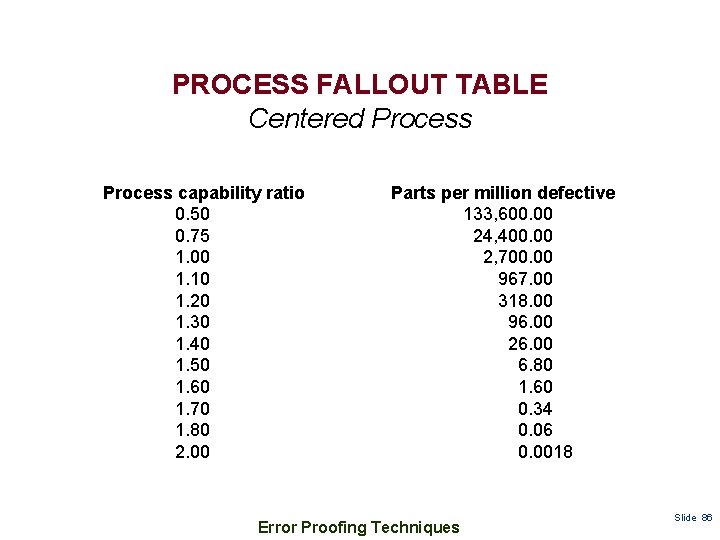
PROCESS FALLOUT TABLE Centered Process capability ratio 0. 50 0. 75 1. 00 1. 10 1. 20 1. 30 1. 40 1. 50 1. 60 1. 70 1. 80 2. 00 Parts per million defective 133, 600. 00 24, 400. 00 2, 700. 00 967. 00 318. 00 96. 00 26. 00 6. 80 1. 60 0. 34 0. 06 0. 0018 Error Proofing Techniques Slide 86
DIDN’T WASH HANDS Error Proofing Techniques Slide 87
ERROR PROOFING Implementation Procedure: • Product Tooling Design Phase ¶ Predict Potential Quality Defects during Product Tooling Design Stage. · Use DFM to modify Tooling Design to Prevent Potential Defects from Occurring in Production based on Potential Defects Identified. · Build Poka-Yoke Devices into the Process where Design “Fixes” can not be Incorporated. Error Proofing Techniques Slide 88
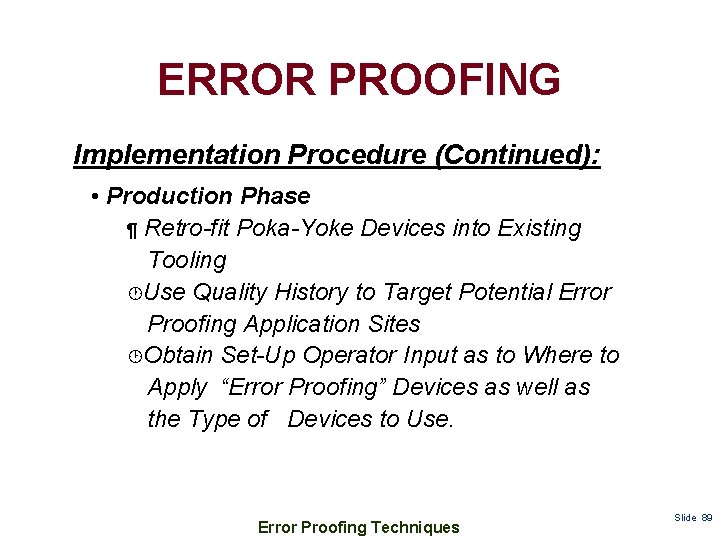
ERROR PROOFING Implementation Procedure (Continued): • Production Phase ¶ Retro-fit Poka-Yoke Devices into Existing Tooling ·Use Quality History to Target Potential Error Proofing Application Sites ¸Obtain Set-Up Operator Input as to Where to Apply “Error Proofing” Devices as well as the Type of Devices to Use. Error Proofing Techniques Slide 89
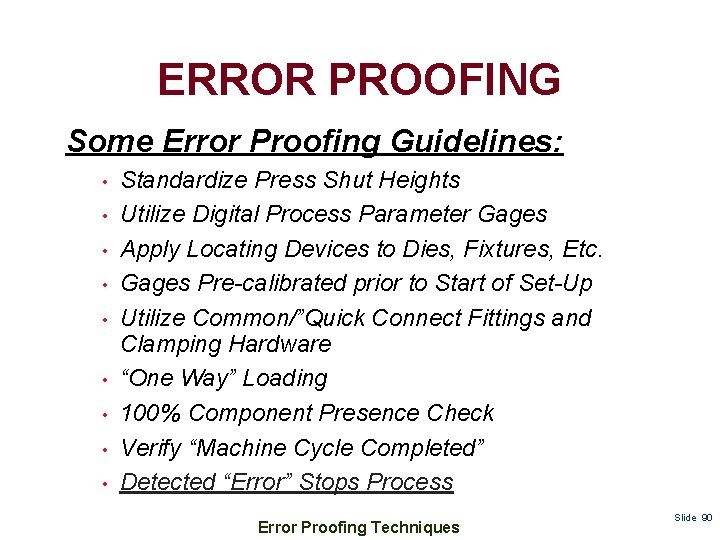
ERROR PROOFING Some Error Proofing Guidelines: • • • Standardize Press Shut Heights Utilize Digital Process Parameter Gages Apply Locating Devices to Dies, Fixtures, Etc. Gages Pre-calibrated prior to Start of Set-Up Utilize Common/”Quick Connect Fittings and Clamping Hardware “One Way” Loading 100% Component Presence Check Verify “Machine Cycle Completed” Detected “Error” Stops Process Error Proofing Techniques Slide 90
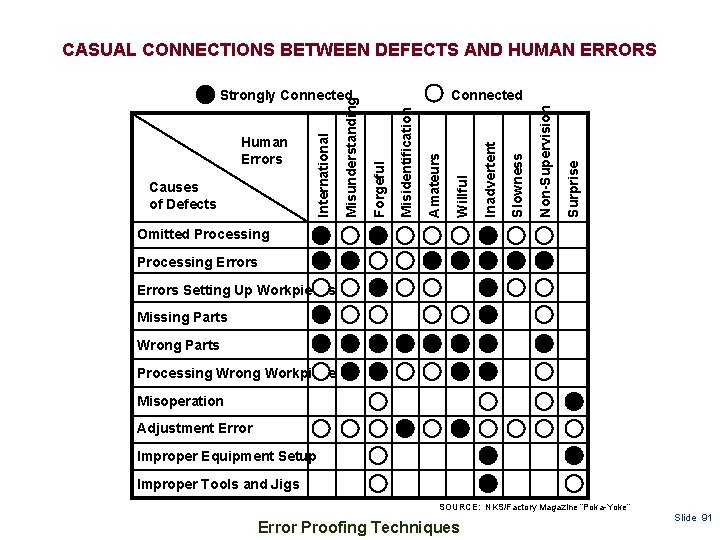
CASUAL CONNECTIONS BETWEEN DEFECTS AND HUMAN ERRORS Surprise Non-Supervision Slowness Inadvertent Willful Amateurs Misidentification Connected Forgeful Causes of Defects Misunderstanding Human Errors International Strongly Connected Omitted Processing Errors Setting Up Workpieces Missing Parts Wrong Parts Processing Wrong Workpiece Misoperation Adjustment Error Improper Equipment Setup Improper Tools and Jigs SOURCE: NKS/Factory Magazine “Poka-Yoke” Error Proofing Techniques Slide 91
ERROR PROOFING TECHNIQUES WORKSHOP OBJECTIVE To improve the PROCESS by helping people prevent ERRORS and increase the chances of DETECTION, so that FAILURE MODE occurrences are ELIMINATED. Error Proofing Techniques Slide 92
Error Proofing Techniques Slide 93
Error Proofing Technique Workshop SUMMARY OF RESULTS DATE OF WORKSHOP: _________ SHORT TERM F/U DATE: ________ LONG TERM F/U DATE: ________ © 1995 Copyright General Motors. All rights reserved. Error Proofing Techniques Slide 94
WHAT IS NECESSARY TO BE SUCCESSFUL? • Management Support • Team Members who: • Are team players • Communicate well • Not afraid to contribute • Are empowered • Have the desire to solve problems • Can make it happen Error Proofing Techniques Slide 95
Error Proofing Techniques TEAM RECOMMENDATION KEY AREAS: • OPERATORS & INSPECTORS FROM STUDY AREA • PROCESS AND DESIGN ENGINEER • QUALITY REPRESENTATIVE • SKILLED TRADES • MANAGEMENT REPRESENTATIVE - MIDDLE TO UPPER LEVELS • MANUFACTURING REPRESENTATIVE OPTIONAL AREAS: • MAINTENANCE REPRESENTATIVE • OTHER TECHNICAL REPRESENTATIVES: • INDUSTRIAL ENGINEER • UNION REPRESENTATIVE Error Proofing Techniques Slide 96
Error Proofing Techniques TEAM MEMBERS DESIRED BACKGROUND KNOWLEDGE AND EXPERIENCE OF THE PROCESS BEING STUDIED. POSSESSING A TEMPERAMENT TO WORK IN TEAMS AND CONTRIBUTE TO TEAM GOALS. WILLING TO MAKE CHANGE AND THINK BEYOND NORMAL PRACTICES. EMPOWERED TO SPEAK FOR ORGANIZATION AND KNOWLEDGEABLE TO WHOM TO REACH FOR CRITICAL DECISIONS OR ANSWERS TO QUESTIONS. INNOVATIVE AND CREATIVE THINKING PROCESS. ABILITY TO REPRESENT AND CONVEY ATTITUDES OF AREA / FUNCTION REPRESENTED. AWARE OF INDUSTRY AND COMPANIES COMPETITIVE SITUATION, AND NEED TO CHANGE. UNDERSTAND ACCEPT THAT THE WORKSHOP PROCESS MAY INVOLVE LONG HOURS. Error Proofing Techniques Slide 97
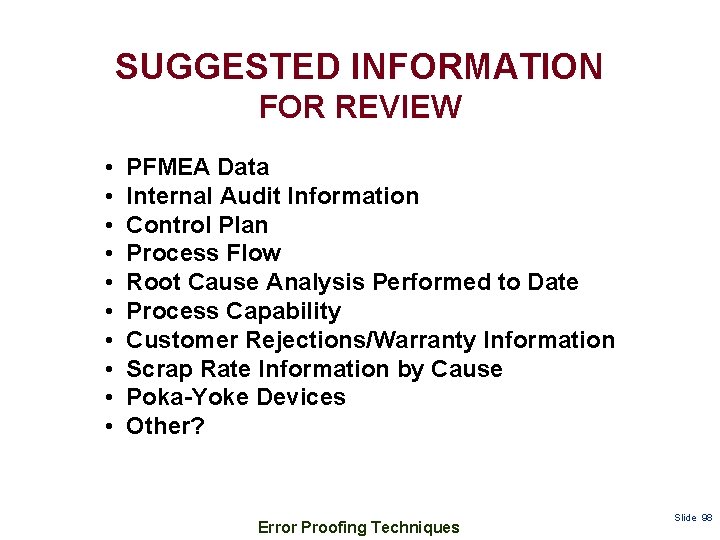
SUGGESTED INFORMATION FOR REVIEW • • • PFMEA Data Internal Audit Information Control Plan Process Flow Root Cause Analysis Performed to Date Process Capability Customer Rejections/Warranty Information Scrap Rate Information by Cause Poka-Yoke Devices Other? Error Proofing Techniques Slide 98
CHECKLIST Page 1 of 2
CHECKLIST Page 2 of 2
ERROR PROOFING TECHNIQUES ATTENDEES NAME COMPANY CURRENT JOB ASSIGNMENT BUSINESS PHONE Error Proofing Techniques Slide 101
Error Proofing Techniques Slide 102
Error Proofing Technique Workshop SUMMARY OF RESULTS DATE OF WORKSHOP: _________ SHORT TERM F/U DATE: ________ LONG TERM F/U DATE: ________ Error Proofing Techniques Slide 103
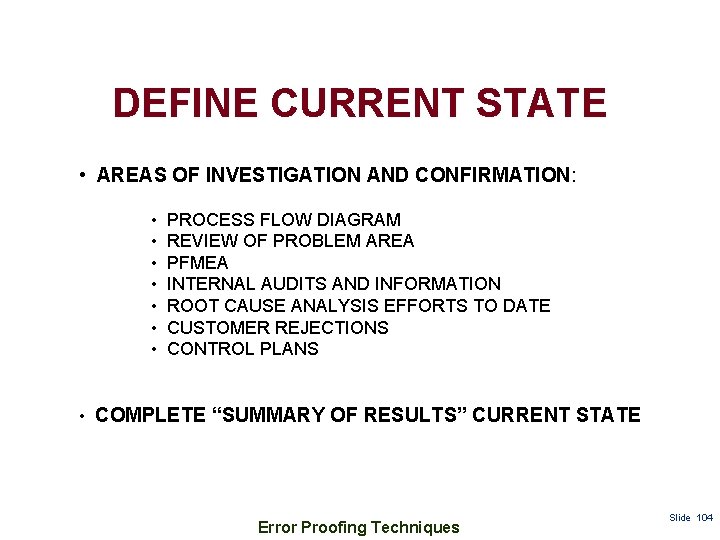
DEFINE CURRENT STATE • AREAS OF INVESTIGATION AND CONFIRMATION: • • PROCESS FLOW DIAGRAM REVIEW OF PROBLEM AREA PFMEA INTERNAL AUDITS AND INFORMATION ROOT CAUSE ANALYSIS EFFORTS TO DATE CUSTOMER REJECTIONS CONTROL PLANS • COMPLETE “SUMMARY OF RESULTS” CURRENT STATE Error Proofing Techniques Slide 104
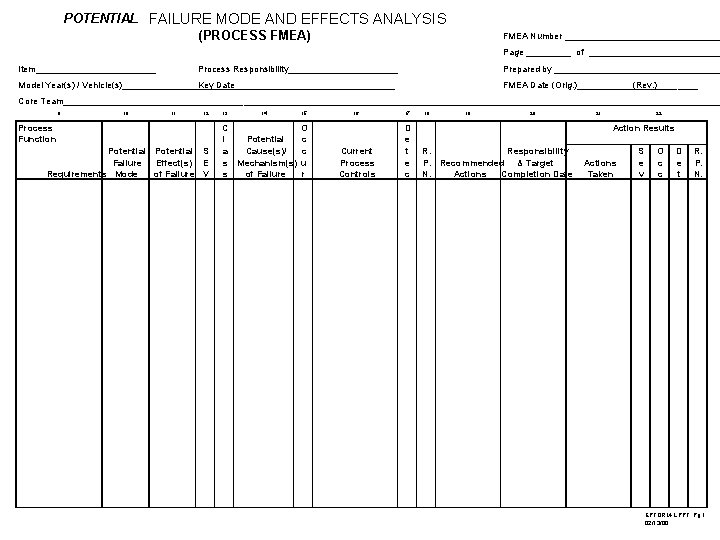
POTENTIAL FAILURE MODE AND EFFECTS ANALYSIS (PROCESS FMEA) FMEA Number ________________ Page _____ of ______________ Item____________ Process Responsibility___________ Prepared by _________________ Model Year(s) / Vehicle(s)____________ Key Date________________ FMEA Date (Orig. )________ (Rev. )____ Core Team__________________________________________________________________ 9 10 11 12 Process Function Potential S Failure Effect(s) E Requirements Mode of Failure V 13 14 15 C O l Potential c a Cause(s)/ c s Mechanism(s) u s of Failure r 16 Current Process Controls 17 D e t e c 18 19 20 21 22 Action Results R. Responsibility P. Recommended & Target N. Actions Completion Date Actions Taken S e v O c c D e t R. P. N. EPFORM-L. PPT Pg. 1 02/13/00
ERROR PROOFING CONTROL PLAN
Error Proofing Techniques SUMMARY OF RESULTS DATE: _____ SHORT TERM F/U DATE: ____ LONG TERM F/U DATE: _____
WHAT IS ERROR PROOFING? HOW AND WHERE DO WE APPLY IT? Error Proofing Techniques Slide 109
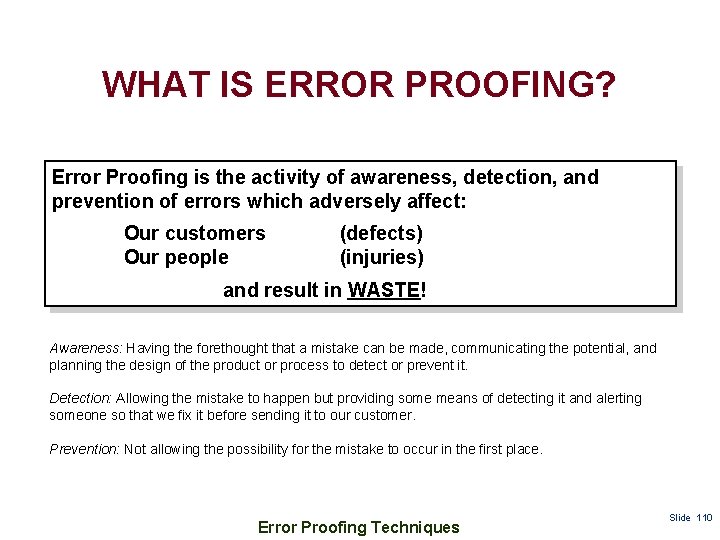
WHAT IS ERROR PROOFING? Error Proofing is the activity of awareness, detection, and prevention of errors which adversely affect: Our customers Our people (defects) (injuries) and result in WASTE! Awareness: Having the forethought that a mistake can be made, communicating the potential, and planning the design of the product or process to detect or prevent it. Detection: Allowing the mistake to happen but providing some means of detecting it and alerting someone so that we fix it before sending it to our customer. Prevention: Not allowing the possibility for the mistake to occur in the first place. Error Proofing Techniques Slide 110
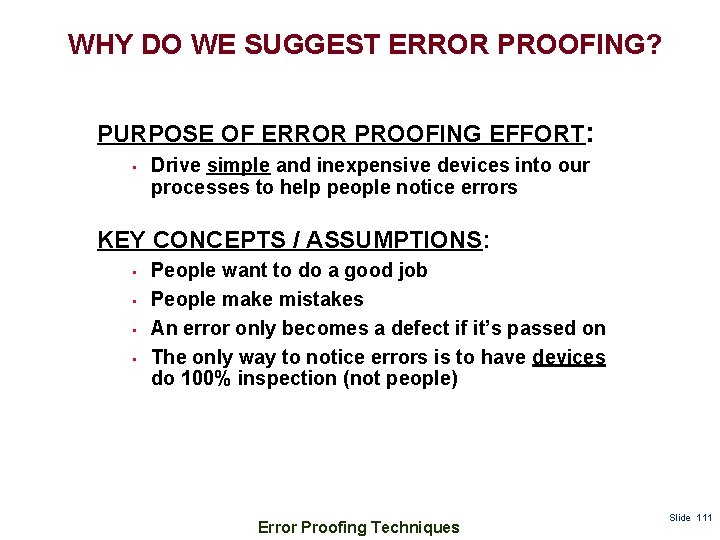
WHY DO WE SUGGEST ERROR PROOFING? PURPOSE OF ERROR PROOFING EFFORT: • Drive simple and inexpensive devices into our processes to help people notice errors KEY CONCEPTS / ASSUMPTIONS: • • People want to do a good job People make mistakes An error only becomes a defect if it’s passed on The only way to notice errors is to have devices do 100% inspection (not people) Error Proofing Techniques Slide 111
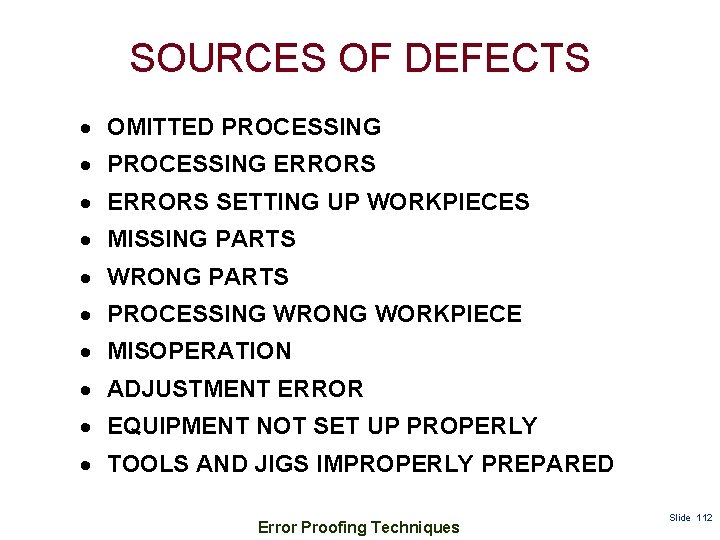
SOURCES OF DEFECTS OMITTED PROCESSING ERRORS SETTING UP WORKPIECES MISSING PARTS WRONG PARTS PROCESSING WRONG WORKPIECE MISOPERATION ADJUSTMENT ERROR EQUIPMENT NOT SET UP PROPERLY TOOLS AND JIGS IMPROPERLY PREPARED Error Proofing Techniques Slide 112
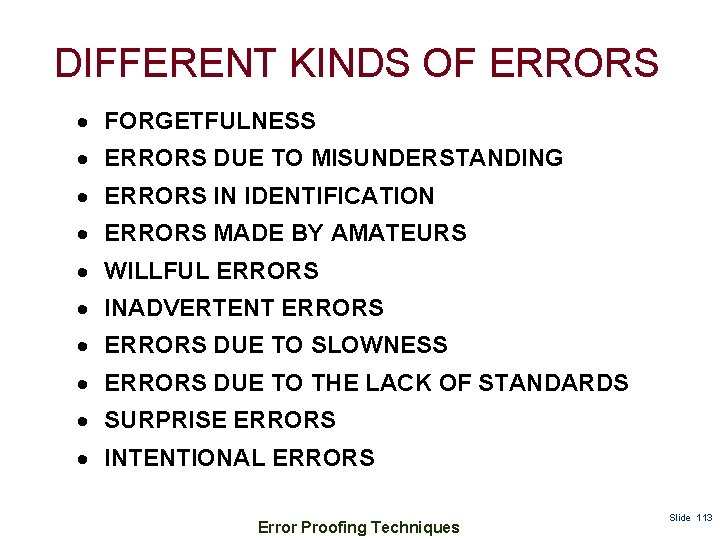
DIFFERENT KINDS OF ERRORS FORGETFULNESS ERRORS DUE TO MISUNDERSTANDING ERRORS IN IDENTIFICATION ERRORS MADE BY AMATEURS WILLFUL ERRORS INADVERTENT ERRORS DUE TO SLOWNESS ERRORS DUE TO THE LACK OF STANDARDS SURPRISE ERRORS INTENTIONAL ERRORS Error Proofing Techniques Slide 113
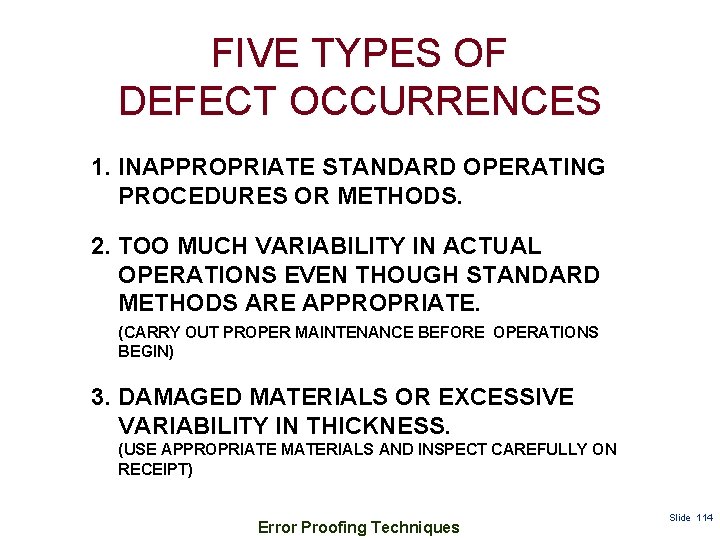
FIVE TYPES OF DEFECT OCCURRENCES 1. INAPPROPRIATE STANDARD OPERATING PROCEDURES OR METHODS. 2. TOO MUCH VARIABILITY IN ACTUAL OPERATIONS EVEN THOUGH STANDARD METHODS ARE APPROPRIATE. (CARRY OUT PROPER MAINTENANCE BEFORE OPERATIONS BEGIN) 3. DAMAGED MATERIALS OR EXCESSIVE VARIABILITY IN THICKNESS. (USE APPROPRIATE MATERIALS AND INSPECT CAREFULLY ON RECEIPT) Error Proofing Techniques Slide 114
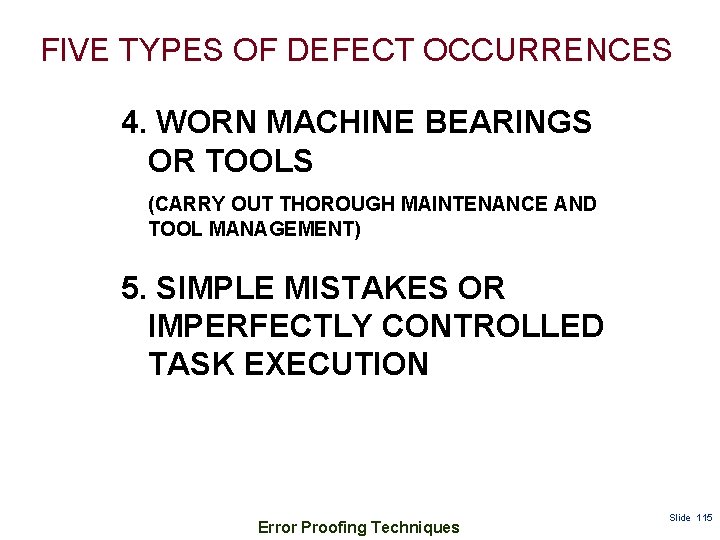
FIVE TYPES OF DEFECT OCCURRENCES 4. WORN MACHINE BEARINGS OR TOOLS (CARRY OUT THOROUGH MAINTENANCE AND TOOL MANAGEMENT) 5. SIMPLE MISTAKES OR IMPERFECTLY CONTROLLED TASK EXECUTION Error Proofing Techniques Slide 115
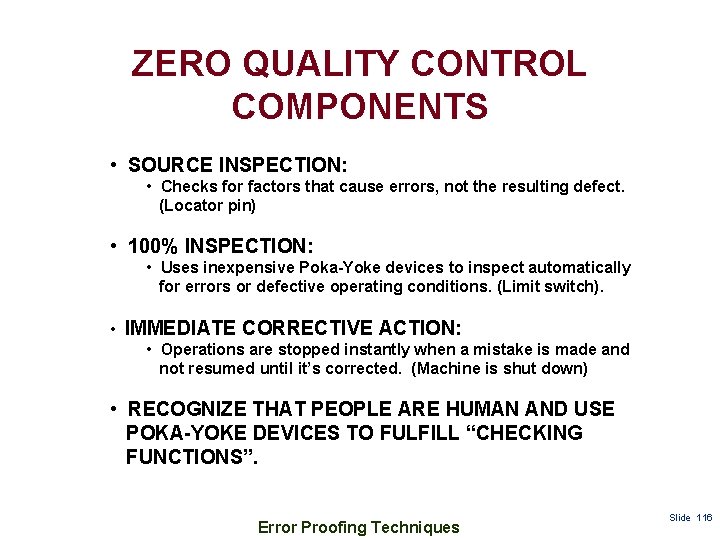
ZERO QUALITY CONTROL COMPONENTS • SOURCE INSPECTION: • Checks for factors that cause errors, not the resulting defect. (Locator pin) • 100% INSPECTION: • Uses inexpensive Poka-Yoke devices to inspect automatically for errors or defective operating conditions. (Limit switch). • IMMEDIATE CORRECTIVE ACTION: • Operations are stopped instantly when a mistake is made and not resumed until it’s corrected. (Machine is shut down) • RECOGNIZE THAT PEOPLE ARE HUMAN AND USE POKA-YOKE DEVICES TO FULFILL “CHECKING FUNCTIONS”. Error Proofing Techniques Slide 116
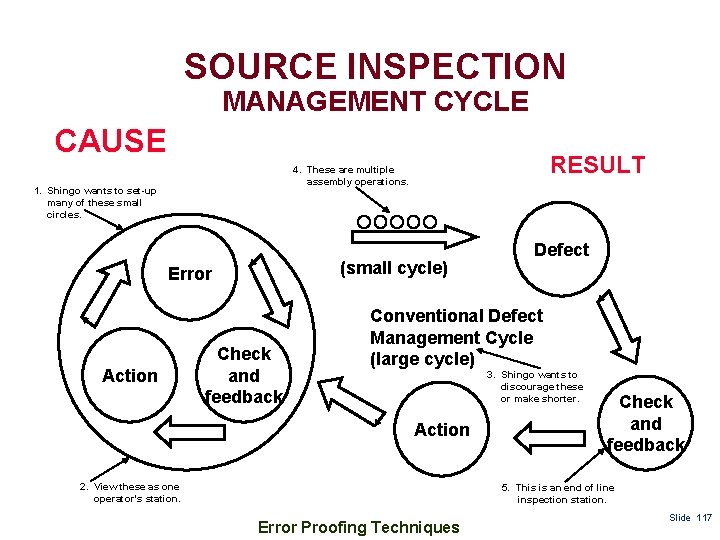
SOURCE INSPECTION MANAGEMENT CYCLE CAUSE RESULT 4. These are multiple assembly operations. 1. Shingo wants to set-up many of these small circles. (small cycle) Error Action Check and feedback Defect Conventional Defect Management Cycle (large cycle) 3. Shingo wants to discourage these or make shorter. Action 2. View these as one operator’s station. Check and feedback 5. This is an end of line inspection station. Error Proofing Techniques Slide 117
ERROR PROOFING Techniques • • Design for Manufacturability “Poka-Yoke” System Devices Error Proofing Techniques Slide 118
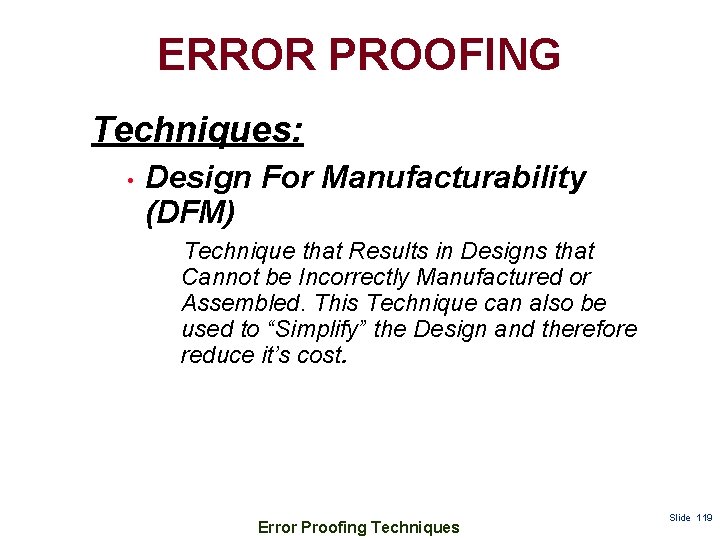
ERROR PROOFING Techniques: • Design For Manufacturability (DFM) Technique that Results in Designs that Cannot be Incorrectly Manufactured or Assembled. This Technique can also be used to “Simplify” the Design and therefore reduce it’s cost. Error Proofing Techniques Slide 119
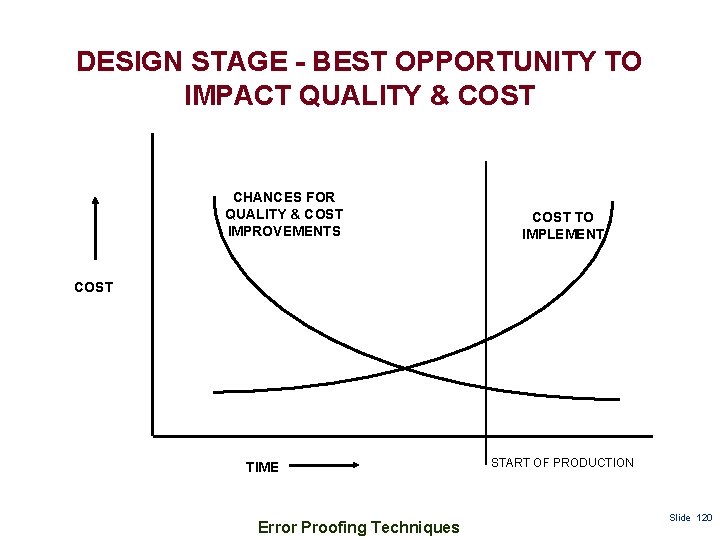
DESIGN STAGE - BEST OPPORTUNITY TO IMPACT QUALITY & COST CHANCES FOR QUALITY & COST IMPROVEMENTS COST TO IMPLEMENT COST TIME Error Proofing Techniques START OF PRODUCTION Slide 120
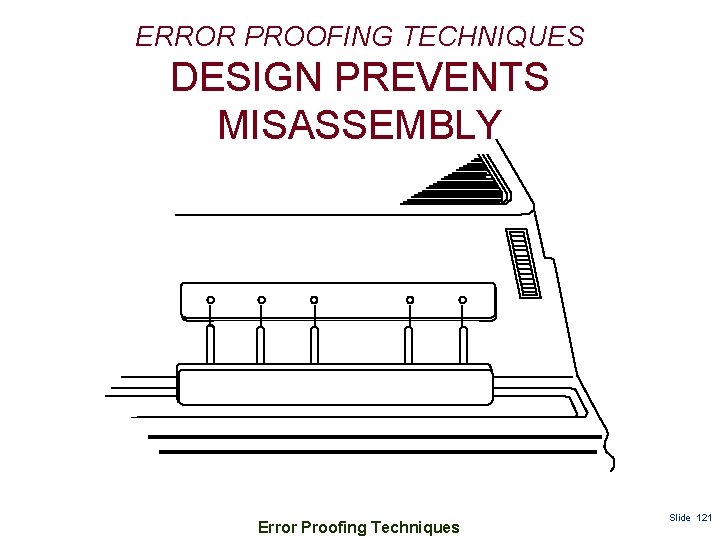
ERROR PROOFING TECHNIQUES DESIGN PREVENTS MISASSEMBLY Error Proofing Techniques Slide 121
ERROR PROOFING Techniques (Continued) • “Poka-Yoke” System* Set-Up Devices or Inspection Techniques that Assure that Set-Up is Done Correctly; i. e. Produces 100% Good Parts from the First Piece on “Zero Quality Control: Source Inspection and the Poka-Yoke System” - Shigeo Shingo; 1986 Error Proofing Techniques Slide 122
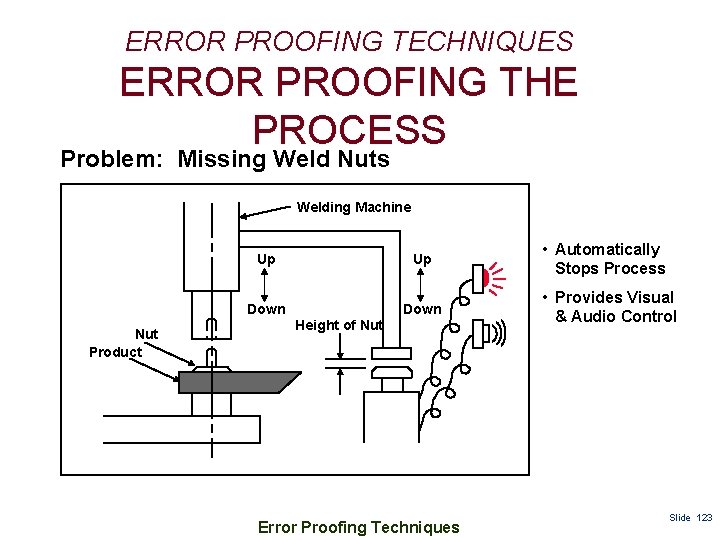
ERROR PROOFING TECHNIQUES ERROR PROOFING THE PROCESS Problem: Missing Weld Nuts Welding Machine Nut Product Up Up Down Height of Nut Error Proofing Techniques • Automatically Stops Process • Provides Visual & Audio Control Slide 123
Effective Error Proofing techniques can reduce or eliminate our dependence on operator knowledge and vigilance, therefore reducing the number of defects we send to our customers!! Error Proofing Techniques Slide 124
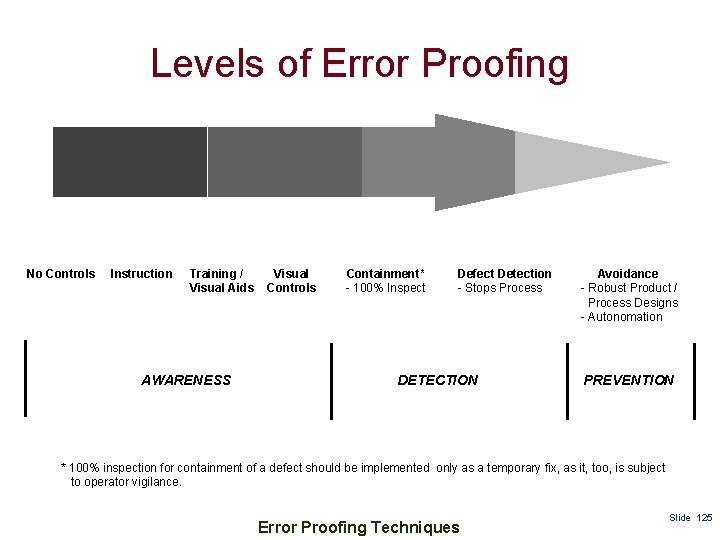
Levels of Error Proofing No Controls Instruction Training / Visual Aids AWARENESS Visual Controls Containment* - 100% Inspect Defect Detection - Stops Process DETECTION Avoidance - Robust Product / Process Designs - Autonomation PREVENTION * 100% inspection for containment of a defect should be implemented only as a temporary fix, as it, too, is subject to operator vigilance. Error Proofing Techniques Slide 125
BASIC FUNCTIONS OF A POKA-YOKE SYSTEM • SHUTDOWN • CONTROL • WARNING Error Proofing Techniques Slide 126
DETECTION DEVICES FOR POKA-YOKE SYSTEMS CONTACT DETECTION DEVICES NON-CONTACT DETECTION DEVICES THAT DETECT PRESSURE, TEMPERATURE, ELECTRIC CURRENT, VIBRATION, CYCLES, TIME, TIMING AND INFORMATION TRANSMISSION Error Proofing Techniques Slide 127
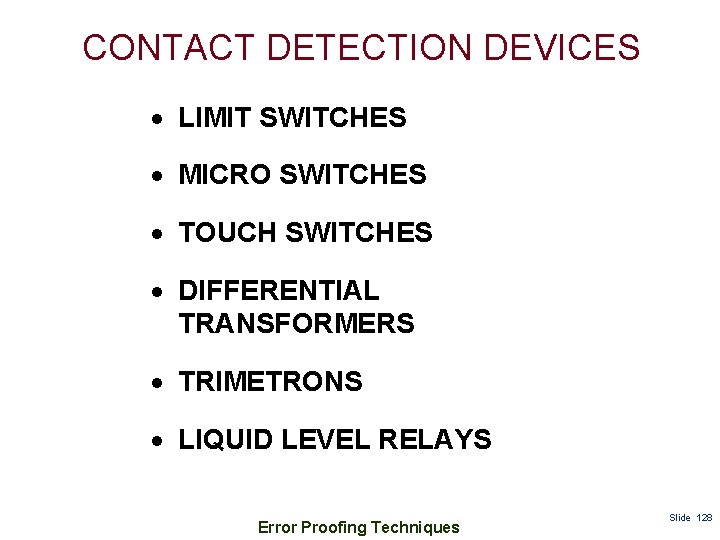
CONTACT DETECTION DEVICES LIMIT SWITCHES MICRO SWITCHES TOUCH SWITCHES DIFFERENTIAL TRANSFORMERS TRIMETRONS LIQUID LEVEL RELAYS Error Proofing Techniques Slide 128
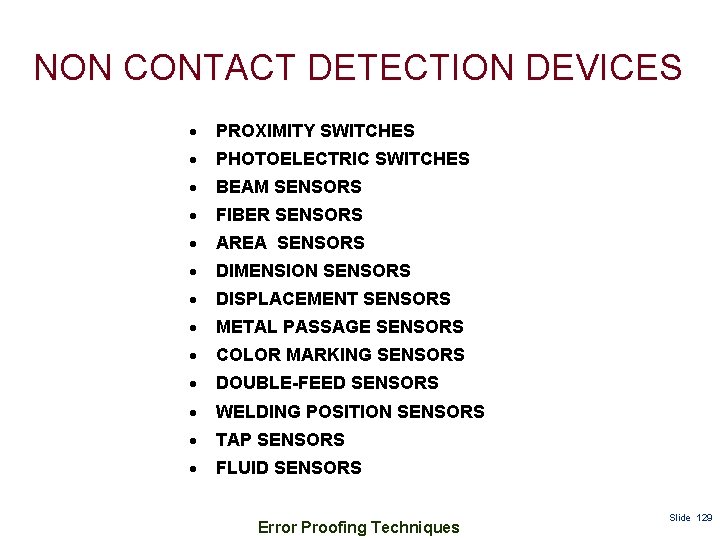
NON CONTACT DETECTION DEVICES PROXIMITY SWITCHES PHOTOELECTRIC SWITCHES BEAM SENSORS FIBER SENSORS AREA SENSORS DIMENSION SENSORS DISPLACEMENT SENSORS METAL PASSAGE SENSORS COLOR MARKING SENSORS DOUBLE-FEED SENSORS WELDING POSITION SENSORS TAP SENSORS FLUID SENSORS Error Proofing Techniques Slide 129
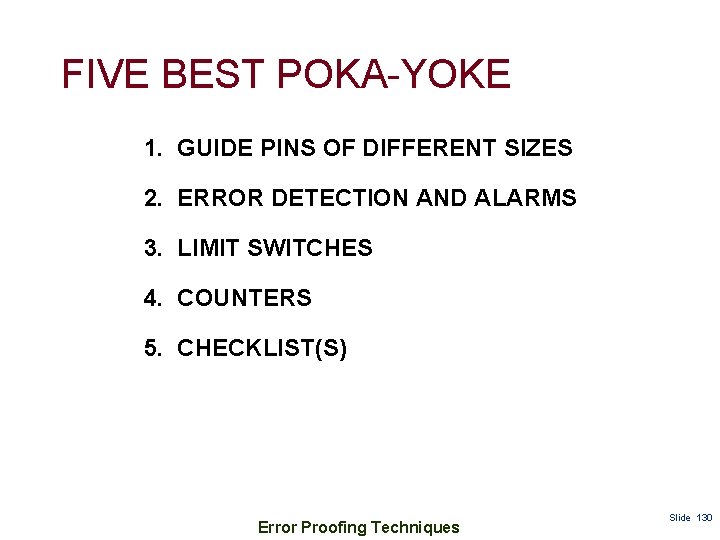
FIVE BEST POKA-YOKE 1. GUIDE PINS OF DIFFERENT SIZES 2. ERROR DETECTION AND ALARMS 3. LIMIT SWITCHES 4. COUNTERS 5. CHECKLIST(S) Error Proofing Techniques Slide 130
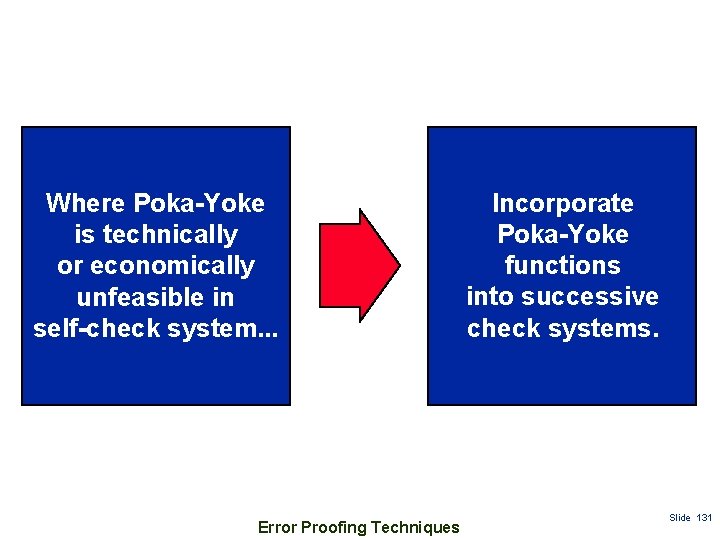
Where Poka-Yoke is technically or economically unfeasible in self-check system. . . Error Proofing Techniques Incorporate Poka-Yoke functions into successive check systems. Slide 131
EXAMPLES OF ERRORS AT WORK. . . • Missing Parts ° Forgetting to assemble a part - screws, labels, orifice tubes. . . • Misassembled Parts ° Misassembly - loose parts, upside down, not aligned e. g. - brackets (backwards), seals (not aligned), screws (loose), labels (upside down), . . . • Incorrect Processing ° Disposing of a part rejected at test to the wrong pile • Incorrect Parts ° Retrieving and assembling the wrong part from a model mix selection seals, labels, brackets, cases. . . Error Proofing Techniques Slide 132
PROBLEM STATEMENT = LOST Error Proofing Techniques Slide 133
WHAT IS THE ROOT CAUSE? ? Error Proofing Techniques Slide 134
PROBLEM SOLVING PROCESS For Customer Satisfaction Institutionalize Continuous Improvement Select Prevent 5. Evaluate 4. Implement Correct Opportunity 1. Identify People & Teamwork 3. Plan 2. Analyze Contain Error Proofing Techniques Slide 135
IDENTIFY Identify Error Proofing Opportunities • PFMEA • Quality Data, PR/R, Warranty Data. . . • Brainstorm (Questions to Ask, Free Form. . . ) Prioritize Opportunities (RPN, Pareto. . . ) HOW Determine Level of Error Proofing ANALYZE TO Brainstorm Error Proofing Mechanisms • Build on past experience • Can use more than one mechanism Select Error Proofing Mechanism • Most cost effective • Simple ERROR PLAN PROOF IMPLEMENT Plan (Process Mechanisms) • Action plan • Error Proofing Control Plan (EPCP) Implement Error Proofing Mechanism • Installation • Validation • EPCP • Check sheet/Log • Operator Instructions EVALUATE Error Proofing Techniques Evaluate Results Slide 136
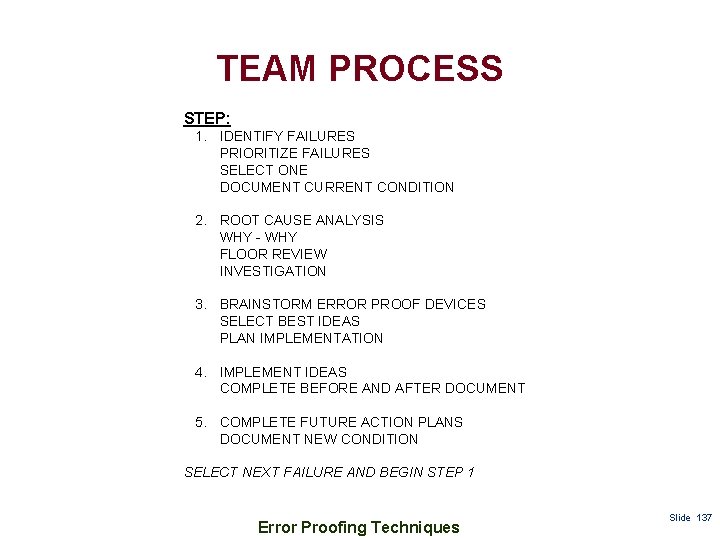
TEAM PROCESS STEP: 1. IDENTIFY FAILURES PRIORITIZE FAILURES SELECT ONE DOCUMENT CURRENT CONDITION 2. ROOT CAUSE ANALYSIS WHY - WHY FLOOR REVIEW INVESTIGATION 3. BRAINSTORM ERROR PROOF DEVICES SELECT BEST IDEAS PLAN IMPLEMENTATION 4. IMPLEMENT IDEAS COMPLETE BEFORE AND AFTER DOCUMENT 5. COMPLETE FUTURE ACTION PLANS DOCUMENT NEW CONDITION SELECT NEXT FAILURE AND BEGIN STEP 1 Error Proofing Techniques Slide 137
TOOLS FOR ANALYSIS Flow Chart Fishbone Diagram Pareto Chart Problem Histogram Problem 5 Why’s Run Chart Why Why Why Root Cause Scatter Plot Control Chart Error Proofing Techniques Pictograph Slide 138
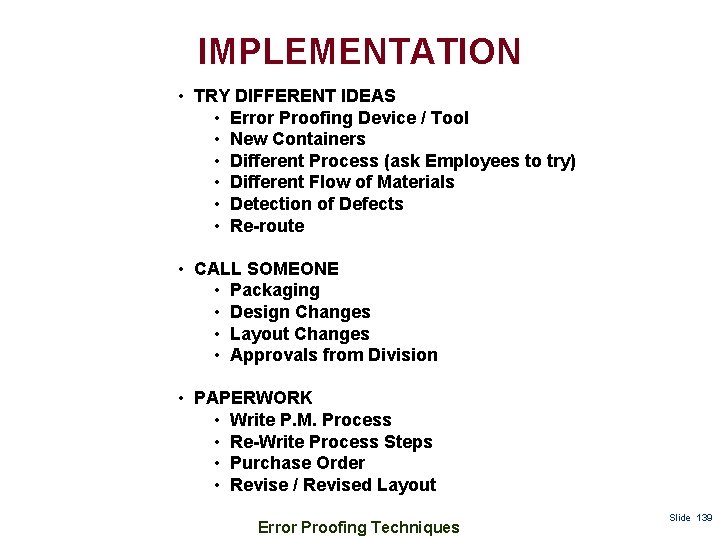
IMPLEMENTATION • TRY DIFFERENT IDEAS • Error Proofing Device / Tool • New Containers • Different Process (ask Employees to try) • Different Flow of Materials • Detection of Defects • Re-route • CALL SOMEONE • Packaging • Design Changes • Layout Changes • Approvals from Division • PAPERWORK • Write P. M. Process • Re-Write Process Steps • Purchase Order • Revise / Revised Layout Error Proofing Techniques Slide 139
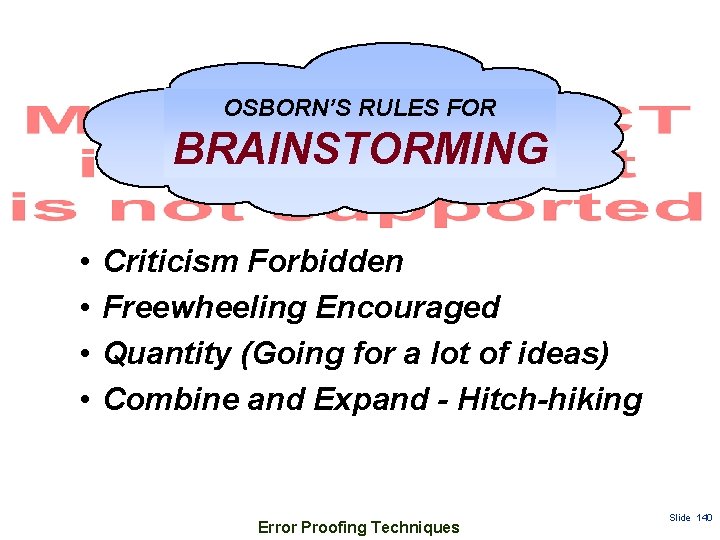
OSBORN’S RULES FOR BRAINSTORMING • • Criticism Forbidden Freewheeling Encouraged Quantity (Going for a lot of ideas) Combine and Expand - Hitch-hiking Error Proofing Techniques Slide 140