
Error Diffusion Halftoning Methods for Printing and Display
![Enhancements III: Clustered Dot Error Diffusion • Feedback output to quantizer input [Levien, 1993]](https://slidetodoc.com/presentation_image/50602b782c5008a1a41c639fdc6472ef/image-19.jpg "Enhancements III: Clustered Dot Error Diffusion • Feedback output to quantizer input [Levien, 1993]")
![Color Error Diffusion Evaluating Linear Vision Models [Monga, Geisler & Evans, 2003] • Objective](https://slidetodoc.com/presentation_image/50602b782c5008a1a41c639fdc6472ef/image-31.jpg "Color Error Diffusion Evaluating Linear Vision Models [Monga, Geisler & Evans, 2003] • Objective")
![Analysis and Modeling Visual Quality Measures [Kite, Evans & Bovik, 2000] • Sharpening: proportional](https://slidetodoc.com/presentation_image/50602b782c5008a1a41c639fdc6472ef/image-39.jpg "Analysis and Modeling Visual Quality Measures [Kite, Evans & Bovik, 2000] • Sharpening: proportional")
![Color Error Diffusion Spatial Filtering • Opponent [Wandell, Zhang 1997] – Data in each](https://slidetodoc.com/presentation_image/50602b782c5008a1a41c639fdc6472ef/image-52.jpg "Color Error Diffusion Spatial Filtering • Opponent [Wandell, Zhang 1997] – Data in each")
![Color Error Diffusion Spatial Filtering Chrominance Frequency Response [Kolpatzik and Bouman – 1992] Using](https://slidetodoc.com/presentation_image/50602b782c5008a1a41c639fdc6472ef/image-54.jpg "Color Error Diffusion Spatial Filtering Chrominance Frequency Response [Kolpatzik and Bouman – 1992] Using")
![Color Error Diffusion Spatial Filtering • Opponent [Wandell, Zhang 1997] Data in each plane](https://slidetodoc.com/presentation_image/50602b782c5008a1a41c639fdc6472ef/image-57.jpg "Color Error Diffusion Spatial Filtering • Opponent [Wandell, Zhang 1997] Data in each plane")
- Slides: 59
Error Diffusion Halftoning Methods for Printing and Display Prof. Brian L. Evans Embedded Signal Processing Laboratory The University of Texas at Austin, TX 78712 -1084 USA http: : //www. ece. utexas. edu/~bevans Ph. D. Graduates: Dr. Niranjan Damera-Venkata (HP Labs) Dr. Thomas D. Kite (Audio Precision) Ph. D. Student: Mr. Vishal Monga (Intern, Xerox Labs) Other Collaborators: Prof. Alan C. Bovik (UT Austin) Prof. Wilson S. Geisler (UT Austin) August 20, 2003
Prof. Brian L. Evans bevans@ece. utexas. edu http: //www. ece. utexas. edu/~bevans magnitude channel carrier http: //signal. ece. utexas. edu ADSL/VDSL Transceiver Design Ph. D. graduates: Güner Arslan (Silicon Labs) Biao Lu (Schlumberger) Milosevic (Schlumberger) Ph. D. students: Dogu Arifler Ming Ding Wireless Communications Ph. D. graduates: Murat Torlak (UT Dallas) Ph. D. students: Kyungtae Han Zukang Shen MS graduates: Srikanth K. Gummadi (TI) Amey A. Deosthali (TI) MS students: Ian Wong Wireless Networking and Comm. Group: http: //www. wncg. org Real-Time Imaging Ph. D. graduates: Thomas D. Kite (Audio Precision) Niranjan Damera-Venkata (HP Labs) Ph. D. students: Gregory E. Allen (UT App. Res. Labs) Serene Banerjee Vishal Monga MS graduates: Young Cho (UCLA) Image Analysis Ph. D. graduates: Dong Wei (SBC Research) K. Clint Slatton (Univ. of Florida) Wade C. Schwartzkopf Center for Perceptual Systems: http: //www. cps. utexas. edu
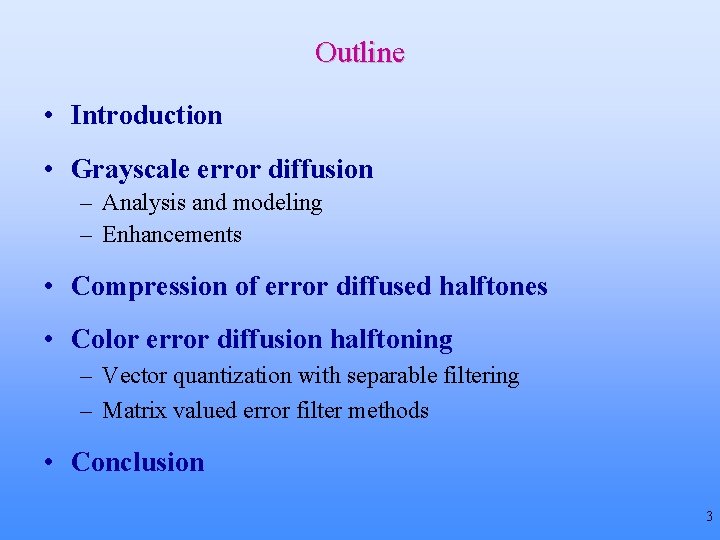
Outline • Introduction • Grayscale error diffusion – Analysis and modeling – Enhancements • Compression of error diffused halftones • Color error diffusion halftoning – Vector quantization with separable filtering – Matrix valued error filter methods • Conclusion 3
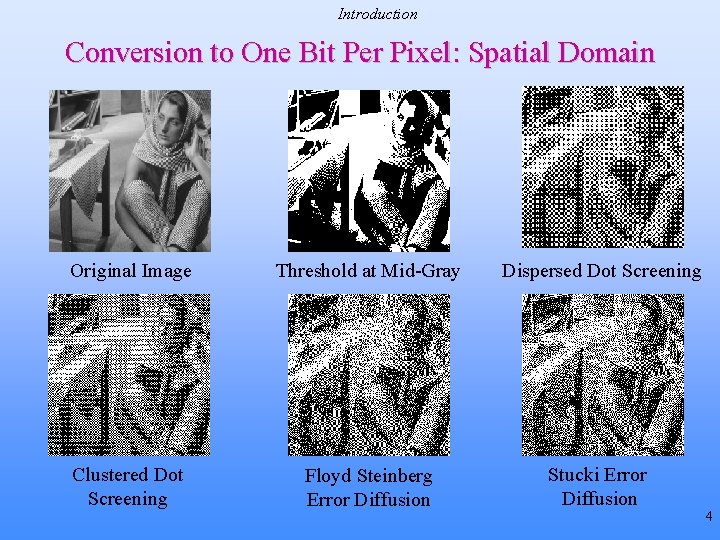
Introduction Conversion to One Bit Per Pixel: Spatial Domain Original Image Threshold at Mid-Gray Dispersed Dot Screening Clustered Dot Screening Floyd Steinberg Error Diffusion Stucki Error Diffusion 4
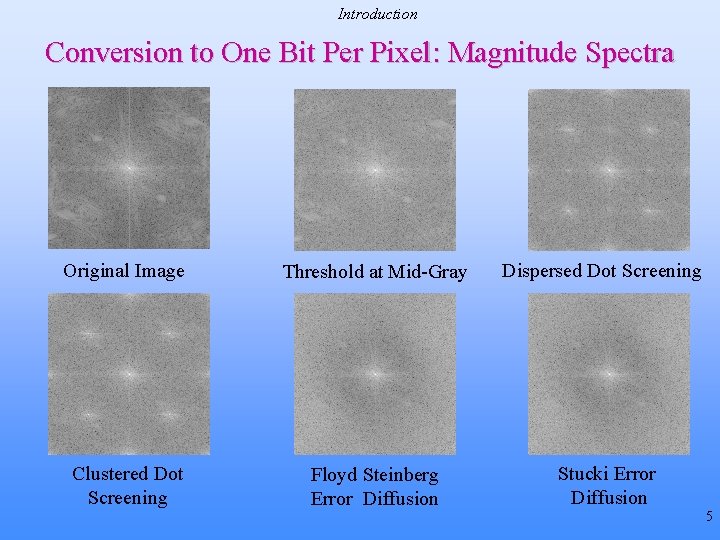
Introduction Conversion to One Bit Per Pixel: Magnitude Spectra Original Image Threshold at Mid-Gray Clustered Dot Screening Floyd Steinberg Error Diffusion Dispersed Dot Screening Stucki Error Diffusion 5
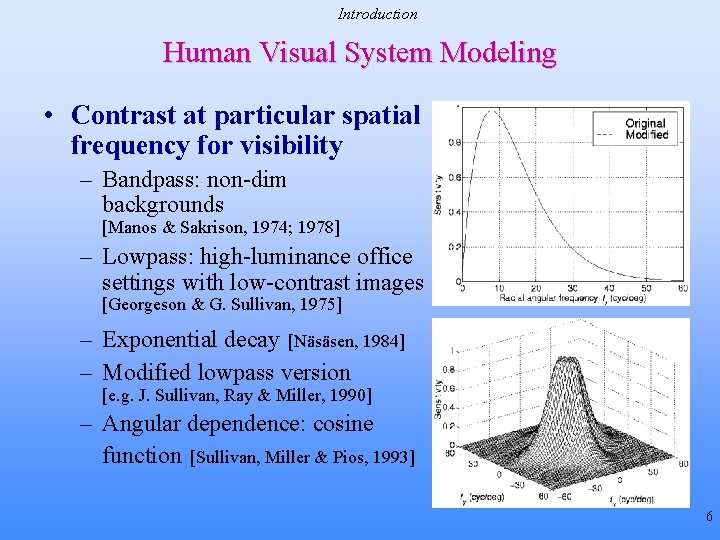
Introduction Human Visual System Modeling • Contrast at particular spatial frequency for visibility – Bandpass: non-dim backgrounds [Manos & Sakrison, 1974; 1978] – Lowpass: high-luminance office settings with low-contrast images [Georgeson & G. Sullivan, 1975] – Exponential decay [Näsäsen, 1984] – Modified lowpass version [e. g. J. Sullivan, Ray & Miller, 1990] – Angular dependence: cosine function [Sullivan, Miller & Pios, 1993] 6
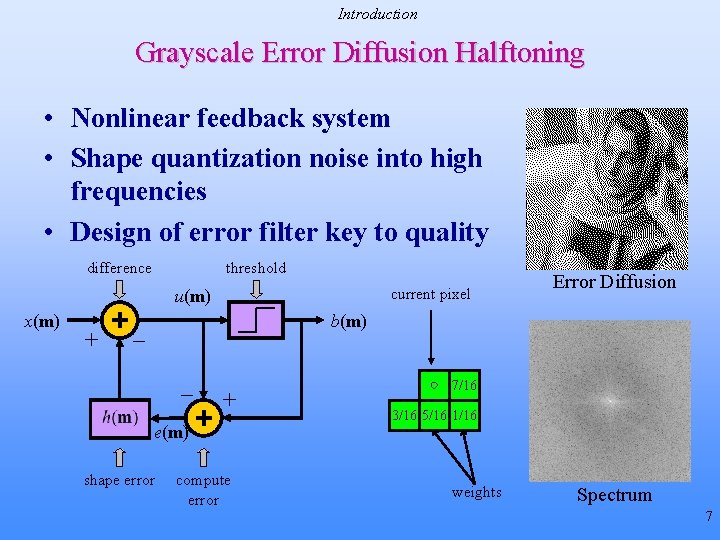
Introduction Grayscale Error Diffusion Halftoning • Nonlinear feedback system • Shape quantization noise into high frequencies • Design of error filter key to quality difference threshold current pixel u(m) x(m) + Error Diffusion b(m) _ _ + e(m) shape error compute error 7/16 3/16 5/16 1/16 weights Spectrum 7
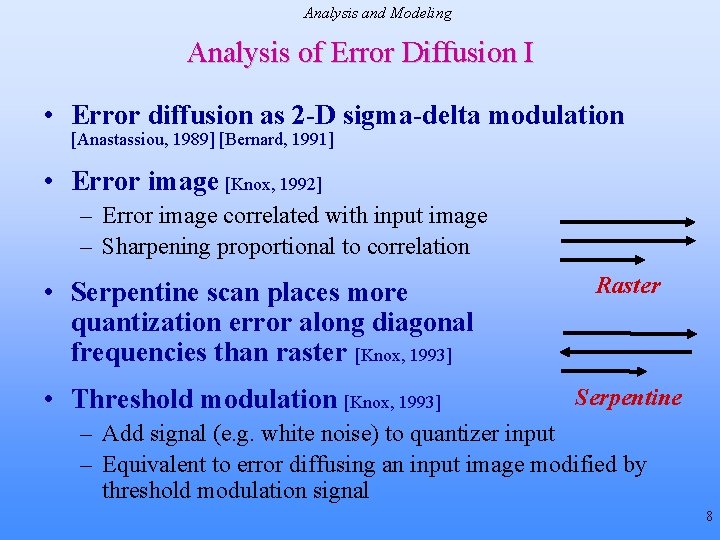
Analysis and Modeling Analysis of Error Diffusion I • Error diffusion as 2 -D sigma-delta modulation [Anastassiou, 1989] [Bernard, 1991] • Error image [Knox, 1992] – Error image correlated with input image – Sharpening proportional to correlation • Serpentine scan places more quantization error along diagonal frequencies than raster [Knox, 1993] • Threshold modulation [Knox, 1993] Raster Serpentine – Add signal (e. g. white noise) to quantizer input – Equivalent to error diffusing an input image modified by threshold modulation signal 8
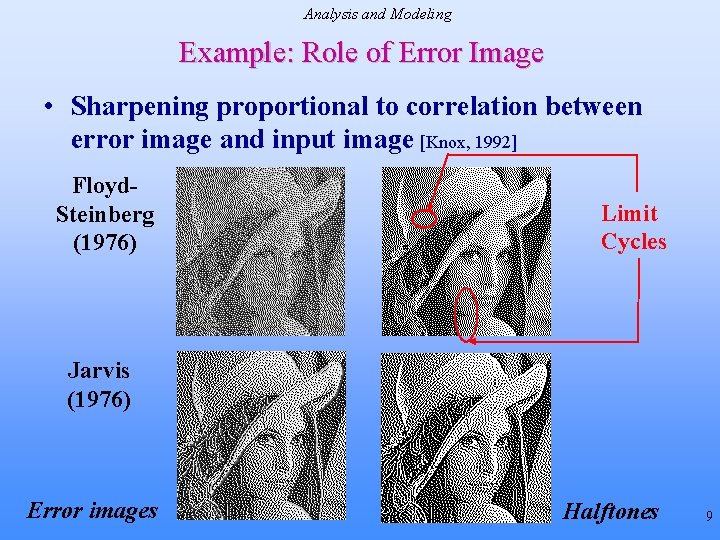
Analysis and Modeling Example: Role of Error Image • Sharpening proportional to correlation between error image and input image [Knox, 1992] Floyd. Steinberg (1976) Limit Cycles Jarvis (1976) Error images Halftones 9
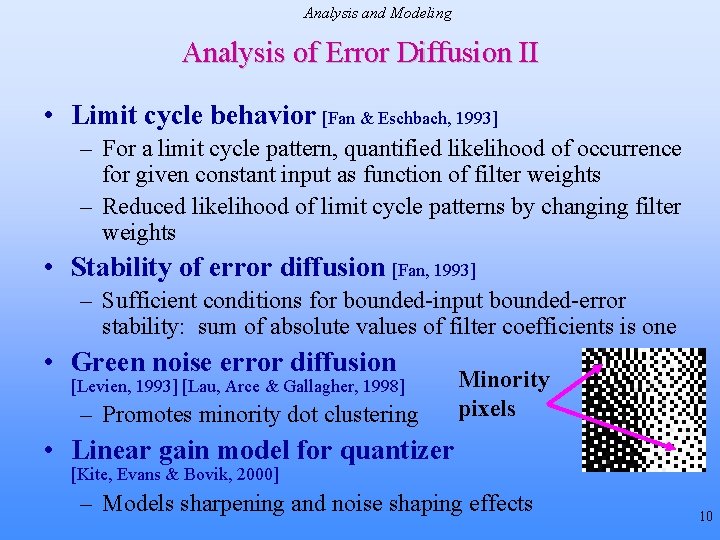
Analysis and Modeling Analysis of Error Diffusion II • Limit cycle behavior [Fan & Eschbach, 1993] – For a limit cycle pattern, quantified likelihood of occurrence for given constant input as function of filter weights – Reduced likelihood of limit cycle patterns by changing filter weights • Stability of error diffusion [Fan, 1993] – Sufficient conditions for bounded-input bounded-error stability: sum of absolute values of filter coefficients is one • Green noise error diffusion [Levien, 1993] [Lau, Arce & Gallagher, 1998] – Promotes minority dot clustering Minority pixels • Linear gain model for quantizer [Kite, Evans & Bovik, 2000] – Models sharpening and noise shaping effects 10
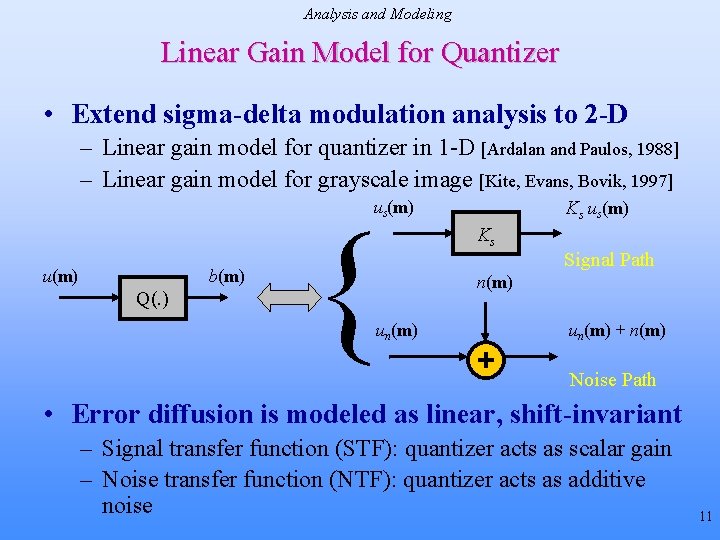
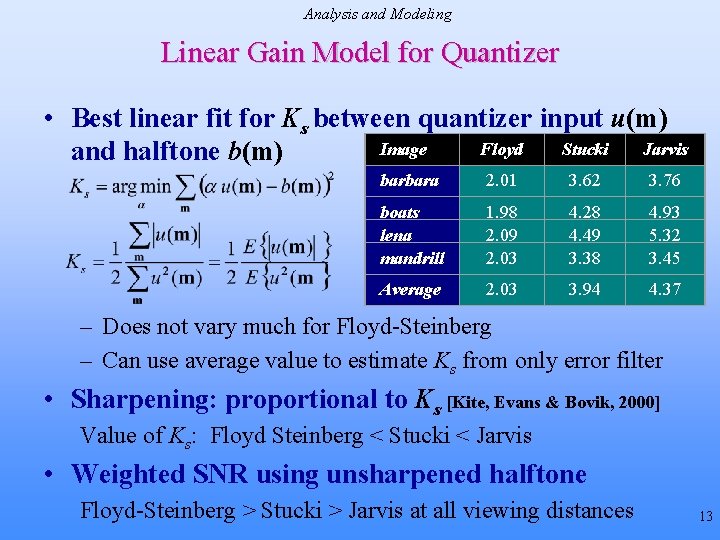
Analysis and Modeling Linear Gain Model for Quantizer • Extend sigma-delta modulation analysis to 2 -D – Linear gain model for quantizer in 1 -D [Ardalan and Paulos, 1988] – Linear gain model for grayscale image [Kite, Evans, Bovik, 1997] Ks us(m) u(m) b(m) Q(. ) { un(m) Ks Signal Path n(m) un(m) + n(m) Noise Path • Error diffusion is modeled as linear, shift-invariant – Signal transfer function (STF): quantizer acts as scalar gain – Noise transfer function (NTF): quantizer acts as additive noise 11
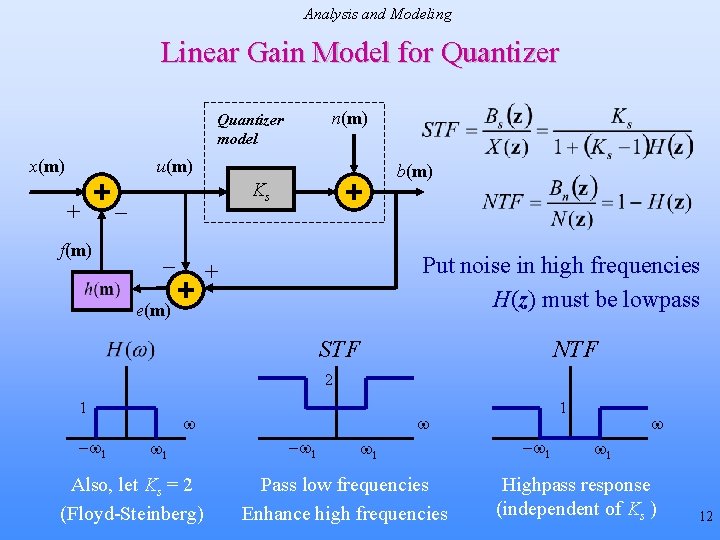
Analysis and Modeling Linear Gain Model for Quantizer n(m) Quantizer model x(m) u(m) + f(m) b(m) Ks _ _ Put noise in high frequencies H(z) must be lowpass + e(m) STF NTF 2 1 -w 1 w w 1 Also, let Ks = 2 (Floyd-Steinberg) 1 w -w 1 Pass low frequencies Enhance high frequencies -w 1 w w 1 Highpass response (independent of Ks ) 12
Analysis and Modeling Linear Gain Model for Quantizer • Best linear fit for Ks between quantizer input u(m) Image Floyd Stucki Jarvis and halftone b(m) barbara 2. 01 3. 62 3. 76 boats lena mandrill 1. 98 2. 09 2. 03 4. 28 4. 49 3. 38 4. 93 5. 32 3. 45 Average 2. 03 3. 94 4. 37 – Does not vary much for Floyd-Steinberg – Can use average value to estimate Ks from only error filter • Sharpening: proportional to Ks [Kite, Evans & Bovik, 2000] Value of Ks: Floyd Steinberg < Stucki < Jarvis • Weighted SNR using unsharpened halftone Floyd-Steinberg > Stucki > Jarvis at all viewing distances 13
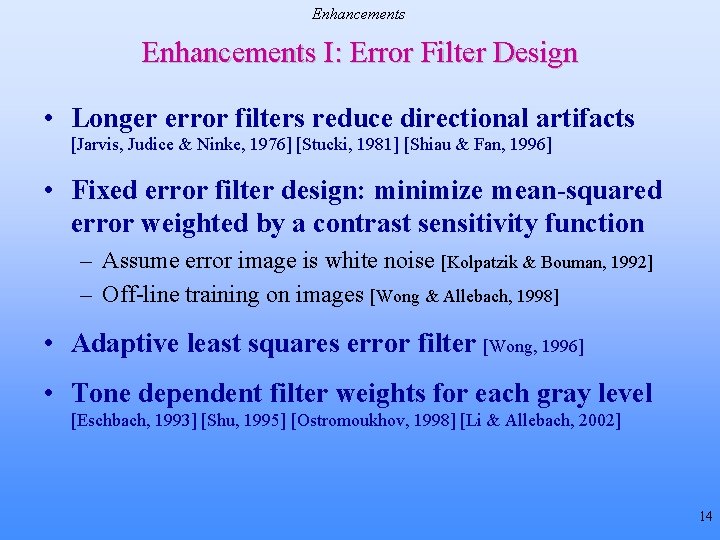
Enhancements I: Error Filter Design • Longer error filters reduce directional artifacts [Jarvis, Judice & Ninke, 1976] [Stucki, 1981] [Shiau & Fan, 1996] • Fixed error filter design: minimize mean-squared error weighted by a contrast sensitivity function – Assume error image is white noise [Kolpatzik & Bouman, 1992] – Off-line training on images [Wong & Allebach, 1998] • Adaptive least squares error filter [Wong, 1996] • Tone dependent filter weights for each gray level [Eschbach, 1993] [Shu, 1995] [Ostromoukhov, 1998] [Li & Allebach, 2002] 14
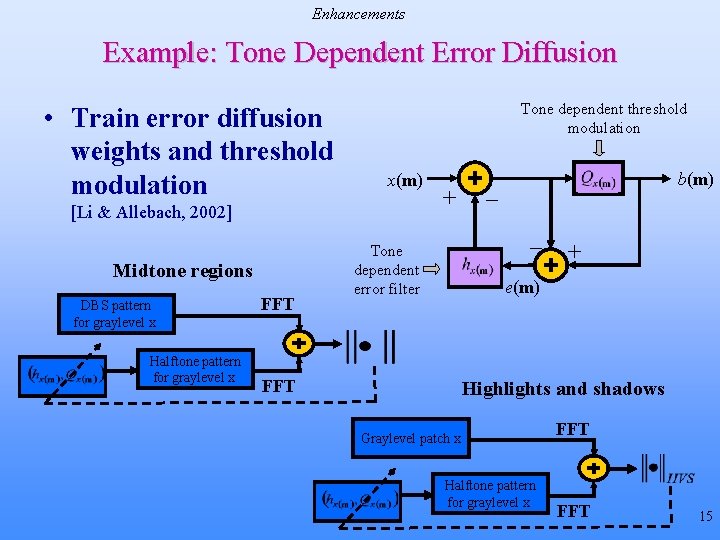
Enhancements Example: Tone Dependent Error Diffusion • Train error diffusion weights and threshold modulation Tone dependent threshold modulation x(m) [Li & Allebach, 2002] Midtone regions DBS pattern for graylevel x Halftone pattern for graylevel x FFT + b(m) _ _ Tone dependent error filter + e(m) FFT Highlights and shadows Graylevel patch x Halftone pattern for graylevel x FFT 15
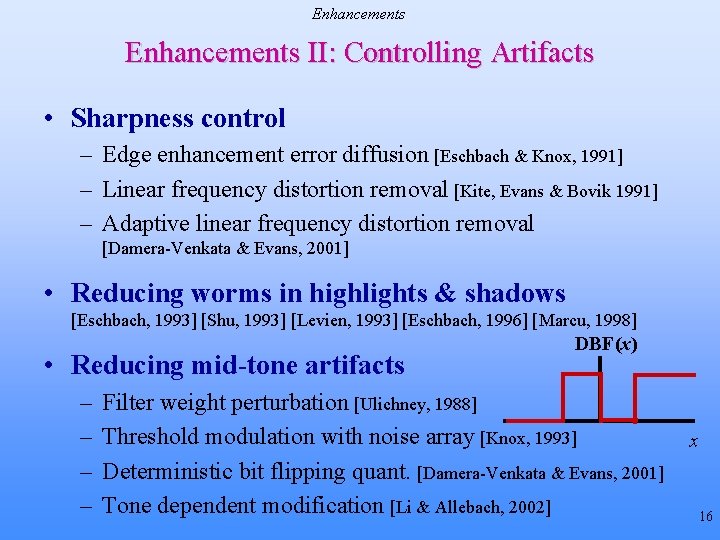
Enhancements II: Controlling Artifacts • Sharpness control – Edge enhancement error diffusion [Eschbach & Knox, 1991] – Linear frequency distortion removal [Kite, Evans & Bovik 1991] – Adaptive linear frequency distortion removal [Damera-Venkata & Evans, 2001] • Reducing worms in highlights & shadows [Eschbach, 1993] [Shu, 1993] [Levien, 1993] [Eschbach, 1996] [Marcu, 1998] • Reducing mid-tone artifacts – – DBF(x) Filter weight perturbation [Ulichney, 1988] Threshold modulation with noise array [Knox, 1993] Deterministic bit flipping quant. [Damera-Venkata & Evans, 2001] Tone dependent modification [Li & Allebach, 2002] x 16
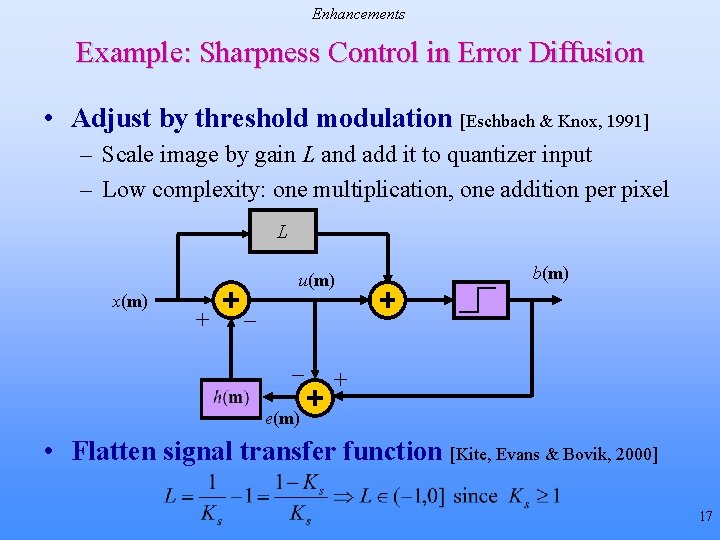
Enhancements Example: Sharpness Control in Error Diffusion • Adjust by threshold modulation [Eschbach & Knox, 1991] – Scale image by gain L and add it to quantizer input – Low complexity: one multiplication, one addition per pixel L u(m) x(m) + b(m) _ _ + e(m) • Flatten signal transfer function [Kite, Evans & Bovik, 2000] 17
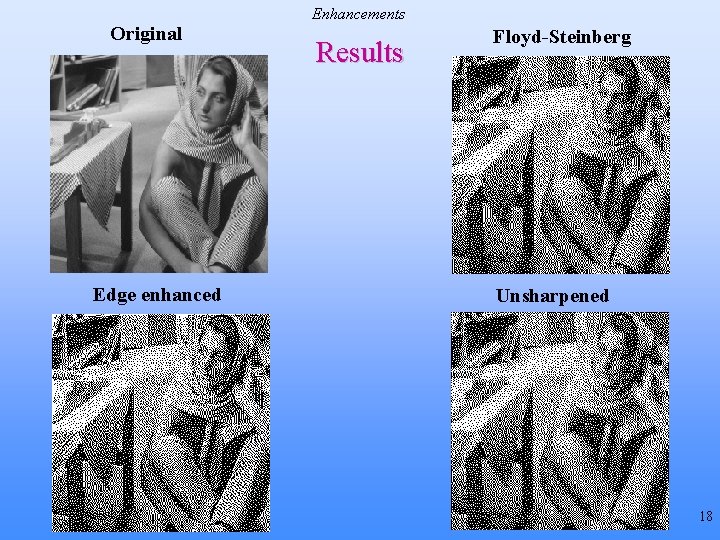
Original Edge enhanced Enhancements Results Floyd-Steinberg Unsharpened 18
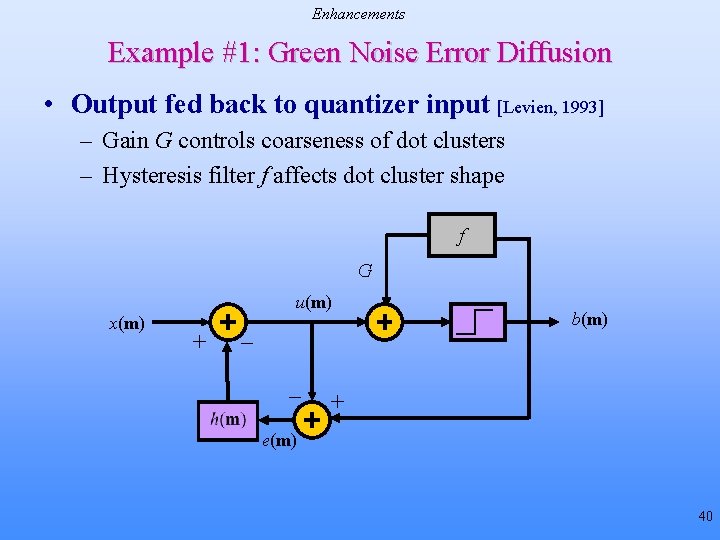
Enhancements III: Clustered Dot Error Diffusion • Feedback output to quantizer input [Levien, 1993] • Dot to dot error diffusion [Fan, 1993] – Apply clustered dot screen on block and diffuse error – Reduces contouring • Clustered minority pixel diffusion [Li & Allebach, 2000] • Block error diffusion [Damera-Venkata & Evans, 2001] • Clustered dot error diffusion using laser pulse width modulation [He & Bouman, 2002] – Simultaneous optimization of dot density and dot size – Minimize distortion based on tone reproduction curve 19
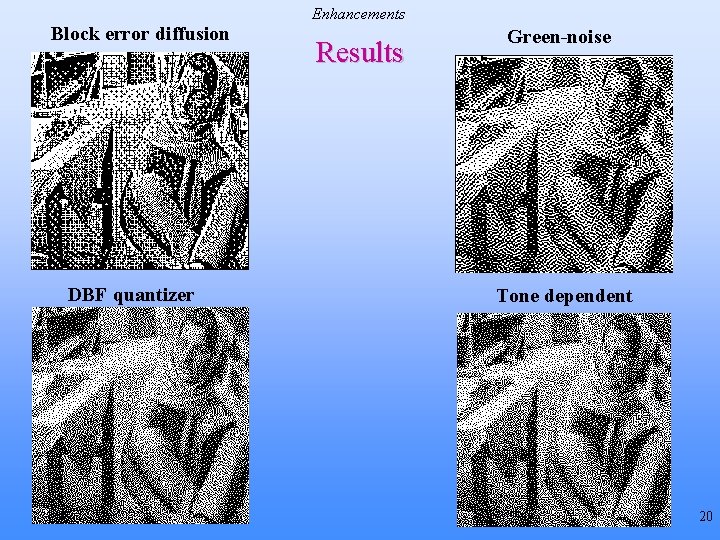
Block error diffusion DBF quantizer Enhancements Results Green-noise Tone dependent 20
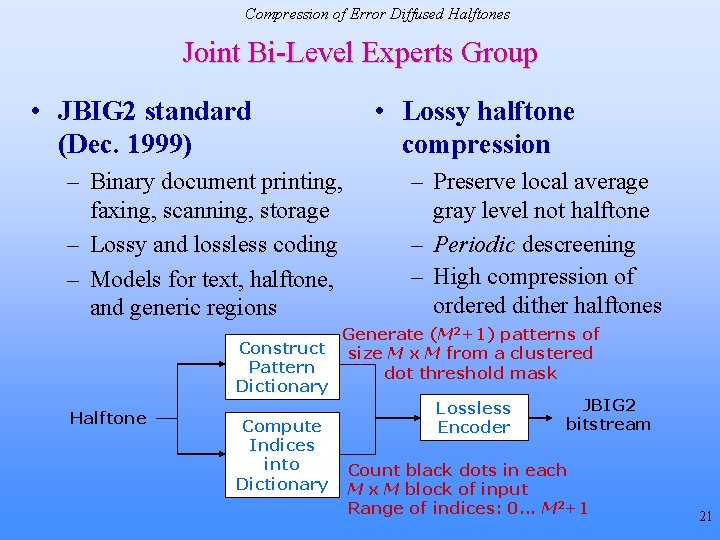
Compression of Error Diffused Halftones Joint Bi-Level Experts Group • JBIG 2 standard (Dec. 1999) • Lossy halftone compression – Binary document printing, faxing, scanning, storage – Lossy and lossless coding – Models for text, halftone, and generic regions Construct Pattern Dictionary Halftone Compute Indices into Dictionary – Preserve local average gray level not halftone – Periodic descreening – High compression of ordered dither halftones Generate (M 2+1) patterns of size M x M from a clustered dot threshold mask Lossless Encoder JBIG 2 bitstream Count black dots in each M x M block of input Range of indices: 0. . . M 2+1 21
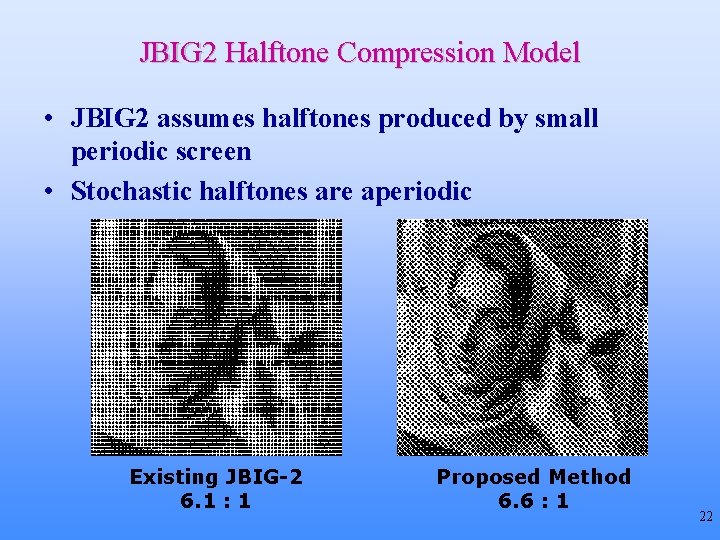
JBIG 2 Halftone Compression Model • JBIG 2 assumes halftones produced by small periodic screen • Stochastic halftones are aperiodic Existing JBIG-2 6. 1 : 1 Proposed Method 6. 6 : 1 22
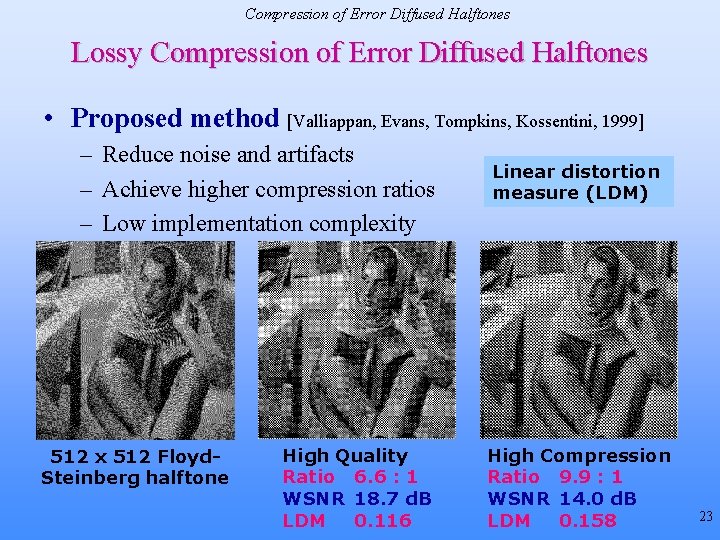
Compression of Error Diffused Halftones Lossy Compression of Error Diffused Halftones • Proposed method [Valliappan, Evans, Tompkins, Kossentini, 1999] – Reduce noise and artifacts – Achieve higher compression ratios – Low implementation complexity 512 x 512 Floyd. Steinberg halftone High Quality Ratio 6. 6 : 1 WSNR 18. 7 d. B LDM 0. 116 Linear distortion measure (LDM) High Compression Ratio 9. 9 : 1 WSNR 14. 0 d. B LDM 0. 158 23
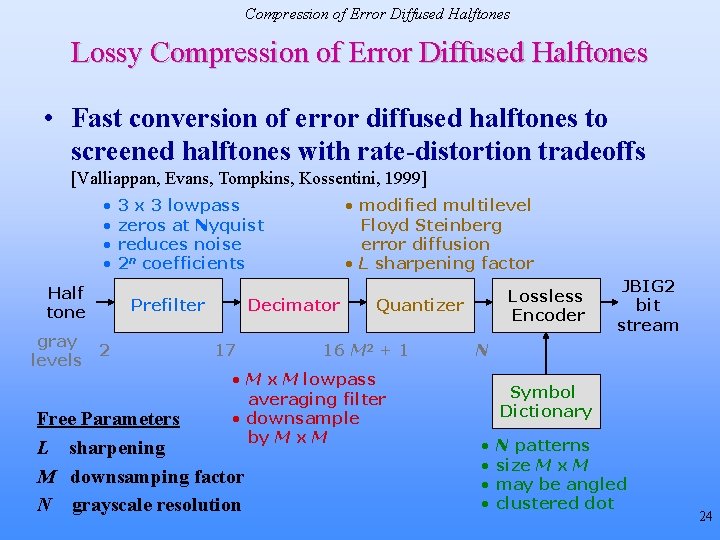
Compression of Error Diffused Halftones Lossy Compression of Error Diffused Halftones • Fast conversion of error diffused halftones to screened halftones with rate-distortion tradeoffs [Valliappan, Evans, Tompkins, Kossentini, 1999] • • Half tone gray levels Prefilter 2 • modified multilevel Floyd Steinberg error diffusion • L sharpening factor 3 x 3 lowpass zeros at Nyquist reduces noise 2 n coefficients Decimator 17 Quantizer 16 M 2 + 1 • M x M lowpass averaging filter • downsample by M x M Free Parameters L sharpening M downsamping factor N grayscale resolution Lossless Encoder JBIG 2 bit stream N Symbol Dictionary • • N patterns size M x M may be angled clustered dot 24
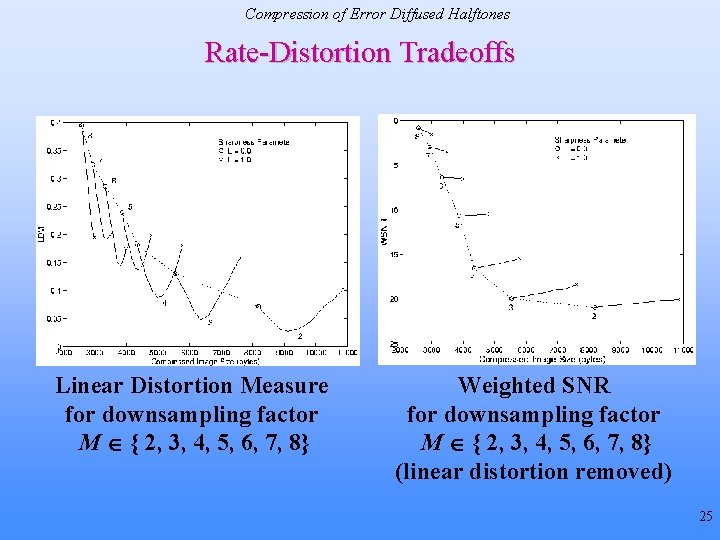
Compression of Error Diffused Halftones Rate-Distortion Tradeoffs Linear Distortion Measure for downsampling factor M { 2, 3, 4, 5, 6, 7, 8} Weighted SNR for downsampling factor M { 2, 3, 4, 5, 6, 7, 8} (linear distortion removed) 25
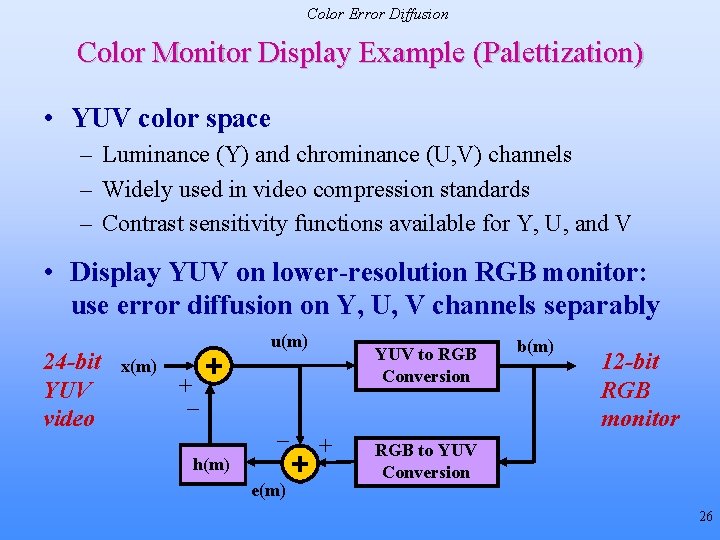
Color Error Diffusion Color Monitor Display Example (Palettization) • YUV color space – Luminance (Y) and chrominance (U, V) channels – Widely used in video compression standards – Contrast sensitivity functions available for Y, U, and V • Display YUV on lower-resolution RGB monitor: use error diffusion on Y, U, V channels separably 24 -bit YUV video u(m) x(m) YUV to RGB Conversion +_ _ h(m) e(m) + b(m) 12 -bit RGB monitor RGB to YUV Conversion 26
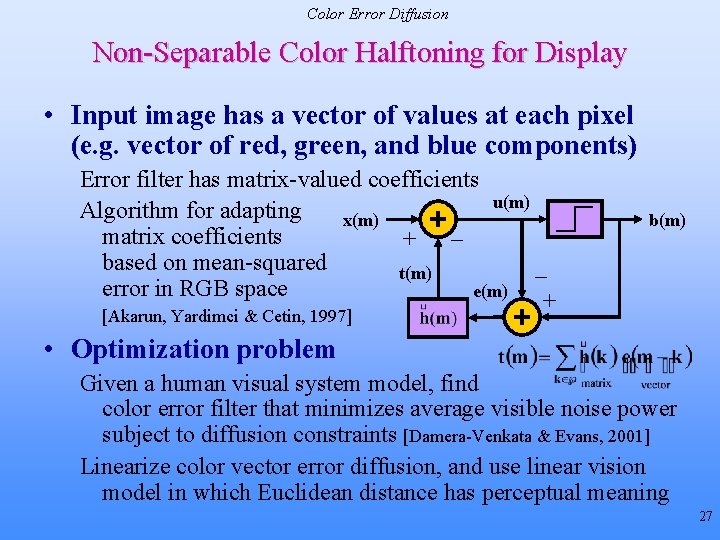
Color Error Diffusion Non-Separable Color Halftoning for Display • Input image has a vector of values at each pixel (e. g. vector of red, green, and blue components) Error filter has matrix-valued coefficients u(m) Algorithm for adapting x(m) matrix coefficients + _ based on mean-squared _ t(m) error in RGB space e(m) + [Akarun, Yardimci & Cetin, 1997] b(m) • Optimization problem Given a human visual system model, find color error filter that minimizes average visible noise power subject to diffusion constraints [Damera-Venkata & Evans, 2001] Linearize color vector error diffusion, and use linear vision model in which Euclidean distance has perceptual meaning 27
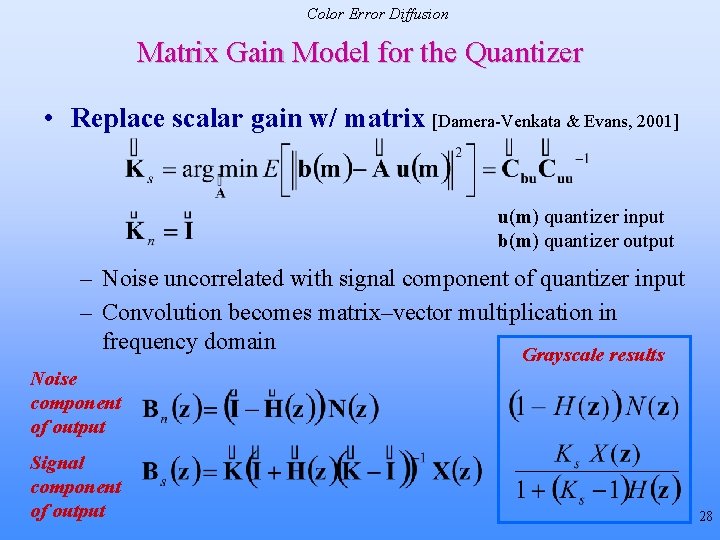
Color Error Diffusion Matrix Gain Model for the Quantizer • Replace scalar gain w/ matrix [Damera-Venkata & Evans, 2001] u(m) quantizer input b(m) quantizer output – Noise uncorrelated with signal component of quantizer input – Convolution becomes matrix–vector multiplication in frequency domain Grayscale results Noise component of output Signal component of output 28
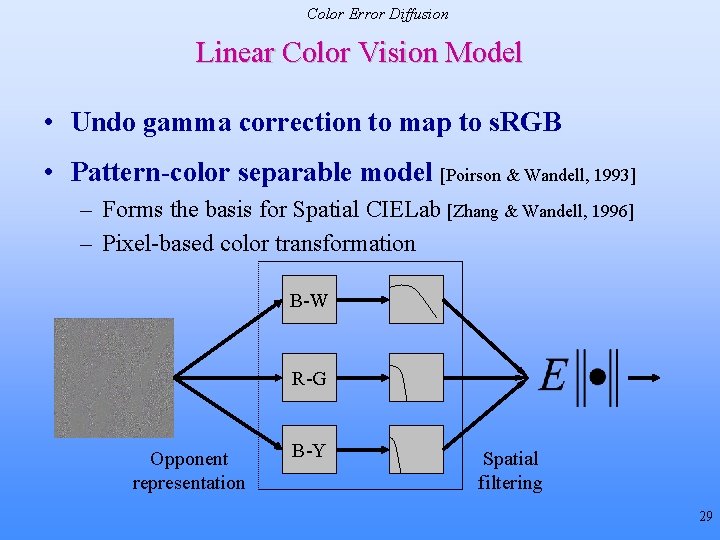
Color Error Diffusion Linear Color Vision Model • Undo gamma correction to map to s. RGB • Pattern-color separable model [Poirson & Wandell, 1993] – Forms the basis for Spatial CIELab [Zhang & Wandell, 1996] – Pixel-based color transformation B-W R-G Opponent representation B-Y Spatial filtering 29
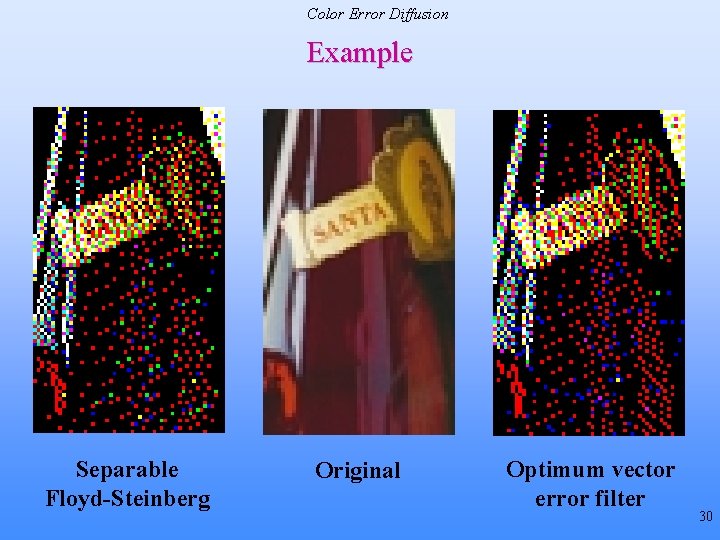
Color Error Diffusion Example Separable Floyd-Steinberg Original Optimum vector error filter 30
Color Error Diffusion Evaluating Linear Vision Models [Monga, Geisler & Evans, 2003] • Objective measure: improvement in noise shaping over separable Floyd-Steinberg • Subjective testing based on paired comparison task halftone B original halftone A Online at www. ece. utexas. edu/~vishal/cgi-bin/test. html • In decreasing subjective (and objective) quality Linearized CIELab > > Opponent > YUV YIQ 31
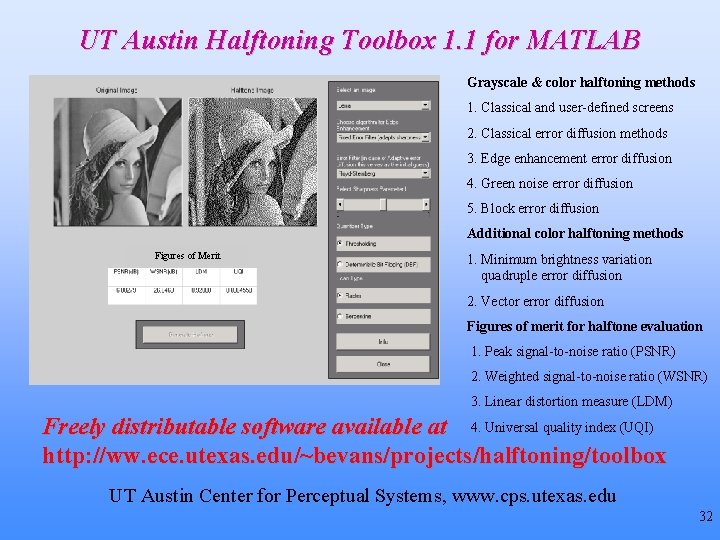
UT Austin Halftoning Toolbox 1. 1 for MATLAB Grayscale & color halftoning methods 1. Classical and user-defined screens 2. Classical error diffusion methods 3. Edge enhancement error diffusion 4. Green noise error diffusion 5. Block error diffusion Additional color halftoning methods Figures of Merit 1. Minimum brightness variation quadruple error diffusion 2. Vector error diffusion Figures of merit for halftone evaluation 1. Peak signal-to-noise ratio (PSNR) 2. Weighted signal-to-noise ratio (WSNR) 3. Linear distortion measure (LDM) Freely distributable software available at 4. Universal quality index (UQI) http: //ww. ece. utexas. edu/~bevans/projects/halftoning/toolbox UT Austin Center for Perceptual Systems, www. cps. utexas. edu 32
Backup Slides
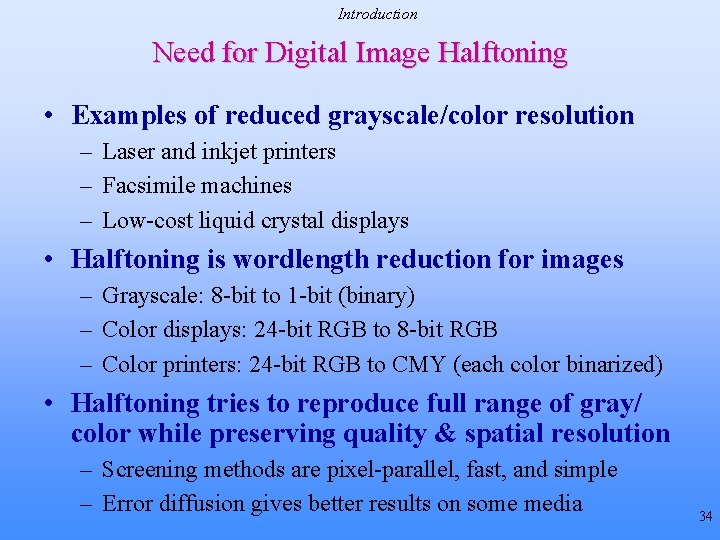
Introduction Need for Digital Image Halftoning • Examples of reduced grayscale/color resolution – Laser and inkjet printers – Facsimile machines – Low-cost liquid crystal displays • Halftoning is wordlength reduction for images – Grayscale: 8 -bit to 1 -bit (binary) – Color displays: 24 -bit RGB to 8 -bit RGB – Color printers: 24 -bit RGB to CMY (each color binarized) • Halftoning tries to reproduce full range of gray/ color while preserving quality & spatial resolution – Screening methods are pixel-parallel, fast, and simple – Error diffusion gives better results on some media 34
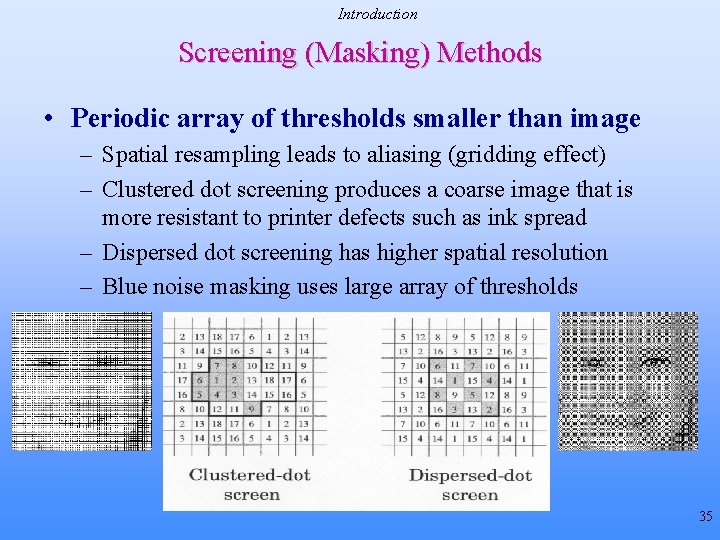
Introduction Screening (Masking) Methods • Periodic array of thresholds smaller than image – Spatial resampling leads to aliasing (gridding effect) – Clustered dot screening produces a coarse image that is more resistant to printer defects such as ink spread – Dispersed dot screening has higher spatial resolution – Blue noise masking uses large array of thresholds 35
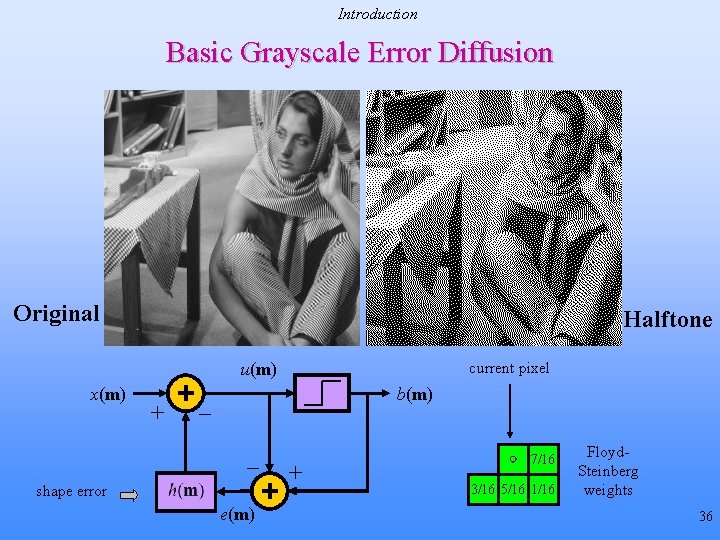
Introduction Basic Grayscale Error Diffusion Original Halftone current pixel u(m) x(m) + b(m) _ _ shape error e(m) + 7/16 3/16 5/16 1/16 Floyd. Steinberg weights 36
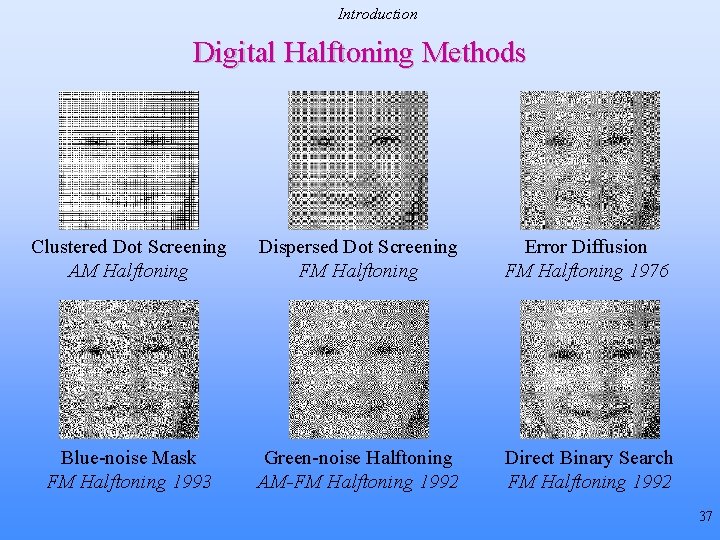
Introduction Digital Halftoning Methods Clustered Dot Screening AM Halftoning Dispersed Dot Screening FM Halftoning Error Diffusion FM Halftoning 1976 Blue-noise Mask FM Halftoning 1993 Green-noise Halftoning AM-FM Halftoning 1992 Direct Binary Search FM Halftoning 1992 37
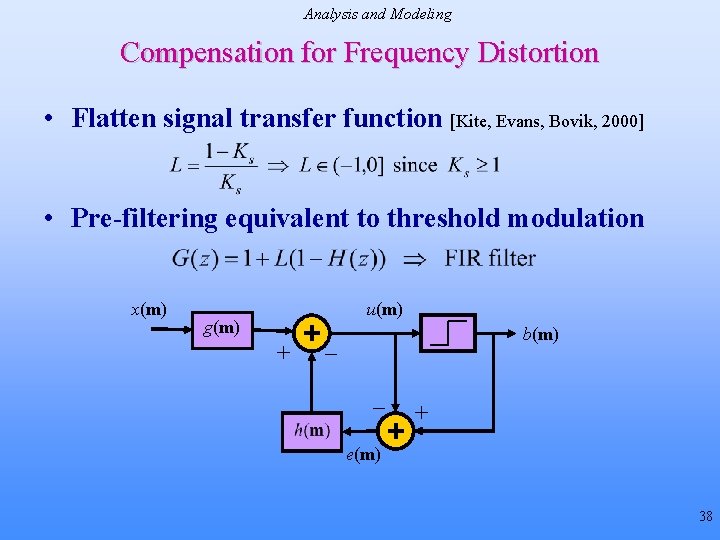
Analysis and Modeling Compensation for Frequency Distortion • Flatten signal transfer function [Kite, Evans, Bovik, 2000] • Pre-filtering equivalent to threshold modulation x(m) u(m) g(m) + b(m) _ _ + e(m) 38
Analysis and Modeling Visual Quality Measures [Kite, Evans & Bovik, 2000] • Sharpening: proportional to Ks Value of Ks: Floyd Steinberg < Stucki < Jarvis • Impact of noise on human visual system Signal-to-noise (SNR) measures appropriate when noise is additive and signal independent Create unsharpened halftone y[m 1, m 2] with flat signal transfer function using threshold modulation Weight signal/noise by contrast sensitivity function C[k 1, k 2] Floyd-Steinberg > Stucki > Jarvis at all viewing distances 39
Enhancements Example #1: Green Noise Error Diffusion • Output fed back to quantizer input [Levien, 1993] – Gain G controls coarseness of dot clusters – Hysteresis filter f affects dot cluster shape f G u(m) x(m) + _ _ b(m) + e(m) 40
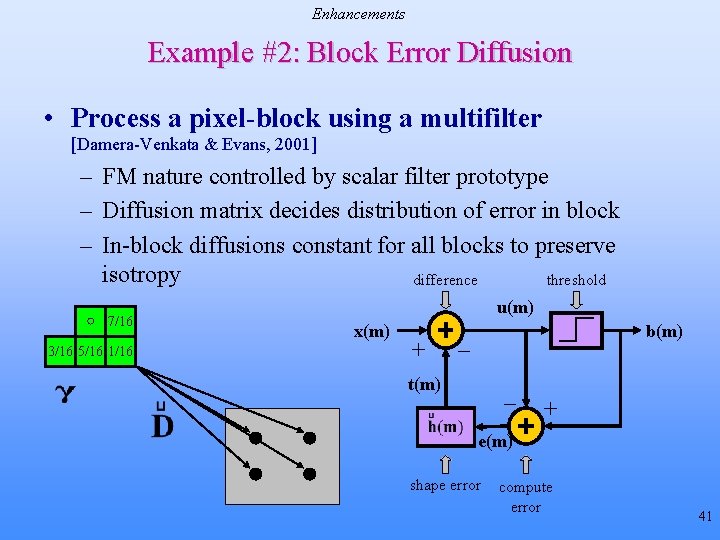
Enhancements Example #2: Block Error Diffusion • Process a pixel-block using a multifilter [Damera-Venkata & Evans, 2001] – FM nature controlled by scalar filter prototype – Diffusion matrix decides distribution of error in block – In-block diffusions constant for all blocks to preserve isotropy difference threshold 7/16 3/16 5/16 1/16 u(m) x(m) + b(m) _ t(m) _ + e(m) shape error compute error 41
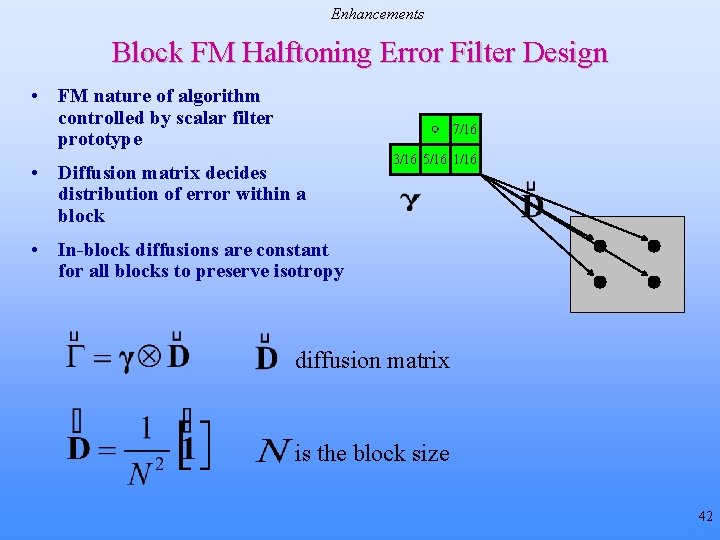
Enhancements Block FM Halftoning Error Filter Design • FM nature of algorithm controlled by scalar filter prototype 7/16 • Diffusion matrix decides distribution of error within a block 3/16 5/16 1/16 • In-block diffusions are constant for all blocks to preserve isotropy diffusion matrix is the block size 42
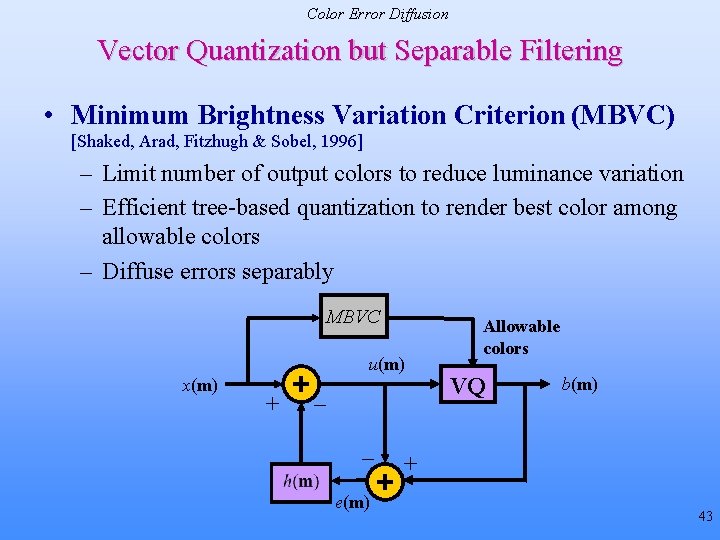
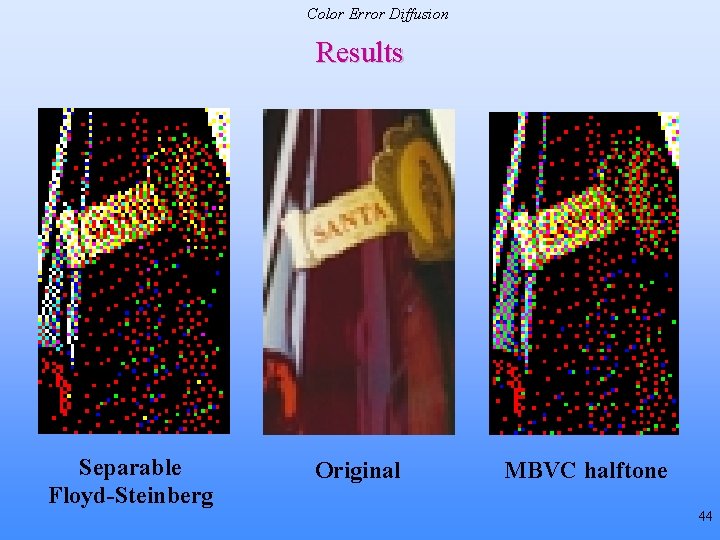
Color Error Diffusion Vector Quantization but Separable Filtering • Minimum Brightness Variation Criterion (MBVC) [Shaked, Arad, Fitzhugh & Sobel, 1996] – Limit number of output colors to reduce luminance variation – Efficient tree-based quantization to render best color among allowable colors – Diffuse errors separably MBVC u(m) x(m) + _ _ e(m) Allowable colors VQ b(m) + 43
Color Error Diffusion Results Separable Floyd-Steinberg Original MBVC halftone 44
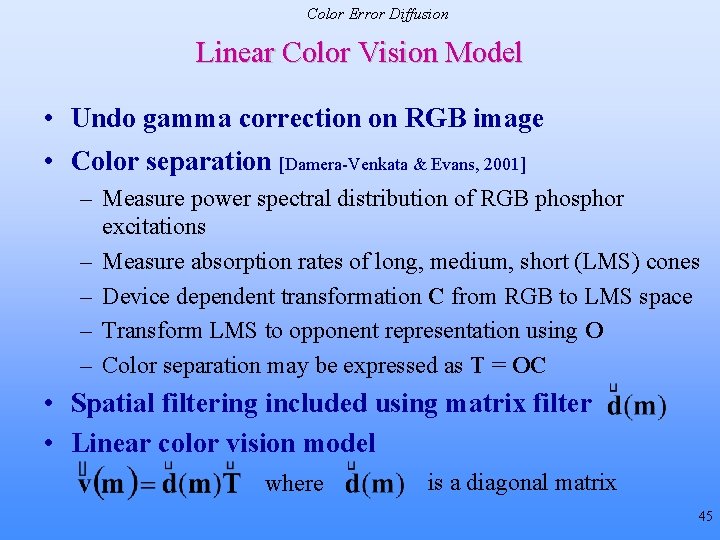
Color Error Diffusion Linear Color Vision Model • Undo gamma correction on RGB image • Color separation [Damera-Venkata & Evans, 2001] – Measure power spectral distribution of RGB phosphor excitations – Measure absorption rates of long, medium, short (LMS) cones – Device dependent transformation C from RGB to LMS space – Transform LMS to opponent representation using O – Color separation may be expressed as T = OC • Spatial filtering included using matrix filter • Linear color vision model where is a diagonal matrix 45
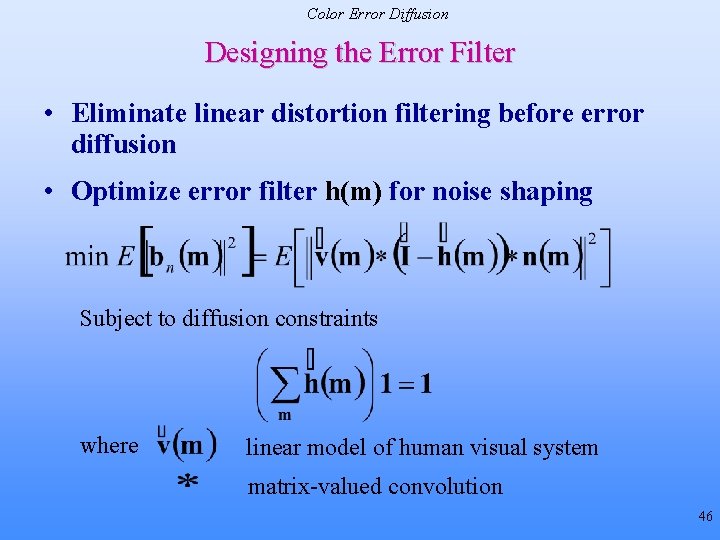
Color Error Diffusion Designing the Error Filter • Eliminate linear distortion filtering before error diffusion • Optimize error filter h(m) for noise shaping Subject to diffusion constraints where linear model of human visual system matrix-valued convolution 46
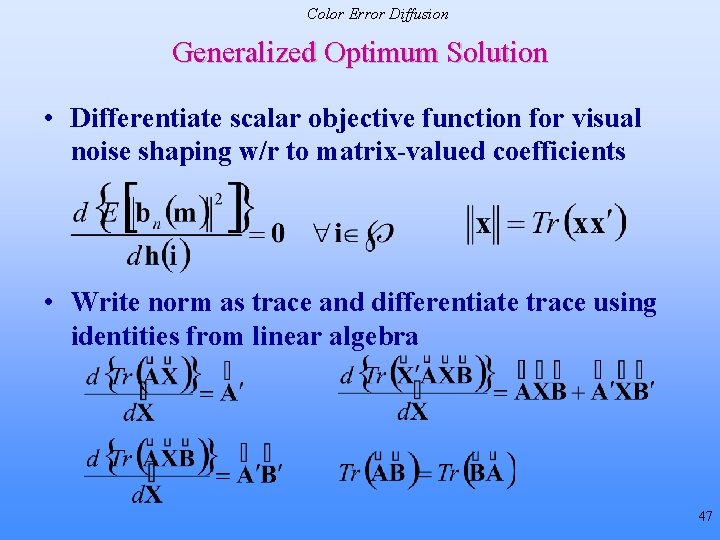
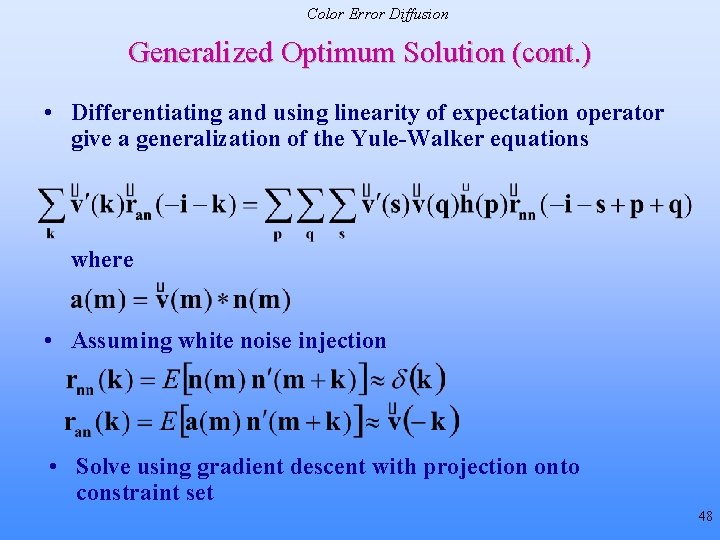
Color Error Diffusion Generalized Optimum Solution • Differentiate scalar objective function for visual noise shaping w/r to matrix-valued coefficients • Write norm as trace and differentiate trace using identities from linear algebra 47
Color Error Diffusion Generalized Optimum Solution (cont. ) • Differentiating and using linearity of expectation operator give a generalization of the Yule-Walker equations where • Assuming white noise injection • Solve using gradient descent with projection onto constraint set 48
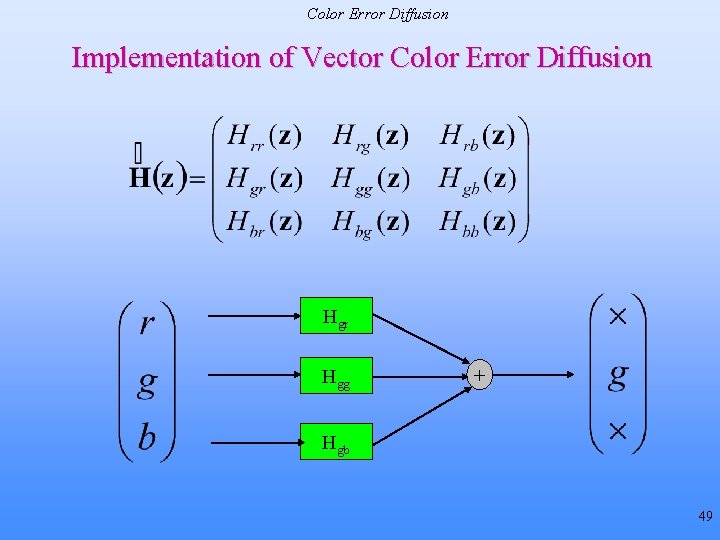
Color Error Diffusion Implementation of Vector Color Error Diffusion Hgr Hgg + Hgb 49
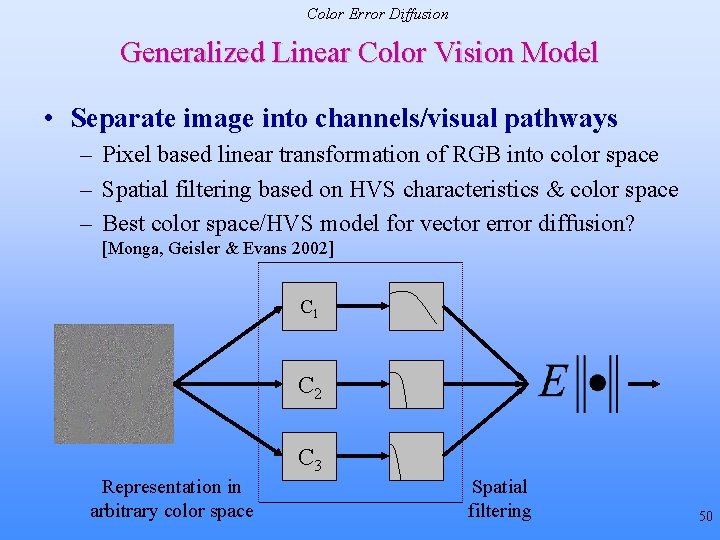
Color Error Diffusion Generalized Linear Color Vision Model • Separate image into channels/visual pathways – Pixel based linear transformation of RGB into color space – Spatial filtering based on HVS characteristics & color space – Best color space/HVS model for vector error diffusion? [Monga, Geisler & Evans 2002] C 1 C 2 C 3 Representation in arbitrary color space Spatial filtering 50
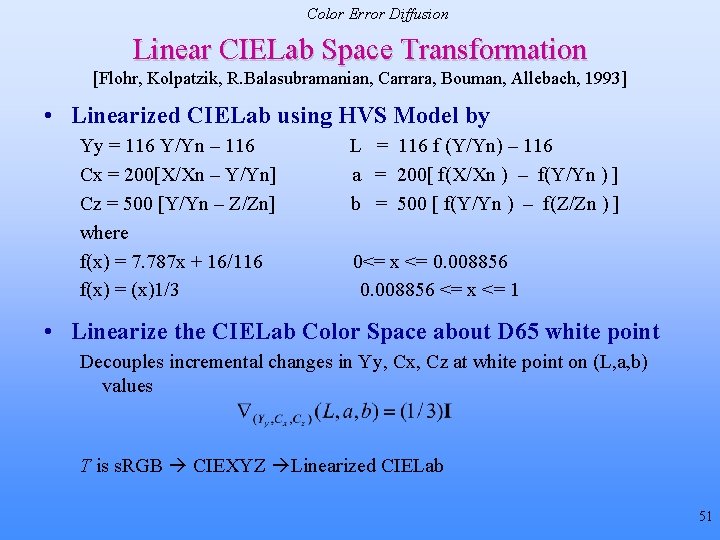
Color Error Diffusion Linear CIELab Space Transformation [Flohr, Kolpatzik, R. Balasubramanian, Carrara, Bouman, Allebach, 1993] • Linearized CIELab using HVS Model by Yy = 116 Y/Yn – 116 L = 116 f (Y/Yn) – 116 Cx = 200[X/Xn – Y/Yn] a = 200[ f(X/Xn ) – f(Y/Yn ) ] Cz = 500 [Y/Yn – Z/Zn] b = 500 [ f(Y/Yn ) – f(Z/Zn ) ] where f(x) = 7. 787 x + 16/116 0<= x <= 0. 008856 f(x) = (x)1/3 0. 008856 <= x <= 1 • Linearize the CIELab Color Space about D 65 white point Decouples incremental changes in Yy, Cx, Cz at white point on (L, a, b) values T is s. RGB CIEXYZ Linearized CIELab 51
Color Error Diffusion Spatial Filtering • Opponent [Wandell, Zhang 1997] – Data in each plane filtered by 2 -D separable spatial kernels – Parameters for the three color planes are Plane Weights wi Spreads σi Luminance 0. 921 0. 0283 0. 105 0. 133 -0. 108 4. 336 Red-green 0. 531 0. 0392 0. 330 0. 494 Blue-yellow 0. 488 0. 0536 0. 371 0. 386 52
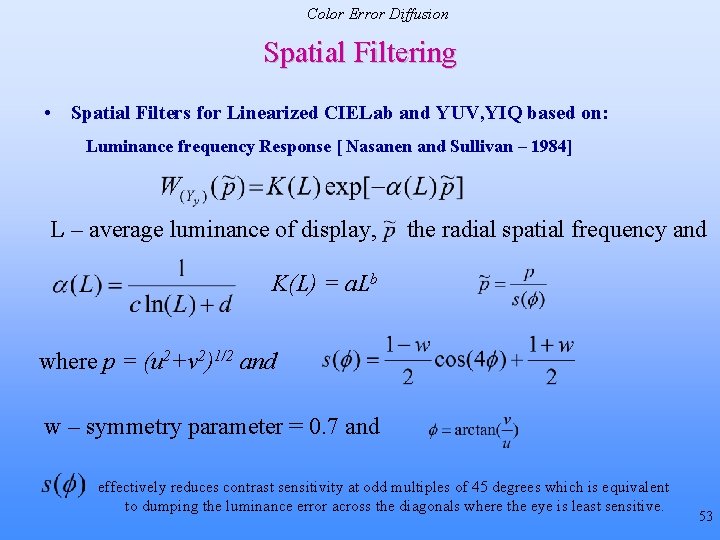
Color Error Diffusion Spatial Filtering • Spatial Filters for Linearized CIELab and YUV, YIQ based on: Luminance frequency Response [ Nasanen and Sullivan – 1984] L – average luminance of display, the radial spatial frequency and K(L) = a. Lb where p = (u 2+v 2)1/2 and w – symmetry parameter = 0. 7 and effectively reduces contrast sensitivity at odd multiples of 45 degrees which is equivalent to dumping the luminance error across the diagonals where the eye is least sensitive. 53
Color Error Diffusion Spatial Filtering Chrominance Frequency Response [Kolpatzik and Bouman – 1992] Using this chrominance response as opposed to same for both luminance and chrominance allows more low frequency chromatic error not perceived by the human viewer. • The problem hence is of designing 2 D-FIR filters which most closely match the desired Luminance and Chrominance frequency responses. • In addition we need zero phase as well. The filters ( 5 x 5 and 15 x 15 were designed using the frequency sampling approach and were real and circularly symmetric). Filter coefficients at: http: //www. ece. utexas. edu/~vishal/halftoning. html • Matrix valued Vector Error Filters for each of the Color Spaces at http: //www. ece. utexas. edu/~vishal/mat_filter. html 54
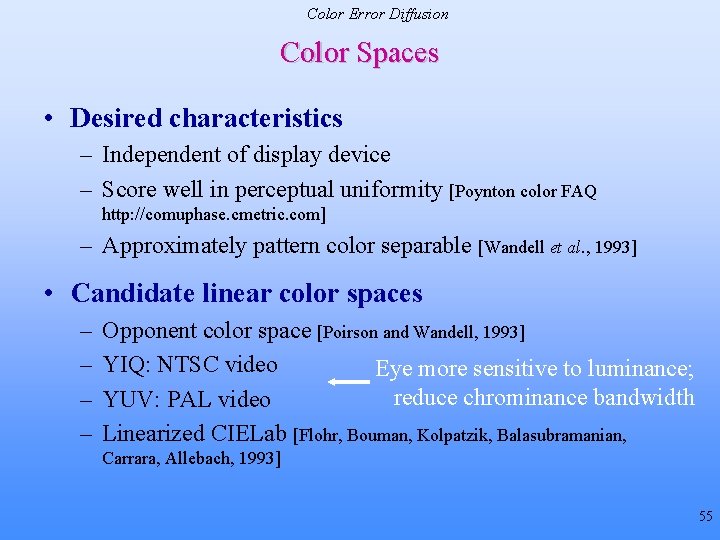
Color Error Diffusion Color Spaces • Desired characteristics – Independent of display device – Score well in perceptual uniformity [Poynton color FAQ http: //comuphase. cmetric. com] – Approximately pattern color separable [Wandell et al. , 1993] • Candidate linear color spaces – – Opponent color space [Poirson and Wandell, 1993] YIQ: NTSC video Eye more sensitive to luminance; reduce chrominance bandwidth YUV: PAL video Linearized CIELab [Flohr, Bouman, Kolpatzik, Balasubramanian, Carrara, Allebach, 1993] 55
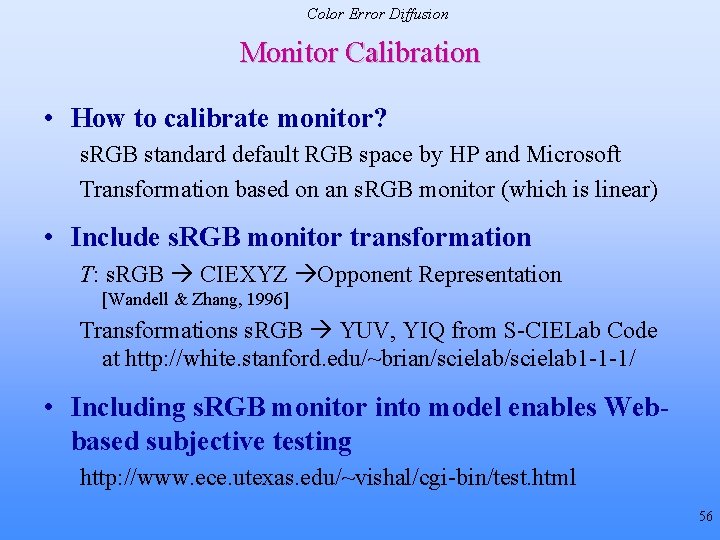
Color Error Diffusion Monitor Calibration • How to calibrate monitor? s. RGB standard default RGB space by HP and Microsoft Transformation based on an s. RGB monitor (which is linear) • Include s. RGB monitor transformation T: s. RGB CIEXYZ Opponent Representation [Wandell & Zhang, 1996] Transformations s. RGB YUV, YIQ from S-CIELab Code at http: //white. stanford. edu/~brian/scielab 1 -1 -1/ • Including s. RGB monitor into model enables Webbased subjective testing http: //www. ece. utexas. edu/~vishal/cgi-bin/test. html 56
Color Error Diffusion Spatial Filtering • Opponent [Wandell, Zhang 1997] Data in each plane filtered by 2 -D separable spatial kernels • Linearized CIELab, YUV, and YIQ Luminance frequency response [Näsänen and Sullivan, 1984] L average luminance of display r radial spatial frequency Chrominance frequency response [Kolpatzik and Bouman, 1992] Chrominance response allows more low frequency chromatic error not to be perceived vs. luminance response 57
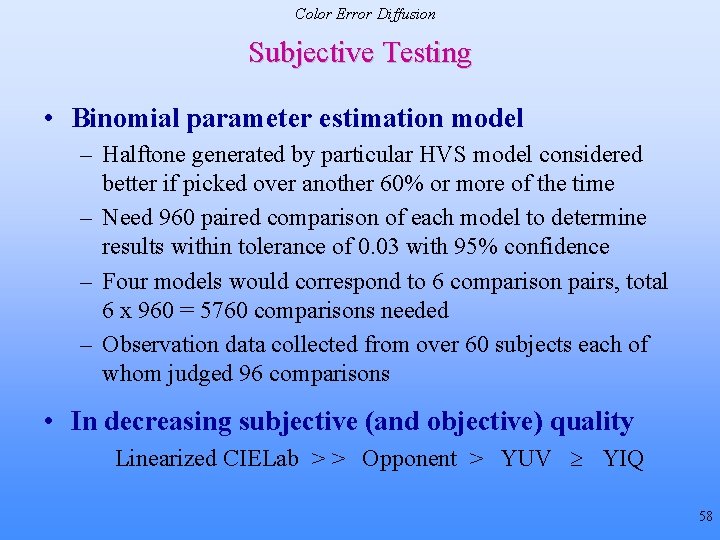
Color Error Diffusion Subjective Testing • Binomial parameter estimation model – Halftone generated by particular HVS model considered better if picked over another 60% or more of the time – Need 960 paired comparison of each model to determine results within tolerance of 0. 03 with 95% confidence – Four models would correspond to 6 comparison pairs, total 6 x 960 = 5760 comparisons needed – Observation data collected from over 60 subjects each of whom judged 96 comparisons • In decreasing subjective (and objective) quality Linearized CIELab > > Opponent > YUV YIQ 58
Conclusion Selected Open Problems • Analysis and modeling – Find less restrictive sufficient conditions for stability of color vector error filters – Find link between spectral characteristics of the halftone pattern and linear gain model at a given graylevel – Model statistical properties of quantization noise • Enhancements – Find vector error filters and threshold modulation for optimal tone-dependent vector color error diffusion – Incorporate printer models into optimal framework for vector color error filter design 59