
Error correction providing feedback Different approaches to the
Error correction; providing feedback
Different approaches to the nature and function of feedback • What is feedback? - information given to the learner about his performance of a learning task (objective – improvement); - forms – different (´Yes, right!´, a grade of 70 % at an exam, raised eyebrow, etc. ); - Feedback – 2 distinguishable components: assessment and correction (Ur, 1991, 242)
• Assessment: • The learner is informed about how well or badly he performed (e. g. a percentage grade); • Correction: • specific information is provided on aspects of the learner´s performance (e. g. through explanation, providing better alternatives); • ! Correction should include information on what the learner did right, as well as wrong, and why !
• It is possible to give assessment without correcting (marking) without the text being returned or commented on. • A meaningful feedback should include both components; some judgement should be involved, but try to make the attitude to mistakes positive: mistakes are a natural and useful part of language learning; when the teacher gives feedback on them, the purpose is to help and promote learning – the way to ´getting things right´ (Ur, 243)
• In other words, our evaluation should be primarily formative = bringing about improvement (to FORM = to enhance x to CONCLUDE) • Summative evaluation – the Teacher´s evaluation – an overall of the Learner´s knowledge to summarize the situation, i. e. how proficient he or she is at a certain point in time, or, how much he or she has progressed during a particular time period. (Summative evaluation may contribute little to the learning process, but is also needed (Ur, 1996).
What are mistakes? • Learners make mistakes – errors often show us that the learner is experimenting with language, trying out ideas, taking risks, attempting to communicate, making progress. • We often learn by trial and error – in many areas. • Dealing with errors – we seek for correction techniques to raise the learners´ own awareness about the language (rather than giving the correct form ´on a plate´). (Scrivener, 2011)
Types of mistakes • 1. ´slips´ (slips of the tongue) – mistakes which students/pupils can correct themselves; • 2. ´errors´ - mistakes which they cannot correct themselves, and which therefore need explanation; • 3. ´attempts´- a pupil tries to say something but does not yet know the correct way of saying it. (Julian Edge, 1989 in Harmer, 2006, 99) • + ´lapses´ - the Friday afternoon tiredness (Bartram, Walton, 2001)
2 basic causes for errors • A) L 1 interference – influence of the mother tongue on the target language acquisition concerning the phonological systems of L 1 and L 2, the lexicon, grammar; • B) Developmental errors – occurring with the FL learner as well as children learning their MT (e. g. *They comed; *He goed); • (Harmer, 206, 99 -100)
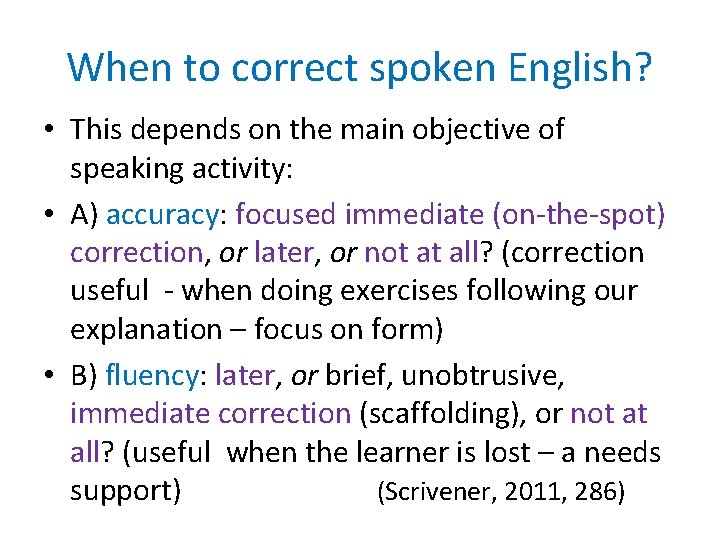
When to correct spoken English? • This depends on the main objective of speaking activity: • A) accuracy: focused immediate (on-the-spot) correction, or later, or not at all? (correction useful - when doing exercises following our explanation – focus on form) • B) fluency: later, or brief, unobtrusive, immediate correction (scaffolding), or not at all? (useful when the learner is lost – a needs support) (Scrivener, 2011, 286)
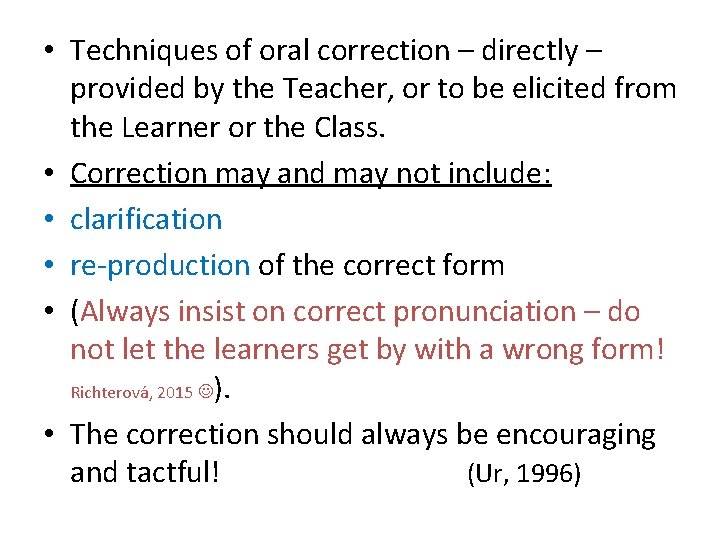
• Techniques of oral correction – directly – provided by the Teacher, or to be elicited from the Learner or the Class. • Correction may and may not include: • clarification • re-production of the correct form • (Always insist on correct pronunciation – do not let the learners get by with a wrong form! Richterová, 2015 ). • The correction should always be encouraging and tactful! (Ur, 1996)
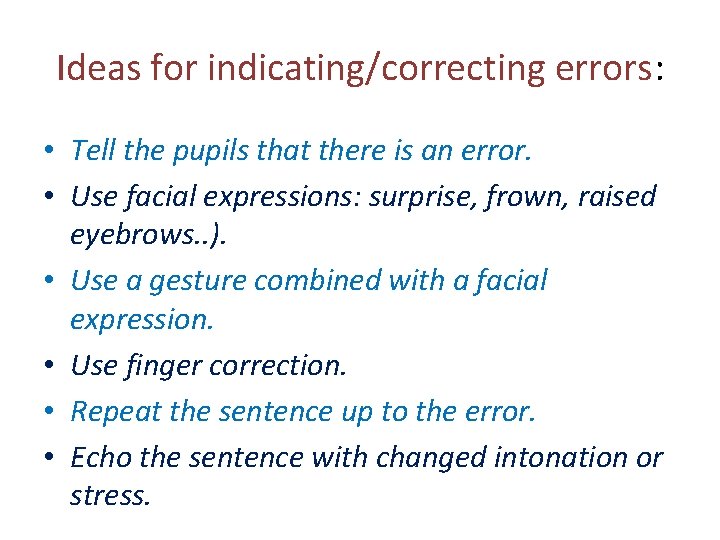
Ideas for indicating/correcting errors: • Tell the pupils that there is an error. • Use facial expressions: surprise, frown, raised eyebrows. . ). • Use a gesture combined with a facial expression. • Use finger correction. • Repeat the sentence up to the error. • Echo the sentence with changed intonation or stress.
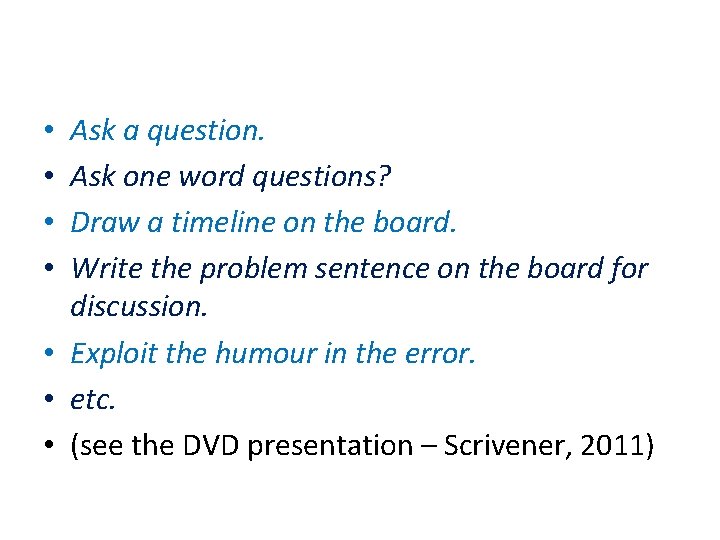
Ask a question. Ask one word questions? Draw a timeline on the board. Write the problem sentence on the board for discussion. • Exploit the humour in the error. • etc. • (see the DVD presentation – Scrivener, 2011) • •
Correcting written work • • • Written work – of various types: written compositions, assignments on grammar + vocabulary, answers to comprehension questions, tests, etc.
• Traditional way (all mistakes underlined with a red pen, the general tone of T´s comments negative) may be perceived as discouraging; • There exist options for getting the learners to look at each other´s work and evaluate it; however, many learners will expect the teacher to look at their work (+ may feel let down if only evaluated by other students);
• Responding to written work: Constructive comments in the margins or under the text – when we expect another draft; • With the final product – say what you liked and what the learner might do better next time; • Another way – show alternative ways through re-formulation; • Use coding (e. g. ´S ´ for spelling); • Use the technique of focusing (to avoid overcorrection give feedback on a particular aspect of language – e. g. spelling (tell the pupils in advance!) (Harmer, 2006, 112)
Variations on traditional teacher marking by Jim Scrivener: • • Use a green pen. Discuss the marking criteria with the learners. Write the correct answers in the margin. Use correction codes in the margin. Underline all errors of one type. Write a letter in reply. Write nothing. Discuss the work with the individual learner.
• Only write a comment on the meaning and message of the piece. • Create a composite essay using good bits and problematic bits from a number of students´ work. Photocopy it and hand it out for students to discuss and correct (together, in groups, pairs, individually). • Use errors from a number of different students´ writing to devise an exercise, quiz, game, etc. • Give a dictation based on sentences from the learners´ work. (Scrivener, 2011, 245)
Evaluating written work – The items to focus on: • Orthography – poor formation of letters, no lower-case letters; • Punctuation – incorrect use of full stops, no other punctuation; • Spelling – mistakes in moving sound to spelling; • Layout – no attempt to lay the text out; • Language - lexis or grammar errors; (Scrivener, 2011, 248) - see lecture 4
Correction codes – the most common symbols: • • • V = verb problem (possibly incorrect tense) WO = word order WW = wrong word λ = missing word SP = spelling It often seems inappropriate to point out every error; you probably need to decide which errors are most important or useful!
• The most common resource of gathering information for assessment – tests • (see lecture 6)
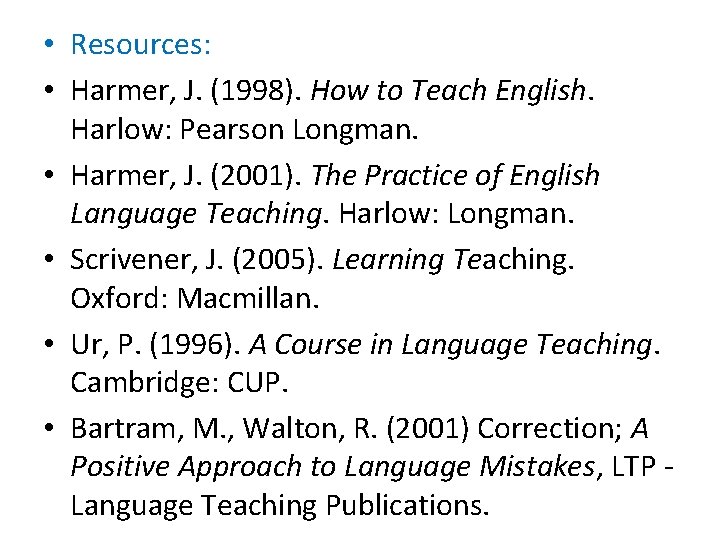
• Resources: • Harmer, J. (1998). How to Teach English. Harlow: Pearson Longman. • Harmer, J. (2001). The Practice of English Language Teaching. Harlow: Longman. • Scrivener, J. (2005). Learning Teaching. Oxford: Macmillan. • Ur, P. (1996). A Course in Language Teaching. Cambridge: CUP. • Bartram, M. , Walton, R. (2001) Correction; A Positive Approach to Language Mistakes, LTP Language Teaching Publications.
- Slides: 21