
ERP Modules Dr Celeste Ng 2004 Prepared by
ERP Modules Dr Celeste Ng 吳思佩 2004 Prepared by: Celeste Ng, YZU
Source: Lawrence F. B. , Jennings D. F. , Reynolds B. E. 2005. ERP in Distribution. Thomson, South-Western: Mason, Ohio; pp. 347. 2004 Prepared by: Celeste Ng, YZU
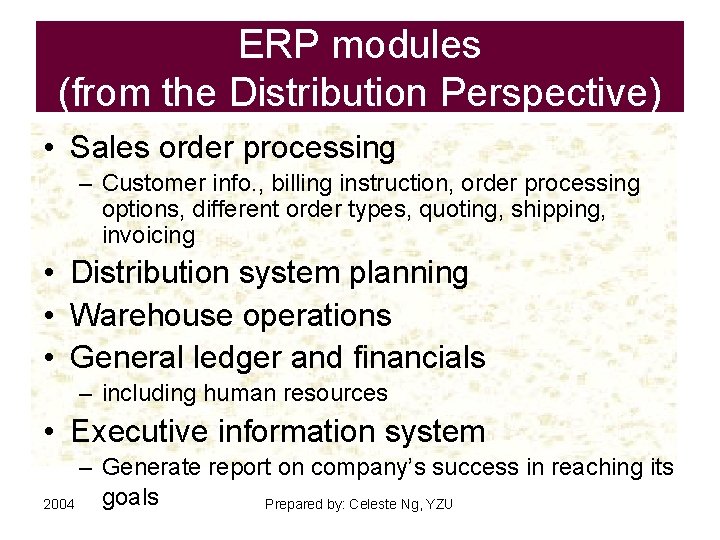
ERP modules (from the Distribution Perspective) • Sales order processing – Customer info. , billing instruction, order processing options, different order types, quoting, shipping, invoicing • Distribution system planning • Warehouse operations • General ledger and financials – including human resources • Executive information system – Generate report on company’s success in reaching its goals 2004 Prepared by: Celeste Ng, YZU
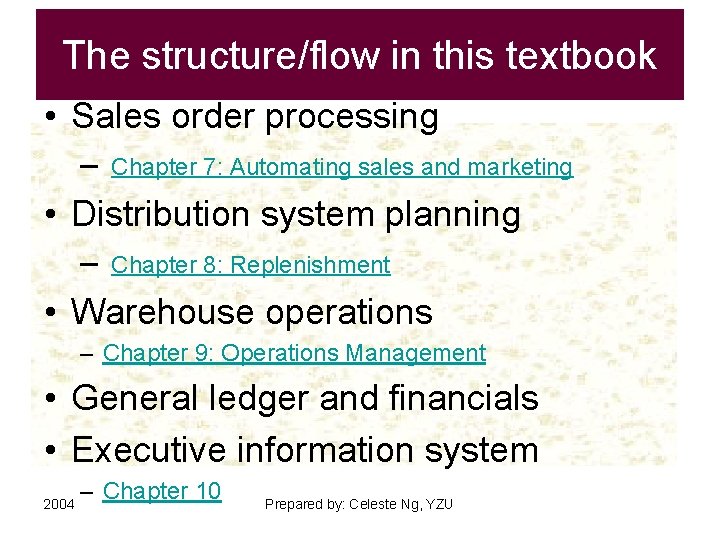
The structure/flow in this textbook • Sales order processing – Chapter 7: Automating sales and marketing • Distribution system planning – Chapter 8: Replenishment • Warehouse operations – Chapter 9: Operations Management • General ledger and financials • Executive information system 2004 – Chapter 10 Prepared by: Celeste Ng, YZU
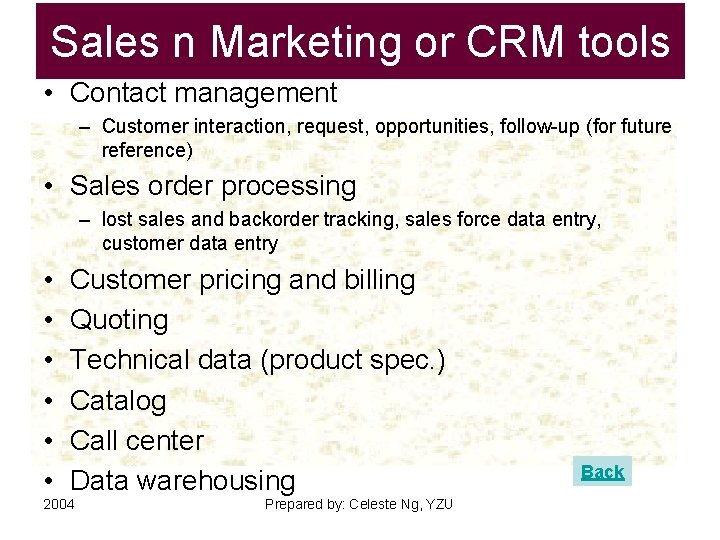
Sales n Marketing or CRM tools • Contact management – Customer interaction, request, opportunities, follow-up (for future reference) • Sales order processing – lost sales and backorder tracking, sales force data entry, customer data entry • • • Customer pricing and billing Quoting Technical data (product spec. ) Catalog Call center Data warehousing 2004 Prepared by: Celeste Ng, YZU Back
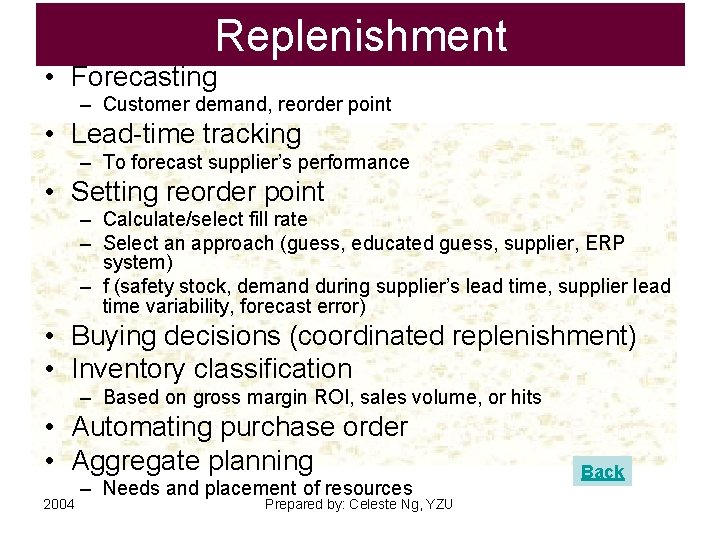
Replenishment • Forecasting – Customer demand, reorder point • Lead-time tracking – To forecast supplier’s performance • Setting reorder point – Calculate/select fill rate – Select an approach (guess, educated guess, supplier, ERP system) – f (safety stock, demand during supplier’s lead time, supplier lead time variability, forecast error) • Buying decisions (coordinated replenishment) • Inventory classification – Based on gross margin ROI, sales volume, or hits • Automating purchase order • Aggregate planning 2004 – Needs and placement of resources Prepared by: Celeste Ng, YZU Back
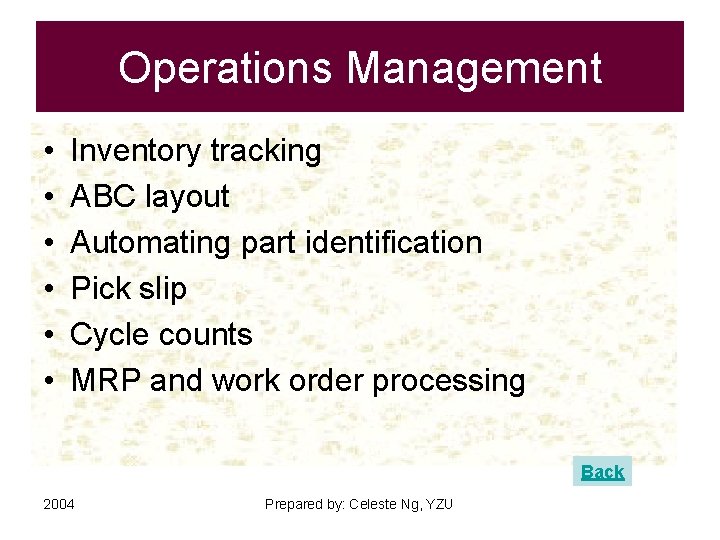
Operations Management • • • Inventory tracking ABC layout Automating part identification Pick slip Cycle counts MRP and work order processing Back 2004 Prepared by: Celeste Ng, YZU
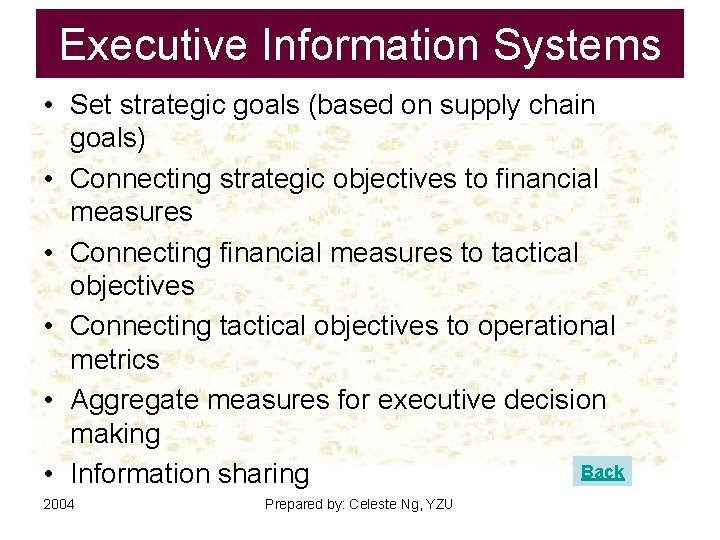
Executive Information Systems • Set strategic goals (based on supply chain goals) • Connecting strategic objectives to financial measures • Connecting financial measures to tactical objectives • Connecting tactical objectives to operational metrics • Aggregate measures for executive decision making Back • Information sharing 2004 Prepared by: Celeste Ng, YZU
Source: Norris G. , Hurley J. R. , Hartley K. M. , Dunleavy J. R. , Balls J. D. 2000. E-Business and ERP: Transforming the Enterprise. John Wiley & Sons: New York; pp. 194. 2004 Prepared by: Celeste Ng, YZU
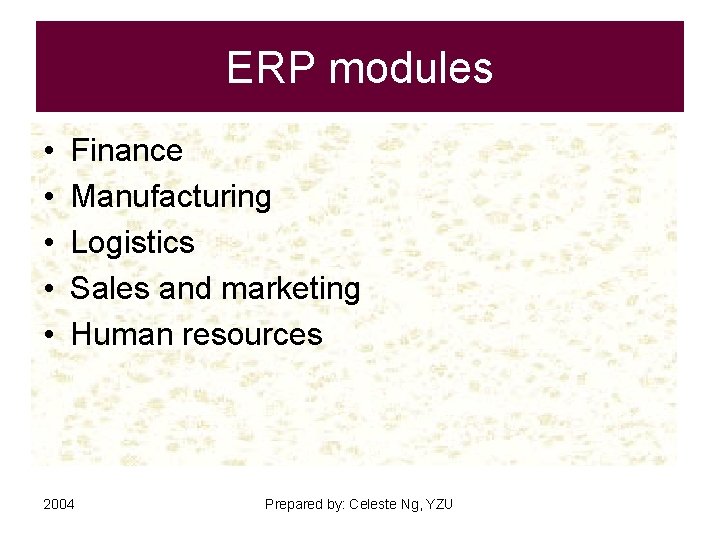
ERP modules • • • Finance Manufacturing Logistics Sales and marketing Human resources 2004 Prepared by: Celeste Ng, YZU
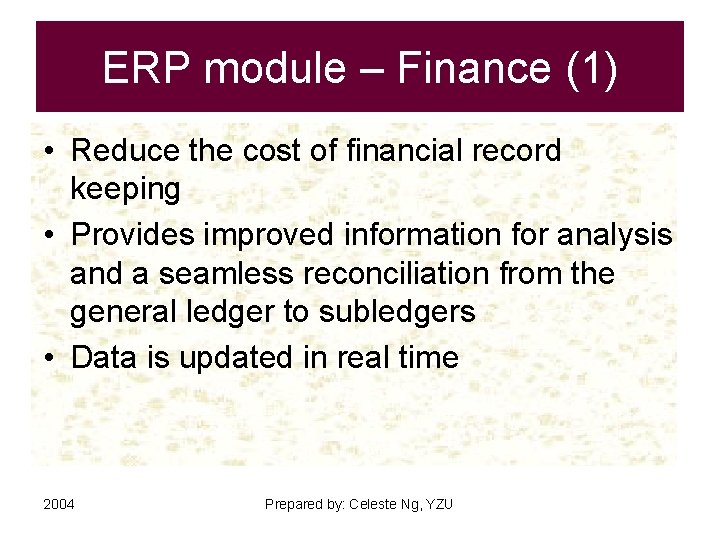
ERP module – Finance (1) • Reduce the cost of financial record keeping • Provides improved information for analysis and a seamless reconciliation from the general ledger to subledgers • Data is updated in real time 2004 Prepared by: Celeste Ng, YZU
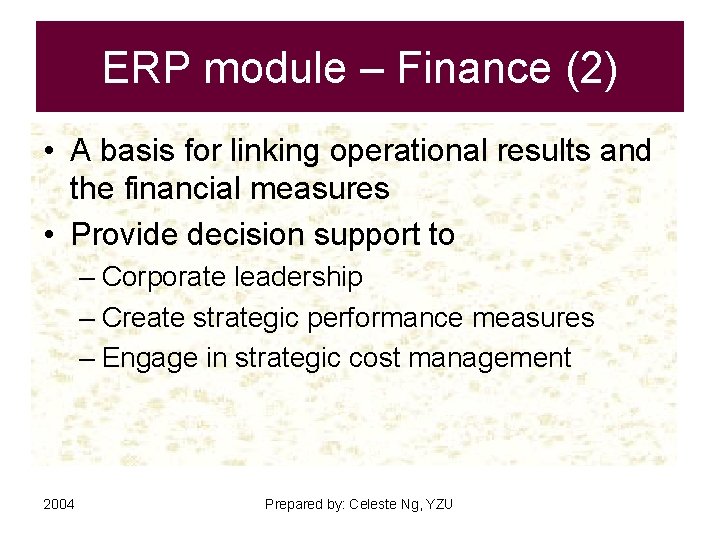
ERP module – Finance (2) • A basis for linking operational results and the financial measures • Provide decision support to – Corporate leadership – Create strategic performance measures – Engage in strategic cost management 2004 Prepared by: Celeste Ng, YZU
ERP module – Manufacturing (1) • Provides a consistent set of product names in a central product registry • A consistent way of looking at customers and vendors • Integration of sales and production information • A way to calculate availability of product for sales, distribution, and material management 2004 Prepared by: Celeste Ng, YZU
ERP module – Manufacturing (2) • Enables better order-to-production planning by linking sales and distribution to material management, production planning, and financials in real-time • Real-time visibility of customer orders and customer demand • Modeling of anticipated orders • Identify sales opportunities based on past performance information • Stock can adjusted nearly instantly • Detailed manufacturing resource planning can 2004 Prepared by: Celeste Ng, YZU be performed daily
ERP module – Logistics • Integrates distribution with manufacturing, sales, and financial reporting – Enhance reporting of future performance indicators and past performance measures • Supports the distribution environment necessary to met customer demands 2004 Prepared by: Celeste Ng, YZU
ERP module – Sales and Marketing • Perform profitability analysis, showing profits and contribution margins by market segment • Design sophisticated pricing procedures that include numerous prices, discounts, rebates, and tax considerations • Project much more accurate delivery dates for orders 2004 Prepared by: Celeste Ng, YZU
ERP module – Human resources (1) • Supports human resource planning, development, and compensation areas • Provides an integrated database of personnel • Maintains salary and benefits structures • Supports planning and recruiting • Keeps track of reimbursable travel and living expenses 2004 Prepared by: Celeste Ng, YZU
ERP module – Human resources (2) • Does payroll accounting • Records individual qualifications and requirements used for – Resource planning – Enhances career and succession planning – Coordination of training programs 2004 Prepared by: Celeste Ng, YZU
Source: Olson D. L. 2004. Managerial Issues of Enterprise Resource Planning Systems. Mc-Graw Hill: Boston; pp. 180. 2004 Prepared by: Celeste Ng, YZU
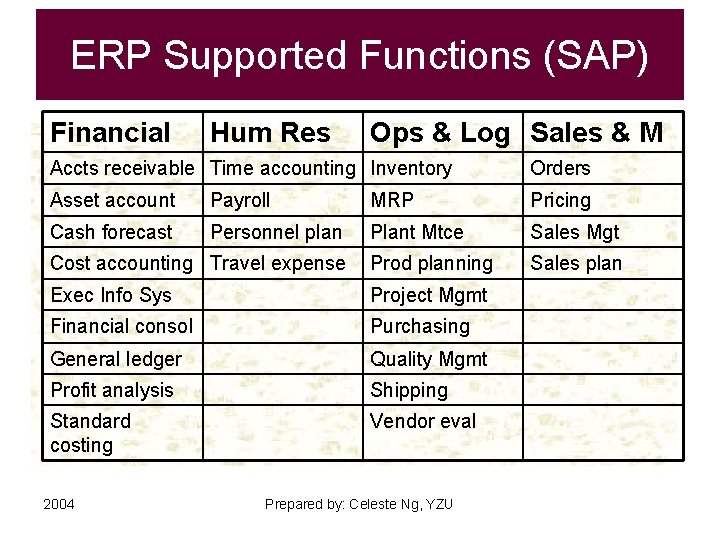
ERP Supported Functions (SAP) Financial Hum Res Ops & Log Sales & M Accts receivable Time accounting Inventory Orders Asset account Payroll MRP Pricing Cash forecast Personnel plan Plant Mtce Sales Mgt Cost accounting Travel expense Prod planning Sales plan Exec Info Sys Project Mgmt Financial consol Purchasing General ledger Quality Mgmt Profit analysis Shipping Standard costing Vendor eval 2004 Prepared by: Celeste Ng, YZU
- Slides: 20