
ERP Implementation Strategies Sujoy Mukhopadhyay Paul Xie Carlos
- Slides: 24
ERP Implementation Strategies Sujoy Mukhopadhyay Paul Xie Carlos Romero
Introduction �ERP implementation – installation of a software package that integrates all data and processes into a centralized, unified database. �Cross functional and company wide �Organizations rely on software for cohesiveness �Can lead to cost savings, more efficient processes
Different Implementation Methodologies �Depends on several factors �Size, industry, sales volume �Common basic factors �Physical Scope, BPR, Resource Allocation � 3 Broad implementation strategies �Big Bang, Middle-road, Vanilla
Things to Consider �Must first define business objectives �High maintenance costs, Mergers & Acquisitions, Compliance �Vendor selection �Evaluated on functionality AND ability to achieve business objective �How involved is the provider with the organization? �Risk analysis: References, track record �Written profile
Alternative Approach �Stick to deadlines, deal with issues/problems as they arise �Traditional Approach �Fix all the “bugs” before rolling out the system
Alternative Approach Advantages Disadvantages �Eliminates possibility of going over budget, missing deadlines �Can create ownership, allows for buy in �Success depends on org. ’s ability to embrace & adapt to change �No one likes change �Problems in system can discourage employees �Lower morale, productivity, efficiency �Constant change leads to frustration �Flawed system increases business risk
The “Big Bang” --- What is the “Big Bang” approach? �-- A straightforward ERP Implementation approach. It means all ERP modules, such as financials, manufacturing, and human resources, etc, are implemented in all business units at all geographic locations at the same time. �-- It will push the entire organization to use the new system at the same time. �-- The old system will be entirely shut down.
The Big Bang Advantages 1)The entire organization reaps the benefits of the deployed system as this enforces process change. 2) Installing the ERP by Big bang approach may help the company to get quicker return on the investment. 3) Easier integration and reporting. 4) No temporary interfaces required. 5) Lower cost of running the systems as legacy systems are retired simultaneously. 6) Faster implementation timeline.
Disadvantages 1) High capital and human resource investment. 2) Any technical performance issue affects the entire user population. 3) Requires training of the entire user population. 4) Complex deployment and testing. 5) The completeness and validity of the converted data is not completely proved, only in the pre-phases, but not in the whole system situation. 6) This adoption of the new system is vulnerable because of the limited possibilities to maneuver, and there is a lot of pressure because the deadline must be met.
Implementation Processes --- Converting the system. -- Planning, convert data from old system, load data in new system, test data in new system, execute off-line trials, and check to verify validity. --- Releasing parts of the system. -- Release converted database, release produced application, release infrastructure. --- Training the future users. -- Create main buffer of experienced staff, training all users. --- Releasing the whole system. -- Turn down the old system and load the new system.
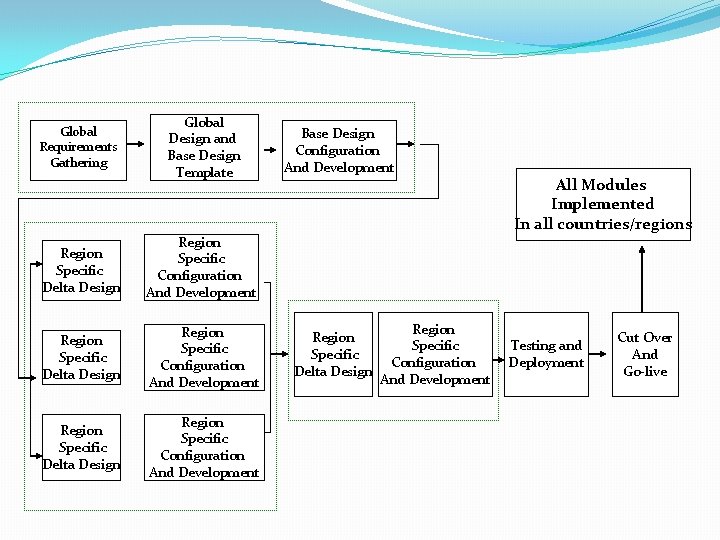
Global Requirements Gathering Global Design and Base Design Template Region Specific Delta Design Region Specific Configuration And Development Base Design Configuration And Development Region Specific Delta Design Region Specific Configuration And Development All Modules Implemented In all countries/regions Testing and Deployment Cut Over And Go-live
Who should choose the “Big bang”? -- The Big bang is difficult to manage for very large organizations. -- It is easier in organizations that are centralized. -- It is less risky with simple processes. -- It is easier for small, simple organizations.
Middle-Road Approach �Physical Scope (Medium) �Less than half of total company sites �Gauge user acceptance �Test in “real world” environment �Reduced risk
Middle-Road Approach �BPR Scope (Medium) �Few changes to existing business processes �Less impact to external parties �Less training �Shorter timeline
Middle-Road Approach �Technical Scope (Medium) �Limited customization �Easier upgrades and support �Reduced risk of knowledge loss when key employees leave
Middle-Road Approach �Module Implementation (“ala carte”) �Not all ERP modules are implemented �Industry specific modules and sub modules can be chosen �Some legacy systems to remain functional
Middle-Road Approach �Resource Scope (Medium) �Training and costs are balanced between Comprehensive (Big Bang) and Vanilla approach
Vanilla Approach �Physical Scope (Low) �Deployment locations are extremely limited �Typically involves less than 100 users �May not be able to detect issues related to capacity
Vanilla Approach �BPR Scope (Low) �Few areas are affected, therefore little change is needed �Shorter timeline �Processes may not exactly match ERP model
Vanilla Approach �Technical Scope (Low) �No modification or customization to software �Easy upgrades and support
Vanilla Approach �Module Implementation (Skeletal) �Only essential modules are chosen �Industry specific modules are discouraged �Minimized risk
Vanilla Approach �Resource Scope (Low) �Less training �Shorter timelines �Least cost
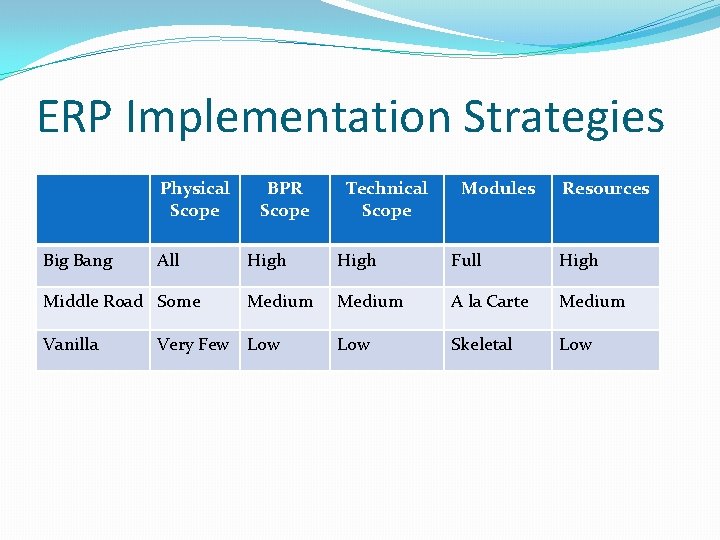
ERP Implementation Strategies Physical Scope Big Bang All Middle Road Some Vanilla BPR Scope Technical Scope Modules Resources High Full High Medium A la Carte Medium Low Skeletal Low Very Few Low
Questions?