
ERP IMPLEMENTATION LIFE CYCLE AND FRAMEWORK Contents Introduction
- Slides: 31
ERP IMPLEMENTATION LIFE CYCLE AND FRAMEWORK
Contents �Introduction To ERP �ERP Implementation Life Cycle �Integrative Framework For ERP Implementation
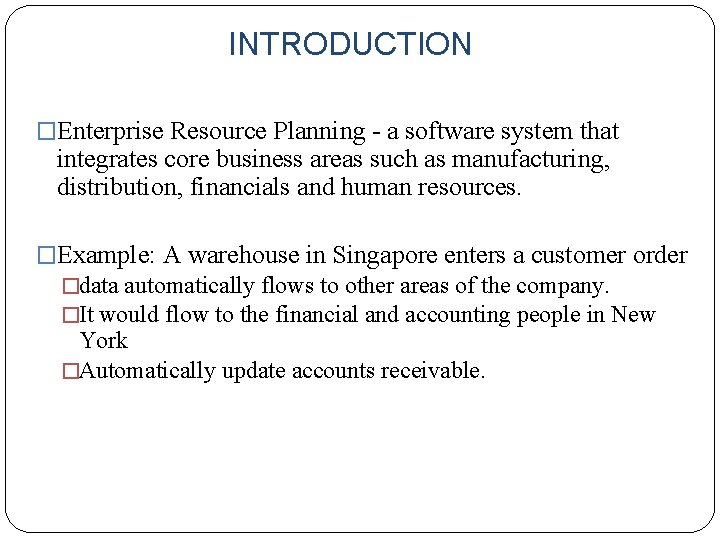
INTRODUCTION �Enterprise Resource Planning - a software system that integrates core business areas such as manufacturing, distribution, financials and human resources. �Example: A warehouse in Singapore enters a customer order �data automatically flows to other areas of the company. �It would flow to the financial and accounting people in New York �Automatically update accounts receivable.
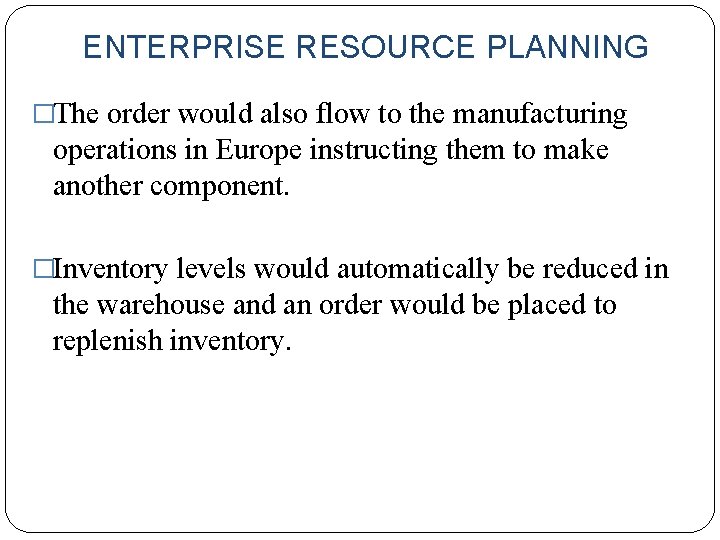
ENTERPRISE RESOURCE PLANNING �The order would also flow to the manufacturing operations in Europe instructing them to make another component. �Inventory levels would automatically be reduced in the warehouse and an order would be placed to replenish inventory.
IMPLEMENTATION LIFE CYCLE Go Through Many Different Phases �No separate Line Between Any of these Phases �They Follows A logical Order �
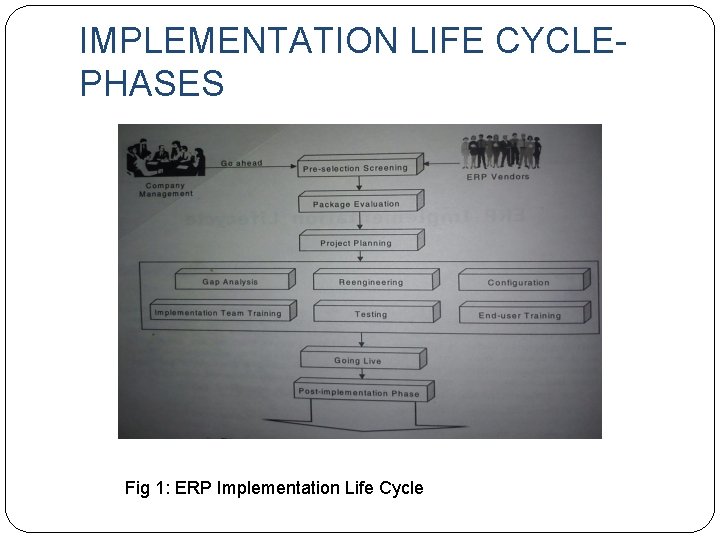
IMPLEMENTATION LIFE CYCLE �The Different Phases of Implementation are �Pre evaluation Screening �Evaluation Package �Project Planning �GAP analysis �Reengineering �Configuration �Implementation Team training �Testing �Going Live �End User Training �Post implementation
IMPLEMENTATION LIFE CYCLEPHASES Fig 1: ERP Implementation Life Cycle
Pre evaluation screening �Decision for perfect package �Number of ERP vendors �Screening eliminates the packages that are not at all suitable for the company’s business processes. �Selection is done on best few package available.
Package Evaluation �Package is selected on the basis of different parameter. �Test and certify the package and also check the coordination with different department �Selected package will determine the success or failure of the project.
Cont. �Package must be user friendly �Regular up gradation should available. �Cost
Project planning �Designs the implementation process. �Resources are identified. �Implementation team is selected and task allocated. �Special arrangement for contegencies.
Gap analysis �Most crucial phase. �Process through which company can create a model of where they are standing now and where they want to go. �Model help the company to cover the functional gap
Reengineering �Implementation is going to involve a significant change in number of employees and their job responsibilities. �Process become more automated and efficient.
Configuration �Main functional area of ERP implementation �This includes synchronizing existing company practices with the ERP packages rather than changing the source code and customizing it to suit the company �Business processes have to be understood and mapped in such a way that arrived solutions match up with the overall goal of the company
Implementation Team Training �Takes place along with the process of implementation. � Company trains its employees to implement and later, run the system. �Employee become self sufficient to implement the software after the vendors and consultant have left.
Testing �This phase is performed to find the weak link so that it can be rectified before its implementation. �Various extreme conditions are checked and made sure system is error free.
Going Live �The work is complete, data conversion is done, databases are up and running, the configuration is complete & testing is done. �The system is officially proclaimed. �Once the system is live the old system is removed
End User Training �The employee who is going to use the system are identified and trained.
Post Implementation �This is the maintenance phase. �Employees who are trained enough to handle problems those crops up time to time. �The post implementation will need a different set of roles and skills than those with less integrated kind of systems.
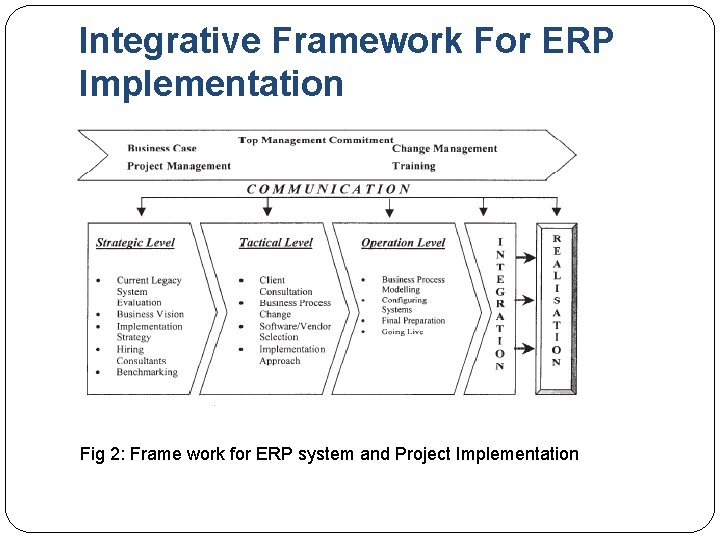
Integrative Framework For ERP Implementation �Developing Stage �Different frame works are there. Few considering operational level only. Then few integrating strategic and tactical level �The real implementation Is a mix of business process
Integrative Framework For ERP Implementation Fig 2: Frame work for ERP system and Project Implementation
Integrative Framework For ERP Implementation �Each level contains a critical factor �Each factors are not independent to each other �Each levels input varies
Dominant ERP Success Factors �Top management commitment/support �Business case �Project management �Change management �Training �Communication
Top management commitment/support � Willingness of top management to provide resources etc �Commitment should be not stopped with initiation and facilitation. Should end after full implementation only.
Business case �A true business case which can show the need for implementation �It focus on present scenario as well as expected return �Scope of project is designed based on the business case
Project Management �The most important one �A best practice of project management should includes following �Project Schedule and Plans �Monitoring and Feedback �Risk Management
Change Management �Activities , methodologies will be changed �Employees must be created awareness regarding �Employees view and their ability to change must be studied
Training �Proper training must be provided to employer �Additional benefits can be provided �An appropriate plan must be made and should be implemented
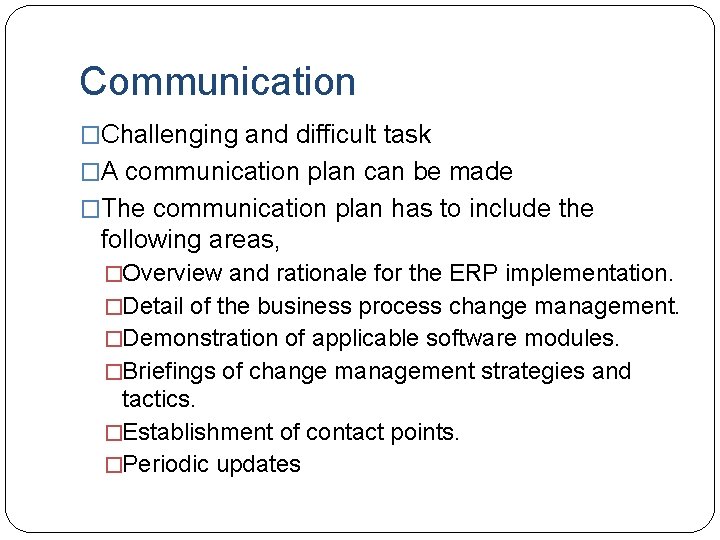
Communication �Challenging and difficult task �A communication plan can be made �The communication plan has to include the following areas, �Overview and rationale for the ERP implementation. �Detail of the business process change management. �Demonstration of applicable software modules. �Briefings of change management strategies and tactics. �Establishment of contact points. �Periodic updates
References � Sean W. O’Donnell, President, Datacor, Inc. “ 5 Steps To Successful ERP Implementation” � Anonymous , “ERP system implementation overview” , � � � � http: //media. wiley. com/product_data/excerpt/80/0471235180. pdf downloaded on 25. 03. 2012 APICS , 2008, “Introduction to ERP “ , http: //www. apicsaustin. org/education/apics_appl_ierp. aspx downloaded on 28. 03. 2012 Apur Gourav, 2003, “ ERP Implementation Life Cycle”, http: //www. slideshare. net/apurvgourav/erp-implementation-life-cycle downloaded on 30. 03. 2012 Duane Trux, 2000 “ERP Life cycle” http: //www. cis. gsu. edu/~dtruex/courses/CIS 8090/pdf/ERPLife. Cycle. pdf downloaded on 30. 03. 2012 Anonymus, 2000 http: //www. prlog. org/10345138 -what-is-erp-implementation-life-cycle. html downloaded on 30. 03. 2012 Michael Donova, “Successful ERP Implementation the First Time”, http: //www. idii. com/wp/donovan_erp_success. pdf downloaded on 30. 03. 2012 Anonymus, Enterprise resource planning”, http: //en. wikipedia. org/wiki/Enterprise_resource_planning H Akkermans and K van Helde, 2005, “Vicious and virtuous cycles in ERP implementation: a case study of interrelations between critical success factor” http: //web. rollins. edu/~tlairson/ecom/virtuouserp. pdf downloaded on 31. 03. 2012 N. Parr, 2002, “A Taxonomy of ERP Implementation Approaches”, http: //www. beyondsoft. com/doc/Success_stories_Mettler_Toledo. pdf downloaded on 25. 03. 2012
References � Philippe Dugerdil, Gil Gaillard, 2003, “Model-Driven ERP Implementation”http: //campus. hesge. ch/dugerdilp/_private/ICEIS 2006. pdf downloaded on 25. 03. 2012 � Ada Won, 2005, “Critical Failure Factors in ERP Implementation” http: //www. pacis-net. org/file/2005/395. pdf downloaded on 31. 03. 2012 � Xavier Thavaruban Thavapragasa, 2005, ”CULTURAL INFLUENCES ON ERP IMPLEMENTATION � SUCCESS “ , http: //www. cs. berkeley. edu/~benr/publications/auscc 03/papers/t havapragasam-auscc 03. pdf downloaded on 31. 03. 2012 � Jiang Yingjie, 2004, ”Critical Success Factors in ERP Implementation in Finland” http: //www. pafis. shh. fi/graduates/yinjia 03. pdf downloaded on 31. 03. 2012 � Chan-Hsing Lo, Chih-Hung Tsai, and Rong-Kwei LA, 2006 “Case Study of ERP Implementation “http: //www. journal. au. edu/ijcim/2005/jan 05/IJCIM-V 131 -pp 2. pdf downloaded on 31. 03. 2012