
EROSION Erosion process by which sediments are obtained
EROSION Erosion - process by which sediments are obtained and carried away. Ø it wears away and lowers the surface features of the Earth. 1
Gravity is the driving force for most agents of erosion; It is the force which drives…. Ø mass wasting Ø running water Ø ice (glaciers) 2
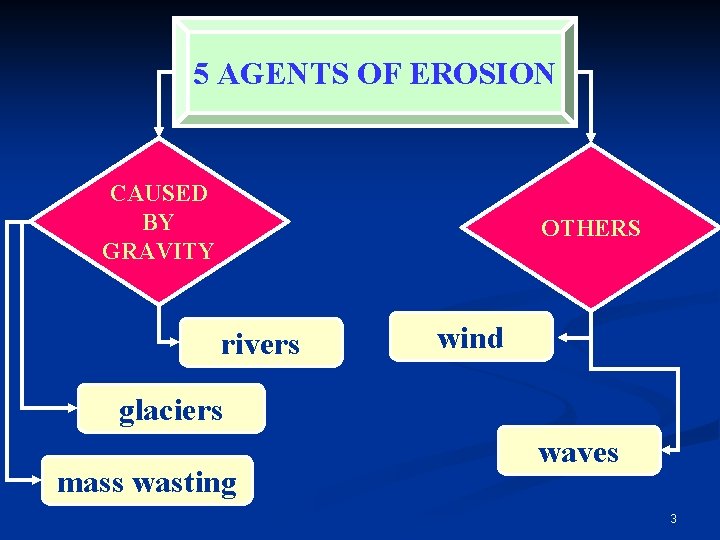
5 AGENTS OF EROSION CAUSED BY GRAVITY OTHERS rivers wind glaciers mass wasting waves 3

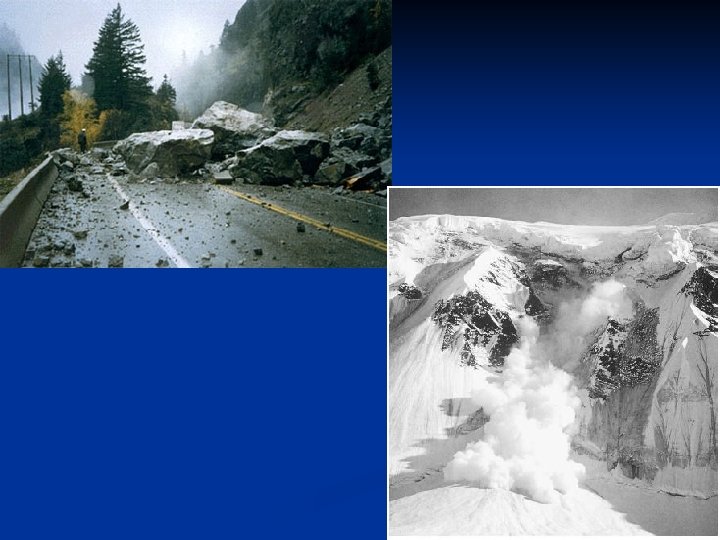
1 – Mass Wasting (mass movement) Ø erosion and deposition done directly by gravity. examples; Øcreep, mudslides, avalanches, landslides. La Conchita, CA 1995 landslide (Courtesy USGS) 4
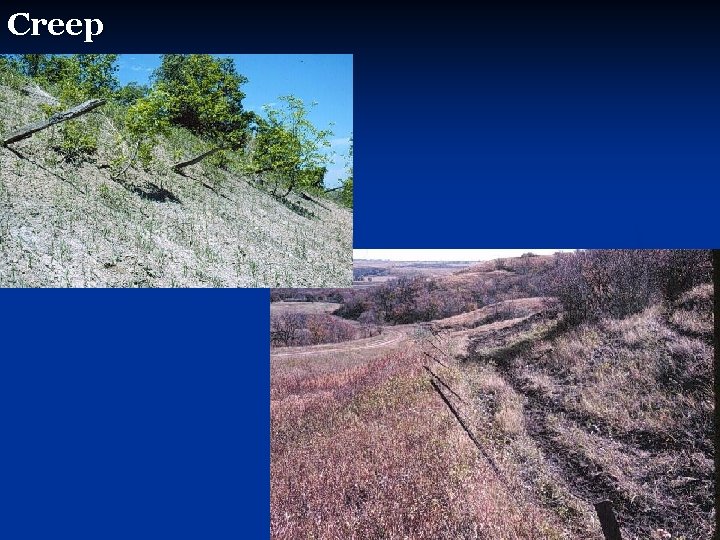
Creep 5
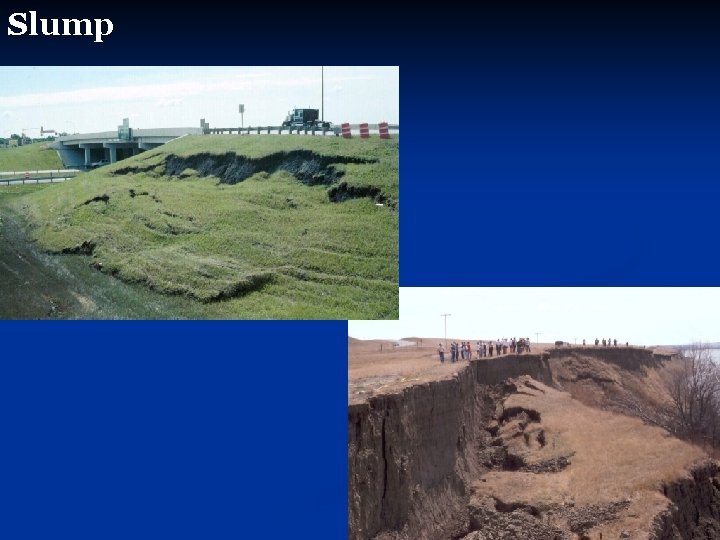
Slump 6
7
Two forces are involved in mass wasting; 1 – the downward pull of gravity. 2 – friction – which holds objects in place. 8
Mass movements often occur after heavy rainfall. Ø the water that soaks into the soil adds mass (downward pull of gravity increases). Ø the water reduces the amount of friction. 9
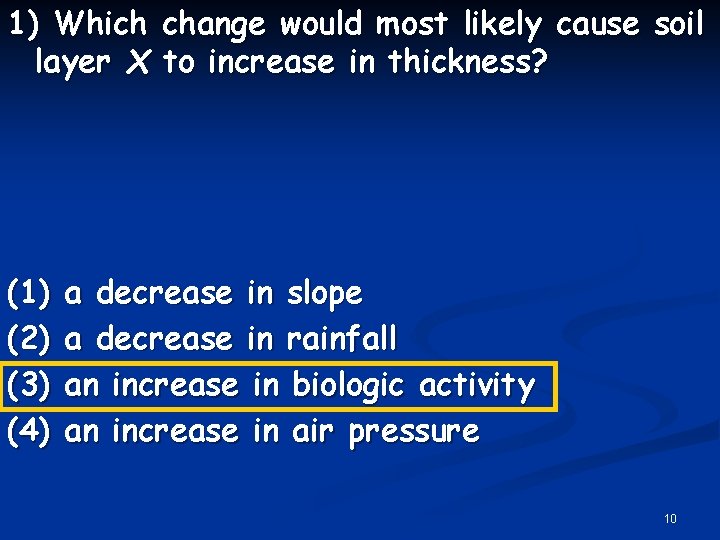
1) Which change would most likely cause soil layer X to increase in thickness? (1) (2) (3) (4) a decrease in slope a decrease in rainfall an increase in biologic activity an increase in air pressure 10
2) Which event is the best example of erosion? (1) breaking apart of shale as a result of water freezing in a crack (2) dissolving of rock particles on a limestone gravestone by acid rain (3) rolling of a pebble along the bottom of a stream (4) crumbling of bedrock in one area to form soil 11
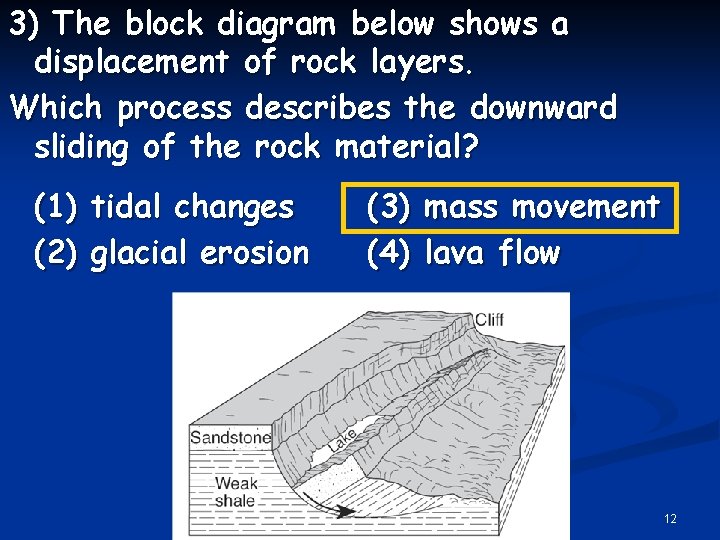
3) The block diagram below shows a displacement of rock layers. Which process describes the downward sliding of the rock material? (1) tidal changes (2) glacial erosion (3) mass movement (4) lava flow 12
4) Unsorted, angular, rough-surfaced cobbles and boulders are found at the base of a cliff. What most likely transported these cobbles and boulders? (1) running water (3) gravity (2) wind (4) ocean currents 13
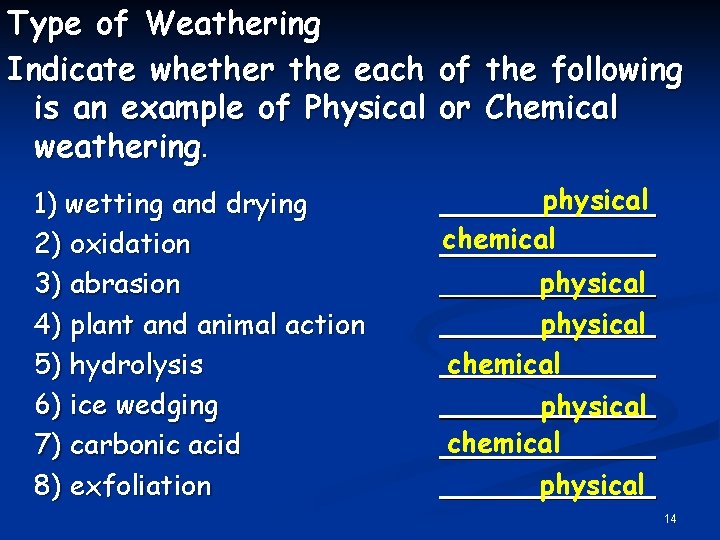
Type of Weathering Indicate whether the each of the following is an example of Physical or Chemical weathering. 1) wetting and drying 2) oxidation 3) abrasion 4) plant and animal action 5) hydrolysis 6) ice wedging 7) carbonic acid 8) exfoliation physical chemical physical 14
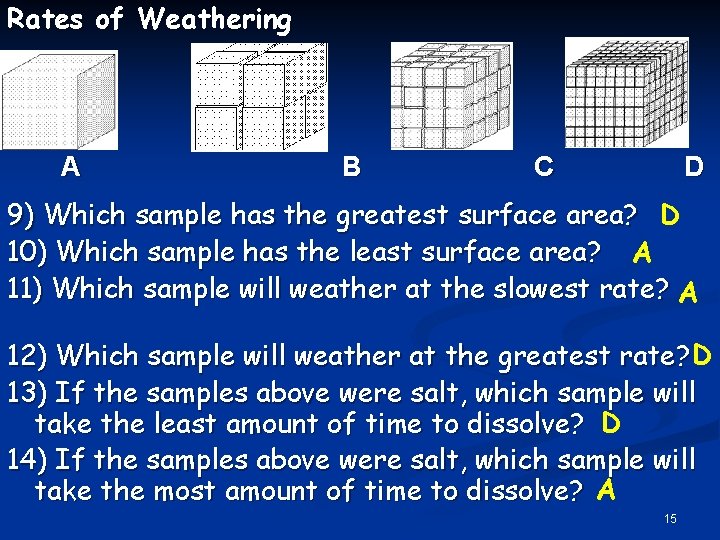
Rates of Weathering A B C D 9) Which sample has the greatest surface area? D 10) Which sample has the least surface area? A 11) Which sample will weather at the slowest rate? A 12) Which sample will weather at the greatest rate? D 13) If the samples above were salt, which sample will take the least amount of time to dissolve? D 14) If the samples above were salt, which sample will take the most amount of time to dissolve? A 15
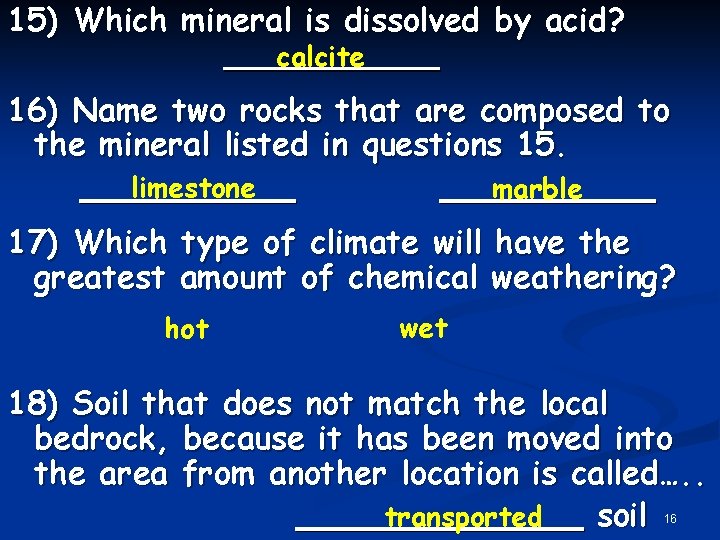
15) Which mineral is dissolved by acid? calcite 16) Name two rocks that are composed to the mineral listed in questions 15. limestone marble 17) Which type of climate will have the greatest amount of chemical weathering? hot wet 18) Soil that does not match the local bedrock, because it has been moved into the area from another location is called…. . soil transported 16
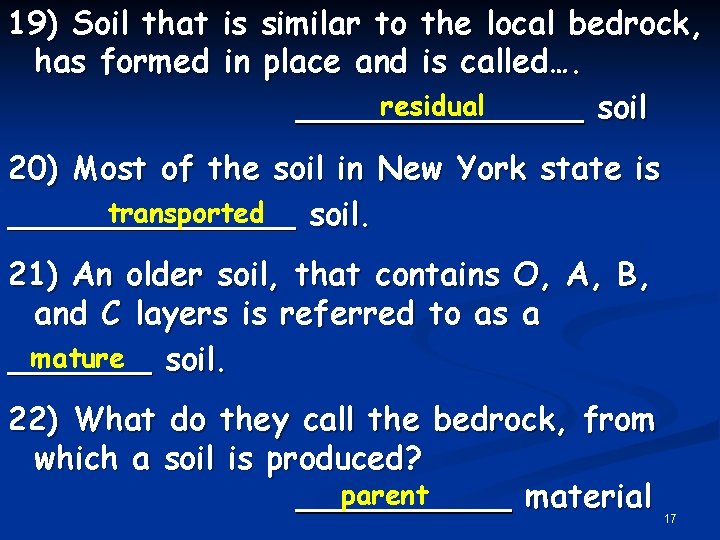
19) Soil that is similar to the local bedrock, has formed in place and is called…. residual soil 20) Most of the soil in New York state is transported soil. 21) An older soil, that contains O, A, B, and C layers is referred to as a mature soil. 22) What do they call the bedrock, from which a soil is produced? parent material 17
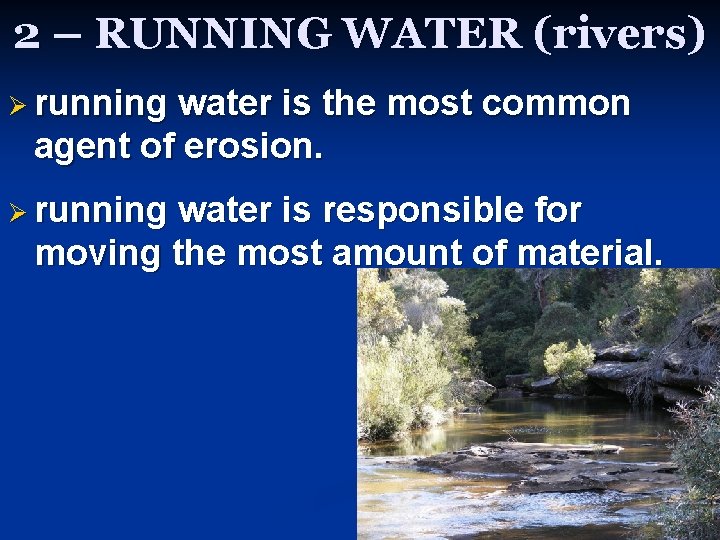
2 – RUNNING WATER (rivers) Ø running water is the most common agent of erosion. Ø running water is responsible for moving the most amount of material. 18
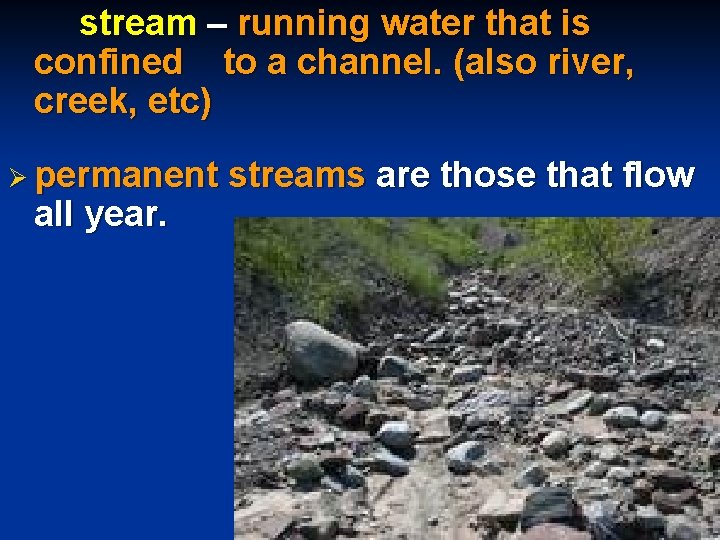
stream – running water that is confined to a channel. (also river, creek, etc) Ø permanent all year. streams are those that flow 19
River terms 20
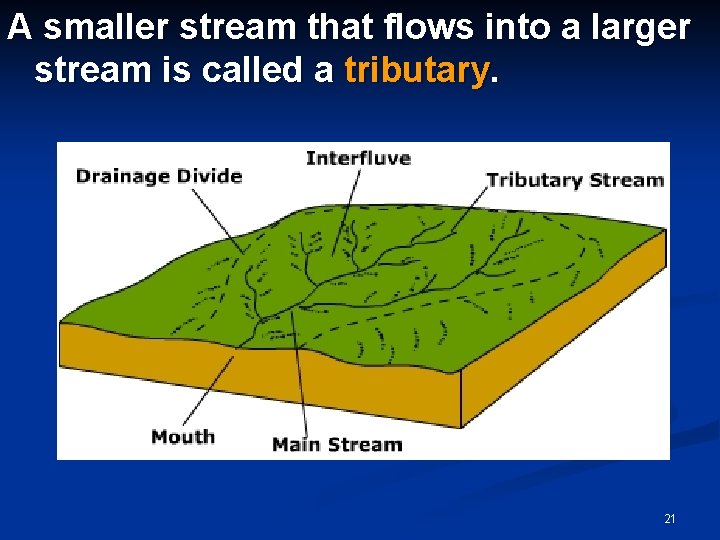
A smaller stream that flows into a larger stream is called a tributary. 21
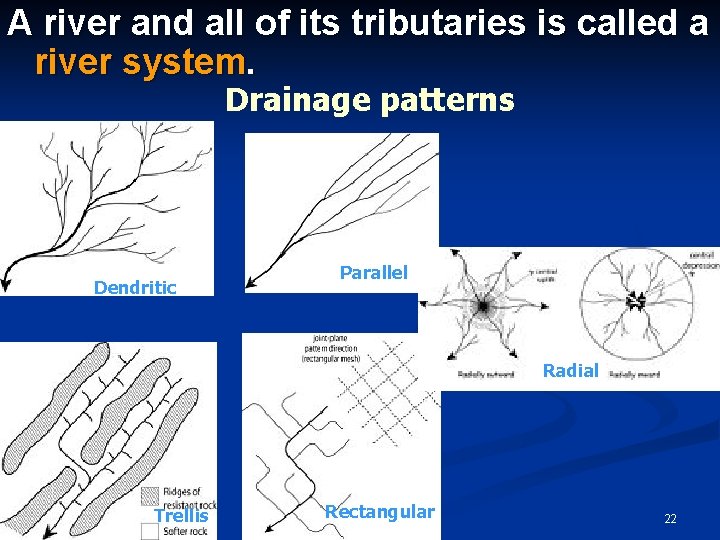
A river and all of its tributaries is called a river system. Drainage patterns Dendritic Parallel Radial Trellis Rectangular 22
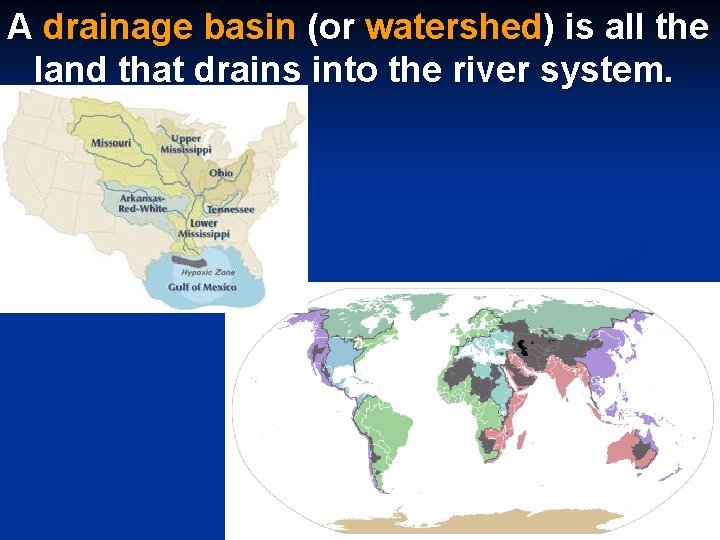
A drainage basin (or watershed) is all the land that drains into the river system. 23
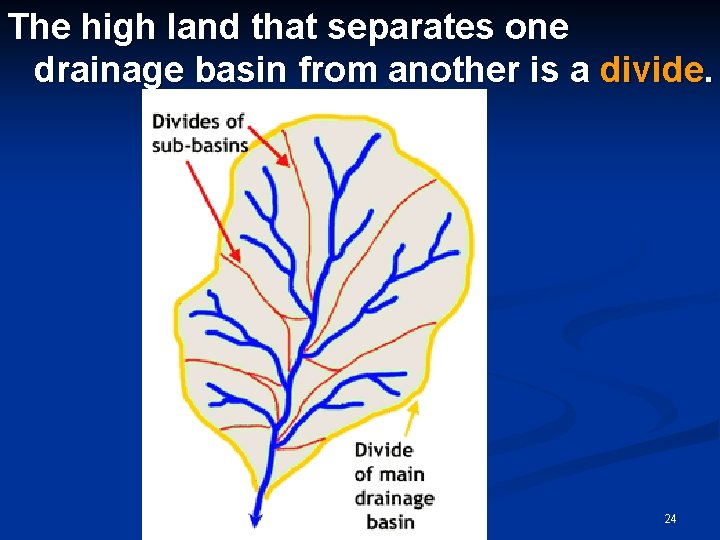
The high land that separates one drainage basin from another is a divide. 24
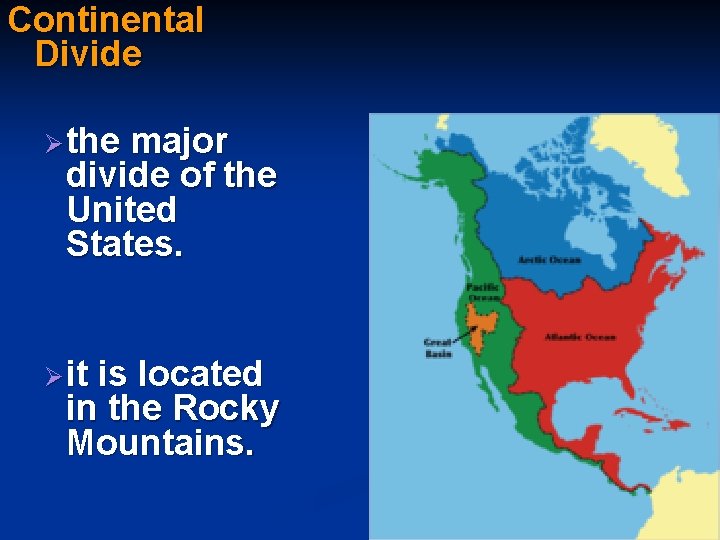
Continental Divide Ø the major divide of the United States. Ø it is located in the Rocky Mountains. 25
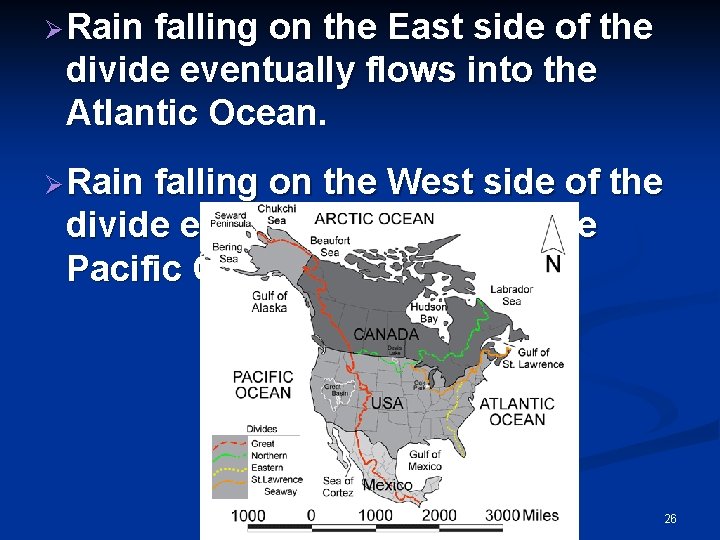
Ø Rain falling on the East side of the divide eventually flows into the Atlantic Ocean. Ø Rain falling on the West side of the divide eventually flows into the Pacific Ocean. 26
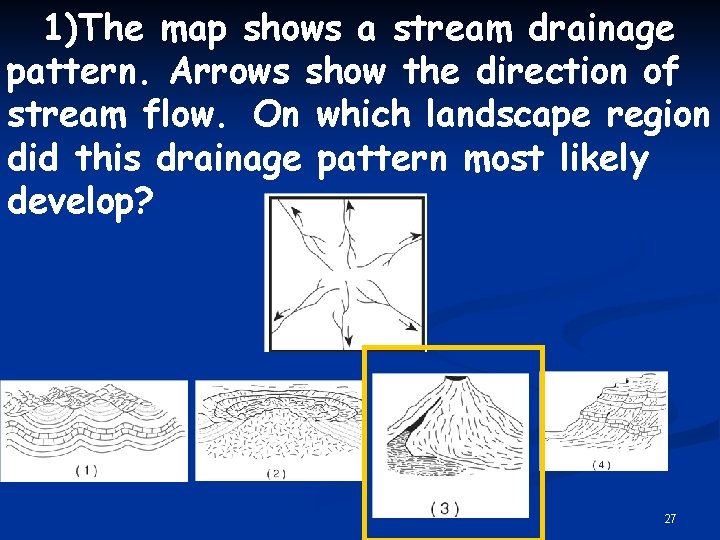
1)The map shows a stream drainage pattern. Arrows show the direction of stream flow. On which landscape region did this drainage pattern most likely develop? 27
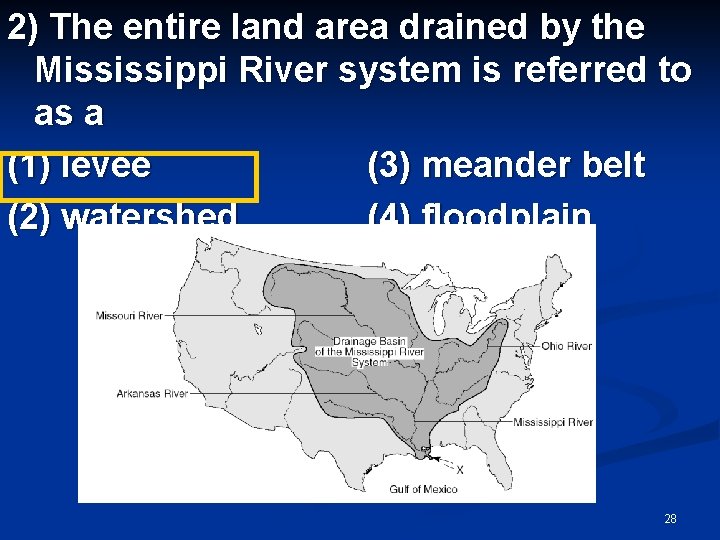
2) The entire land area drained by the Mississippi River system is referred to as a (1) levee (3) meander belt (2) watershed (4) floodplain 28
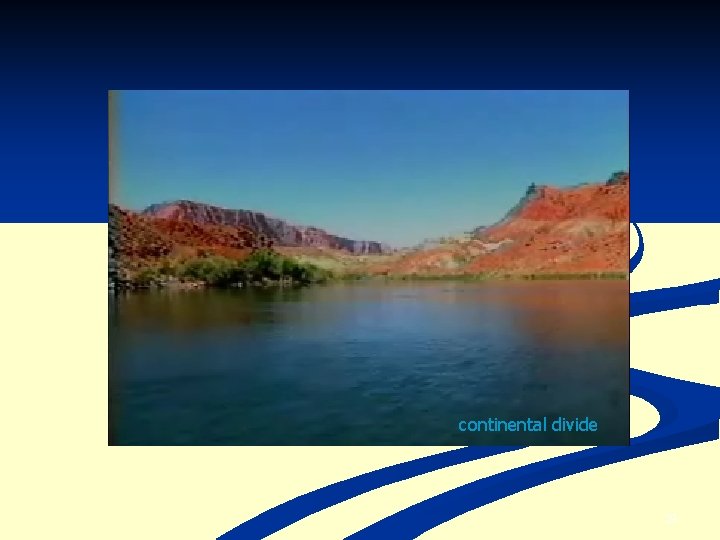
continental divide 29
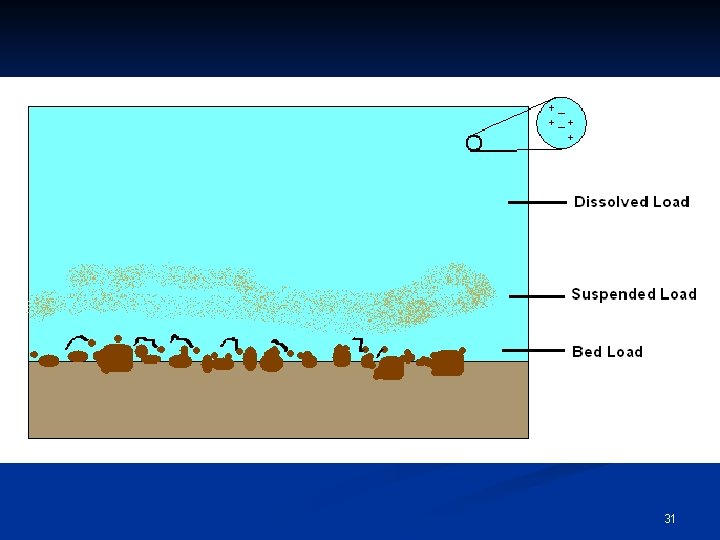
3 Ways in Which streams carry sediment 1 – Solution Ø mineral matter that has been dissolved from the bedrock (ex calcium). 2 – Suspension Ø material carried by the river (clay, silt, fine sand). 3 – Bed Load (saltation or traction) Ø heavier materials that are moved 30
31
Velocity of a stream; As the velocity of the river increases… Ø The amount of material that it can carry will increase. Ø The size of the largest particle it can carry will increase. SEE ESRT 32
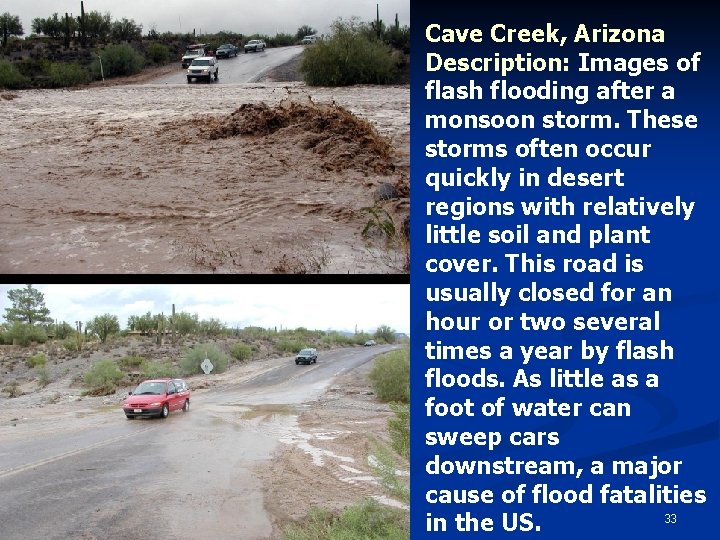
Cave Creek, Arizona Description: Images of flash flooding after a monsoon storm. These storms often occur quickly in desert regions with relatively little soil and plant cover. This road is usually closed for an hour or two several times a year by flash floods. As little as a foot of water can sweep cars downstream, a major cause of flood fatalities 33 in the US.
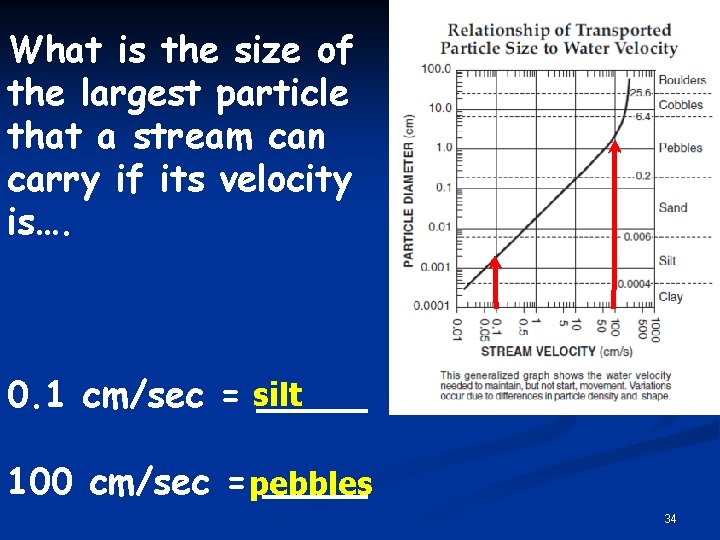
What is the size of the largest particle that a stream can carry if its velocity is…. 0. 1 cm/sec = silt 100 cm/sec = pebbles 34
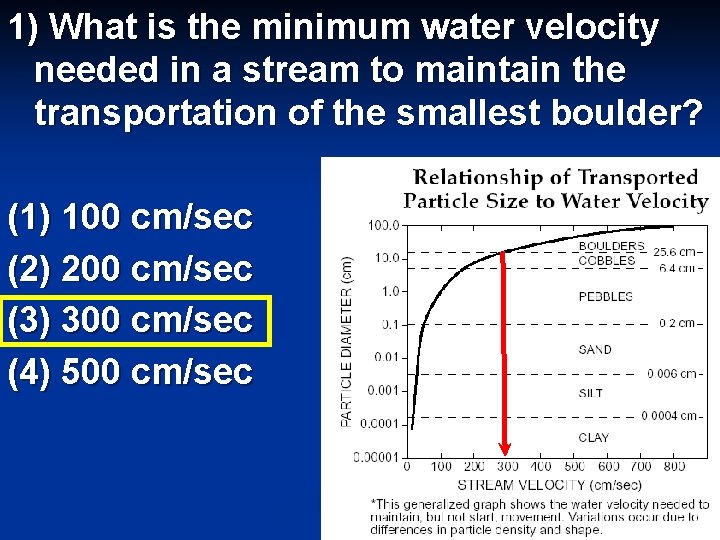
1) What is the minimum water velocity needed in a stream to maintain the transportation of the smallest boulder? (1) 100 cm/sec (2) 200 cm/sec (3) 300 cm/sec (4) 500 cm/sec 35
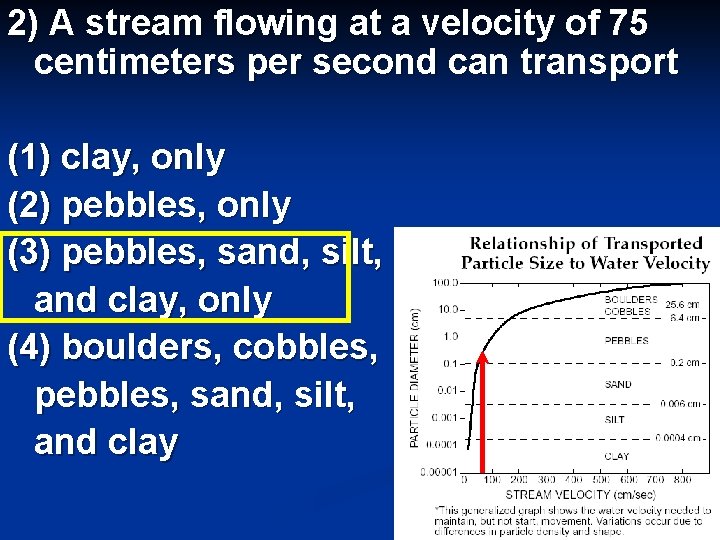
2) A stream flowing at a velocity of 75 centimeters per second can transport (1) clay, only (2) pebbles, only (3) pebbles, sand, silt, and clay, only (4) boulders, cobbles, pebbles, sand, silt, and clay 36
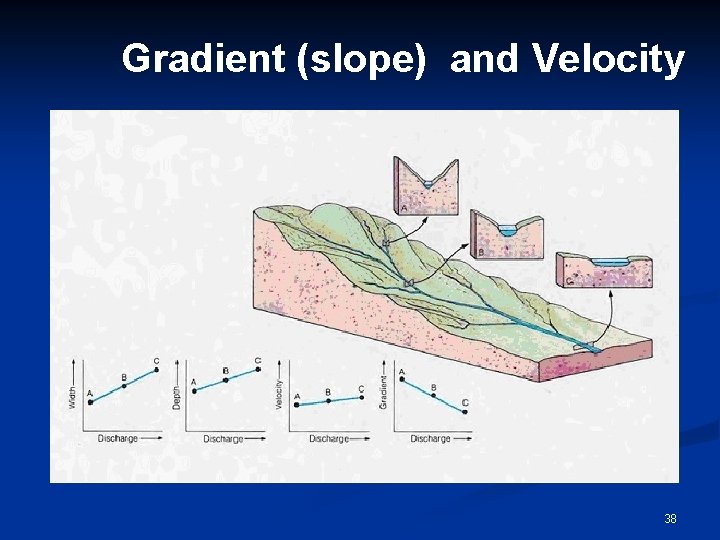
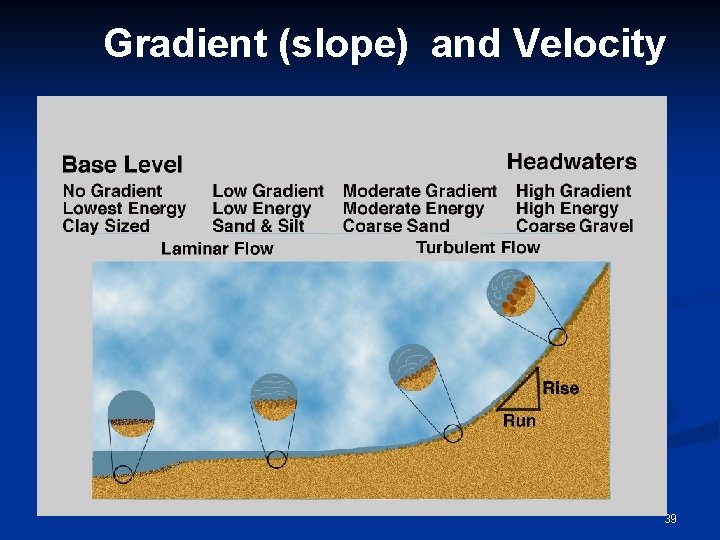
Three Factors that affect Stream Velocity 1 – gradient (slope of the stream). Ø as gradient increases, velocity increases. 2 – discharge (the volume of water in the stream) Ø as discharge increases, velocity increases. 3 – channel shape 37
Gradient (slope) and Velocity 38
Gradient (slope) and Velocity 39
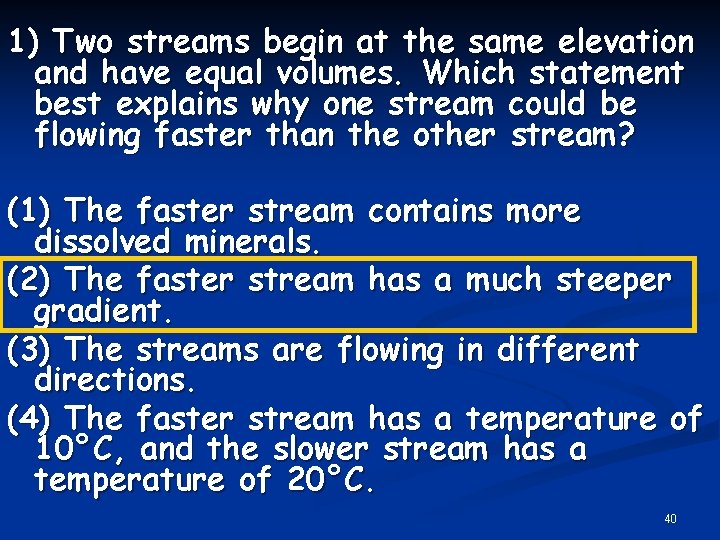
1) Two streams begin at the same elevation and have equal volumes. Which statement best explains why one stream could be flowing faster than the other stream? (1) The faster stream contains more dissolved minerals. (2) The faster stream has a much steeper gradient. (3) The streams are flowing in different directions. (4) The faster stream has a temperature of 10°C, and the slower stream has a temperature of 20°C. 40
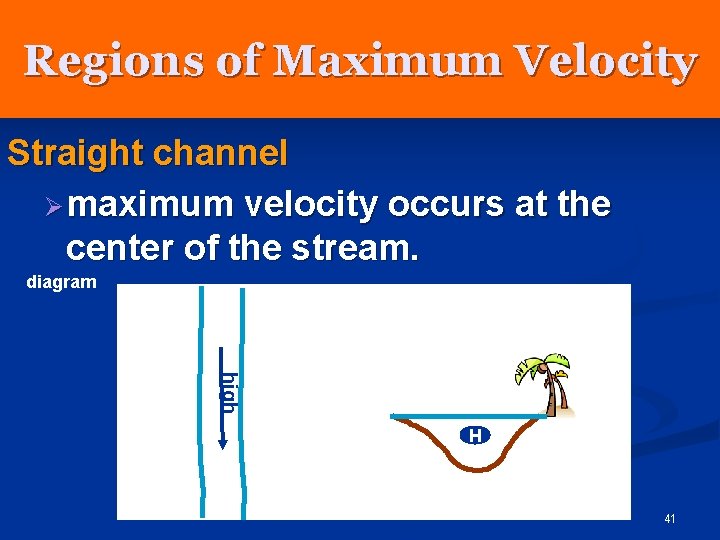
Regions of Maximum Velocity Straight channel Ø maximum velocity occurs at the center of the stream. diagram high H 41
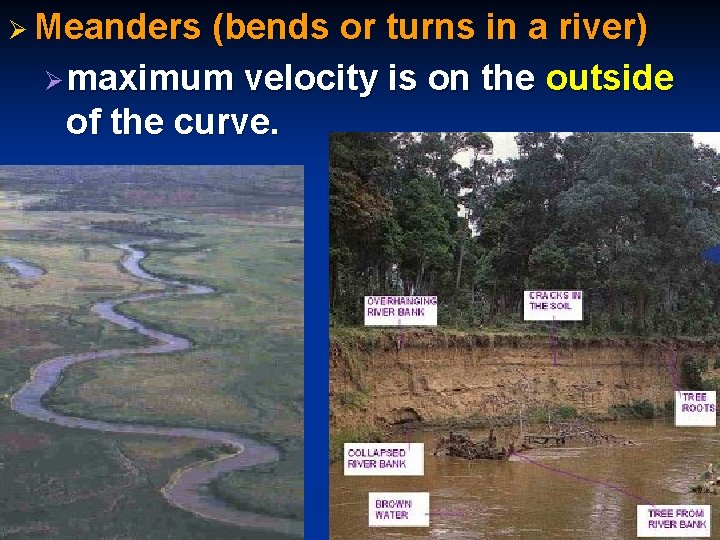
Ø Meanders (bends or turns in a river) Ø maximum velocity is on the outside of the curve. 42
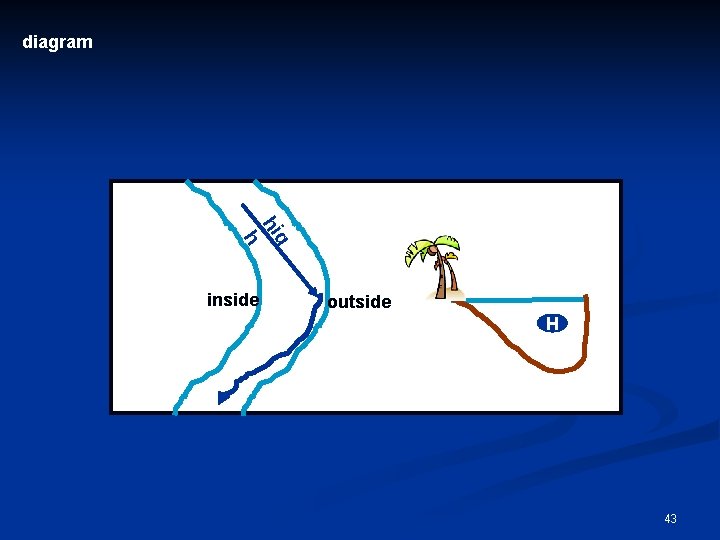
diagram g hi h inside outside H 43
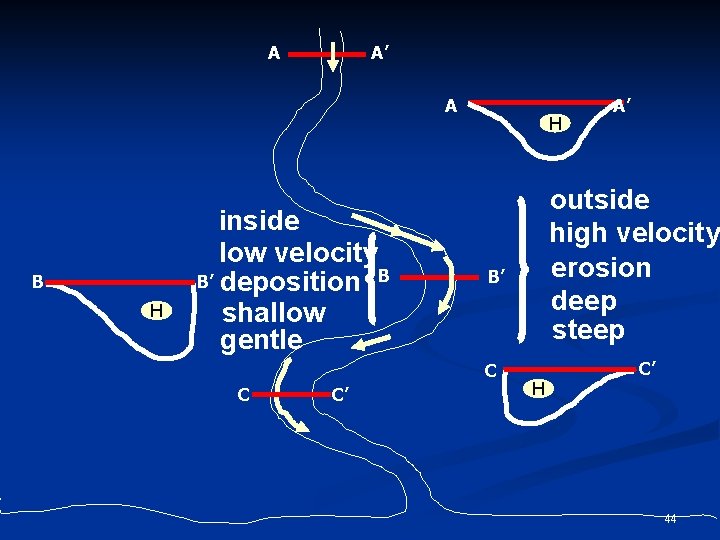
A A’ A B H inside low velocity B’ deposition B shallow gentle H C C’ outside high velocity erosion deep steep B’ C A’ C’ H 44

Ø Velocity also varies with depth Ø Friction, with the stream bed, causes the velocity to decrease. Ø greatest velocity is just below the surface. diagram H classzone. com 45
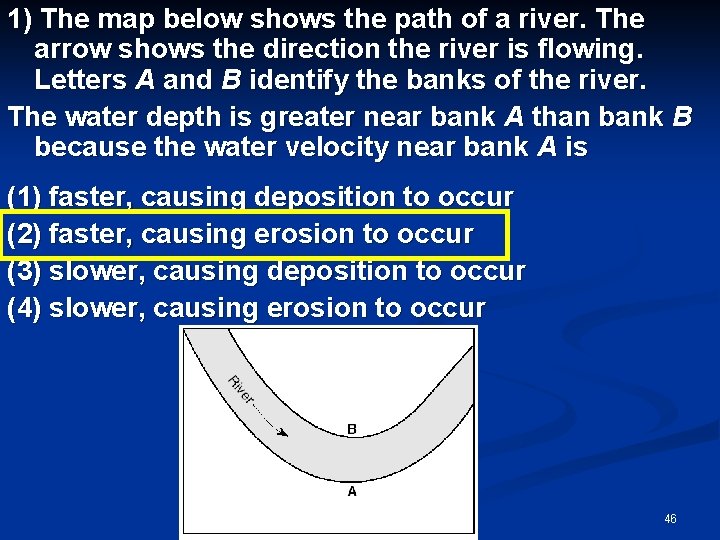
1) The map below shows the path of a river. The arrow shows the direction the river is flowing. Letters A and B identify the banks of the river. The water depth is greater near bank A than bank B because the water velocity near bank A is (1) faster, causing deposition to occur (2) faster, causing erosion to occur (3) slower, causing deposition to occur (4) slower, causing erosion to occur 46
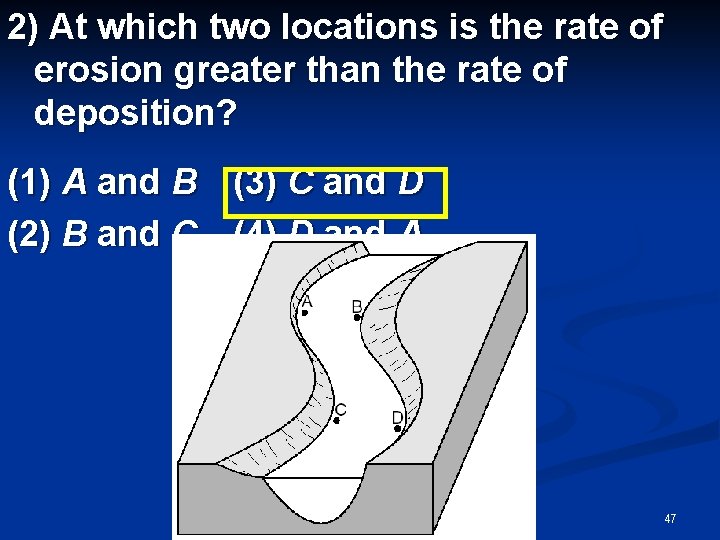
2) At which two locations is the rate of erosion greater than the rate of deposition? (1) A and B (3) C and D (2) B and C (4) D and A 47
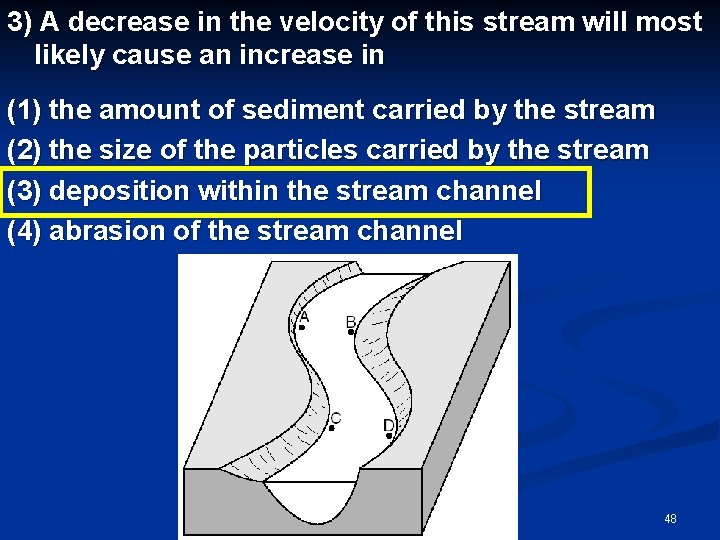
3) A decrease in the velocity of this stream will most likely cause an increase in (1) the amount of sediment carried by the stream (2) the size of the particles carried by the stream (3) deposition within the stream channel (4) abrasion of the stream channel 48
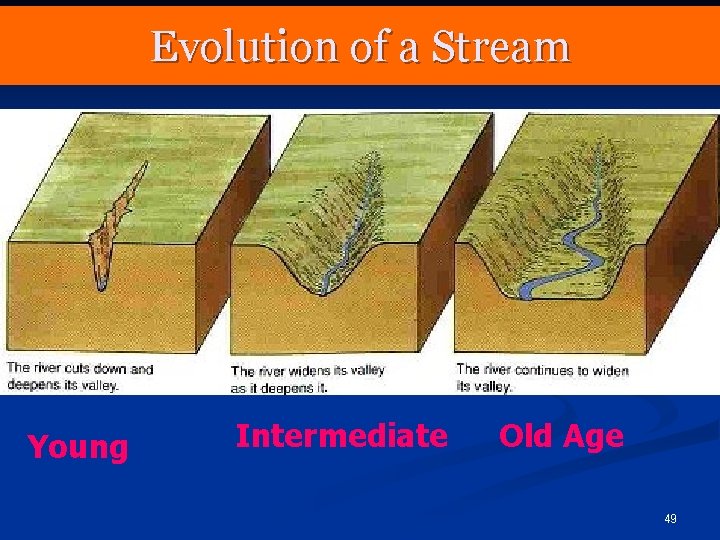
Evolution of a Stream Young Intermediate Old Age 49
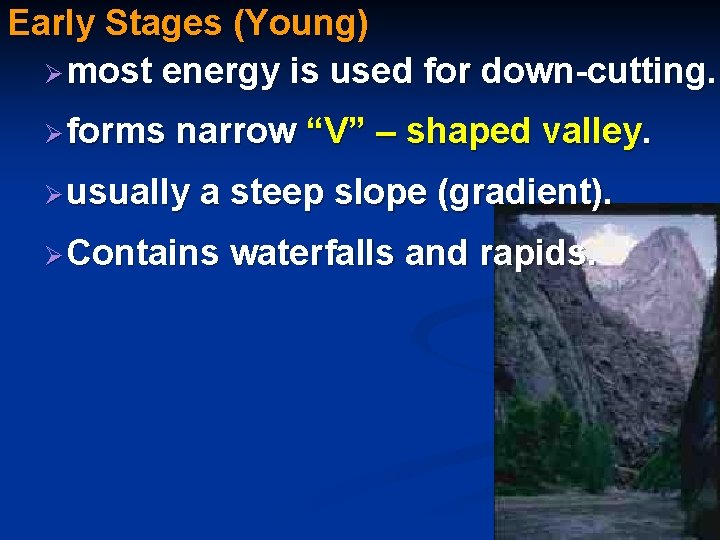
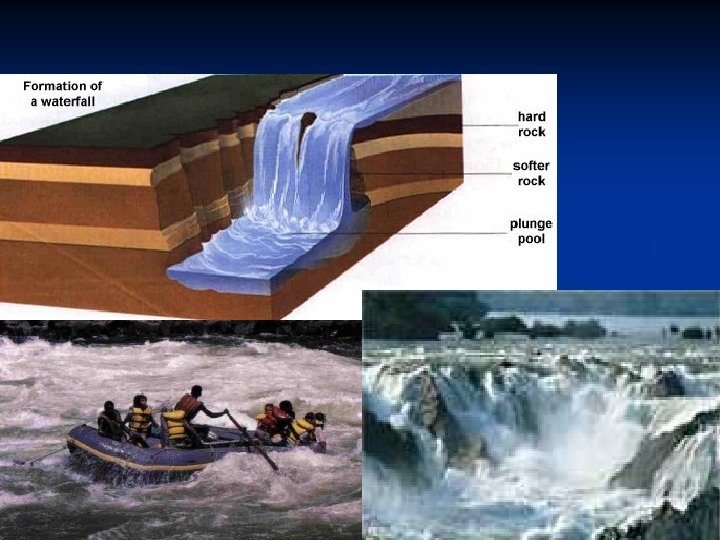
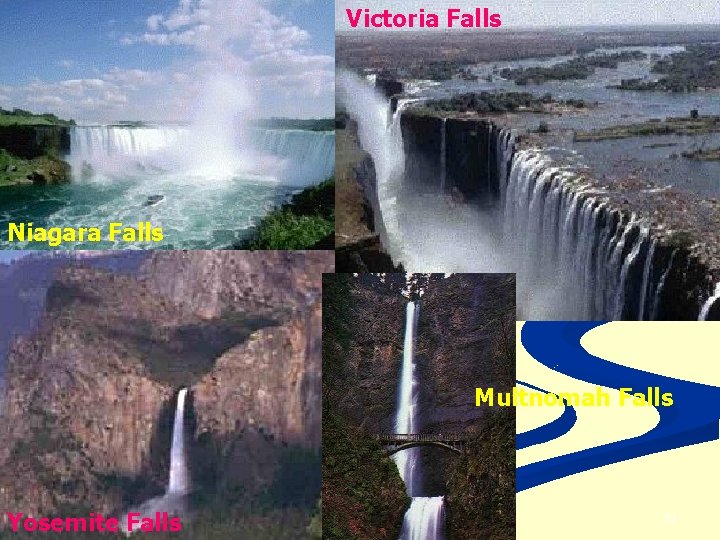
Early Stages (Young) Ø most energy is used for down-cutting. Ø forms narrow “V” – shaped valley. Ø usually a steep slope (gradient). Ø Contains waterfalls and rapids. 50
51
Victoria Falls Niagara Falls Multnomah Falls Yosemite Falls 52
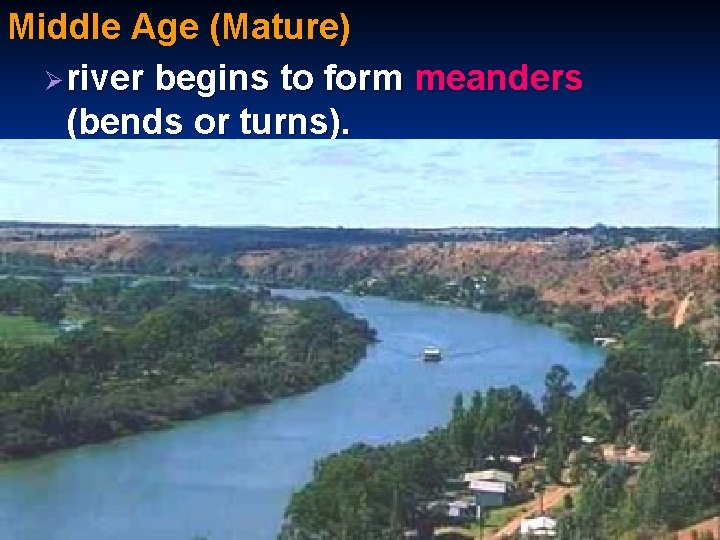
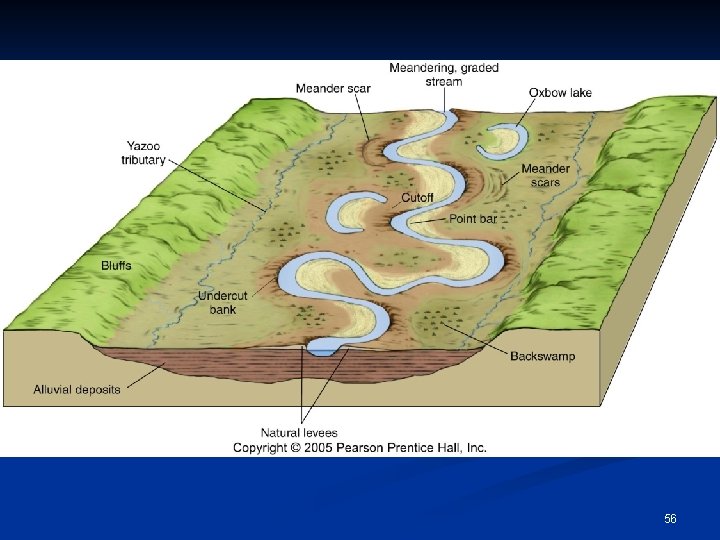
Middle Age (Mature) Ø river begins to form meanders (bends or turns). 53
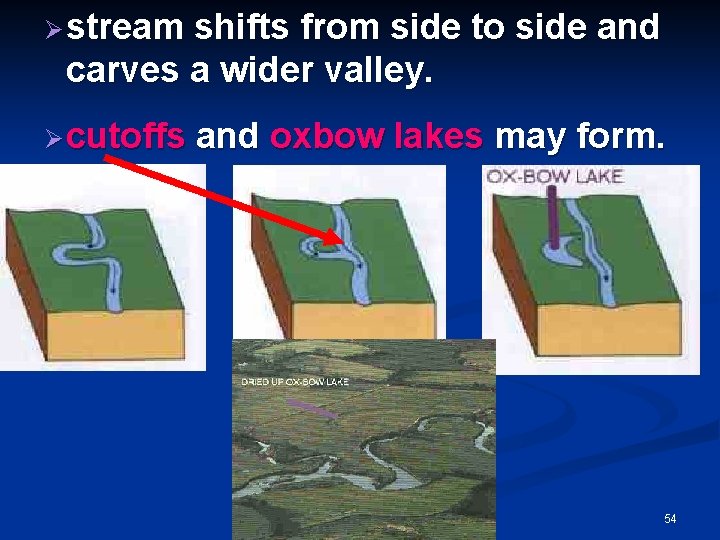
Ø stream shifts from side to side and carves a wider valley. Ø cutoffs and oxbow lakes may form. 54
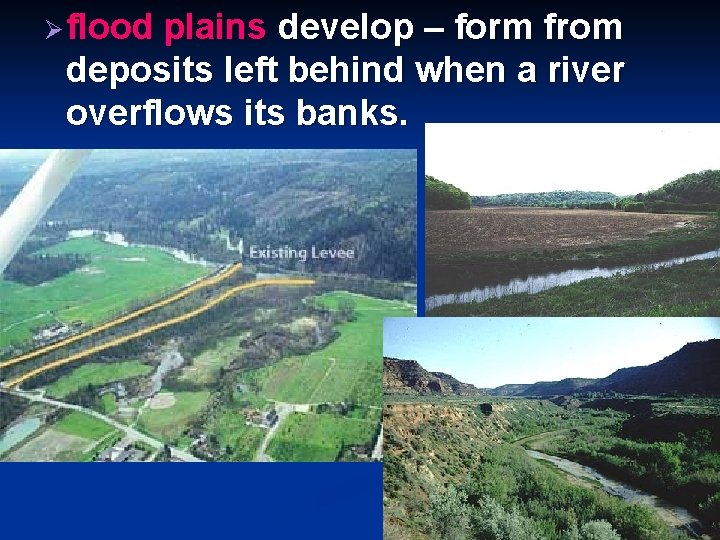
Ø flood plains develop – form from deposits left behind when a river overflows its banks. 55
56
Old Age Ø meanders, cut-offs and oxbow lakes. Ø little slope (gradient). Ø very wide valley and floodplain. 57
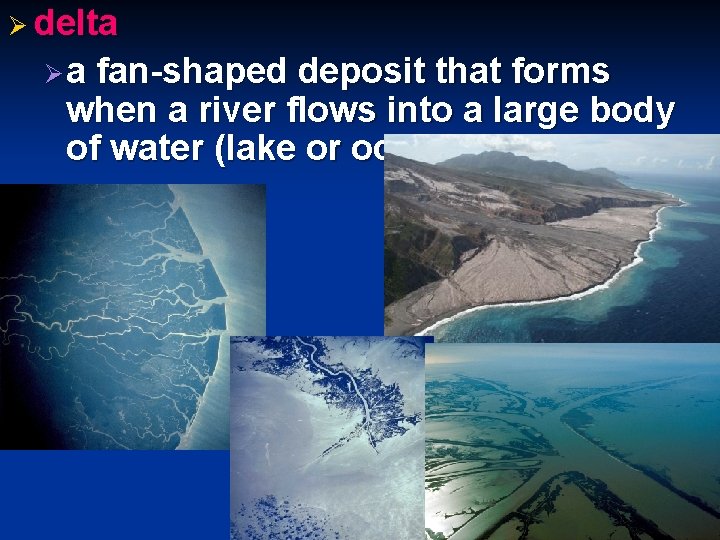
Ø delta Øa fan-shaped deposit that forms when a river flows into a large body of water (lake or ocean). 58
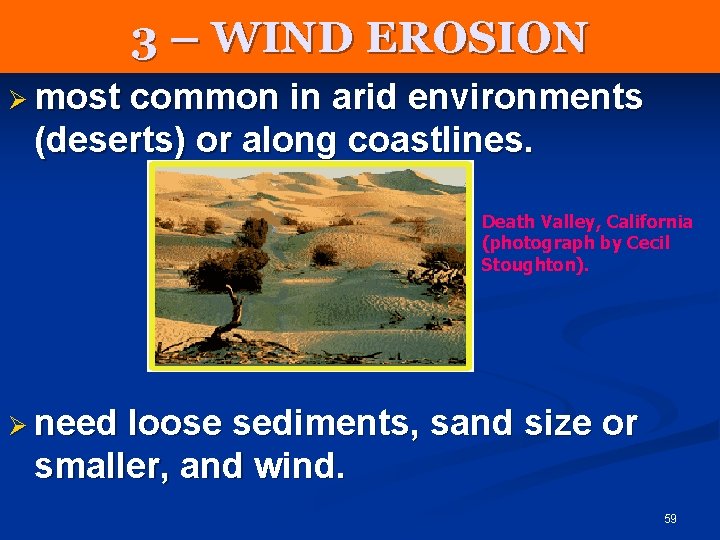
3 – WIND EROSION Ø most common in arid environments (deserts) or along coastlines. Death Valley, California (photograph by Cecil Stoughton). Ø need loose sediments, sand size or smaller, and wind. 59
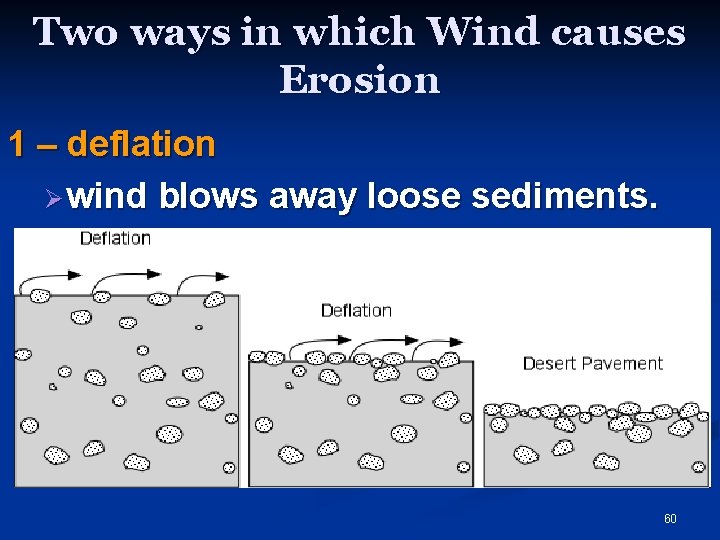
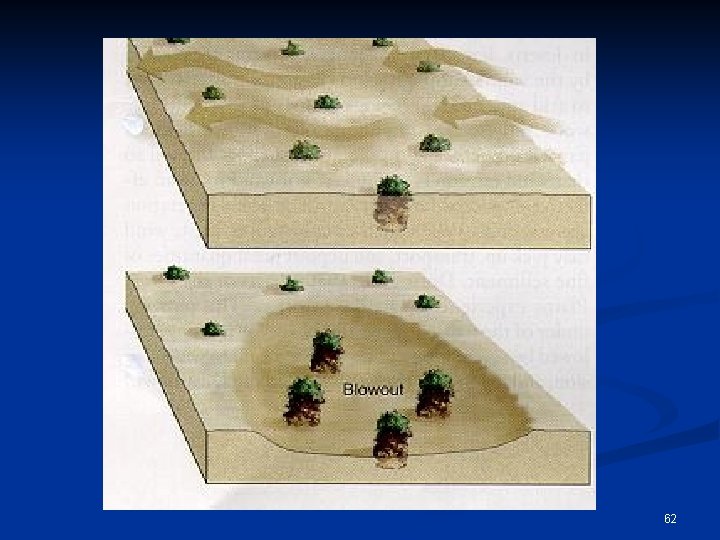
Two ways in which Wind causes Erosion 1 – deflation Ø wind blows away loose sediments. 60
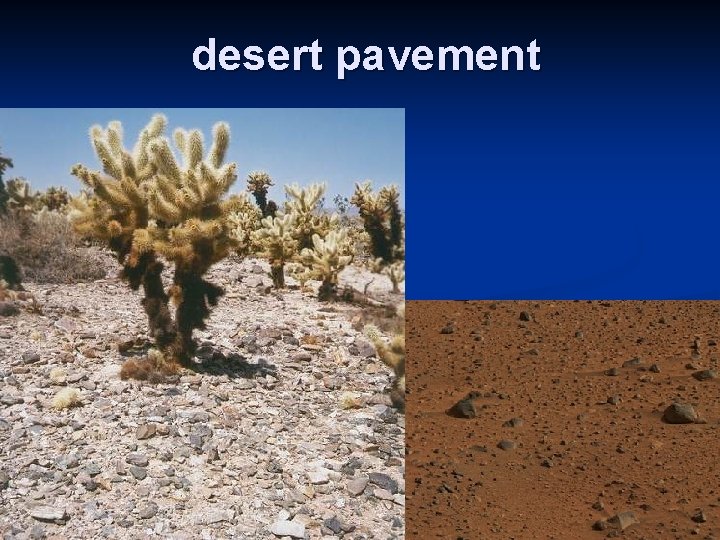
desert pavement 61
62
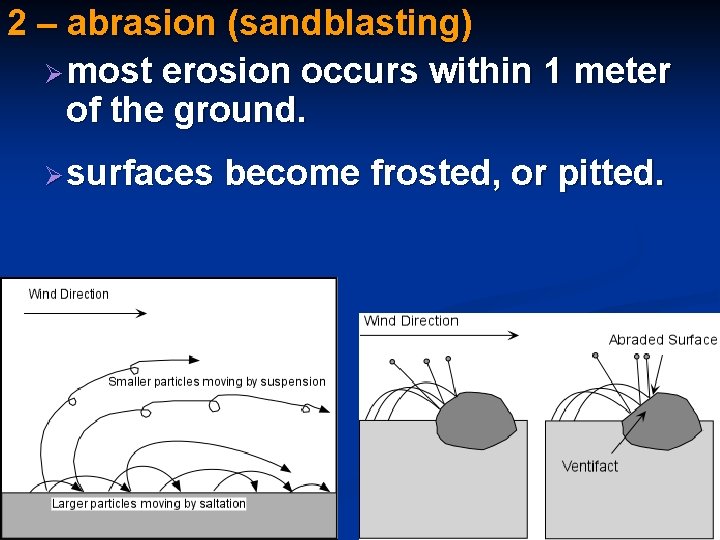
2 – abrasion (sandblasting) Ø most erosion occurs within 1 meter of the ground. Ø surfaces become frosted, or pitted. 63
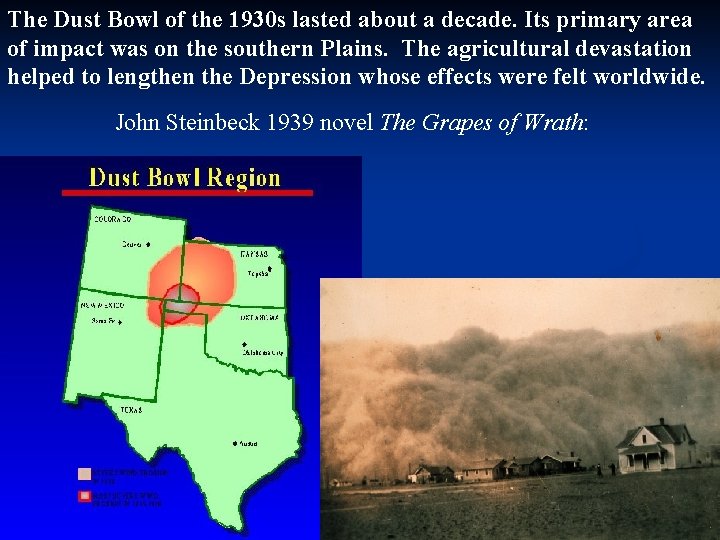
The Dust Bowl of the 1930 s lasted about a decade. Its primary area of impact was on the southern Plains. The agricultural devastation helped to lengthen the Depression whose effects were felt worldwide. John Steinbeck 1939 novel The Grapes of Wrath: Texas 1935 64
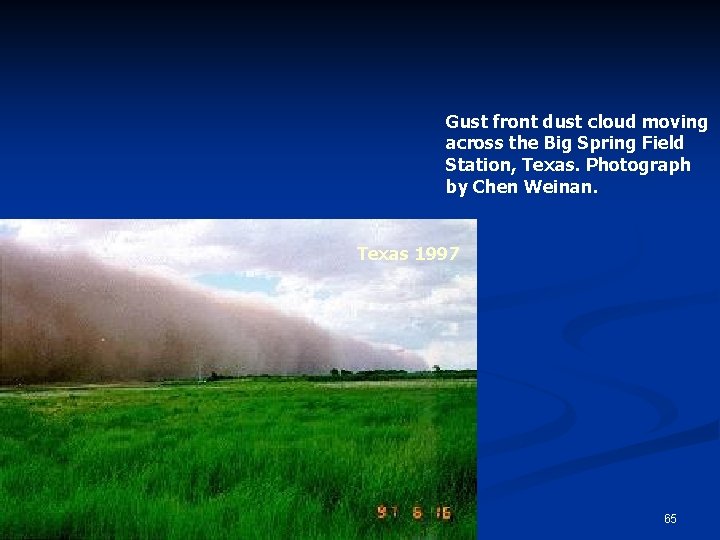
Gust front dust cloud moving across the Big Spring Field Station, Texas. Photograph by Chen Weinan. Texas 1997 65

66
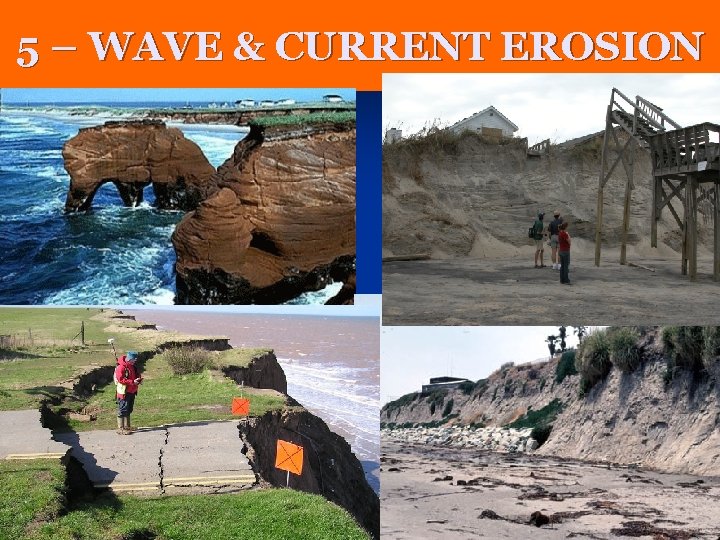
5 – WAVE & CURRENT EROSION 67
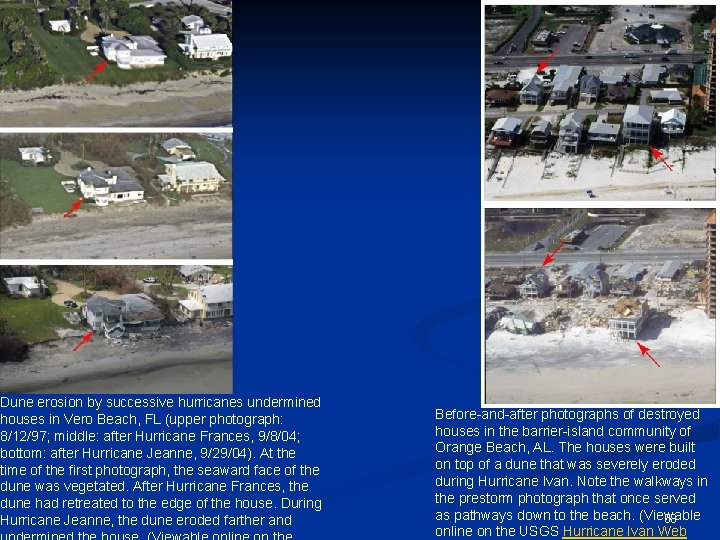
Dune erosion by successive hurricanes undermined houses in Vero Beach, FL (upper photograph: 8/12/97; middle: after Hurricane Frances, 9/8/04; bottom: after Hurricane Jeanne, 9/29/04). At the time of the first photograph, the seaward face of the dune was vegetated. After Hurricane Frances, the dune had retreated to the edge of the house. During Hurricane Jeanne, the dune eroded farther and Before-and-after photographs of destroyed houses in the barrier-island community of Orange Beach, AL. The houses were built on top of a dune that was severely eroded during Hurricane Ivan. Note the walkways in the prestorm photograph that once served as pathways down to the beach. (Viewable 68 online on the USGS Hurricane Ivan Web
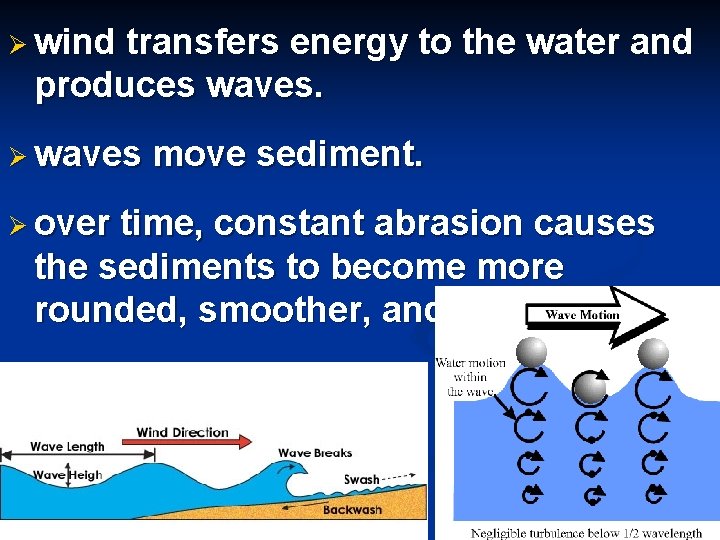
Ø wind transfers energy to the water and produces waves. Ø waves move sediment. Ø over time, constant abrasion causes the sediments to become more rounded, smoother, and smaller. 69
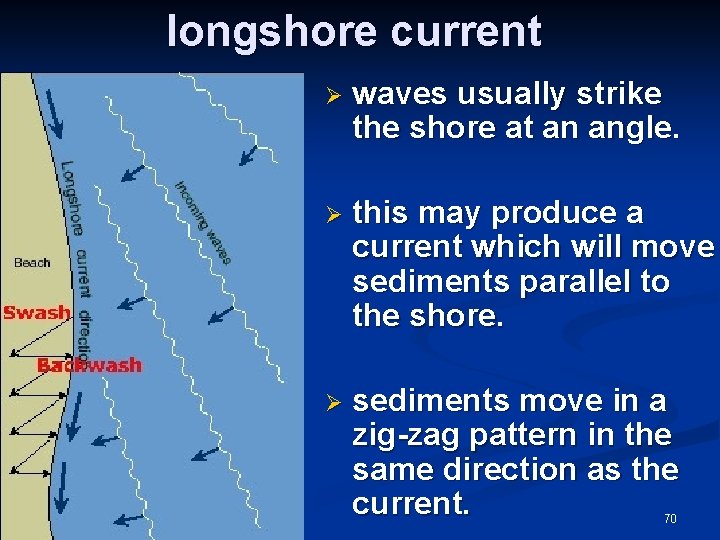
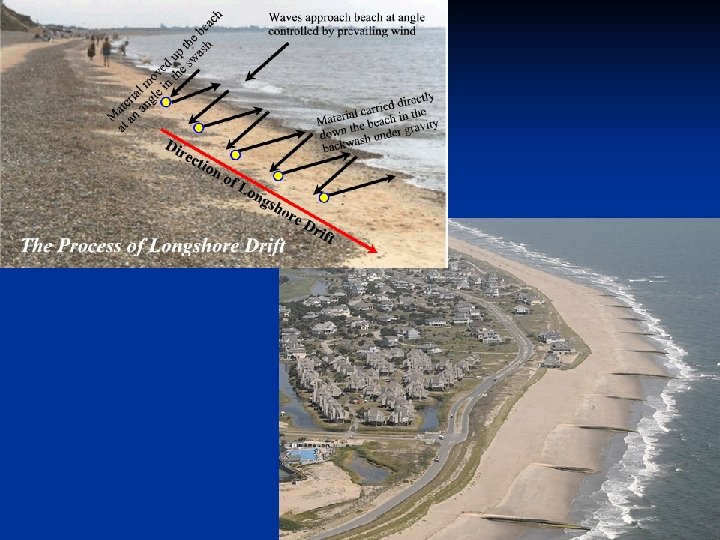
longshore current Ø waves usually strike the shore at an angle. Ø this may produce a current which will move sediments parallel to the shore. Ø sediments move in a zig-zag pattern in the same direction as the current. 70
71
- Slides: 71