
Erin Marra MD Aventura Hospital and Medical Center
- Slides: 53
Erin Marra MD Aventura Hospital and Medical Center 2016 Jeopardy Wound Management
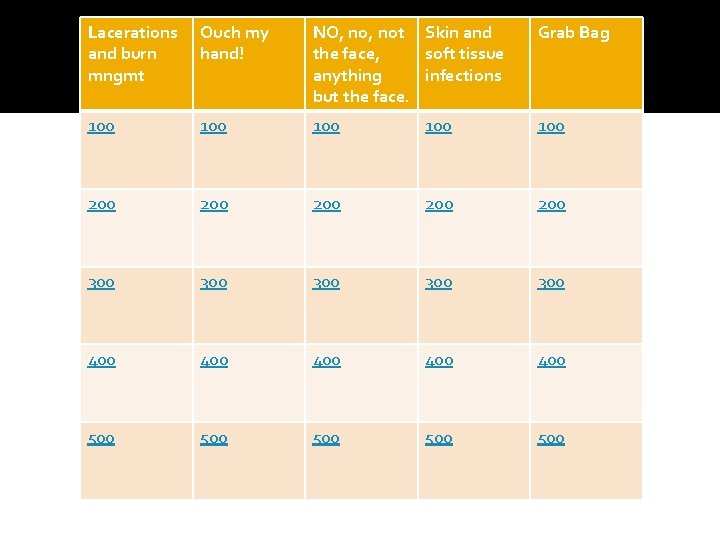
Lacerations and burn mngmt Ouch my hand! NO, not Skin and the face, soft tissue anything infections but the face. Grab Bag 100 100 100 200 200 200 300 300 300 400 400 400 500 500 500
Lacerations and burns 100 �Which of the following is the most appropriate suture to use for gaping intraoral lacerations involving the mucosal surface? A. 6 -0 nylon B. 6 -0 vicryl C. 4 -0 nylon D. 4 -0 vicryl E. 2 -0 Silk
Answer �D. 4 -0 vicryl
Lacerations and burns 200 � A 55 year old woman presents with a laceration on her arm after falling while riding her bicycle. She does not know the last time she had a tetanus booster, but wants to know why she should have one. Which of the following is true regarding tetanus? � A. mortality for clinically evident tetanus is almost 50% � B. all patients with tetanus have a history of preceding injury � C. Wound cultures are helpful for diagnostic screening � D. Cardiac dysrhythmia is the most common cause of death � E. Tetanus boosters should be updated every year with clean wounds.
Answer �A. Tetanus is a serious toxin mediated disease with a mortality of up to 50% �Gram positive aerobic organism �Tetanus is a clinical diagnosis and does not require cultures �Causes diffuse muscle rigidity, autonomic instability, hyperthermia and rhabdomyolysis
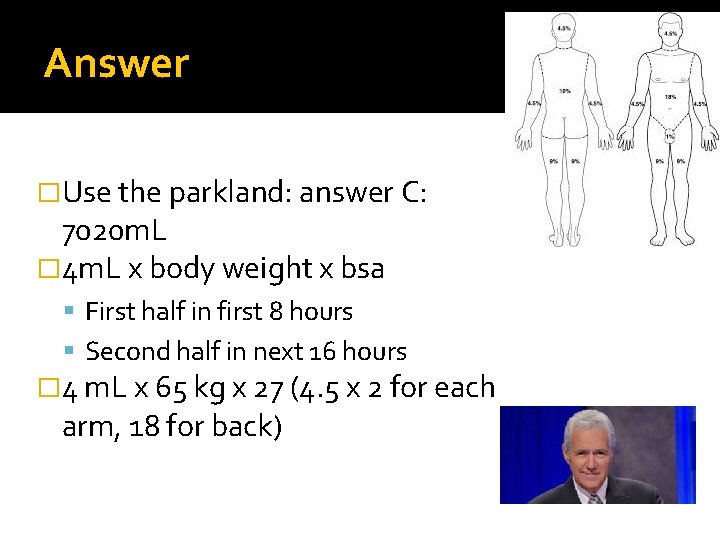
Lacerations and burns 300 �A 30 year old woman presents with partial- thickness burns on her entire back and her entire posterior aspects of both arms after a fire. She weighs 65 kg. How much crystalloid should she receive in the first 24 hours? �A. 2340 m. L �B. 4680 m. L �C. 7020 m. L �D. 9360 m. L
Answer �Use the parkland: answer C: 7020 m. L � 4 m. L x body weight x bsa First half in first 8 hours Second half in next 16 hours � 4 m. L x 65 kg x 27 (4. 5 x 2 for each arm, 18 for back)
Lacerations and Burns 400 �Which of the following can be appropriately managed with primary closure at the time of emergency department presentation? A. Crush wound to the foot B. Dog bite to the face C. Heavily contaminated wound D. Human bite wound to the palm
Answer �B. Dog bite to face �Do not primarily close heavily contaminated wounds from soil, organic matter, feces or freshwater streams or lakes �Do not primarily close large stellate lacerations to the foot �Human bite wounds should never be closed �Dog bites to the face, where cosmesis is a concern, often are closed primarily with good results
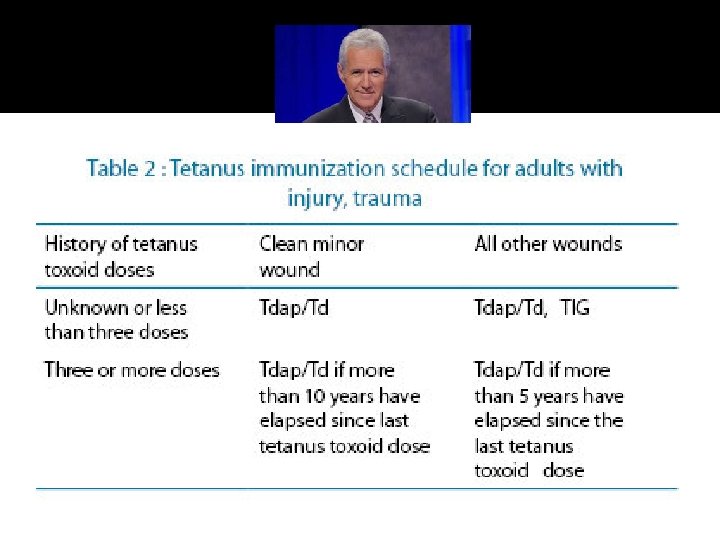
Lacerations and burns 500 �A 30 year old woman presents with a laceration on her foot. She says she received vaccines when she was a child, but none since then. Which formula should be ordered? �A. Diphtheria, tetanus, whole cell pertussis �B. Tetanus and diphtheria toxoid �C. Tetanus and diphtheria toxoid with human tetanus immune globulin �D. Tetanus, diphtheria toxoid, acellular pertussis
Answer �D. tetanus, diphtheria toxoid and acellular pertussis �If patient has had a primary vaccine series within the last 10 years or a booster in the last ten years; no treatment required. �If contaminated wound and patient’s last booster was >5 years ago, you should update the vaccine. �For patients 11 -64, preferred vaccins is tetanus, diphtheria toxoid and acellular pertussis (Tdap)
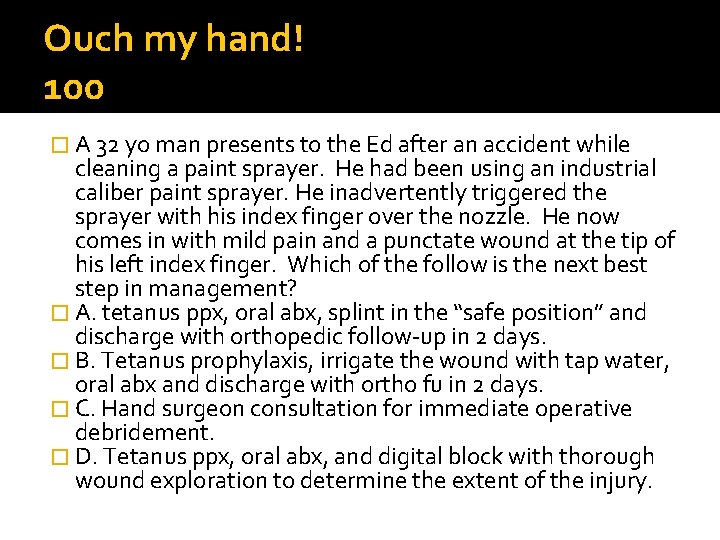
Ouch my hand! 100 � A 32 yo man presents to the Ed after an accident while cleaning a paint sprayer. He had been using an industrial caliber paint sprayer. He inadvertently triggered the sprayer with his index finger over the nozzle. He now comes in with mild pain and a punctate wound at the tip of his left index finger. Which of the follow is the next best step in management? � A. tetanus ppx, oral abx, splint in the “safe position” and discharge with orthopedic follow-up in 2 days. � B. Tetanus prophylaxis, irrigate the wound with tap water, oral abx and discharge with ortho fu in 2 days. � C. Hand surgeon consultation for immediate operative debridement. � D. Tetanus ppx, oral abx, and digital block with thorough wound exploration to determine the extent of the injury.
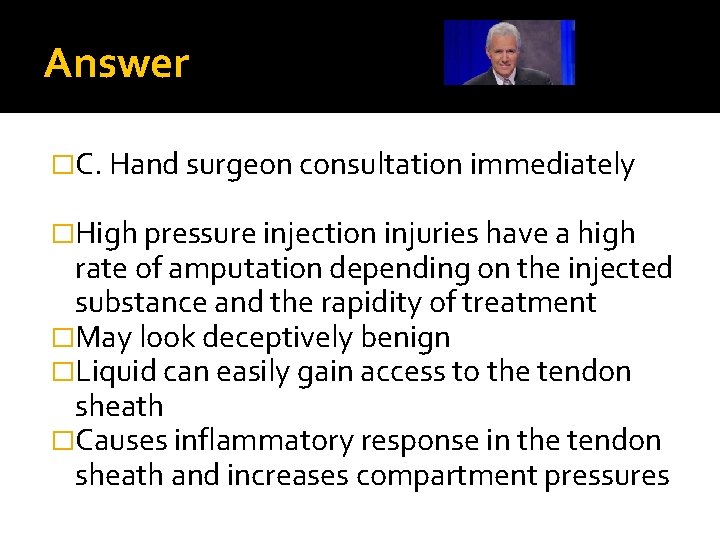
Answer �C. Hand surgeon consultation immediately �High pressure injection injuries have a high rate of amputation depending on the injected substance and the rapidity of treatment �May look deceptively benign �Liquid can easily gain access to the tendon sheath �Causes inflammatory response in the tendon sheath and increases compartment pressures
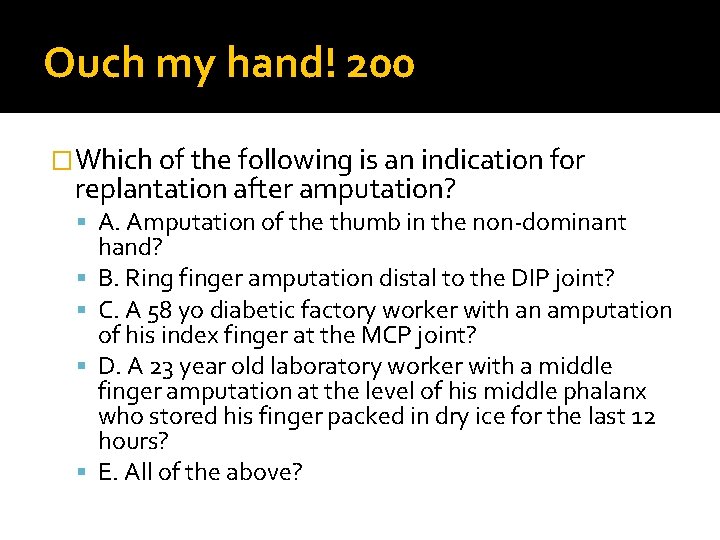
Ouch my hand! 200 �Which of the following is an indication for replantation after amputation? A. Amputation of the thumb in the non-dominant hand? B. Ring finger amputation distal to the DIP joint? C. A 58 yo diabetic factory worker with an amputation of his index finger at the MCP joint? D. A 23 year old laboratory worker with a middle finger amputation at the level of his middle phalanx who stored his finger packed in dry ice for the last 12 hours? E. All of the above?
Answer �A. Thumb �Indications for re-implantation: Multiple digits Thumbs Wrist and forearm Single digits between the PIP and DIP Any pediatric amputations
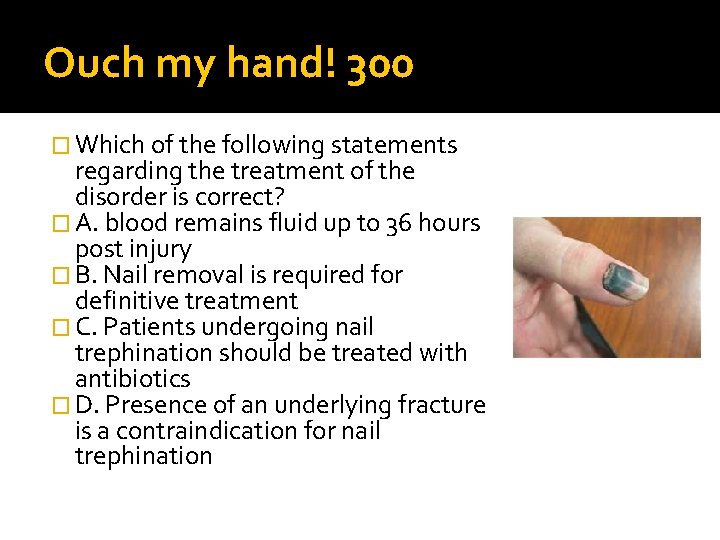
Ouch my hand! 300 � Which of the following statements regarding the treatment of the disorder is correct? � A. blood remains fluid up to 36 hours post injury � B. Nail removal is required for definitive treatment � C. Patients undergoing nail trephination should be treated with antibiotics � D. Presence of an underlying fracture is a contraindication for nail trephination
Answer �A: Blood is fluid up to 36 hours after the injury �Trephination without nail removal is fully adequate for most injuries, including nails with hematoma over 100% of the nail surface. �Nail removal is only necessary if there is significant nail bed injury and the fingertip is unstable �Technically, trephination does convert a closed fracture to an open one, however, there are no significant complications from this; Abx are needed for ppx.
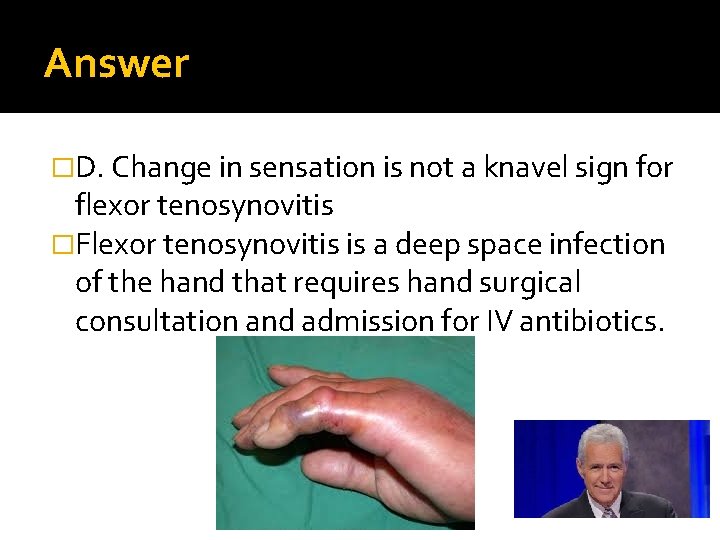
Ouch my hand! 400 �Which of these is NOT one of Knavel’s signs for flexor tenosynovitis? �A. Pain on passive extension �B. Finger held in flexed position �C. Severe tenderness along the tendon sheath �D. Sensory change to digit �E. Symmetric swelling of digit
Answer �D. Change in sensation is not a knavel sign for flexor tenosynovitis �Flexor tenosynovitis is a deep space infection of the hand that requires hand surgical consultation and admission for IV antibiotics.
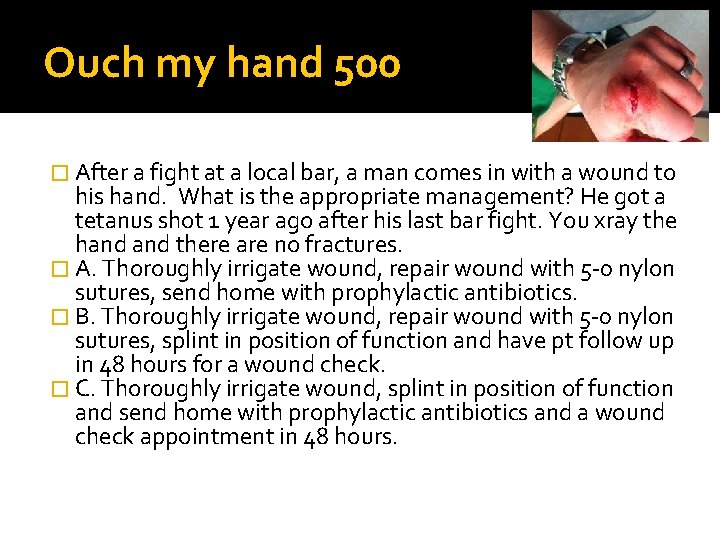
Ouch my hand 500 � After a fight at a local bar, a man comes in with a wound to his hand. What is the appropriate management? He got a tetanus shot 1 year ago after his last bar fight. You xray the hand there are no fractures. � A. Thoroughly irrigate wound, repair wound with 5 -0 nylon sutures, send home with prophylactic antibiotics. � B. Thoroughly irrigate wound, repair wound with 5 -0 nylon sutures, splint in position of function and have pt follow up in 48 hours for a wound check. � C. Thoroughly irrigate wound, splint in position of function and send home with prophylactic antibiotics and a wound check appointment in 48 hours.
Answer �C. Lacerations resulting from closed fist injuries should not be sutured, but allowed to heal by secondary intention. �Hand should be splinted in a position of function �Discharge with a 3 -5 day course of prophylactic antibiotics.
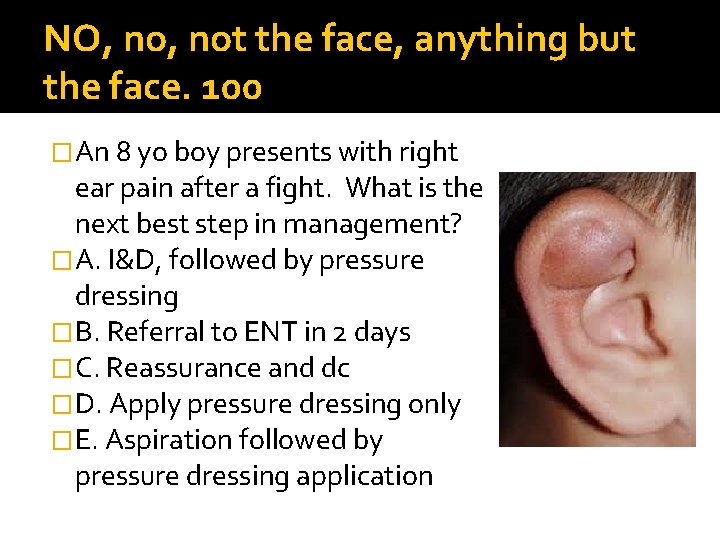
NO, not the face, anything but the face. 100 �An 8 yo boy presents with right ear pain after a fight. What is the next best step in management? �A. I&D, followed by pressure dressing �B. Referral to ENT in 2 days �C. Reassurance and dc �D. Apply pressure dressing only �E. Aspiration followed by pressure dressing application
Answer �A. I&D and pressure dressing �Pt has auricular hematoma from bleeding between the auricular cartilage and the perichondrium �Need to I&D the hematoma to prevent formation of a “cauliflower ear” which is 2/2 necrosis of the cartilage �Pack the ear with a bulky dressing
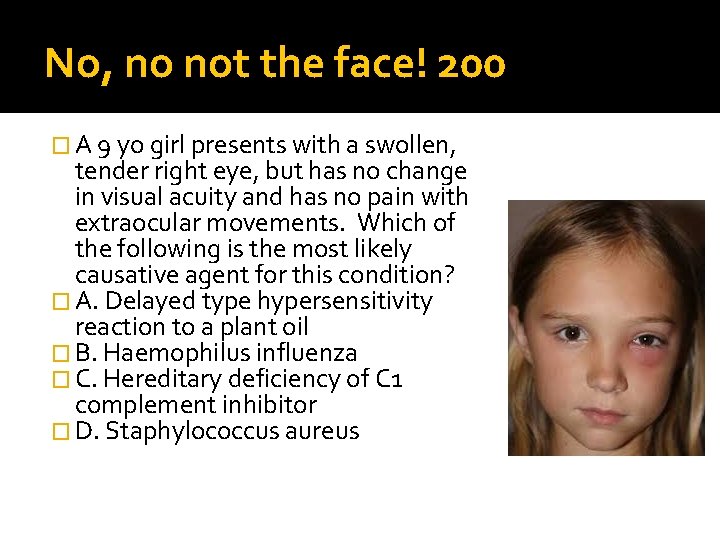
No, no not the face! 200 � A 9 yo girl presents with a swollen, tender right eye, but has no change in visual acuity and has no pain with extraocular movements. Which of the following is the most likely causative agent for this condition? � A. Delayed type hypersensitivity reaction to a plant oil � B. Haemophilus influenza � C. Hereditary deficiency of C 1 complement inhibitor � D. Staphylococcus aureus
Answer �D. Staph Aureus �She has preseptal cellulitis/periorbital cellulitis �H. Flu used to be a major cause, but has decreased since the incidence of the H. Flu vaccine
No not the face! 300 �Which of the following injuries can be safely repaired by an emergency physician? �A. 0. 5 cm lower eyelid laceration at the medial canthus �B. 1 cm horizontal upper eyelid laceration with a small area of exposed fat �C. lower eyelid laceration with a small area of avulsed tissue �D. Oblique, partial thickness laceration of the upper eyelid
Answer �D. Oblique partial thickness laceration of the upper eyelid �Simple eyelid lacerations can be closed using 6 -0 or 7 -0 interrupted non absorbable sutures. �Removal after 5 days �Lacerations to be seen by an ophthalmologist: Involvement of lid margin Involvement of medial canthus Fat protrusion (violation of orbital septum) Avulsed tissue
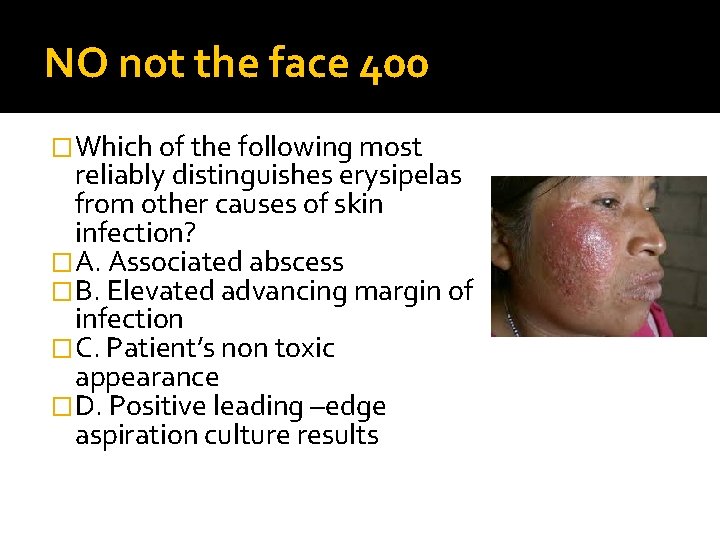
NO not the face 400 �Which of the following most reliably distinguishes erysipelas from other causes of skin infection? �A. Associated abscess �B. Elevated advancing margin of infection �C. Patient’s non toxic appearance �D. Positive leading –edge aspiration culture results
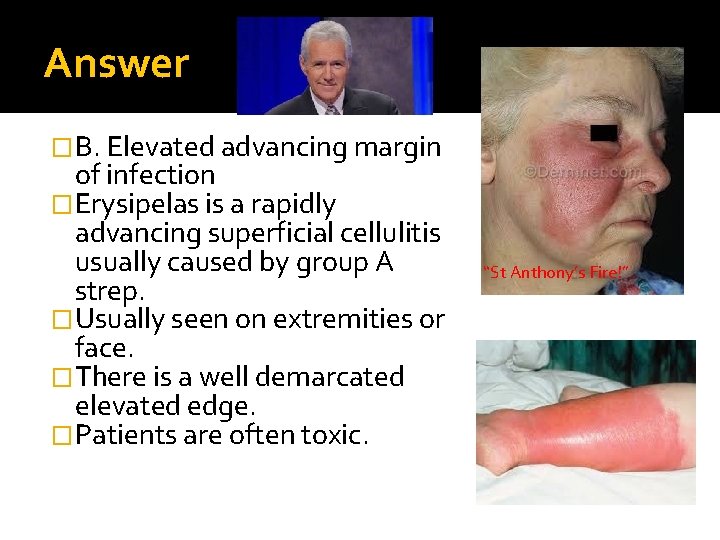
Answer �B. Elevated advancing margin of infection �Erysipelas is a rapidly advancing superficial cellulitis usually caused by group A strep. �Usually seen on extremities or face. �There is a well demarcated elevated edge. �Patients are often toxic. “St Anthony’s Fire!”
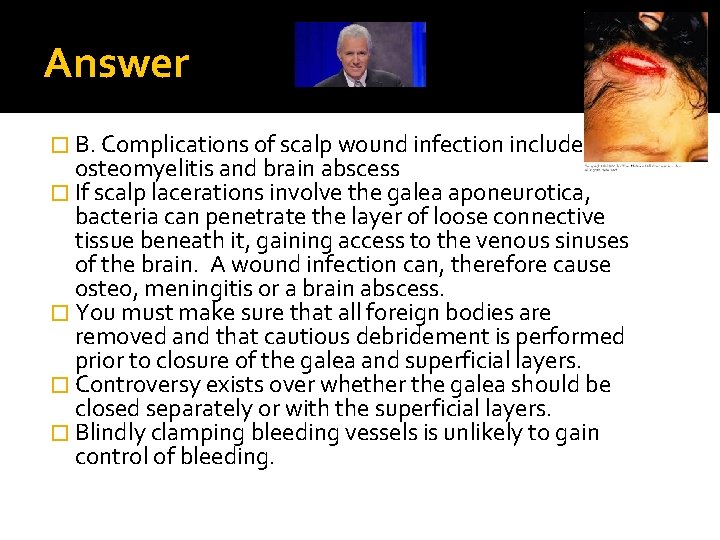
No Not the face 500 �Which of the following statements regarding closure of scalp lacerations is correct? �A. Clamping a vessel is the best way to gain control of active bleeding. �B. Complications of scalp wound infection include osteomyelitis and brain abscess �C. Hair should be shaved prior to suturing or stapling a scalp wound �D. Hair should not be washed for 24 -48 hours after wound closure
Answer � B. Complications of scalp wound infection include osteomyelitis and brain abscess � If scalp lacerations involve the galea aponeurotica, bacteria can penetrate the layer of loose connective tissue beneath it, gaining access to the venous sinuses of the brain. A wound infection can, therefore cause osteo, meningitis or a brain abscess. � You must make sure that all foreign bodies are removed and that cautious debridement is performed prior to closure of the galea and superficial layers. � Controversy exists over whether the galea should be closed separately or with the superficial layers. � Blindly clamping bleeding vessels is unlikely to gain control of bleeding.
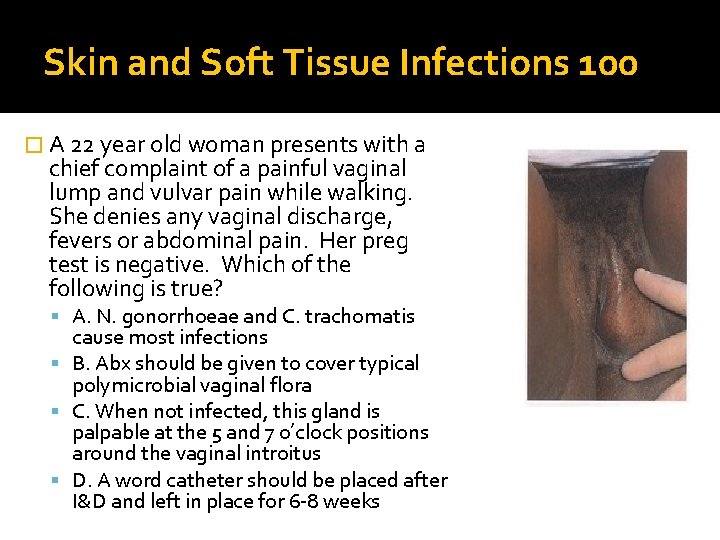
Skin and Soft Tissue Infections 100 � A 22 year old woman presents with a chief complaint of a painful vaginal lump and vulvar pain while walking. She denies any vaginal discharge, fevers or abdominal pain. Her preg test is negative. Which of the following is true? A. N. gonorrhoeae and C. trachomatis cause most infections B. Abx should be given to cover typical polymicrobial vaginal flora C. When not infected, this gland is palpable at the 5 and 7 o’clock positions around the vaginal introitus D. A word catheter should be placed after I&D and left in place for 6 -8 weeks
Answer �D. Word catheter for 6 -8 weeks �Pt has a bartolin gland abscess �Healthy glands are not palpated �Usually caused by polymicrobial vaginal flora �No abx needed unless associated cellulitis
Skin and Soft Tissue Infections 200 �Given the rate of infection for all types of mammal bites, routine antibiotic prophylaxis is recommended for bites to the: �A. Ankle �B. arm �C. face �D. hand
Answer �D. Hand
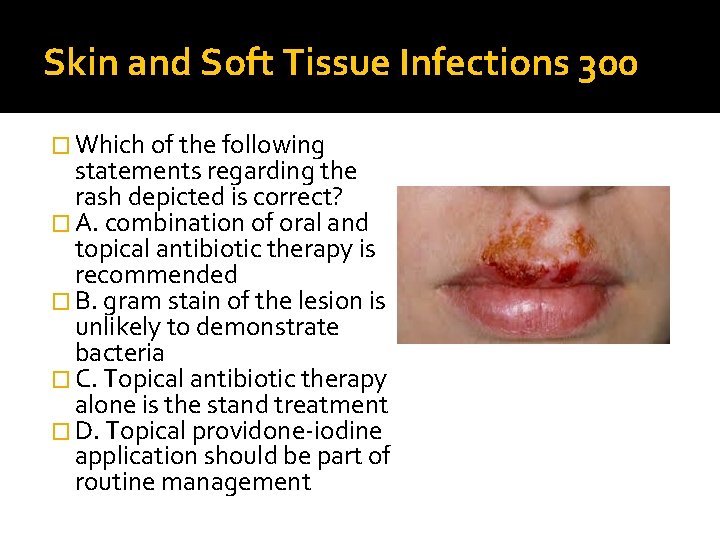
Skin and Soft Tissue Infections 300 � Which of the following statements regarding the rash depicted is correct? � A. combination of oral and topical antibiotic therapy is recommended � B. gram stain of the lesion is unlikely to demonstrate bacteria � C. Topical antibiotic therapy alone is the stand treatment � D. Topical providone-iodine application should be part of routine management
Answer �C. Topical antibiotics alone �Impetigo is highly contagious �Most common in children �Honey crusted coloring �Usually 2/2 Staphylococcus aureus and Streptococcus pyogenes
Skin and Soft Tissue Infections 400 �Which of the following statements regarding necrotizing soft tissue infections is correct? A. Antibiotic mono-therapy is not appropriate B. Clostridial myonecrosis is most commonly caused by wound contamination C. Degree of muscle necrosis can be estimated based on associated skin changes D. Early signs of gas in the tissue help make the diagnosis in the majority of patients.
Answer �B. Closteridial myonecrosis most commonly occurs from contaminated postsurgical or traumatic wounds. It does not affect healthy tissues, but rather is a super infection of already infected or traumatized tissue. Also referred to as gangrene. �Other common pathogens include group A. streptococci and anaerobic staphylococci. �Deep tissue infections can occur with minimal surface changes. �Crepitus and gas on imaging is a late finding.
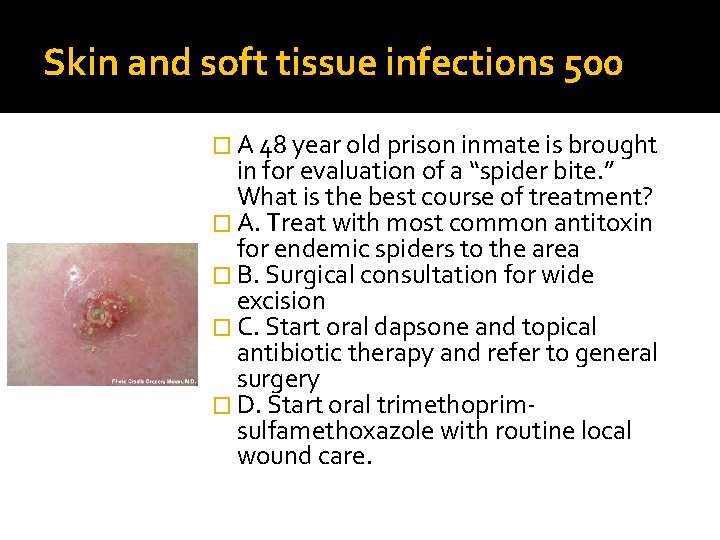
Skin and soft tissue infections 500 � A 48 year old prison inmate is brought in for evaluation of a “spider bite. ” What is the best course of treatment? � A. Treat with most common antitoxin for endemic spiders to the area � B. Surgical consultation for wide excision � C. Start oral dapsone and topical antibiotic therapy and refer to general surgery � D. Start oral trimethoprimsulfamethoxazole with routine local wound care.
Answer �D. Start oral trimethoprim-sulfamethoxazole �Pt has an abscess with cellulitis from MRSA, not a spider bite. �Pts commonly think they have been bitten by a spider �Hx of incarceration or participation on a sports team is a risk factor for MRSA �MRSA infections can look like brown recluse spider bites if you are in the US. MRSA infections tend to have multiple small furuncles near the main lesion, but a spider bite is solitary.
Grab bag 100 �A patient presents with new onset psychosis. Which of the following suggests a medical, rather than psychiatric, cause for the symptom? �A. Auditory hallucinations �B. Age <35 �C. Gradual onset �D. Aphasia �E. flat affect
Answer �D. Aphasia �Signs of a medical cause include: acute onset, older patient, visual hallucinations, disorientation, impaired consciousness �Abnormal physical examination findings such as abnormal vital signs, aphasia, ataxia, CN abnormalities also indicate a medical cause.
Grab bag 200 �Which of the following is true regarding orbital cellulitis? �A. Pain with extraocular movements is a characteristic finding. �B. Hematogenous spread of bacteria commonly occurs �C. Sinusitis is an uncommon predisposing factor. �D. Periorbital cellulitis often spontaneously progresses to involve the orbit.
Answer �A. Pain with extraocular movements, decrease in visual acuity, proptosis and opthalmoplegia more commonly occur in orbital cellulitis than in periorbital cellulitis. �Usually results from spread of adjacent infections such as sinusitis �Periorbital cellulitis usually results from hematogenous spread �Periorbital cellulitis does not progress to orbital cellulitis without trauma
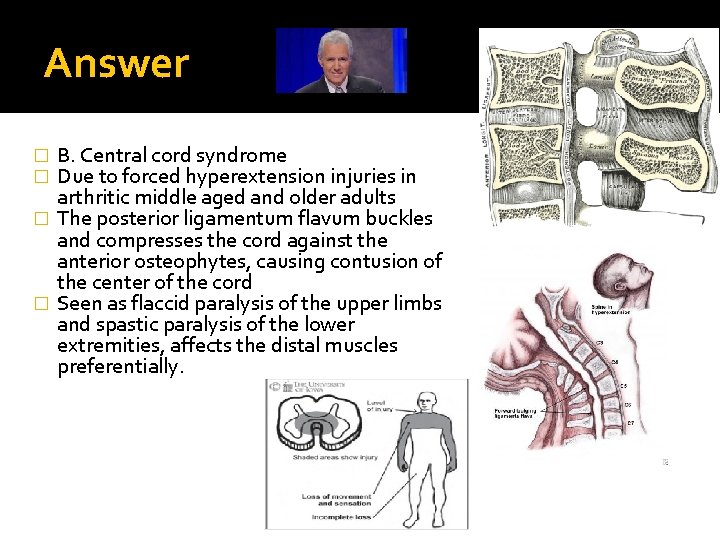
Grab bag 300 �Among trauma patients, which of the following is the most common incomplete spinal cord syndrome? �A. Brown-sequard syndrome �B. Central cord syndrome �C. Anterior cord syndrome �D. Posterior cord syndrome
Answer B. Central cord syndrome Due to forced hyperextension injuries in arthritic middle aged and older adults � The posterior ligamentum flavum buckles and compresses the cord against the anterior osteophytes, causing contusion of the center of the cord � Seen as flaccid paralysis of the upper limbs and spastic paralysis of the lower extremities, affects the distal muscles preferentially. � �
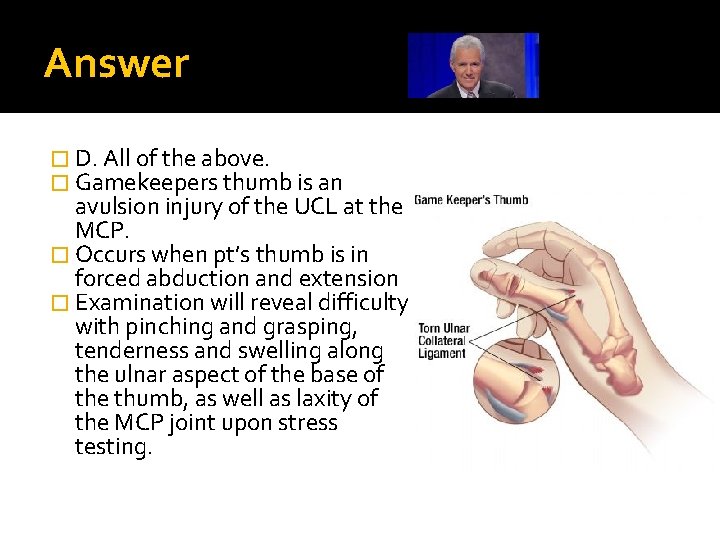
Grab bag 400 �A 25 year old woman presents after a skiing accident in which she fell with her thumb caught in the straps of her pole. Which of the following is most true? �A. She should be placed in a thumb spica splint. �B. She has torn the ulnar collateral ligament (UCL) at the thumb metacarpophalangeal (MCP) joint. �C. She will have difficulty with pinching and grasping. �D. All of the above.
Answer � D. All of the above. � Gamekeepers thumb is an avulsion injury of the UCL at the MCP. � Occurs when pt’s thumb is in forced abduction and extension � Examination will reveal difficulty with pinching and grasping, tenderness and swelling along the ulnar aspect of the base of the thumb, as well as laxity of the MCP joint upon stress testing.
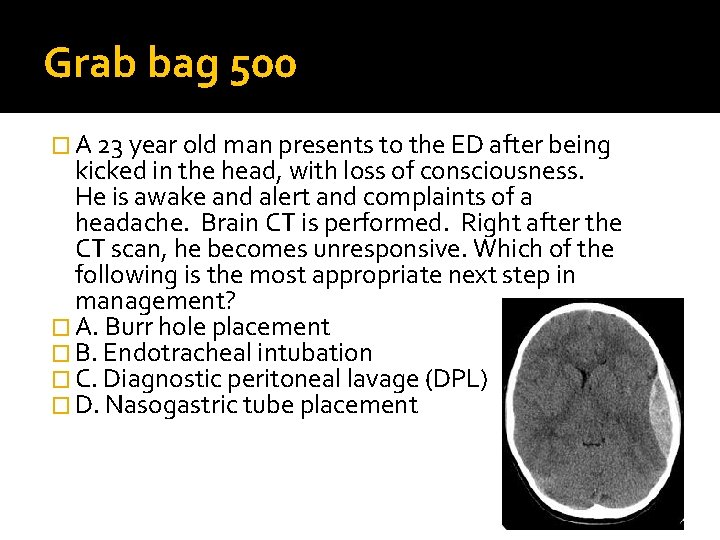
Grab bag 500 � A 23 year old man presents to the ED after being kicked in the head, with loss of consciousness. He is awake and alert and complaints of a headache. Brain CT is performed. Right after the CT scan, he becomes unresponsive. Which of the following is the most appropriate next step in management? � A. Burr hole placement � B. Endotracheal intubation � C. Diagnostic peritoneal lavage (DPL) � D. Nasogastric tube placement
Answer �B. Intubate �Pt has an epidural hematoma. He arrives in his lucid interval. Acute worsening of the clinical status mandates returning to the ABCs of trauma. �Burr hole placement is the most important definitive management, but control of the airway is the most important initial step.