
Erikson The LifeSpan Approach HSB 4 UI Erikson
Erikson: The Life-Span Approach HSB 4 UI
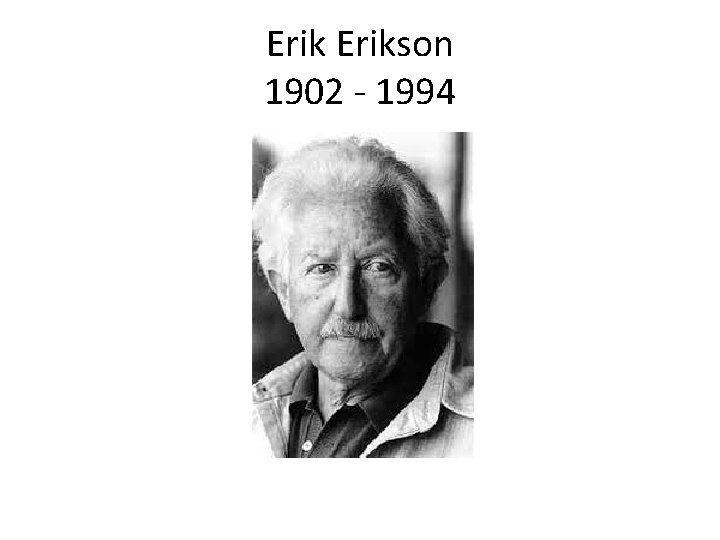
Erikson 1902 - 1994
Psychosocial Stages of Personality Development • 8 successive stages over the lifespan • Addresses biological, social, situational, personal influences • Crisis: must adaptively or maladaptively cope with task in each developmental stage – Respond adaptively: acquire strengths needed for next developmental stage – Respond maladaptively: less likely to be able to adapt to later problems • Basic strengths: Motivating characteristics and beliefs that derive from successful resolution of crisis in each stage
Stage 1: Basic Trust vs. Mistrust • Birth to age 1 • Totally dependent on others • If caregiver meets physical and psycholoical needs: child develops trust • If caregiver does not meet needs: child develops mistrust • Basic strength: Hope – Belief our desires will be satisfied – Feeling of confidence

Stage 2: Autonomy vs. Shame and Doubt • Ages 1 -3 • Child able to exercise some degree of choice • If child’s independence is thwarted: child develops feelings of self-doubt, shame in dealing with others • Basic Strength: Will – Determination to exercise freedom of choice in face of society’s demands
Stage 3: Initiative vs. Guilt • Ages 3 -5 • Child expresses desire to take initiative in activities • If parents punish child for initiative or failures: child develops feelings of guilt that will affect self-directed activity throughout life • Basic strength: Purpose – Courage to envision and pursue goals
Stage 4: Industriousness vs. Inferiority • Ages 6 -11 • Child develops cognitive abilities to enable in task completion (school work, play) • If parents/teachers do not support child’s efforts: child develops feelings of inferiority and inadequacy or unrealistic expectations • Basic strength: Competence – Exertion of skill and intelligence in pursuing and completing tasks
• Stages 1 -4 – Largely determined by others (parents, teachers) • Stages 5 -8 – Individual has more control over environment – Individual responsibility for crisis resolution in each stage
Stage 5: Identity vs. Role Confusion • Ages 12 -18 • Form ego identity: self-image • Strong sense of identity: face adulthood with certainty and confidence • Identity crisis: confusion of ego identity • Basic strength: Fidelity – Emerges from cohesive ego identity – Sincerity, genuineness, sense of duty in relationships with others
Stage 6: Intimacy vs. Isolation • Ages 18 -35 (approximately) • Undertake productive work and establish intimate relationships • Inability to establish intimacy leads to social isolation, bad relationships • Basic strength: Love – Mutual devotion in a shared identity – Fusing of oneself with another person
Stage 7: Generativity vs. Stagnation • Ages 35 -55 (approximately) • Generativity: Active involvement in teaching/guiding the next generation • Stagnation involves not seeking outlets for generativity, lack of concern for others • Basic strength: Care – Broad concern for others – Need to teach others
Stage 8: Ego Integrity vs. Despair Ages 55+ Evaluation of entire life Integrity: Look back with satisfaction Despair: Review with anger, frustration; midlife crisis • Basic strength: Wisdom • • – Detached concern with the whole of life
Research in Erikson’s Theory • Trust – Early strong bonds with mother later were more curious, sociable and popular • Identity – Strong identity associated with greater cognitive and emotional functioning in college students – Crisis may begin later than age 12 – Continuing process over the lifespan
Research in Erikson’s Theory • Generativity – Evokes need to feel closer to others – Correlated with extraversion, openness to new experiences – Likely to be involved in community, social relationships
Research in Erikson’s Theory • Maturity – High ego integrity: spent much time reviewing their lives • Ethnic Identity – Ethnic minorities: ethnic identity significant factor in determining sense of self
Contributions of Erikson • Personality develops throughout the lifetime • Identity crisis in adolescence • Impact of social, cultural, personal and situational forces in forming personality
Criticisms of Erikson • Ambiguous terms and concepts • Lack of precision – Some terms are not easily measured empirically • Experiences in stage may only apply to males • Identity crisis may only apply to those affluent enough to explore identities
- Slides: 17