
Ergonomics The science of fitting the job to
Ergonomics The science of fitting the job to the worker
MULTIDISCIPLINARY NATURE OF ERGONOMICS l Anatomy and physiology l Engineering Psychology l Engineering l Medicine l Anthropology l Biomechanics
Benefits of Ergonomics Decreased injury risk l Increased productivity l Decreased mistakes/rework l Increased efficiency l Decreased lost work days l Decreased turnover l Improved morale l
HISTORICAL PERSPECTIVE Ramazzinni described posture and disease in 1700 s Before WWI labor surplus During WWII labor scarce WWII mass production of sophisticated equipment Reading Errors Control-Display Relations
EROGONOMIC CONCEPTS Tool design Workstation Design Material handling limits Visual and auditory task design
ENVIRONMENTAL FACTORS Noise Vision Thermal Chemical
PSYCHOLOGICAL STRESS l Machine Pacing l Shift Work l Morale
PHYSICAL l Posture l Force l Repetition l Manual Materials Handling

TARGET REGIONS l Back l Upper Extremities l Lower Extremities
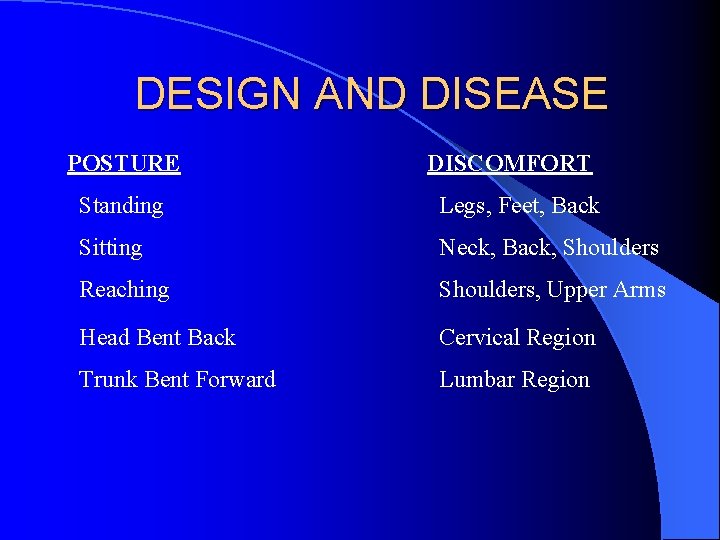
DESIGN AND DISEASE POSTURE DISCOMFORT Standing Legs, Feet, Back Sitting Neck, Back, Shoulders Reaching Shoulders, Upper Arms Head Bent Back Cervical Region Trunk Bent Forward Lumbar Region
STATIC EXERTIONS l Holding activities l Carrying l Standing l Pushing and pulling l Arms raised
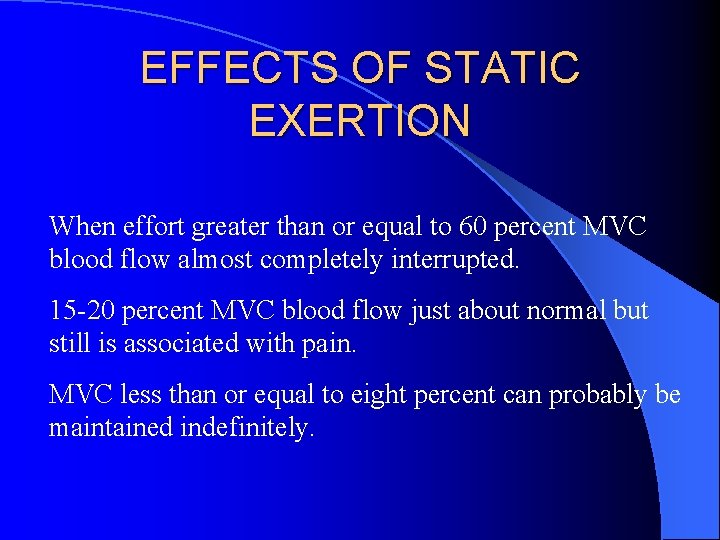
EFFECTS OF STATIC EXERTION When effort greater than or equal to 60 percent MVC blood flow almost completely interrupted. 15 -20 percent MVC blood flow just about normal but still is associated with pain. MVC less than or equal to eight percent can probably be maintained indefinitely.
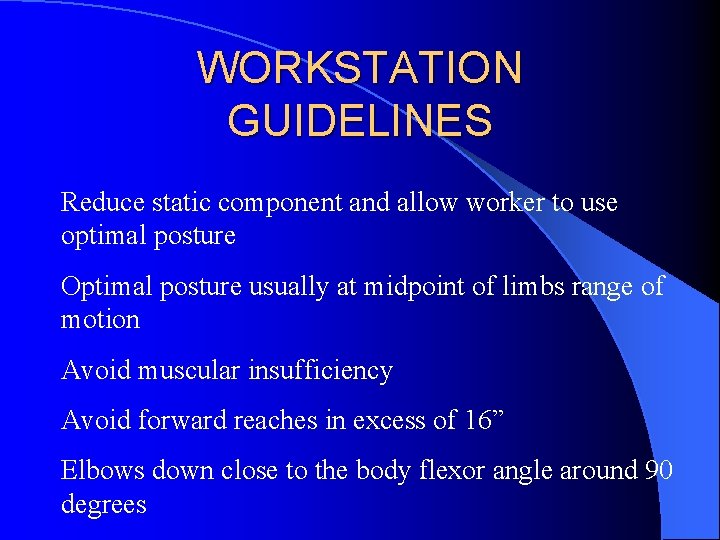
WORKSTATION GUIDELINES Reduce static component and allow worker to use optimal posture Optimal posture usually at midpoint of limbs range of motion Avoid muscular insufficiency Avoid forward reaches in excess of 16” Elbows down close to the body flexor angle around 90 degrees
WORKSTATION GUIDELINES (continued) Sit-Stand preferred but rarely seen Use gravity do not work against it Avoid the need for excessive head movement Avoid compression Ischemia
WORKPLACE INDICATORS l Performance deterioration…Engineering l Quality Control problems l Absenteeism and turn-over…Human Resources l Musculoskeletal disorders…OSHA Logs WC reports l Complaints of fatigue and discomfort
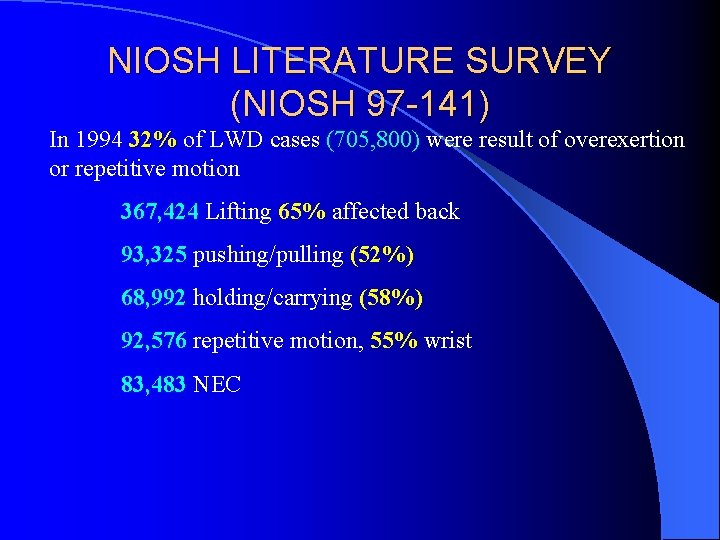
NIOSH LITERATURE SURVEY (NIOSH 97 -141) In 1994 32% of LWD cases (705, 800) were result of overexertion or repetitive motion 367, 424 Lifting 65% affected back 93, 325 pushing/pulling (52%) 68, 992 holding/carrying (58%) 92, 576 repetitive motion, 55% wrist 83, 483 NEC
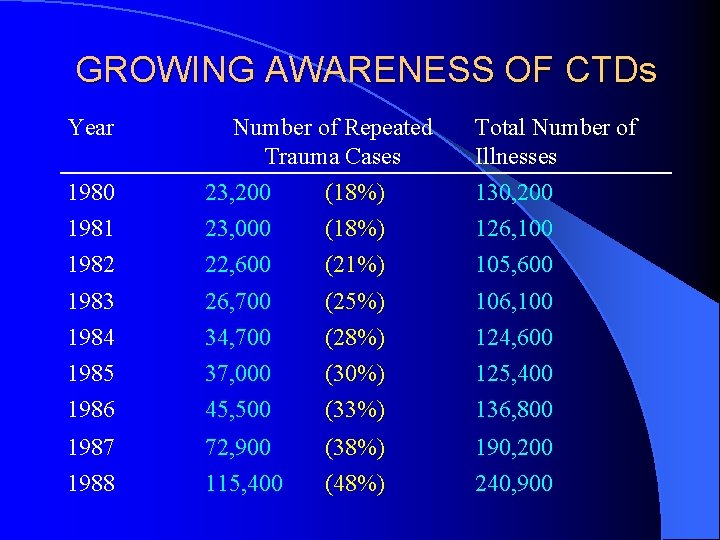
GROWING AWARENESS OF CTDs Year 1980 1981 Number of Repeated Trauma Cases 23, 200 (18%) 23, 000 (18%) Total Number of Illnesses 130, 200 126, 100 1982 22, 600 (21%) 105, 600 1983 1984 1985 1986 26, 700 34, 700 37, 000 45, 500 (25%) (28%) (30%) (33%) 106, 100 124, 600 125, 400 136, 800 1987 1988 72, 900 115, 400 (38%) (48%) 190, 200 240, 900

TOP FIVE CTD INCIDENCE INDUSTRIES BY RATE 1990 Meatpacking Poultry Processing Household Refrigerator/Freezer Motor Vehicle and Car Body Men’s and Boy’s Trousers and Slacks
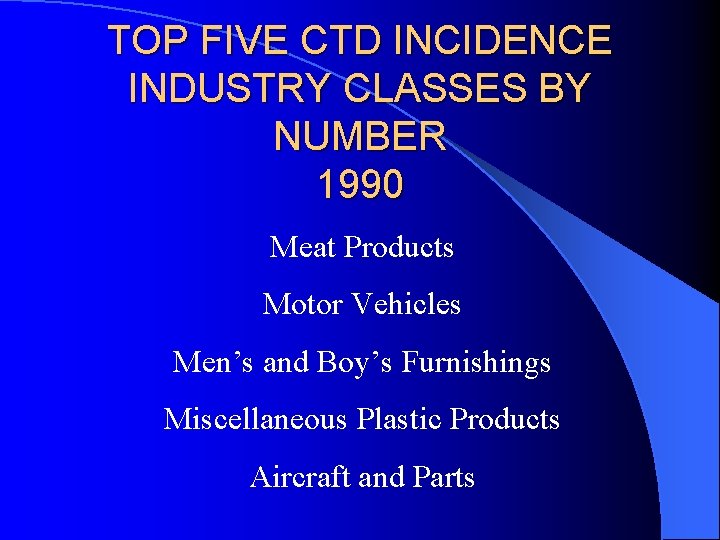
TOP FIVE CTD INCIDENCE INDUSTRY CLASSES BY NUMBER 1990 Meat Products Motor Vehicles Men’s and Boy’s Furnishings Miscellaneous Plastic Products Aircraft and Parts
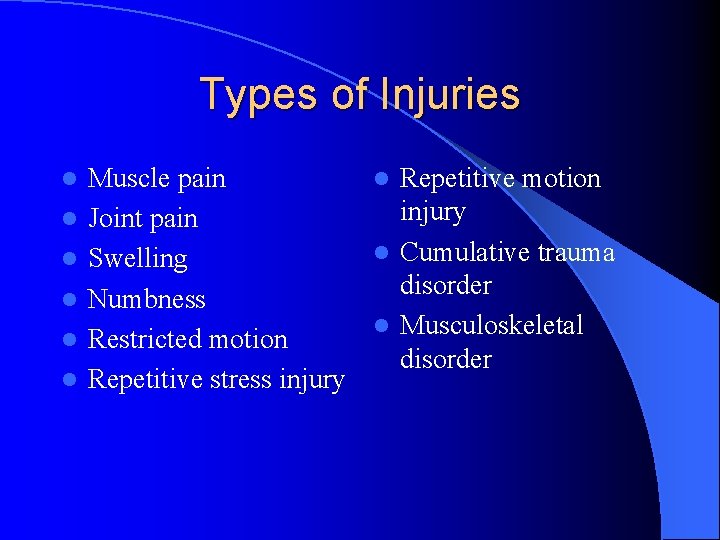
Types of Injuries l l l Muscle pain l Repetitive motion injury Joint pain l Cumulative trauma Swelling disorder Numbness l Musculoskeletal Restricted motion disorder Repetitive stress injury
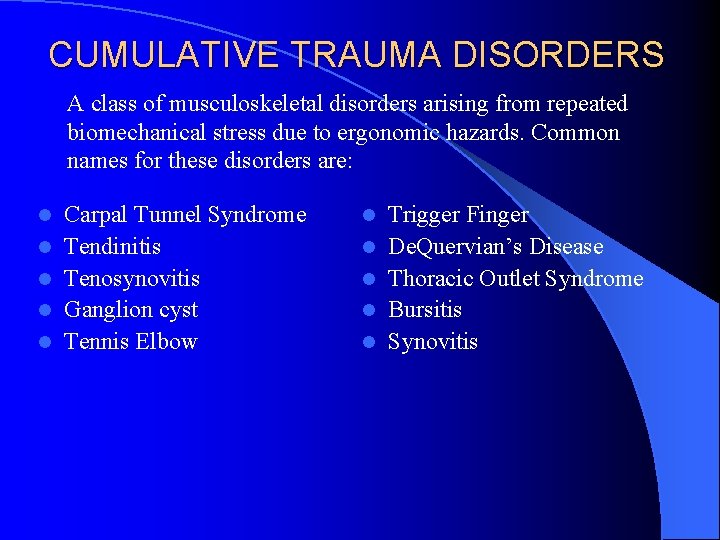
CUMULATIVE TRAUMA DISORDERS A class of musculoskeletal disorders arising from repeated biomechanical stress due to ergonomic hazards. Common names for these disorders are: l l l Carpal Tunnel Syndrome Tendinitis Tenosynovitis Ganglion cyst Tennis Elbow l l l Trigger Finger De. Quervian’s Disease Thoracic Outlet Syndrome Bursitis Synovitis
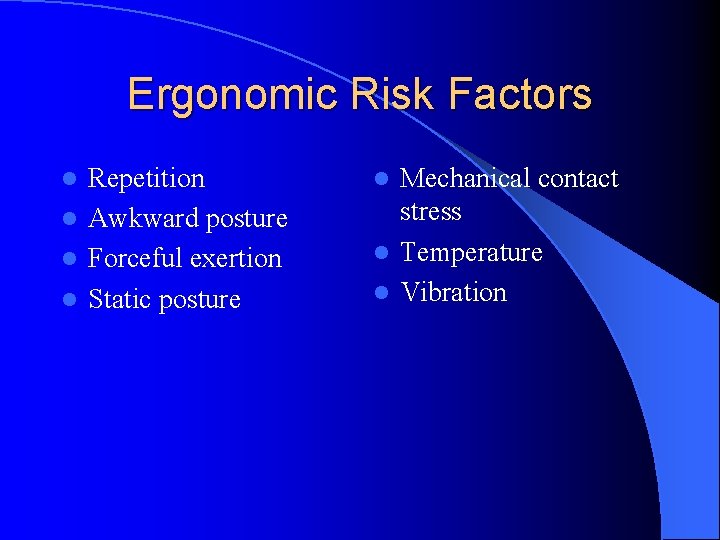
Ergonomic Risk Factors Repetition l Awkward posture l Forceful exertion l Static posture l Mechanical contact stress l Temperature l Vibration l

PSYCHOSOCIAL FACTORS LA Times HETA 90 -013 -2277 NIOSH PUBS 1 -800 -356 -4674 US West HETA 89 -299 -2230
PSYCHOSOCIAL FACTORS (continued) Significant Findings Fear of being replaced by computers Enlarged Jobs Uncertainty about job future Work pressure Lack of co-worker support Lack of productivity standard Lack of participation in decision-making Perception management not value ergo
Ergonomic Controls l Engineering l Administrative l Work Practices
CONTROL TECHNOLOGY l Tool redesign l Workstation redesign l Job methods l Early detection l Job rotation l Machine pacing l Medical surveillance
REDUCTION OF REPETITION Task Enlargement Mechanization Automation
REDUCTION OF EXTREME JOINT MOVEMENT Altering tool or controls Workstation Design Moving the Worker
REDUCTION OF FORCE Reducing the force Spreading the force Better mechanical advantage
ADMINISTRATIVE CONTROLS HAZARD PREVENTION AND CONTROL l Rest-pause l Increase number of employees l Job rotation l Physical conditioning l Relief personnel l Medical management
MATERIALS HANDLING Lifting/Lowering Pushing/Pulling Carrying Weights and Forces Frequency of activities Load Center of Gravity
JOB RISK FACTORS Weight lifted Position of load center of gravity Frequency Posture Torso Flexion Twisting Arms extended
JOB DESIGN Can reduce one-third of compensable LBP Minimize reach and lift distances Keep off floor Work station design Frequency Relax time standard Rotation Work-Rest allowances
JOB DESIGN (continued) Minimize Weight Mechanical aids Carton capacity Balance contents Convert: Carry to push/pull Push over pull Use large wheels
TRAINING Focus on awareness and avoidance Get object as close to body as possible Planning Use of handling aids Back Schools Strength and fitness important
WORKPLACE USE OF BACK BELTS NIOSH 94 -122 l Insufficient Data that belts significantly reduce trunk loading l Insufficient data that wearing reduces risk of injury based on IAP and EMG l May strain cardiovascular system l Insufficient data that discontinuation of use increases risk among healthy workers NIOSH does not recommend as tool for prevention
ORGANIZATIONAL INFLUENCES Wage Systems Quality Control Management-Labor Relations Machine-paced versus Self-paced work Rest Breaks Overtime Shift Work
RECOMMENDATIONS l l l l l 1. Identify Team Members 2. Identify problem jobs 3. Survey Employees 4. Develop Plan of Action 5. Select most feasible 6. Implement on small scale 7. Train 8. Measure response 9. Wider application or goto 4 10. Goto 2
REDESIGN EFFORT Based on job analysis Employee Feedback Anthropometry Fitting Trials (Prototyping) Monitoring and Measurement
REMEMBER WORKSTATION DESIGN GUIDELINES Design where hands spend most of time Normal reach envelope Elbow height Edge compression Limit forward reaches to 16!

WORK SITE ANALYSIS l Review OSHA 200 log l Employee interviews l Performance Data (turnover, etc. ) l Video analysis of identified hazardous positions
Ergonomics Program Elements Management leadership and employee participation l Hazard information and reporting l Job hazard analysis and control l Training l MSD management l Program evaluation l
REFERENCES Applications guide for the revised NIOSH lifting equation NTIS PB 94 -176930 (703) 487 -4650 NTIS PB 91 -226274 Scientific Documentation Elements of Ergonomic Programs NIOSH 97 -117 1 -800 -35 -NIOSH Musculoskeletal Disorders and Workplace Factors NIOSH 97 -141 Work Practices Guide for Manual Lifting NIOSH 81 -122 $12. 00
REFERENCES (continued) Cumulative Trauma Disorders: A Manual for MSDs of the Upper Limbs, Putz-Anderson Fitting the Task to the Man, Grandjean Taylor and Francis 1 -800 -821 -8312 Methodological Limitations in the Study of VDT use and UEMDs Gerr, Marcus, Ortiz, American J. Ind. Med. 29: 649 -656 (1996) Ergonomics: The Study of Work, OSHA 3125, www. OSHA. gov Dan Ortiz, Georgia Tech www. oshainfo. gatech. edu (404) 894 -8276
- Slides: 44