
ERATE FALL 2018 PREPARE FOR FY 2019 ERATE
- Slides: 76
E-RATE- FALL 2018 PREPARE FOR FY 2019 E-RATE CENTRAL © E-RATE CENTRAL 2018
Today’s Agenda §Introductions §BDCP and BB 4 E §Overview of the E-Rate Process §Important E-rate Deadlines §Eligible Services List FY 2019 §FCC Form 470, Competitive Bidding, Bid Evaluations §Category 2 Budgets §E-rate Discount Calculations §E-rate Productivity Center (EPC) © E-RATE CENTRAL 2018
BDCP and BB 4 E E-RATE FY 2018 © E-RATE CENTRAL 2018
BDCP and BB 4 E § PSCOC’s Broadband Deficiencies Correction Program (BDCP) (See http: //www. nmpsfa. org/? q=broadband) § Matching funds for fiber projects and E-rate eligible infrastructure upgrades § Help schools improve connectivity and reduce costs § Governor’s Broadband for Education Initiative (BB 4 E) (See http: //www. broadband 4 education. nm. gov/Default. aspx) § Procurement Assistance Model § Mini-Quote System © E-RATE CENTRAL 2018
What is BDCP? § Created by Senate Bill (SB) 159 to allow the Public School Capital Outlay Council (PSCOC) to expend up to $10 million per year to improve broadband infrastructure affecting public schools ◦ Originally funding was to be provided for Fiscal Years 2015 through 2019 ◦ In 2017, SB 64 removed the five year cap, so 2019 is longer a state deadline § The day-to-day management of the BDCP program is led by the Public Schools Facilities Association (PSFA) © E-RATE CENTRAL 2018
What does BDCP Support? § BDCP can provide up to 10% in matching funds for “special construction” of fiber. § § If BDCP funding is provided for “special construction” of fiber USAC will match the funding up to 10%, which could mean a school pays nothing for the “special construction. ” BDCP can provide funding for the non-discount portion of E-rate funded internal connections projects based on PSCOC’s Capital Outlay Formula. § See http: //www. nmpsfa. org/legacy/17 -18 docs/20172018_State_Local_Match_Percentages. pdf for the current matching funds percentages. © E-RATE CENTRAL 2018
BDCP Program Contacts § § § Ovidiu Viorica- BDCP Program Manager- oviorica@nmpsfa. org 505 -843 -6272 Richard Govea- BDCP Broadband Project Manager- rgovea@nmpsfa. org 505 -468 -0269 Jerry Smith BDCP Broadband Project Manager- jsmith@nmpsfa. org 505 -468 -0266 Ruth Bingham- BDCP Administrative Assistant- rbingham@nmpsfa. org 505 -468 -0268 Shatona Martin- Contracts Administrator- smartin@nmpsfa. org 505 -468 -0286 © E-RATE CENTRAL 2018
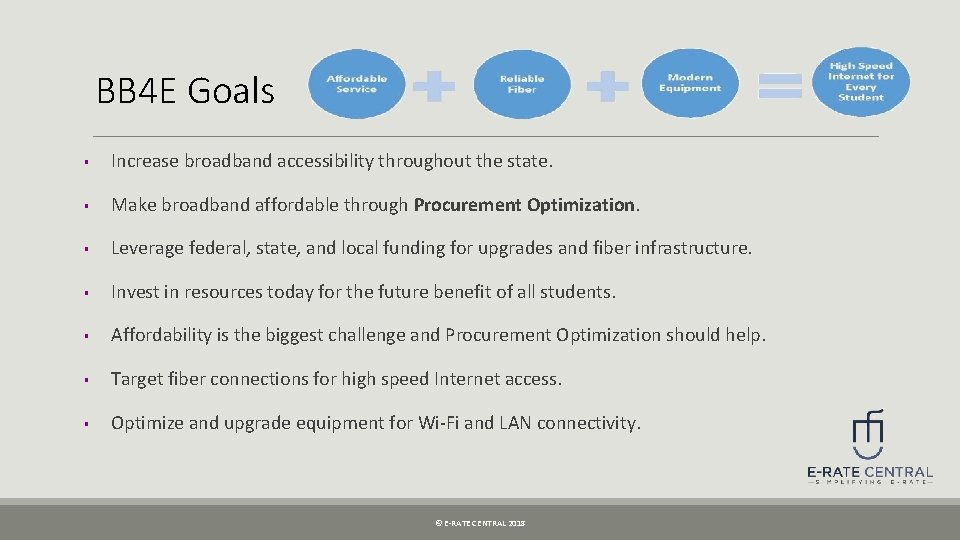
BB 4 E Goals § Increase broadband accessibility throughout the state. § Make broadband affordable through Procurement Optimization. § Leverage federal, state, and local funding for upgrades and fiber infrastructure. § Invest in resources today for the future benefit of all students. § Affordability is the biggest challenge and Procurement Optimization should help. § Target fiber connections for high speed Internet access. § Optimize and upgrade equipment for Wi-Fi and LAN connectivity. © E-RATE CENTRAL 2018
Who can help me? § Who should schools contact for help? State E-Rate Coordinator for Schools JOHN CHADWICK New Mexico Public Education Department (PED) E-rate Phone: (505) 827 -6491 E-rate Email: State. Erate. Coordinator@state. nm. us Website: http: //ped. state. nm. us § E-rate help? Who should libraries contact for help? State E-Rate Coordinator for Libraries JOY POOLE Deputy State Librarian 505 -476 -9712 Joy. Poole@state. nm. us § PATRICIA MOORE Library Technology Consultant (505) 476 -9724 Patricia. Moore@state. nm. us E-Rate Central is also contracted with the state to support the BDCP and provide E-rate assistance to the state and applicants within the state. © E-RATE CENTRAL 2018
E-Rate 2. 0 Performance Goals § Affordable access to Connect. Ed broadband goals § Schools: Internet at 100 Mbps per 1, 000 students now and 1 Gbps per 1, 000 students within the next two years § Libraries: Internet at 100 Mbps for populations under 50, 000 and 1 Gbps for larger populations § WAN connectivity “scalable” to 10 Gbps § The not-for-profit Education. Super. Highway (ESH) has released their annual State of the States Report © E-RATE CENTRAL 2018
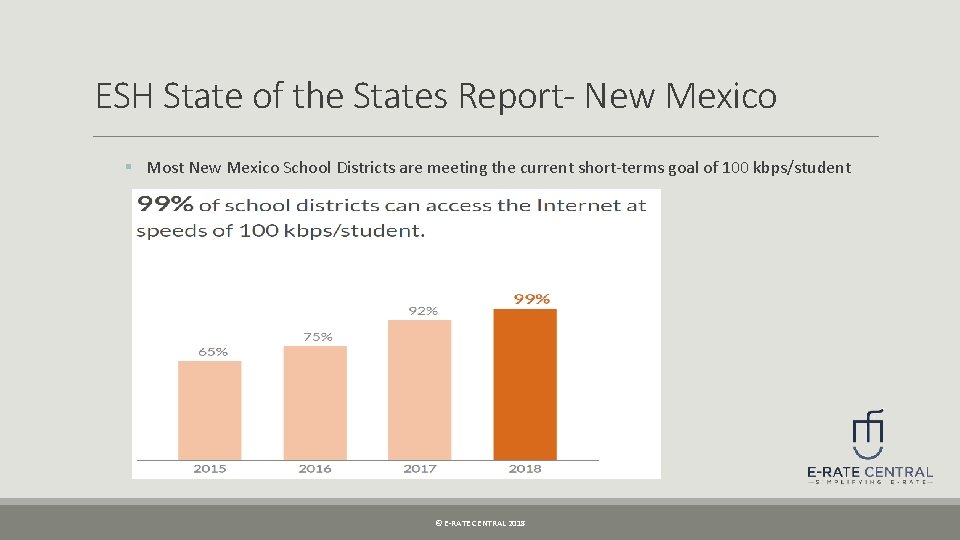
ESH State of the States Report- New Mexico § Most New Mexico School Districts are meeting the current short-terms goal of 100 kbps/student © E-RATE CENTRAL 2018
ESH State of the States Report- New Mexico § Review the ESH New Mexico Snapshot for 2018 § Key Facts from the ESH New Mexico Snapshot for 2018: § Since 2015, median bandwidth costs have dropped by 66% § Over the last three years median bandwidth speeds have increased by 3. 9 x from 136 kbps to 528 kpbs § Much work is still required to meet the goal of 1000 Kbps per student § Many New Mexico schools are leaving Category 2 dollars on the table § $23 Million have been used, $16 million remain unused © E-RATE CENTRAL 2018
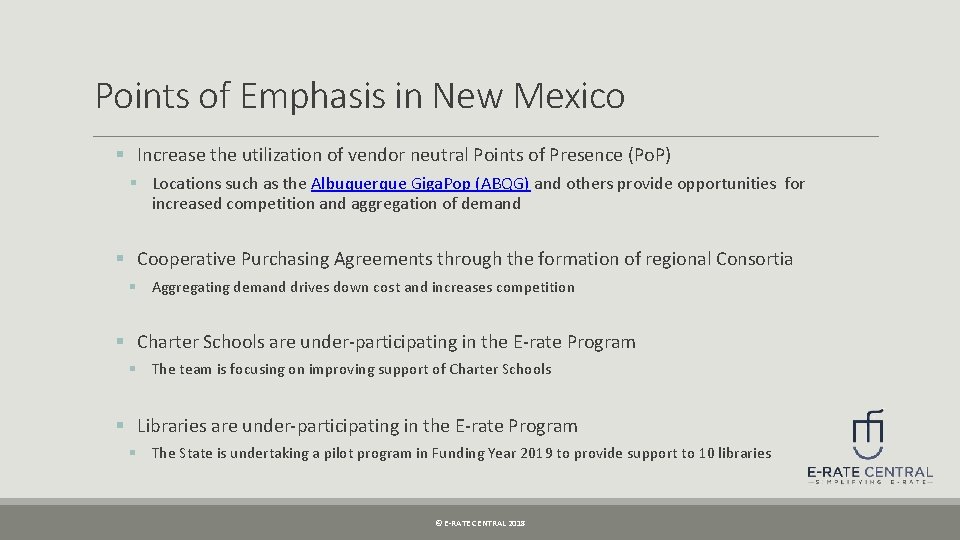
Points of Emphasis in New Mexico § Increase the utilization of vendor neutral Points of Presence (Po. P) § Locations such as the Albuquerque Giga. Pop (ABQG) and others provide opportunities for increased competition and aggregation of demand § Cooperative Purchasing Agreements through the formation of regional Consortia § Aggregating demand drives down cost and increases competition § Charter Schools are under-participating in the E-rate Program § The team is focusing on improving support of Charter Schools § Libraries are under-participating in the E-rate Program § The State is undertaking a pilot program in Funding Year 2019 to provide support to 10 libraries © E-RATE CENTRAL 2018
Overview of the E-rate Process E-RATE FY 2018 © E-RATE CENTRAL 2018
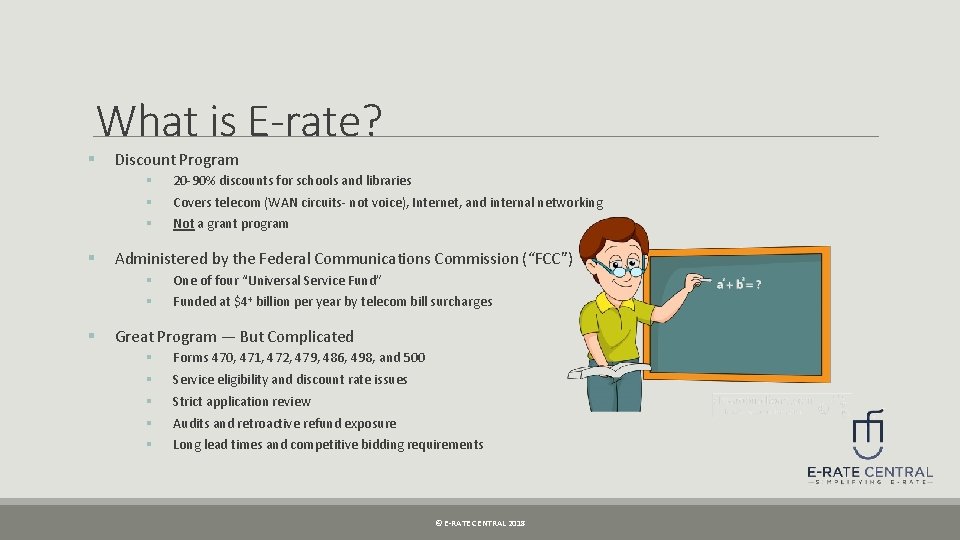
What is E-rate? § § § Discount Program § 20 -90% discounts for schools and libraries § Covers telecom (WAN circuits- not voice), Internet, and internal networking § Not a grant program Administered by the Federal Communications Commission (“FCC”) § One of four “Universal Service Fund” § Funded at $4+ billion per year by telecom bill surcharges Great Program — But Complicated § Forms 470, 471, 472, 479, 486, 498, and 500 § Service eligibility and discount rate issues § Strict application review § Audits and retroactive refund exposure § Long lead times and competitive bidding requirements © E-RATE CENTRAL 2018
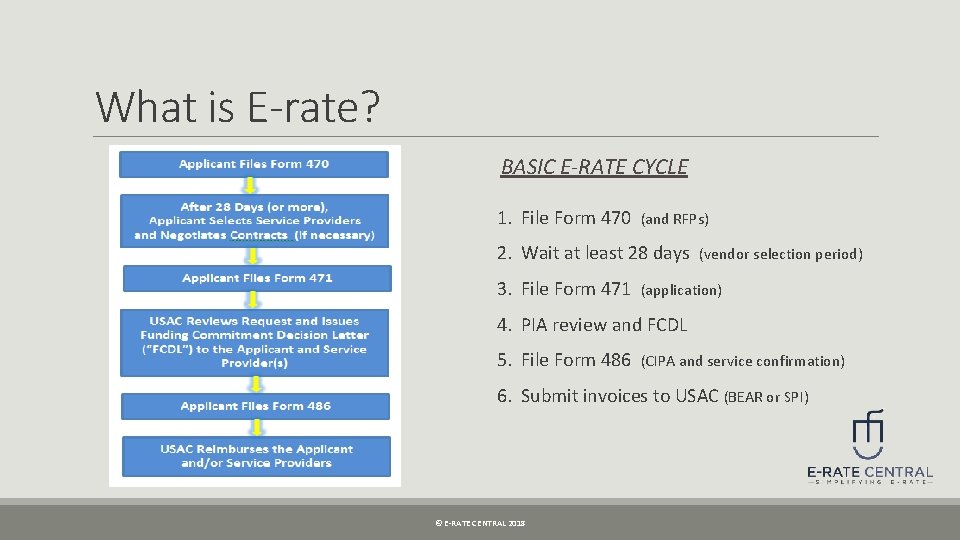
What is E-rate? BASIC E-RATE CYCLE 1. File Form 470 (and RFPs) 2. Wait at least 28 days (vendor selection period) 3. File Form 471 (application) 4. PIA review and FCDL 5. File Form 486 (CIPA and service confirmation) 6. Submit invoices to USAC (BEAR or SPI) © E-RATE CENTRAL 2018
A Year of E-rate FALL § REVIEW NEW E-RATE RULES § DETERMINE NEEDS FOR FOLLOWING YEAR § ESTABLISH CONSORTIA (IF NEEDED) § PREPARE RFPS (IF NEEDED) § FILE FORM 470 § FOR PREVIOUS YEAR: FILE FORM 472 (APPLICANTS) OR FORM 474 (VENDORS) BY OCTOBER 28 § FOR CURRENT YEAR BEGINNING JULY 1: FILE FORM 486 NO LATER THAN OCTOBER 29 (OR 120 DAYS AFTER RECEIPT OF A FUNDING COMMITMENT DECISION LETTER) © E-RATE CENTRAL 2018
A Year of E-rate WINTER • EVALUATE BID RESPONSES • PRESENT PROPOSALS TO BOARD • SIGN CONTRACTS • DETERMINE ELIGIBLE SERVICES • CALCULATE DISCOUNT (WITH SCHOOL NUTRITION) • FILE FORM 471 WITHIN FILING WINDOW © E-RATE CENTRAL 2018
A Year of E-rate SPRING • RESPOND TO PIA QUESTIONS AND OTHER APPLICATION REVIEWS • HOPEFULLY RECEIVE FUNDING COMMITMENT LETTER • WORK ON BEAR FORMS FOR CURRENT FUNDING YEAR © E-RATE CENTRAL 2018
A Year of E-rate SUMMER • START OF NEW FUNDING YEAR • END OF PREVIOUS FUNDING YEAR • INVOICING FOR PREVIOUS YEAR • PLANNING FOR NEXT YEAR © E-RATE CENTRAL 2018
Important E-rate Dates E-RATE FY 2018 © E-RATE CENTRAL 2018
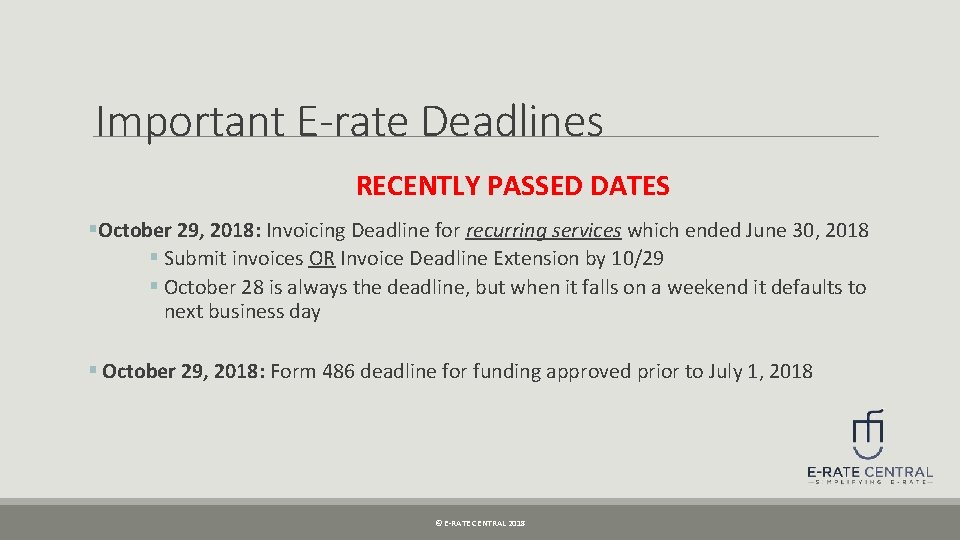
Important E-rate Deadlines RECENTLY PASSED DATES §October 29, 2018: Invoicing Deadline for recurring services which ended June 30, 2018 § Submit invoices OR Invoice Deadline Extension by 10/29 § October 28 is always the deadline, but when it falls on a weekend it defaults to next business day § October 29, 2018: Form 486 deadline for funding approved prior to July 1, 2018 © E-RATE CENTRAL 2018
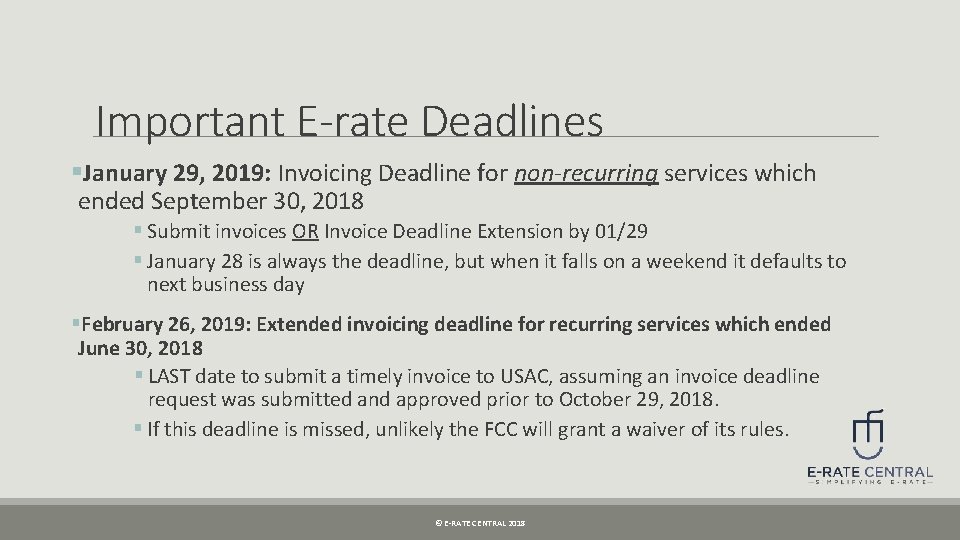
Important E-rate Deadlines §January 29, 2019: Invoicing Deadline for non-recurring services which ended September 30, 2018 § Submit invoices OR Invoice Deadline Extension by 01/29 § January 28 is always the deadline, but when it falls on a weekend it defaults to next business day §February 26, 2019: Extended invoicing deadline for recurring services which ended June 30, 2018 § LAST date to submit a timely invoice to USAC, assuming an invoice deadline request was submitted and approved prior to October 29, 2018. § If this deadline is missed, unlikely the FCC will grant a waiver of its rules. © E-RATE CENTRAL 2018
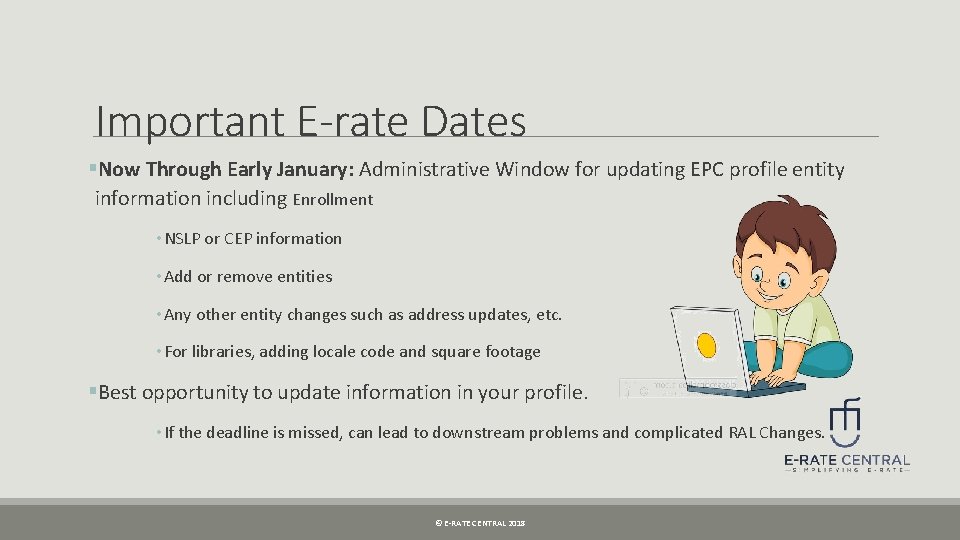
Important E-rate Dates §Now Through Early January: Administrative Window for updating EPC profile entity information including Enrollment • NSLP or CEP information • Add or remove entities • Any other entity changes such as address updates, etc. • For libraries, adding locale code and square footage §Best opportunity to update information in your profile. • If the deadline is missed, can lead to downstream problems and complicated RAL Changes. © E-RATE CENTRAL 2018
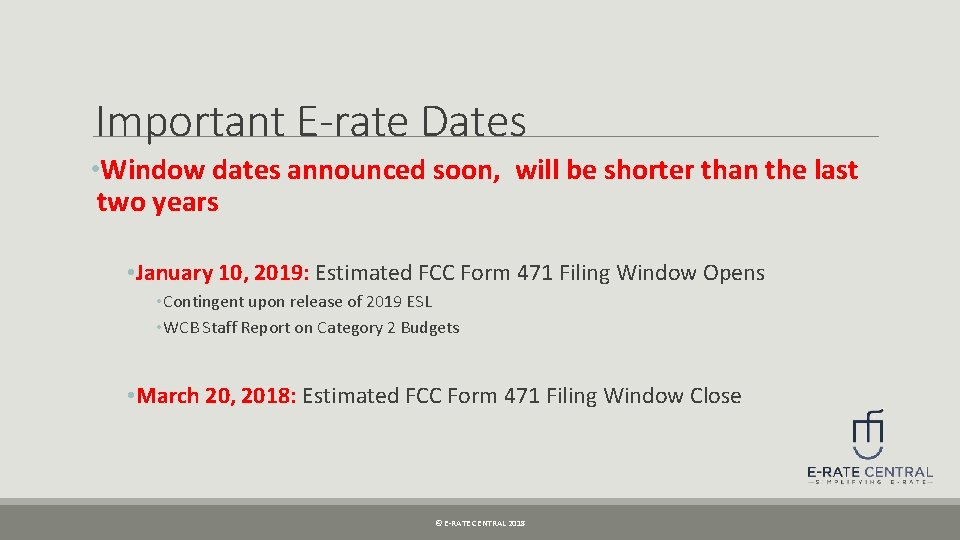
Important E-rate Dates • Window dates announced soon, will be shorter than the last two years • January 10, 2019: Estimated FCC Form 471 Filing Window Opens • Contingent upon release of 2019 ESL • WCB Staff Report on Category 2 Budgets • March 20, 2018: Estimated FCC Form 471 Filing Window Close © E-RATE CENTRAL 2018
ELIGIBLE SERVICES E-RATE FY 2019 © E-RATE CENTRAL 2018
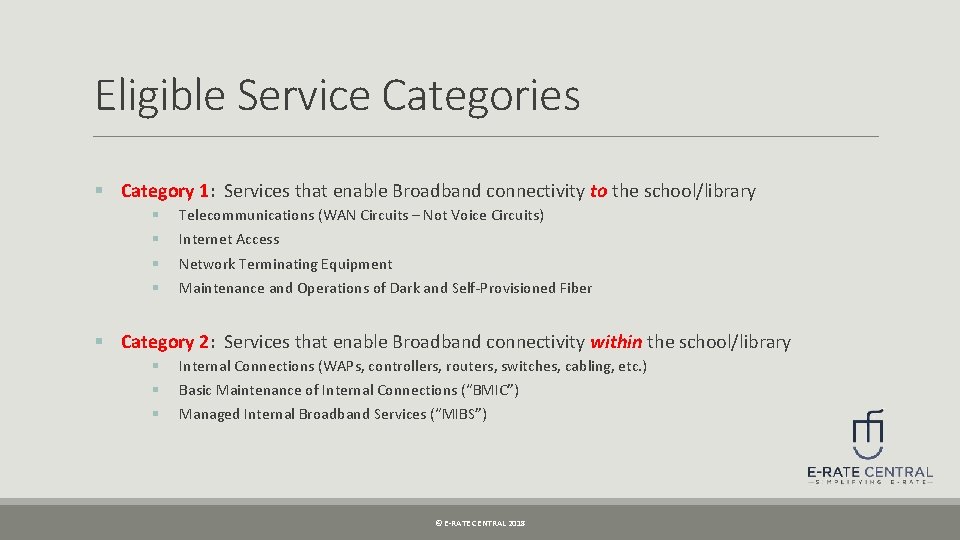
Eligible Service Categories § Category 1: Services that enable Broadband connectivity to the school/library § § Telecommunications (WAN Circuits – Not Voice Circuits) Internet Access Network Terminating Equipment Maintenance and Operations of Dark and Self-Provisioned Fiber § Category 2: Services that enable Broadband connectivity within the school/library § § § Internal Connections (WAPs, controllers, routers, switches, cabling, etc. ) Basic Maintenance of Internal Connections (“BMIC”) Managed Internal Broadband Services (“MIBS”) © E-RATE CENTRAL 2018
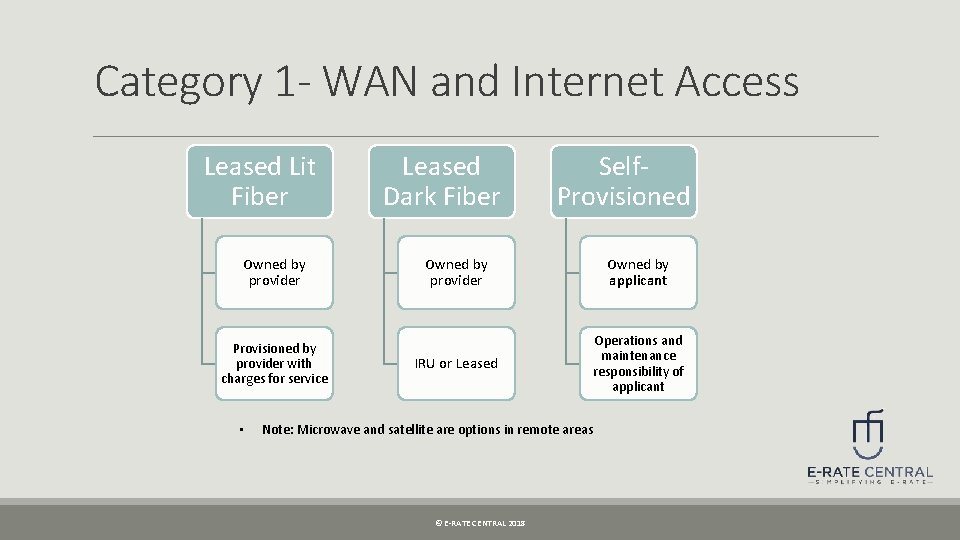
Category 1 - WAN and Internet Access Leased Lit Fiber Owned by provider Provisioned by provider with charges for service • Leased Dark Fiber Self. Provisioned Owned by provider Owned by applicant IRU or Leased Operations and maintenance responsibility of applicant Note: Microwave and satellite are options in remote areas © E-RATE CENTRAL 2018
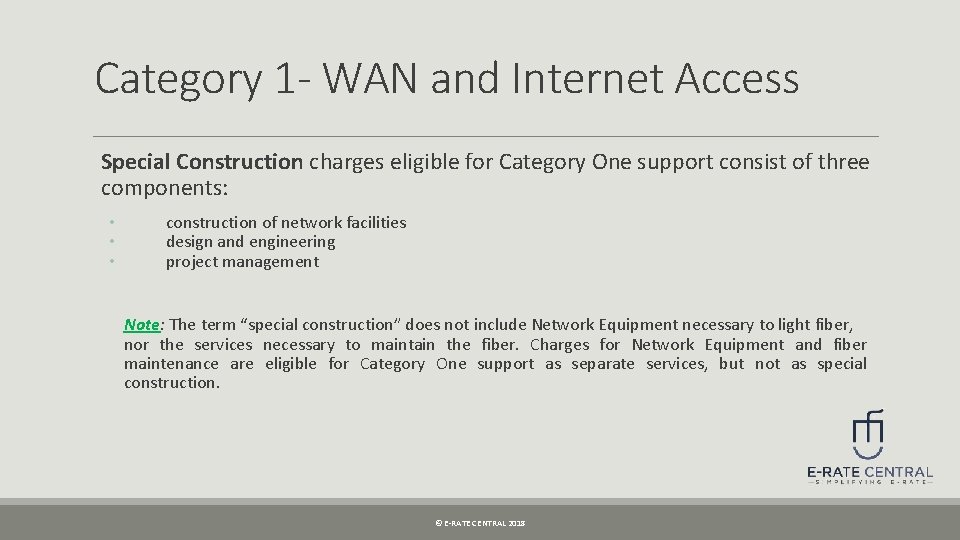
Category 1 - WAN and Internet Access Special Construction charges eligible for Category One support consist of three components: • • • construction of network facilities design and engineering project management Note: The term “special construction” does not include Network Equipment necessary to light fiber, nor the services necessary to maintain the fiber. Charges for Network Equipment and fiber maintenance are eligible for Category One support as separate services, but not as special construction. © E-RATE CENTRAL 2018
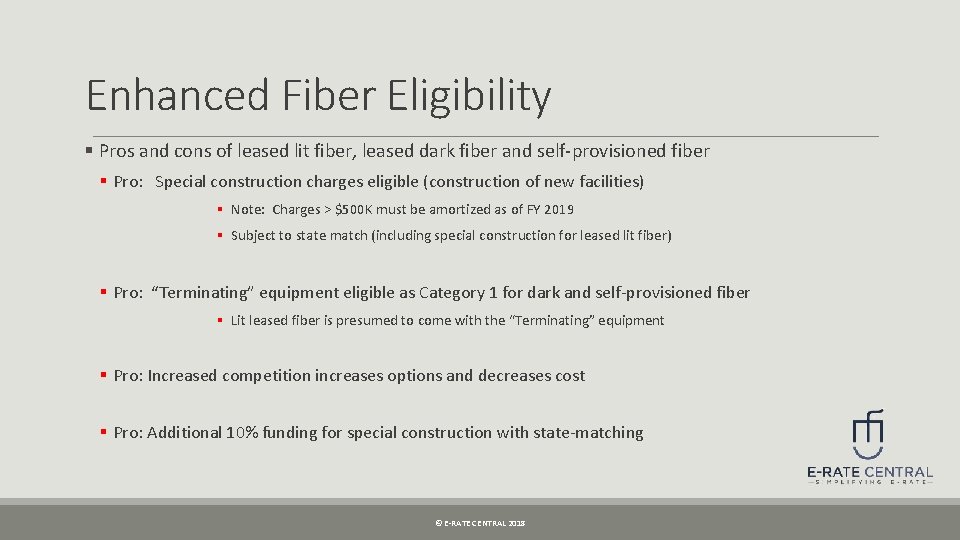
Enhanced Fiber Eligibility § Pros and cons of leased lit fiber, leased dark fiber and self-provisioned fiber § Pro: Special construction charges eligible (construction of new facilities) § Note: Charges > $500 K must be amortized as of FY 2019 § Subject to state match (including special construction for leased lit fiber) § Pro: “Terminating” equipment eligible as Category 1 for dark and self-provisioned fiber § Lit leased fiber is presumed to come with the “Terminating” equipment § Pro: Increased competition increases options and decreases cost § Pro: Additional 10% funding for special construction with state-matching © E-RATE CENTRAL 2018
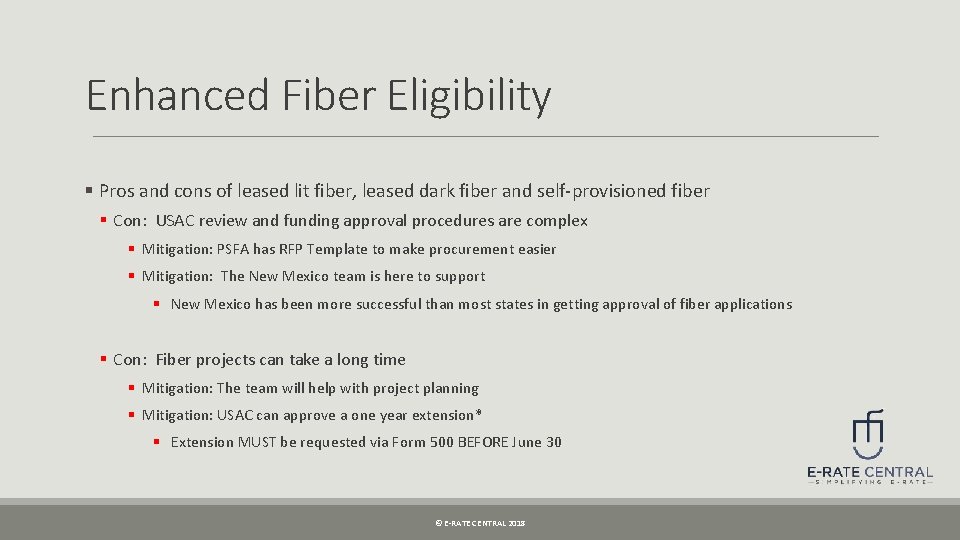
Enhanced Fiber Eligibility § Pros and cons of leased lit fiber, leased dark fiber and self-provisioned fiber § Con: USAC review and funding approval procedures are complex § Mitigation: PSFA has RFP Template to make procurement easier § Mitigation: The New Mexico team is here to support § New Mexico has been more successful than most states in getting approval of fiber applications § Con: Fiber projects can take a long time § Mitigation: The team will help with project planning § Mitigation: USAC can approve a one year extension* § Extension MUST be requested via Form 500 BEFORE June 30 © E-RATE CENTRAL 2018
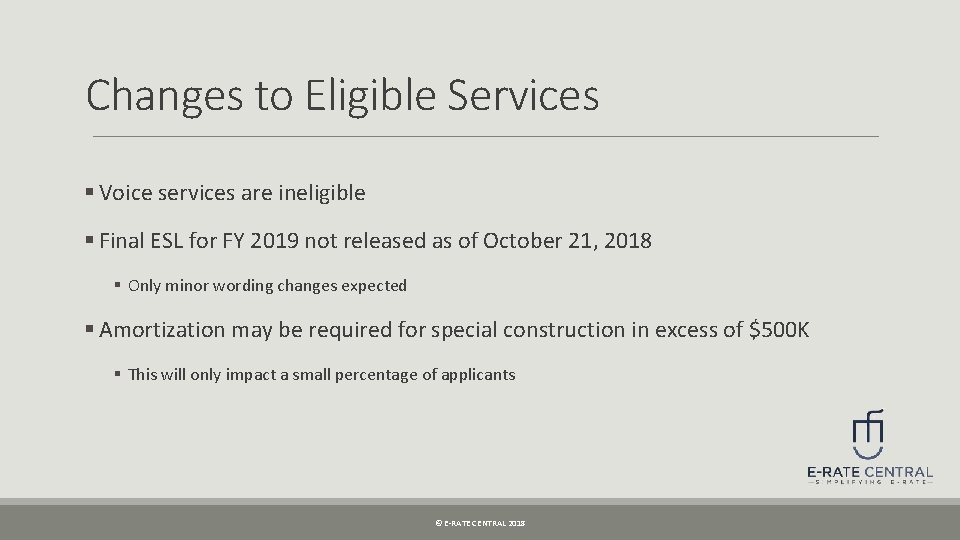
Changes to Eligible Services § Voice services are ineligible § Final ESL for FY 2019 not released as of October 21, 2018 § Only minor wording changes expected § Amortization may be required for special construction in excess of $500 K § This will only impact a small percentage of applicants © E-RATE CENTRAL 2018
FCC Form 470/Competitive Bidding © E-RATE CENTRAL 2018
FCC Form 470 §This Form is used to seek bids on E-rate eligible services and helps ensure that the bidding is done in a fair and open manner § Form must be posted for 28 -days before closing the bidding period, selecting a vendor, or entering into a contract § In addition to complying with the E-rate bidding requirements applicants MUST also comply with State and Local Bidding rules. © E-RATE CENTRAL 2018
FCC FORM 470 (REQUEST SERVICES) §The FCC Form 470 opens the competitive bidding process and notifies potential bidders of the types and quantities of services needed: § Posted to the USAC website and the EPC Portal § Potential bidders review forms and submit bids to the applicant § All RFPs or other supplemental documentation must be attached in EPC (even if it is posted on your website) §Only an authorized representative of the applicant can prepare, sign, or submit the FCC Form 470 © E-RATE CENTRAL 2018
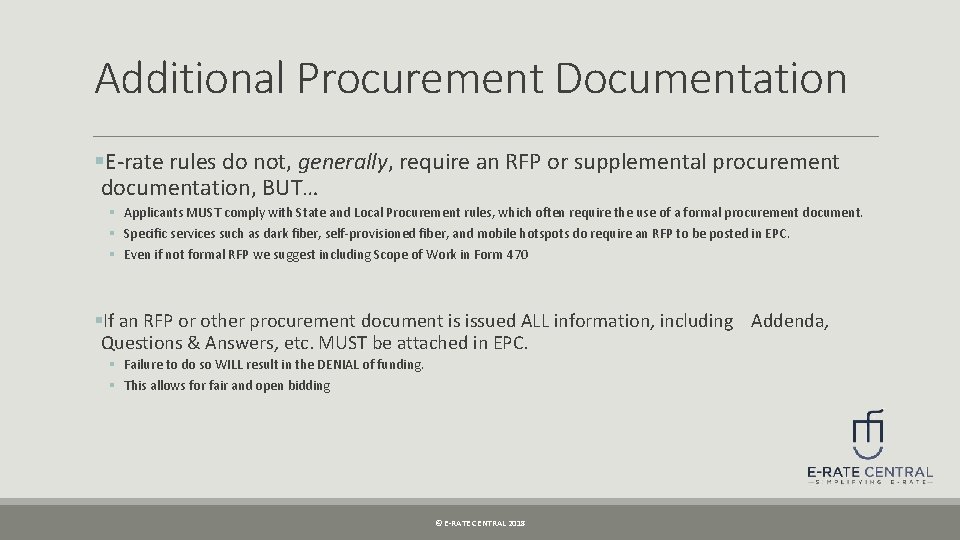
Additional Procurement Documentation §When filing a Form 470, the user is prompted to add a Request for Proposal (“RFP”) if one exists. §USAC uses the term “RFP” generically to refer to any supplemental document that helps to describe the requested services or provides additional information not in the FCC Form 470, this includes: • • • A Request for Bid (RFB) Request for Information (RFI) Invitation to Bid (ITB) Request for Proposal (RFP) Any document that provides additional information to vendors © E-RATE CENTRAL 2018
Additional Procurement Documentation §E-rate rules do not, generally, require an RFP or supplemental procurement documentation, BUT… § Applicants MUST comply with State and Local Procurement rules, which often require the use of a formal procurement document. § Specific services such as dark fiber, self-provisioned fiber, and mobile hotspots do require an RFP to be posted in EPC. § Even if not formal RFP we suggest including Scope of Work in Form 470 §If an RFP or other procurement document is issued ALL information, including Addenda, Questions & Answers, etc. MUST be attached in EPC. § Failure to do so WILL result in the DENIAL of funding. § This allows for fair and open bidding © E-RATE CENTRAL 2018
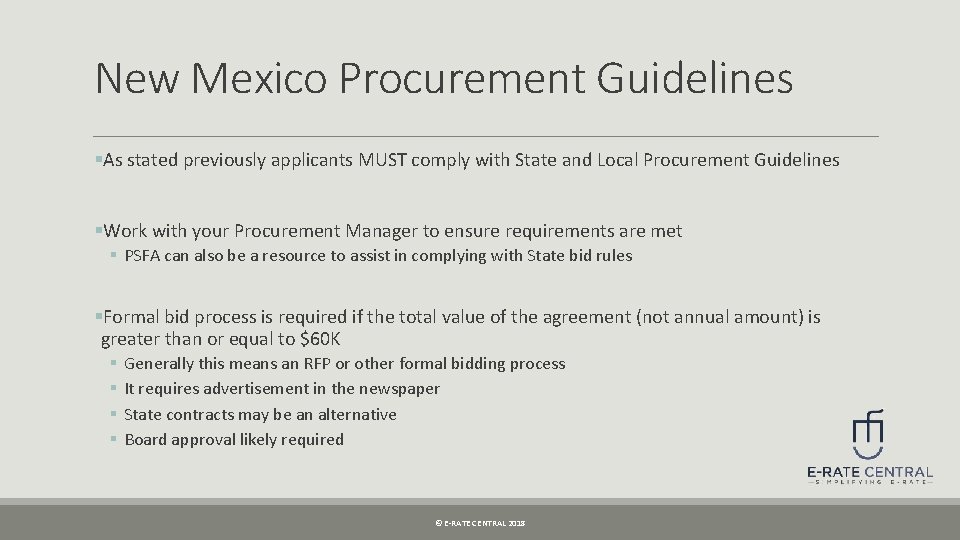
New Mexico Procurement Guidelines §As stated previously applicants MUST comply with State and Local Procurement Guidelines §Work with your Procurement Manager to ensure requirements are met § PSFA can also be a resource to assist in complying with State bid rules §Formal bid process is required if the total value of the agreement (not annual amount) is greater than or equal to $60 K § § Generally this means an RFP or other formal bidding process It requires advertisement in the newspaper State contracts may be an alternative Board approval likely required © E-RATE CENTRAL 2018
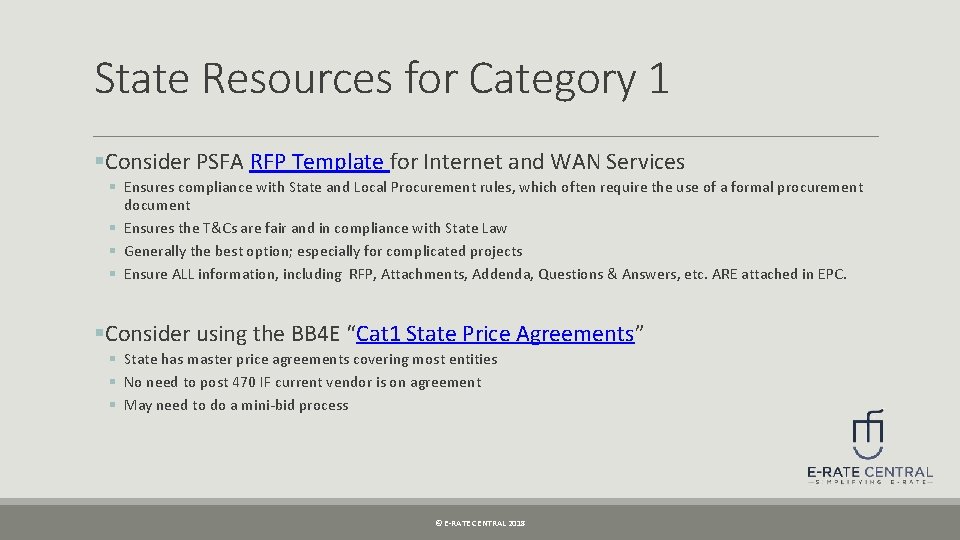
State Resources for Category 1 §Consider PSFA RFP Template for Internet and WAN Services § Ensures compliance with State and Local Procurement rules, which often require the use of a formal procurement document § Ensures the T&Cs are fair and in compliance with State Law § Generally the best option; especially for complicated projects § Ensure ALL information, including RFP, Attachments, Addenda, Questions & Answers, etc. ARE attached in EPC. §Consider using the BB 4 E “Cat 1 State Price Agreements” § State has master price agreements covering most entities § No need to post 470 IF current vendor is on agreement § May need to do a mini-bid process © E-RATE CENTRAL 2018
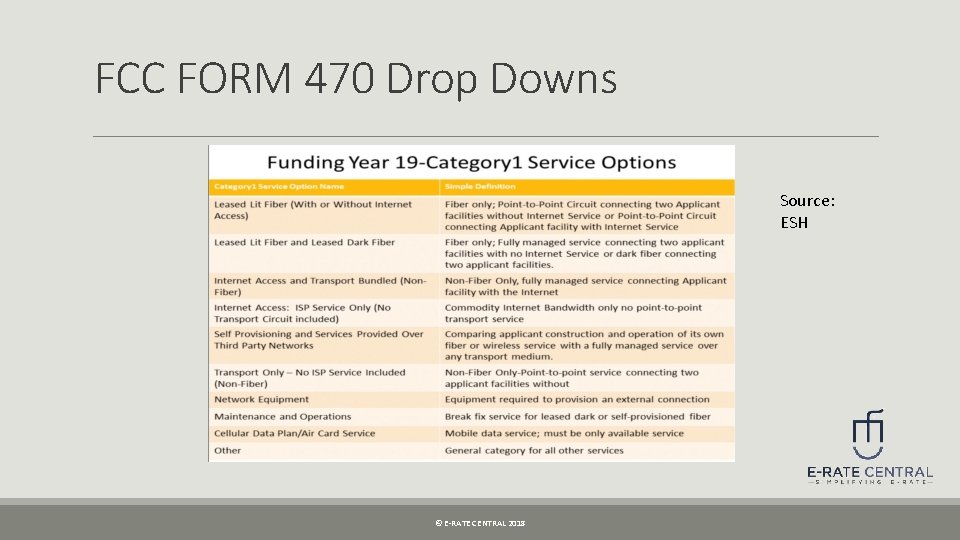
FCC FORM 470 Drop Downs Source: ESH © E-RATE CENTRAL 2018
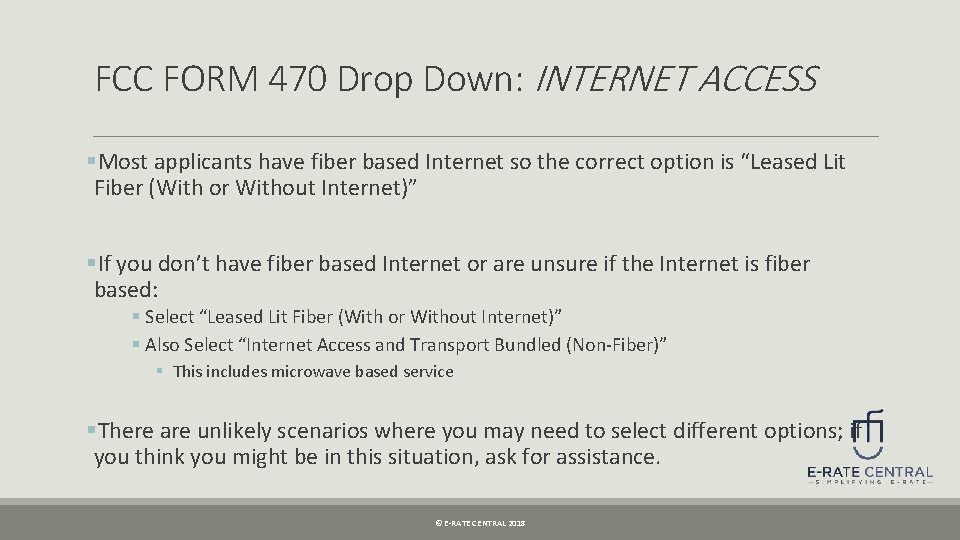
FCC FORM 470 Drop Down: INTERNET ACCESS §Most applicants have fiber based Internet so the correct option is “Leased Lit Fiber (With or Without Internet)” §If you don’t have fiber based Internet or are unsure if the Internet is fiber based: § Select “Leased Lit Fiber (With or Without Internet)” § Also Select “Internet Access and Transport Bundled (Non-Fiber)” § This includes microwave based service §There are unlikely scenarios where you may need to select different options; if you think you might be in this situation, ask for assistance. © E-RATE CENTRAL 2018
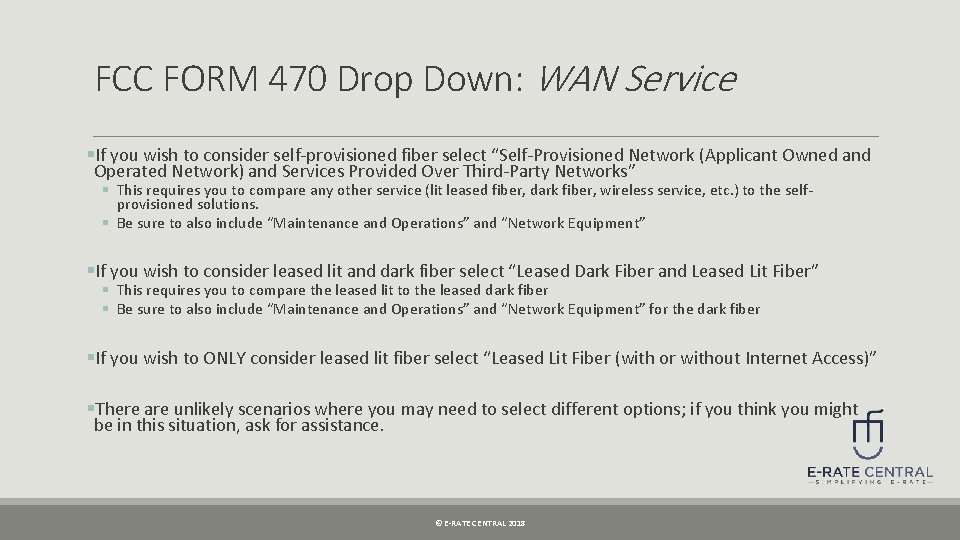
FCC FORM 470 Drop Down: WAN Service §If you wish to consider self-provisioned fiber select “Self-Provisioned Network (Applicant Owned and Operated Network) and Services Provided Over Third-Party Networks” § This requires you to compare any other service (lit leased fiber, dark fiber, wireless service, etc. ) to the selfprovisioned solutions. § Be sure to also include “Maintenance and Operations” and “Network Equipment” §If you wish to consider leased lit and dark fiber select “Leased Dark Fiber and Leased Lit Fiber” § This requires you to compare the leased lit to the leased dark fiber § Be sure to also include “Maintenance and Operations” and “Network Equipment” for the dark fiber §If you wish to ONLY consider leased lit fiber select “Leased Lit Fiber (with or without Internet Access)” §There are unlikely scenarios where you may need to select different options; if you think you might be in this situation, ask for assistance. © E-RATE CENTRAL 2018
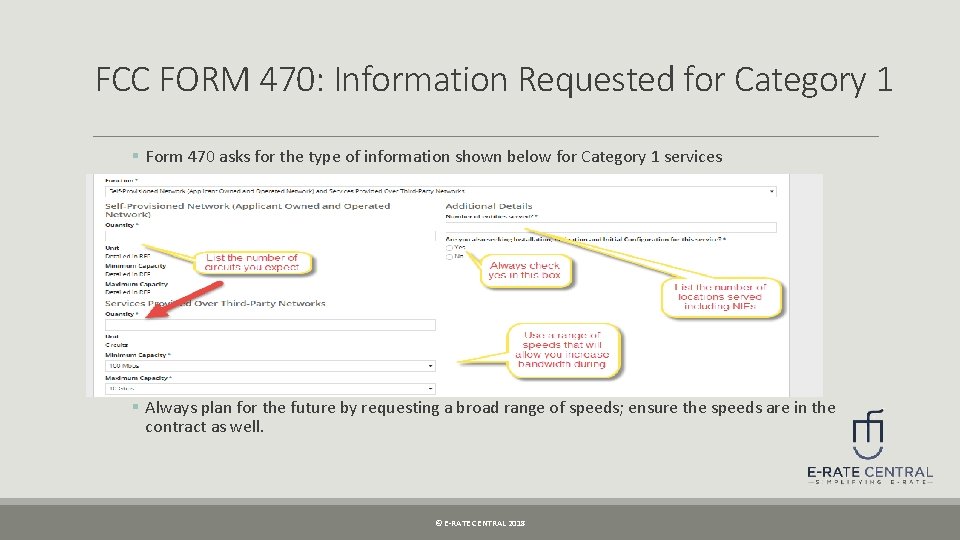
FCC FORM 470: Information Requested for Category 1 § Form 470 asks for the type of information shown below for Category 1 services § fdgfdf § Always plan for the future by requesting a broad range of speeds; ensure the speeds are in the contract as well. © E-RATE CENTRAL 2018
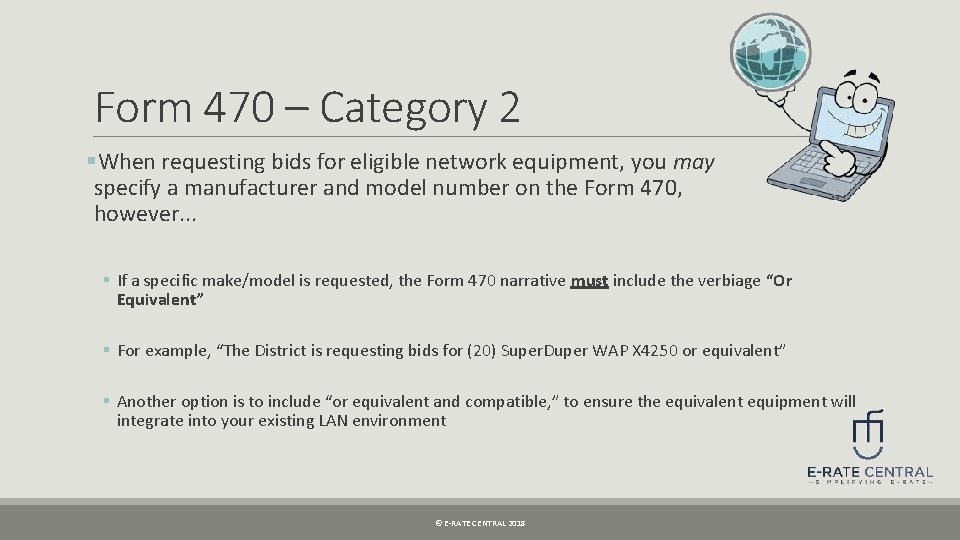
Form 470 – Category 2 §When requesting bids for eligible network equipment, you may specify a manufacturer and model number on the Form 470, however. . . § If a specific make/model is requested, the Form 470 narrative must include the verbiage “Or Equivalent” § For example, “The District is requesting bids for (20) Super. Duper WAP X 4250 or equivalent” § Another option is to include “or equivalent and compatible, ” to ensure the equivalent equipment will integrate into your existing LAN environment © E-RATE CENTRAL 2018
Form 470 – Category 2 §When requesting bids for eligible network equipment, also create a line item for basic maintenance of Internal Connections (BMIC) and management of Internal Broadband Services (MIBS) for the same piece of equipment. § USAC considers some bundled warranties and licenses to be partially basic maintenance. If basic maintenance is not included on the Form 470, USAC will deny funding for the warranty or license line items. § Additionally some of the SKUs vendors may bid could be considered BMIC or MIBS, so it is best to ask for all three on the Form 470. §For example, if requesting bids for wireless access points, also request bids for BMIC for wireless access points and MIBS for Wireless access points. §For manufacturer, select Other and type in “As recommended for new equipment on this request. ” © E-RATE CENTRAL 2018
FCC FORM 470 EXEMPTIONS • Under limited circumstances you are not required to file an FCC Form 470: • Multi-year contracts ◦ A new FCC Form 470 is not required if a contract is still in effect and the costs/services are still within the terms of the establishing FCC Form 470. • State Master Contract with Form 470 ◦ Must conduct a mini-bid ◦ Can post your own Form 470 and limit to valid purchasing vehicles • Low-cost, high-speed Internet (suggest not using)- No 470 Needed if: ◦ Commercially available, business class Internet access. ◦ Minimum speeds of 100 Mbps download / 10 Mbps upload. ◦ The pre-discount price, including any one-time charges, is $3, 600 or less annually. © E-RATE CENTRAL 2018
COMPETITIVE BIDDING REQUIREMENTS • Your FCC Form 470 and RFP must describe the desired products and services with sufficient detail in order for service providers to be able to submit responsive bids. • All potential bidders must have access to your FCC Form 470, RFP, and RFP documents. Be prepared to accept bids and answer questions. All documents must be made available to all potential bidders • You must select the most cost-effective bid with cost of E-rate eligible goods and services being the most heavily weighted factor • As stated earlier in addition to E-rate rules you also MUST comply with state and local bidding requirements © E-RATE CENTRAL 2018
COMPETITIVE BIDDING REQUIREMENTS • The competitive bidding process must be open and fair. ◦ "Open" means that information shared with one bidder must be shared with all. ◦ "Fair" means that bidders must be evaluated fairly and equally. • Minimum required 28 -day waiting period ◦ FCC Form 470 and any RFPs (if applicable) must be posted on the USAC website for a minimum of 28 days. ◦ The end of the 28 -day period is when you are allowed to review bids and select vendors — also referred to as the allowable contract date (ACD). © E-RATE CENTRAL 2018
CARDINAL CHANGES §A cardinal change is any change that significantly alters your original request § Lack of clear guidance from USAC § Suggest waiting 28 -days after last Q&A before closing bid §Examples of cardinal changes include but are not limited to: § Answering any question from any potential bidder is considered a cardinal change. § Upload all Q & A into EPC as an RFP document to your Form 470. §Making a change to the scope of the services you are seeking. § If so, create and certify a new FCC Form 470 and begin a new 28 -day waiting period. © E-RATE CENTRAL 2018
CARDINAL CHANGES In the following cases, you must post a new FCC Form 470. You cannot simply add an RFP document to your existing certified FCC Form 470: § Omitting an available RFP before you certified your form. The option to add RFP documents to a certified form is only available if you already attached at least one RFP document to your form before you certified it. § Making a significant change to your service requests that goes beyond what was included on Form 470. § Adding new products and/or services; To post for new products and/or services, either file a new FCC Form 470 or cancel your existing form and post a new form featuring all of the products and/or services from both forms. © E-RATE CENTRAL 2018
EVALUATING BIDS FY 2019 © E-RATE CENTRAL 2018
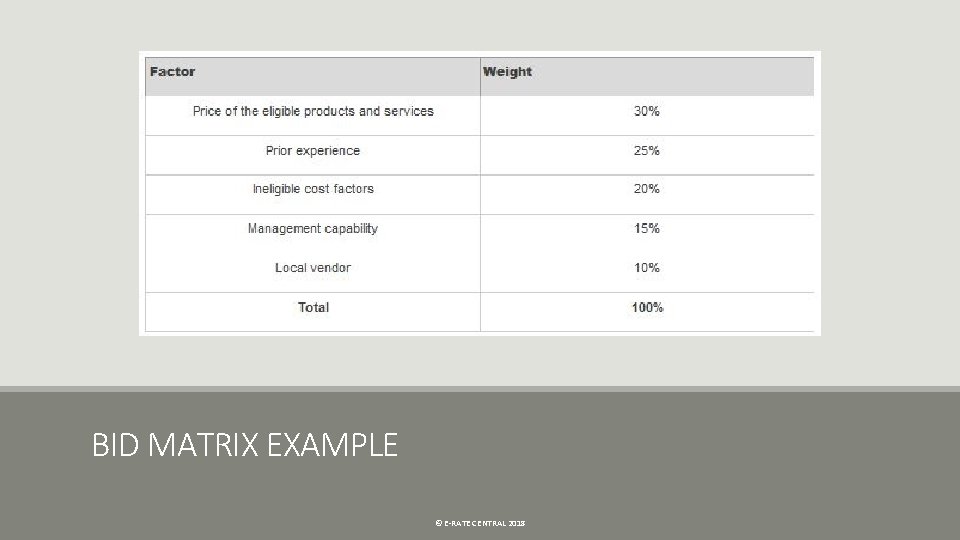
BID EVALUATION §When evaluating bids received for eligible services, you must select the most cost-effective bid § The price of the eligible products and services must be the primary factor in the evaluation, but does not have to be the sole factor §Other relevant evaluation factors may include: § § § Prior experience including past performance Personnel qualifications including technical excellence Management capability including schedule compliance Cost of ineligible goods and services Local vendor Other © E-RATE CENTRAL 2018
BID MATRIX EXAMPLE © E-RATE CENTRAL 2018
BID EVALUATION CONSIDERATIONS Disqualification Factors §You can set out specific requirements and disqualify bids that do not meet certain requirements as long as you clearly identify the disqualification reasons on your FCC Form 470 and/or your RFP §Disqualification reasons MUST be determined prior to any substantive bid evaluation. §Disqualification reasons cannot be scored on a range, but rather are binary – i. e. , the service provider either meets the standard or does not meet the standard © E-RATE CENTRAL 2018
BID EVALUATION CONSIDERATIONS Receive one or no bids for a service? §If you receive one or no bids after 28 -day waiting period in response to an FCC Form 470 keep a written record of this fact §You can contact service providers after the bid closing date if you received one or no bids after initial 28 -day waiting period (non-RFP) §State and local procurement rules may also require certain actions when this situation occurs © E-RATE CENTRAL 2018
Entering into a Contract §E-Rate rules require a legally binding agreement (as defined by state law) or a contract to be in place BEFORE filing the 471 §Remember the contract must comply with State and local procurement law §Use the contracts that PSFA has on its website or other contracts approved by the state §Make sure you follow procurement rules (e. g. board approval if required) © E-RATE CENTRAL 2018
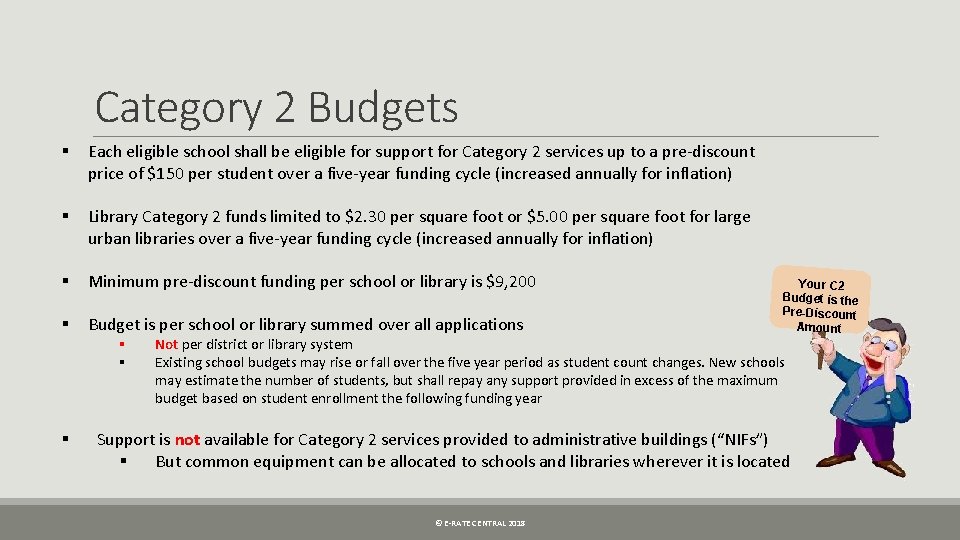
Category 2 Budgets § Each eligible school shall be eligible for support for Category 2 services up to a pre-discount price of $150 per student over a five-year funding cycle (increased annually for inflation) § Library Category 2 funds limited to $2. 30 per square foot or $5. 00 per square foot for large urban libraries over a five-year funding cycle (increased annually for inflation) § Minimum pre-discount funding per school or library is $9, 200 § Budget is per school or library summed over all applications § § § Your C 2 Budget is the Pre-Discount Amount Not per district or library system Existing school budgets may rise or fall over the five year period as student count changes. New schools may estimate the number of students, but shall repay any support provided in excess of the maximum budget based on student enrollment the following funding year Support is not available for Category 2 services provided to administrative buildings (“NIFs”) § But common equipment can be allocated to schools and libraries wherever it is located © E-RATE CENTRAL 2018
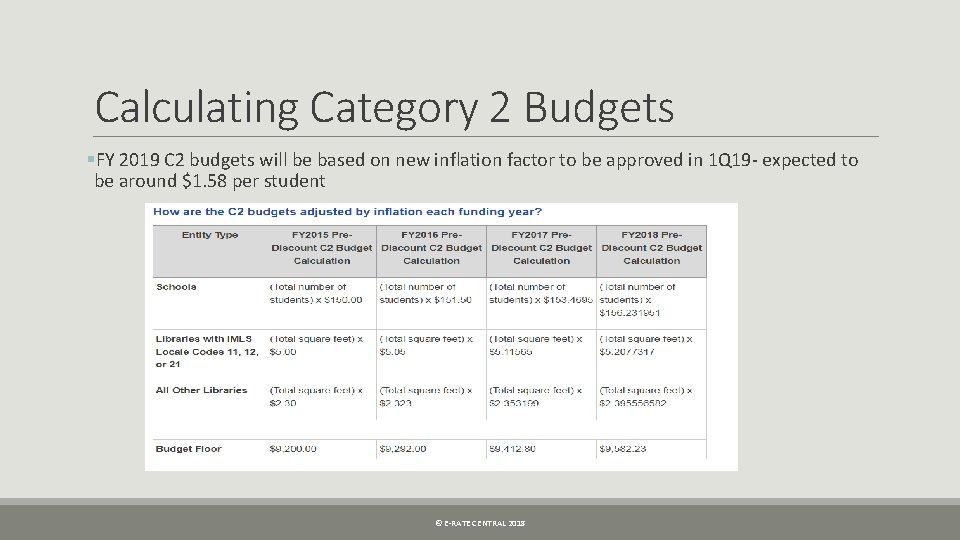
Calculating Category 2 Budgets §FY 2019 C 2 budgets will be based on new inflation factor to be approved in 1 Q 19 - expected to be around $1. 58 per student © E-RATE CENTRAL 2018
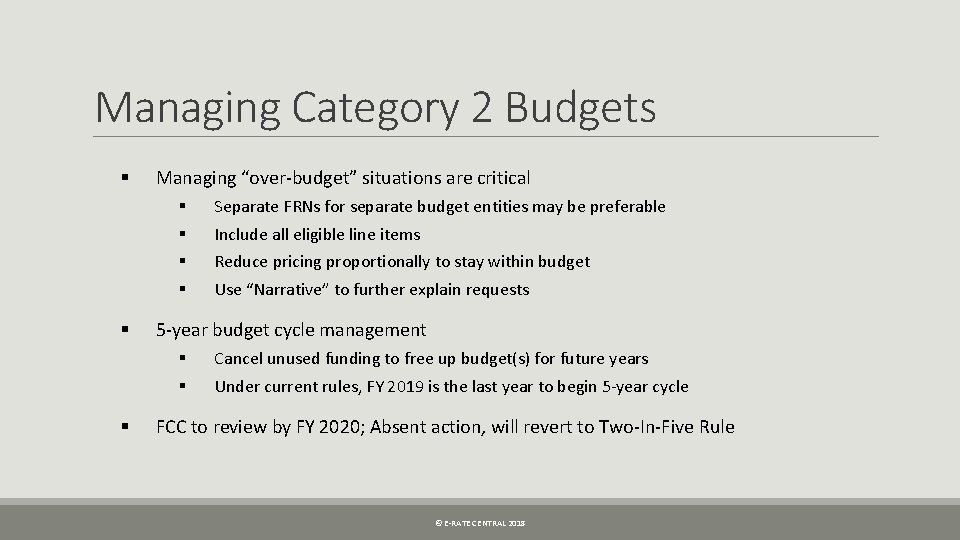
Managing Category 2 Budgets § Managing “over-budget” situations are critical § § § Include all eligible line items Reduce pricing proportionally to stay within budget Use “Narrative” to further explain requests 5 -year budget cycle management § § § Separate FRNs for separate budget entities may be preferable Cancel unused funding to free up budget(s) for future years Under current rules, FY 2019 is the last year to begin 5 -year cycle FCC to review by FY 2020; Absent action, will revert to Two-In-Five Rule © E-RATE CENTRAL 2018
DISCOUNT RATE CALCULATION E-RATE FY 2018 © E-RATE CENTRAL 2018
E-RATE DISCOUNT RATE Types of Eligible Entities: • School District or Individual School • Library, Library System or Library Consortium • Consortium of Schools &/or Libraries • Head Start, Pre-Kindergarten, Juvenile Justice, or Adult Education © E-RATE CENTRAL 2018
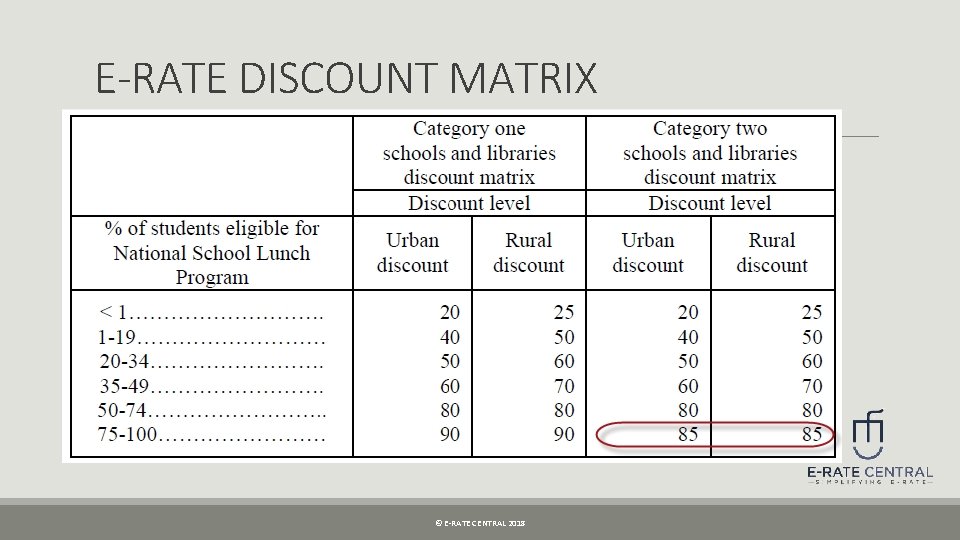
SCHOOL DISTRICT DISCOUNT RATE §In general, the School District calculation is the basis for discount calculations for all types of entities. Each school or group of schools in a school district must use the single district-wide “matrix” discount rate for all funding requests §To calculate the discount for a school district: • Determine the total number of students eligible for the National School Lunch Program (NSLP) in the entire school district • Determine the total number of students in the school district • Divide the first number by the second number to get the percentage of students eligible for NSLP in the school district • Using this percentage and the urban or rural status of the school district, find the appropriate Category One and Category Two discount for the school district in the discount matrix, see next slide © E-RATE CENTRAL 2018
E-RATE DISCOUNT MATRIX © E-RATE CENTRAL 2018
LIBRARY DISCOUNT RATE • An individual library uses the eligibility percentage of the district where library is located • All libraries in a library system must use the single system-wide “matrix” discount rate for all funding requests using the eligibility percentage of the district where the Main Branch of the library system is located © E-RATE CENTRAL 2018
CONSORTIUM DISCOUNT RATE §Based on simple average of member discounts §Consortium is the only type of applicant that can have a non-matrix discount §Consortium discount applies to all FRNs within an application §Per FCC direction, USAC will prioritize application review for state and regional consortium applicants §Consortium membership LOAs must be in place prior to filing the Form 470 © E-RATE CENTRAL 2018
ALTERNATIVE DISCOUNT MECHANISMS §For schools which either do not participate in NSLP or choose not to use NSLP participation numbers, there acceptable alternative discount mechanisms: §In all cases, these mechanisms must be based on or not exceed the same measure of poverty used by NSLP §Applicants must maintain accurate and complete documentation of the calculations that support their funding requests Remember that documentation must be retained for at least ten years after the last date to receive service © E-RATE CENTRAL 2018
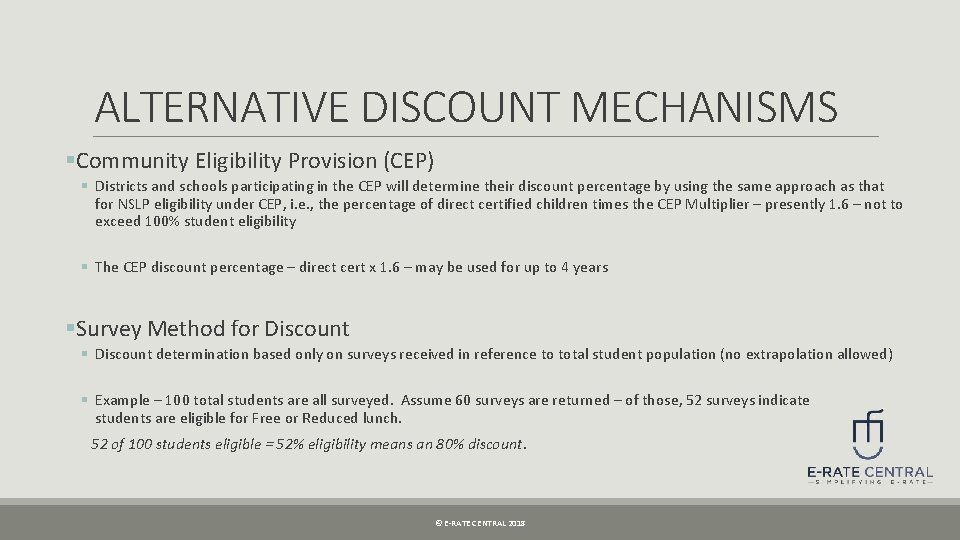
ALTERNATIVE DISCOUNT MECHANISMS §Community Eligibility Provision (CEP) § Districts and schools participating in the CEP will determine their discount percentage by using the same approach as that for NSLP eligibility under CEP, i. e. , the percentage of direct certified children times the CEP Multiplier – presently 1. 6 – not to exceed 100% student eligibility § The CEP discount percentage – direct cert x 1. 6 – may be used for up to 4 years §Survey Method for Discount § Discount determination based only on surveys received in reference to total student population (no extrapolation allowed) § Example – 100 total students are all surveyed. Assume 60 surveys are returned – of those, 52 surveys indicate students are eligible for Free or Reduced lunch. 52 of 100 students eligible = 52% eligibility means an 80% discount. © E-RATE CENTRAL 2018
DISCOUNT RATE – OTHER CONSIDERATIONS § District charter schools are considered part of the district § Discount calculated using the district’s NSLP information not the charter’s NSLP information § State charter schools are considered as their own district § Determine discount using only their NSLP information § Consider forming consortia to drive down costs § Members can include a mixture of school districts, libraries, charters, other entities (may require cost allocation) © E-RATE CENTRAL 2018
Children’s Internet Protection Act (CIPA) E-RATE FY 2018 © E-RATE CENTRAL 2018
CIPA Overview • Compliance required for discounts on services beyond basic telecommunications • Requires both schools and libraries adopt an Internet Safety Policy that must be discussed in one public meeting • See E-Rate Central’s Sample Internet Safety Policy • Requires a technology protection measure that filters obscene images, child pornography, and other items “harmful to minors” • More information may be found on the USAC website • E-rate Program rules specify that "[a] determination regarding matter inappropriate for minors shall be made by the school board, local educational agency, library, or other authority responsible for making the determination” © E-RATE CENTRAL 2018
CIPA for Schools • Schools must address in their Internet Safety Policy how they are educating students about cyber bullying, and appropriate behavior regarding social networking and chat rooms • The policy must also include monitoring the online activities of minors • Schools must document that they’ve complied with their policy to educate minors • Certification of compliance with CIPA must be made on the Form 486 and Form 479 © E-RATE CENTRAL 2018
CIPA for Libraries • For libraries, CIPA compliance is not as onerous as compliance for schools • Filters in libraries may be disabled for any adult for lawful purposes • New technology facilitates filtering via cloud hosting and control of filtering levels by library card • Libraries not required to include the education of minors in Internet Safety Policy • As with schools, certification of compliance is made on Forms 486/479 • New applicants are given a year to become CIPA compliant if this is the first year of E-rate funding • More information available from the American Library Association © E-RATE CENTRAL 2018
2019 Potential Challenges § USAC is migrating away from their Forms processing contractor, Solix § Uncertainty about amortization of special construction § Uncertainty about cost allocation of ports used for security § Recent audit finding that switch ports dedicated to security cameras do not meet the definition of “Educational Purposes” § Unforgiving invoicing deadlines and review procedures. © E-RATE CENTRAL 2018
E-RATE PRODUCTIVITY CENTER (EPC) E-RATE FY 2018 © E-RATE CENTRAL 2018
LIVE EPC DEMONSTRATION © E-RATE CENTRAL 2018
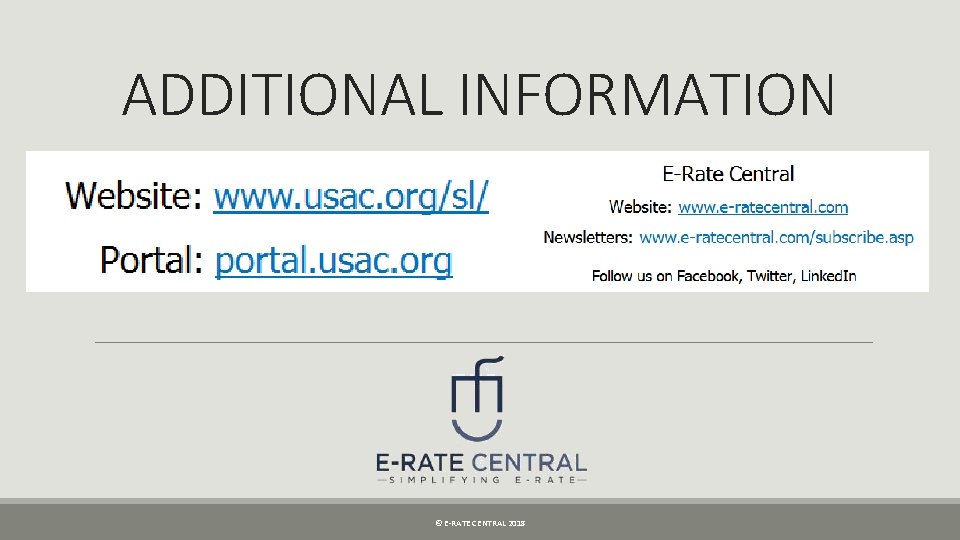
ADDITIONAL INFORMATION © E-RATE CENTRAL 2018