
Erasure Coding Giza Hyperbolic Caching 1 Giza Erasure

Erasure Coding: Giza + Hyperbolic Caching 1

Giza Erasure coding objects across Global Data Centers Yu Lin Chen, NYU & Microsoft Corporation; Shuai Mu and Jinyang Li, NYU; Cheng Huang, Jin Li, Aaron Ogus, and Douglas Phillips, Microsoft Corporation Presented by: Samarth Kulshreshtha 2
Why the name ‘Giza’? Image source: news. com 3
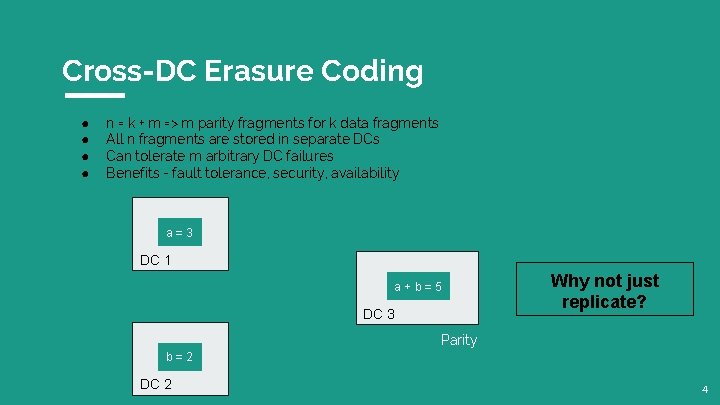
Cross-DC Erasure Coding ● ● n = k + m => m parity fragments for k data fragments All n fragments are stored in separate DCs Can tolerate m arbitrary DC failures Benefits - fault tolerance, security, availability a=3 DC 1 a+b=5 DC 3 Why not just replicate? Parity b=2 DC 2 4
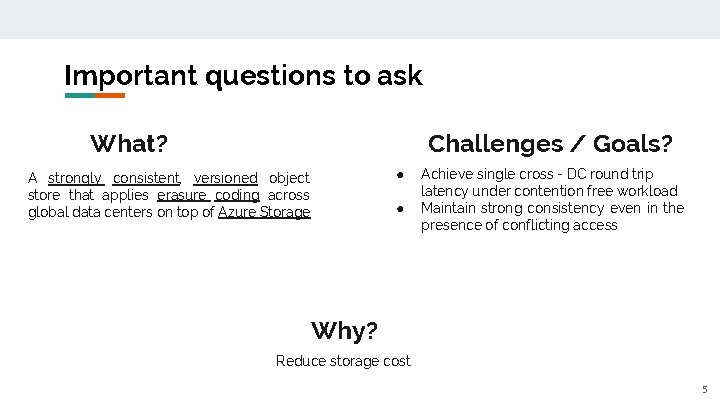
Important questions to ask What? Challenges / Goals? ● A strongly consistent, versioned object store that applies erasure coding across global data centers on top of Azure Storage ● Achieve single cross - DC round trip latency under contention free workload Maintain strong consistency even in the presence of conflicting access Why? Reduce storage cost 5
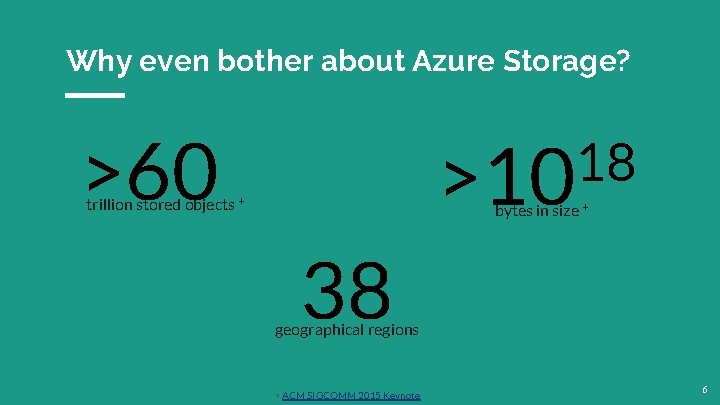
Why even bother about Azure Storage? >60 18 >10 trillion stored objects + bytes in size + 38 geographical regions + ACM SIGCOMM 2015 Keynote 6
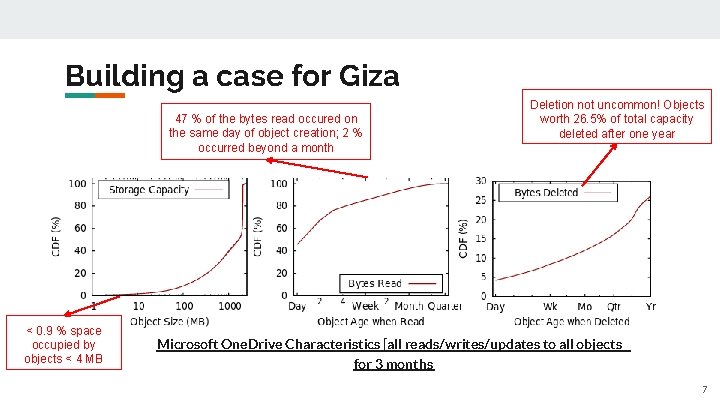
Building a case for Giza 47 % of the bytes read occured on the same day of object creation; 2 % occurred beyond a month < 0. 9 % space occupied by objects < 4 MB Deletion not uncommon! Objects worth 26. 5% of total capacity deleted after one year Microsoft One. Drive Characteristics [all reads/writes/updates to all objects for 3 months 7
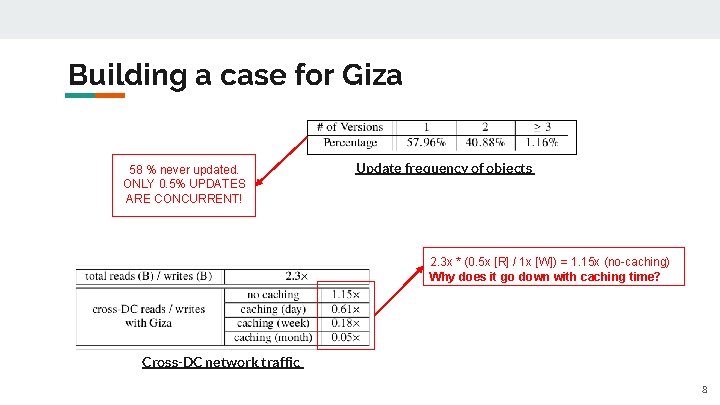
Building a case for Giza 58 % never updated. ONLY 0. 5% UPDATES ARE CONCURRENT! Update frequency of objects 2. 3 x * (0. 5 x [R] / 1 x [W]) = 1. 15 x (no-caching) Why does it go down with caching time? Cross-DC network traffic 8
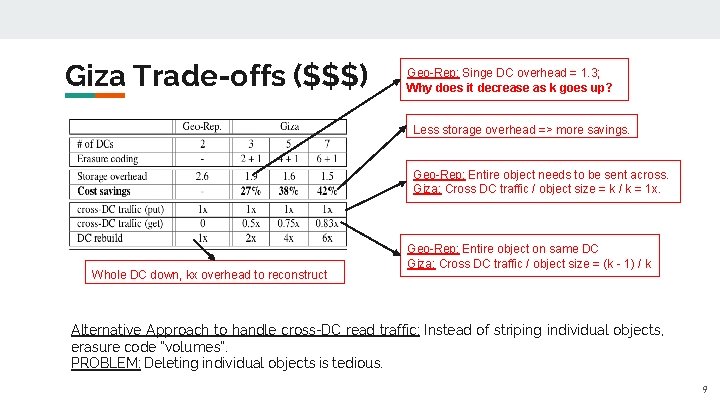
Giza Trade-offs ($$$) Geo-Rep: Singe DC overhead = 1. 3; Why does it decrease as k goes up? Less storage overhead => more savings. Geo-Rep: Entire object needs to be sent across. Giza: Cross DC traffic / object size = k / k = 1 x. Whole DC down, kx overhead to reconstruct Geo-Rep: Entire object on same DC Giza: Cross DC traffic / object size = (k - 1) / k Alternative Approach to handle cross-DC read traffic: Instead of striping individual objects, erasure code “volumes”. PROBLEM: Deleting individual objects is tedious. 9
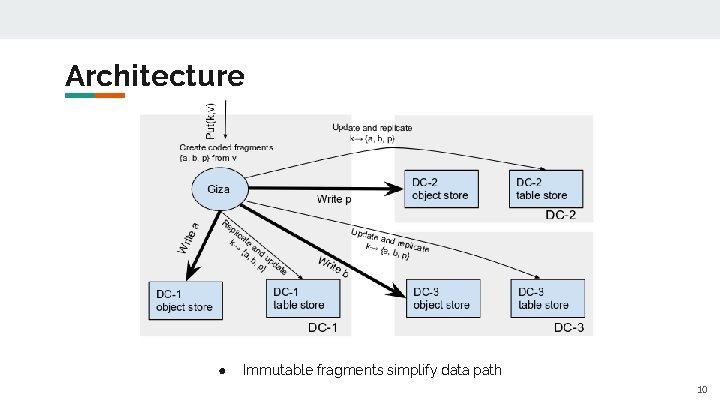
Architecture ● Immutable fragments simplify data path 10
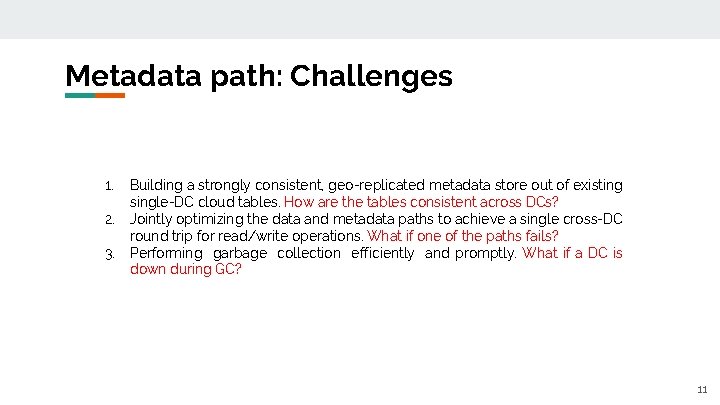
Metadata path: Challenges 1. 2. 3. Building a strongly consistent, geo-replicated metadata store out of existing single-DC cloud tables. How are the tables consistent across DCs? Jointly optimizing the data and metadata paths to achieve a single cross-DC round trip for read/write operations. What if one of the paths fails? Performing garbage collection efficiently and promptly. What if a DC is down during GC? 11
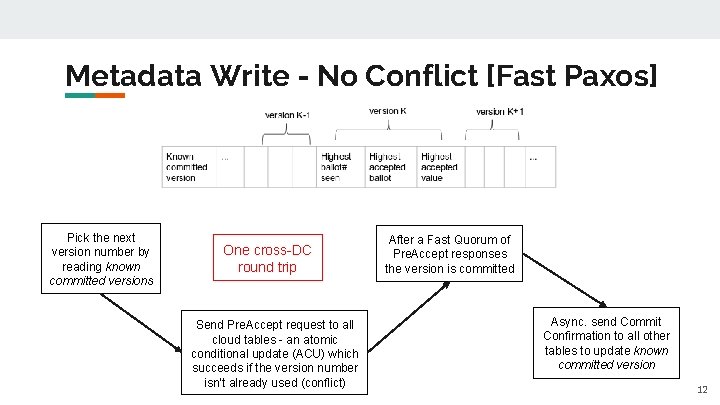
Metadata Write - No Conflict [Fast Paxos] Pick the next version number by reading known committed versions One cross-DC round trip Send Pre. Accept request to all cloud tables - an atomic conditional update (ACU) which succeeds if the version number isn’t already used (conflict) After a Fast Quorum of Pre. Accept responses the version is committed Async. send Commit Confirmation to all other tables to update known committed version 12
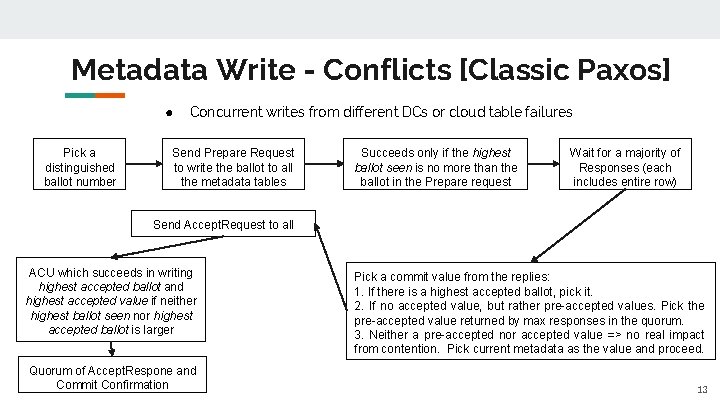
Metadata Write - Conflicts [Classic Paxos] ● Pick a distinguished ballot number Concurrent writes from different DCs or cloud table failures Send Prepare Request to write the ballot to all the metadata tables Succeeds only if the highest ballot seen is no more than the ballot in the Prepare request Wait for a majority of Responses (each includes entire row) Send Accept. Request to all ACU which succeeds in writing highest accepted ballot and highest accepted value if neither highest ballot seen nor highest accepted ballot is larger Quorum of Accept. Respone and Commit Confirmation Pick a commit value from the replies: 1. If there is a highest accepted ballot, pick it. 2. If no accepted value, but rather pre-accepted values. Pick the pre-accepted value returned by max responses in the quorum. 3. Neither a pre-accepted nor accepted value => no real impact from contention. Pick current metadata as the value and proceed. 13
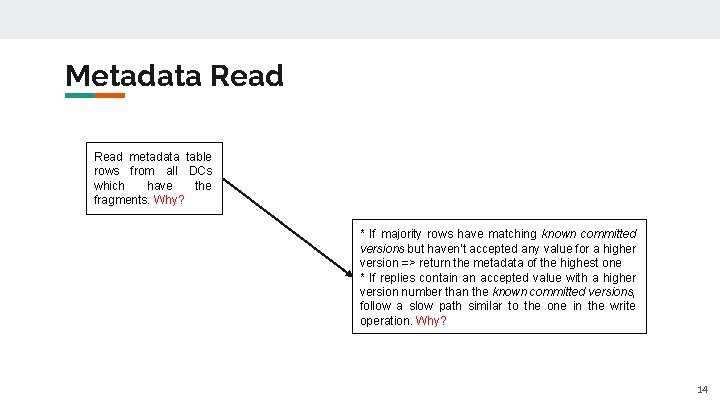
Metadata Read metadata table rows from all DCs which have the fragments. Why? * If majority rows have matching known committed versions but haven’t accepted any value for a higher version => return the metadata of the highest one * If replies contain an accepted value with a higher version number than the known committed versions, follow a slow path similar to the one in the write operation. Why? 14
Joint optimization of data and metadata operations ● ● ● All operations in parallel. What if one of the paths fail? Put operation: ○ Wait for ack from both data and metadata paths as well as Commit Confirmations Get operation: ○ Read metadata table row from local DC to get known committed versions and names and locations of the latest version fragments ○ Immediately start reading fragments, in parallel validate if this version is indeed the latest one ○ If validation fails, issue read again for the new version 15
Deletion and Garbage Collection ● ● Execute metadata path to write a new version indicating deletion, once the metadata update succeeds ack deletion Garbage collection: ○ Delete objects from blob storage and truncate columns of deleted versions from metadata table row ○ Steps: 1. Fetch metadata 2. delete fragments 3. truncate columns ○ Two phase commit for truncating row ○ What happens when a DC goes down during delete? 16
Failure Recovery ● ● ● Within DC failures resolved by cloud object store and table store Transient DC failures: ○ Get/Put operations slow but still work ○ Upon DC recovery, catch up ■ Issue read request for each object ■ If local and committed version match - do nothing ■ If mismatch - read fragments of all missing versions - reconstruct and store in blob as well as update metadata Permanent DC failures: ○ Indirection - Physical DC mapped to a logical name ○ Mapping stored in an external service ○ Upon failure remap to another DC and reconstruct ○ Metadata stores only the logical DC name 17
Implementation ● ● ● C++ Uses Azure Blob Storage and Azure Table Storage Atomic Conditional Write - ETags Read ETag - check condition - issue write request along with ETag - rejected if incoming ETag mismatches with the one in the table service Minimize latency by delegating write requests to remote nodes in same DC as the tables 18
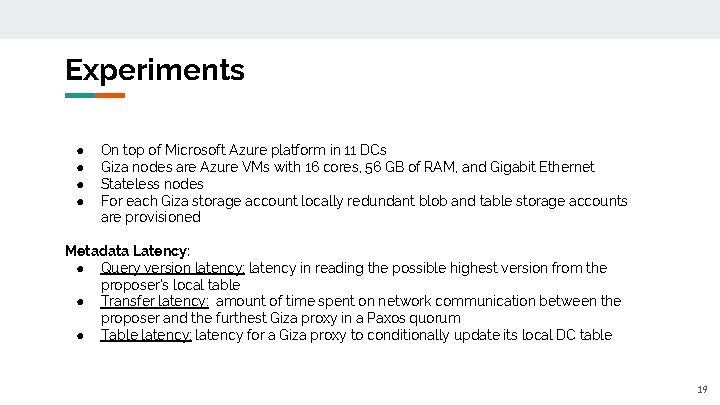
Experiments ● ● On top of Microsoft Azure platform in 11 DCs Giza nodes are Azure VMs with 16 cores, 56 GB of RAM, and Gigabit Ethernet Stateless nodes For each Giza storage account locally redundant blob and table storage accounts are provisioned Metadata Latency: ● Query version latency: latency in reading the possible highest version from the proposer’s local table ● Transfer latency: amount of time spent on network communication between the proposer and the furthest Giza proxy in a Paxos quorum ● Table latency: latency for a Giza proxy to conditionally update its local DC table 19
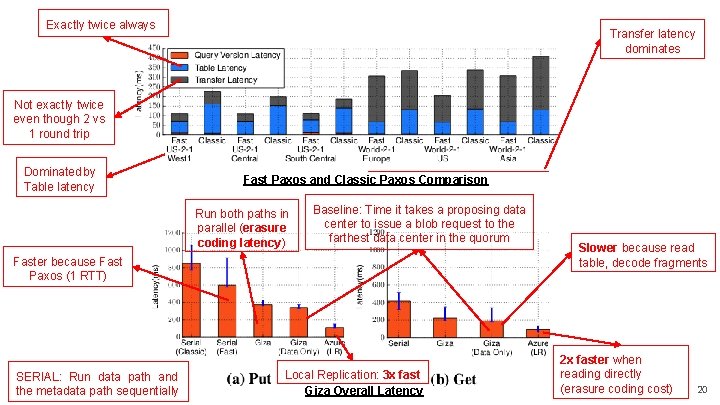
Exactly twice always Transfer latency dominates Not exactly twice even though 2 vs 1 round trip Dominated by Table latency Fast Paxos and Classic Paxos Comparison Run both paths in parallel (erasure coding latency) Baseline: Time it takes a proposing data center to issue a blob request to the farthest data center in the quorum Faster because Fast Paxos (1 RTT) SERIAL: Run data path and the metadata path sequentially Local Replication: 3 x fast Giza Overall Latency Slower because read table, decode fragments 2 x faster when reading directly (erasure coding cost) 20
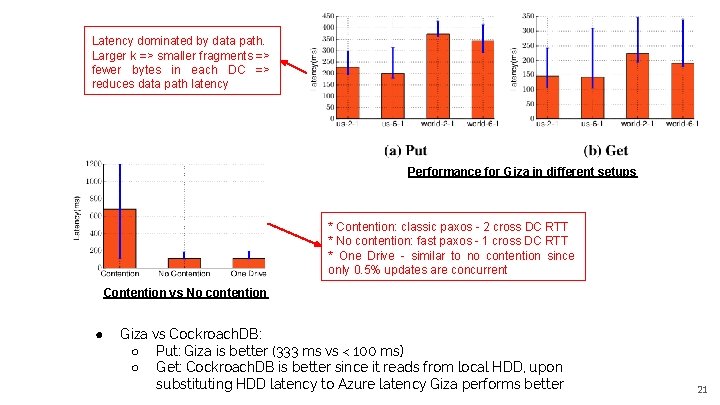
Latency dominated by data path. Larger k => smaller fragments => fewer bytes in each DC => reduces data path latency Performance for Giza in different setups * Contention: classic paxos - 2 cross DC RTT * No contention: fast paxos - 1 cross DC RTT * One Drive - similar to no contention since only 0. 5% updates are concurrent Contention vs No contention ● Giza vs Cockroach. DB: ○ Put: Giza is better (333 ms vs < 100 ms) ○ Get: Cockroach. DB is better since it reads from local HDD, upon substituting HDD latency to Azure latency Giza performs better 21
Thoughts ● ● ● ● Very well written and easy to follow Thorough performance and workload analysis (system driven by One Drive workloads) Performs well and provides significant cost benefits (works only with Azure Storage) Garbage collection process is not described in detail - how often does it run? Overheads? Can GC impact performance? Does not talk about how cache consistency is maintained (they do present caching benefits)? What modifications are needed to make this work in an untrusted environment? Is there any way to optimize cross-WAN repair bandwidth? 22
Key Takeaways ● ● Makes a strong case for conducting workload analysis in order to improve system performance For a workload with archival properties Erasure Coding seems to provide significant cost benefits Giza provides an interesting example for how choosing an appropriate consensus algorithm can help achieve lower cross-DC latency Provides a technique for achieving globally consistent put and get with versioning support 23

Hyperbolic Caching Flexible Caching for Web Applications Aaron Blankstein, Siddhartha Sen, Michael J. Freedman Presented by: Sanchay Javeria 24

Motivation - Web apps have become increasingly popular (Reddit, Medium, Twitter etc. ) Users expect performance but app ecosystem diversity makes improving performance non-trivial Solution? Deploy caches; but can we improve hit rates?
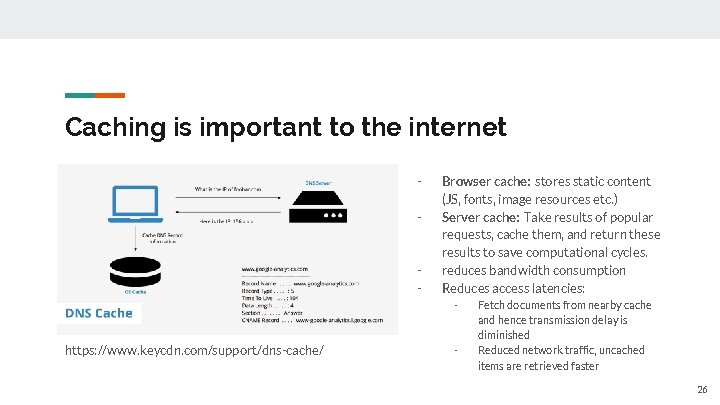
Caching is important to the internet - - Browser cache: stores static content (JS, fonts, image resources etc. ) Server cache: Take results of popular requests, cache them, and return these results to save computational cycles. reduces bandwidth consumption Reduces access latencies: - https: //www. keycdn. com/support/dns-cache/ - Fetch documents from nearby cache and hence transmission delay is diminished Reduced network traffic, uncached items are retrieved faster 26
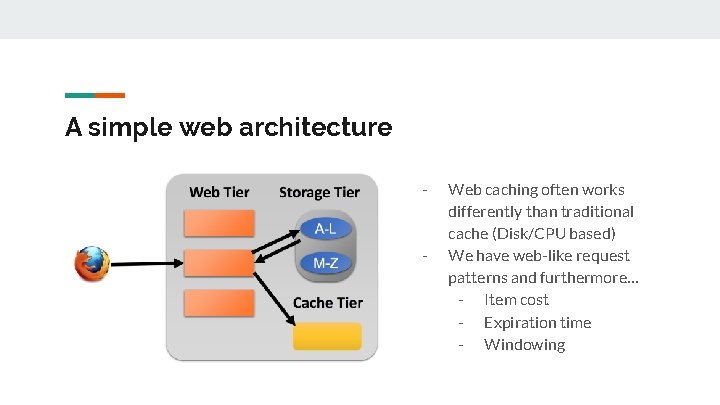
A simple web architecture - - Web caching often works differently than traditional cache (Disk/CPU based) We have web-like request patterns and furthermore… - Item cost - Expiration time - Windowing
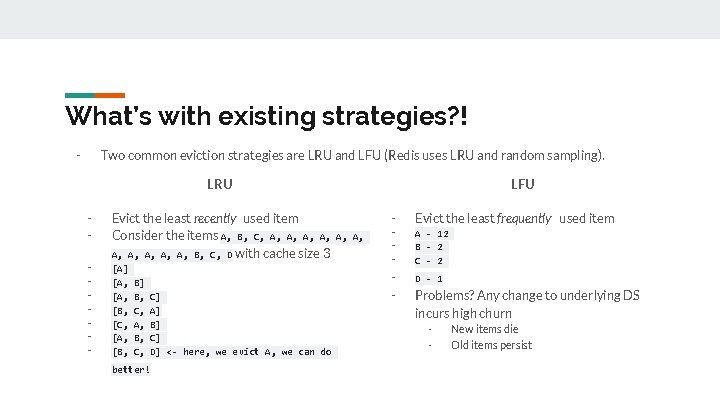
What’s with existing strategies? ! - Two common eviction strategies are LRU and LFU (Redis uses LRU and random sampling). LRU - Evict the least recently used item Consider the items A, B, C, A, A, A, B, C, D with cache size 3 [A] [A, [B, [C, [A, [B, B] B, C, A, B, C, C] A] B] C] D] <- here, we evict A, we can do better! LFU A, A, - Evict the least frequently used item A - 12 B - 2 C - 2 D - 1 Problems? Any change to underlying DS incurs high churn - New items die Old items persist
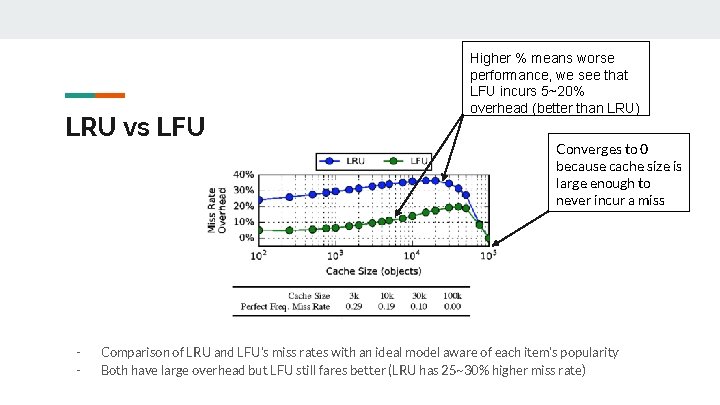
LRU vs LFU - Higher % means worse performance, we see that LFU incurs 5~20% overhead (better than LRU) Converges to 0 because cache size is large enough to never incur a miss Comparison of LRU and LFU’s miss rates with an ideal model aware of each item’s popularity Both have large overhead but LFU still fares better (LRU has 25~30% higher miss rate)
Other improvements. . . Greedy. Dual: Improvement to LRU, where each item has an associated value (= c(p)/s(p) + L) LRU-k: Holds priorities using k priority queues (each adhere to LRU) COMMON PROBLEM: All approaches are limited by the use of an eviction data structure and thus limiting how they are prioritizing items
Main idea Decouple item priorities from eviction data structures! How? - Random sampling - - Now, item priorities do not necessarily need to be tied to a particular data structure This opens up the design space for prioritization Lazy evaluation - Don’t evaluate priorities on every GET/PUT operation Instead, evaluate only when an item is considered for eviction
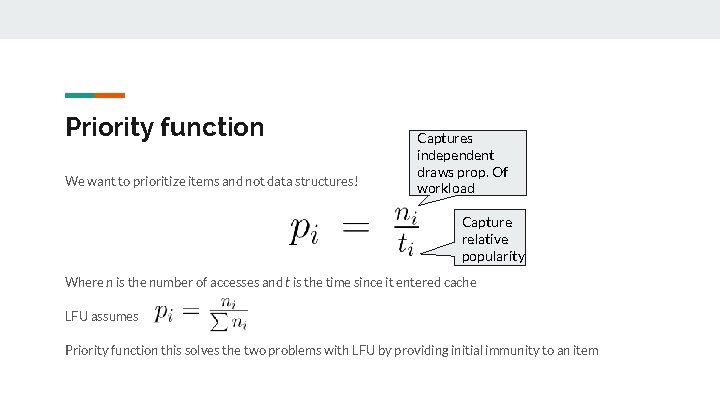
Priority function We want to prioritize items and not data structures! Captures independent draws prop. Of workload Capture relative popularity Where n is the number of accesses and t is the time since it entered cache LFU assumes Priority function this solves the two problems with LFU by providing initial immunity to an item
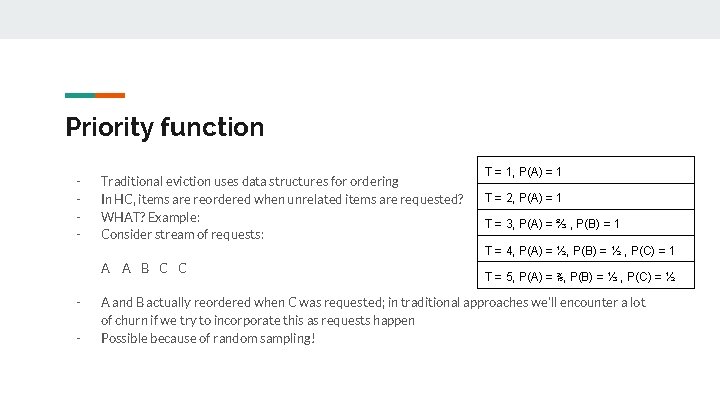
Priority function - Traditional eviction uses data structures for ordering In HC, items are reordered when unrelated items are requested? WHAT? Example: Consider stream of requests: T = 1, P(A) = 1 T = 2, P(A) = 1 T = 3, P(A) = ⅔ , P(B) = 1 T = 4, P(A) = ½, P(B) = ½ , P(C) = 1 A A B C C - T = 5, P(A) = ⅖, P(B) = ⅓ , P(C) = ½ A and B actually reordered when C was requested; in traditional approaches we’ll encounter a lot of churn if we try to incorporate this as requests happen Possible because of random sampling!
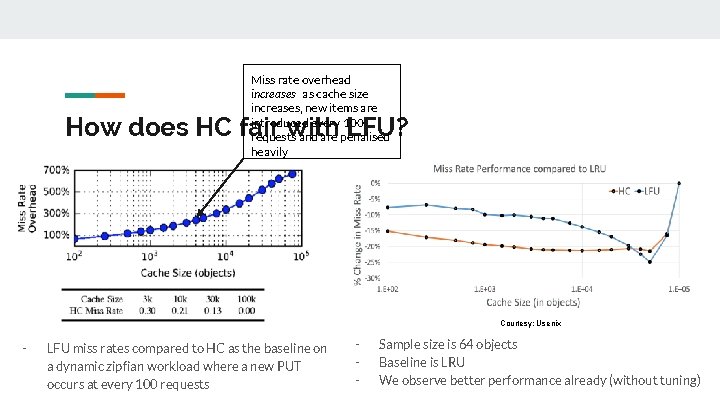
Miss rate overhead increases as cache size increases, new items are introduced every 100 requests and are penalised heavily How does HC fair with LFU? Courtesy: Usenix - LFU miss rates compared to HC as the baseline on a dynamic zipfian workload where a new PUT occurs at every 100 requests - Sample size is 64 objects Baseline is LRU We observe better performance already (without tuning)
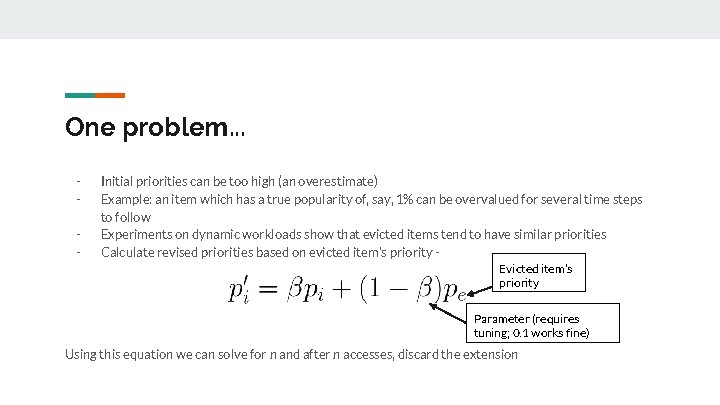
One problem. . . - Initial priorities can be too high (an overestimate) Example: an item which has a true popularity of, say, 1% can be overvalued for several time steps to follow Experiments on dynamic workloads show that evicted items tend to have similar priorities Calculate revised priorities based on evicted item’s priority Evicted item’s priority Parameter (requires tuning; 0. 1 works fine) Using this equation we can solve for n and after n accesses, discard the extension
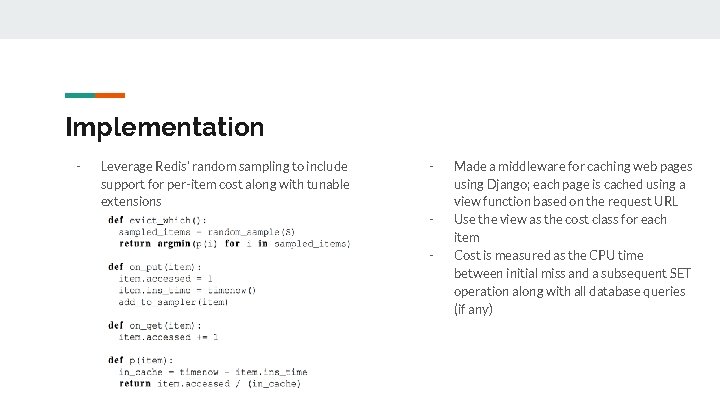
Implementation - Leverage Redis’ random sampling to include support for per-item cost along with tunable extensions - - Made a middleware for caching web pages using Django; each page is cached using a view function based on the request URL Use the view as the cost class for each item Cost is measured as the CPU time between initial miss and a subsequent SET operation along with all database queries (if any)

Customizing Hyperbolic Caching Tailoring HC to application needs - Item costs - Expiration times - Item classes
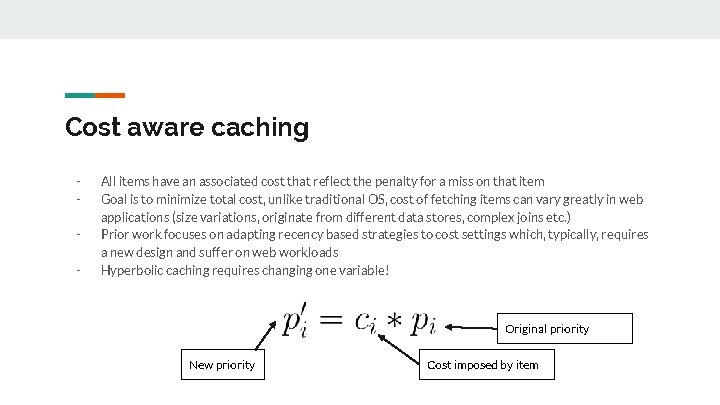
Cost aware caching - All items have an associated cost that reflect the penalty for a miss on that item Goal is to minimize total cost, unlike traditional OS, cost of fetching items can vary greatly in web applications (size variations, originate from different data stores, complex joins etc. ) Prior work focuses on adapting recency based strategies to cost settings which, typically, requires a new design and suffer on web workloads Hyperbolic caching requires changing one variable! Original priority New priority Cost imposed by item
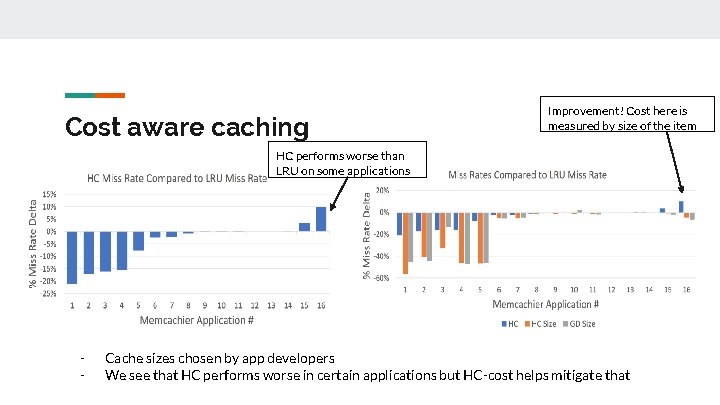
Cost aware caching Improvement! Cost here is measured by size of the item HC performs worse than LRU on some applications - Cache sizes chosen by app developers We see that HC performs worse in certain applications but HC-cost helps mitigate that
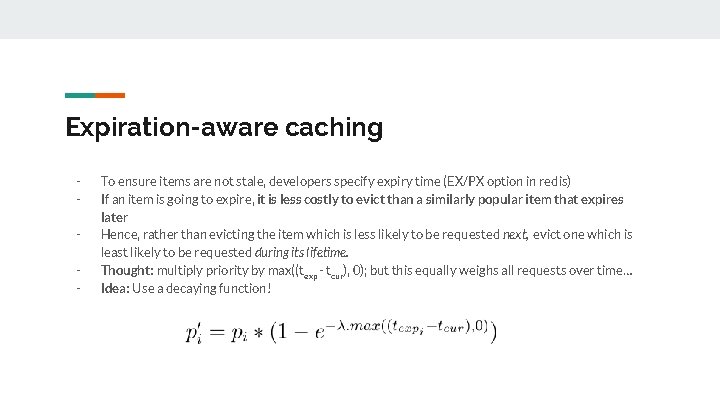
Expiration-aware caching - To ensure items are not stale, developers specify expiry time (EX/PX option in redis) If an item is going to expire, it is less costly to evict than a similarly popular item that expires later Hence, rather than evicting the item which is less likely to be requested next, evict one which is least likely to be requested during its lifetime. Thought: multiply priority by max((texp - tcur), 0); but this equally weighs all requests over time… Idea: Use a decaying function!
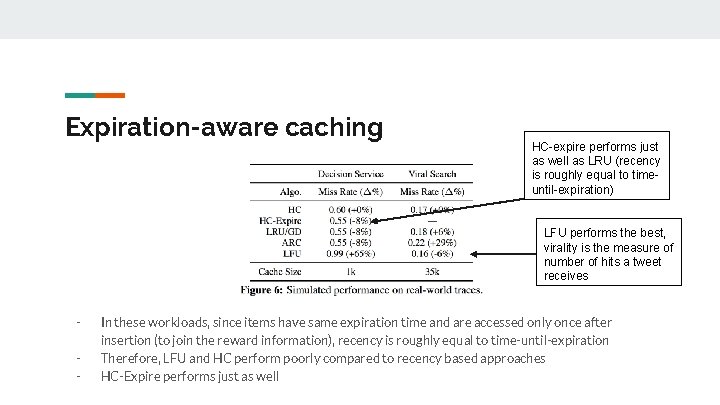
Expiration-aware caching HC-expire performs just as well as LRU (recency is roughly equal to timeuntil-expiration) LFU performs the best, virality is the measure of number of hits a tweet receives - In these workloads, since items have same expiration time and are accessed only once after insertion (to join the reward information), recency is roughly equal to time-until-expiration Therefore, LFU and HC perform poorly compared to recency based approaches HC-Expire performs just as well
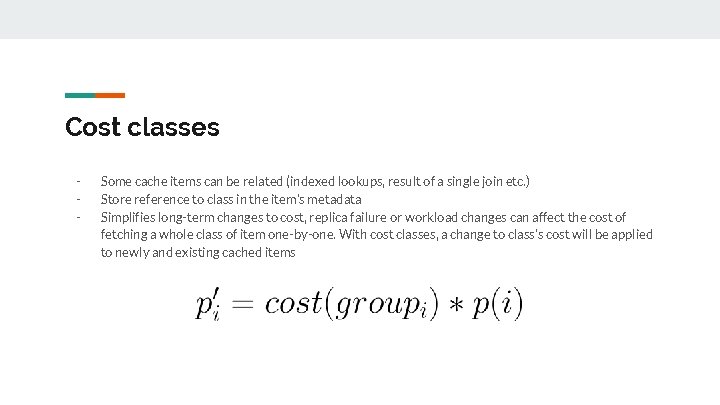
Cost classes - Some cache items can be related (indexed lookups, result of a single join etc. ) Store reference to class in the item’s metadata Simplifies long-term changes to cost, replica failure or workload changes can affect the cost of fetching a whole class of item one-by-one. With cost classes, a change to class’s cost will be applied to newly and existing cached items
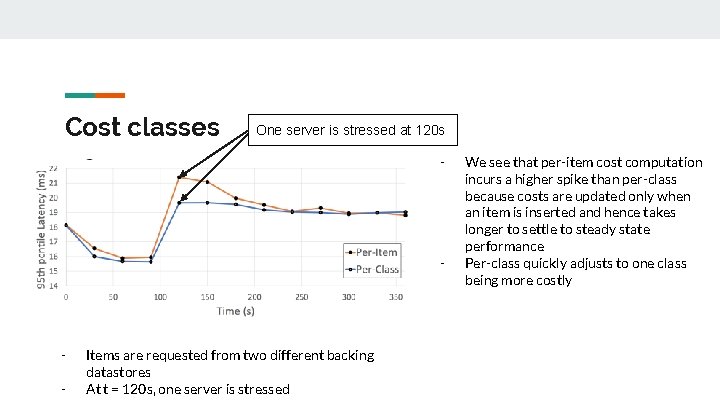
Cost classes One server is stressed at 120 s - - - Items are requested from two different backing datastores At t = 120 s, one server is stressed We see that per-item cost computation incurs a higher spike than per-class because costs are updated only when an item is inserted and hence takes longer to settle to steady state performance Per-class quickly adjusts to one class being more costly
Potential problems - How to determine cost classes? Incorrect assignment can degrade caching performance; same item can belong to multiple cost classes Optimization was proposed to retain samples between evictions, this can boost accuracy of random sampling but was not considered. As compared to LRU, HC stores more metadata in item cost, request count, and time of entry (roughly ~96 bits on a 32 bit machine and 192 bits on a 64 bit machine). Although, no significant performance overhead was observed
Key takeaways - Easy to read paper proposing a simple caching strategy which can yield great performance benefits in production-level web applications Simplifies tuning the priority function based on varying workloads as compared to other strategies which incur high churn due to the use of an underlying data structure Hit rate improvements under both synthetic and real-life workloads over long-standing strategies like LRU, LFU etc. while serving upto 10 M requests
What’s the most CPU intensive task here? Random sampling or computing the per item priority? 47

How well would Hyperbolic caching work with hyperscale applications? 48
As compared to native Redis, will the computational cost to compute the lowest priority item for eviction affect performance? 49

How often should the Garbage Collection happen? How would you design it to minimize performance impact? 50
How often do workloads have similar characteristics to those of One. Drive? 51
What do you think of a storage solution based on the similar idea which provides availability over consistency? 52
- Slides: 51