
Erasmus Mundus Thematic Conference Communication Lets redefine the
- Slides: 13
Erasmus Mundus Thematic Conference: Communication: Let's re-define the terms 29 th – 30 th March 2010, Bordeaux, France Scientific communication – within and outside Buga Berković Erasmus Mundus Master of Science in Marine Biodiversity and Conservation
Outlook: What, Why & How? n Defining the terms ¨ n Hypothesis ¨ n How to (effectively) communicate – within and outside the scientific environment Expected results ¨ n Why do we talk about science? Methodology ¨ n What are communication, science, scientific communication, scientists, public and stakeholders? Can we (did we) achieve the goals? Discussion ¨ What is the problem?
Defining the terms (1) What are communication, science, scientific communication, scientists, public and stakeholders? n Communication ¨ n Science ¨ n “. . . the activity of conveying information. . . something that is communicated by or to or between people or groups. . . a connection allowing access between persons or places “ “knowledge about the structure and behaviour of the natural and physical world, based on facts that you can prove, for example by experiments. . . a system for organizing the knowledge about a particular subject, especially one concerned with aspects of human behaviour or society” Scientific communication ¨ ? ? ? communication OF science. . . communication WITHIN science. . . communication PERFORMED by scientists. . . wordnetweb. princeton. edu; www. oup. com
Defining the terms (2) What are communication, science, scientific communication, scientists, public and stakeholders? n Scientists ¨ n Public ¨ n “. . . scientist - a person with advanced knowledge of one or more sciences. . . A scientist, in the broadest sense, is any person who engages in a systematic activity to acquire knowledge or an individual that engages in such practices and traditions that are linked to schools of thought or philosophy. In a more restricted sense, a scientist is an individual who uses the scientific method. . . ” “. . . a body of people sharing some common interest. . . small groups of people who follow one or more particular issue very closely. . . ” Stakeholders ¨ “. . . someone entrusted to hold the stakes for two or more persons betting against one another. . . Project stakeholders are those entities within or outside an organization which: a) sponsor a project or b) have an interest or a gain upon a successful completion of a project c) may have a positive or negative influence in the Project Completion. . . a person or group affected by the actions of another. . . ” wordnetweb. princeton. edu; www. wikipedia. org
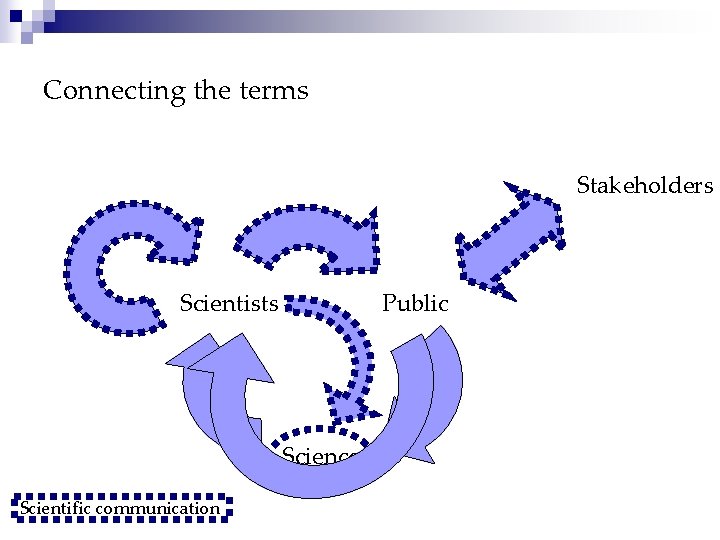
Connecting the terms Stakeholders Scientists Public Science Scientific communication
Hypothesis Why do we talk about science?
Defining the terms (1) What are communication, science, scientific communication, scientists, public and stakeholders? n Communication ¨ n Science ¨ n “. . . the activity of conveying information. . . something that is communicated by or to or between people or groups. . . a connection allowing access between persons or places “ “knowledge about the structure and behaviour of the natural and physical world, based on facts that you can prove, for example by experiments. . . a system for organizing the knowledge about a particular subject, especially one concerned with aspects of human behaviour or society” Scientific communication ¨ ? ? ? communication OF science. . . communication WITHIN science. . . communication PERFORMED by scientists. . . wordnetweb. princeton. edu; www. oup. com
Hypothesis Why do we talk about science? Science can’t function as “l'art pour l'art “*, to develop it needs communication n application n financing n www. wikipedia. org • “French l'art pour l'art, a phrase creditted to Theophile Gautier. An expression of the belief that art has or should have no ecoanomic, social, political or religious functions, that beauty is its only purporse. ”
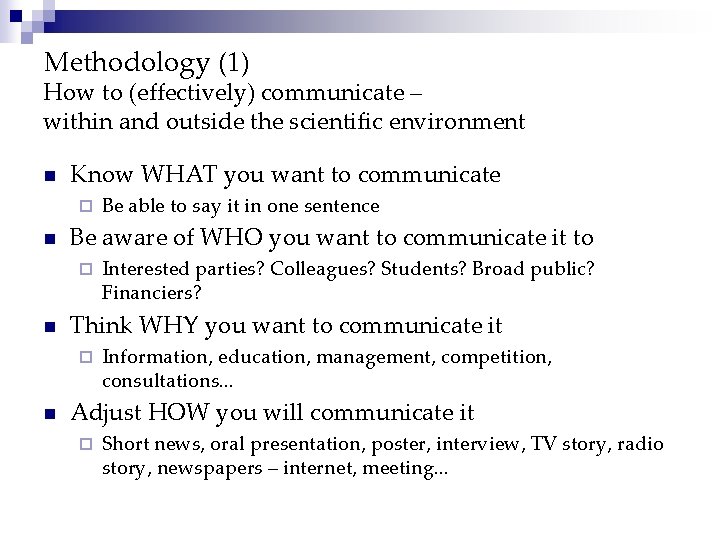
Methodology (1) How to (effectively) communicate – within and outside the scientific environment n Know WHAT you want to communicate ¨ n Be aware of WHO you want to communicate it to ¨ n Interested parties? Colleagues? Students? Broad public? Financiers? Think WHY you want to communicate it ¨ n Be able to say it in one sentence Information, education, management, competition, consultations. . . Adjust HOW you will communicate it ¨ Short news, oral presentation, poster, interview, TV story, radio story, newspapers – internet, meeting. . .
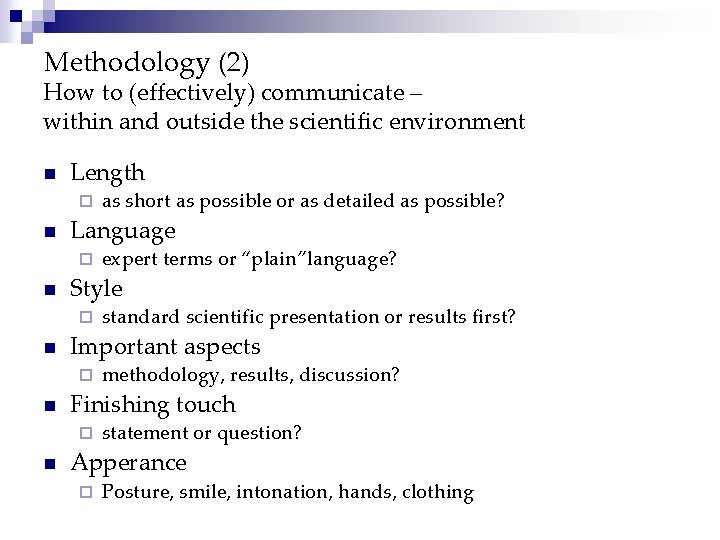
Methodology (2) How to (effectively) communicate – within and outside the scientific environment n Length ¨ n Language ¨ n methodology, results, discussion? Finishing touch ¨ n standard scientific presentation or results first? Important aspects ¨ n expert terms or “plain”language? Style ¨ n as short as possible or as detailed as possible? statement or question? Apperance ¨ Posture, smile, intonation, hands, clothing
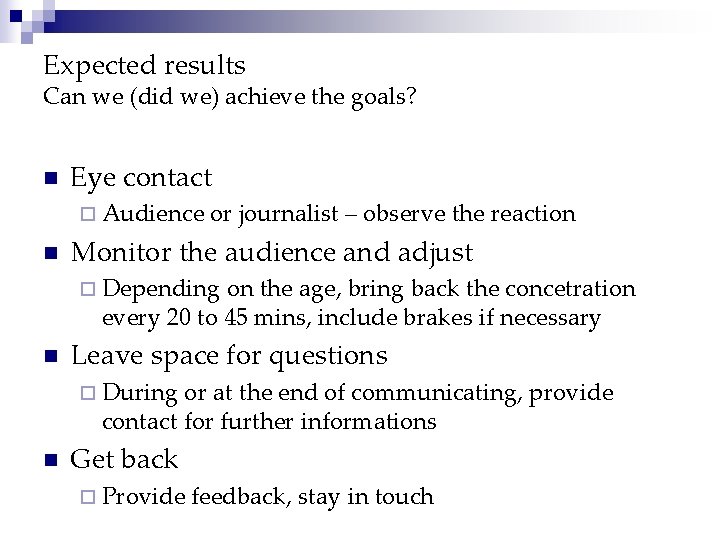
Expected results Can we (did we) achieve the goals? n Eye contact ¨ Audience n or journalist – observe the reaction Monitor the audience and adjust ¨ Depending on the age, bring back the concetration every 20 to 45 mins, include brakes if necessary n Leave space for questions ¨ During or at the end of communicating, provide contact for further informations n Get back ¨ Provide feedback, stay in touch
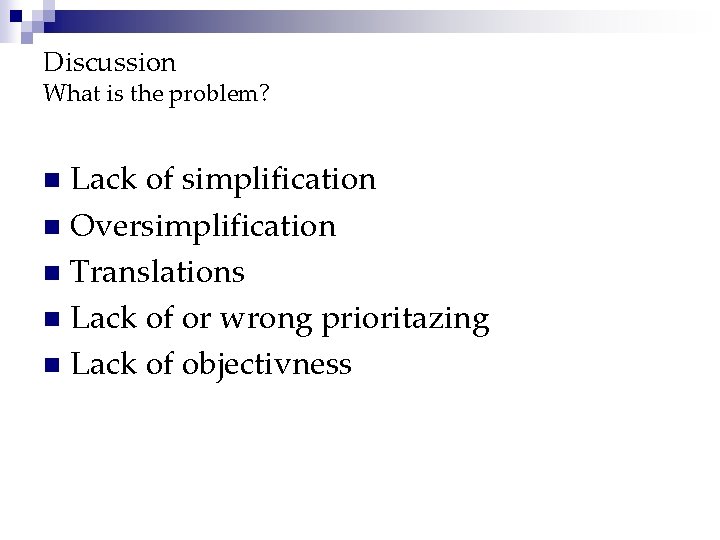
Discussion What is the problem? Lack of simplification n Oversimplification n Translations n Lack of or wrong prioritazing n Lack of objectivness n
Thank you!