
ERASMUS EMREX Supporting Student Mobility IAAO 5 5
ERASMUS+ EMREX – Supporting Student Mobility IAAO 5. 5. 2016 Mats Lindstedt
Agenda ERASMUS+ What is EMREX? Where are we now? Demo What happens next? “Field trial on the impact of enabling easy mobility on recognition of external studies”
EMREX prehistory ERASMUS+ Collaboration between the Nordic countries (Finland, Sweden, Norway and Denmark) began more than 10 years ago. A couple of earlier attempts at creating a solution for electronic transfer (EMREX) Prestudy done by Nordforum and afterwards decision to start a common project Preproposal submitted to EACEA in May 2014 Project started 1. 1. 2015
Facts about the project ERASMUS+ • EU Erasmus+ project (2015 -2017) • Ministry level initiative • Increase student mobility (20%) • Recognition of previous studies • Electronic and secure transfer of student data between HEIs • Field trial and evaluation of impact • Denmark, Finland, Italy, Norway, Poland, Sweden
EMREX animation video Purpose is to briefly explain to students (and administrators) what EMREX is all about EMREX video -> www. emrex. eu ERASMUS+
Participants in EMREX ERASMUS+ Steering group with Ministry representatives from four countries CSC-IT Center for Science (Finland) Ladok Consortium, Umeå University and Swedish Council for Higher Education (Sweden) FSAT, University of Oslo (Norway) IT department of the Ministry of Higher Education and Science (Denmark) University of Warsaw (Poland) KION (Italy)
Benefits for higher education ERASMUS+ Fast and easy-to-use tool for fetching achievement records Significantly increases the availability, quality and recognition of degrees and credits Reduces the risk of overlapping studies Diminishes the risk of forged transcripts and/or certificates Reduces the administrative workload, saving time and money Promotes student mobility Students used to google – demand fast and online services
More benefits National/European Mobility targets - increases student mobility and crediting Enables automatic recognition of studies Mobility statistic – reliable and aggregated data Non-HEIs e. g. government/student support agencies Turnkey solution for connecting existing systems: – Easy tool to implement locally – Student authorization (no new contracts) – Local infrastructure (data warehouses, authentication) to be utilized ERASMUS+
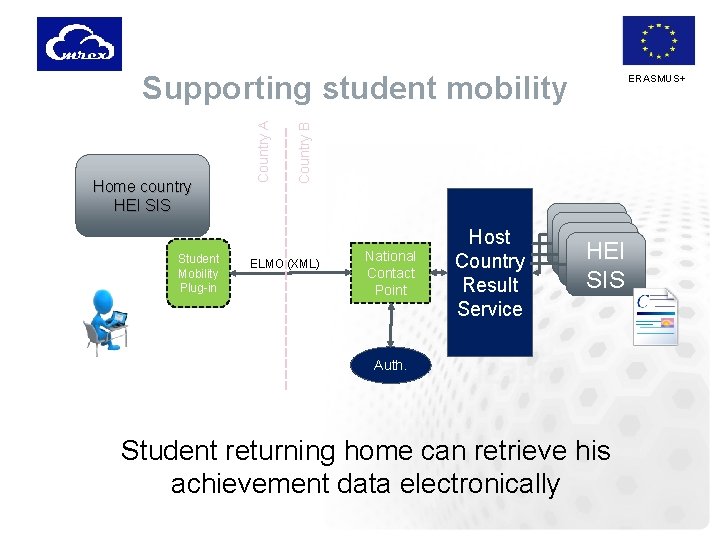
Student Mobility Plug-in Country B Home country HEI SIS Country A Supporting student mobility ELMO (XML) National Contact Point Host Country Result Service Oodi HEI Oodi SIS Auth. Student returning home can retrieve his achievement data electronically ERASMUS+
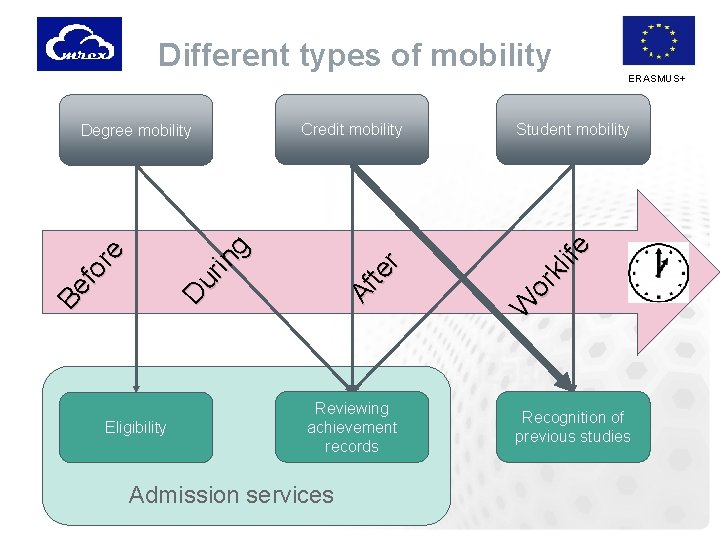
Different types of mobility Af te r Be fo re Eligibility Reviewing achievement records Admission services Student mobility W or k li fe Credit mobility D ur in g Degree mobility ERASMUS+ Recognition of previous studies
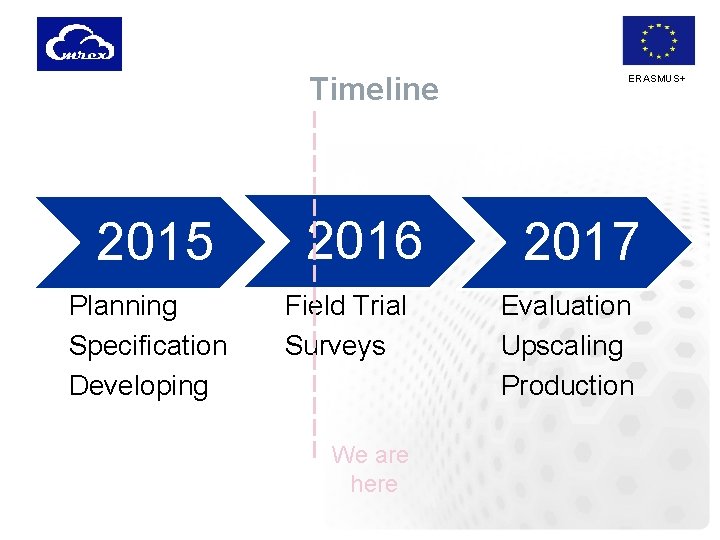
Timeline 2015 Planning Specification Developing 2016 Field Trial Surveys We are here ERASMUS+ 2017 Evaluation Upscaling Production
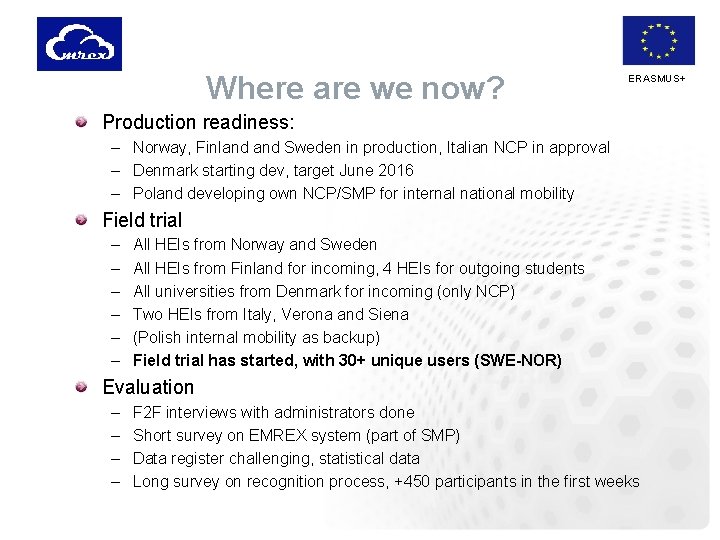
Where are we now? ERASMUS+ Production readiness: – Norway, Finland Sweden in production, Italian NCP in approval – Denmark starting dev, target June 2016 – Poland developing own NCP/SMP for internal national mobility Field trial – – – All HEIs from Norway and Sweden All HEIs from Finland for incoming, 4 HEIs for outgoing students All universities from Denmark for incoming (only NCP) Two HEIs from Italy, Verona and Siena (Polish internal mobility as backup) Field trial has started, with 30+ unique users (SWE-NOR) Evaluation – – F 2 F interviews with administrators done Short survey on EMREX system (part of SMP) Data register challenging, statistical data Long survey on recognition process, +450 participants in the first weeks
Demo …. if it works…. ERASMUS+
What happens next? Field trial continues, first analysis during summer 2016 EACEA asked the project to “engage the ministries more” Lots of conferences – – – – IAAO Groningen Declaration annual meeting ECCA Nordlys EUNIS 2016, also pre-conference meeting on student mobility Nordunet EAIE Co-operation with Erasmus Without Paper- project – Joint technical solutions – Joint EU organization for hand-over of results – Also EGRACONS and other projects on mobility ERASMUS+
And after the project? EMREX components available already today – Open source, no licencing costs, in Git. Hub Plans for an EMREX Steering Committee, or joint European Moiblity organization Co-operation with other projects (e. g. ERASMUS Without Paper) Building block for new services (automatic recognition, admission, recruitment, etc) Scaling up to the whole of EU !! ERASMUS+
Additional information EMREX website ERASMUS+ www. emrex. eu – Field trial support: emrex-support@emrex. eu – Survey support: surveys@emrex. eu EMREX-info mailing list, e. g. monthly reports (Enquiries: Mats Lindstedt)
Questions? ERASMUS+
Backup ERASMUS+
European Education and Training 2020 (ET 2020). The conclusions of the mid-term stocktaking are reflected in the draft ET 2020 Joint Report, presented by the European Commission on the 8 th of September 2015. Priority nr 5/6: 5. Transparency and recognition of skills and qualifications; “Supporting the mobility of students, staff and researchers and the development of strategic partnerships and joint courses by increasing HE internationalisation” ERASMUS+
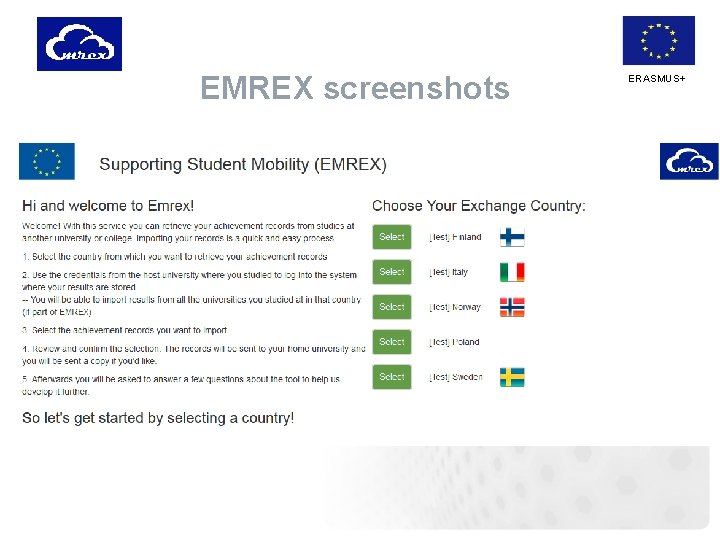
EMREX screenshots ERASMUS+
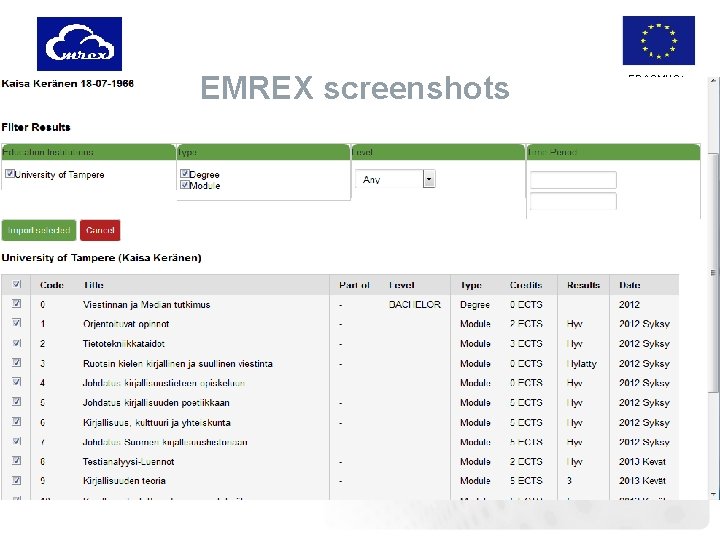
EMREX screenshots ERASMUS+
- Slides: 21