
Erasmus Center for Optimization in Public Transport Bus

Erasmus Center for Optimization in Public Transport Bus Scheduling & Delays Dennis Huisman Email: huisman@few. eur. nl Joint work with: Richard Freling and Albert P. M. Wagelmans May 23, 2002
Erasmus Center for Optimization in Public Transport Contents • Introduction • Static versus Dynamic Scheduling • Dynamic Vehicle Scheduling: – single-depot – multiple-depot • Computational Experience • Conclusions and Future Research 2
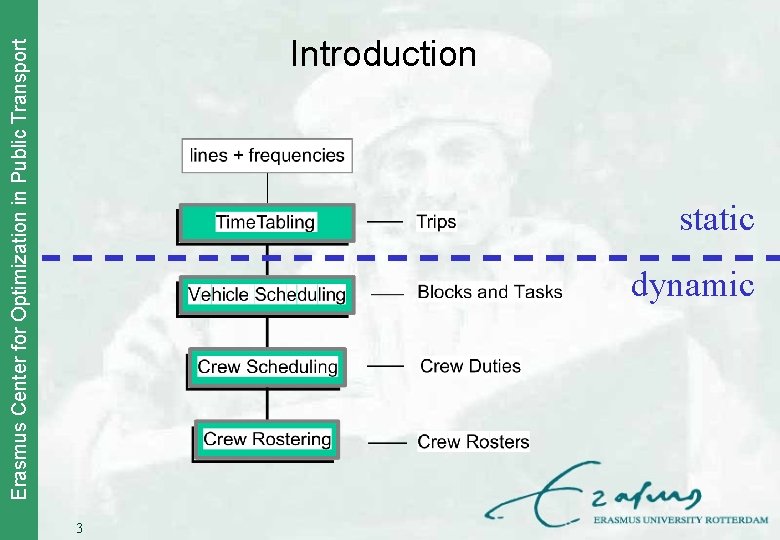
Erasmus Center for Optimization in Public Transport Introduction static dynamic 3
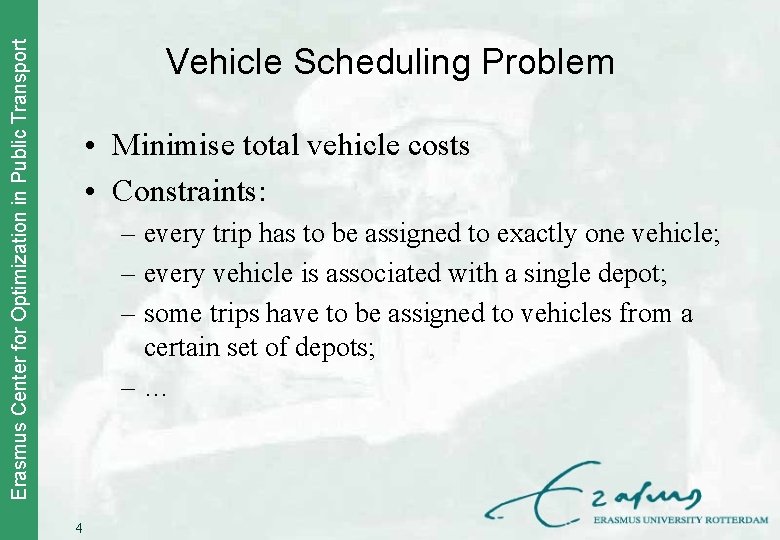
Erasmus Center for Optimization in Public Transport Vehicle Scheduling Problem • Minimise total vehicle costs • Constraints: – every trip has to be assigned to exactly one vehicle; – every vehicle is associated with a single depot; – some trips have to be assigned to vehicles from a certain set of depots; –… 4
Erasmus Center for Optimization in Public Transport Static versus Dynamic Scheduling (1) • • 5 Traditional: static vehicle scheduling Disadvantage: a lot of delays Solution? --> Fixed buffer times? ? ? No!!! Idea: dynamic vehicle scheduling
Erasmus Center for Optimization in Public Transport Static versus Dynamic Scheduling (2) • Example: – 2 trips (1 & 2) end at location A at time 10: 00 – 1 trip (3) starts at A at time 10: 05 – 1 trip (4) starts at A at time 10: 15 • Static optimal solution: 1 3 and 2 4 • Suppose trip 1 has a delay of 10 minutes • Dynamic scheduling: change schedule to 1 4 and 2 3 6
Erasmus Center for Optimization in Public Transport Static versus Dynamic Scheduling (3) • Dynamic vehicle scheduling: – reschedule a few times per day – take into account delays in the past --> scenarios 7
Erasmus Center for Optimization in Public Transport Dynamic vehicle scheduling • At time point T, we make decisions for the period [T, T+l). • Assumption: travel times are known for this period. • For the period after T+l, we consider different scenarios for the travel times based on historical data, or one average scenario. • Consequence: the smaller l, the more realistic, but the quality of the solution decreases and the cpu time increases. 8
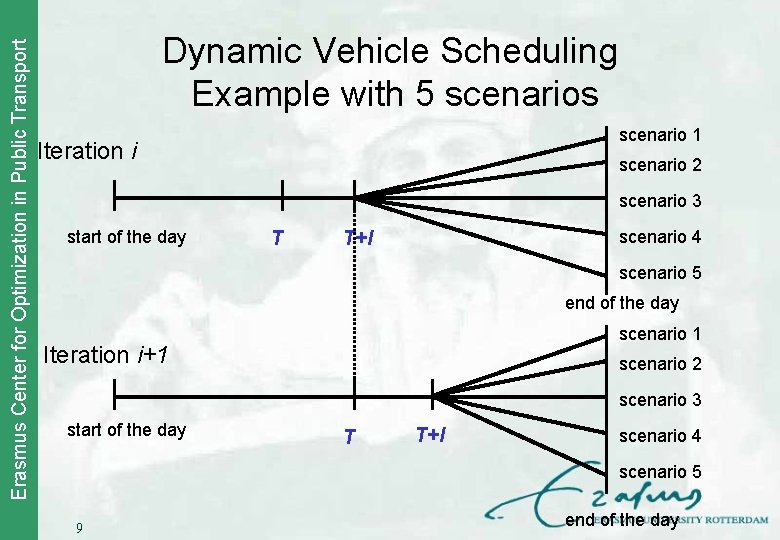
Erasmus Center for Optimization in Public Transport Dynamic Vehicle Scheduling Example with 5 scenarios scenario 1 Iteration i scenario 2 scenario 3 start of the day T scenario 4 T+l scenario 5 end of the day scenario 1 Iteration i+1 scenario 2 scenario 3 start of the day T T+l scenario 4 scenario 5 9 end of the day
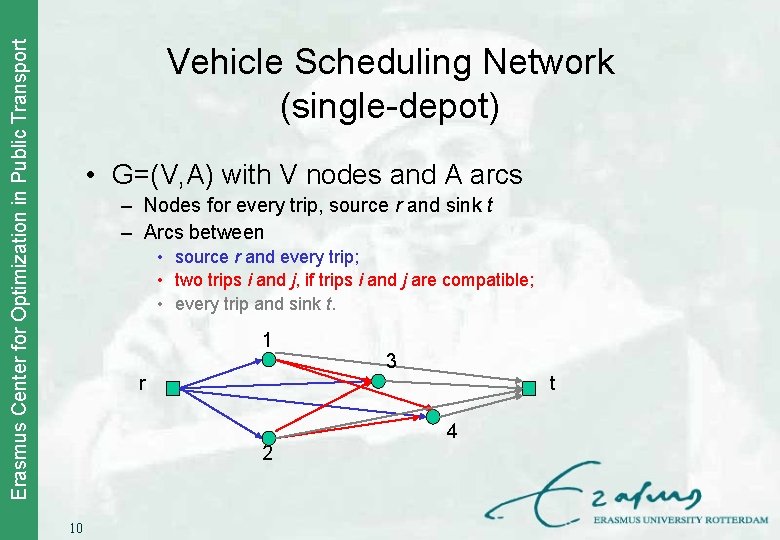
Erasmus Center for Optimization in Public Transport Vehicle Scheduling Network (single-depot) • G=(V, A) with V nodes and A arcs – Nodes for every trip, source r and sink t – Arcs between • source r and every trip; • two trips i and j, if trips i and j are compatible; • every trip and sink t. 1 r 2 10 3 t 4
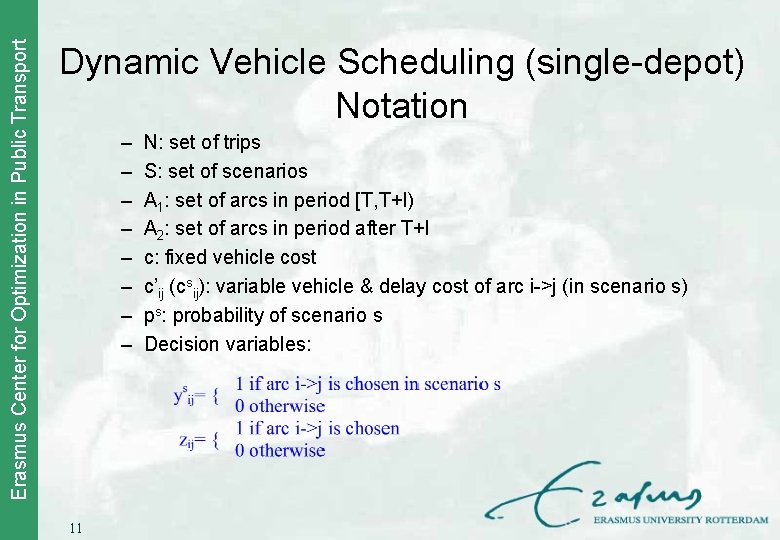
Erasmus Center for Optimization in Public Transport Dynamic Vehicle Scheduling (single-depot) Notation – – – – 11 N: set of trips S: set of scenarios A 1: set of arcs in period [T, T+l) A 2: set of arcs in period after T+l c: fixed vehicle cost c’ij (csij): variable vehicle & delay cost of arc i->j (in scenario s) ps: probability of scenario s Decision variables:
Erasmus Center for Optimization in Public Transport Assumption (1) • Special cost structure: – fixed costs for every vehicle; – variable costs per time unit that a vehicle is without passengers outside the depot. 12
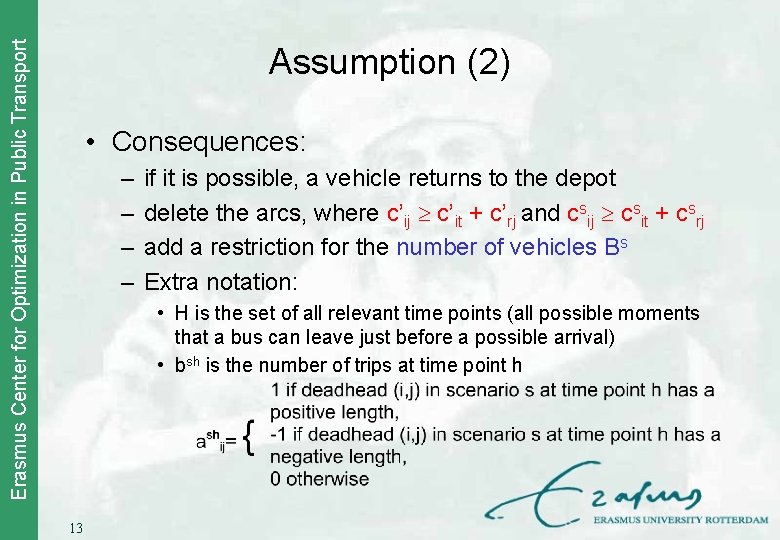
Erasmus Center for Optimization in Public Transport Assumption (2) • Consequences: – – if it is possible, a vehicle returns to the depot delete the arcs, where c’ij c’it + c’rj and csij csit + csrj add a restriction for the number of vehicles Bs Extra notation: • H is the set of all relevant time points (all possible moments that a bus can leave just before a possible arrival) • bsh is the number of trips at time point h 13
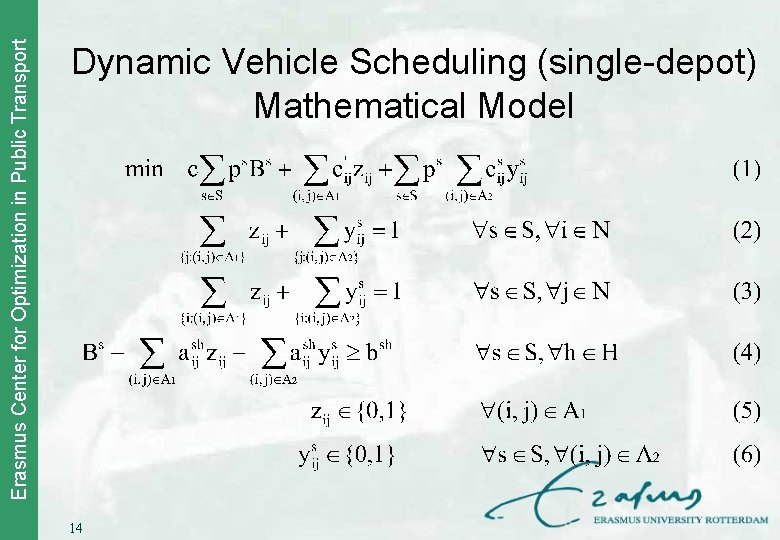
Erasmus Center for Optimization in Public Transport Dynamic Vehicle Scheduling (single-depot) Mathematical Model 14
Erasmus Center for Optimization in Public Transport Dynamic Vehicle Scheduling (multiple-depot) • Size of the problem is very large • Cluster-Reschedule Heuristic: – cluster the trips via the static MDVSP – reschedule per depot via the dynamic SDVSP • Lagrangean Relaxation for computing lower bounds 15
Erasmus Center for Optimization in Public Transport Data (1) • • 16 Data from Connexxion 1104 trips and 4 depots Rotterdam, Utrecht and Dordrecht Average depot group size: 1. 71
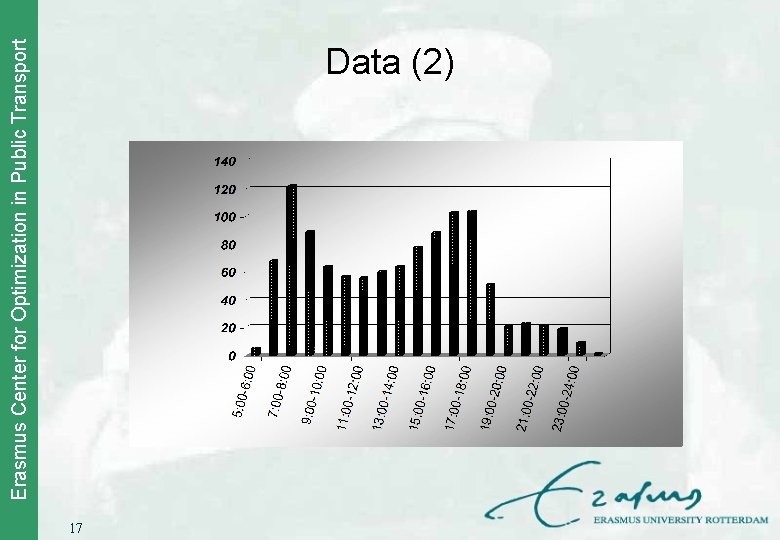
Erasmus Center for Optimization in Public Transport Data (2) 17
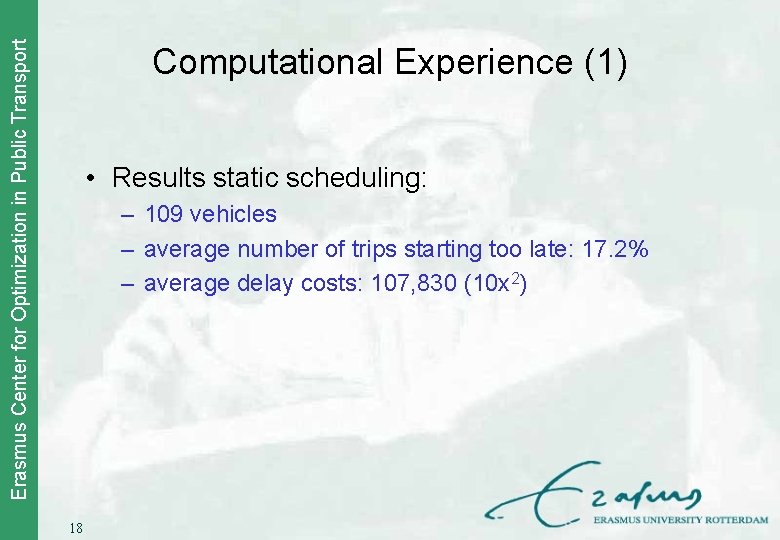
Erasmus Center for Optimization in Public Transport Computational Experience (1) • Results static scheduling: – 109 vehicles – average number of trips starting too late: 17. 2% – average delay costs: 107, 830 (10 x 2) 18
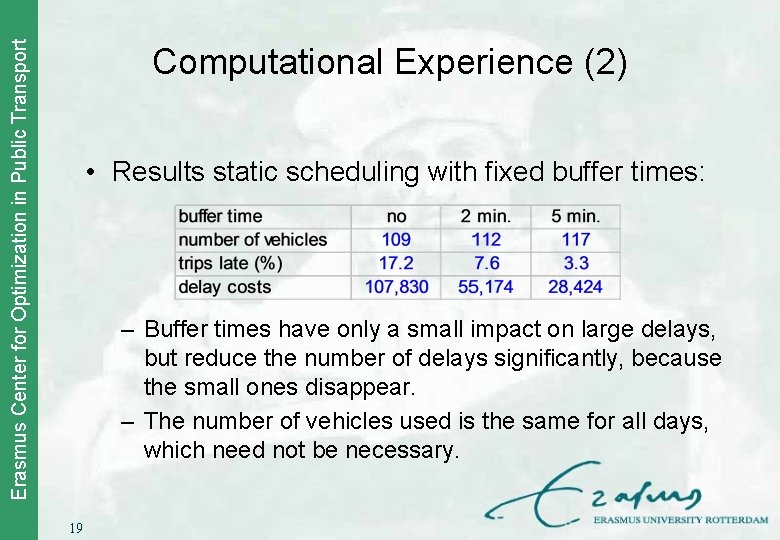
Erasmus Center for Optimization in Public Transport Computational Experience (2) • Results static scheduling with fixed buffer times: – Buffer times have only a small impact on large delays, but reduce the number of delays significantly, because the small ones disappear. – The number of vehicles used is the same for all days, which need not be necessary. 19
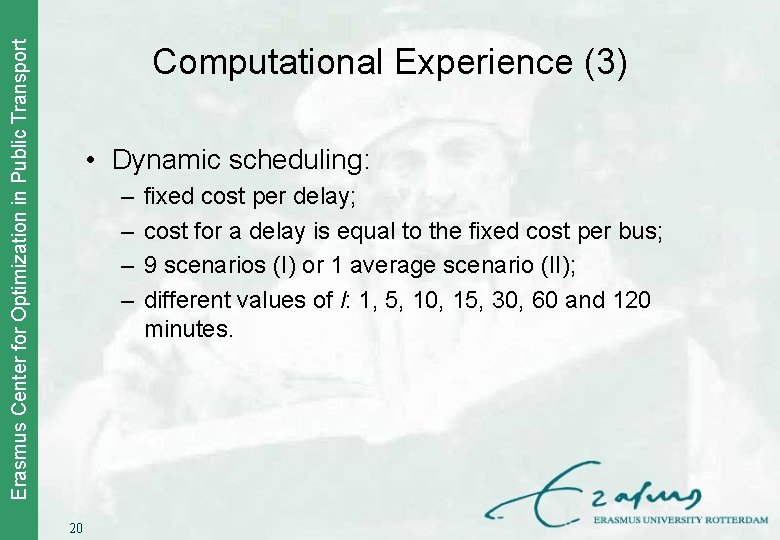
Erasmus Center for Optimization in Public Transport Computational Experience (3) • Dynamic scheduling: – – 20 fixed cost per delay; cost for a delay is equal to the fixed cost per bus; 9 scenarios (I) or 1 average scenario (II); different values of l: 1, 5, 10, 15, 30, 60 and 120 minutes.
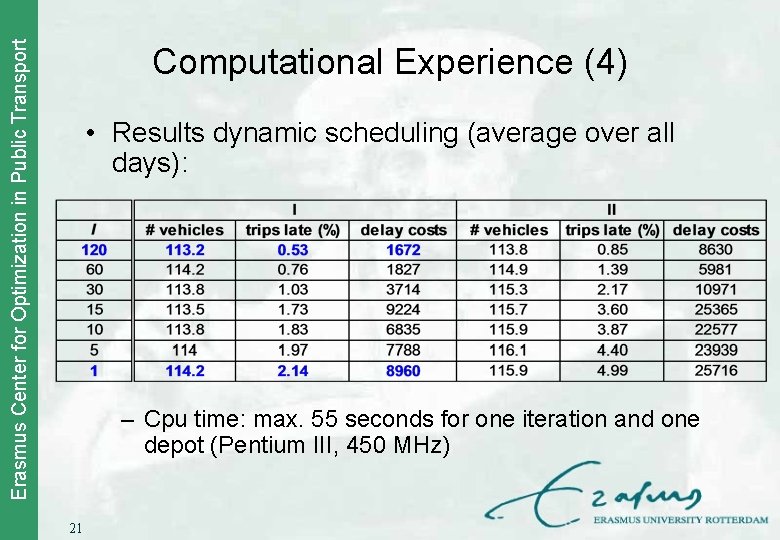
Erasmus Center for Optimization in Public Transport Computational Experience (4) • Results dynamic scheduling (average over all days): – Cpu time: max. 55 seconds for one iteration and one depot (Pentium III, 450 MHz) 21
Erasmus Center for Optimization in Public Transport Computational Experience (5) • Lower bound: – gap between the cluster-reschedule heuristic and the lower bound is in the first iteration about 3. 5% (I) and 5. 7% (II) • Perfect information: – optimal: 110. 6 vehicles – heuristic: 114. 5 vehicles • Sensitivity analysis: – small mistakes in the estimated travel times have a small influence on the quality of the solution 22
Erasmus Center for Optimization in Public Transport Conclusions and Future Research • An optimal solution for the static vehicle scheduling may lead to a lot of delays. • Dynamic vehicle scheduling performs better in both the number of vehicles & the number of trips starting late than static vehicle scheduling with fixed buffer times. • Future: – integration with crew scheduling. 23

24 Erasmus Center for Optimization in Public Transport

25 Erasmus Center for Optimization in Public Transport
- Slides: 25