
ERASMUS Capacitybuilding in Higher Education LFM LOGICal Frame
ERASMUS+ Capacity-building in Higher Education LFM- LOGICal Frame. WOrk MATRIX A TOOL in PROJECT IMPLEMENTATION Erasmus+
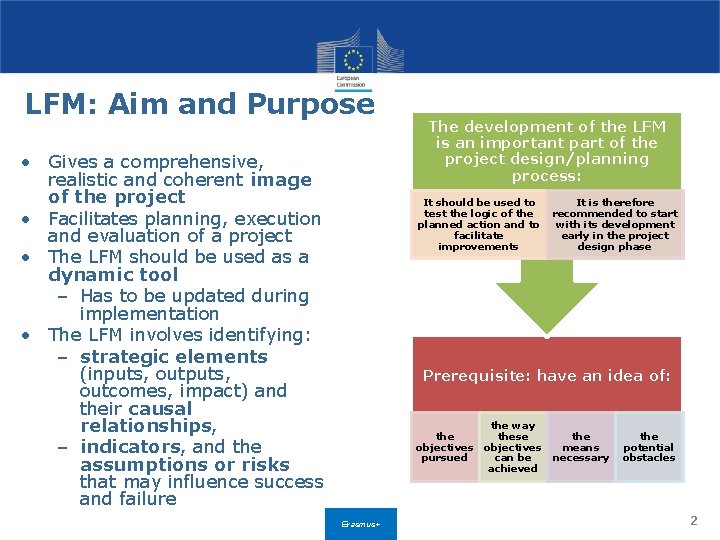
LFM: Aim and Purpose • Gives a comprehensive, realistic and coherent image of the project • Facilitates planning, execution and evaluation of a project • The LFM should be used as a dynamic tool – Has to be updated during implementation • The LFM involves identifying: – strategic elements (inputs, outcomes, impact) and their causal relationships, – indicators, and the assumptions or risks that may influence success and failure The development of the LFM is an important part of the project design/planning process: It should be used to test the logic of the planned action and to facilitate improvements It is therefore recommended to start with its development early in the project design phase Prerequisite: have an idea of: the objectives pursued Erasmus+ the way these objectives can be achieved the means necessary the potential obstacles 2
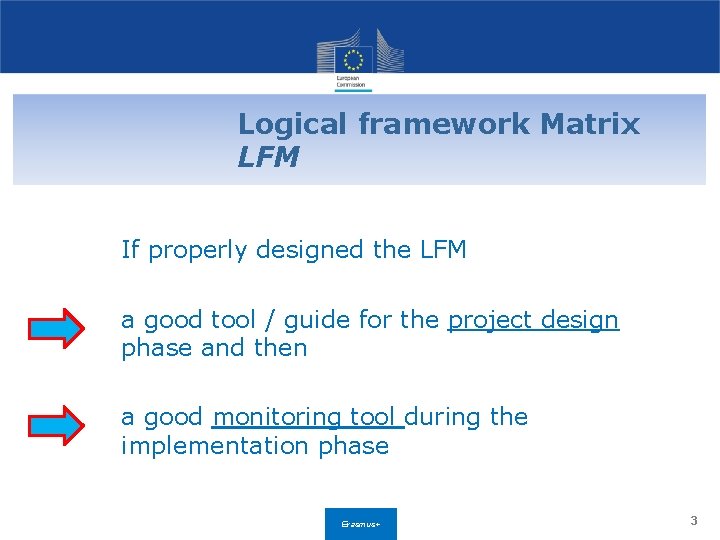
Logical framework Matrix LFM If properly designed the LFM a good tool / guide for the project design phase and then a good monitoring tool during the implementation phase Erasmus+ 3
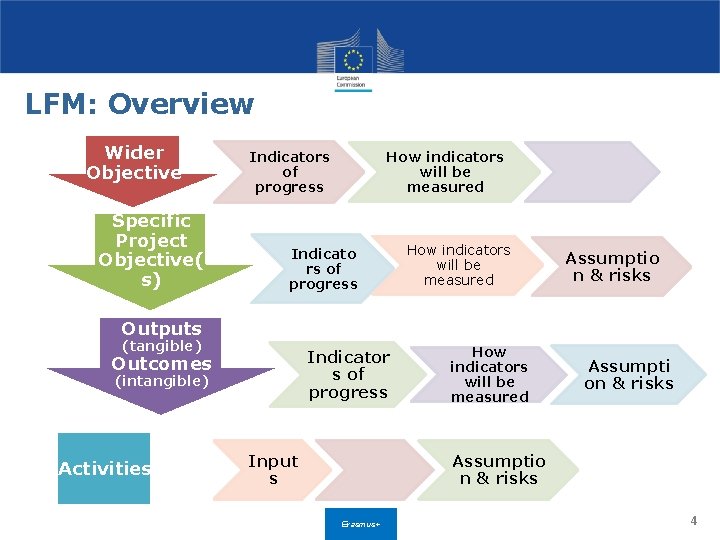
LFM: Overview Wider Objective Specific Project Objective( s) Indicators of progress How indicators will be measured Indicato rs of progress How indicators will be measured Assumptio n & risks Outputs (tangible) Indicator s of progress Outcomes (intangible) Activities Input s How indicators will be measured Assumpti on & risks Assumptio n & risks Erasmus+ 4
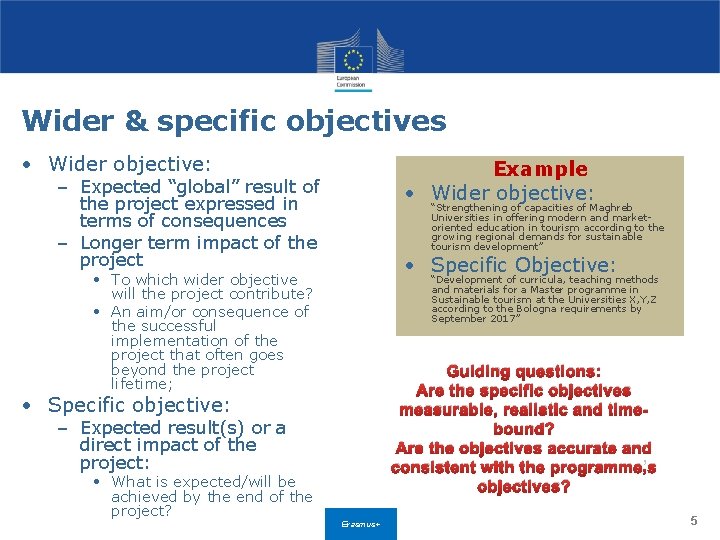
Wider & specific objectives • Wider objective: Example • Wider objective: – Expected “global” result of the project expressed in terms of consequences – Longer term impact of the project “Strengthening of capacities of Maghreb Universities in offering modern and marketoriented education in tourism according to the growing regional demands for sustainable tourism development” • Specific Objective: • To which wider objective will the project contribute? • An aim/or consequence of the successful implementation of the project that often goes beyond the project lifetime; “Development of curricula, teaching methods and materials for a Master programme in Sustainable tourism at the Universities X, Y, Z according to the Bologna requirements by September 2017” Guiding questions: Are the specific objectives measurable, realistic and timebound? Are the objectives accurate and consistent with the programme’s objectives? • Specific objective: – Expected result(s) or a direct impact of the project: • What is expected/will be achieved by the end of the project? Erasmus+ 5
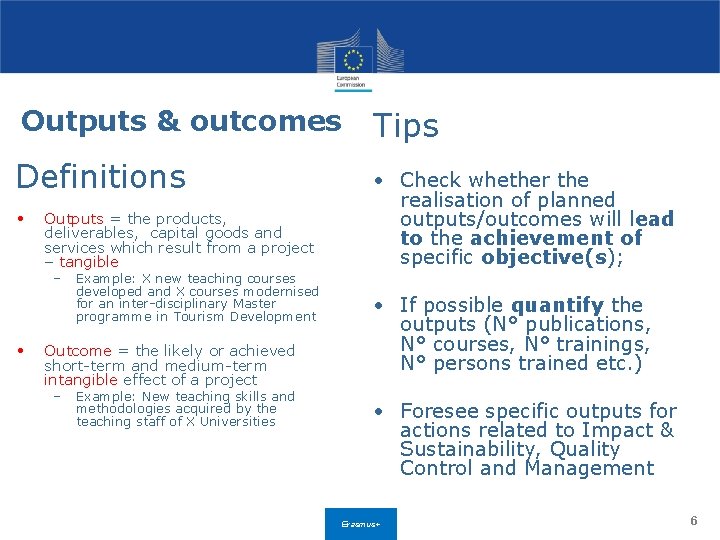
Outputs & outcomes Definitions • Outputs = the products, deliverables, capital goods and services which result from a project – tangible – • Example: X new teaching courses developed and X courses modernised for an inter-disciplinary Master programme in Tourism Development Outcome = the likely or achieved short-term and medium-term intangible effect of a project – Example: New teaching skills and methodologies acquired by the teaching staff of X Universities Tips • Check whether the realisation of planned outputs/outcomes will lead to the achievement of specific objective(s); • If possible quantify the outputs (N° publications, N° courses, N° trainings, N° persons trained etc. ) • Foresee specific outputs for actions related to Impact & Sustainability, Quality Control and Management Erasmus+ 6
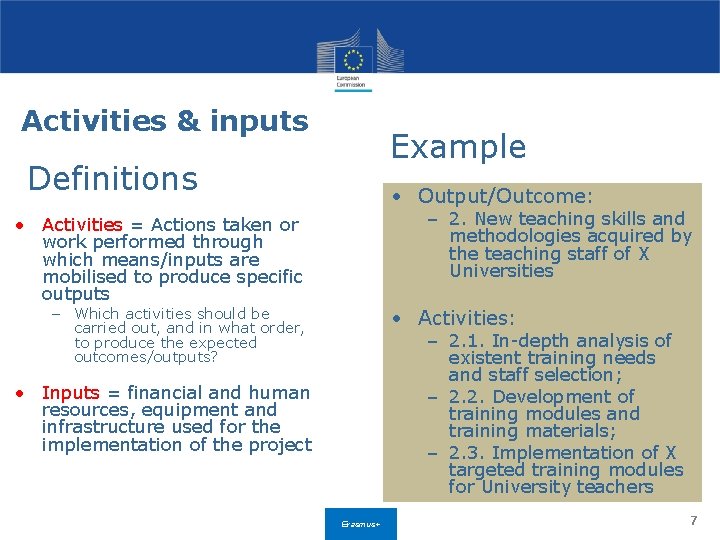
Activities & inputs Example Definitions • Output/Outcome: – 2. New teaching skills and methodologies acquired by the teaching staff of X Universities • Activities = Actions taken or work performed through which means/inputs are mobilised to produce specific outputs – Which activities should be carried out, and in what order, to produce the expected outcomes/outputs? • Activities: – 2. 1. In-depth analysis of existent training needs and staff selection; – 2. 2. Development of training modules and training materials; – 2. 3. Implementation of X targeted training modules for University teachers • Inputs = financial and human resources, equipment and infrastructure used for the implementation of the project Erasmus+ 7
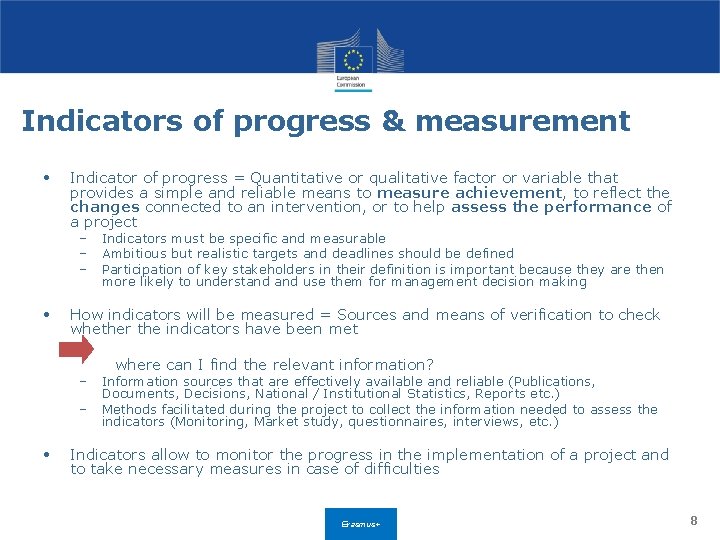
Indicators of progress & measurement • Indicator of progress = Quantitative or qualitative factor or variable that provides a simple and reliable means to measure achievement, to reflect the changes connected to an intervention, or to help assess the performance of a project – – – • How indicators will be measured = Sources and means of verification to check whether the indicators have been met – – • Indicators must be specific and measurable Ambitious but realistic targets and deadlines should be defined Participation of key stakeholders in their definition is important because they are then more likely to understand use them for management decision making where can I find the relevant information? Information sources that are effectively available and reliable (Publications, Documents, Decisions, National / Institutional Statistics, Reports etc. ) Methods facilitated during the project to collect the information needed to assess the indicators (Monitoring, Market study, questionnaires, interviews, etc. ) Indicators allow to monitor the progress in the implementation of a project and to take necessary measures in case of difficulties Erasmus+ 8
Assumptions and risks • Assumptions = Desired situation if an assumption is formulated in a negative way it becomes a risk • Risks = External factors outside the control of the project, but which are critical for the achievement of its objective • Assumptions and risks analysis = elaboration of hypotheses about factors or risks which could affect the progress or success of the project • The assumptions and risks analysis allows to identify, or to give the means to identify, the risks that could be faced and to take the necessary measure as early as possible • Guiding questions: – – What are the assumptions required for the achievement of the project? What are the risks which should be taken into account? What are the possible measures to limit or prevent these risks? Have these measures been translated in project activities whenever possible? Erasmus+ 9
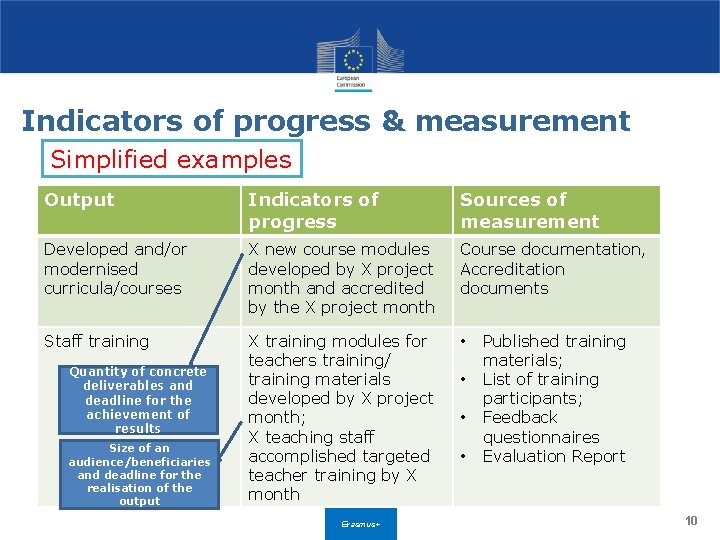
Indicators of progress & measurement Simplified examples Output Indicators of progress Sources of measurement Developed and/or modernised curricula/courses X new course modules developed by X project month and accredited by the X project month Course documentation, Accreditation documents Staff training X training modules for teachers training/ training materials developed by X project month; X teaching staff accomplished targeted teacher training by X month • Quantity of concrete deliverables and deadline for the achievement of results Size of an audience/beneficiaries and deadline for the realisation of the output Erasmus+ • • • Published training materials; List of training participants; Feedback questionnaires Evaluation Report 10
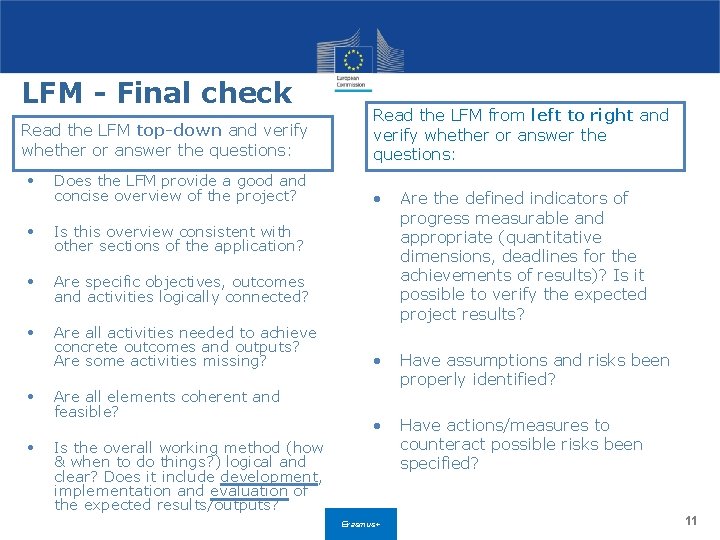
LFM - Final check Read the LFM top-down and verify whether or answer the questions: • Does the LFM provide a good and concise overview of the project? • Is this overview consistent with other sections of the application? • Are specific objectives, outcomes and activities logically connected? • Are all activities needed to achieve concrete outcomes and outputs? Are some activities missing? • • Are all elements coherent and feasible? Read the LFM from left to right and verify whether or answer the questions: • Are the defined indicators of progress measurable and appropriate (quantitative dimensions, deadlines for the achievements of results)? Is it possible to verify the expected project results? • Have assumptions and risks been properly identified? • Have actions/measures to counteract possible risks been specified? Is the overall working method (how & when to do things? ) logical and clear? Does it include development, implementation and evaluation of the expected results/outputs? Erasmus+ 11
- Slides: 11