
Eras of Earths History EQ What causes changes

- Slides: 31
Eras of Earth’s History EQ: What causes changes in the Earth? How does knowing the past give us a VISION for the future?
Geologic Time Scale ¨ Using the football field you will complete the geologic time scale. ¨ You will accurately arrange the events along the time scale according to their date.
Conclusion Questions ¨ In what ways do evolutionary events correspond to other types of events during the history of life? ¨ How might extinctions affect the evolution of organisms that survive the event? ¨ In what ways have geologic changes influenced evolutionary events and/or extinctions? ¨ How does the length of the history of life help to explain the evolutionary events of single-celled organisms to complex multicellular organisms like mammals? ¨ Epochs are subdivisions of periods. Why are there periods and epochs in the latest era but not in the earlier ones?
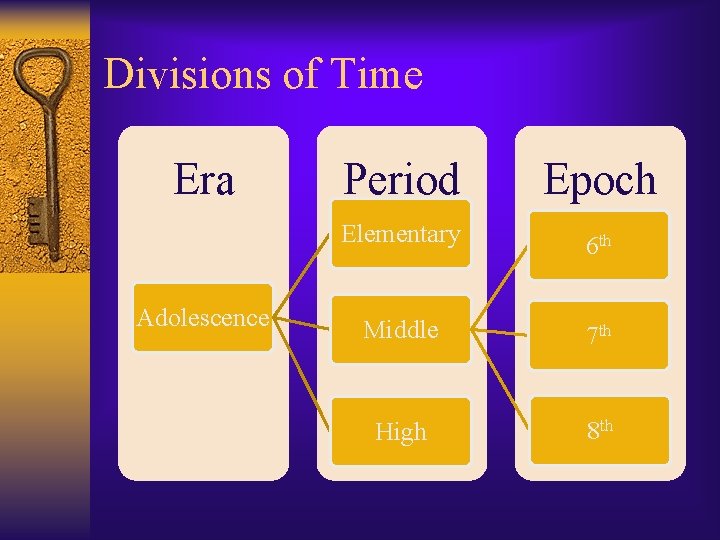
Divisions of Time Era Adolescence Period Epoch Elementary 6 th Middle 7 th High 8 th
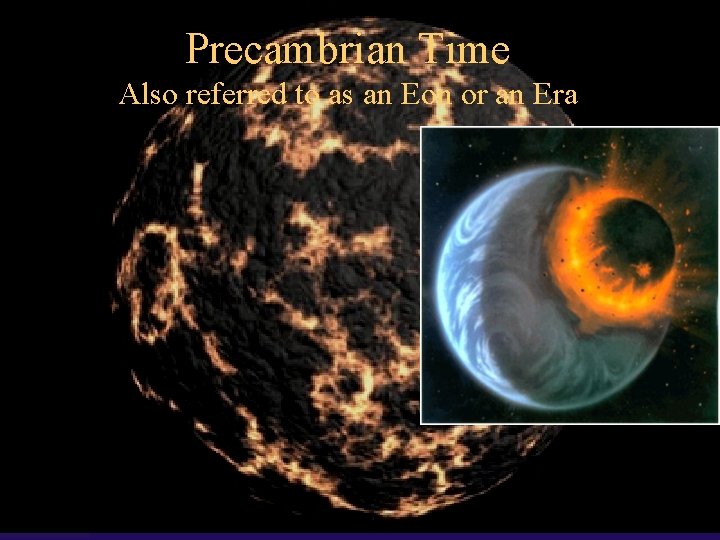
Precambrian Time Also referred to as an Eon or an Era
Precambrian Time Era ¨ 4. 6 billion years ago-545 million years ago ¨ Information about this time on Earth is SCARCE ¨ Rocks are buried deep within Earth’s Crust ¨ Information on rocks damaged or destroyed by Earth’s inner heat and pressure of other rock layers ¨ Moon forms during this time
Precambrian Era continued…. ¨Earth originally thought to be “dead” ¨Volcanoes produce toxic atmosphere ¨ Water and water Vapor that form the oceans comes from volcanoes, asteroids and comets!!!
*Precambrian Era continued…. LIFE* ¨ Closer look at rocks show Signs of cynobacteria ¨ Cynobacteria-changed Earth’s past atmosphere of water vapor, ammonia and methane into Nitrogen and Oxygen: STILL FOUND ALIVE TODAY in deep sea Thermal Vents and in volcanoes ¨ Today’s atmosphere made up of nitrogen , oxygen and water vapor
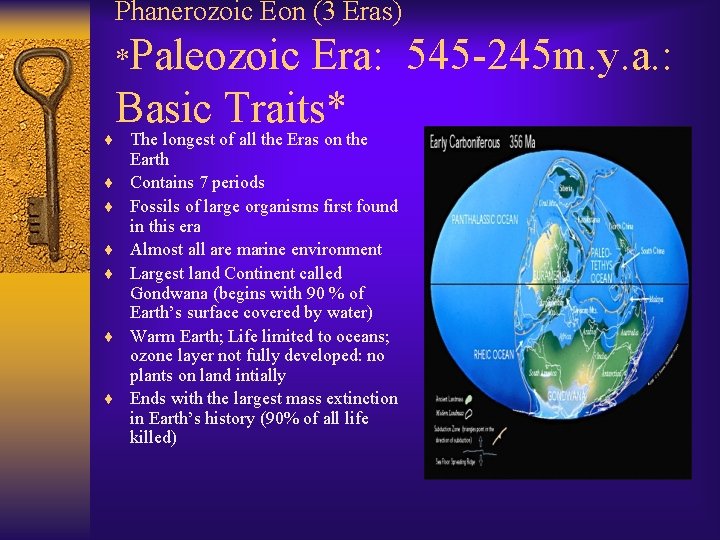
Phanerozoic Eon (3 Eras) *Paleozoic Era: 545 -245 m. y. a. : Basic Traits* ¨ The longest of all the Eras on the ¨ ¨ ¨ Earth Contains 7 periods Fossils of large organisms first found in this era Almost all are marine environment Largest land Continent called Gondwana (begins with 90 % of Earth’s surface covered by water) Warm Earth; Life limited to oceans; ozone layer not fully developed: no plants on land intially Ends with the largest mass extinction in Earth’s history (90% of all life killed)
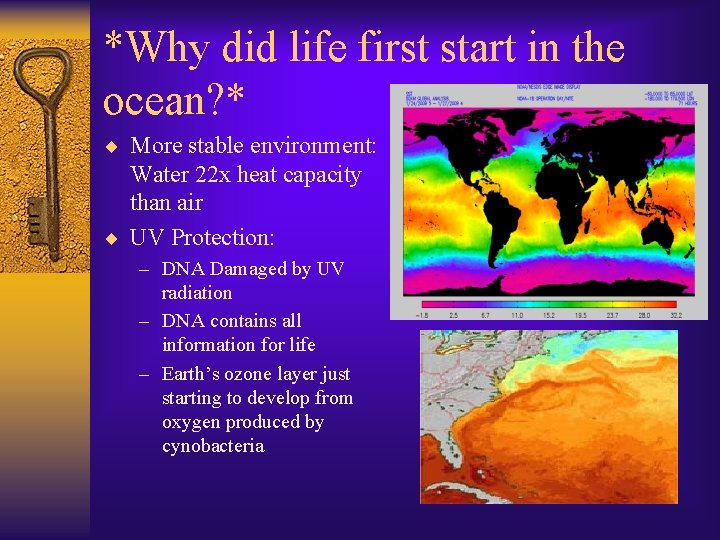
*Why did life first start in the ocean? * ¨ More stable environment: Water 22 x heat capacity than air ¨ UV Protection: – DNA Damaged by UV radiation – DNA contains all information for life – Earth’s ozone layer just starting to develop from oxygen produced by cynobacteria
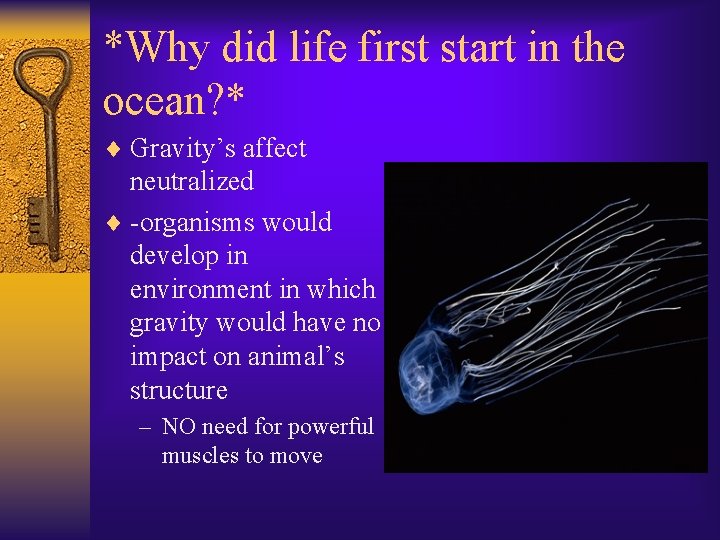
*Why did life first start in the ocean? * ¨ Gravity’s affect neutralized ¨ -organisms would develop in environment in which gravity would have no impact on animal’s structure – NO need for powerful muscles to move
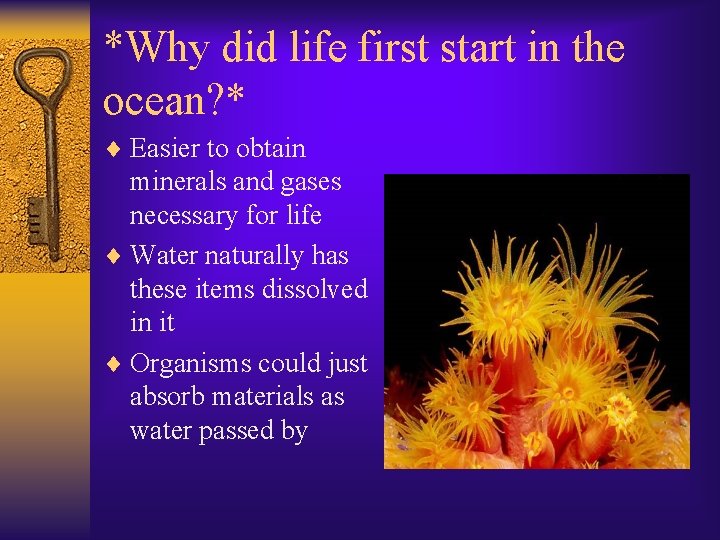
*Why did life first start in the ocean? * ¨ Easier to obtain minerals and gases necessary for life ¨ Water naturally has these items dissolved in it ¨ Organisms could just absorb materials as water passed by
*Easier to obtain food* ¨ Food would be suspended in 3 dimensions: filter feeding or feeding with tentacles become popular
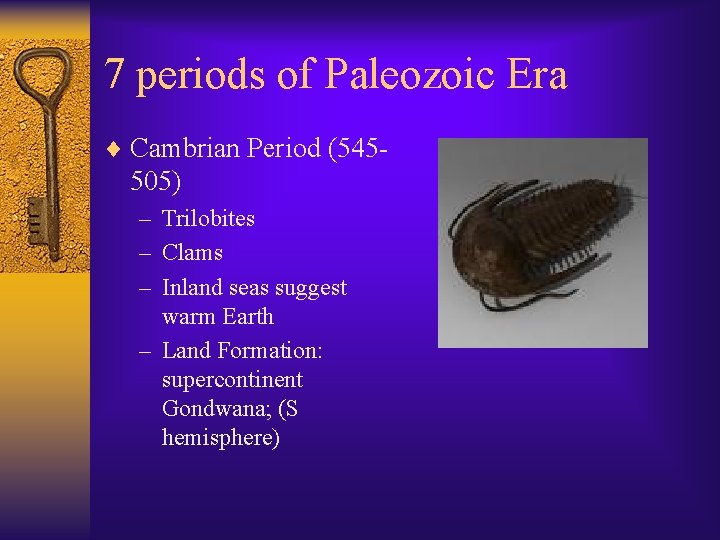
7 periods of Paleozoic Era ¨ Cambrian Period (545 - 505) – Trilobites – Clams – Inland seas suggest warm Earth – Land Formation: supercontinent Gondwana; (S hemisphere)
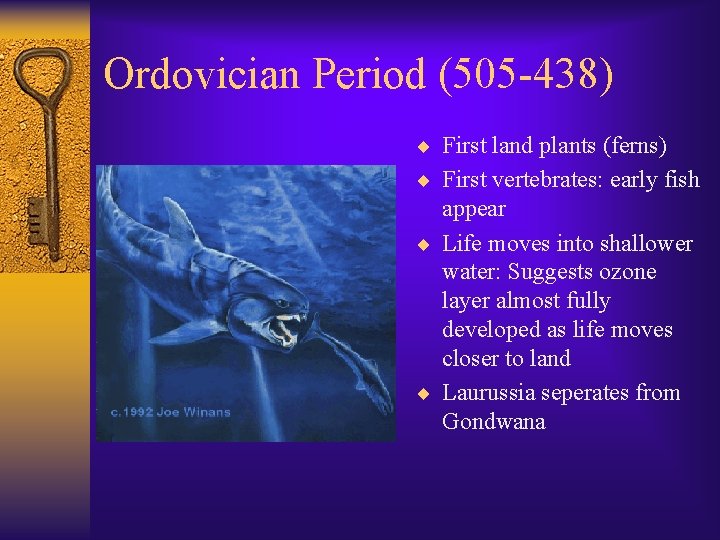
Ordovician Period (505 -438) ¨ First land plants (ferns) ¨ First vertebrates: early fish appear ¨ Life moves into shallower water: Suggests ozone layer almost fully developed as life moves closer to land ¨ Laurussia seperates from Gondwana
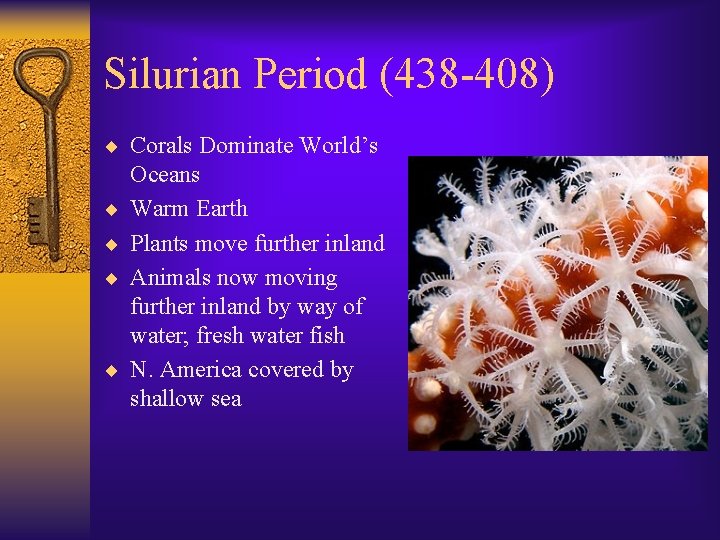
Silurian Period (438 -408) ¨ Corals Dominate World’s ¨ ¨ Oceans Warm Earth Plants move further inland Animals now moving further inland by way of water; fresh water fish N. America covered by shallow sea
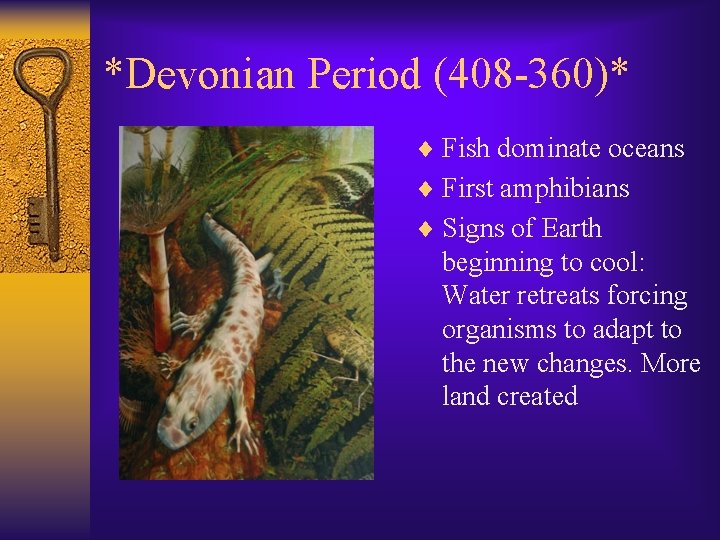
*Devonian Period (408 -360)* ¨ Fish dominate oceans ¨ First amphibians ¨ Signs of Earth beginning to cool: Water retreats forcing organisms to adapt to the new changes. More land created
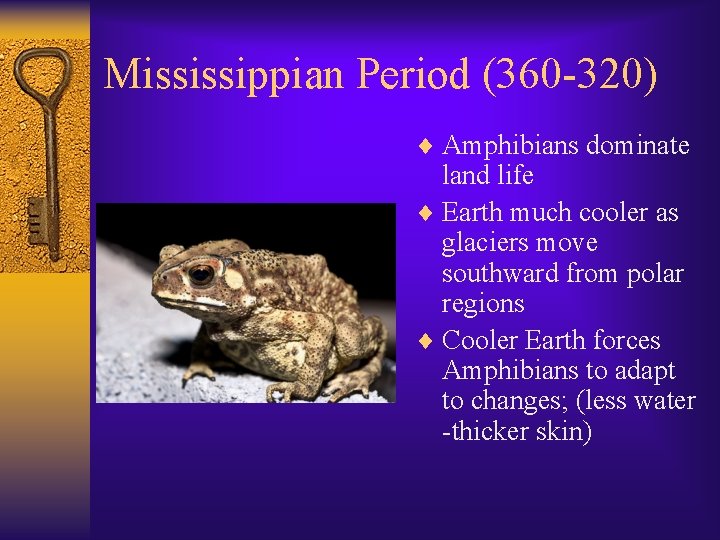
Mississippian Period (360 -320) ¨ Amphibians dominate land life ¨ Earth much cooler as glaciers move southward from polar regions ¨ Cooler Earth forces Amphibians to adapt to changes; (less water -thicker skin)
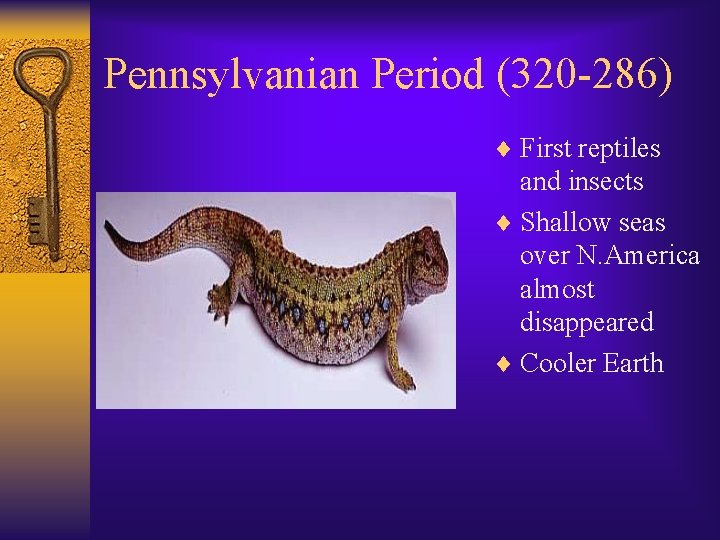
Pennsylvanian Period (320 -286) ¨ First reptiles and insects ¨ Shallow seas over N. America almost disappeared ¨ Cooler Earth
*Permian Period (286 -245)* ¨ Glaciers retreat ¨ Earth Warming back up ¨ Ends with largest mass extinction in fossil record (Asteroid impact)
*Mesozoic Era * ¨ AGE OF DINOSAURS ¨ 245 -65 Million Years Ago ¨ Split into 3 major periods ¨ Triassic period (245 -208 million years) ¨ Jurassic Period (208 -144 million years) ¨ Cretaceous Period (144 -65 million years)
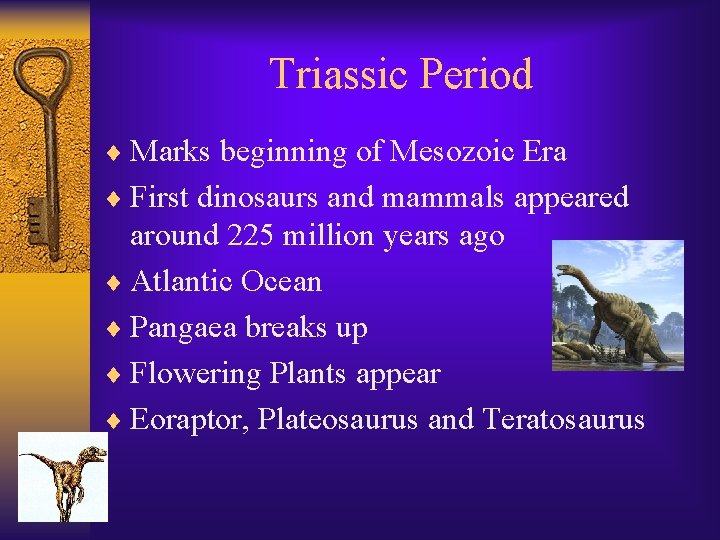
Triassic Period ¨ Marks beginning of Mesozoic Era ¨ First dinosaurs and mammals appeared around 225 million years ago ¨ Atlantic Ocean ¨ Pangaea breaks up ¨ Flowering Plants appear ¨ Eoraptor, Plateosaurus and Teratosaurus
*Why Dinosaurs Evolve* ¨ Environmental Factors- As Pangaea break apart each land mass gets a unique climate ¨ Disease Influence- Diseases possible reason species die out ¨ Competition for Food- organisms compete for same food sources; winners live losers die ¨ Predatory Influence- animals develop defenses against Predators
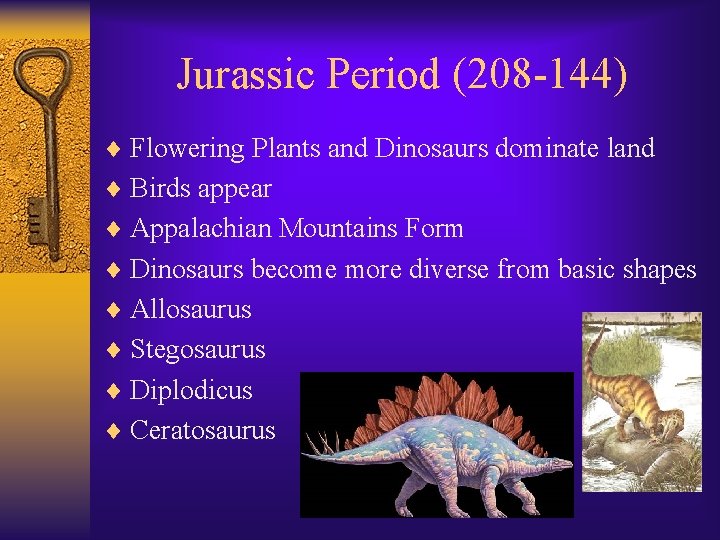
Jurassic Period (208 -144) ¨ Flowering Plants and Dinosaurs dominate land ¨ Birds appear ¨ Appalachian Mountains Form ¨ Dinosaurs become more diverse from basic shapes ¨ Allosaurus ¨ Stegosaurus ¨ Diplodicus ¨ Ceratosaurus
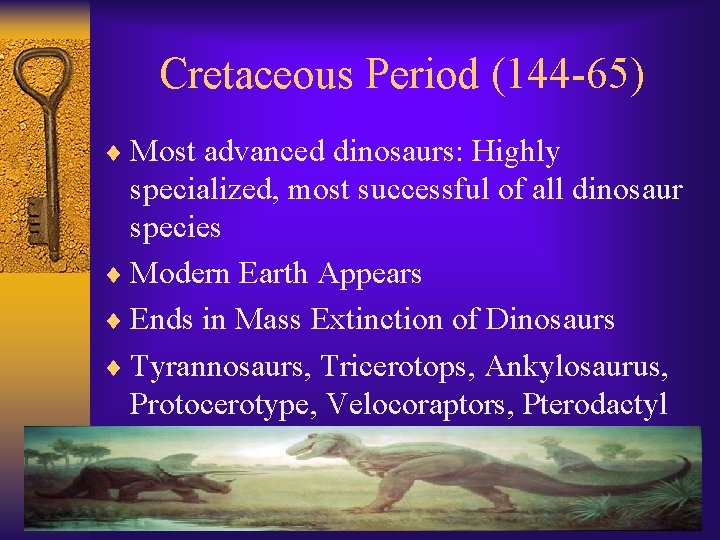
Cretaceous Period (144 -65) ¨ Most advanced dinosaurs: Highly specialized, most successful of all dinosaur species ¨ Modern Earth Appears ¨ Ends in Mass Extinction of Dinosaurs ¨ Tyrannosaurs, Tricerotops, Ankylosaurus, Protocerotype, Velocoraptors, Pterodactyl
*Meteorite Theory? * ¨ Says that asteroid/comet 3 -5 miles wide struck near Yucatan Peninsula and caused Dinosaur Extinction ¨ Iridium deposits in KT layer help support this ¨ However, closest Dinosaur bones ever found date about 1, 000 prior to event ¨ Climate Change/Disease reason for extinction? ?
*Cenozoic Era* ¨ Continents were drifting apart—present time of Earth ¨ African plate collided with European plate creating the Alps ¨ India slammed into Asian plate creating Himalayas ¨ Climate was cooled causing several “ice ages”
*Mammals Survive because* ¨ Small size easier to maintain body temperature in climate change ¨ Ability to Hibernate during an extreme event ¨ Mothers provide food for young from milk, No other organisms do this (mammals unique)
Cenozoic Era ¨ Age of Mammals (65 mya- present day) ¨ 2 Periods
Tertiary Period (65 mya – 1. 6 mya) ¨ Earth’s climate was warm and mild ¨ Ocean mammals like dolphins and whales evolve ¨ Land-insects, flowering plants and mammals, birds dominate ¨ Mega mammals evolve ¨ Alps and Himalayas Form
Quaternary Period: (1. 6 mya- today) ¨ Mega mammals die out/ (Climate Change? ) ¨ Present period ¨ Humans appear— 100, 000 years ago ¨ Grand Canyon forms ¨ Last ice age 15, 000 -10, 000 years ago