
ERAS Enhanced Recovery After Surgery What is it



- Slides: 34
ERAS: Enhanced Recovery After Surgery What is it and how does it affect my patients and practice? Jason Skelley, MD Anesthesiologist Southern Anesthesia Management, St. Vincent’s East Division
Objectives At the end of this presentation, a participant will be able to: • Describe the history and evolution of ERAS protocols • Discuss benefits and basic concepts of ERAS • Describe some specific medications utilized • Understand the current initiatives and their role as a provider • Describe the vision for future expansion
Disclosures I have no financially relevant disclosures related to the content of this presentation.
History of surgical management in GI surgery Previous perioperative management adhered to: ◦ Pre-operative: Prolonged fasting and mechanical bowel prep ◦ Intra-operative: NGT and surgical drain placement with liberal fluid and opioid administration ◦ Post-operative: Prolonged bed rest and delayed resumption of oral intake
The early 1990’s… ERAS principles begin to emerge within colorectal surgical population with goals of: • Reducing the stress response to surgery • Reducing incidence of complications • Accelerating recovery 1. 2. Ljungqvist O, Scott M, Fearon KC. Enhanced Recovery After Surgery A Review. JAMA Surg. 2017; 152(3): 292– 298. Bardram L, Funch-Jensen P, Crawford ME, Kehlet H. Recovery after laparoscopic colonic surgery with epidural analgesia, and early oral nutrition and mobilization. Lancet. 1995; 345(8952): 763 -64.
ERAS protocol development and modification over the following years was centered around one fundamental goal: To reduce the endocrine and metabolic stress response to surgery
ERAS protocols are: • • Patient centered Evidence based Standardized/Protocol Driven Multidisciplinary
So that begs the question Why do we care?
Benefits of Enhanced Recovery Protocols Reduction in: length of stay, complication rates, opioid/analgesic consumption, cost 1, 2 Increase in: patient comfort, involvement and satisfaction of patients with their care 2 1. 2. Ljungqvist O, Scott M, Fearon KC. Enhanced Recovery After Surgery A Review. JAMA Surg. 2017; 152(3): 292– 298. Thiele RH, Rea KM, Turrentine FE, et al. Standardization of care: impact of an enhanced recovery protocol on length of stay, complications, and direct costs after colorectal surgery. J Am Coll Surg. 2015; 220: 430 -43.
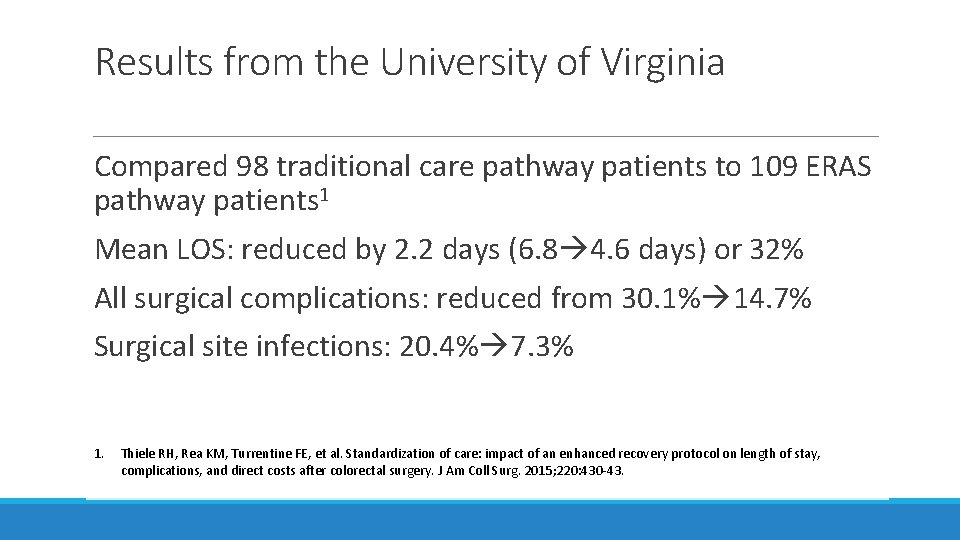
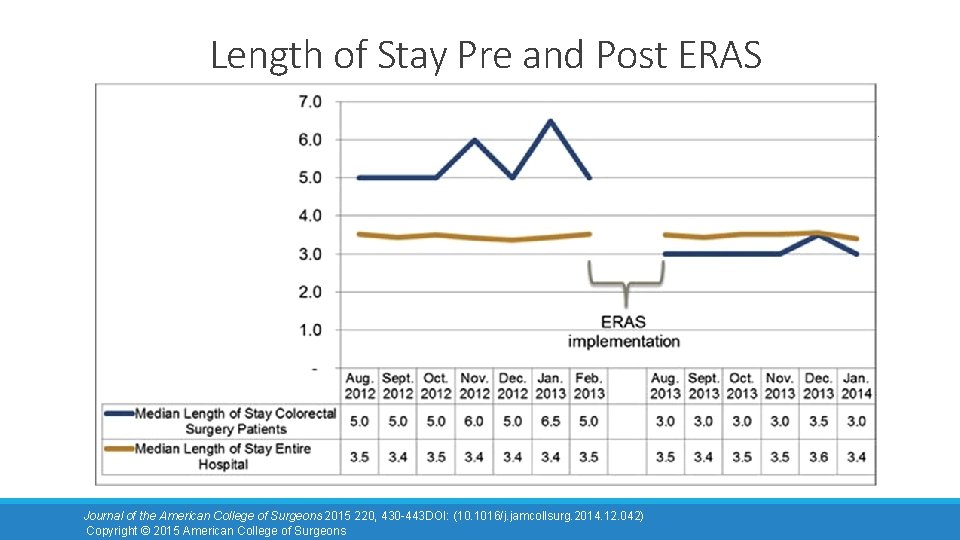
Results from the University of Virginia Compared 98 traditional care pathway patients to 109 ERAS pathway patients 1 Mean LOS: reduced by 2. 2 days (6. 8 4. 6 days) or 32% All surgical complications: reduced from 30. 1% 14. 7% Surgical site infections: 20. 4% 7. 3% 1. Thiele RH, Rea KM, Turrentine FE, et al. Standardization of care: impact of an enhanced recovery protocol on length of stay, complications, and direct costs after colorectal surgery. J Am Coll Surg. 2015; 220: 430 -43.
Length of Stay Pre and Post ERAS Journal of the American College of Surgeons 2015 220, 430 -443 DOI: (10. 1016/j. jamcollsurg. 2014. 12. 042) Copyright © 2015 American College of Surgeons
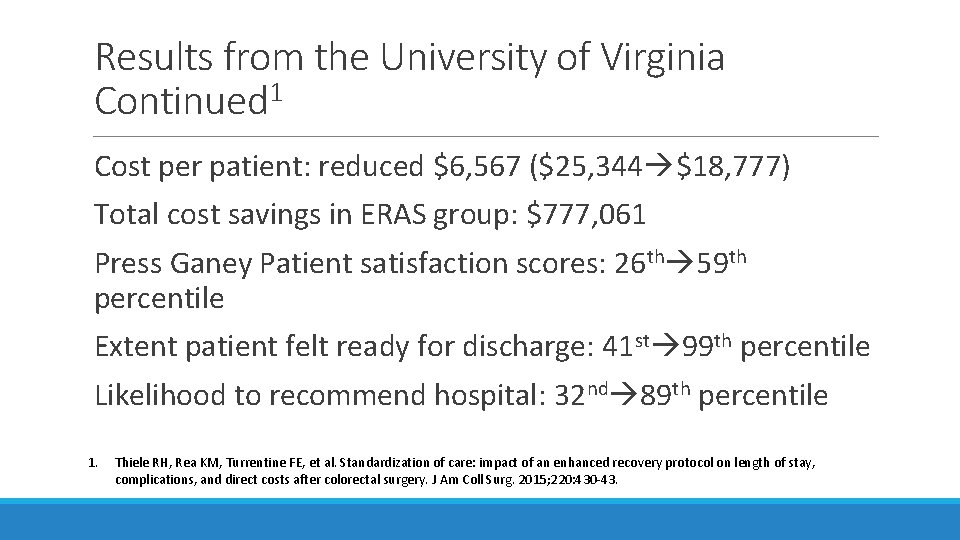
Results from the University of Virginia Continued 1 Cost per patient: reduced $6, 567 ($25, 344 $18, 777) Total cost savings in ERAS group: $777, 061 Press Ganey Patient satisfaction scores: 26 th 59 th percentile Extent patient felt ready for discharge: 41 st 99 th percentile Likelihood to recommend hospital: 32 nd 89 th percentile 1. Thiele RH, Rea KM, Turrentine FE, et al. Standardization of care: impact of an enhanced recovery protocol on length of stay, complications, and direct costs after colorectal surgery. J Am Coll Surg. 2015; 220: 430 -43.
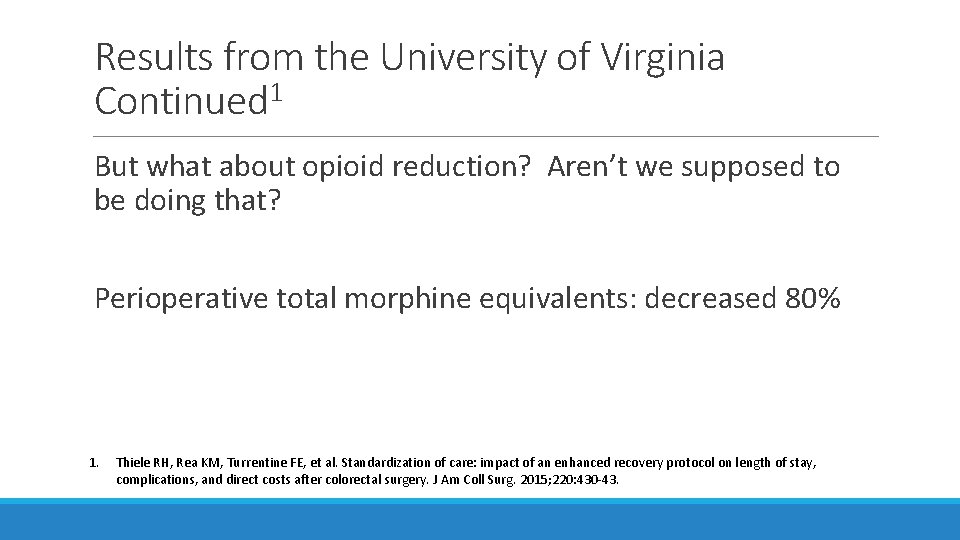
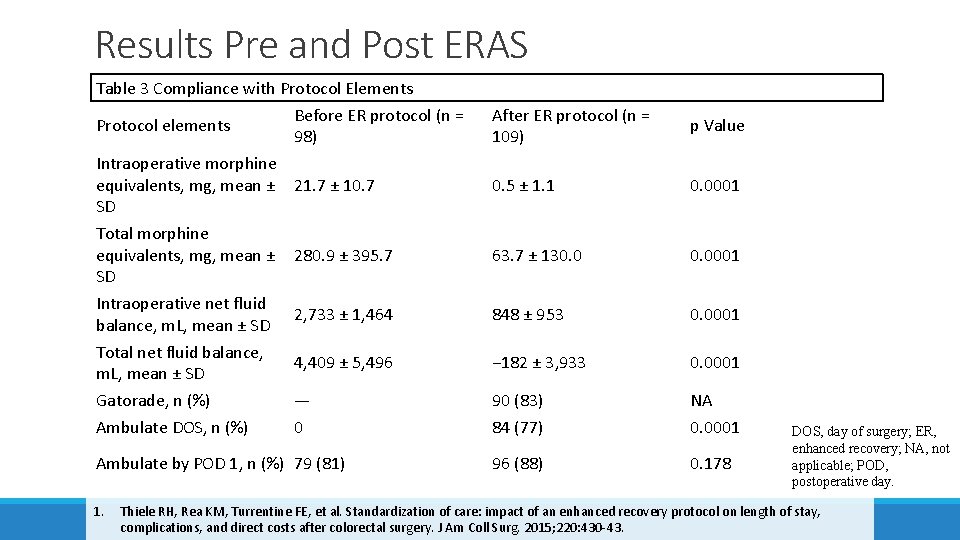
Results from the University of Virginia Continued 1 But what about opioid reduction? Aren’t we supposed to be doing that? Perioperative total morphine equivalents: decreased 80% 1. Thiele RH, Rea KM, Turrentine FE, et al. Standardization of care: impact of an enhanced recovery protocol on length of stay, complications, and direct costs after colorectal surgery. J Am Coll Surg. 2015; 220: 430 -43.
Results Pre and Post ERAS Table 3 Compliance with Protocol Elements Before ER protocol (n = Protocol elements 98) Intraoperative morphine equivalents, mg, mean ± 21. 7 ± 10. 7 SD Total morphine equivalents, mg, mean ± 280. 9 ± 395. 7 SD Intraoperative net fluid 2, 733 ± 1, 464 balance, m. L, mean ± SD Total net fluid balance, 4, 409 ± 5, 496 m. L, mean ± SD Gatorade, n (%) — Ambulate DOS, n (%) 0 Ambulate by POD 1, n (%) 79 (81) 1. After ER protocol (n = 109) p Value 0. 5 ± 1. 1 0. 0001 63. 7 ± 130. 0001 848 ± 953 0. 0001 − 182 ± 3, 933 0. 0001 90 (83) 84 (77) NA 0. 0001 96 (88) 0. 178 DOS, day of surgery; ER, enhanced recovery; NA, not applicable; POD, postoperative day. Thiele RH, Rea KM, Turrentine FE, et al. Standardization of care: impact of an enhanced recovery protocol on length of stay, complications, and direct costs after colorectal surgery. J Am Coll Surg. 2015; 220: 430 -43.
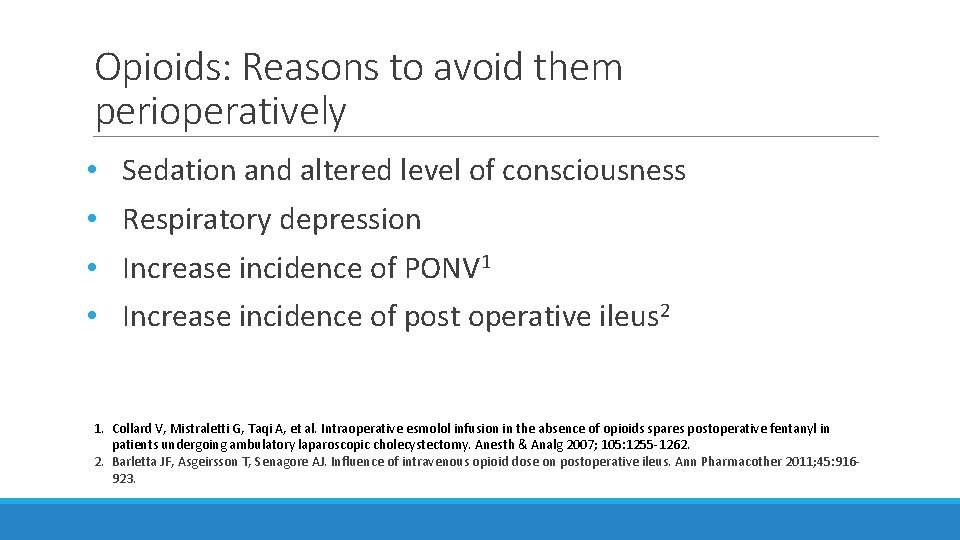
Opioids: Reasons to avoid them perioperatively • • Sedation and altered level of consciousness Respiratory depression Increase incidence of PONV 1 Increase incidence of post operative ileus 2 1. Collard V, Mistraletti G, Taqi A, et al. Intraoperative esmolol infusion in the absence of opioids spares postoperative fentanyl in patients undergoing ambulatory laparoscopic cholecystectomy. Anesth & Analg 2007; 105: 1255 -1262. 2. Barletta JF, Asgeirsson T, Senagore AJ. Influence of intravenous opioid dose on postoperative ileus. Ann Pharmacother 2011; 45: 916923.
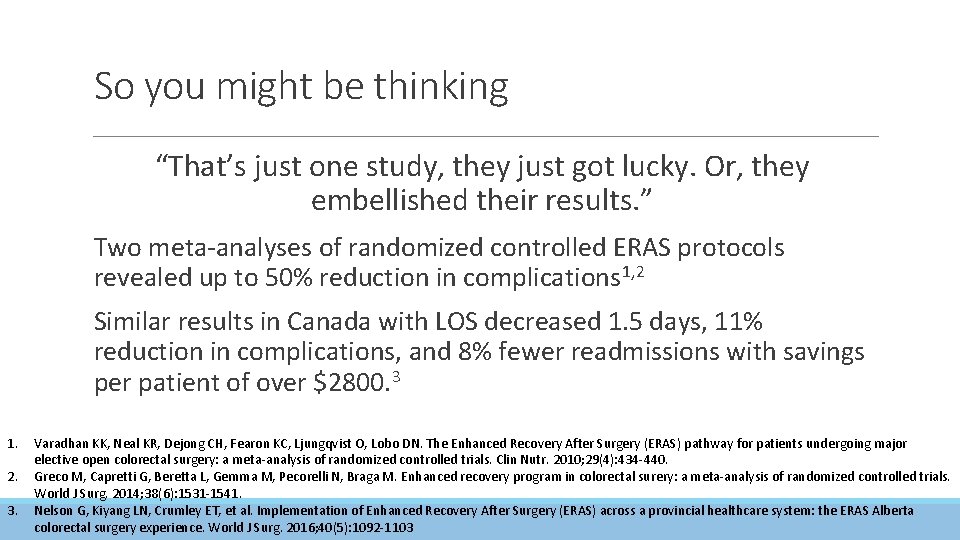
So you might be thinking “That’s just one study, they just got lucky. Or, they embellished their results. ” Two meta-analyses of randomized controlled ERAS protocols revealed up to 50% reduction in complications 1, 2 Similar results in Canada with LOS decreased 1. 5 days, 11% reduction in complications, and 8% fewer readmissions with savings per patient of over $2800. 3 1. 2. 3. Varadhan KK, Neal KR, Dejong CH, Fearon KC, Ljungqvist O, Lobo DN. The Enhanced Recovery After Surgery (ERAS) pathway for patients undergoing major elective open colorectal surgery: a meta-analysis of randomized controlled trials. Clin Nutr. 2010; 29(4): 434 -440. Greco M, Capretti G, Beretta L, Gemma M, Pecorelli N, Braga M. Enhanced recovery program in colorectal surery: a meta-analysis of randomized controlled trials. World J Surg. 2014; 38(6): 1531 -1541. Nelson G, Kiyang LN, Crumley ET, et al. Implementation of Enhanced Recovery After Surgery (ERAS) across a provincial healthcare system: the ERAS Alberta colorectal surgery experience. World J Surg. 2016; 40(5): 1092 -1103
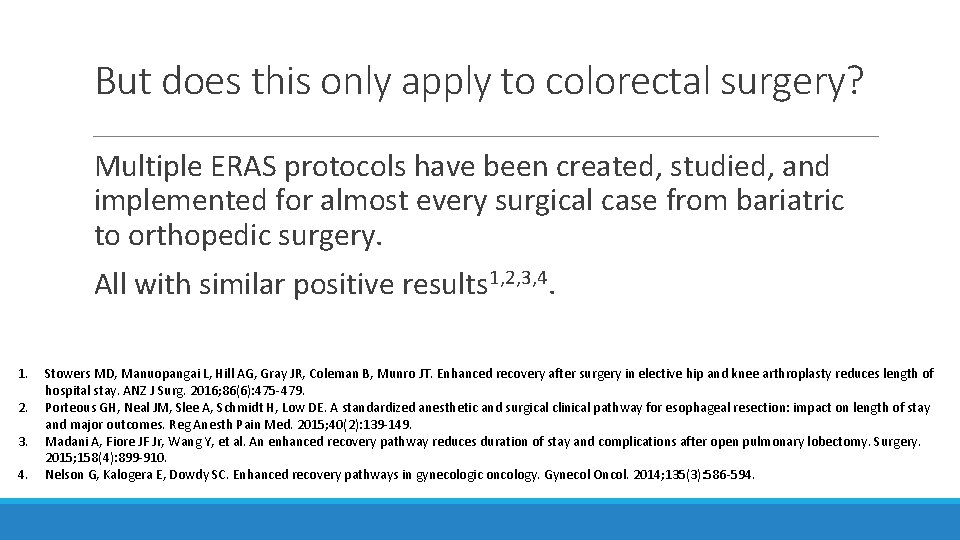
But does this only apply to colorectal surgery? Multiple ERAS protocols have been created, studied, and implemented for almost every surgical case from bariatric to orthopedic surgery. All with similar positive results 1, 2, 3, 4. 1. 2. 3. 4. Stowers MD, Manuopangai L, Hill AG, Gray JR, Coleman B, Munro JT. Enhanced recovery after surgery in elective hip and knee arthroplasty reduces length of hospital stay. ANZ J Surg. 2016; 86(6): 475 -479. Porteous GH, Neal JM, Slee A, Schmidt H, Low DE. A standardized anesthetic and surgical clinical pathway for esophageal resection: impact on length of stay and major outcomes. Reg Anesth Pain Med. 2015; 40(2): 139 -149. Madani A, Fiore JF Jr, Wang Y, et al. An enhanced recovery pathway reduces duration of stay and complications after open pulmonary lobectomy. Surgery. 2015; 158(4): 899 -910. Nelson G, Kalogera E, Dowdy SC. Enhanced recovery pathways in gynecologic oncology. Gynecol Oncol. 2014; 135(3): 586 -594.
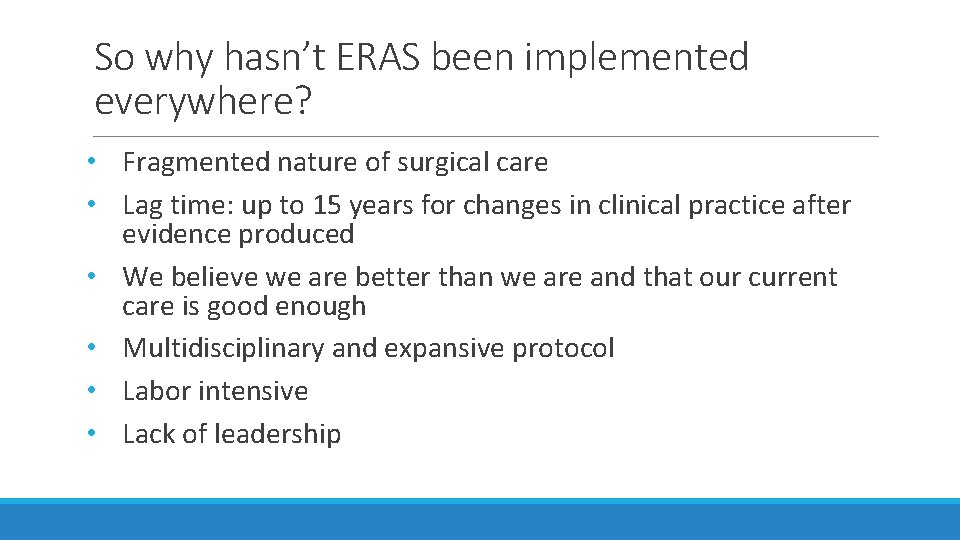
So why hasn’t ERAS been implemented everywhere? • Fragmented nature of surgical care • Lag time: up to 15 years for changes in clinical practice after evidence produced • We believe we are better than we are and that our current care is good enough • Multidisciplinary and expansive protocol • Labor intensive • Lack of leadership
Required compliance with protocol • 70 -80% compliance necessary for noticeable improvement 1 • Increased compliance leads to increased outcome improvement 2, 3 1. 2. 3. Gotlib Conn L, Mc. Kenzie M, Pearsall EA, Mc. Leod RS. Successful implementation of an enhanced recovery after surgery programme for elective colorectal surgery: a process evaluation of champions’ experiences. Implement Sci. 2015; 10: 99. Gustafsson UO, Hausel J, Thorell A, Ljungqvist O, Soop M, Nygren J; Enhanced Recovery After Surgery Study Group. Adherence to the enhanced recovery after surgery protocol and outcomes after colorectal cancer surgery. Arch Surg. 2011; 146(5): 571 -577. ERAS Compliance Group. The impact of enhanced recovery protocol compliance on elective colorectal cancer resection: results from an international registry. Ann Surg. 2015; 261(6): 1153 -1159.
Typical aspects of ERAS protocols: Preoperative (4 -6 weeks pre-procedure) • • Optimization of chronic disease states Enhance physical status with exercise Nutritional screening Smoking cessation
Typical aspects of ERAS protocols: Preoperative • Structured preop information and engagement of patient and caregivers • Carbohydrate loading • Prophylactic antithrombotics • Post-op Nausea and Vomiting (PONV) prophylaxis • Regional anesthesia, intrathecal opioid vs epidural
Preoperative oral multimodal analgesics Gabapentin Celecoxib Acetaminophen
Typical aspects of ERAS protocols: Intraoperative • Minimally invasive surgical technique • Standardized anesthesia protocol • Avoidance of opioids, particularly long acting opioids
Typical aspects of ERAS protocols: Intraoperative Continued • Goal directed fluid therapy: support blood pressure with vasopressors not IV fluids • Removal of nasogastric tubes • Restrict usage of surgical site drains
Intraoperative medications • • • Dexamethasone Ketamine IV lidocaine Fentanyl (used sparingly) Ondansetron
Fluid management • Goal directed fluid therapy with defined targets and responses • 800 cc/hr open and 500 cc/hr laparoscopic cases • MAP<60 mm. Hg or SBP<80 mm. Hg, 250 cc IVF bolus x 2 • Less concern with volume of urine output intraoperatively and immediately postoperatively
Typical aspects of ERAS protocols: Postoperative • • Scheduled multimodal analgesics Early mobilization (day of surgery) Early oral intake (day of surgery) Early removal of catheters and drains Multimodal PONV prevention Discharge planning Continuous audit
What can I do as a primary care provider? • Optimize preoperative blood pressure and heart rate control • Facilitate smoking cessation • Optimize preoperative nutritional status • Encourage regular exercise/physical activity
What can I do as a nurse? • • Assist patients in early ambulation post operatively Limit IV opioid administration Encourage oral fluid intake early and continually Don’t let patients lie in bed
What can I do as a surgeon? • • • Ask your anesthesia group about ERAS protocols Educate your patients Adopt changes in post-op order sets Reduce post operative opioid prescriptions Attempt to limit use of NGT’s and surgical drains
Current implementation at St Vincent’s East Bariatric surgery population began implementation 9/4/2018
Future expansion at St Vincent’s East • Plans for eventual expansion to all surgical service lines • Next will be colorectal surgery, urology, and gynecology
Key points • ERAS protocols are focused, multi-disciplinary, perioperative care models that are patient-centered and evidence-based • ERAS protocols are effective at reducing LOS, cost, and complications with concomitant increase in patient satisfaction with care • Implementation is challenging and time-consuming • Continued success depends on adherence to at least 80% of the protocol and continual evaluation/audit of the process and outcomes
Questions?