
ER VERBS How to Conjugate ER verbs in
‘ER’ VERBS How to Conjugate ER verbs in the present tense

What are ER verbs? • a group of verbs with an infinitive that ends with the letters ER – Example: Parler = to speak – Example: Aimer = to like • REGULAR ER VERBS ALWAYS FOLLOW THE SAME CONJUGATION RULES – You know one you know all!
ER verb conjugation Rules • ER verbs are conjugated following these rules – Step one: Remove the ER to get the stem of the verb (example: Parler -> Parl) • The stem of the verb remains the same for all subjects! – Step two: Add the correct ending to the stem of the verb that agrees with the subject of the sentence
ER VERB ENDINGS • The ending for ER verbs are as follows – Je ____ e – Tu ____ es – Il _____ e – Elle/on ___ e Nous ____ ons Vous ____ ez Ils _____ ent Elles ____ ent • These are the endings you add to the stem after removing the ER – Example: Je parle : Nous parlons
TRANSLATING INTO THE PRESENT TENSE • PARLER = TO SPEAK – Je parle = I speak / I’m speaking – Tu parles = you speak / you’re speaking – Il parle = he speaks / he’s speaking – Elle parle = she speaks / she’s speaking – On parle = People speak/they’re speaking – Nous parlons = we speak/we’re speaking – Vous parlez = you speak (plural/formal) – Ils parlent = they speak/they’re speaking (masc. ) – Elles parlent = they speak/they’re speaking (fem. )
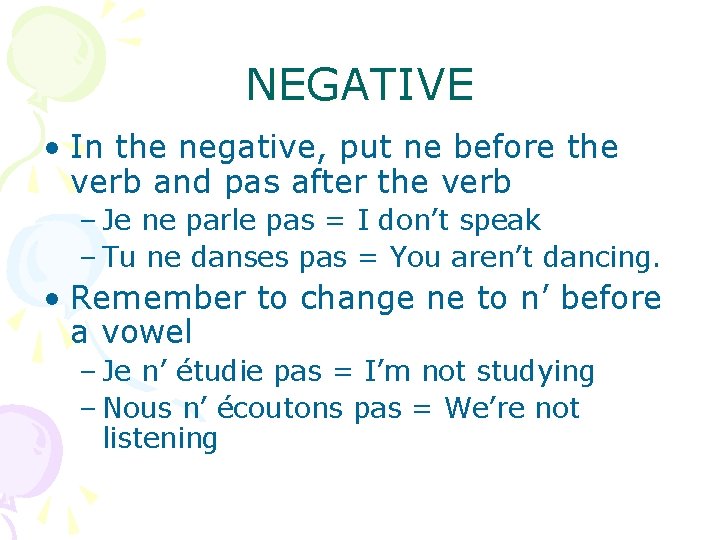
NEGATIVE • In the negative, put ne before the verb and pas after the verb – Je ne parle pas = I don’t speak – Tu ne danses pas = You aren’t dancing. • Remember to change ne to n’ before a vowel – Je n’ étudie pas = I’m not studying – Nous n’ écoutons pas = We’re not listening
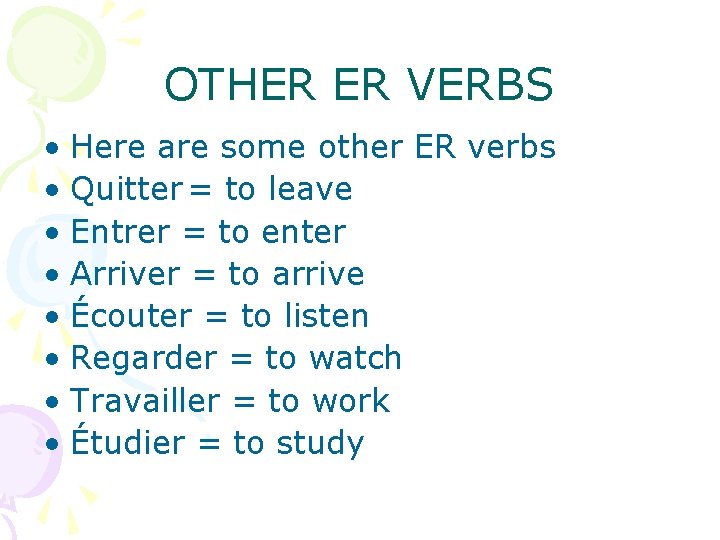
OTHER ER VERBS • Here are some other ER verbs • Quitter = to leave • Entrer = to enter • Arriver = to arrive • Écouter = to listen • Regarder = to watch • Travailler = to work • Étudier = to study

Other ER verbs continued • • • Poser une question = to ask a question Passer un examen = to take a test Rentrer = to return (go back) Habiter = to live Chanter = to sing Danser = to dance Rigoler = to have fun / joke around Aimer = to like/love All of these verbs follow the ER verb conjugation rules
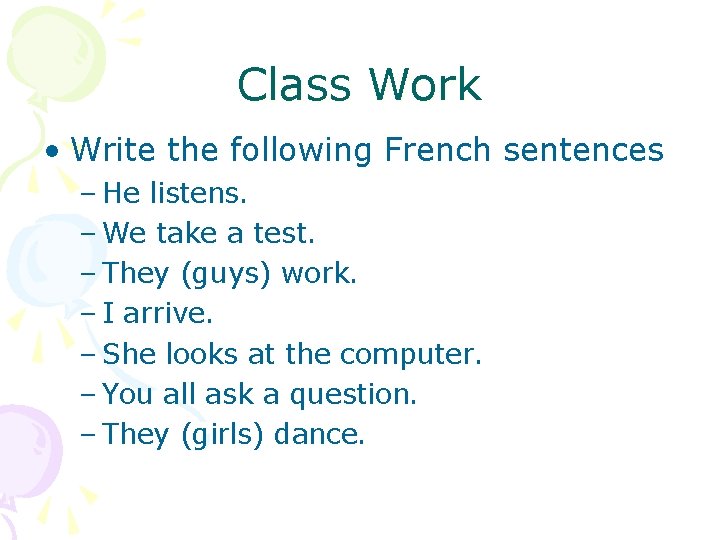
Class Work • Write the following French sentences – He listens. – We take a test. – They (guys) work. – I arrive. – She looks at the computer. – You all ask a question. – They (girls) dance.

AIMER + INFINITIVE • Infinitive = – Unconjugated form of the verb – Example: Parler, aimer, chanter, danser etc. • aimer + a verb infinitive – Conjugate Aimer to agree with the subject – Don’t conjugate both verbs!

AIMER CONJUGATED • The first step is to conjugate the verb aimer in the present tense – J’aime – Il/elle aime – Vous aimez tu aimes nous aimons ils/elles aiment • This is the only verb you will conjugate in the sentence!

ADDING THE INFINITIVE • After you conjugate aimer, add the infinitive of the second verb. – Example: j’aime danser. = I like to dance – Example: Nous aimons donner une fête. = We like to give (throw) a party. • DO NOT CONJUGATE THE SECOND VERB!! LEAVE IT IN ITS INFINITIVE FORM!!

EXAMPLES • Il aime regarder la télé. – He likes to watch the tv. • Elles aiment chanter. – They like to sing. • J’aime écouter la radio. – I like to listen to the radio.
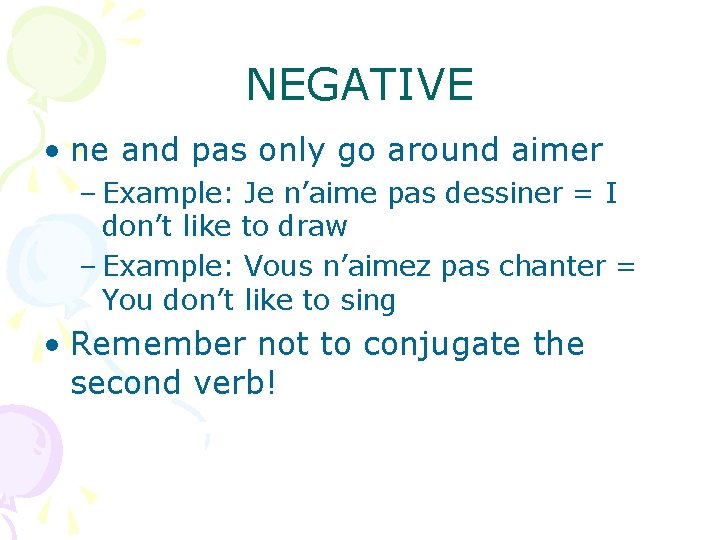
NEGATIVE • ne and pas only go around aimer – Example: Je n’aime pas dessiner = I don’t like to draw – Example: Vous n’aimez pas chanter = You don’t like to sing • Remember not to conjugate the second verb!
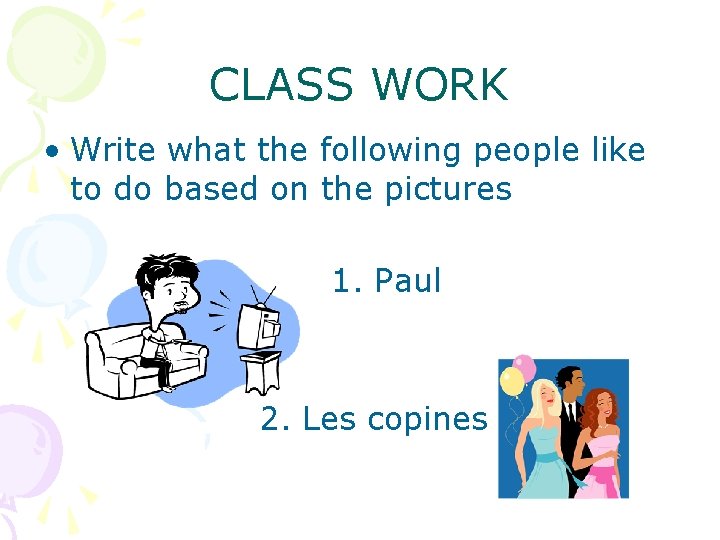
CLASS WORK • Write what the following people like to do based on the pictures 1. Paul 2. Les copines
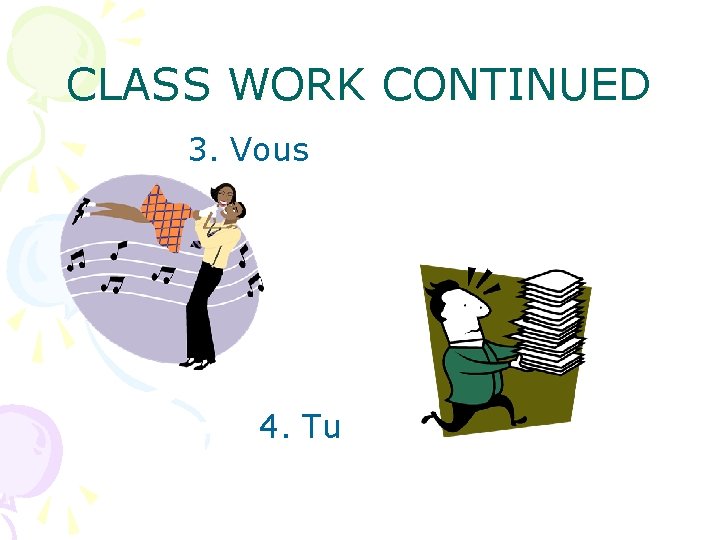
CLASS WORK CONTINUED 3. Vous 4. Tu
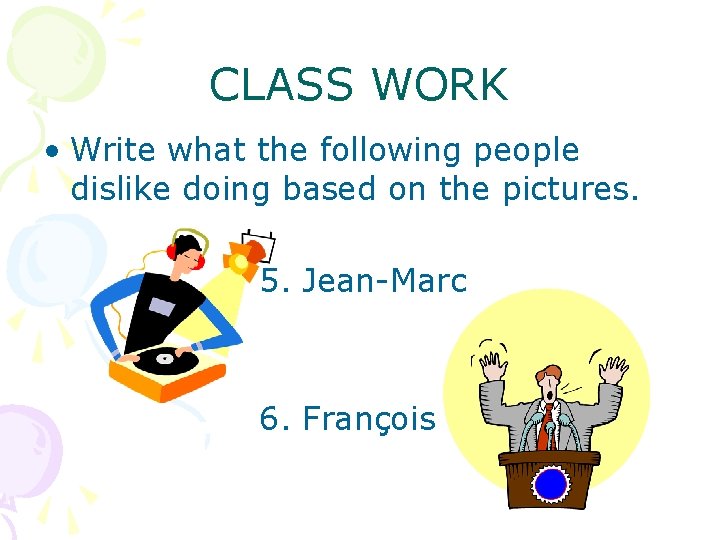
CLASS WORK • Write what the following people dislike doing based on the pictures. 5. Jean-Marc 6. François
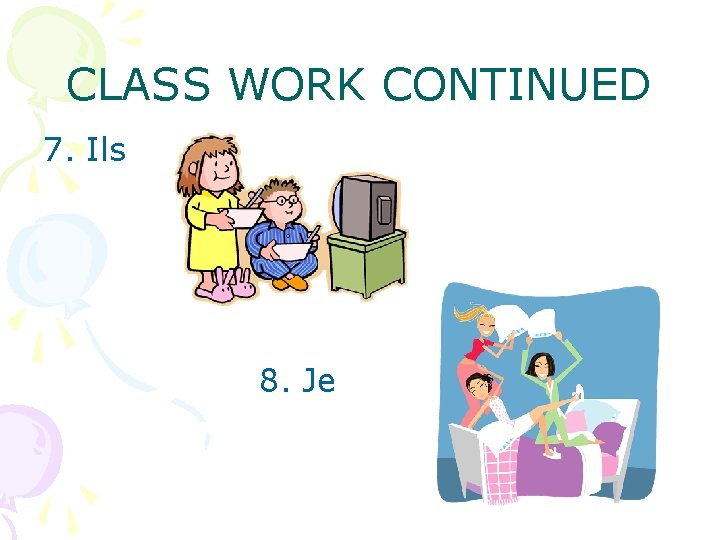
CLASS WORK CONTINUED 7. Ils 8. Je
- Slides: 18