
Equivalent Fractions STANDARD M 6 N 1 OBJECTIVES
Equivalent Fractions STANDARD: M 6 N 1 OBJECTIVES: 1. Demonstrate and explain the meaning of equivalent fractions 2. Find equivalent fractions using a specified multiplier 3. Perform tasks associated with finding equal fractions
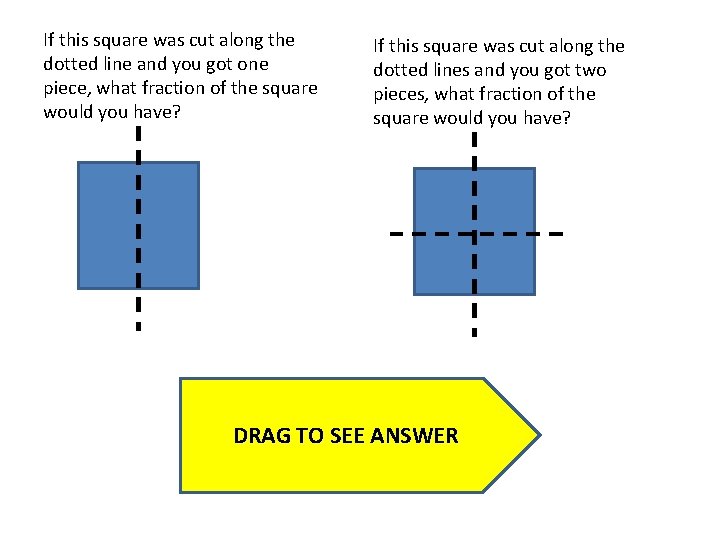
If this square was cut along the dotted line and you got one piece, what fraction of the square would you have? If this square was cut along the dotted lines and you got two pieces, what fraction of the square would you have? In both cases, you will have ½ of the box. This means that ½ DRAG TO SEE ANSWER and 2/4 are equal. These are EQUIVALENT FRACTIONS.
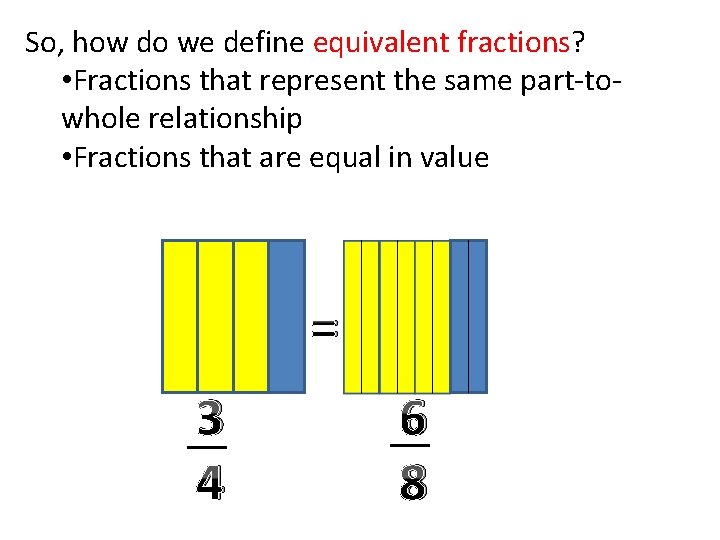
So, how do we define equivalent fractions? • Fractions that represent the same part-towhole relationship • Fractions that are equal in value = 3 4 6 8
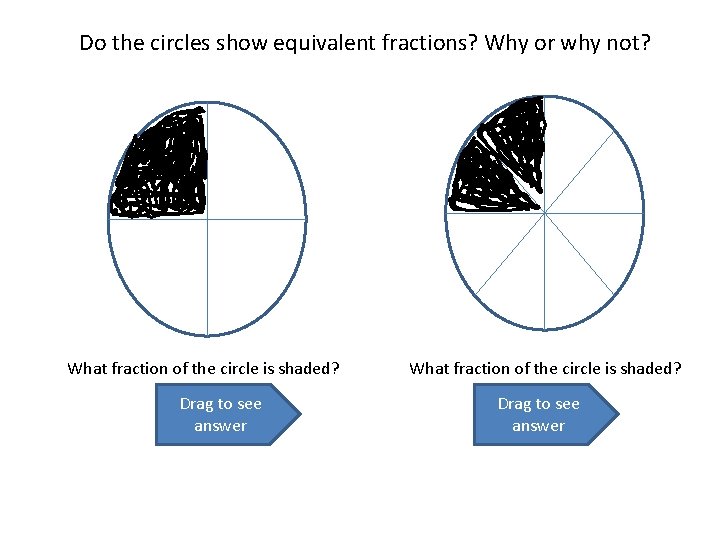
Do the circles show equivalent fractions? Why or why not? What fraction of the circle is shaded? Drag 1/4 to see answer What fraction of the circle is shaded? Drag 2/8 to see answer
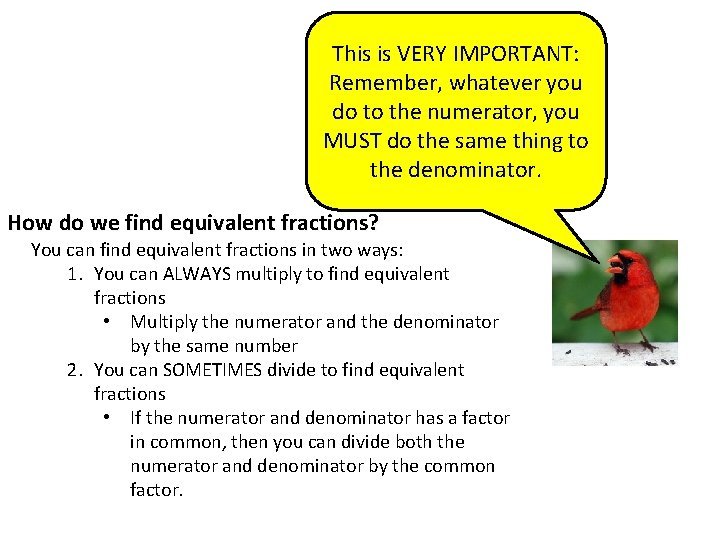
This is VERY IMPORTANT: Remember, whatever you do to the numerator, you MUST do the same thing to the denominator. How do we find equivalent fractions? You can find equivalent fractions in two ways: 1. You can ALWAYS multiply to find equivalent fractions • Multiply the numerator and the denominator by the same number 2. You can SOMETIMES divide to find equivalent fractions • If the numerator and denominator has a factor in common, then you can divide both the numerator and denominator by the common factor.
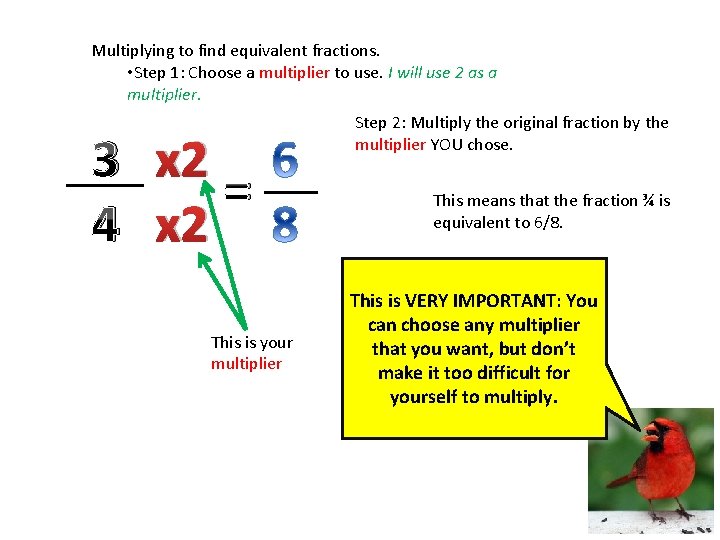
Multiplying to find equivalent fractions. • Step 1: Choose a multiplier to use. I will use 2 as a multiplier. 3 x 2 = 4 x 2 This is your multiplier Step 2: Multiply the original fraction by the multiplier YOU chose. This means that the fraction ¾ is equivalent to 6/8. This is VERY IMPORTANT: You can choose any multiplier that you want, but don’t make it too difficult for yourself to multiply.
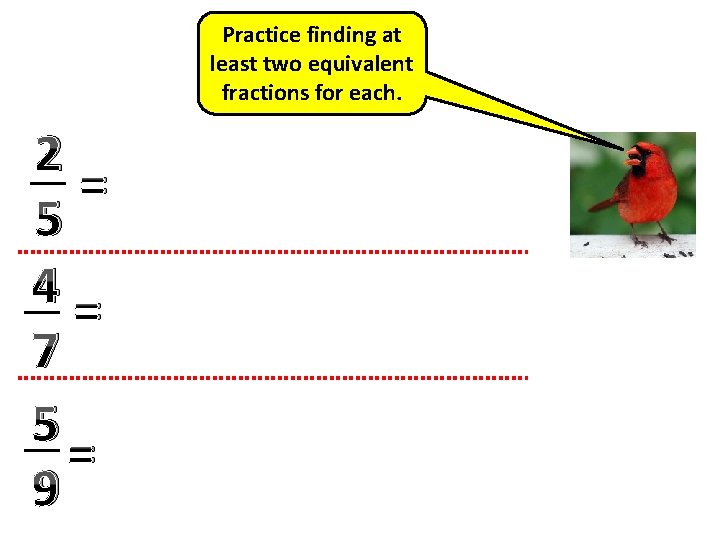
Practice finding at least two equivalent fractions for each. 2 = 5 4= 7 5 = 9
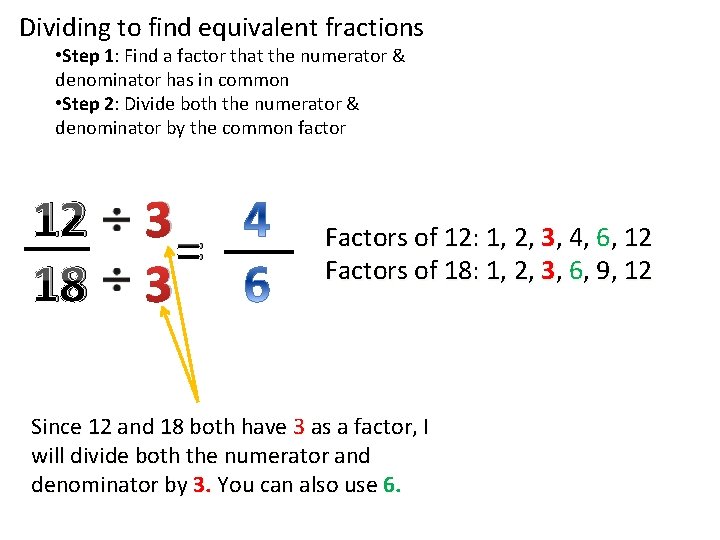
Dividing to find equivalent fractions • Step 1: Find a factor that the numerator & denominator has in common • Step 2: Divide both the numerator & denominator by the common factor 12 18 3 = 3 Factors of 12: 1, 2, 3, 4, 6, 12 Factors of 18: 1, 2, 3, 6, 9, 12 Since 12 and 18 both have 3 as a factor, I will divide both the numerator and denominator by 3. You can also use 6.
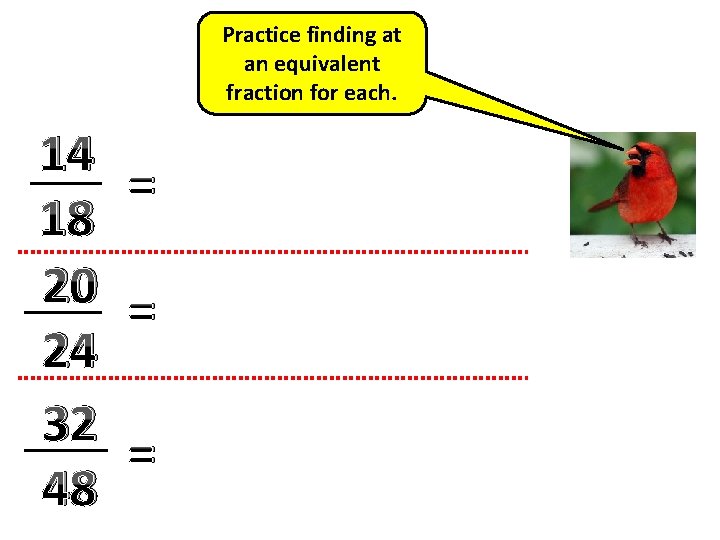
Practice finding at an equivalent fraction for each. 14 = 18 20 = 24 32 = 48
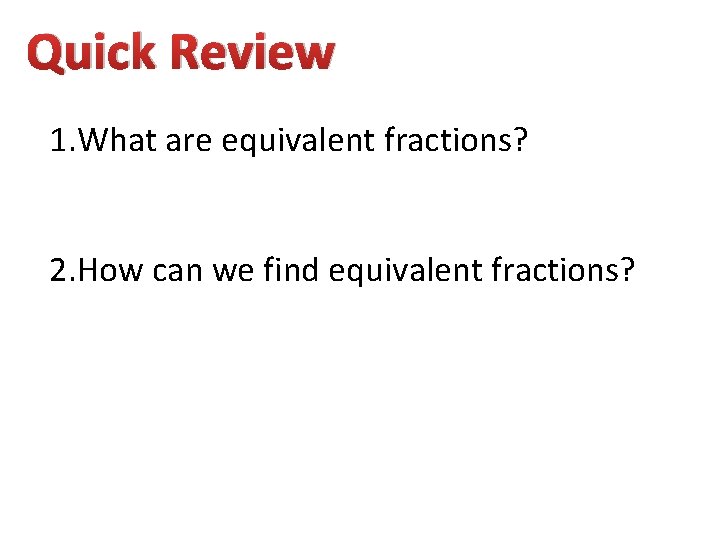
Quick Review 1. What are equivalent fractions? 2. How can we find equivalent fractions?
- Slides: 10